Market Overview
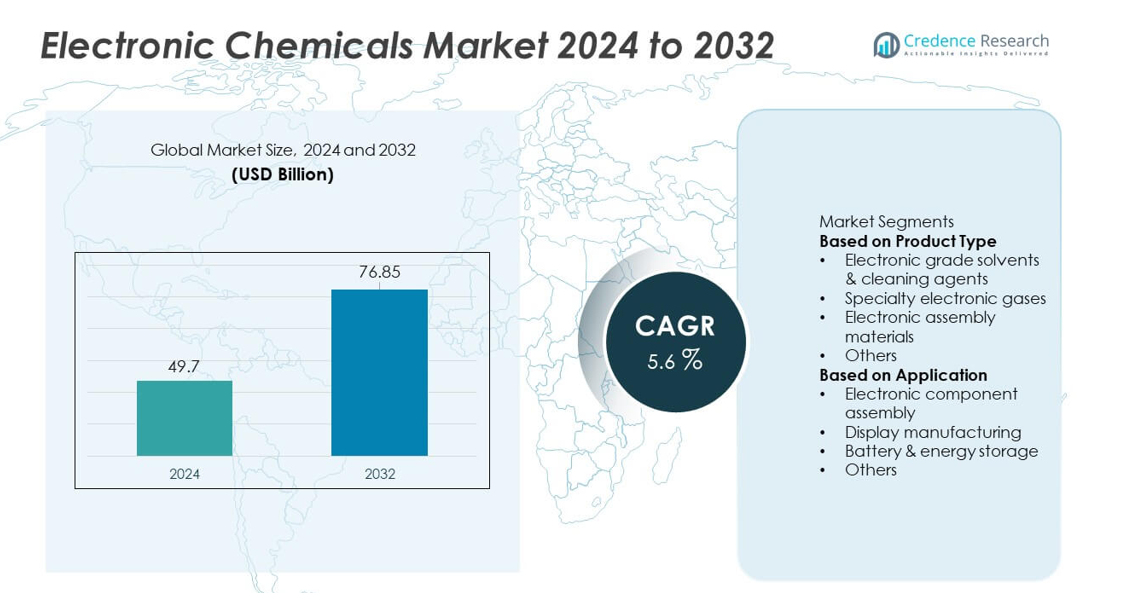
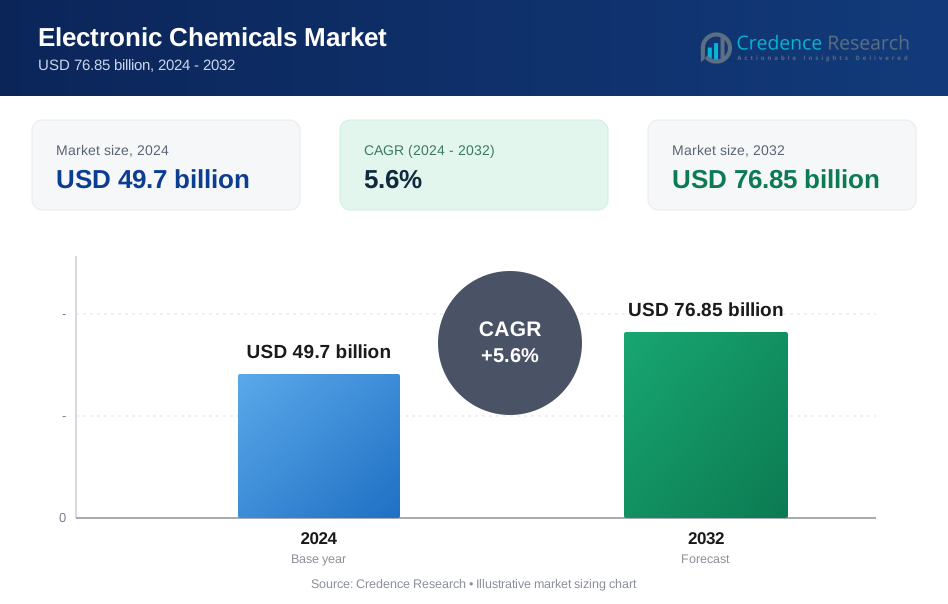
The Electronic Chemicals market size reached USD 49.7 billion in 2024 and is projected to reach USD 76.85 billion by 2032, supported by a 5.6% CAGR during the forecast period.
| REPORT ATTRIBUTE | DETAILS |
|---|---|
| Historical Period | 2020-2023 |
| Base Year | 2024 |
| Forecast Period | 2025-2032 |
| Electronic Chemicals Market Size 2024 | USD 49.7 billion |
| Electronic Chemicals Market, CAGR | 5.6% |
| Electronic Chemicals Market Size 2032 | USD 76.85 billion |
Top players in the Electronic Chemicals market focus on high-purity solvents, specialty gases, photoresists, and advanced cleaning agents that support semiconductor, display, and battery manufacturing. Companies strengthen their presence through global production networks, partnerships with chipmakers, and development of materials compatible with advanced nodes and EUV lithography. Asia Pacific leads the market with a 38% share, driven by strong semiconductor manufacturing in China, Taiwan, South Korea, and Japan. North America follows with a 32% share, supported by expanding fab investments and rising demand for high-performance electronic materials. Europe holds a 25% share, benefiting from advanced electronics, EV battery production, and strict quality standards across precision manufacturing industries.
Market Insights
- The Electronic Chemicals market reached USD 49.7 billion in 2024 and is set to grow at a 5.6% CAGR, supported by rising demand across semiconductor and electronics manufacturing.
- Strong growth comes from expanding chip production, increasing consumption of high-purity solvents, and rapid adoption of specialty gases used in advanced lithography and etching processes.
- Key trends include rising use of ultrapure chemicals, EUV-compatible materials, and sustainable low-emission formulations, with electronic grade solvents leading the product segment with a 37% share.
- Competitive activity accelerates as major suppliers expand global footprints, strengthen supply chains, and invest in R&D to support next-generation semiconductor nodes and high-density packaging technologies.
- Asia Pacific leads with a 38% share, followed by North America at 32% and Europe at 25%, while electronic component assembly dominates the application segment with a 42% share, driven by strong growth in consumer electronics, EVs, and computing devices.
Market Segmentation Analysis:
By Product Type
Electronic grade solvents and cleaning agents lead the segment with a 37% share, driven by strong usage in wafer cleaning, surface preparation, and contamination control across semiconductor fabrication. These chemicals support high-purity processing required for advanced nodes, boosting demand as chipmakers scale production for 5G, AI, and automotive electronics. Specialty electronic gases follow with rising adoption in etching, deposition, and lithography processes. Electronic assembly materials gain traction as device miniaturization increases the need for high-performance adhesives, solders, and encapsulants. Growing production of integrated circuits and high-density packaging continues to reinforce chemical demand across fabrication steps.
- For instance, Samsung Electronics expanded its EUV wafer output at its Hwaseong V line, a facility dedicated to mass-producing chips using advanced process nodes. The company's V fab has utilized numerous EUV scanners as part of its strategy to meet growing global demand and increase overall capacity.
By Application
Electronic component assembly dominates the application segment with a 42% share, supported by increasing production of semiconductors, PCBs, and microelectronic devices across consumer electronics, EVs, and industrial automation. High-purity chemicals ensure reliability, conductivity, and defect-free assembly in high-density circuitry. Display manufacturing holds significant share as OLED, LCD, and advanced panel production grows across smartphones, televisions, and automotive displays. Battery and energy storage applications expand rapidly due to rising demand for lithium-ion cells, requiring specialized electrolytes and high-purity solvents. Growth in IoT devices, data centers, and electric mobility continues to drive robust chemical consumption across all application areas.
- For instance, TSMC's extensive wafer processing operations lift the global consumption of various assembly and cleaning chemicals.
Key Growth Drivers
Rising Semiconductor Manufacturing and Advanced Chip Production
Growth in semiconductor fabrication drives strong demand for high-purity electronic chemicals used in cleaning, etching, photolithography, and deposition processes. Chipmakers expand capacity to support 5G, AI, automotive electronics, and high-performance computing, increasing the need for precise and contamination-free chemicals. Shrinking node sizes require more advanced formulations that ensure low defect rates and improved yield. Strong investments in new fabs across Asia, North America, and Europe further accelerate consumption. As semiconductor complexity rises, electronic chemicals remain essential for enabling reliable, high-precision manufacturing.
- For instance, Intel operated manufacturing processes across its global fabs, which increased the consumption of deposition precursors.
Expansion of Consumer Electronics and Smart Devices
Global demand for smartphones, tablets, wearables, gaming devices, and smart home electronics boosts consumption of chemicals used in assembly, display manufacturing, and PCB cleaning. The shift toward miniaturized components and high-density circuits requires more advanced materials and higher chemical purity. OLED and flexible display production also increases chemical usage across coating and patterning steps. With rising adoption of connected devices, manufacturers scale production volumes, driving continuous need for solvents, gases, and assembly materials. Rapid product refresh cycles further amplify demand across consumer electronics supply chains.
- For instance, Sony has shipped a substantial number of PlayStation 5 units, raising consumption of high-reliability solder pastes and thermal interface materials.
Growth of Electric Vehicles and Energy Storage Technologies
The rapid expansion of electric vehicles and lithium-ion battery production drives strong demand for chemical formulations used in electrode preparation, electrolytes, and cell assembly. High-purity solvents support stable battery performance, while specialty chemicals improve safety, conductivity, and cycle life. Battery gigafactories in Asia Pacific, Europe, and North America fuel large-scale chemical procurement. Energy storage systems for renewable integration also expand usage across advanced materials. As the EV market accelerates, electronic chemicals play a critical role in supporting efficient, high-quality battery manufacturing.
Key Trends & Opportunities
Increasing Use of High-Purity and Ultrapure Chemicals
As semiconductor nodes continue to scale below 5 nm, manufacturers require ultrapure chemicals with low metal content and minimal particle contamination. This trend drives innovation in purification technologies and specialty chemical formulations. Growth in EUV lithography and advanced deposition processes creates new opportunities for material suppliers. Demand for ultrapure water, high-precision etchants, and photoresist chemicals is rising as fabs adopt more complex manufacturing steps. Suppliers offering better purity levels and tighter specifications gain a strong competitive advantage in the market.
- For instance, JSR Corporation produced photoresists optimized for EUV scanners, which are designed to operate at extreme ultraviolet wavelengths, thereby helping enable high-volume manufacturing of advanced semiconductor devices.
Shift Toward Sustainable and Low-Emission Chemical Solutions
Manufacturers adopt eco-friendly solvents, low-GWP specialty gases, and recyclable materials to meet sustainability goals and regulatory expectations. Green chemistry initiatives drive development of safer, low-toxicity formulations for semiconductor cleaning and etching. Companies also explore waste reduction, chemical recycling, and energy-efficient purification technologies. Growing focus on ESG compliance creates opportunities for suppliers offering environmentally optimized products. As the electronics industry works toward carbon reduction, sustainable chemical solutions become integral to long-term production strategies.
- For instance, Air Liquide helps clients in the semiconductor industry reduce emissions by developing innovative and low global warming potential advanced materials such as its enScribe material line, which avoids significant carbon emissions annually when adopted by a major customer.
Key Challenges
High Manufacturing Costs and Need for Extreme Purity
Electronic chemicals require stringent purity levels, precision production, and continuous quality monitoring, leading to high manufacturing costs. Achieving defect-free performance in semiconductor processes demands advanced purification equipment and strict contamination control. Smaller suppliers struggle with capital-intensive production requirements, limiting market entry. As chip nodes shrink, specifications become more demanding, increasing costs for R&D and process validation. These challenges place pressure on producers to maintain quality while controlling expenses.
Supply Chain Vulnerabilities and Raw Material Constraints
The market faces supply disruptions due to dependence on limited raw materials, geopolitical tensions, and concentrated semiconductor manufacturing hubs. Shortages of specialty gases, solvents, and critical precursors affect fab operations and delay production timelines. Logistic challenges and fluctuating chemical prices increase procurement risks for manufacturers. Heavy reliance on Asia Pacific for key chemical inputs also exposes global supply chains to instability. Strengthening regional manufacturing and diversifying supply sources remain essential to mitigating these risks.
Regional Analysis
North America
North America holds a 32% share of the Electronic Chemicals market, driven by strong semiconductor manufacturing activity and rising investments in advanced chip fabrication. The United States leads regional demand through expansions by major foundries and government-backed initiatives to boost domestic chip production. Growth in electric vehicles, data centers, and high-performance computing further increases consumption of high-purity solvents, specialty gases, and assembly chemicals. Strong R&D capabilities and partnerships between chemical suppliers and semiconductor manufacturers support continuous innovation. Canada contributes through growing electronics assembly and clean-energy technology development, reinforcing steady regional demand.
Europe
Europe accounts for a 25% share, supported by advanced electronics manufacturing, strong regulatory standards, and rising investment in semiconductor fabs. Countries such as Germany, France, and the Netherlands drive demand for high-purity cleaning agents, photoresist chemicals, and specialty gases used in precision chipmaking and display technologies. The region’s growing EV sector boosts consumption of battery-related chemicals, while sustainability goals push the adoption of eco-friendly formulations. EU initiatives to strengthen semiconductor sovereignty and expand local production capacity further enhance market growth. Collaboration among chemical suppliers, research institutes, and OEMs supports long-term development.
Asia Pacific
Asia Pacific dominates with a 38% share, driven by large-scale semiconductor manufacturing in China, Taiwan, South Korea, and Japan. The region’s leadership in consumer electronics, displays, and lithium-ion battery production fuels extensive demand for ultrapure solvents, etchants, deposition gases, and assembly materials. Expanding 5G infrastructure and rapid growth in electric mobility further strengthen chemical consumption. Significant investments in new fabs and capacity upgrades by major foundries reinforce Asia Pacific’s position as the global hub for electronic chemicals. Emerging markets in Southeast Asia also contribute through expanding electronics assembly and component manufacturing.
Latin America
Latin America holds a 3% share, supported by rising electronics assembly, growing adoption of renewable energy technologies, and increasing investment in battery manufacturing. Brazil and Mexico lead the region through expanding automotive electronics production and growing demand for consumer devices. The region’s slow semiconductor development limits large-scale chemical consumption, but increasing interest in industrial automation and EV component production offers steady opportunities. Improvements in manufacturing infrastructure and supportive government policies are gradually enhancing the region’s role in the global supply chain, boosting demand for basic solvents, cleaning agents, and assembly materials.
Middle East & Africa
The Middle East & Africa region accounts for a 2% share, driven by emerging electronics assembly operations, increasing adoption of smart devices, and growth of renewable and battery-related industries. Gulf countries such as the UAE and Saudi Arabia invest in advanced manufacturing and high-tech clusters, supporting demand for specialized electronic chemicals. Africa shows gradual growth as telecom expansion and consumer electronics usage rise across major economies. Limited semiconductor manufacturing restricts large-volume consumption, but ongoing digital transformation and technology investments create opportunities for chemical suppliers in select high-growth markets.
Market Segmentations:
By Product Type
- Electronic grade solvents & cleaning agents
- Specialty electronic gases
- Electronic assembly materials
- Others
By Application
- Electronic component assembly
- Display manufacturing
- Battery & energy storage
- Others
By Geography
- North America
- U.S.
- Canada
- Mexico
- Europe
- Germany
- France
- U.K.
- Italy
- Spain
- Rest of Europe
- Asia Pacific
- China
- Japan
- India
- South Korea
- South-east Asia
- Rest of Asia Pacific
- Latin America
- Brazil
- Argentina
- Rest of Latin America
- Middle East & Africa
- GCC Countries
- South Africa
- Rest of the Middle East and Africa
Competitive Landscape
Major players in the Electronic Chemicals market include Air Liquide S.A., Arkema S.A., Avantor Inc., BASF SE, Brewer Science Inc., Cabot Microelectronics Corporation, Chemours Company, Covestro AG, Dongjin Semichem Co. Ltd., and Dow Inc. These companies compete by developing high-purity chemicals, specialty gases, advanced photoresists, and precision cleaning agents essential for semiconductor manufacturing. Market leaders strengthen their positions through strategic partnerships with chipmakers, investments in new purification technologies, and expansion of production facilities in key semiconductor hubs. Many players focus on supplying materials that support advanced nodes, EUV lithography, and high-density packaging. Increasing demand for eco-friendly and low-contamination formulations drives innovation across the supply base. Companies also pursue acquisitions and global footprint expansion to ensure stable supply chains and meet rising demand from electronics, display, and battery manufacturers. Continuous R&D investment and technology alignment with leading fabs remain central to competitive differentiation.
Key Player Analysis
- Dow Inc.
- Brewer Science Inc.
- Air Liquide S.A.
- Covestro AG
- Chemours Company
- Dongjin Semichem Co. Ltd.
- BASF SE
- Cabot Microelectronics Corporation
- Arkema S.A.
- Avantor Inc.
Recent Developments
- In November 2025, BASF SE signed a cooperation agreement with Air Liquide S.A. (via its Shanghai subsidiary) and a third party, the Chinese energy company Shenergy, to produce low-carbon MDI using biomethane feedstock.
- In October 2025, BASF SE announced the construction of a new electronic-grade ammonium hydroxide (NH₄OH EG) plant in Ludwigshafen, Germany, to support wafer cleaning, etching, and other precision processes in semiconductor manufacturing.
- In May 2025, Brewer Science, Inc. announced it would showcase advanced material innovations, including BrewerBOND® materials that enable high-yield wafer thinning for advanced compound semiconductors and 3D integration, at the CS MANTECH and ECTC industry conferences
Report Coverage
The research report offers an in-depth analysis based on Product Type, Application and Geography. It details leading market players, providing an overview of their business, product offerings, investments, revenue streams, and key applications. Additionally, the report includes insights into the competitive environment, SWOT analysis, current market trends, as well as the primary drivers and constraints. Furthermore, it discusses various factors that have driven market expansion in recent years. The report also explores market dynamics, regulatory scenarios, and technological advancements that are shaping the industry. It assesses the impact of external factors and global economic changes on market growth. Lastly, it provides strategic recommendations for new entrants and established companies to navigate the complexities of the market.
Future Outlook
- Demand for ultrapure chemicals will rise as semiconductor nodes continue to shrink.
- Investment in EUV-compatible materials will increase to support advanced lithography.
- Growth in EV and battery manufacturing will boost consumption of high-purity solvents and electrolytes.
- OLED, microLED, and flexible display production will expand demand for specialty coating chemicals.
- Chip fabrication capacity additions across Asia, North America, and Europe will strengthen long-term chemical procurement.
- Sustainable, low-toxicity, and low-GWP chemical formulations will gain wider adoption.
- Automation and digital monitoring will enhance chemical handling and purity control in fabs.
- Supply chain diversification will accelerate to reduce dependency on single-source regions.
- High-density packaging and 3D chip architectures will increase demand for advanced assembly materials.
- Collaboration between chemical suppliers and semiconductor manufacturers will deepen to support next-generation process requirements.
Request a Free Sample
Fill in your details and we'll send you a free sample report.
- Sample data tables & charts
- Research methodology
Market Dynamics
Rising Semiconductor Manufacturing and Advanced Chip Production
The expansion of semiconductor fabrication, especially for advanced nodes and high-performance computing, is driving demand for high-purity electronic chemicals used in cleaning, etching, photolithography, and deposition. As chipmakers invest in new fabs and scale up production for 5G, AI, and automotive electronics, the need for precise, contamination-free chemicals increases.
Expansion of Consumer Electronics and Smart Devices
Growing global consumption of smartphones, tablets, wearables, and smart home devices boosts the use of electronic chemicals in assembly, display manufacturing, and PCB cleaning. The trend toward miniaturized, high-density circuits requires more advanced and purer materials, increasing chemical demand across the electronics supply chain.
Growth of Electric Vehicles and Energy Storage Technologies
The rapid rise in electric vehicle and lithium-ion battery production is fueling demand for specialized chemical formulations used in electrode preparation, electrolytes, and cell assembly. High-purity solvents and specialty chemicals are essential for stable battery performance, safety, and longevity, driving procurement from battery gigafactories worldwide.
Increasing Use of High-Purity and Ultrapure Chemicals
As semiconductor nodes shrink below 5 nm, manufacturers require ultrapure chemicals with extremely low contamination levels. This trend is pushing innovation in purification technologies and specialty formulations, with suppliers offering higher purity levels gaining a competitive edge in supporting advanced chip manufacturing.
Shift Toward Sustainable and Low-Emission Chemical Solutions
Manufacturers are increasingly adopting eco-friendly solvents, low-GWP specialty gases, and recyclable materials to meet sustainability goals and regulatory requirements. The push for green chemistry and reduced emissions is driving the development and adoption of safer, low-toxicity chemical solutions in semiconductor and electronics manufacturing.
Need a Custom Version of This Report?
Tailor the scope, geography, or segments to your exact requirements.
- Custom geography or segment scope
- Direct access to our analyst team
Frequently Asked Questions
What is the current market size for Electronic Chemicals market, and what is its projected size in 2032?
At what Compound Annual Growth Rate is the Electronic Chemicals market projected to grow between 2025 and 2032?
Who are the top five players in the global Electronic Chemical industry?
Which is the fastest growing application market for global electronic chemical industry?
Which is the leading regional market for global electronic chemical industry?
Who are the leading companies in the Electronic Chemicals market?
Table of Content
Chapter 1 Market Segmentation
- 1.1 Segmentation Framework
- 1.1.1 Product and Service Classification
- 1.1.2 Application and End-Use Classification
- 1.1.3 Technology and Solution Classification
- 1.1.4 Customer and Distribution Channel Classification
- 1.1.5 Geographic Segmentation
- 1.1.6 Market Segment Definitions and Boundaries
- 1.2 By Application
- 1.2.1 Electronic component assembly
- 1.2.2 Display manufacturing
- 1.2.3 Battery & energy storage
- 1.2.4 Others
- 1.3 By Product Type
- 1.3.1 Electronic grade solvents & cleaning agents
- 1.3.2 Specialty electronic gases
- 1.3.3 Electronic assembly materials
- 1.3.4 Others
Chapter 2 Introduction
- 2.1 Report Objectives and Scope
- 2.2 Product Definition and Industry Terminology
- 2.3 Market Inclusions and Exclusions
- 2.4 Research Process
- 2.4.1 Primary Research and Expert Interviews
- 2.4.2 Secondary Research and Source Review
- 2.4.3 Top-Down and Bottom-Up Estimation
- 2.4.4 Data Triangulation and Verification
- 2.5 Market Size Measurement Basis
- 2.5.1 2024: USD 49.7 billion → 2032: USD 76.85 billion
- 2.6 Historical and Forecast Reference Periods
- 2.6.1 Base Year: 2024
- 2.6.2 Forecast Period: 2024-2032
- 2.7 Research Assumptions and Limitations
Chapter 3 Executive Summary
- 3.1 Market Snapshot and Key Findings
- 3.2 Base-Year Market Size, 2024
- 3.3 Forecast Market Size, 2032
- 3.4 Revenue and Volume Growth Outlook
- 3.5 Key Demand and Supply Indicators
- 3.6 Leading Market Segments
- 3.7 Fastest-Growing Market Opportunities
- 3.8 Regional Performance Highlights
- 3.9 Technology and Industry Transformation
- 3.10 Competitive Landscape Summary
- 3.11 Analyst View and Strategic Implications
Chapter 4 Global Electronic Chemicals Market Trends and Developments
- 4.1 Historical Industry Development
- 4.2 Recent Market Trends and Developments
- 4.3 Demand and Customer Behavior Trends
- 4.4 Technology and Product Innovation
- 4.5 Artificial Intelligence, Automation and Digitalization
- 4.6 Local Manufacturing and Supply Chain Realignment
- 4.7 Industry Partnerships, Mergers and Acquisitions
- 4.8 Sustainability and Circular Economy Developments
- 4.9 Government and Private Sector Investment Trends
- 4.10 Emerging Business Models and Commercialization
- 4.11 Industry Developments and Announcements
Chapter 5 Global Electronic Chemicals Market Production, Supply and Demand Analysis
- 5.1 Demand Trend and Consumption Analysis
- 5.2 Demand Forecast, 2024-2032
- 5.3 Production and Output Trend
- 5.4 Production and Output Forecast, 2024-2032
- 5.5 Installed Capacity and Capacity Utilization
- 5.6 Company-Wise Production Plants and Statistics
- 5.6.1 Installed Production Capacity
- 5.6.2 Actual Production
- 5.6.3 Planned Capacity and Expansion Targets
- 5.7 Supply Chain Structure and Procurement Trends
- 5.8 Supply-Demand Gap and Bottlenecks
- 5.9 Import Dependence and Sourcing Structure
- 5.10 Contract Manufacturing and Outsourcing
- 5.11 Regional Supply and Demand Concentration
Chapter 6 Global Electronic Chemicals Market Pricing Analysis
- 6.1 Pricing Structure and Measurement
- 6.2 Historical Pricing Trends
- 6.3 Pricing Outlook, 2024-2032
- 6.4 Average Selling Price and Unit Economics
- 6.5 Pricing by Product and Market Segment
- 6.6 Geographic Pricing Differences
- 6.7 Key Input, Energy, Labor and Logistics Costs
- 6.8 Contract Pricing and Purchasing Models
- 6.9 Pricing Sensitivity and Competitive Positioning
- 6.10 Price, Margin and Profitability Implications
Chapter 7 Global Electronic Chemicals Market Dynamics
- 7.1 Market Growth Drivers
- 7.1.1 Demand-Side Drivers
- 7.1.2 Technology and Innovation Drivers
- 7.1.3 Infrastructure and Investment Drivers
- 7.1.4 Regulatory and Policy Drivers
- 7.2 Market Restraints
- 7.2.1 Cost and Affordability Constraints
- 7.2.2 Technology and Adoption Barriers
- 7.2.3 Supply Chain and Operational Constraints
- 7.3 Market Challenges
- 7.3.1 Competitive Pressure and Margin Erosion
- 7.3.2 Skills, Infrastructure and Implementation Gaps
- 7.4 Emerging Market Opportunities
- 7.5 Market Dynamics Impact and Time-Horizon Assessment
Chapter 8 Global Electronic Chemicals Value Chain Analysis
- 8.1 Industry Value Chain Overview
- 8.2 Upstream Suppliers and Critical Inputs
- 8.3 Technology and Component Providers
- 8.4 Manufacturing or Service Delivery
- 8.5 Distribution, Channel Partners and Integrators
- 8.6 Downstream Applications and End Users
- 8.7 Value Addition and Profit Pools
- 8.8 Vertical Integration and Outsourcing
- 8.9 Supplier Concentration and Risk
- 8.10 Supply Chain Localization and Resilience
Chapter 9 Global Electronic Chemicals Market Regulations and Policies
- 9.1 Relevant Laws, Standards and Compliance Frameworks
- 9.2 Product, Service, Safety and Quality Requirements
- 9.3 Government Policies, Incentives and Subsidies
- 9.4 Imports, Exports and Trade Barriers
- 9.5 Public Procurement and Local Content Requirements
- 9.6 Environmental and Sustainability Compliance
- 9.7 Upcoming Policy Changes and Market Implications
Chapter 10 Global Electronic Chemicals Market Hotspots and Opportunities
- 10.1 Market Opportunity Mapping and Growth Hotspots
- 10.2 High-Growth Applications and Customer Groups
- 10.3 Underserved Markets and White-Space Opportunities
- 10.4 Emerging Technology and Product Opportunities
- 10.5 New Capacity and Investment Hotspots
- 10.6 Market Entry and Expansion Opportunities
- 10.7 Distribution and Partnership Opportunities
- 10.8 Near-Term and Long-Term Commercial Potential
- 10.9 Opportunity Attractiveness and Execution Risks
Chapter 11 Global Electronic Chemicals Market Outlook, 2024-2032
- 11.1 Market Size and Analysis
- 11.1.1 Revenue (Market Measurement: 2024: USD 49.7 billion → 2032: USD 76.85 billion)
- 11.1.2 Market Volume and Quantity Sold
- 11.1.3 Historical Market Size
- 11.1.4 Base-Year Market Size, 2024
- 11.2 Market Forecast, 2024-2032
- 11.2.1 Revenue Forecast to 2032
- 11.2.2 Volume Forecast to 2032
- 11.2.3 CAGR and Year-on-Year Growth
- 11.2.4 Incremental Revenue Opportunity
- 11.3 Forecast Assumptions and Scenario Analysis
- 11.3.1 Base-Case Forecast
- 11.3.2 Optimistic and Conservative Scenarios
- 11.3.3 Technology, Pricing and Policy Sensitivities
- 11.4 Market Attractiveness and Growth Outlook
Chapter 12 Global Electronic Chemicals Market Segmentation and Outlook
- 12.1 Segmentation Summary and Market Shares, 2024
- 12.2 Largest and Fastest-Growing Segments
- 12.3 By Application - Market Size and Forecast, 2024-2032
- 12.3.1 Segment Definition and Scope
- 12.3.2 Historical Market Size
- 12.3.3 Revenue Forecast, 2024-2032
- 12.3.4 Volume Forecast, 2024-2032
- 12.3.5 Base-Year Market Share, 2024
- 12.3.6 Segment CAGR and Growth Drivers
- 12.3.7 Subsegment Market Size and Forecast
- 12.3.7.1 Electronic component assembly
- 12.3.7.2 Display manufacturing
- 12.3.7.3 Battery & energy storage
- 12.3.7.4 Others
- 12.3.8 Subsegment Pricing and Adoption Trends
- 12.3.9 Leading Suppliers and Competition
- 12.3.10 Regional Demand and Opportunities
- 12.4 By Product Type - Market Size and Forecast, 2024-2032
- 12.4.1 Segment Definition and Scope
- 12.4.2 Historical Market Size
- 12.4.3 Revenue Forecast, 2024-2032
- 12.4.4 Volume Forecast, 2024-2032
- 12.4.5 Base-Year Market Share, 2024
- 12.4.6 Segment CAGR and Growth Drivers
- 12.4.7 Subsegment Market Size and Forecast
- 12.4.7.1 Electronic grade solvents & cleaning agents
- 12.4.7.2 Specialty electronic gases
- 12.4.7.3 Electronic assembly materials
- 12.4.7.4 Others
- 12.4.8 Subsegment Pricing and Adoption Trends
- 12.4.9 Leading Suppliers and Competition
- 12.4.10 Regional Demand and Opportunities
- 12.5 Segment Growth Comparison
- 12.6 Segment Attractiveness and Priority Matrix
Chapter 13 Global Electronic Chemicals End-Use and Application Market Outlook
- 13.1 End-Use Industry and Customer Demand Structure
- 13.2 Leading Applications and Customer Groups
- 13.3 End-Use Market Size, Share and Forecast
- 13.4 Major End-Use Industry Deep Dives
- 13.4.1 Customer Requirements and Use Cases
- 13.4.2 Demand and Replacement Cycles
- 13.4.3 Technical and Regulatory Considerations
- 13.4.4 Purchasing and Procurement Models
- 13.4.5 Leading Vendors and Distribution Channels
- 13.4.6 Forecast and Commercial Opportunities
- 13.5 Emerging Applications and Cross-Segment Demand
- 13.6 End-Use Industry Investment Priorities
Chapter 14 Global Electronic Chemicals Geographic Market Outlook, 2024-2032
- 14.1 Regional Market Size and Share, 2024
- 14.2 Regional Market Forecast, 2024-2032
- 14.3 Regional Pricing, Production and Demand Differences
- 14.4 North America
- 14.4.1 United States
- 14.4.2 Canada
- 14.4.3 Mexico
- 14.5 Europe
- 14.5.1 Germany
- 14.5.2 France
- 14.5.3 Italy
- 14.5.4 United Kingdom
- 14.5.5 Spain
- 14.5.6 Poland
- 14.5.7 Russia
- 14.5.8 Netherlands
- 14.5.9 Belgium
- 14.5.10 Sweden
- 14.5.11 Denmark
- 14.5.12 Norway
- 14.5.13 Rest of Europe
- 14.6 Asia Pacific
- 14.6.1 China
- 14.6.2 India
- 14.6.3 Japan
- 14.6.4 South Korea
- 14.6.5 Thailand
- 14.6.6 Indonesia
- 14.6.7 Vietnam
- 14.6.8 Malaysia
- 14.6.9 Australia
- 14.6.10 Rest of Asia Pacific
- 14.7 Latin America
- 14.7.1 Brazil
- 14.7.2 Argentina
- 14.7.3 Colombia
- 14.7.4 Chile
- 14.7.5 Rest of Latin America
- 14.8 Middle East
- 14.8.1 Saudi Arabia
- 14.8.2 United Arab Emirates
- 14.8.3 Turkey
- 14.8.4 Israel
- 14.8.5 Iran
- 14.8.6 Rest of the Middle East
- 14.9 Africa
- 14.9.1 South Africa
- 14.9.2 Egypt
- 14.9.3 Nigeria
- 14.9.4 Morocco
- 14.9.5 Rest of Africa
- 14.10 Regional Investment, Policy and Supply Chain Differences
- 14.11 Regional Competitive Landscape
- 14.12 Geographic Growth Hotspots
Chapter 15 Global Electronic Chemicals Technology, Innovation and Sustainability Outlook
- 15.1 Technology Landscape and Maturity
- 15.2 Product, Process and Service Innovation
- 15.3 AI, Automation and Digital Tools in the Industry
- 15.4 Technology Adoption and Performance Benchmarking
- 15.5 Innovation Pipeline and R&D Investment
- 15.6 Patent and Intellectual Property Trends
- 15.7 Energy Efficiency and Resource Management
- 15.8 Sustainability, Recycling and Circularity
- 15.9 Technology Roadmap, 2024-2032
- 15.10 Risks of Obsolescence and Technology Substitution
Chapter 16 Global Electronic Chemicals Market Key Strategic Imperatives
- 16.1 Growth and Market Entry Priorities
- 16.2 High-Return Products and Segments
- 16.3 Pricing, Profitability and Cost Optimization
- 16.4 Technology Investment and Product Differentiation
- 16.5 Supply Chain Localization and Resilience
- 16.6 Distribution and Customer Acquisition
- 16.7 Partnership, Acquisition and Capacity Strategy
- 16.8 Regional Expansion Priorities
- 16.9 Short-, Medium- and Long-Term Actions
Chapter 17 Competition Outlook
- 17.1 Industry Competition Characteristics
- 17.2 Market Structure and Concentration
- 17.3 Market Share and Competitive Positioning, 2024
- 17.4 Company-Wise Revenue and Product Benchmarking
- 17.5 Production and Service Capacity Benchmarking
- 17.6 Technology, Pricing and Differentiation
- 17.7 Regional Footprint and Distribution Strength
- 17.8 Mergers, Acquisitions and Strategic Alliances
- 17.9 New Entrants and Competitive Threats
- 17.10 Porter's Five Forces and Industry Attractiveness
- 17.11 Competitive Outlook, 2024-2032
Chapter 18 Company Profiles
- 18.1 Company Coverage and Selection Criteria
- 18.2 Air Liquide S.A.
- 18.2.1 Business Description
- 18.2.2 Company Ownership and Geographic Presence
- 18.2.3 Product and Service Portfolio
- 18.2.4 Manufacturing and Operating Footprint
- 18.2.5 Production Capacity and Expansion Plans
- 18.2.6 Financial Performance and Investment
- 18.2.7 Market Share and Competitive Position
- 18.2.8 Technology and Innovation Capabilities
- 18.2.9 Strategic Alliances or Partnerships
- 18.2.10 Recent Developments
- 18.2.11 Growth Strategy and Outlook
- 18.3 Arkema S.A.
- 18.4 Avantor Inc.
- 18.5 BASF SE
- 18.6 Brewer Science Inc.
- 18.7 Cabot Microelectronics Corporation
- 18.8 Chemours Company
- 18.9 Covestro AG
- 18.10 Dongjin Semichem Co. Ltd.
- 18.11 Dow Inc.
- 18.12 Other Relevant Market Participants
Note: Every listed company is profiled on the structure shown under the first company. The company list is preliminary and may change based on research findings, market developments, data availability and client requirements.
Chapter 19 Disclaimer
- 19.1 Research and Forecast Disclaimer
- 19.2 Data Source and Estimation Limitations
Note: The depth of individual sections depends on data availability for this market. Volume, capacity, trade and other unit-based metrics are included where applicable.