
Electrostatic Discharge Technologies Market Overview:
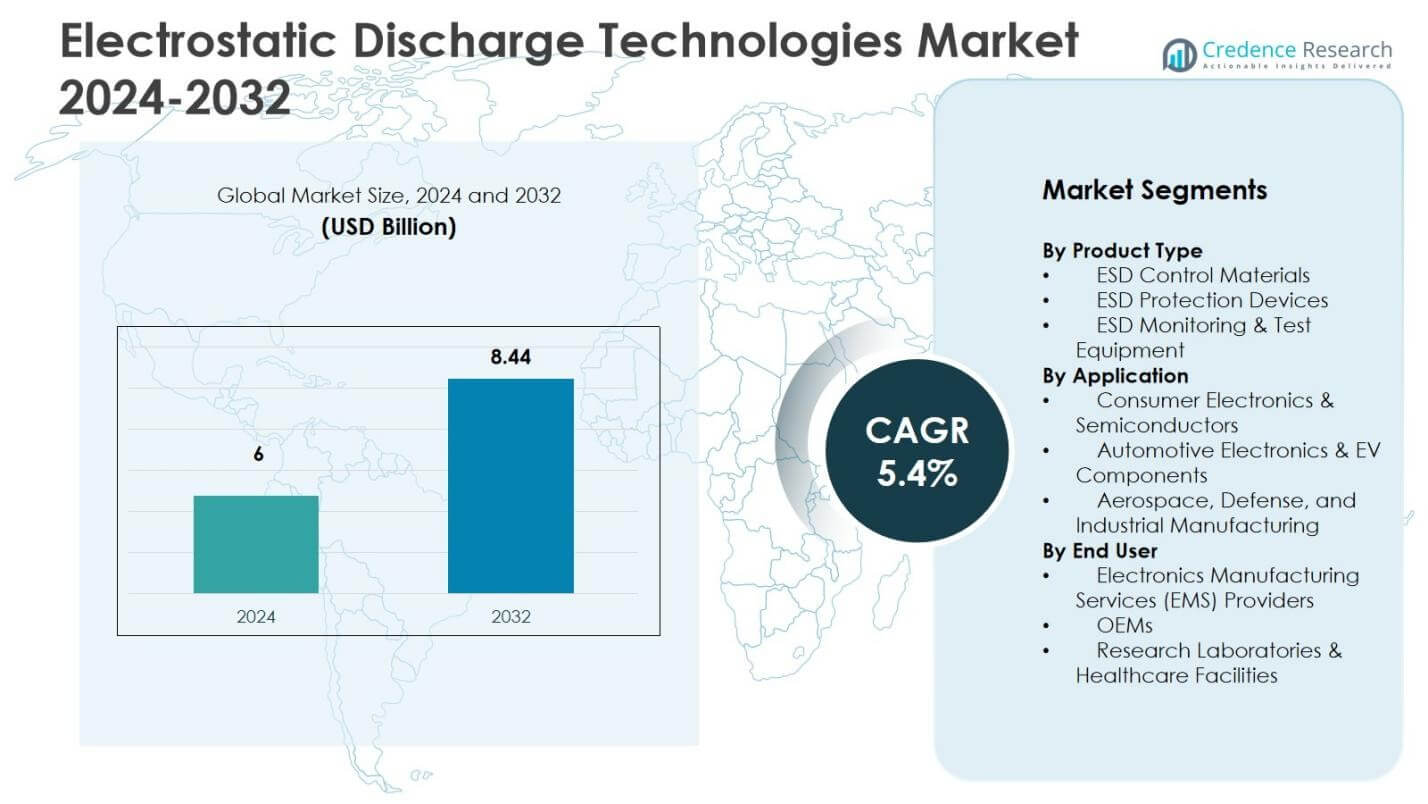
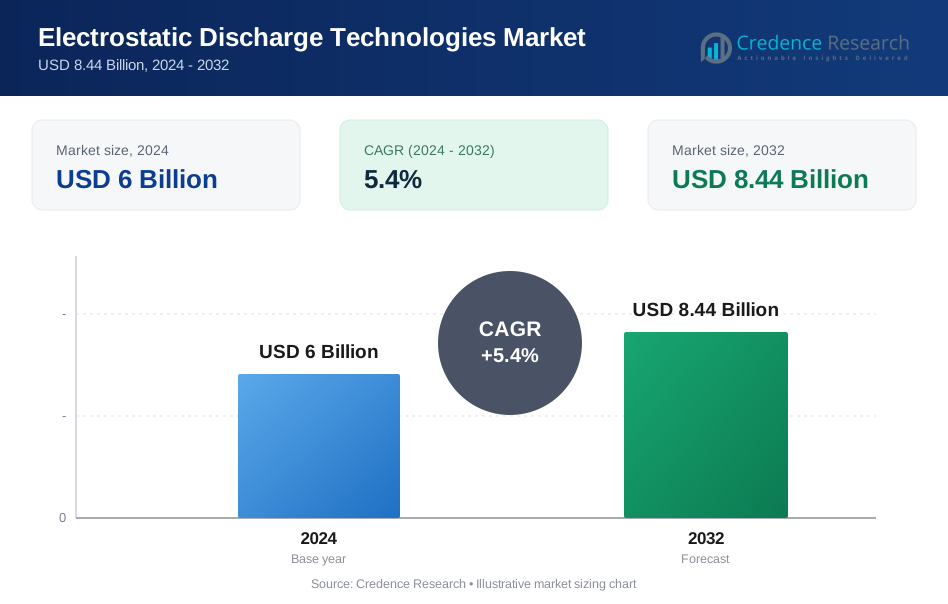
The electrostatic discharge technologies market was valued at $6 billion in 2024 and is anticipated to reach $8.44 billion by 2032, at a CAGR of 5.4% during the forecast period.
| REPORT ATTRIBUTE | DETAILS |
|---|---|
| Historical Period | 2020-2023 |
| Base Year | 2024 |
| Forecast Period | 2025-2032 |
| Electrostatic Discharge Technologies Market Size 2024 | USD 6 Billion |
| Electrostatic Discharge Technologies Market, CAGR | 5.4% |
| Electrostatic Discharge Technologies Market Size 2032 | USD 8.44 Billion |
Electrostatic Discharge Technologies Market insights
- The electrostatic discharge technologies market was valued at $6 billion in 2024 and will reach $8.44 billion by 2032 at a CAGR of 5.4%.
- The primary market driver is rising adoption of ESD protection across semiconductor fabrication, consumer electronics and automotive electronics, with the consumer electronics and semiconductors segment holding a 52.8% share in 2024 due to high-volume PCB assembly and chip manufacturing.
- Market trends include rapid deployment of smart ESD monitoring systems, IoT-enabled grounding solutions and advanced ESD materials that support cleanroom manufacturing and reliability-focused production environments across EMS operations and OEM facilities.
- Competitive analysis shows a strong presence of global players focusing on innovation in ESD flooring, coatings, packaging and protection devices, along with strategic investments in automation, compliance-certified solutions and expansion across high-growth electronics manufacturing hubs.
- North America holds a 34.6% share, Asia-Pacific accounts for a 29.8% share and Europe represents a 27.3% share in 2024, supported by semiconductor capacity expansion, EV electronics production, aerospace manufacturing and industrial automation initiatives.
Electrostatic Discharge Technologies Market segmentation analysis
By product type
The electrostatic discharge technologies market by product type is led by ESD control materials, which accounted for a 46.2% share in 2024, making it the dominant sub-segment. This category includes ESD flooring, packaging and coatings that support large-scale manufacturing environments. Its growth is driven by expanding semiconductor fabrication, stricter quality-control protocols and rising deployment of cleanroom infrastructure across electronics and automotive facilities. ESD protection devices and ESD monitoring and test equipment collectively hold the remaining market share, supported by increasing use of sensitive microelectronic components and the need for real-time static charge measurement in production lines.
- Sherwin-Williams provides electrostatic dissipative flooring systems for semiconductor manufacturing facilities, offering chemical resistance and protection against static damage in cleanrooms and fabrication areas.
By application
Consumer electronics and semiconductors emerged as the dominant application segment, securing a 52.8% share in 2024. The segment's leadership is driven by rising production of smartphones, wearables, advanced chips and PCB assemblies that require stringent ESD control during design and assembly. Increasing wafer miniaturization and higher circuit density further strengthen demand for robust ESD protection systems. Automotive electronics and EV components and aerospace, defense and industrial manufacturing together account for the remaining share, supported by electrification trends, safety standards and reliability-critical electronic systems.
- Nexperia launched a high-surge ESD diode in a wafer-level chip-scale package in 2024 for wearables. The compact design enhances board efficiency in devices with USB-C charging and sensors.
By end user
Electronics manufacturing services providers dominate the market with a 41.6% share in 2024, driven by large-volume electronic assembly operations and contract manufacturing for global OEMs. The segment benefits from rising outsourcing of PCB assembly, surface-mount technology lines and semiconductor packaging activities that require consistent static-safe environments. OEMs represent the second-largest share as they integrate in-house quality protection processes, while research laboratories and healthcare facilities contribute the remaining share, driven by precision instrumentation, medical device manufacturing and controlled laboratory environments where ESD-induced failures must be prevented.
Electrostatic Discharge Technologies Market Key Growth Drivers
Rapid expansion of semiconductor and electronics manufacturing
The electrostatic discharge technologies market grows significantly due to the accelerating expansion of semiconductor fabrication, PCB assembly and microelectronics manufacturing worldwide. Increasing wafer miniaturization, higher transistor density and advanced packaging technologies heighten the sensitivity of components to electrostatic failures, driving large-scale adoption of ESD flooring, coatings, protective packaging and grounding systems. The surge in smartphone production, wearable devices, data-center electronics and consumer Internet of Things products further strengthens demand. Governments and manufacturing clusters in Asia-Pacific and North America invest heavily in semiconductor capacity expansion, reinforcing the need for robust ESD control infrastructure across cleanrooms and high-precision assembly environments.
- STMicroelectronics deploys ESD protection devices like the BPF8089-01SC6, which safeguards GNSS receiver chipsets such as the STA8089GA against eight-kilovolt ESD-HBM transients while maintaining downstream voltage thresholds.
Rising deployment of automotive electronics and electric vehicles
The increasing integration of electronic control units, power electronics, battery-management systems and infotainment modules in modern vehicles acts as a major growth catalyst. Electric vehicles and hybrid systems require highly reliable semiconductor components, where static discharge failures can affect safety, efficiency and operational integrity. Automotive OEMs and Tier-1 suppliers adopt advanced ESD-safe materials, test equipment and protection devices across manufacturing, assembly and repair environments. Growing regulatory emphasis on reliability, combined with expansion of ADAS, autonomous systems and smart mobility platforms, fuels sustained investment in standardized ESD-protection frameworks across automotive production ecosystems.
- Bosch mandates ESD-safe and anti-static materials in all tape-and-reel packaging for automotive electronics, supporting baking up to 40 degrees Celsius for 79 days per J-STD-033 norms without mechanical alterations.
Stringent quality-control standards and compliance mandates
Global manufacturing environments increasingly operate under strict quality-assurance regulations and industry standards such as ANSI/ESD S20.20 and IEC-61340, which reinforce adoption of structured ESD-control programs. Electronics producers, EMS providers, aerospace contractors and medical device manufacturers deploy certified ESD technologies to minimize warranty costs, product recalls and latent defect risks. Corporate quality programs now integrate continuous monitoring, ESD audits and operator-safety protocols, encouraging widespread use of grounded workstations, conductive materials and real-time charge measurement solutions. The growing importance of zero-defect manufacturing, combined with customer-driven reliability benchmarks, strengthens long-term demand for compliant and audit-ready ESD-protection systems.
Electrostatic Discharge Technologies Market Key trends and opportunities
Shift toward smart, connected and AI-enabled ESD monitoring systems
A major trend shaping the market is the transition from manual ESD inspection toward intelligent, sensor-driven and network-connected monitoring platforms. Manufacturers increasingly deploy IoT-enabled wrist-strap testers, smart grounding modules and cloud-based analytics dashboards that track static charge levels in real time across workstations and production lines. Integration with manufacturing execution systems and quality-management systems enables predictive alerts, automated compliance reporting and data-driven risk prevention. Vendors are also exploring AI-powered anomaly detection and digital-twin environments to optimize ESD-control performance. This evolution opens significant opportunities for software-centric ESD ecosystems, subscription-based monitoring services and Industry 4.0-aligned production environments.
- Transforming Technologies offers the WST200, a portable wrist strap tester that measures resistance between the operator, wrist strap and ground cord using nine-volt DC, indicating high, low or OK status via LED and audible alarm with factory-set parameters of 800K to 10M ohms.
Growing adoption of ESD solutions in healthcare, aerospace and high-reliability sectors
New growth opportunities are emerging from sectors where operational safety and reliability are mission-critical. Medical device assembly, diagnostic instrumentation, aerospace avionics and defense electronics increasingly rely on precision circuits vulnerable to static discharge damage. As these industries scale production and modernize facilities, they invest in static-safe materials, conductive flooring, ESD-certified workbenches and contamination-controlled environments. The rise of digital healthcare equipment, implantable devices and space-grade electronics further expands the application scope, positioning ESD technologies as strategic enablers of product longevity, safety compliance and performance assurance across specialized manufacturing domains.
- Bosch Rexroth provides ESD-interlinked manual workstations designed for medical engineering assembly lines, featuring electrostatically conductive or dissipative components that meet DIN EN 61340-5-1 standards for protecting sensitive devices.
Electrostatic Discharge Technologies Market Key challenges
High implementation costs and complexity of ESD program integration
One of the key challenges for the market is the high initial cost associated with implementing comprehensive ESD-control programs. Large-scale deployments require facility upgrades, specialized materials, staff training, certification audits and ongoing maintenance investments, which may slow adoption among small and midsize manufacturers. Integrating ESD systems into legacy production environments can be technically complex, requiring workflow redesign and operational downtime. Organizations without dedicated quality-engineering teams often struggle to maintain continuous compliance, leading to partial or inconsistent implementation. This cost-complexity barrier limits penetration across cost-sensitive markets and emerging-economy manufacturing ecosystems.
Lack of awareness and inconsistent compliance practices across industries
Despite technological advancement, many organizations still underestimate the operational and financial risks associated with ESD-induced failures, particularly in developing manufacturing ecosystems. Limited technical awareness, absence of standardized enforcement and fragmented training programs result in inconsistent adherence to global ESD standards. Some industries continue to rely on basic grounding practices instead of structured, audited ESD-control systems, increasing defect probability and reliability concerns. Addressing this challenge requires wider industry education, certification-driven adoption models and stronger collaboration between ESD solution providers, regulatory bodies and manufacturing quality leaders.
Regional analysis
North America
North America holds a strong position in the electrostatic discharge technologies market, accounting for a 34.6% market share in 2024, driven by advanced semiconductor fabrication, aerospace electronics and high-reliability manufacturing environments. The United States leads regional demand due to the presence of major EMS providers, automotive electronics plants and defense technology manufacturers that require stringent ESD-control compliance. Investments in cleanroom infrastructure, quality-assurance programs and electronics R&D further strengthen adoption. Growing EV production, coupled with strong enforcement of ANSI/ESD standards, supports sustained market growth across healthcare devices, industrial automation and precision electronic assemblies.
Europe
Europe captured a 27.3% market share in 2024, supported by advanced automotive manufacturing, aerospace engineering hubs and strong electronics quality-compliance frameworks. Germany, France and the United Kingdom drive demand through high-value electronics assembly, avionics production and laboratory instrumentation manufacturing that rely on certified ESD environments. The region benefits from strict regulatory alignment with IEC-61340 standards and growing investments in semiconductor packaging ecosystems. Expansion of electric mobility platforms, industrial automation programs and renewable-energy control electronics further enhances the need for ESD-safe materials, monitoring systems and protection devices.
Asia-Pacific
Asia-Pacific represents the largest growth-driven region, securing a 29.8% market share in 2024, fueled by massive semiconductor fabrication, consumer electronics assembly and contract manufacturing operations across China, South Korea, Taiwan, Japan and India. Rapid expansion of PCB production, smartphone manufacturing, EV electronics and chip-packaging facilities increases reliance on static-safe flooring, coatings, packaging and grounding solutions. Government-backed industrial corridors, electronics export clusters and rising OEM outsourcing further accelerate adoption. Increasing penetration of smart factories and Industry 4.0 initiatives strengthens demand for automated ESD monitoring systems and compliance-certified production environments.
Latin America
Latin America accounted for a 5.4% market share in 2024, supported by expanding electronics assembly, automotive component manufacturing and industrial equipment production across Mexico and Brazil. The region experiences rising adoption of ESD-safe workstations, conductive packaging and testing equipment as multinational EMS providers strengthen regional manufacturing footprints. Growth is influenced by increasing investments in automotive electronics, consumer device assembly and medical equipment production that require reliability-controlled environments. Efforts to align with global quality-assurance standards and gradual modernization of industrial infrastructure continue to create steady opportunities for ESD technology deployment.
Middle East and Africa
The Middle East and Africa region held a 2.9% market share in 2024, driven by emerging investments in industrial electronics, defense equipment assembly and healthcare technology manufacturing across Gulf economies. Growth is supported by the establishment of specialized manufacturing parks, electronics refurbishment facilities and laboratory research environments that require controlled static-protection measures. Increasing government-led industrial diversification programs encourage the adoption of ESD flooring, monitoring devices and certified protective materials. Rising participation in high-reliability manufacturing sectors is expected to strengthen future market penetration.
Electrostatic Discharge Technologies Market Segmentations:
By Product Type
- ESD Control Materials
- ESD Protection Devices
- ESD Monitoring & Test Equipment
By Application
- Consumer Electronics & Semiconductors
- Automotive Electronics & EV Components
- Aerospace, Defense, and Industrial Manufacturing
By End User
- Electronics Manufacturing Services (EMS) Providers
- OEMs
- Research Laboratories & Healthcare Facilities
By Geography
- North America
- U.S.
- Canada
- Mexico
- Europe
- Germany
- France
- U.K.
- Italy
- Spain
- Rest of Europe
- Asia Pacific
- China
- Japan
- India
- South Korea
- South-east Asia
- Rest of Asia Pacific
- Latin America
- Brazil
- Argentina
- Rest of Latin America
- Middle East & Africa
- GCC Countries
- South Africa
- Rest of the Middle East and Africa
Competitive landscape
The competitive landscape in the electrostatic discharge technologies market is shaped by leading players such as 3M Co., Desco Industries Inc., PPG Industries Inc., Henkel AG & Co. KGaA, Keyence Corp., Texas Instruments Inc., STMicroelectronics N.V., Microchip Technology Inc., Protektive Pak and Elmech ESD Solutions. The market features a mix of global manufacturers, electronics component suppliers and specialty material providers that focus on reliability, product innovation and compliance-driven ESD protection solutions. Companies emphasize portfolio expansion across ESD flooring, coatings, packaging materials, monitoring systems and protection devices to address diverse end-use environments including semiconductor fabrication, automotive electronics, aerospace and EMS operations. Strategic priorities include technology integration, automation-enabled ESD monitoring and certification-based offerings aligned with ANSI/ESD and IEC standards. Partnerships with OEMs and contract manufacturers, along with regional manufacturing expansions in Asia-Pacific and North America, further strengthen market presence.
Key player analysis
- 3M Co.
- Desco Industries Inc.
- PPG Industries Inc.
- Henkel AG & Co. KGaA
- Keyence Corp.
- Texas Instruments Inc.
- STMicroelectronics N.V.
- Microchip Technology Inc.
- Protektive Pak (Botron Company Inc.)
- Elmech ESD Solutions
Recent developments
- In Dec. 2025, Cortec introduced EcoSonic VpCI-125 HP Permanent ESD Stretch Film, offering permanent ESD protection with added corrosion resistance for electronics packaging.
- In March 2025, EOS/ESD Association Services LLC partnered with SRF Technologies to deliver comprehensive ESD and EOS diagnostic, mitigation and testing solutions worldwide.
- In Feb. 2025, Semtech Corp. launched a new ESD protection device, the RClamp10022PWQ, designed for automotive Ethernet applications to support high-speed networks used in ADAS and autonomous driving systems.
- In July 2024, Sweden's ESD Center acquired Denmark's ZENITECH.dk to enhance its electrostatic discharge packaging and cleanroom product offerings.
Report coverage
The research report offers an in-depth analysis based on product type, application, end user and geography. It details leading market players, providing an overview of their business, product offerings, investments, revenue streams and key applications. The report also includes insights into the competitive environment, SWOT analysis, current market trends, and primary drivers and constraints. It examines market dynamics, regulatory scenarios and technological advancements shaping the industry, and provides strategic recommendations for new entrants and established companies.
Future outlook
- The market will witness stronger adoption of advanced ESD monitoring and automation-driven control systems across electronics manufacturing environments.
- Semiconductor miniaturization and high-density chip architectures will continue to accelerate demand for robust ESD protection frameworks.
- Automotive electronics and EV component production will drive sustained investment in certified ESD-safe materials and assembly infrastructure.
- Industry 4.0 integration will enable data-driven ESD risk assessment, predictive maintenance and centralized compliance tracking.
- Healthcare, aerospace and defense manufacturing will emerge as expanding application areas requiring high-reliability ESD solutions.
- Vendors will focus on developing eco-efficient and durable ESD materials that support cleanroom and sustainability standards.
- Outsourced electronics manufacturing and EMS expansion will increase deployment of standardized ESD programs across global production networks.
- Regulatory alignment with international ESD safety and quality standards will strengthen enforcement and program adoption.
- Cloud-connected and AI-enabled ESD analytics platforms will gain traction to support real-time monitoring and reporting.
- Market participants will emphasize training, certification services and lifecycle support to enhance operational reliability and customer value.
Request a Free Sample
Fill in your details and we'll send you a free sample report.
- Sample data tables & charts
- Research methodology
Need a Custom Version of This Report?
Tailor the scope, geography, or segments to your exact requirements.
- Custom geography or segment scope
- Direct access to our analyst team
Frequently Asked Questions
What is the current market size for Electrostatic Discharge Technologies Market, and what is its projected size in 2032?
At what Compound Annual Growth Rate is the Electrostatic Discharge Technologies Market projected to grow between 2024 and 2032?
Which Electrostatic Discharge Technologies Market segment held the largest share in 2024?
What are the primary factors fueling the growth of the Electrostatic Discharge Technologies Market?
Who are the leading companies in the Electrostatic Discharge Technologies Market?
Which region commanded the largest share of the Electrostatic Discharge Technologies Market in 2024?
Table of Content
Chapter 1. Report Introduction
- 1.1 Report Description & Purpose
- 1.1.1 Report Title & Market Definition
- 1.1.2 Unique Selling Propositions (USP) & Key Differentiators
- 1.1.3 Value Proposition for Stakeholders
- 1.2 Research Objectives
- 1.2.1 Market Sizing Objectives (Volume & Revenue)
- 1.2.2 Segmentation Objectives
- 1.2.3 Competitive Intelligence Objectives
- 1.2.4 Forecast & Scenario Objectives
- 1.3 Report Scope
- 1.3.1 Electrostatic Discharge Technologies Scope – Types & Subtypes Covered
- 1.3.2 Geographic Scope – Regions & Countries Covered
- 1.3.3 Historical Period, Base Year & Forecast Period (2024; forecast to 2032)
- 1.3.4 Inclusions & Exclusions
- 1.4 HS Code & Classification Framework
- 1.5 Currency, Units & Pricing Basis
- 1.6 Target Stakeholders
- 1.7 Limitations & Assumptions
Chapter 2. Executive Summary
- 2.1 Global Electrostatic Discharge Technologies Market Snapshot
- 2.1.1 Market Size – Historical (2024) & Forecast (2024-2032) (2024: USD 6 Billion → 2032: USD 8.44 Billion)
- 2.1.2 Volume & Revenue – Global Totals
- 2.1.3 Key Market Highlights – Top Five Facts
- 2.2 Electrostatic Discharge Technologies Market Segmentation Snapshot
- 2.2.1 Market Split by Region – 2024 vs. 2032
- 2.3 Competitive Snapshot
- 2.3.1 Top 10 Players by Revenue Share – 2024
- 2.3.2 Top 10 Players by Volume Share – 2024
- 2.3.3 Recent Strategic Developments (18-Month Summary)
- 2.4 Key Investment Highlights & Strategic Conclusions
Chapter 3. Electrostatic Discharge Technologies Market Dynamics & Industry Analysis
- 3.1 Market Overview & Context
- 3.1.1 Electrostatic Discharge Technologies Market Position in the Broader Automotive Value Chain
- 3.1.2 OEM vs. Replacement Market Dynamics
- 3.1.3 Market Maturity & Development Stage by Region
- 3.2 Electrostatic Discharge Technologies Market Drivers
- 3.3 Electrostatic Discharge Technologies Market Restraints & Challenges
- 3.4 Electrostatic Discharge Technologies Market Opportunities
- 3.5 Porter's Five Forces Analysis
- 3.5.1 Threat of New Entrants
- 3.5.2 Bargaining Power of Suppliers
- 3.5.3 Bargaining Power of Buyers
- 3.5.4 Threat of Substitutes
- 3.5.5 Competitive Rivalry – Intensity Assessment
- 3.6 Electrostatic Discharge Technologies Value Chain Analysis
- 3.6.1 Upstream – Raw Material/Input Suppliers
- 3.6.1.1 Raw Material/Input 1
- 3.6.1.2 Raw Material/Input 2
- 3.6.1.3 Raw Material/Input 3
- 3.6.2 Midstream – Production/Manufacturing/Service Delivery
- 3.6.2.1 Production/Process Overview
- 3.6.2.2 Key Facility Locations & Capacity by Manufacturer
- 3.6.3 Downstream – Distribution & End Consumer
- 3.6.3.1 Primary Channel – B2B/OEM
- 3.6.3.2 Secondary Channels – Dealer, Retail, Online, Direct
- 3.6.4 Value Chain Profitability Analysis
- 3.6.1 Upstream – Raw Material/Input Suppliers
- 3.7 PESTEL Analysis
- 3.7.1 Political Factors
- 3.7.2 Economic Factors
- 3.7.3 Social Factors
- 3.7.4 Technological Factors
- 3.7.5 Environmental Factors
- 3.7.6 Legal Factors
- 3.8 Electrostatic Discharge Technologies Supply Chain Analysis
- 3.8.1 Raw Material/Input Supply Risk Assessment
- 3.8.2 Manufacturing Concentration Risk (Geographic Exposure)
- 3.8.3 Trade Disruption Impact Analysis
- 3.9 Regulatory & Policy Landscape
Note: The regulatory and policy landscape section covers regulations based on their applicability to the market, Electrostatic Discharge Technologies category, geography, and scope of the study. Only regulatory frameworks with a material impact on operations, compliance, trade, sustainability, or market access are analyzed in detail.
Chapter 4. Key Investment Pockets & Opportunity Analysis
- 4.1 Electrostatic Discharge Technologies Market Attractiveness Analysis
- 4.1.1 By Region – Investment Attractiveness Matrix (Volume × CAGR)
- 4.2 Absolute Revenue Growth Opportunity
- 4.2.1 By Region – Absolute USD Growth Through 2032
- 4.3 Incremental Volume Opportunity
- 4.3.1 By Region – Incremental Volume Through 2032
- 4.3.2 Segment – Incremental Volume
- 4.4 Emerging Submarket Opportunity Deep Dive (Subject to Applicability)
- 4.5 Emerging Market Opportunity Scorecards
- 4.5.1 United States
- 4.5.2 Europe
- 4.5.3 Asia
- 4.5.4 Middle East & Africa
Note: Emerging Market Opportunity Scorecards will be included based on relevance and strategic importance. Regions listed are indicative and may vary depending on data availability and market dynamics.
Chapter 5. Electrostatic Discharge Technologies Import-Export Analysis & Trade Flows
- 5.1 Global Trade Overview
- 5.1.1 Global Export Value by Country (2024)
- 5.1.2 Global Export Volume by Country (2024)
- 5.1.3 Global Import Value by Country (2024)
- 5.1.4 Global Import Volume by Country (2024)
- 5.1.5 Net Trade Balance by Country (2024)
- 5.2 Export Analysis – Segment
- 5.2.1 Type 1 (HS Code)
- 5.2.2 Type 2 (HS Code)
- 5.2.3 Type 3 (HS Code)
- 5.2.4 Type 4 (HS Code)
- 5.2.5 Type 5 (HS Code)
- 5.3 Import Analysis – Segment
- 5.3.1 Type 1 (HS Code)
- 5.3.2 Type 2 (HS Code)
- 5.3.3 Type 3 (HS Code)
- 5.3.4 Type 4 (HS Code)
- 5.3.5 Type 5 (HS Code)
- 5.4 Average Unit Trade Prices
- 5.4.1 Average Export Price – Segment & Country
- 5.4.2 Average Import Price – Segment & Source Country
- 5.4.3 Price Trends (2024)
- 5.5 Key Trade Route Analysis
- 5.5.1 Trade Route 1
- 5.5.2 Trade Route 2
- 5.5.3 Trade Route 3
- 5.5.4 Trade Route 4
- 5.5.5 Trade Route 5
- 5.6 Trade Policy Impact Assessment
- 5.6.1 US Anti-Dumping & Section 301 Tariffs
- 5.6.2 EU Customs Union Impact
- 5.6.3 Major Free Trade Agreements
- 5.6.4 USMCA Rules of Origin
Note: Trade policy analysis will be included only where relevant to the Electrostatic Discharge Technologies market.
Chapter 6. Competitive Landscape & Company Benchmarking
- 6.1 Electrostatic Discharge Technologies Market Concentration & Structure
- 6.1.1 Herfindahl-Hirschman Index (HHI) – vs. 2024
- 6.1.2 Tier 1, Tier 2 & Tier 3 Market Structure
- 6.1.3 Global, Regional & Local Player Dynamics
- 6.2 Electrostatic Discharge Technologies Market Share Analysis – 2024
- 6.2.1 Global Revenue Share by Company
- 6.2.2 Global Volume Share by Company
- 6.2.3 Regional Revenue Share
- 6.2.4 Market Share Evolution ( vs. 2024)
- 6.2.5 OEM Segment Share by Company
- 6.2.6 Replacement Segment Share by Company
- 6.3 Production/Delivery Capacity & Facility Analysis
- 6.3.1 Global Installed Capacity
- 6.3.2 Capacity Utilization Rates
- 6.3.3 Production/Output Volume
- 6.3.4 Facility Locations & Capacity Map
- 6.3.5 Planned Capacity Additions
- 6.4 Electrostatic Discharge Technologies Competitive Benchmarking Matrix
- 6.4.1 Revenue, Volume, CAGR & Profitability Comparison
- 6.4.2 Channel Revenue Mix
- 6.4.3 Geographic Revenue Exposure
- 6.4.4 R&D Intensity
- 6.4.5 Sustainability Maturity
- 6.5 Strategic Developments in Electrostatic Discharge Technologies (Last 24 Months)
- 6.5.1 Mergers, Acquisitions & Divestments
- 6.5.2 New Electrostatic Discharge Technologies Launches
- 6.5.3 Facility Expansions
- 6.5.4 Strategic Alliances, Joint Ventures & Partnerships
- 6.5.5 Distribution Expansion & Market Entry
- 6.5.6 Sustainability & ESG Initiatives
- 6.6 Competitive Strategy Mapping
- 6.6.1 Leader, Challenger, Follower & Niche Classification
- 6.6.2 Pricing Strategy Comparison
- 6.6.3 Channel Strategy Matrix
Note: Strategic developments are included based on their materiality and the availability of reliable information.
Chapter 7. Global Electrostatic Discharge Technologies Market – By Distribution Channel
- 7.1 Segment Overview
- 7.1.1 Volume & Revenue Split by Channel (2024 & 2032)
- 7.1.2 Channel Mix Evolution (2024-2032)
Chapter 8. Regional Market Analysis – Global Overview
- 8.1 Global Regional Overview
- 8.1.1 Regional Volume Share
- 8.1.2 Regional Revenue Share
- 8.1.3 Regional Volume by Region
- 8.1.4 Regional Revenue by Region
- 8.1.5 Regional Forecast Through 2032
- 8.2 Cross-Regional Segment Analysis
- 8.2.1 By Distribution Channel
- 8.2.2 By Brand/Price Tier
Chapter 9. North America Electrostatic Discharge Technologies Market
- 9.1 United States
- 9.2 Canada
- 9.3 Mexico
Chapter 10. Europe Electrostatic Discharge Technologies Market
- 10.1 Germany
- 10.2 France
- 10.3 Italy
- 10.4 United Kingdom
- 10.5 Spain
- 10.6 Poland
- 10.7 Russia
- 10.8 Netherlands
- 10.9 Belgium
- 10.10 Sweden
- 10.11 Denmark
- 10.12 Norway
- 10.13 Rest of Europe
Chapter 11. Asia Pacific Electrostatic Discharge Technologies Market
- 11.1 China
- 11.2 India
- 11.3 Japan
- 11.4 South Korea
- 11.5 Thailand
- 11.6 Indonesia
- 11.7 Vietnam
- 11.8 Malaysia
- 11.9 Australia
- 11.10 Rest of Asia Pacific
Chapter 12. Latin America Electrostatic Discharge Technologies Market
- 12.1 Brazil
- 12.2 Argentina
- 12.3 Colombia
- 12.4 Chile
- 12.5 Rest of Latin America
Chapter 13. Middle East Electrostatic Discharge Technologies Market
- 13.1 Saudi Arabia
- 13.2 United Arab Emirates
- 13.3 Turkey
- 13.4 Israel
- 13.5 Iran
- 13.6 Rest of the Middle East
Chapter 14. Africa Electrostatic Discharge Technologies Market
- 14.1 South Africa
- 14.2 Egypt
- 14.3 Nigeria
- 14.4 Morocco
- 14.5 Rest of Africa
Chapter 15. Electrostatic Discharge Technologies Company Profiles
- 15.1 [Company 01]
- 15.1.1 Company Overview
- 15.1.2 Key Management Personnel
- 15.1.3 Products & Services Portfolio
- 15.1.4 Financial Performance
- 15.1.5 Key Market Focus & Geographic Presence
- 15.1.6 Recent Developments & Strategic Initiatives
Note: The company profile list is preliminary and may change based on research findings, market developments, data availability, and client requirements.
Chapter 16. Appendices
- Appendix A – List of Abbreviations & Acronyms
- Appendix B – Industry Classification Code Reference – Full Series
- Appendix C – Production & Capacity Data Tables
- Appendix D – End-Use & Demand Base Tables
- Appendix E – Consumption & Replacement Rate Assumptions
- Appendix F – ASP Reference Tables
- Appendix G – Manufacturing & Facility Database
- Appendix H – Import-Export Data Tables
- Appendix I – Regulatory Summary Tables
- Appendix J – Primary Research Participant List (Anonymized)
- Appendix K – Primary Research Questionnaire Framework
- Appendix L – Data Sources & Bibliography
- Appendix M – Market Size Divergence & Source Comparison
Chapter 17. Research Methodology
- 17.1 Research Framework & Philosophy
- 17.2 Secondary Research – Sources, Hierarchy & Data Extraction
- 17.3 Data Modeling – Bottom-Up & Top-Down Market Sizing
- 17.4 Primary Research – Stakeholder Framework, LOI & Sample Sizes
- 17.5 Forecast Methodology – Regression, Scenario & Sensitivity Analysis
- 17.6 Quality Control – Four-Layer Validation Framework
- 17.7 Limitations & Standard Assumptions
- 17.8 Disclaimer
