
Ultrasonic Sensors Market Overview:
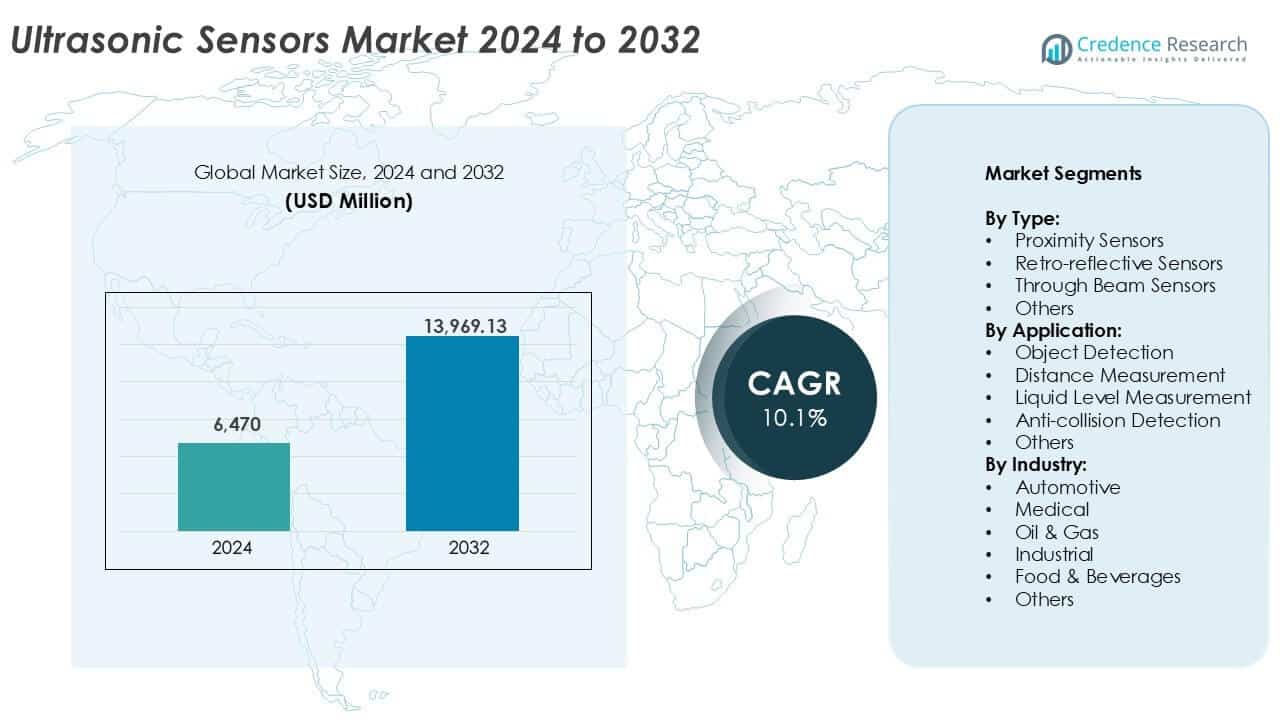
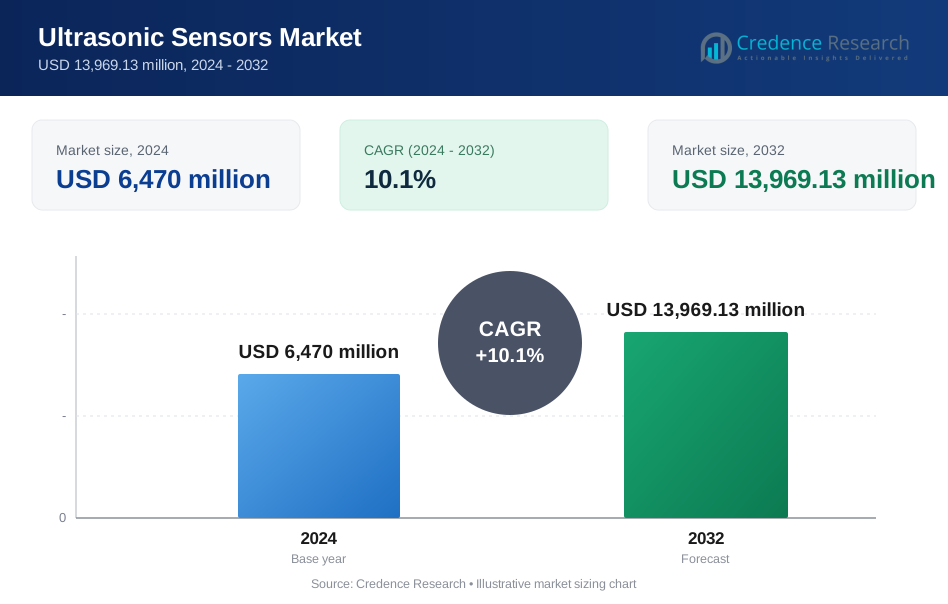
The Ultrasonic Sensors market size was valued at USD 6,470 million in 2024 and is anticipated to reach USD 13,969.13 million by 2032, at a CAGR of 10.1% during the forecast period.
| REPORT ATTRIBUTE | DETAILS |
|---|---|
| Historical Period | 2020-2023 |
| Base Year | 2024 |
| Forecast Period | 2025-2032 |
| Ultrasonic Sensors Market Size 2024 | USD 6,470 million |
| Ultrasonic Sensors Market, CAGR | 10.1% |
| Ultrasonic Sensors Market Size 2032 | USD 13,969.13 million |
Key players in the ultrasonic sensors market include Siemens AG, Honeywell International, Omron Corporation, Rockwell Automation, and Keyence Corporation. These companies lead through strong R&D capabilities, diverse sensor portfolios, and wide industry reach. Mid-tier players such as Balluff GmbH, Baumer Ltd, Pepperl+Fuchs AG, and Murata Manufacturing Co., Ltd. focus on industrial automation and precision sensing. Blatek Inc and Crest Ultrasonic cater to niche applications in medical and non-destructive testing. Asia Pacific emerged as the leading region in 2024, accounting for over 35% of the global market share, driven by high automotive production, industrial expansion, and smart infrastructure investments in China, Japan, and South Korea.
Ultrasonic Sensors Market Insights
- The ultrasonic sensors market was valued at USD 6,470 million in 2024 and is projected to reach USD 13,969.13 million by 2032, growing at a CAGR of 10.1% during the forecast period.
- Industrial automation and automotive ADAS applications are key drivers, with proximity sensors holding the largest share among sensor types due to widespread use in smart factories and vehicles.
- Integration of wireless and IoT-enabled sensors is a major trend, supporting real-time monitoring across smart cities, manufacturing, and fluid management systems.
- The market is competitive, led by Siemens AG, Honeywell, Rockwell Automation, Omron, and Keyence, while mid-sized firms focus on customized industrial solutions and niche innovations.
- Asia Pacific dominated with over 35% market share in 2024, followed by North America at 25% and Europe at 22%; the automotive industry was the top end-user segment due to strong sensor demand in electric and semi-autonomous vehicles.
Ultrasonic Sensors Market Segmentation Analysis:
By Type
Proximity sensors held the largest market share in 2024 among ultrasonic sensor types. Their dominance stems from widespread use in industrial automation, automotive parking systems, and robotics. Proximity sensors offer high accuracy for short-range object detection without physical contact. They are also cost-effective and easy to integrate into compact devices. Demand for proximity-based collision prevention in autonomous systems further supports growth. Retro-reflective and through beam sensors follow in adoption, especially in packaging lines and conveyor systems, where reliable detection under varied lighting is required.
- For instance, Pepperl+Fuchs’ UC2000 ultrasonic proximity sensor detects objects up to 2,000 millimeters with a repeat accuracy of 1% of the full-scale value.
By Application
Object detection emerged as the dominant application in 2024, driven by its broad utility in automotive, industrial, and robotic systems. This segment benefits from increased adoption in collision avoidance, assembly line automation, and autonomous navigation. Rising integration of smart sensors in automated warehouses boosts demand. Distance measurement and liquid level measurement follow closely, with growth in smart tanks, chemical processing, and logistics. Anti-collision detection applications gain traction in mobile robotics and forklifts, supporting operational safety in confined spaces.
- For instance, Bosch ultrasonic sensors used in parking assist systems detect obstacles within a range of 15 to 550 centimeters (0.15 to 5.5 meters), depending on the sensor generation.
By Industry
The automotive industry accounted for the highest market share among end-use sectors in 2024. Automakers widely deploy ultrasonic sensors in parking assistance, blind spot detection, and obstacle avoidance systems. Electrification and advanced driver-assistance systems (ADAS) continue to fuel growth. The industrial segment ranks second, propelled by factory automation, inventory control, and machine safety systems. Food & beverage and medical sectors adopt sensors for non-contact liquid level detection and sterile environment compliance. Oil & gas applications remain niche but steady, requiring sensors for tank monitoring and hazardous zone safety.
Ultrasonic Sensors Market Key Growth Drivers
Rising Demand for Industrial Automation and Smart Manufacturing
Ultrasonic sensors play a crucial role in industrial automation, enabling accurate and non-contact measurement in dynamic environments. Their usage spans across assembly lines, material handling, packaging, and robotic navigation. With industries moving toward Industry 4.0, demand for intelligent sensing technologies continues to accelerate. Ultrasonic sensors provide real-time distance, presence, and object detection data, supporting predictive maintenance and process optimization. Sectors like automotive, electronics, and heavy machinery adopt these sensors to improve productivity and reduce human intervention. Their compatibility with IoT and wireless monitoring systems further strengthens their appeal in smart manufacturing environments. Emerging economies are increasingly adopting automation to stay competitive, which supports sensor deployment at scale. This shift toward connected manufacturing environments drives consistent growth across sensor suppliers and solution integrators globally.
- For instance, Pepperl+Fuchs supplies ultrasonic sensors with IO-Link connectivity handling update cycles below 5 milliseconds in automated assembly lines.
Expanding Adoption in Automotive Advanced Driver Assistance Systems (ADAS)
The automotive sector significantly boosts demand for ultrasonic sensors due to their integration in Advanced Driver Assistance Systems (ADAS). These sensors support functions such as park assist, blind spot detection, proximity alerts, and automatic braking systems. As governments enforce stricter vehicle safety regulations, OEMs are integrating more sensors to meet compliance. The growth of electric vehicles and semi-autonomous driving platforms has further increased the need for robust sensing technologies. Ultrasonic sensors are particularly effective for close-range detection, offering reliable performance regardless of lighting or environmental conditions. Their cost-effectiveness compared to LiDAR or radar systems makes them ideal for mass-market vehicles. Growing consumer preference for safer and smarter vehicles ensures continued investment in ultrasonic-based sensing modules, especially in Asia Pacific and North America where automotive production is strong.
- For instance, Bosch supplies ultrasonic parking sensors detecting obstacles between 30 and 250 centimeters in passenger vehicles.
Growth in Liquid Level Monitoring Across Healthcare, Oil & Gas, and Water Treatment
Non-contact ultrasonic sensors have become critical for level monitoring in tanks, containers, and reservoirs across industries. In the healthcare sector, they are used to monitor intravenous fluid levels and in diagnostic devices. Oil & gas operators deploy them in harsh environments to safely measure fuel, chemical, and wastewater levels. Water treatment plants rely on them for continuous level tracking in storage tanks and distribution systems. Ultrasonic sensors offer safe, hygienic, and accurate measurement without physical contact, making them ideal for applications requiring contamination-free operation. Their ability to function in corrosive, explosive, or high-pressure environments adds further value. The rising global emphasis on water conservation, chemical handling safety, and medical precision has made ultrasonic sensors essential for fluid management. Sensor manufacturers continue to innovate with wireless and battery-powered solutions, expanding deployment flexibility.
Ultrasonic Sensors Market Key Trends & Opportunities
Integration of Wireless and IoT-Enabled Ultrasonic Sensors
The integration of wireless connectivity and IoT capabilities into ultrasonic sensors is creating significant growth opportunities. These smart sensors enable real-time monitoring, remote diagnostics, and seamless integration with industrial control systems. In manufacturing, wireless ultrasonic sensors reduce wiring complexity and installation costs while improving flexibility in machine layout and retrofitting. In smart cities, they support parking management, traffic flow analysis, and waste level detection in smart bins. IoT integration allows cloud-based data analytics, predictive maintenance, and improved asset tracking. This trend supports digital transformation strategies across multiple sectors. Sensor suppliers are offering Bluetooth, LoRaWAN, and Wi-Fi enabled devices to address varying communication needs. The ability to combine ultrasonic accuracy with smart analytics opens new use cases across logistics, agriculture, environmental monitoring, and building automation, especially in regions pursuing smart infrastructure investments.
- For instance, Pepperl+Fuchs’ wireless ultrasonic sensors support IO-Link Wireless with cycle times of 5 milliseconds and ranges up to 2,000 millimeters.
Miniaturization and Custom Sensor Module Development
Miniaturization of ultrasonic sensors is a key trend enabling their use in compact and portable devices. Consumer electronics, wearables, and medical devices are adopting micro-ultrasonic modules for functions like proximity detection, gesture recognition, and fluid monitoring. In automotive design, smaller sensor footprints allow seamless integration into bumpers, mirrors, and headlamps without compromising aesthetics. OEMs also seek custom modules optimized for their mechanical layouts and communication protocols. This demand drives development of modular sensor platforms with programmable output ranges and form factors. Miniaturized ultrasonic sensors also consume less power, making them suitable for battery-operated and embedded systems. Research into MEMS-based ultrasonic transducers is expanding performance boundaries, allowing higher resolution and shorter blind zones. This customization and scaling of sensor capabilities is fueling broader market penetration into niche and emerging applications.
Ultrasonic Sensors Market Key Challenges
Performance Limitations in Noisy and Extreme Environments
Ultrasonic sensors can face reliability issues in high-noise or high-vibration environments, which affect signal clarity and accuracy. In industrial settings with machinery noise or temperature fluctuations, signal interference may result in false readings or delayed response times. Similarly, in outdoor or extreme conditions, such as heavy rain, dust, or high humidity, ultrasonic waves can scatter or attenuate, reducing effective sensing range. These limitations make them less suitable in certain automotive or aerospace applications where reliability is critical. While sensor manufacturers are developing signal compensation and filtering techniques, these solutions may add cost or complexity. Competing technologies such as radar or LiDAR offer better performance under such conditions, posing a threat to ultrasonic sensor usage in sensitive applications. Addressing environmental robustness remains a technical challenge, especially for broader adoption in safety-critical or outdoor deployments.
Intense Market Competition and Price Pressure
The ultrasonic sensors market is highly competitive, with numerous global and regional players offering similar products. Price sensitivity among industrial buyers and automotive OEMs intensifies pressure on sensor manufacturers to deliver cost-effective solutions without compromising performance. This commoditization affects profit margins, especially for standard sensor formats. New entrants from Asia are offering low-cost alternatives, increasing competition for established brands. Furthermore, advancements in alternative sensing technologies such as infrared, capacitive, and radar sensors are fragmenting demand across applications. Companies must continuously invest in innovation, miniaturization, and software integration to differentiate their offerings. Long sales cycles and qualification processes in industries like automotive and healthcare add to market entry barriers. Balancing cost competitiveness with technology advancement remains a persistent challenge across the value chain.
Ultrasonic Sensors Market Regional Analysis
North America
North America held a significant market share of over 25% in the global ultrasonic sensors market in 2024. The region benefits from strong adoption across automotive, industrial automation, and healthcare sectors. The U.S. leads in terms of demand, driven by investments in ADAS, smart factories, and IoT-based monitoring systems. Sensor integration in parking assist and collision avoidance systems remains high. The presence of established players and advanced R&D infrastructure further supports innovation. Growth is reinforced by regulatory support for safety standards and automation in manufacturing. Canada contributes steadily through industrial and energy-based applications.
Europe
Europe accounted for approximately 22% of the global ultrasonic sensors market in 2024, led by Germany, France, and the UK. The region’s strong automotive base, particularly in Germany, drives extensive use of ultrasonic sensors in ADAS and electric vehicles. Industrial automation is a key contributor, with wide-scale deployment in robotics and production lines. Stringent regulations on vehicle and workplace safety encourage sensor integration. Medical and environmental monitoring applications are also expanding, particularly in Western Europe. Continuous investments in smart infrastructure and clean energy systems sustain growth across major economies and boost sensor deployment in public utilities.
Asia Pacific
Asia Pacific dominated the ultrasonic sensors market with a market share exceeding 35% in 2024. China, Japan, South Korea, and India lead regional demand, driven by rapid industrialization and vehicle production. China remains the largest contributor, supported by domestic manufacturing and smart city initiatives. Japan and South Korea emphasize high-tech applications in automotive and consumer electronics. India shows rising adoption in smart factories and water management systems. Government support for Industry 4.0 and smart mobility strengthens market growth. Cost-effective sensor manufacturing in the region further improves export potential and adoption among local OEMs.
Latin America
Latin America held a moderate share of around 8% in the global ultrasonic sensors market in 2024. Brazil and Mexico are key contributors, driven by the automotive, oil & gas, and food processing industries. Sensor use in vehicle safety systems, tank monitoring, and non-contact level detection supports demand. Economic diversification and efforts to modernize manufacturing infrastructure aid adoption. However, budget constraints and limited domestic production capabilities pose challenges. Despite this, regional growth remains stable due to increased foreign investments in automation and renewable energy projects, especially in Brazil’s industrial corridors and Mexico’s export manufacturing zones.
Middle East & Africa (MEA)
The Middle East & Africa accounted for nearly 5% of the global ultrasonic sensors market share in 2024. GCC countries, especially the UAE and Saudi Arabia, lead demand due to automation in oil & gas, utilities, and water management sectors. Smart city developments and investments in infrastructure modernization support sensor integration. In Africa, South Africa shows adoption in automotive assembly and agriculture-based monitoring. Limited local manufacturing and import dependency constrain rapid growth. However, increasing industrial safety norms and digital transformation initiatives present long-term opportunities, particularly in energy, desalination, and public infrastructure projects.
Ultrasonic Sensors Market Segmentations:
By Type:
- Proximity Sensors
- Retro-reflective Sensors
- Through Beam Sensors
- Others
By Application:
- Object Detection
- Distance Measurement
- Liquid Level Measurement
- Anti-collision Detection
- Others
By Industry:
- Automotive
- Medical
- Oil & Gas
- Industrial
- Food & Beverages
- Others
By Geography:
- North America
- U.S.
- Canada
- Mexico
- Europe
- Germany
- France
- U.K.
- Italy
- Spain
- Rest of Europe
- Asia Pacific
- China
- Japan
- India
- South Korea
- South-east Asia
- Rest of Asia Pacific
- Latin America
- Brazil
- Argentina
- Rest of Latin America
- Middle East & Africa
- GCC Countries
- South Africa
- Rest of the Middle East and Africa
Competitive Landscape
The ultrasonic sensors market features a competitive landscape marked by the presence of both global giants and specialized sensor manufacturers. Key players such as Siemens AG, Honeywell International, Omron Corporation, and Rockwell Automation dominate through broad product portfolios and strong distribution networks. These companies invest heavily in R&D to enhance sensor accuracy, miniaturization, and wireless integration. Mid-sized firms like Balluff GmbH, Baumer Ltd, and Pepperl+Fuchs AG focus on industrial and automation-specific solutions, offering application-specific customization. Companies such as Murata Manufacturing and Keyence Corporation lead in high-performance and compact sensor technologies for electronics and automotive sectors. Startups and niche players like Blatek Inc and Crest Ultrasonic contribute to innovation in specialized applications such as medical diagnostics and non-destructive testing. Strategic partnerships, new product launches, and geographic expansions remain core growth strategies. The market sees rising competition as players strive to offer cost-effective, smart, and robust sensor systems to meet the evolving needs of automation-driven industries.
Key Player Analysis
- Baumer Ltd
- Blatek Inc
- Honeywell International
- Crest Ultrasonic
- Siemens AG
- Balluff GmbH
- Pepperl + Fuchs AG
- Murata Manufacturing Co., Ltd
- Omron Corporation
- Rockwell Automation
- Keyence Corporation
Recent Developments
- In September 2024, Baumer launched the UF200 ultrasonic sensor, which is the flattest front-mount ultrasonic sensor available with a housing depth of only 20.5 mm. It features a detection range of up to 2000 mm and an extremely short blind range starting at 20 mm. This innovative design utilizes NexSonic technology, enhancing performance in object detection and distance measurement while providing significant engineering flexibility for various applications.
- In February 2024, the Siemens launched ACUSON Sequoia. It helps to address industry challenges in ultrasound imaging. It offers new updates contrast-enhanced ultrasound and elastography with the help of Deep Abdominal Transducer (DAX). It has penetration power up to 40cm. It enables high-resolution imaging at greater depths without impacting real-time performance.
- In August 2023, Balluff introduced the BFD ultrasonic position sensor, designed to monitor hydraulic short-stroke cylinders directly for workpiece clamping. This innovative sensor provides real-time information on clamping status and can detect issues such as oil supply problems and contour deviations, enhancing reliability and safety in metalworking applications. Its compact design and flexible integration via standardized interfaces make it a cost-effective solution for modern production demands.
Report Coverage
The research report offers an in-depth analysis based on Type, Application, Industry and Geography. It details leading market players, providing an overview of their business, product offerings, investments, revenue streams, and key applications. Additionally, the report includes insights into the competitive environment, SWOT analysis, current market trends, as well as the primary drivers and constraints. Furthermore, it discusses various factors that have driven market expansion in recent years. The report also explores market dynamics, regulatory scenarios, and technological advancements that are shaping the industry. It assesses the impact of external factors and global economic changes on market growth. Lastly, it provides strategic recommendations for new entrants and established companies to navigate the complexities of the market.
Future Outlook
- The market will continue expanding with rising adoption in industrial automation and smart factories.
- Automotive sector demand will grow due to increasing integration of ADAS and safety systems.
- Wireless and IoT-enabled ultrasonic sensors will gain popularity for remote and real-time monitoring.
- Miniaturized sensors will see higher use in medical devices, consumer electronics, and compact robotics.
- Smart city infrastructure will drive sensor deployment in parking, waste management, and traffic systems.
- Manufacturers will focus on improving sensor performance in harsh and noisy environments.
- Strategic partnerships and collaborations will rise to support technology integration and global reach.
- Asia Pacific will retain its leadership position, supported by strong manufacturing and export activities.
- Custom sensor module development will increase to meet specific OEM and industry needs.
- Competitive pressure will push innovation in cost-effective, energy-efficient, and high-accuracy sensor solutions.
Request a Free Sample
Fill in your details and we'll send you a free sample report.
- Sample data tables & charts
- Research methodology
Need a Custom Version of This Report?
Tailor the scope, geography, or segments to your exact requirements.
- Custom geography or segment scope
- Direct access to our analyst team
Frequently Asked Questions
What is the current market size for Ultrasonic Sensors market, and what is its projected size in 2032?
At what Compound Annual Growth Rate is the Ultrasonic Sensors market projected to grow between 2024 and 2032?
Which Ultrasonic Sensors market segment held the largest share in 2024?
What are the primary factors fueling the growth of the Ultrasonic Sensors market?
Who are the leading companies in the Ultrasonic Sensors market?
Which region commanded the largest share of the Ultrasonic Sensors market in 2024?
Table of Content
Chapter 1. Report Introduction
- 1.1 Report Description & Purpose
- 1.1.1 Report Title & Market Definition
- 1.1.2 Unique Selling Propositions (USP) & Key Differentiators
- 1.1.3 Value Proposition for Stakeholders
- 1.2 Research Objectives
- 1.2.1 Market Sizing Objectives (Volume & Revenue)
- 1.2.2 Segmentation Objectives
- 1.2.3 Competitive Intelligence Objectives
- 1.2.4 Forecast & Scenario Objectives
- 1.3 Report Scope
- 1.3.1 Ultrasonic Sensors Scope – Types & Subtypes Covered
- 1.3.2 Geographic Scope – Regions & Countries Covered
- 1.3.3 Historical Period, Base Year & Forecast Period (2024; forecast to 2032)
- 1.3.4 Inclusions & Exclusions
- 1.4 HS Code & Classification Framework
- 1.5 Currency, Units & Pricing Basis
- 1.6 Target Stakeholders
- 1.7 Limitations & Assumptions
Chapter 2. Executive Summary
- 2.1 Global Ultrasonic Sensors Market Snapshot
- 2.1.1 Market Size – Historical (2024) & Forecast (2024-2032) (2024: USD 6,470 million → 2032: USD 13,969.13 million)
- 2.1.2 Volume & Revenue – Global Totals
- 2.1.3 Key Market Highlights – Top Five Facts
- 2.2 Ultrasonic Sensors Market Segmentation Snapshot
- 2.2.1 Market Split by Region – 2024 vs. 2032
- 2.3 Competitive Snapshot
- 2.3.1 Top 10 Players by Revenue Share – 2024
- 2.3.2 Top 10 Players by Volume Share – 2024
- 2.3.3 Recent Strategic Developments (18-Month Summary)
- 2.4 Key Investment Highlights & Strategic Conclusions
Chapter 3. Ultrasonic Sensors Market Dynamics & Industry Analysis
- 3.1 Market Overview & Context
- 3.1.1 Ultrasonic Sensors Market Position in the Broader Automotive Value Chain
- 3.1.2 OEM vs. Replacement Market Dynamics
- 3.1.3 Market Maturity & Development Stage by Region
- 3.2 Ultrasonic Sensors Market Drivers
- 3.3 Ultrasonic Sensors Market Restraints & Challenges
- 3.4 Ultrasonic Sensors Market Opportunities
- 3.5 Porter's Five Forces Analysis
- 3.5.1 Threat of New Entrants
- 3.5.2 Bargaining Power of Suppliers
- 3.5.3 Bargaining Power of Buyers
- 3.5.4 Threat of Substitutes
- 3.5.5 Competitive Rivalry – Intensity Assessment
- 3.6 Ultrasonic Sensors Value Chain Analysis
- 3.6.1 Upstream – Raw Material/Input Suppliers
- 3.6.1.1 Raw Material/Input 1
- 3.6.1.2 Raw Material/Input 2
- 3.6.1.3 Raw Material/Input 3
- 3.6.2 Midstream – Production/Manufacturing/Service Delivery
- 3.6.2.1 Production/Process Overview
- 3.6.2.2 Key Facility Locations & Capacity by Manufacturer
- 3.6.3 Downstream – Distribution & End Consumer
- 3.6.3.1 Primary Channel – B2B/OEM
- 3.6.3.2 Secondary Channels – Dealer, Retail, Online, Direct
- 3.6.4 Value Chain Profitability Analysis
- 3.6.1 Upstream – Raw Material/Input Suppliers
- 3.7 PESTEL Analysis
- 3.7.1 Political Factors
- 3.7.2 Economic Factors
- 3.7.3 Social Factors
- 3.7.4 Technological Factors
- 3.7.5 Environmental Factors
- 3.7.6 Legal Factors
- 3.8 Ultrasonic Sensors Supply Chain Analysis
- 3.8.1 Raw Material/Input Supply Risk Assessment
- 3.8.2 Manufacturing Concentration Risk (Geographic Exposure)
- 3.8.3 Trade Disruption Impact Analysis
- 3.9 Regulatory & Policy Landscape
Note: The regulatory and policy landscape section covers regulations based on their applicability to the market, Ultrasonic Sensors category, geography, and scope of the study. Only regulatory frameworks with a material impact on operations, compliance, trade, sustainability, or market access are analyzed in detail.
Chapter 4. Key Investment Pockets & Opportunity Analysis
- 4.1 Ultrasonic Sensors Market Attractiveness Analysis
- 4.1.1 By Region – Investment Attractiveness Matrix (Volume × CAGR)
- 4.2 Absolute Revenue Growth Opportunity
- 4.2.1 By Region – Absolute USD Growth Through 2032
- 4.3 Incremental Volume Opportunity
- 4.3.1 By Region – Incremental Volume Through 2032
- 4.3.2 Segment – Incremental Volume
- 4.4 Emerging Submarket Opportunity Deep Dive (Subject to Applicability)
- 4.5 Emerging Market Opportunity Scorecards
- 4.5.1 United States
- 4.5.2 Europe
- 4.5.3 Asia
- 4.5.4 Middle East & Africa
Note: Emerging Market Opportunity Scorecards will be included based on relevance and strategic importance. Regions listed are indicative and may vary depending on data availability and market dynamics.
Chapter 5. Ultrasonic Sensors Import-Export Analysis & Trade Flows
- 5.1 Global Trade Overview
- 5.1.1 Global Export Value by Country (2024)
- 5.1.2 Global Export Volume by Country (2024)
- 5.1.3 Global Import Value by Country (2024)
- 5.1.4 Global Import Volume by Country (2024)
- 5.1.5 Net Trade Balance by Country (2024)
- 5.2 Export Analysis – Segment
- 5.2.1 Type 1 (HS Code)
- 5.2.2 Type 2 (HS Code)
- 5.2.3 Type 3 (HS Code)
- 5.2.4 Type 4 (HS Code)
- 5.2.5 Type 5 (HS Code)
- 5.3 Import Analysis – Segment
- 5.3.1 Type 1 (HS Code)
- 5.3.2 Type 2 (HS Code)
- 5.3.3 Type 3 (HS Code)
- 5.3.4 Type 4 (HS Code)
- 5.3.5 Type 5 (HS Code)
- 5.4 Average Unit Trade Prices
- 5.4.1 Average Export Price – Segment & Country
- 5.4.2 Average Import Price – Segment & Source Country
- 5.4.3 Price Trends (2024)
- 5.5 Key Trade Route Analysis
- 5.5.1 Trade Route 1
- 5.5.2 Trade Route 2
- 5.5.3 Trade Route 3
- 5.5.4 Trade Route 4
- 5.5.5 Trade Route 5
- 5.6 Trade Policy Impact Assessment
- 5.6.1 US Anti-Dumping & Section 301 Tariffs
- 5.6.2 EU Customs Union Impact
- 5.6.3 Major Free Trade Agreements
- 5.6.4 USMCA Rules of Origin
Note: Trade policy analysis will be included only where relevant to the Ultrasonic Sensors market.
Chapter 6. Competitive Landscape & Company Benchmarking
- 6.1 Ultrasonic Sensors Market Concentration & Structure
- 6.1.1 Herfindahl-Hirschman Index (HHI) – vs. 2024
- 6.1.2 Tier 1, Tier 2 & Tier 3 Market Structure
- 6.1.3 Global, Regional & Local Player Dynamics
- 6.2 Ultrasonic Sensors Market Share Analysis – 2024
- 6.2.1 Global Revenue Share by Company
- 6.2.2 Global Volume Share by Company
- 6.2.3 Regional Revenue Share
- 6.2.4 Market Share Evolution ( vs. 2024)
- 6.2.5 OEM Segment Share by Company
- 6.2.6 Replacement Segment Share by Company
- 6.3 Production/Delivery Capacity & Facility Analysis
- 6.3.1 Global Installed Capacity
- 6.3.2 Capacity Utilization Rates
- 6.3.3 Production/Output Volume
- 6.3.4 Facility Locations & Capacity Map
- 6.3.5 Planned Capacity Additions
- 6.4 Ultrasonic Sensors Competitive Benchmarking Matrix
- 6.4.1 Revenue, Volume, CAGR & Profitability Comparison
- 6.4.2 Channel Revenue Mix
- 6.4.3 Geographic Revenue Exposure
- 6.4.4 R&D Intensity
- 6.4.5 Sustainability Maturity
- 6.5 Strategic Developments in Ultrasonic Sensors (Last 24 Months)
- 6.5.1 Mergers, Acquisitions & Divestments
- 6.5.2 New Ultrasonic Sensors Launches
- 6.5.3 Facility Expansions
- 6.5.4 Strategic Alliances, Joint Ventures & Partnerships
- 6.5.5 Distribution Expansion & Market Entry
- 6.5.6 Sustainability & ESG Initiatives
- 6.6 Competitive Strategy Mapping
- 6.6.1 Leader, Challenger, Follower & Niche Classification
- 6.6.2 Pricing Strategy Comparison
- 6.6.3 Channel Strategy Matrix
Note: Strategic developments are included based on their materiality and the availability of reliable information.
Chapter 7. Global Ultrasonic Sensors Market – By Distribution Channel
- 7.1 Segment Overview
- 7.1.1 Volume & Revenue Split by Channel (2024 & 2032)
- 7.1.2 Channel Mix Evolution (2024-2032)
Chapter 8. Regional Market Analysis – Global Overview
- 8.1 Global Regional Overview
- 8.1.1 Regional Volume Share
- 8.1.2 Regional Revenue Share
- 8.1.3 Regional Volume by Region
- 8.1.4 Regional Revenue by Region
- 8.1.5 Regional Forecast Through 2032
- 8.2 Cross-Regional Segment Analysis
- 8.2.1 By Distribution Channel
- 8.2.2 By Brand/Price Tier
Chapter 9. North America Ultrasonic Sensors Market
- 9.1 United States
- 9.2 Canada
- 9.3 Mexico
Chapter 10. Europe Ultrasonic Sensors Market
- 10.1 Germany
- 10.2 France
- 10.3 Italy
- 10.4 United Kingdom
- 10.5 Spain
- 10.6 Poland
- 10.7 Russia
- 10.8 Netherlands
- 10.9 Belgium
- 10.10 Sweden
- 10.11 Denmark
- 10.12 Norway
- 10.13 Rest of Europe
Chapter 11. Asia Pacific Ultrasonic Sensors Market
- 11.1 China
- 11.2 India
- 11.3 Japan
- 11.4 South Korea
- 11.5 Thailand
- 11.6 Indonesia
- 11.7 Vietnam
- 11.8 Malaysia
- 11.9 Australia
- 11.10 Rest of Asia Pacific
Chapter 12. Latin America Ultrasonic Sensors Market
- 12.1 Brazil
- 12.2 Argentina
- 12.3 Colombia
- 12.4 Chile
- 12.5 Rest of Latin America
Chapter 13. Middle East Ultrasonic Sensors Market
- 13.1 Saudi Arabia
- 13.2 United Arab Emirates
- 13.3 Turkey
- 13.4 Israel
- 13.5 Iran
- 13.6 Rest of the Middle East
Chapter 14. Africa Ultrasonic Sensors Market
- 14.1 South Africa
- 14.2 Egypt
- 14.3 Nigeria
- 14.4 Morocco
- 14.5 Rest of Africa
Chapter 15. Ultrasonic Sensors Company Profiles
- 15.1 [Company 01]
- 15.1.1 Company Overview
- 15.1.2 Key Management Personnel
- 15.1.3 Products & Services Portfolio
- 15.1.4 Financial Performance
- 15.1.5 Key Market Focus & Geographic Presence
- 15.1.6 Recent Developments & Strategic Initiatives
Note: The company profile list is preliminary and may change based on research findings, market developments, data availability, and client requirements.
Chapter 16. Appendices
- Appendix A – List of Abbreviations & Acronyms
- Appendix B – Industry Classification Code Reference – Full Series
- Appendix C – Production & Capacity Data Tables
- Appendix D – End-Use & Demand Base Tables
- Appendix E – Consumption & Replacement Rate Assumptions
- Appendix F – ASP Reference Tables
- Appendix G – Manufacturing & Facility Database
- Appendix H – Import-Export Data Tables
- Appendix I – Regulatory Summary Tables
- Appendix J – Primary Research Participant List (Anonymized)
- Appendix K – Primary Research Questionnaire Framework
- Appendix L – Data Sources & Bibliography
- Appendix M – Market Size Divergence & Source Comparison
Chapter 17. Research Methodology
- 17.1 Research Framework & Philosophy
- 17.2 Secondary Research – Sources, Hierarchy & Data Extraction
- 17.3 Data Modeling – Bottom-Up & Top-Down Market Sizing
- 17.4 Primary Research – Stakeholder Framework, LOI & Sample Sizes
- 17.5 Forecast Methodology – Regression, Scenario & Sensitivity Analysis
- 17.6 Quality Control – Four-Layer Validation Framework
- 17.7 Limitations & Standard Assumptions
- 17.8 Disclaimer
