
Logistics Robotics Market Overview:
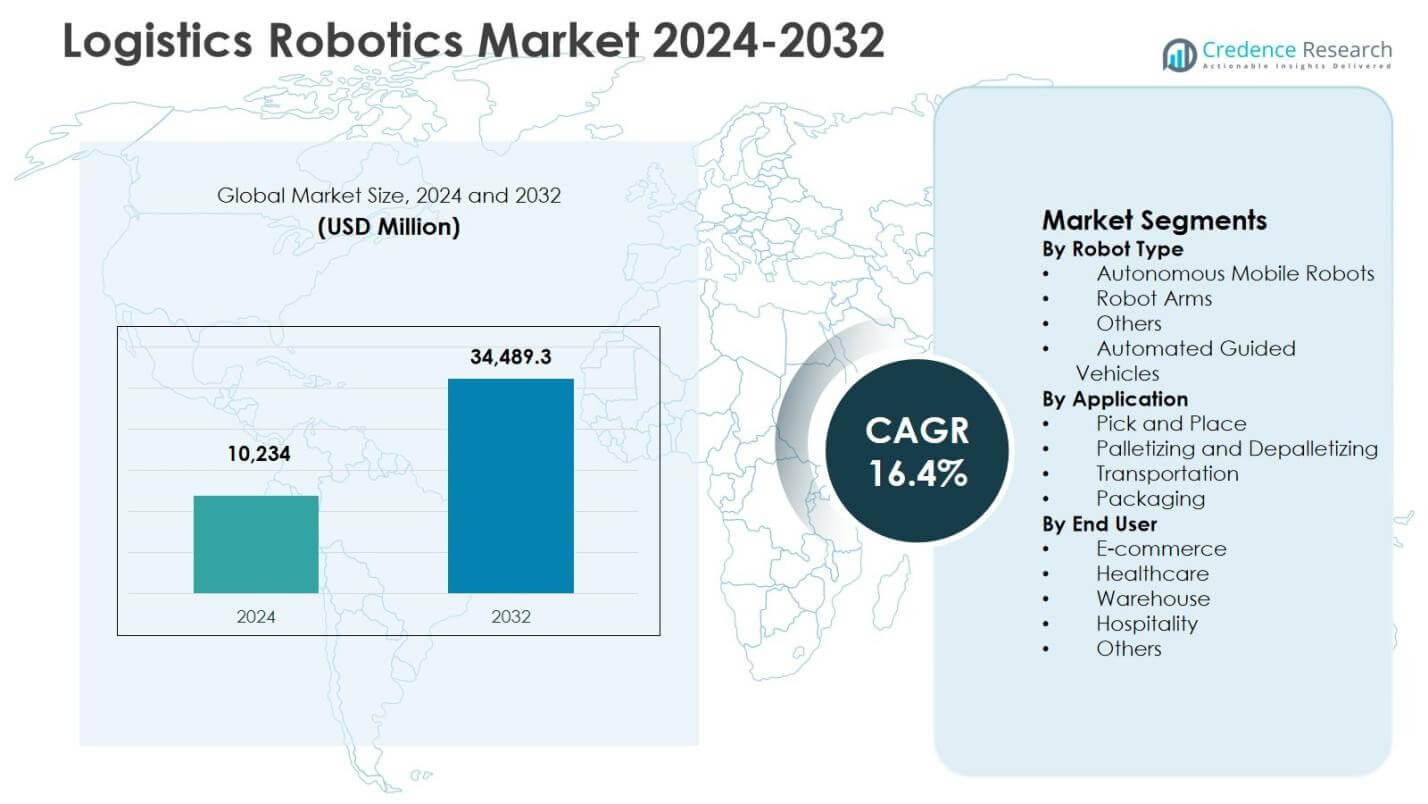
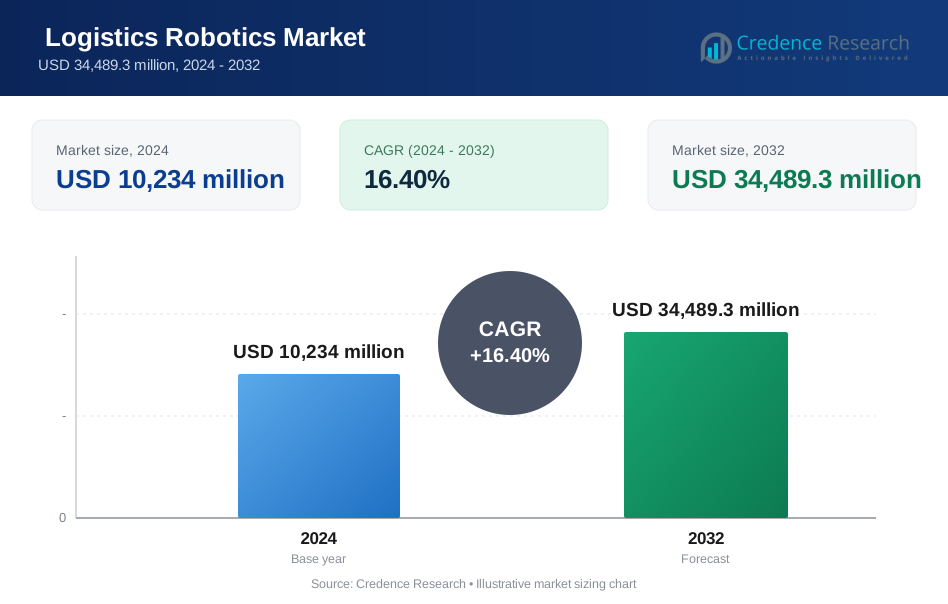
The Logistics Robotics Market size was valued at USD 10,234 million in 2024 and is anticipated to reach USD 34,489.3 million by 2032, at a CAGR of 16.4% during the forecast period.
| REPORT ATTRIBUTE | DETAILS |
|---|---|
| Historical Period | 2020-2023 |
| Base Year | 2024 |
| Forecast Period | 2025-2032 |
| Logistics Robotics Market Size 2024 | USD 10,234 million |
| Logistics Robotics Market , CAGR | 16.4% |
| Logistics Robotics Market Size 2032 | USD 34,489.3 million |
Logistics Robotics Market Insights
- Market growth is primarily driven by rapid expansion of e-commerce, labor shortages, rising workforce costs, and the need for faster order fulfillment, with Autonomous Mobile Robots leading the robot type segment at 42.6% share in 2024.
- Key market trends include increasing adoption of AMRs, integration of AI and machine vision, and growing use of robotics-as-a-service models, while the Transportation application segment dominated with a 37.8% share in 2024.
- Market restraints include high initial investment, system integration complexity, and workforce adaptation challenges, which continue to impact adoption among small and mid-sized logistics operators.
- Regionally, North America led with a 38.2% share in 2024, followed by Europe at 27.4% and Asia Pacific at 24.1%, while e-commerce emerged as the largest end-user segment with a 44.9% share.
Logistics Robotics Market Segmentation Analysis:
By Robot Type:
The Logistics Robotics Market by robot type is led by Autonomous Mobile Robots, which accounted for 42.6% market share in 2024, driven by their flexibility, scalability, and ability to operate in dynamic warehouse environments without fixed infrastructure. AMRs are widely adopted for order fulfillment, sorting, and internal logistics across large distribution centers. Automated Guided Vehicles held 28.4% share, supported by their reliability in repetitive transport tasks. Robot arms captured 19.1% share, driven by palletizing and picking automation, while others contributed 9.9%, reflecting niche and customized robotic solutions.
- For instance, Roche’s Elecsys pTau181 blood test, cleared by the FDA in 2025 as the first blood-based assay to help rule out Alzheimer’s-related amyloid pathology in primary care, enables minimally invasive assessment of neurodegenerative changes and supports earlier clinical decision-making.
By Application:
By application, Transportation dominated the Logistics Robotics Market with a 37.8% share in 2024, supported by rising demand for automated material movement within warehouses and fulfillment centers to improve throughput and reduce labor dependency. Pick and place followed with 26.3% share, driven by high-volume order processing in e-commerce and retail logistics. Palletizing and depalletizing accounted for 21.4% share, benefiting from growing adoption in bulk handling and distribution hubs. Packaging represented 14.5% share, supported by increasing automation in final-stage logistics operations.
- For instance, DHL has deployed fleets of autonomous mobile robots and solutions such as LocusBots in multiple facilities, enabling automated transport of totes and cartons between picking zones and packing stations and contributing to hundreds of millions of robot-assisted picks globally.
By End User:
Among end users, E-commerce emerged as the dominant segment with a 44.9% market share in 2024, driven by rapid growth in online retail, same-day delivery models, and high order variability requiring robotic automation. Warehouses accounted for 29.6% share, supported by investments in smart distribution centers and labor optimization. Healthcare held 11.8% share, driven by automated transport of medical supplies and pharmaceuticals. Hospitality contributed 7.1%, while others captured 6.6%, reflecting adoption in manufacturing logistics and third-party logistics providers.
Key Growth Drivers
Rapid Expansion of E-commerce and Omnichannel Fulfillment
The Logistics Robotics Market is significantly driven by the rapid expansion of e-commerce and omnichannel fulfillment models, which demand faster order processing, higher accuracy, and scalable logistics operations. Increasing online retail penetration, rising same-day and next-day delivery expectations, and growing SKU complexity are pushing logistics providers to adopt robotics for picking, sorting, and material movement. Robotics enables continuous operations, minimizes order cycle times, and improves fulfillment accuracy. The expansion of urban micro-fulfillment centers further strengthens demand for compact and flexible robotic systems across global logistics networks.
- For instance, Ocado's On Grid Robotic Pick (OGRP) system used AI-powered robotic arms to pick over 30 million items in 2024, extending picking hours for 24/7 operations and increasing throughput without expanding physical warehouse space.
Labor Shortages and Escalating Workforce Costs
Labor shortages and rising workforce costs are key drivers accelerating adoption in the Logistics Robotics Market. Warehousing and logistics operations face persistent challenges related to workforce availability, high employee turnover, and increasing wage pressures. Robotics helps address these issues by automating repetitive, physically demanding, and time-critical tasks such as transportation, palletizing, and picking. By reducing dependency on manual labor, logistics operators improve productivity, enhance workplace safety, and achieve consistent operational performance, making robotics a strategic investment across developed and emerging markets.
- For instance, DHL partnered with Locus Robotics to deploy autonomous mobile robots that doubled picker productivity by minimizing walking time in order fulfillment.
Advancements in Robotics, AI, and Sensor Technologies
Continuous advancements in robotics, artificial intelligence, machine vision, and sensor technologies are strongly driving market growth. Modern logistics robots offer intelligent navigation, real-time obstacle avoidance, adaptive routing, and seamless system interoperability. AI-enabled software improves fleet coordination, predictive maintenance, and workflow optimization, delivering higher operational efficiency. Declining hardware costs and improved software platforms have lowered adoption barriers, enabling broader deployment across warehouses, healthcare logistics, and hospitality operations, thereby expanding the addressable market.
Key Trends & Opportunities
Rising Adoption of Autonomous Mobile Robots
The increasing adoption of autonomous mobile robots represents a major trend shaping the Logistics Robotics Market. AMRs provide superior flexibility compared to fixed automation systems, allowing rapid deployment and easy scalability in dynamic warehouse environments. Their ability to collaborate safely with human workers supports hybrid automation models and improves operational agility. This trend creates strong opportunities for vendors offering modular robotic platforms, advanced fleet management software, and robotics-as-a-service solutions that align automation investments with evolving logistics demand.
- For instance, ICM A/S deployed three MiR1000 AMRs to transport pallets in its high-rise warehouse, replacing manual stackers and enabling close collaboration with high-reach trucks via tablet controls and audio signals.
Integration with Smart and Connected Warehouse Ecosystems
The integration of logistics robots with smart warehouse ecosystems presents a significant growth opportunity. Companies are increasingly combining robotics with warehouse management systems, IoT platforms, and advanced analytics to enable real-time visibility and data-driven decision-making. This integration supports optimized inventory management, automated workflow orchestration, and predictive demand planning. As digital transformation accelerates across logistics operations, demand is rising for interoperable and software-centric robotic solutions that seamlessly connect with enterprise infrastructure.
- For instance, Walmart partners with Symbotic to deploy AI-powered robotics across 42 regional distribution centers, integrated with software for high-density storage and retrieval. The system uses autonomous robots with vision systems to handle cases and totes at high speeds, enhancing inventory accuracy and workflow orchestration.
Key Challenges
High Initial Capital Investment and System Integration Complexity
High upfront investment remains a major challenge for the Logistics Robotics Market, particularly among small and mid-sized enterprises. Robotics deployment involves substantial costs related to hardware acquisition, software implementation, infrastructure upgrades, and system integration. Integrating robotic solutions with legacy warehouse systems often requires specialized expertise and extended implementation timelines. These factors can delay return on investment and create adoption hesitation, especially in cost-sensitive markets despite long-term efficiency benefits.
Workforce Adaptation and Operational Flexibility Constraints
Workforce adaptation and maintaining operational flexibility present ongoing challenges in logistics robotics adoption. Logistics environments frequently change due to seasonal demand fluctuations, layout modifications, and product mix variations, requiring robots to adapt quickly. At the same time, employees must be trained to manage, maintain, and collaborate with robotic systems. Skill gaps and resistance to automation can hinder deployment efficiency. Effective training programs and change-management strategies are essential to ensure successful long-term integration.
Regional Analysis
North America
North America accounted for 38.2% market share in 2024 in the Logistics Robotics Market, supported by early adoption of automation, strong e-commerce penetration, and large-scale warehouse infrastructure. The United States leads regional growth due to high investments in autonomous mobile robots, robotic arms, and AI-enabled fulfillment systems. Strong presence of major logistics providers, advanced supply chain digitization, and persistent labor shortages continue to accelerate robotics deployment. Additionally, rising demand for same-day delivery and expansion of micro-fulfillment centers are strengthening adoption across retail, healthcare logistics, and third-party logistics operations in the region.
Europe
Europe held 27.4% market share in 2024, driven by advanced manufacturing ecosystems, strong automation culture, and growing focus on warehouse efficiency. Countries such as Germany, the United Kingdom, and France are key contributors, supported by investments in smart warehouses and Industry 4.0 initiatives. Strict labor regulations and rising operational costs are pushing logistics operators toward robotic automation for transportation, palletizing, and picking operations. Growth is further supported by increasing cross-border e-commerce, sustainability-driven efficiency goals, and strong adoption across automotive, retail, and pharmaceutical logistics sectors.
Asia Pacific
Asia Pacific captured 24.1% market share in 2024 and is the fastest-growing region in the Logistics Robotics Market. Rapid expansion of e-commerce, large-scale warehouse development, and rising labor costs in countries such as China, Japan, and South Korea are driving adoption. Strong domestic manufacturing of robotics and aggressive automation investments by logistics providers support regional growth. Increasing urbanization, expanding retail logistics networks, and government initiatives promoting smart logistics infrastructure are further strengthening demand for autonomous mobile robots and automated guided vehicles across high-volume distribution environments.
Latin America
Latin America accounted for 6.1% market share in 2024, supported by gradual modernization of logistics infrastructure and growing regional e-commerce activity. Brazil and Mexico are key markets, driven by investments in distribution centers and adoption of robotics for material handling and transportation tasks. Although adoption remains lower than developed regions, rising labor inefficiencies, increasing warehouse scale, and growing interest from multinational logistics providers are encouraging automation investments. Improvements in supply chain digitalization and expanding third-party logistics services are expected to steadily enhance robotics penetration across the region.
Middle East & Africa
The Middle East & Africa region held 4.2% market share in 2024, supported by growing investments in logistics hubs and warehouse automation. Countries such as the United Arab Emirates and Saudi Arabia are leading adoption, driven by expansion of e-commerce, smart city initiatives, and diversification of non-oil economies. Robotics adoption is increasing in large distribution centers, ports, and airport logistics operations. While infrastructure gaps limit growth in parts of Africa, rising regional trade activity and government-backed logistics modernization programs continue to create long-term growth opportunities.
Logistics Robotics Market Segmentations:
By Robot Type
- Autonomous Mobile Robots
- Robot Arms
- Others
- Automated Guided Vehicles
By Application
- Pick and Place
- Palletizing and Depalletizing
- Transportation
- Packaging
By End User
- E-commerce
- Healthcare
- Warehouse
- Hospitality
- Others
By Geography
- North America
- U.S.
- Canada
- Mexico
- Europe
- Germany
- France
- U.K.
- Italy
- Spain
- Rest of Europe
- Asia Pacific
- China
- Japan
- India
- South Korea
- South-east Asia
- Rest of Asia Pacific
- Latin America
- Brazil
- Argentina
- Rest of Latin America
- Middle East & Africa
- GCC Countries
- South Africa
- Rest of the Middle East and Africa
Competitive Landscape
Competitive landscape analysis of the Logistics Robotics Market features key players such as ABB Ltd, KUKA AG, Toyota Industries Corporation, Fanuc Corporation, Yaskawa Electric Corporation, Kion Group AG, Omron Corporation, and Kawasaki Heavy Industries Ltd.. The market is characterized by strong competition focused on technological innovation, system integration, and expansion of autonomous mobile robot portfolios. Leading companies emphasize AI-driven navigation, fleet management software, and modular robotic platforms to address diverse warehouse and fulfillment needs. Strategic partnerships with e-commerce players, logistics service providers, and warehouse automation integrators remain central to market positioning. Continuous investments in R&D, expansion of regional manufacturing footprints, and service-based deployment models are strengthening customer adoption. As demand for scalable and flexible automation rises, competition increasingly centers on software capabilities, deployment speed, and lifecycle service offerings.
Key Player Analysis
- Kion Group AG
- Fanuc Corporation
- Omron Corporation
- Toyota Industries Corporation
- Krones AG
- ABB Ltd
- Kawasaki Heavy Industries Ltd.
- Yaskawa Electric Corporation
- Toshiba Corporation
- KUKA AG
Recent Developments
- In May 2025, DHL Group signed a strategic Memorandum of Understanding (MOU) with Boston Dynamics to deploy over 1,000 additional robotic units across its operations, strengthening robotics integration in logistics and fulfillment services.
- In February 2025, KUKA AG partnered with Dassault Systèmes to integrate the 3DEXPERIENCE platform into KUKA’s digital ecosystem, enhancing robotics and automation efficiency for manufacturers and logistics applications.
- In February 2025, Locus Robotics entered a strategic partnership with BITO Lagertechnik to integrate AI-driven autonomous mobile robots with storage systems for optimized warehouse processes.
- In November 2024, JD Logistics introduced its "Zhilang" automated warehousing solution at CeMAT ASIA 2024, designed to improve picking efficiency by over three times compared to traditional methods.
Report Coverage
The research report offers an in-depth analysis based on Robot Type, Application, End User and Geography. It details leading market players, providing an overview of their business, product offerings, investments, revenue streams, and key applications. Additionally, the report includes insights into the competitive environment, SWOT analysis, current market trends, as well as the primary drivers and constraints. Furthermore, it discusses various factors that have driven market expansion in recent years. The report also explores market dynamics, regulatory scenarios, and technological advancements that are shaping the industry. It assesses the impact of external factors and global economic changes on market growth. Lastly, it provides strategic recommendations for new entrants and established companies to navigate the complexities of the market.
Future Outlook
- The Logistics Robotics Market will witness accelerated adoption driven by expanding e-commerce fulfillment and high-volume order processing requirements.
- Autonomous mobile robots will gain wider deployment due to their flexibility, scalability, and ease of integration within dynamic warehouse environments.
- Artificial intelligence and machine learning will play a greater role in navigation, task optimization, and predictive maintenance across robotic fleets.
- Robotics-as-a-service models will increase adoption among small and mid-sized logistics operators by lowering entry barriers.
- Integration with warehouse management systems and digital platforms will enhance end-to-end supply chain visibility and efficiency.
- Labor shortages and rising workforce costs will continue to strengthen the business case for logistics automation.
- Demand for collaborative robots will grow as operators adopt human-robot hybrid workflows to improve productivity and safety.
- Expansion of micro-fulfillment centers will drive demand for compact and high-speed robotic solutions.
- Emerging economies will experience rising adoption as logistics infrastructure modernizes and automation awareness increases.
- Continuous innovation in software, sensors, and energy-efficient designs will improve operational reliability and return on investment.
Request a Free Sample
Fill in your details and we'll send you a free sample report.
- Sample data tables & charts
- Research methodology
Need a Custom Version of This Report?
Tailor the scope, geography, or segments to your exact requirements.
- Custom geography or segment scope
- Direct access to our analyst team
Frequently Asked Questions
What is the current market size for the Logistics Robotics Market, and what is its projected size in 2032?
At what Compound Annual Growth Rate is the Logistics Robotics Market projected to grow between 2024 and 2032?
Who are the major players in the Logistics Robots Market?
What are the primary factors fueling the growth of the Logistics Robotics Market?
Who are the leading companies in the Logistics Robotics Market?
Which region commanded the largest share of the Logistics Robotics Market in 2024?
Table of Content
Chapter 1. Report Introduction
- 1.1 Report Description & Purpose
- 1.1.1 Report Title & Market Definition
- 1.1.2 Unique Selling Propositions (USP) & Key Differentiators
- 1.1.3 Value Proposition for Stakeholders
- 1.2 Research Objectives
- 1.2.1 Market Sizing Objectives (Volume & Revenue)
- 1.2.2 Segmentation Objectives
- 1.2.3 Competitive Intelligence Objectives
- 1.2.4 Forecast & Scenario Objectives
- 1.3 Report Scope
- 1.3.1 Logistics Robotics Scope – Types & Subtypes Covered
- 1.3.2 Geographic Scope – Regions & Countries Covered
- 1.3.3 Historical Period, Base Year & Forecast Period (2024; forecast to 2032)
- 1.3.4 Inclusions & Exclusions
- 1.4 HS Code & Classification Framework
- 1.5 Currency, Units & Pricing Basis
- 1.6 Target Stakeholders
- 1.7 Limitations & Assumptions
Chapter 2. Executive Summary
- 2.1 Global Logistics Robotics Market Snapshot
- 2.1.1 Market Size – Historical (2024) & Forecast (2024-2032) (2024: USD 10,234 million → 2032: USD 34,489.3 million)
- 2.1.2 Volume & Revenue – Global Totals
- 2.1.3 Key Market Highlights – Top Five Facts
- 2.2 Logistics Robotics Market Segmentation Snapshot
- 2.2.1 Market Split by Region – 2024 vs. 2032
- 2.3 Competitive Snapshot
- 2.3.1 Top 10 Players by Revenue Share – 2024
- 2.3.2 Top 10 Players by Volume Share – 2024
- 2.3.3 Recent Strategic Developments (18-Month Summary)
- 2.4 Key Investment Highlights & Strategic Conclusions
Chapter 3. Logistics Robotics Market Dynamics & Industry Analysis
- 3.1 Market Overview & Context
- 3.1.1 Logistics Robotics Market Position in the Broader Automotive Value Chain
- 3.1.2 OEM vs. Replacement Market Dynamics
- 3.1.3 Market Maturity & Development Stage by Region
- 3.2 Logistics Robotics Market Drivers
- 3.3 Logistics Robotics Market Restraints & Challenges
- 3.4 Logistics Robotics Market Opportunities
- 3.5 Porter's Five Forces Analysis
- 3.5.1 Threat of New Entrants
- 3.5.2 Bargaining Power of Suppliers
- 3.5.3 Bargaining Power of Buyers
- 3.5.4 Threat of Substitutes
- 3.5.5 Competitive Rivalry – Intensity Assessment
- 3.6 Logistics Robotics Value Chain Analysis
- 3.6.1 Upstream – Raw Material/Input Suppliers
- 3.6.1.1 Raw Material/Input 1
- 3.6.1.2 Raw Material/Input 2
- 3.6.1.3 Raw Material/Input 3
- 3.6.2 Midstream – Production/Manufacturing/Service Delivery
- 3.6.2.1 Production/Process Overview
- 3.6.2.2 Key Facility Locations & Capacity by Manufacturer
- 3.6.3 Downstream – Distribution & End Consumer
- 3.6.3.1 Primary Channel – B2B/OEM
- 3.6.3.2 Secondary Channels – Dealer, Retail, Online, Direct
- 3.6.4 Value Chain Profitability Analysis
- 3.6.1 Upstream – Raw Material/Input Suppliers
- 3.7 PESTEL Analysis
- 3.7.1 Political Factors
- 3.7.2 Economic Factors
- 3.7.3 Social Factors
- 3.7.4 Technological Factors
- 3.7.5 Environmental Factors
- 3.7.6 Legal Factors
- 3.8 Logistics Robotics Supply Chain Analysis
- 3.8.1 Raw Material/Input Supply Risk Assessment
- 3.8.2 Manufacturing Concentration Risk (Geographic Exposure)
- 3.8.3 Trade Disruption Impact Analysis
- 3.9 Regulatory & Policy Landscape
Note: The regulatory and policy landscape section covers regulations based on their applicability to the market, Logistics Robotics category, geography, and scope of the study. Only regulatory frameworks with a material impact on operations, compliance, trade, sustainability, or market access are analyzed in detail.
Chapter 4. Key Investment Pockets & Opportunity Analysis
- 4.1 Logistics Robotics Market Attractiveness Analysis
- 4.1.1 By Region – Investment Attractiveness Matrix (Volume × CAGR)
- 4.2 Absolute Revenue Growth Opportunity
- 4.2.1 By Region – Absolute USD Growth Through 2032
- 4.3 Incremental Volume Opportunity
- 4.3.1 By Region – Incremental Volume Through 2032
- 4.3.2 Segment – Incremental Volume
- 4.4 Emerging Submarket Opportunity Deep Dive (Subject to Applicability)
- 4.5 Emerging Market Opportunity Scorecards
- 4.5.1 United States
- 4.5.2 Europe
- 4.5.3 Asia
- 4.5.4 Middle East & Africa
Note: Emerging Market Opportunity Scorecards will be included based on relevance and strategic importance. Regions listed are indicative and may vary depending on data availability and market dynamics.
Chapter 5. Logistics Robotics Import-Export Analysis & Trade Flows
- 5.1 Global Trade Overview
- 5.1.1 Global Export Value by Country (2024)
- 5.1.2 Global Export Volume by Country (2024)
- 5.1.3 Global Import Value by Country (2024)
- 5.1.4 Global Import Volume by Country (2024)
- 5.1.5 Net Trade Balance by Country (2024)
- 5.2 Export Analysis – Segment
- 5.2.1 Type 1 (HS Code)
- 5.2.2 Type 2 (HS Code)
- 5.2.3 Type 3 (HS Code)
- 5.2.4 Type 4 (HS Code)
- 5.2.5 Type 5 (HS Code)
- 5.3 Import Analysis – Segment
- 5.3.1 Type 1 (HS Code)
- 5.3.2 Type 2 (HS Code)
- 5.3.3 Type 3 (HS Code)
- 5.3.4 Type 4 (HS Code)
- 5.3.5 Type 5 (HS Code)
- 5.4 Average Unit Trade Prices
- 5.4.1 Average Export Price – Segment & Country
- 5.4.2 Average Import Price – Segment & Source Country
- 5.4.3 Price Trends (2024)
- 5.5 Key Trade Route Analysis
- 5.5.1 Trade Route 1
- 5.5.2 Trade Route 2
- 5.5.3 Trade Route 3
- 5.5.4 Trade Route 4
- 5.5.5 Trade Route 5
- 5.6 Trade Policy Impact Assessment
- 5.6.1 US Anti-Dumping & Section 301 Tariffs
- 5.6.2 EU Customs Union Impact
- 5.6.3 Major Free Trade Agreements
- 5.6.4 USMCA Rules of Origin
Note: Trade policy analysis will be included only where relevant to the Logistics Robotics market.
Chapter 6. Competitive Landscape & Company Benchmarking
- 6.1 Logistics Robotics Market Concentration & Structure
- 6.1.1 Herfindahl-Hirschman Index (HHI) – vs. 2024
- 6.1.2 Tier 1, Tier 2 & Tier 3 Market Structure
- 6.1.3 Global, Regional & Local Player Dynamics
- 6.2 Logistics Robotics Market Share Analysis – 2024
- 6.2.1 Global Revenue Share by Company
- 6.2.2 Global Volume Share by Company
- 6.2.3 Regional Revenue Share
- 6.2.4 Market Share Evolution ( vs. 2024)
- 6.2.5 OEM Segment Share by Company
- 6.2.6 Replacement Segment Share by Company
- 6.3 Production/Delivery Capacity & Facility Analysis
- 6.3.1 Global Installed Capacity
- 6.3.2 Capacity Utilization Rates
- 6.3.3 Production/Output Volume
- 6.3.4 Facility Locations & Capacity Map
- 6.3.5 Planned Capacity Additions
- 6.4 Logistics Robotics Competitive Benchmarking Matrix
- 6.4.1 Revenue, Volume, CAGR & Profitability Comparison
- 6.4.2 Channel Revenue Mix
- 6.4.3 Geographic Revenue Exposure
- 6.4.4 R&D Intensity
- 6.4.5 Sustainability Maturity
- 6.5 Strategic Developments in Logistics Robotics (Last 24 Months)
- 6.5.1 Mergers, Acquisitions & Divestments
- 6.5.2 New Logistics Robotics Launches
- 6.5.3 Facility Expansions
- 6.5.4 Strategic Alliances, Joint Ventures & Partnerships
- 6.5.5 Distribution Expansion & Market Entry
- 6.5.6 Sustainability & ESG Initiatives
- 6.6 Competitive Strategy Mapping
- 6.6.1 Leader, Challenger, Follower & Niche Classification
- 6.6.2 Pricing Strategy Comparison
- 6.6.3 Channel Strategy Matrix
Note: Strategic developments are included based on their materiality and the availability of reliable information.
Chapter 7. Global Logistics Robotics Market – By Distribution Channel
- 7.1 Segment Overview
- 7.1.1 Volume & Revenue Split by Channel (2024 & 2032)
- 7.1.2 Channel Mix Evolution (2024-2032)
Chapter 8. Regional Market Analysis – Global Overview
- 8.1 Global Regional Overview
- 8.1.1 Regional Volume Share
- 8.1.2 Regional Revenue Share
- 8.1.3 Regional Volume by Region
- 8.1.4 Regional Revenue by Region
- 8.1.5 Regional Forecast Through 2032
- 8.2 Cross-Regional Segment Analysis
- 8.2.1 By Distribution Channel
- 8.2.2 By Brand/Price Tier
Chapter 9. North America Logistics Robotics Market
- 9.1 United States
- 9.2 Canada
- 9.3 Mexico
Chapter 10. Europe Logistics Robotics Market
- 10.1 Germany
- 10.2 France
- 10.3 Italy
- 10.4 United Kingdom
- 10.5 Spain
- 10.6 Poland
- 10.7 Russia
- 10.8 Netherlands
- 10.9 Belgium
- 10.10 Sweden
- 10.11 Denmark
- 10.12 Norway
- 10.13 Rest of Europe
Chapter 11. Asia Pacific Logistics Robotics Market
- 11.1 China
- 11.2 India
- 11.3 Japan
- 11.4 South Korea
- 11.5 Thailand
- 11.6 Indonesia
- 11.7 Vietnam
- 11.8 Malaysia
- 11.9 Australia
- 11.10 Rest of Asia Pacific
Chapter 12. Latin America Logistics Robotics Market
- 12.1 Brazil
- 12.2 Argentina
- 12.3 Colombia
- 12.4 Chile
- 12.5 Rest of Latin America
Chapter 13. Middle East Logistics Robotics Market
- 13.1 Saudi Arabia
- 13.2 United Arab Emirates
- 13.3 Turkey
- 13.4 Israel
- 13.5 Iran
- 13.6 Rest of the Middle East
Chapter 14. Africa Logistics Robotics Market
- 14.1 South Africa
- 14.2 Egypt
- 14.3 Nigeria
- 14.4 Morocco
- 14.5 Rest of Africa
Chapter 15. Logistics Robotics Company Profiles
- 15.1 [Company 01]
- 15.1.1 Company Overview
- 15.1.2 Key Management Personnel
- 15.1.3 Products & Services Portfolio
- 15.1.4 Financial Performance
- 15.1.5 Key Market Focus & Geographic Presence
- 15.1.6 Recent Developments & Strategic Initiatives
Note: The company profile list is preliminary and may change based on research findings, market developments, data availability, and client requirements.
Chapter 16. Appendices
- Appendix A – List of Abbreviations & Acronyms
- Appendix B – Industry Classification Code Reference – Full Series
- Appendix C – Production & Capacity Data Tables
- Appendix D – End-Use & Demand Base Tables
- Appendix E – Consumption & Replacement Rate Assumptions
- Appendix F – ASP Reference Tables
- Appendix G – Manufacturing & Facility Database
- Appendix H – Import-Export Data Tables
- Appendix I – Regulatory Summary Tables
- Appendix J – Primary Research Participant List (Anonymized)
- Appendix K – Primary Research Questionnaire Framework
- Appendix L – Data Sources & Bibliography
- Appendix M – Market Size Divergence & Source Comparison
Chapter 17. Research Methodology
- 17.1 Research Framework & Philosophy
- 17.2 Secondary Research – Sources, Hierarchy & Data Extraction
- 17.3 Data Modeling – Bottom-Up & Top-Down Market Sizing
- 17.4 Primary Research – Stakeholder Framework, LOI & Sample Sizes
- 17.5 Forecast Methodology – Regression, Scenario & Sensitivity Analysis
- 17.6 Quality Control – Four-Layer Validation Framework
- 17.7 Limitations & Standard Assumptions
- 17.8 Disclaimer
