
Market Overview
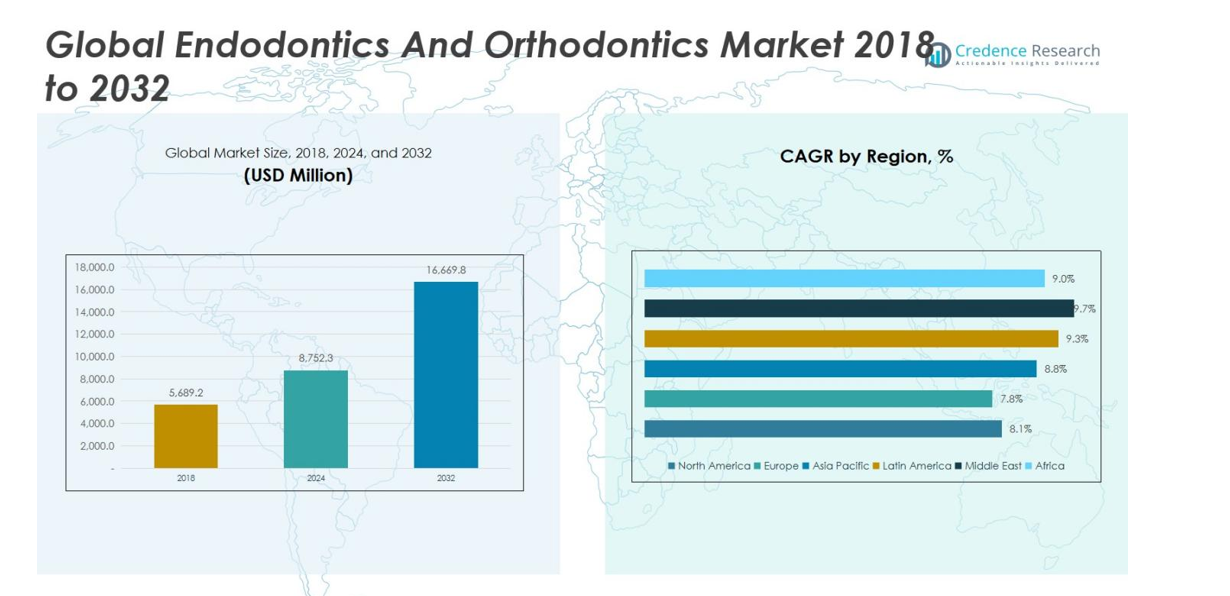
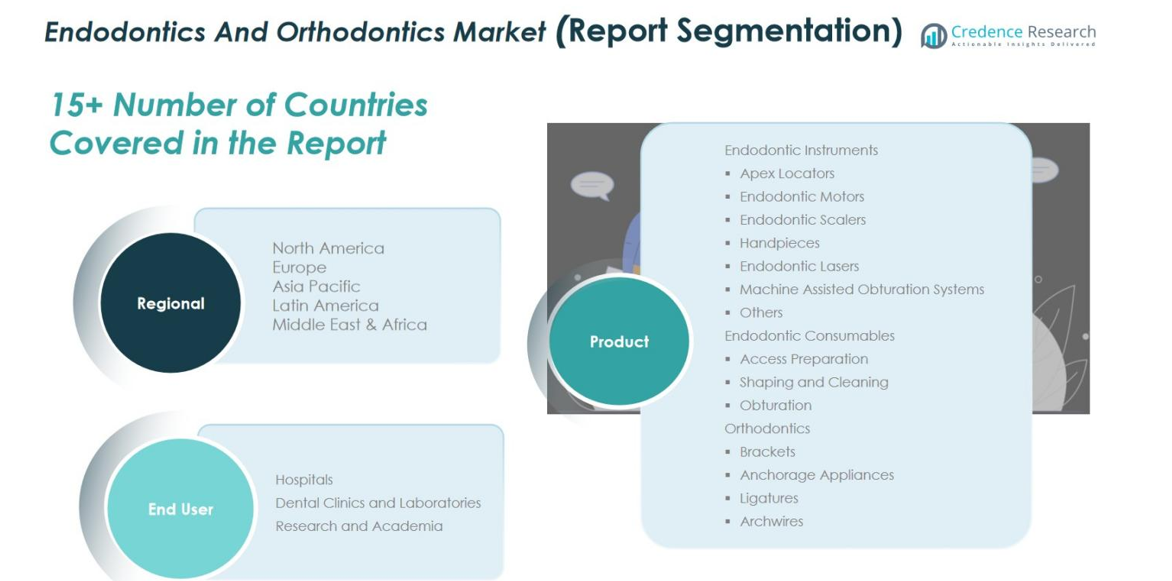
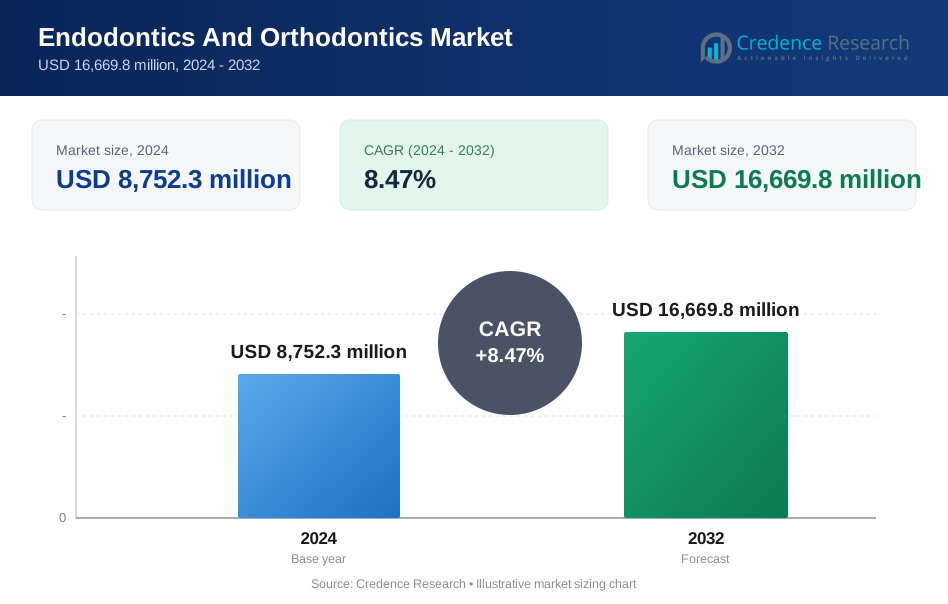
The Global Endodontics and Orthodontics Market size was valued at USD 5,689.2 million in 2018, increased to USD 8,752.3 million in 2024, and is anticipated to reach USD 16,669.8 million by 2032, growing at a CAGR of 8.47% during the forecast period.
| REPORT ATTRIBUTE | DETAILS |
|---|---|
| Historical Period | 2020-2023 |
| Base Year | 2024 |
| Forecast Period | 2025-2032 |
| Endodontics and Orthodontics Market Size 2024 | USD 8,752.3 million |
| Endodontics and Orthodontics Market, CAGR | 8.47% |
| Endodontics and Orthodontics Market Size 2032 | USD 16,669.8 million |
The Global Endodontics and Orthodontics Market is driven by prominent players such as Danaher Corporation, Dentsply Sirona, FKG Dentaire SA, Ultradent Products Inc., Ivoclar Vivadent AG, Brasseler Holdings LLC, TP Orthodontics Inc., DB Orthodontics Ltd., and Align Technology Inc. These companies emphasize innovation, digital integration, and advanced material development to enhance treatment precision and patient outcomes. Strategic partnerships, product diversification, and regional expansion remain key competitive strategies. North America emerged as the leading region in 2024, capturing a 34.4% market share, supported by robust dental infrastructure, early adoption of digital technologies, and strong consumer demand for aesthetic and restorative dental care solutions.
Market Insights
- The Global Endodontics and Orthodontics Market was valued at USD 8,752.3 million in 2024 and is projected to reach USD 16,669.8 million by 2032, expanding at a CAGR of 8.47% during the forecast period.
- Growing prevalence of dental disorders, increased focus on aesthetic dentistry, and advancements in digital dental technologies such as AI-assisted imaging and 3D printing are driving market expansion.
- The market is witnessing strong trends toward minimally invasive procedures, adoption of clear aligners, and integration of smart endodontic systems, enhancing clinical efficiency and patient comfort.
- The competitive landscape includes key players such as Danaher Corporation, Dentsply Sirona, Ivoclar Vivadent AG, and Align Technology Inc., focusing on product innovation, mergers, and regional market penetration.
- Regionally, North America led with a 34.4% share in 2024, followed by Europe with 26.4% and Asia Pacific with 28.1%, while the Endodontic Instruments segment dominated with a 42.6% share.
Market Segmentation Analysis:
By Product
The Endodontic Instruments segment dominated the Global Endodontics and Orthodontics Market with a 42.6% share in 2024, driven by technological advancements and growing demand for precision-based dental procedures. Within this category, endodontic motors emerged as the leading sub-segment, capturing 25.3% of the share due to their enhanced torque control, efficiency, and compatibility with digital systems. Increasing use of apex locators and endodontic lasers further supports the trend toward minimally invasive and time-efficient treatments, strengthening adoption across clinics and hospitals globally.
- For instance, Dentsply Sirona’s X-Smart IQ motor, equipped with Bluetooth connectivity and real-time torque adjustment, has improved treatment precision and reduced chair time.
By End User
Based on end user, the market is categorized into symmetrical and asymmetrical, with the symmetrical segment accounting for the dominant 61.4% share in 2024. This growth is attributed to the rising preference for balanced occlusal treatments, better alignment outcomes, and growing utilization in corrective dental procedures. Dental practitioners favor symmetrical systems due to their precision, uniform pressure distribution, and patient comfort. The asymmetrical segment, while smaller, is expected to gain traction due to customized orthodontic solutions and specialized treatment needs.
- For instance, 3M’s Clarity Aligners are designed to ensure even force distribution, supporting effective and consistent tooth alignment.
Key Growth Drivers
Advancements in Dental Technology
Rapid technological progress in dental care is a major growth driver for the Global Endodontics and Orthodontics Market. Innovations such as AI-assisted imaging, 3D printing, and digital workflow integration enhance treatment precision and patient outcomes. The introduction of smart endodontic motors, advanced laser systems, and self-ligating brackets has improved procedural efficiency and reduced treatment duration. These advancements are increasing adoption among dental professionals and driving consistent demand across both developed and emerging markets, strengthening the overall market expansion.
- For instance, Overjet has developed AI-assisted imaging that overlays intelligent analysis onto dental X-rays in real-time, enabling faster and more accurate detection of caries and bone loss, which supports better diagnosis and treatment planning.
Rising Prevalence of Dental Disorders
The growing incidence of dental caries, pulp infections, and malocclusion disorders significantly fuels market growth. Poor dietary habits, aging populations, and increasing awareness of oral health have led to higher demand for root canal and orthodontic treatments. Moreover, the expanding base of patients seeking corrective and aesthetic dental procedures contributes to rising adoption of endodontic consumables and orthodontic appliances. This growing clinical need encourages investments in advanced dental solutions, boosting overall market revenue.
Increasing Focus on Aesthetic Dentistry
The surging demand for aesthetic and restorative dental care has emerged as a strong driver for market growth. Consumers increasingly prioritize dental appearance, leading to higher adoption of cosmetic orthodontics and endodontic restorations. Clear aligners, invisible brackets, and natural-looking crowns are gaining popularity among adults and young professionals. The trend toward minimally invasive and visually appealing dental treatments supports the integration of modern technologies and materials, creating lucrative opportunities for manufacturers and dental service providers globally.
- For instance, Straumann’s Roxolid dental implants, designed to preserve bone and achieve natural tooth-like results, exemplify how material innovation enhances both function and appearance in restorative dentistry.
Key Trends & Opportunities
Adoption of Digital Dentistry and AI Solutions
The integration of digital technologies such as CAD/CAM, 3D imaging, and artificial intelligence is transforming the Endodontics and Orthodontics Market. Digital workflows enable precise diagnosis, personalized treatment planning, and efficient appliance fabrication. AI-powered diagnostic tools assist clinicians in detecting pathologies and predicting treatment outcomes with higher accuracy. This digital shift enhances patient experience, reduces chair time, and supports sustainable clinical practices, presenting significant growth opportunities for technology-driven dental manufacturers.
- For instance, LuxCreo partnered with Evident to enable dental clinics to produce same-day resin veneers, reducing patient appointments from 4-7 weeks to a single visit while enhancing aesthetics and fit.
Expanding Dental Care Infrastructure in Emerging Markets
Emerging economies in Asia-Pacific and Latin America present untapped potential due to rising healthcare investments and improving access to dental services. Governments and private sectors are investing in modern dental facilities, promoting preventive care, and increasing awareness of oral hygiene. Expanding dental tourism, particularly in countries like India, Thailand, and Mexico, further supports market expansion. The availability of affordable treatment options and skilled practitioners makes these regions attractive destinations for global dental device manufacturers.
- For instance, Dentsply Sirona has expanded its product offerings and established regional distribution hubs in India and Southeast Asia to support growing dental clinics with advanced diagnostic and treatment equipment.
Key Challenges
High Cost of Advanced Dental Equipment
The high cost associated with endodontic and orthodontic instruments, especially advanced digital systems and laser technologies, remains a major market restraint. Small and medium-sized dental clinics in developing regions often face financial constraints in adopting these innovations. Additionally, maintenance and training costs further increase the overall expenditure. This limits the penetration of advanced equipment, particularly in cost-sensitive markets, and creates barriers to large-scale implementation of modern dental technologies.
Shortage of Skilled Dental Professionals
The global shortage of skilled endodontists and orthodontists poses a significant challenge to market growth. Many regions, particularly in low- and middle-income countries, face an uneven distribution of qualified dental practitioners, leading to limited access to specialized care. This skills gap hinders the adoption of complex technologies and delays patient treatment. Addressing this challenge requires enhanced dental education programs, training in digital tools, and international collaboration to strengthen the professional workforce in the dental sector.
Regional Analysis
North America
North America dominated the Global Endodontics and Orthodontics Market, accounting for a 34.4% market share in 2024, valued at USD 2,889.76 million, up from USD 1,921.81 million in 2018. The region is projected to reach USD 5,334.35 million by 2032, expanding at a CAGR of 8.1%. Market growth is driven by advanced dental infrastructure, strong presence of leading manufacturers, and early adoption of digital dentistry. Increasing demand for aesthetic orthodontic treatments, coupled with a rise in oral care awareness and high healthcare spending, continues to strengthen the region’s dominant position globally.
Europe
Europe held a significant 26.4% share of the global market in 2024, valued at USD 1,843.23 million, growing from USD 1,239.11 million in 2018, and is expected to reach USD 3,350.64 million by 2032 at a CAGR of 7.8%. Growth in this region is supported by strong public healthcare systems, an aging population, and increasing adoption of advanced endodontic and orthodontic technologies. Countries such as Germany, the UK, and France lead the market due to their high dental care standards and continuous investments in modern clinical equipment and orthodontic innovations.
Asia Pacific
The Asia Pacific region is emerging as the fastest-growing market, holding a 28.1% share in 2024, with a market value of USD 2,462.39 million, up from USD 1,567.94 million in 2018. It is projected to reach USD 4,817.59 million by 2032, registering a robust CAGR of 8.8%. Rapid urbanization, rising disposable incomes, and growing awareness of dental aesthetics are key growth drivers. Expanding dental tourism in countries such as India, Thailand, and South Korea, along with government initiatives to improve healthcare infrastructure, further boost the market outlook across the region.
Latin America
Latin America accounted for a 10.2% market share in 2024, valued at USD 889.48 million, rising from USD 550.14 million in 2018, and is forecasted to reach USD 1,803.68 million by 2032 with a CAGR of 9.3%. Market growth is fueled by improving healthcare access, increasing dental awareness, and expanding cosmetic dentistry demand. Brazil and Mexico dominate regional revenue due to their well-established dental care industries and growing medical tourism. The region’s investments in modern dental technologies and professional training are also contributing to sustained growth momentum.
Middle East
The Middle East region captured a 5.4% market share in 2024, valued at USD 408.36 million, up from USD 246.91 million in 2018, and is expected to reach USD 850.16 million by 2032, growing at a CAGR of 9.7%. Expansion is driven by increasing adoption of advanced dental equipment, growing cosmetic dentistry trends, and the rapid modernization of healthcare infrastructure, particularly in GCC countries. Rising awareness of oral health, higher income levels, and strategic collaborations with global dental technology providers are strengthening the regional market’s future potential.
Africa
Africa held a 3.5% market share in 2024, valued at USD 259.07 million, up from USD 163.28 million in 2018, and is projected to reach USD 513.43 million by 2032, expanding at a CAGR of 9.0%. Market growth is supported by an improving healthcare landscape, growing focus on preventive dental care, and increasing government initiatives for oral health awareness. South Africa leads the regional market, followed by Egypt, due to the presence of trained dental professionals and expanding private healthcare facilities. Rising affordability of dental services further enhances the regional market outlook.
Market Segmentations:
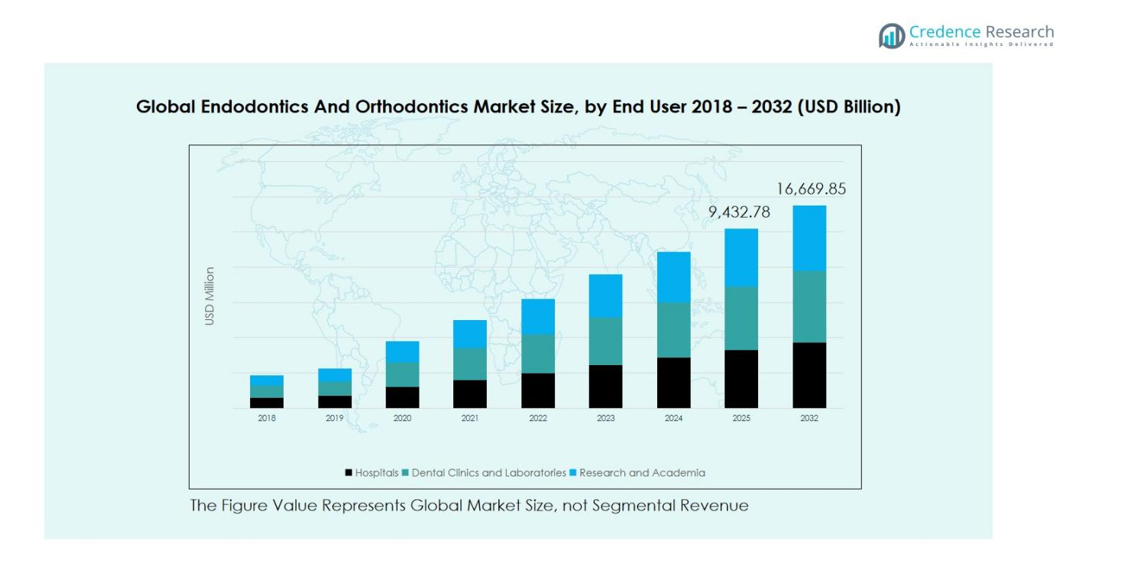
By Product
Endodontic Instruments
- Apex Locators
- Endodontic Motors
- Endodontic Scalers
- Handpieces
- Endodontic Lasers
- Machine Assisted Obturation Systems
- Others
Endodontic Consumables
- Access Preparation
- Shaping and Cleaning
- Obturation
Orthodontics
- Brackets
- Anchorage Appliances
- Ligatures
- Archwires
By End User
- Symmetrical
- Asymmetrical
By Region
- North America
- U.S.
- Canada
- Mexico
- Europe
- Germany
- France
- U.K.
- Italy
- Spain
- Rest of Europe
- Asia Pacific
- China
- Japan
- India
- South Korea
- South-east Asia
- Rest of Asia Pacific
- Latin America
- Brazil
- Argentina
- Rest of Latin America
- Middle East & Africa
- GCC Countries
- South Africa
- Rest of the Middle East and Africa
Competitive Landscape
The competitive landscape of the Global Endodontics and Orthodontics Market is characterized by the presence of major players such as Danaher Corporation, Dentsply Sirona, FKG Dentaire SA, Ultradent Products Inc., Ivoclar Vivadent AG, Brasseler Holdings LLC, TP Orthodontics Inc., DB Orthodontics Ltd., and Align Technology Inc. These companies focus on innovation, strategic mergers, and technological advancements to strengthen their global footprint. Market leaders are increasingly investing in digital dentistry solutions, including 3D imaging, AI-based diagnostics, and CAD/CAM systems, to enhance treatment precision and patient outcomes. Product diversification, strong distribution networks, and R&D investments remain key competitive strategies. Additionally, companies are expanding their presence in emerging markets through collaborations and localized manufacturing. The rising demand for aesthetic and minimally invasive treatments continues to drive competition, encouraging players to develop cost-effective, high-performance instruments and consumables tailored to both clinical and cosmetic dental applications.
Key Player Analysis
- Danaher Corporation
- Dentsply Sirona
- FKG Dentaire SA
- Ultradent Products, Inc.
- Ivoclar Vivadent AG
- Brasseler Holdings LLC
- TP Orthodontics, Inc.
- DB Orthodontics Ltd.
- Align Technology, Inc.
- Other Key Players
Recent Developments
- In July 2025, Mikrona Group AG (Switzerland) acquired FTC Frey Trading & Consulting Sàrl (FTC Dental) and its associated online training platform to expand its digital and clinical orthodontic solutions portfolio.
- In September 2025, Dentsply Sirona introduced two advanced endodontic sealers ProRoot® Bio Sealer and AH Plus® Ribbon aimed at improving root canal treatment precision and biocompatibility.
- In June 2025, Align Technology announced funding for 12 global university research projects through its Annual Research Award Program to advance innovations in clear-aligner therapy and digital orthodontics
- In July 2025, Mikrona Group AG acquired FTC Frey Trading & Consulting Sàrl (FTC Dental) and its online training platform, enhancing its orthodontic solutions and digital education offerings.
Report Coverage
The research report offers an in-depth analysis based on Product, End User and Region. It details leading market players, providing an overview of their business, product offerings, investments, revenue streams, and key applications. Additionally, the report includes insights into the competitive environment, SWOT analysis, current market trends, as well as the primary drivers and constraints. Furthermore, it discusses various factors that have driven market expansion in recent years. The report also explores market dynamics, regulatory scenarios, and technological advancements that are shaping the industry. It assesses the impact of external factors and global economic changes on market growth. Lastly, it provides strategic recommendations for new entrants and established companies to navigate the complexities of the market.
Future Outlook
- The market is expected to witness steady growth driven by rising demand for advanced dental care and aesthetic orthodontic solutions.
- Increasing adoption of digital dentistry and AI-integrated diagnostic tools will enhance treatment efficiency and precision.
- Technological innovations in endodontic instruments and consumables will continue to improve clinical outcomes.
- Growing awareness of oral health and preventive dentistry will expand patient adoption globally.
- Expansion of dental infrastructure in emerging economies will create new growth opportunities.
- Strategic collaborations and mergers among leading manufacturers will strengthen global market presence.
- The trend toward minimally invasive and pain-free dental procedures will accelerate product innovation.
- Rising dental tourism in Asia-Pacific and Latin America will support regional market expansion.
- Continuous professional training and digital education will boost practitioner adoption of advanced tools.
- Sustainability initiatives and eco-friendly dental materials will gain traction across global dental practices.
Request a Free Sample
Fill in your details and we'll send you a free sample report.
- Sample data tables & charts
- Research methodology
Market Dynamics
Advancements in Dental Technology
Innovations such as AI-assisted imaging, 3D printing, and digital workflow integration are enhancing treatment precision and patient outcomes, making advanced endodontic and orthodontic procedures more accessible and efficient.
Rising Prevalence of Dental Disorders
Increasing cases of dental caries, pulp infections, and malocclusion disorders are driving demand for root canal and orthodontic treatments, fueling the adoption of both endodontic and orthodontic devices and consumables.
Increasing Focus on Aesthetic Dentistry
Growing consumer preference for aesthetic and restorative dental care is boosting demand for clear aligners, invisible brackets, and natural-looking restorations, expanding the market for both orthodontic and endodontic solutions.
Expanding Dental Care Infrastructure in Emerging Markets
Investments in modern dental facilities, rising dental tourism, and improved access to dental services in Asia-Pacific and Latin America are creating new opportunities for market growth.
Adoption of Digital Dentistry and AI Solutions
The integration of CAD/CAM, 3D imaging, and AI-powered diagnostics is streamlining clinical workflows, improving diagnostic accuracy, and enabling personalized treatment planning, which accelerates market expansion.
Need a Custom Version of This Report?
Tailor the scope, geography, or segments to your exact requirements.
- Custom geography or segment scope
- Direct access to our analyst team
Frequently Asked Questions
What is the current market size for the Global Endodontics and Orthodontics Market, and what is its projected size in 2032?
At what Compound Annual Growth Rate is the Global Endodontics and Orthodontics Market projected to grow between 2025 and 2032?
Which Global Endodontics and Orthodontics Market segment held the largest share in 2024?
Who are the major players in this market?
What are the primary factors fueling the growth of the Global Endodontics and Orthodontics Market?
Who are the leading companies in the Global Endodontics and Orthodontics Market?
Which region commanded the largest share of the Global Endodontics and Orthodontics Market in 2024?
Table of Content
Chapter 1 Market Segmentation
- 1.1 Segmentation Framework
- 1.1.1 Product and Service Classification
- 1.1.2 Application and End-Use Classification
- 1.1.3 Technology and Solution Classification
- 1.1.4 Customer and Distribution Channel Classification
- 1.1.5 Geographic Segmentation
- 1.1.6 Market Segment Definitions and Boundaries
- 1.2 By Product
- 1.2.1 Endodontic Instruments
- 1.2.2 Endodontic Consumables
- 1.2.3 Orthodontics
- 1.3 By End User
- 1.3.1 Symmetrical
- 1.3.2 Asymmetrical
- 1.4 By Orthodontics
- 1.4.1 Brackets
- 1.4.2 Anchorage Appliances
- 1.4.3 Ligatures
- 1.4.4 Archwires
- 1.5 By Endodontic Instruments
- 1.5.1 Apex Locators
- 1.5.2 Endodontic Motors
- 1.5.3 Endodontic Scalers
- 1.5.4 Handpieces
- 1.5.5 Endodontic Lasers
- 1.5.6 Machine Assisted Obturation Systems
- 1.5.7 Others
Chapter 2 Introduction
- 2.1 Report Objectives and Scope
- 2.2 Product Definition and Industry Terminology
- 2.3 Market Inclusions and Exclusions
- 2.4 Research Process
- 2.4.1 Primary Research and Expert Interviews
- 2.4.2 Secondary Research and Source Review
- 2.4.3 Top-Down and Bottom-Up Estimation
- 2.4.4 Data Triangulation and Verification
- 2.5 Market Size Measurement Basis
- 2.5.1 2024: USD 8,752.3 million → 2032: USD 16,669.8 million
- 2.6 Historical and Forecast Reference Periods
- 2.6.1 Base Year: 2024
- 2.6.2 Forecast Period: 2024-2032
- 2.7 Research Assumptions and Limitations
Chapter 3 Executive Summary
- 3.1 Market Snapshot and Key Findings
- 3.2 Base-Year Market Size, 2024
- 3.3 Forecast Market Size, 2032
- 3.4 Revenue and Volume Growth Outlook
- 3.5 Key Demand and Supply Indicators
- 3.6 Leading Market Segments
- 3.7 Fastest-Growing Market Opportunities
- 3.8 Regional Performance Highlights
- 3.9 Technology and Industry Transformation
- 3.10 Competitive Landscape Summary
- 3.11 Analyst View and Strategic Implications
Chapter 4 Global Endodontics And Orthodontics Market Trends and Developments
- 4.1 Historical Industry Development
- 4.2 Recent Market Trends and Developments
- 4.3 Demand and Customer Behavior Trends
- 4.4 Technology and Product Innovation
- 4.5 Artificial Intelligence, Automation and Digitalization
- 4.6 Local Manufacturing and Supply Chain Realignment
- 4.7 Industry Partnerships, Mergers and Acquisitions
- 4.8 Sustainability and Circular Economy Developments
- 4.9 Government and Private Sector Investment Trends
- 4.10 Emerging Business Models and Commercialization
- 4.11 Industry Developments and Announcements
Chapter 5 Global Endodontics And Orthodontics Market Production, Supply and Demand Analysis
- 5.1 Demand Trend and Consumption Analysis
- 5.2 Demand Forecast, 2024-2032
- 5.3 Production and Output Trend
- 5.4 Production and Output Forecast, 2024-2032
- 5.5 Installed Capacity and Capacity Utilization
- 5.6 Company-Wise Production Plants and Statistics
- 5.6.1 Installed Production Capacity
- 5.6.2 Actual Production
- 5.6.3 Planned Capacity and Expansion Targets
- 5.7 Supply Chain Structure and Procurement Trends
- 5.8 Supply-Demand Gap and Bottlenecks
- 5.9 Import Dependence and Sourcing Structure
- 5.10 Contract Manufacturing and Outsourcing
- 5.11 Regional Supply and Demand Concentration
Chapter 6 Global Endodontics And Orthodontics Market Pricing Analysis
- 6.1 Pricing Structure and Measurement
- 6.2 Historical Pricing Trends
- 6.3 Pricing Outlook, 2024-2032
- 6.4 Average Selling Price and Unit Economics
- 6.5 Pricing by Product and Market Segment
- 6.6 Geographic Pricing Differences
- 6.7 Key Input, Energy, Labor and Logistics Costs
- 6.8 Contract Pricing and Purchasing Models
- 6.9 Pricing Sensitivity and Competitive Positioning
- 6.10 Price, Margin and Profitability Implications
Chapter 7 Global Endodontics And Orthodontics Market Dynamics
- 7.1 Market Growth Drivers
- 7.1.1 Demand-Side Drivers
- 7.1.2 Technology and Innovation Drivers
- 7.1.3 Infrastructure and Investment Drivers
- 7.1.4 Regulatory and Policy Drivers
- 7.2 Market Restraints
- 7.2.1 Cost and Affordability Constraints
- 7.2.2 Technology and Adoption Barriers
- 7.2.3 Supply Chain and Operational Constraints
- 7.3 Market Challenges
- 7.3.1 Competitive Pressure and Margin Erosion
- 7.3.2 Skills, Infrastructure and Implementation Gaps
- 7.4 Emerging Market Opportunities
- 7.5 Market Dynamics Impact and Time-Horizon Assessment
Chapter 8 Global Endodontics And Orthodontics Value Chain Analysis
- 8.1 Industry Value Chain Overview
- 8.2 Upstream Suppliers and Critical Inputs
- 8.3 Technology and Component Providers
- 8.4 Manufacturing or Service Delivery
- 8.5 Distribution, Channel Partners and Integrators
- 8.6 Downstream Applications and End Users
- 8.7 Value Addition and Profit Pools
- 8.8 Vertical Integration and Outsourcing
- 8.9 Supplier Concentration and Risk
- 8.10 Supply Chain Localization and Resilience
Chapter 9 Global Endodontics And Orthodontics Market Regulations and Policies
- 9.1 Relevant Laws, Standards and Compliance Frameworks
- 9.2 Product, Service, Safety and Quality Requirements
- 9.3 Government Policies, Incentives and Subsidies
- 9.4 Imports, Exports and Trade Barriers
- 9.5 Public Procurement and Local Content Requirements
- 9.6 Environmental and Sustainability Compliance
- 9.7 Upcoming Policy Changes and Market Implications
Chapter 10 Global Endodontics And Orthodontics Market Hotspots and Opportunities
- 10.1 Market Opportunity Mapping and Growth Hotspots
- 10.2 High-Growth Applications and Customer Groups
- 10.3 Underserved Markets and White-Space Opportunities
- 10.4 Emerging Technology and Product Opportunities
- 10.5 New Capacity and Investment Hotspots
- 10.6 Market Entry and Expansion Opportunities
- 10.7 Distribution and Partnership Opportunities
- 10.8 Near-Term and Long-Term Commercial Potential
- 10.9 Opportunity Attractiveness and Execution Risks
Chapter 11 Global Endodontics And Orthodontics Market Outlook, 2024-2032
- 11.1 Market Size and Analysis
- 11.1.1 Revenue (Market Measurement: 2024: USD 8,752.3 million → 2032: USD 16,669.8 million)
- 11.1.2 Market Volume and Quantity Sold
- 11.1.3 Historical Market Size
- 11.1.4 Base-Year Market Size, 2024
- 11.2 Market Forecast, 2024-2032
- 11.2.1 Revenue Forecast to 2032
- 11.2.2 Volume Forecast to 2032
- 11.2.3 CAGR and Year-on-Year Growth
- 11.2.4 Incremental Revenue Opportunity
- 11.3 Forecast Assumptions and Scenario Analysis
- 11.3.1 Base-Case Forecast
- 11.3.2 Optimistic and Conservative Scenarios
- 11.3.3 Technology, Pricing and Policy Sensitivities
- 11.4 Market Attractiveness and Growth Outlook
Chapter 12 Global Endodontics And Orthodontics Market Segmentation and Outlook
- 12.1 Segmentation Summary and Market Shares, 2024
- 12.2 Largest and Fastest-Growing Segments
- 12.3 By Product - Market Size and Forecast, 2024-2032
- 12.3.1 Segment Definition and Scope
- 12.3.2 Historical Market Size
- 12.3.3 Revenue Forecast, 2024-2032
- 12.3.4 Volume Forecast, 2024-2032
- 12.3.5 Base-Year Market Share, 2024
- 12.3.6 Segment CAGR and Growth Drivers
- 12.3.7 Subsegment Market Size and Forecast
- 12.3.7.1 Endodontic Instruments
- 12.3.7.2 Endodontic Consumables
- 12.3.7.3 Orthodontics
- 12.3.8 Subsegment Pricing and Adoption Trends
- 12.3.9 Leading Suppliers and Competition
- 12.3.10 Regional Demand and Opportunities
- 12.4 By End User - Market Size and Forecast, 2024-2032
- 12.4.1 Segment Definition and Scope
- 12.4.2 Historical Market Size
- 12.4.3 Revenue Forecast, 2024-2032
- 12.4.4 Volume Forecast, 2024-2032
- 12.4.5 Base-Year Market Share, 2024
- 12.4.6 Segment CAGR and Growth Drivers
- 12.4.7 Subsegment Market Size and Forecast
- 12.4.7.1 Symmetrical
- 12.4.7.2 Asymmetrical
- 12.4.8 Subsegment Pricing and Adoption Trends
- 12.4.9 Leading Suppliers and Competition
- 12.4.10 Regional Demand and Opportunities
- 12.5 By Orthodontics - Market Size and Forecast, 2024-2032
- 12.5.1 Segment Definition and Scope
- 12.5.2 Historical Market Size
- 12.5.3 Revenue Forecast, 2024-2032
- 12.5.4 Volume Forecast, 2024-2032
- 12.5.5 Base-Year Market Share, 2024
- 12.5.6 Segment CAGR and Growth Drivers
- 12.5.7 Subsegment Market Size and Forecast
- 12.5.7.1 Brackets
- 12.5.7.2 Anchorage Appliances
- 12.5.7.3 Ligatures
- 12.5.7.4 Archwires
- 12.5.8 Subsegment Pricing and Adoption Trends
- 12.5.9 Leading Suppliers and Competition
- 12.5.10 Regional Demand and Opportunities
- 12.6 By Endodontic Instruments - Market Size and Forecast, 2024-2032
- 12.6.1 Segment Definition and Scope
- 12.6.2 Historical Market Size
- 12.6.3 Revenue Forecast, 2024-2032
- 12.6.4 Volume Forecast, 2024-2032
- 12.6.5 Base-Year Market Share, 2024
- 12.6.6 Segment CAGR and Growth Drivers
- 12.6.7 Subsegment Market Size and Forecast
- 12.6.7.1 Apex Locators
- 12.6.7.2 Endodontic Motors
- 12.6.7.3 Endodontic Scalers
- 12.6.7.4 Handpieces
- 12.6.7.5 Endodontic Lasers
- 12.6.7.6 Machine Assisted Obturation Systems
- 12.6.7.7 Others
- 12.6.8 Subsegment Pricing and Adoption Trends
- 12.6.9 Leading Suppliers and Competition
- 12.6.10 Regional Demand and Opportunities
- 12.7 Segment Growth Comparison
- 12.8 Segment Attractiveness and Priority Matrix
Chapter 13 Global Endodontics And Orthodontics End-Use and Application Market Outlook
- 13.1 End-Use Industry and Customer Demand Structure
- 13.2 Leading Applications and Customer Groups
- 13.3 End-Use Market Size, Share and Forecast
- 13.4 Major End-Use Industry Deep Dives
- 13.4.1 Customer Requirements and Use Cases
- 13.4.2 Demand and Replacement Cycles
- 13.4.3 Technical and Regulatory Considerations
- 13.4.4 Purchasing and Procurement Models
- 13.4.5 Leading Vendors and Distribution Channels
- 13.4.6 Forecast and Commercial Opportunities
- 13.5 Emerging Applications and Cross-Segment Demand
- 13.6 End-Use Industry Investment Priorities
Chapter 14 Global Endodontics And Orthodontics Geographic Market Outlook, 2024-2032
- 14.1 Regional Market Size and Share, 2024
- 14.2 Regional Market Forecast, 2024-2032
- 14.3 Regional Pricing, Production and Demand Differences
- 14.4 North America
- 14.4.1 United States
- 14.4.2 Canada
- 14.4.3 Mexico
- 14.5 Europe
- 14.5.1 Germany
- 14.5.2 France
- 14.5.3 Italy
- 14.5.4 United Kingdom
- 14.5.5 Spain
- 14.5.6 Poland
- 14.5.7 Russia
- 14.5.8 Netherlands
- 14.5.9 Belgium
- 14.5.10 Sweden
- 14.5.11 Denmark
- 14.5.12 Norway
- 14.5.13 Rest of Europe
- 14.6 Asia Pacific
- 14.6.1 China
- 14.6.2 India
- 14.6.3 Japan
- 14.6.4 South Korea
- 14.6.5 Thailand
- 14.6.6 Indonesia
- 14.6.7 Vietnam
- 14.6.8 Malaysia
- 14.6.9 Australia
- 14.6.10 Rest of Asia Pacific
- 14.7 Latin America
- 14.7.1 Brazil
- 14.7.2 Argentina
- 14.7.3 Colombia
- 14.7.4 Chile
- 14.7.5 Rest of Latin America
- 14.8 Middle East
- 14.8.1 Saudi Arabia
- 14.8.2 United Arab Emirates
- 14.8.3 Turkey
- 14.8.4 Israel
- 14.8.5 Iran
- 14.8.6 Rest of the Middle East
- 14.9 Africa
- 14.9.1 South Africa
- 14.9.2 Egypt
- 14.9.3 Nigeria
- 14.9.4 Morocco
- 14.9.5 Rest of Africa
- 14.10 Regional Investment, Policy and Supply Chain Differences
- 14.11 Regional Competitive Landscape
- 14.12 Geographic Growth Hotspots
Chapter 15 Global Endodontics And Orthodontics Technology, Innovation and Sustainability Outlook
- 15.1 Technology Landscape and Maturity
- 15.2 Product, Process and Service Innovation
- 15.3 AI, Automation and Digital Tools in the Industry
- 15.4 Technology Adoption and Performance Benchmarking
- 15.5 Innovation Pipeline and R&D Investment
- 15.6 Patent and Intellectual Property Trends
- 15.7 Energy Efficiency and Resource Management
- 15.8 Sustainability, Recycling and Circularity
- 15.9 Technology Roadmap, 2024-2032
- 15.10 Risks of Obsolescence and Technology Substitution
Chapter 16 Global Endodontics And Orthodontics Market Key Strategic Imperatives
- 16.1 Growth and Market Entry Priorities
- 16.2 High-Return Products and Segments
- 16.3 Pricing, Profitability and Cost Optimization
- 16.4 Technology Investment and Product Differentiation
- 16.5 Supply Chain Localization and Resilience
- 16.6 Distribution and Customer Acquisition
- 16.7 Partnership, Acquisition and Capacity Strategy
- 16.8 Regional Expansion Priorities
- 16.9 Short-, Medium- and Long-Term Actions
Chapter 17 Competition Outlook
- 17.1 Industry Competition Characteristics
- 17.2 Market Structure and Concentration
- 17.3 Market Share and Competitive Positioning, 2024
- 17.4 Company-Wise Revenue and Product Benchmarking
- 17.5 Production and Service Capacity Benchmarking
- 17.6 Technology, Pricing and Differentiation
- 17.7 Regional Footprint and Distribution Strength
- 17.8 Mergers, Acquisitions and Strategic Alliances
- 17.9 New Entrants and Competitive Threats
- 17.10 Porter's Five Forces and Industry Attractiveness
- 17.11 Competitive Outlook, 2024-2032
Chapter 18 Company Profiles
- 18.1 Company Coverage and Selection Criteria
- 18.2 Danaher Corporation
- 18.2.1 Business Description
- 18.2.2 Company Ownership and Geographic Presence
- 18.2.3 Product and Service Portfolio
- 18.2.4 Manufacturing and Operating Footprint
- 18.2.5 Production Capacity and Expansion Plans
- 18.2.6 Financial Performance and Investment
- 18.2.7 Market Share and Competitive Position
- 18.2.8 Technology and Innovation Capabilities
- 18.2.9 Strategic Alliances or Partnerships
- 18.2.10 Recent Developments
- 18.2.11 Growth Strategy and Outlook
- 18.3 Dentsply Sirona
- 18.4 FKG Dentaire SA
- 18.5 Ultradent Products Inc.
- 18.6 Ivoclar Vivadent AG
- 18.7 Brasseler Holdings LLC
- 18.8 TP Orthodontics Inc.
- 18.9 DB Orthodontics Ltd.
- 18.10 Align Technology Inc.
- 18.11 3M
- 18.12 Other Relevant Market Participants
Note: Every listed company is profiled on the structure shown under the first company. The company list is preliminary and may change based on research findings, market developments, data availability and client requirements.
Chapter 19 Disclaimer
- 19.1 Research and Forecast Disclaimer
- 19.2 Data Source and Estimation Limitations
Note: The depth of individual sections depends on data availability for this market. Volume, capacity, trade and other unit-based metrics are included where applicable.

