
| REPORT ATTRIBUTE | DETAILS |
|---|---|
| Historical Period | 2020-2023 |
| Base Year | 2024 |
| Forecast Period | 2025-2032 |
| Endometrial Ablation Devices market Size 2024 | USD 1,201.44 million |
| Endometrial Ablation Devices market, CAGR | 5.57% |
| Endometrial Ablation Devices market Size 2032 | USD 1,846.92 million |
Market Overview
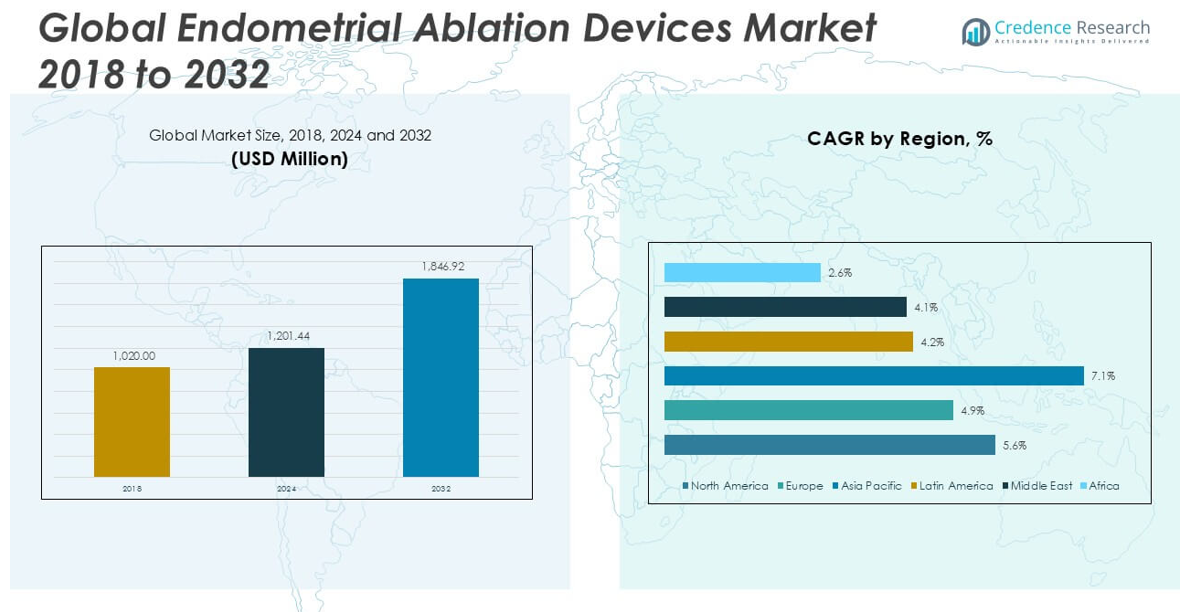
The Endometrial Ablation Devices market size was valued at USD 1,020.00 million in 2018, reached USD 1,201.44 million in 2024, and is anticipated to reach USD 1,846.92 million by 2032, growing at a CAGR of 5.57% during the forecast period.
The Endometrial Ablation Devices market is led by prominent players such as Hologic, Boston Scientific, Medtronic, Minerva Surgical, AEGEA Medical, AngioDynamics, Karl Storz, Olympus, and The Cooper Companies. These companies dominate the market through continuous technological advancements, extensive product portfolios, and strategic global expansions. Hologic and Boston Scientific maintain strong leadership positions due to their innovative minimally invasive solutions and broad customer base. Geographically, North America holds the largest market share at approximately 39.7% in 2024, driven by advanced healthcare infrastructure, early adoption of new technologies, and favorable reimbursement policies. Europe and Asia Pacific follow, with Asia Pacific showing the fastest growth potential.
Market Insights
- The Endometrial Ablation Devices market was valued at USD 1,201.44 million in 2024 and is projected to reach USD 1,846.92 million by 2032, growing at a CAGR of 5.57% during the forecast period.
- The market is driven by the increasing prevalence of abnormal uterine bleeding and the rising demand for minimally invasive treatment options offering faster recovery and reduced hospital stays.
- A key trend is the growing preference for outpatient and ambulatory surgical center procedures, along with technological advancements that enhance the safety, precision, and effectiveness of ablation devices.
- The competitive landscape is marked by continuous product innovation, strategic collaborations, and rising investments in R&D to develop advanced and cost-effective devices suitable for various healthcare settings.
- North America leads the market with a 39.7% share in 2024, followed by Europe and Asia Pacific, while radiofrequency ablation dominates the product segment due to its high adoption and clinical efficiency.
Market Segmentation Analysis:
By Product
In the Endometrial Ablation Devices market, radiofrequency ablation emerged as the dominant product segment, accounting for the largest market share in 2024. Its strong position is driven by its minimal invasiveness, shorter procedure times, and higher success rates in treating abnormal uterine bleeding compared to traditional methods. Additionally, the widespread adoption of radiofrequency ablation is supported by the increasing preference for outpatient procedures and the availability of technologically advanced devices. The growing patient awareness regarding effective and less painful treatment options further accelerates demand in this segment. Hysteroscopy devices support both diagnosis and treatment, enhancing their adoption in clinical practices. Cryoablation and hydrothermal ablation are experiencing moderate growth, driven by advancements in equipment and patient demand for minimally invasive solutions. The “other products” category includes emerging technologies that contribute to market diversification.
- For instance, Hologic's NovaSure system has been used in over 3 million procedures globally and offers an average treatment time of approximately 5 minutes, significantly reducing procedure duration compared to earlier methods.
By End Use
Among the end-use segments, hospitals held the largest market share in the Endometrial Ablation Devices market in 2024. This dominance is attributed to the availability of advanced medical infrastructure, skilled healthcare professionals, and a higher volume of patient intake for surgical procedures. Hospitals also offer comprehensive post-operative care, which strengthens patient preference. Additionally, hospitals frequently adopt new and innovative ablation technologies, further consolidating their leading position in this market segment. Clinics and ambulatory surgical centers (ASCs) are rapidly emerging as significant contributors, driven by increasing demand for same-day, minimally invasive procedures that reduce patient recovery time and overall treatment costs.
- For instance, Boston Scientific’s global network of over 12,000 hospital installations enables rapid deployment of their endometrial ablation solutions, facilitating broad hospital-based adoption.
Market Overview
Rising Prevalence of Abnormal Uterine Bleeding
The increasing incidence of abnormal uterine bleeding (AUB) among women of reproductive age significantly drives the growth of the Endometrial Ablation Devices market. AUB affects quality of life and often necessitates medical intervention, creating a consistent demand for effective treatment options. As awareness regarding this condition rises, more women are opting for minimally invasive procedures like endometrial ablation over traditional hysterectomies. This growing patient pool, coupled with the need for quicker recovery solutions, continues to propel market expansion globally.
- For instance, Hologic reported treating over 3 million women with NovaSure, directly addressing the clinical burden of AUB with high efficacy and minimal recovery time.
Preference for Minimally Invasive Procedures
The global shift toward minimally invasive treatments fuels the demand for endometrial ablation devices. These procedures offer several advantages, including reduced hospital stays, lower complication rates, and faster recovery times compared to conventional surgical methods. Healthcare providers increasingly recommend ablation techniques due to their cost-effectiveness and efficiency. Additionally, patient preference for less invasive treatments with minimal discomfort and downtime further accelerates the adoption of advanced endometrial ablation devices across various healthcare settings.
- For instance, Minerva Surgical’s FDA-approved system achieves a reported 93% reduction in heavy menstrual bleeding at 12 months follow-up, highlighting its effectiveness as a less invasive alternative to hysterectomy.
Technological Advancements in Ablation Devices
Continuous technological innovation plays a critical role in the growth of the Endometrial Ablation Devices market. The introduction of next-generation devices with improved safety, precision, and user-friendly designs enhances procedural outcomes. Innovations such as radiofrequency-based systems, improved hysteroscopic guidance, and real-time monitoring capabilities provide more accurate and effective treatment solutions. These advancements not only increase the success rates of ablation procedures but also expand the scope of endometrial ablation across different patient profiles, driving market penetration.
Key Trends & Opportunities
Growth of Outpatient and Ambulatory Surgical Centers
A notable trend in the Endometrial Ablation Devices market is the rising demand for outpatient and ambulatory surgical center (ASC) procedures. These settings offer cost-effective, same-day treatments, making them increasingly attractive for both patients and healthcare providers. The ability to perform minimally invasive procedures in ASCs without requiring extended hospital stays is expected to open new revenue streams and significantly boost market growth, especially in developed and urban regions.
- For instance, AEGEA Medical’s FDA-cleared water vapor therapy system is fully operable in an office setting and requires less than 10 minutes from preparation to treatment completion, making it ideal for ASCs.
Expanding Application in Emerging Markets
Emerging markets present significant growth opportunities for endometrial ablation device manufacturers. Increasing healthcare investments, improving medical infrastructure, and rising awareness of advanced gynecological treatments in countries across Asia-Pacific, Latin America, and the Middle East are accelerating device adoption. Additionally, the growing acceptance of minimally invasive techniques and expanding access to specialized care in these regions create favorable conditions for market penetration and long-term growth.
- For instance, Olympus has established over 30 regional service and training centers across Asia and Latin America, supporting wider clinical adoption of its hysteroscopy and ablation technologies in these emerging healthcare markets.
Key Challenges
Risk of Post-procedural Complications
Despite the advantages of minimally invasive ablation, the potential for post-procedural complications, such as infection, uterine perforation, or thermal injury to surrounding tissues, remains a significant concern. These risks can limit patient acceptance and make some healthcare providers cautious in recommending ablation procedures, particularly for women who may wish to preserve fertility. Addressing these safety concerns through improved device designs and stringent procedural protocols is essential for sustained market growth.
Limited Treatment Suitability for All Patients
Endometrial ablation is not a universal solution and may not be suitable for all patient groups, particularly women with specific uterine abnormalities, large fibroids, or those desiring future pregnancies. This limited applicability restricts the potential patient base and can slow overall market adoption. Healthcare providers must carefully evaluate candidacy, which can lengthen the decision-making process and reduce procedural volumes in some regions.
High Cost of Advanced Devices
The relatively high cost of technologically advanced endometrial ablation devices poses a challenge, especially in price-sensitive markets. Many healthcare facilities in developing countries may struggle to justify the investment, limiting access to state-of-the-art equipment. Additionally, the cost factor may deter patients in regions with limited insurance coverage or high out-of-pocket expenses, restraining the broader adoption of these devices in lower-income demographics.
Regional Analysis
North America
North America held the largest share of the Endometrial Ablation Devices market, accounting for approximately 39.7% of the global market in 2024, with a market size of USD 476.72 million, up from USD 409.22 million in 2018. The market is projected to reach USD 731.94 million by 2032, growing at a CAGR of 5.6%. The region’s dominance is driven by the high prevalence of abnormal uterine bleeding, early adoption of advanced medical technologies, and strong healthcare infrastructure. Increasing patient preference for minimally invasive procedures and favorable reimbursement policies further support market expansion.
Europe
Europe accounted for around 26.5% of the global Endometrial Ablation Devices market in 2024, with a market size of USD 318.11 million, rising from USD 280.50 million in 2018. The market is anticipated to reach USD 463.12 million by 2032, progressing at a CAGR of 4.9%. Factors such as rising awareness of women’s health issues, growing adoption of minimally invasive gynecological procedures, and supportive healthcare policies contribute to market growth. Additionally, the increasing geriatric population and well-established hospital networks across major European countries further stimulate regional demand.
Asia Pacific
The Asia Pacific region demonstrated strong growth, capturing 23.1% of the global market share in 2024, with a market size of USD 278.55 million, up from USD 225.42 million in 2018. The market is projected to reach USD 479.25 million by 2032, advancing at the highest regional CAGR of 7.1%. Rapid urbanization, increasing healthcare expenditure, and growing awareness of minimally invasive gynecological treatments are key drivers. Expanding medical infrastructure and a large target population, particularly in China, India, and Japan, create substantial growth opportunities for endometrial ablation device manufacturers in this region.
Latin America
Latin America held a 4.5% market share in 2024 within the global Endometrial Ablation Devices market, with a market size of USD 53.57 million, growing from USD 46.10 million in 2018. The market is expected to reach USD 74.01 million by 2032, expanding at a CAGR of 4.2%. Increasing demand for cost-effective, minimally invasive procedures and gradual improvements in healthcare accessibility are driving regional growth. Brazil and Mexico are key contributors, supported by growing investments in women's health and improving medical infrastructure, which are enhancing market penetration across the region.
Middle East
The Middle East accounted for approximately 3.2% of the global market in 2024, reaching a market size of USD 38.56 million, up from USD 35.19 million in 2018. The market is projected to reach USD 52.83 million by 2032, growing at a CAGR of 4.1%. Market growth is supported by the increasing focus on women's healthcare, rising demand for modern treatment solutions, and expanding private healthcare facilities. However, growth potential is somewhat constrained by limited awareness in rural areas and varying access to advanced medical equipment across the region.
Africa
Africa represented the smallest share, holding 3.0% of the global Endometrial Ablation Devices market in 2024, with a market size of USD 35.93 million, increasing from USD 23.56 million in 2018. The market is expected to grow to USD 45.77 million by 2032, at a CAGR of 2.6%. Growth in this region is modest due to limited access to advanced healthcare technologies, economic constraints, and lower awareness of endometrial ablation procedures. However, gradual improvements in healthcare infrastructure and increasing governmental focus on women’s health may create future opportunities for market expansion.
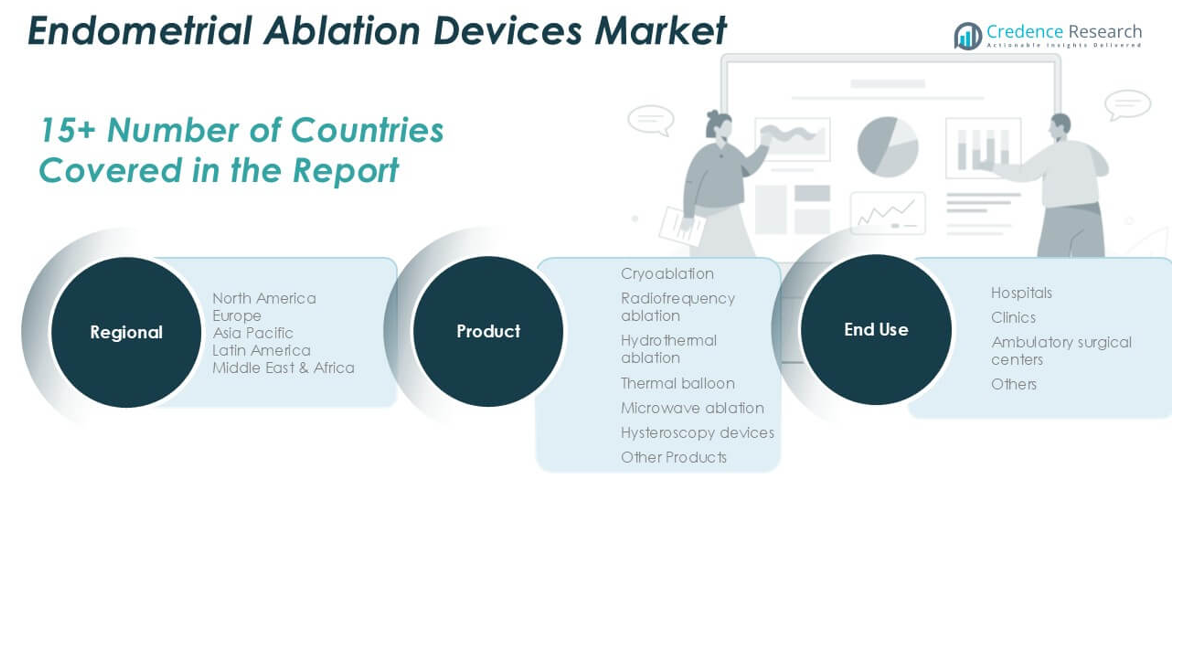
Market Segmentations:
By Product
- Cryoablation
- Radiofrequency Ablation
- Hydrothermal Ablation
- Thermal Balloon
- Microwave Ablation
- Hysteroscopy Devices
- Other Products
By End Use
- Hospitals
- Clinics
- Ambulatory Surgical Centers
- Others
By Geography
- North America
- U.S.
- Canada
- Mexico
- Europe
- Germany
- France
- U.K.
- Italy
- Spain
- Rest of Europe
- Asia Pacific
- China
- Japan
- India
- South Korea
- South-east Asia
- Rest of Asia Pacific
- Latin America
- Brazil
- Argentina
- Rest of Latin America
- Middle East & Africa
- GCC Countries
- South Africa
- Rest of the Middle East and Africa
Competitive Landscape
The Endometrial Ablation Devices market is moderately competitive, with key players focusing on product innovation, strategic partnerships, and geographical expansion to strengthen their market positions. Leading companies such as Hologic, Boston Scientific, Medtronic, and Minerva Surgical dominate the market through their extensive product portfolios and strong global presence. These players consistently invest in research and development to introduce advanced, minimally invasive devices that improve patient outcomes and procedural efficiency. Strategic collaborations, product launches, and regulatory approvals are common as manufacturers aim to strengthen their market positions and expand their geographical footprint. Additionally, the market is witnessing a rise in mergers and acquisitions to enhance product portfolios and gain competitive advantages. Increasing demand for outpatient and cost-effective treatments is also prompting companies to develop devices suitable for ambulatory surgical centers and clinics. Competitive pricing, product differentiation, and continuous advancements in ablation technologies are critical factors influencing success in this space. The evolving regulatory landscape and the need for clinical validation further drive competition, encouraging innovation while ensuring safety and effectiveness in endometrial ablation procedures.
Key Player Analysis
- AEGEA Medical
- AngioDynamics
- Boston Scientific
- Hologic
- IDOMAN-MED
- Karl Storz
- Medtronic
- Minerva Surgical
- Olympus
- Richard Wolf
- The Cooper Companies
- Veldana Medical
Recent Developments
- In November 2024, Olympus Corporation of the Americas showcased its comprehensive range of gynecological solutions at the AAGL World Congress. The display included hysteroscopy systems featuring Plasma Hysteroscopic Resection and Vaporization Electrodes, and the VERSAPOINT II Bipolar Electrosurgery System. These systems can be utilized in procedures such as Endometrial ablation.
- In October 2024, Minerva Surgical, partnered with Blackmaple Group to offer minimally invasive gynecologic technologies to WHAAPA physician members. The agreement includes the Minerva ES Ablation System and Medical Endoscopy Image Processing System for detecting and treating abnormal uterine bleeding (AUB).
- In February 2023, Hologic received regulatory approval for its NovaSure V5 Global Endometrial Ablation Device in Canada and Europe. This next-generation device features SmartDepth for precise ablation and SureClear for effective suction, enabling personalized treatment and improved outcomes. The NovaSure V5 has demonstrated high patient satisfaction and long-term efficacy rates. Hologic’s commitment to innovation and regulatory expansion continued into 2024–2025, reinforcing its leadership in the market.
Market Concentration & Characteristics
The Endometrial Ablation Devices Market demonstrates moderate market concentration, with several established companies holding significant shares while smaller players continue to emerge. It is characterized by rapid technological advancements and a steady shift toward minimally invasive procedures. The market focuses on improving device safety, procedural efficiency, and patient comfort, which drives continuous product development. Strong regulatory oversight shapes product approvals and market entry, creating a structured competitive environment. Manufacturers aim to differentiate their offerings through innovation, cost efficiency, and reliability. It remains highly responsive to the increasing demand for outpatient and same-day surgical procedures, particularly in developed regions. Hospitals currently represent the largest end-use segment due to their advanced medical infrastructure and high patient volumes. Radiofrequency ablation holds the dominant product share because of its clinical success and shorter recovery time. North America leads the regional landscape, supported by well-established healthcare systems, while Asia Pacific presents significant growth potential due to improving healthcare access and rising awareness.
Report Coverage
The research report offers an in-depth analysis based on Product, End Use and Geography. It details leading market players, providing an overview of their business, product offerings, investments, revenue streams, and key applications. Additionally, the report includes insights into the competitive environment, SWOT analysis, current market trends, as well as the primary drivers and constraints. Furthermore, it discusses various factors that have driven market expansion in recent years. The report also explores market dynamics, regulatory scenarios, and technological advancements that are shaping the industry. It assesses the impact of external factors and global economic changes on market growth. Lastly, it provides strategic recommendations for new entrants and established companies to navigate the complexities of the market.
Future Outlook
- The market will continue to expand due to the growing preference for minimally invasive gynecological procedures.
- Demand for endometrial ablation devices in ambulatory surgical centers and outpatient clinics will increase.
- Technological advancements will focus on improving safety, precision, and ease of use.
- Radiofrequency ablation will maintain its leading position among product segments.
- Hospitals will remain the primary end users due to high patient intake and advanced facilities.
- Asia Pacific will emerge as the fastest-growing region driven by expanding healthcare access.
- Manufacturers will invest in cost-effective solutions to penetrate price-sensitive markets.
- Rising awareness of women’s health and non-surgical treatment options will support market growth.
- Companies will focus on securing regulatory approvals to strengthen global market presence.
- The competitive landscape will see more collaborations and product innovations to meet evolving clinical needs.

Request a Free Sample
Fill in your details and we'll send you a free sample report.
- Sample data tables & charts
- Research methodology
Market Dynamics
Rising Prevalence of Abnormal Uterine Bleeding
The increasing incidence of abnormal uterine bleeding among women of reproductive age is driving demand for effective treatment options, making endometrial ablation devices a preferred solution over traditional surgical interventions.
Preference for Minimally Invasive Procedures
Patients and healthcare providers are increasingly opting for minimally invasive treatments due to their benefits of reduced hospital stays, lower complication rates, and faster recovery, which directly boosts the adoption of endometrial ablation devices.
Technological Advancements in Ablation Devices
Continuous innovation, such as the development of radiofrequency-based systems and improved hysteroscopic guidance, enhances procedural safety, precision, and outcomes, expanding the applicability and appeal of these devices.
Growth of Outpatient and Ambulatory Surgical Centers
The shift toward outpatient and ambulatory surgical center procedures enables cost-effective, same-day treatments, increasing the accessibility and frequency of endometrial ablation procedures, especially in developed markets.
Expanding Application in Emerging Markets
Rising healthcare investments, improving infrastructure, and greater awareness of advanced gynecological treatments in emerging regions are creating new opportunities for market penetration and long-term growth.
Need a Custom Version of This Report?
Tailor the scope, geography, or segments to your exact requirements.
- Custom geography or segment scope
- Direct access to our analyst team
Frequently Asked Questions
What is the current size of the Endometrial Ablation Devices Market?
What are the key segments within the Endometrial Ablation Devices Market?
What are some challenges faced by the Endometrial Ablation Devices Market?
Who are the major players in the Endometrial Ablation Devices Market?
Table of Content
Chapter 1 Market Segmentation
- 1.1 Segmentation Framework
- 1.1.1 Product and Service Classification
- 1.1.2 Application and End-Use Classification
- 1.1.3 Technology and Solution Classification
- 1.1.4 Customer and Distribution Channel Classification
- 1.1.5 Geographic Segmentation
- 1.1.6 Market Segment Definitions and Boundaries
- 1.2 By End Use
- 1.2.1 Hospitals
- 1.2.2 Clinics
- 1.2.3 Ambulatory Surgical Centers
- 1.2.4 Others
- 1.3 By Product
- 1.3.1 Cryoablation
- 1.3.2 Radiofrequency Ablation
- 1.3.3 Hydrothermal Ablation
- 1.3.4 Thermal Balloon
- 1.3.5 Microwave Ablation
- 1.3.6 Hysteroscopy Devices
- 1.3.7 Other Products
Chapter 2 Introduction
- 2.1 Report Objectives and Scope
- 2.2 Product Definition and Industry Terminology
- 2.3 Market Inclusions and Exclusions
- 2.4 Research Process
- 2.4.1 Primary Research and Expert Interviews
- 2.4.2 Secondary Research and Source Review
- 2.4.3 Top-Down and Bottom-Up Estimation
- 2.4.4 Data Triangulation and Verification
- 2.5 Market Size Measurement Basis
- 2.5.1 2024: USD 1,201.44 million → 2032: USD 1,846.92 million
- 2.6 Historical and Forecast Reference Periods
- 2.6.1 Base Year: 2024
- 2.6.2 Forecast Period: 2024-2032
- 2.7 Research Assumptions and Limitations
Chapter 3 Executive Summary
- 3.1 Market Snapshot and Key Findings
- 3.2 Base-Year Market Size, 2024
- 3.3 Forecast Market Size, 2032
- 3.4 Revenue and Volume Growth Outlook
- 3.5 Key Demand and Supply Indicators
- 3.6 Leading Market Segments
- 3.7 Fastest-Growing Market Opportunities
- 3.8 Regional Performance Highlights
- 3.9 Technology and Industry Transformation
- 3.10 Competitive Landscape Summary
- 3.11 Analyst View and Strategic Implications
Chapter 4 Global Endometrial Ablation Devices Market Trends and Developments
- 4.1 Historical Industry Development
- 4.2 Recent Market Trends and Developments
- 4.3 Demand and Customer Behavior Trends
- 4.4 Technology and Product Innovation
- 4.5 Artificial Intelligence, Automation and Digitalization
- 4.6 Local Manufacturing and Supply Chain Realignment
- 4.7 Industry Partnerships, Mergers and Acquisitions
- 4.8 Sustainability and Circular Economy Developments
- 4.9 Government and Private Sector Investment Trends
- 4.10 Emerging Business Models and Commercialization
- 4.11 Industry Developments and Announcements
Chapter 5 Global Endometrial Ablation Devices Market Production, Supply and Demand Analysis
- 5.1 Demand Trend and Consumption Analysis
- 5.2 Demand Forecast, 2024-2032
- 5.3 Production and Output Trend
- 5.4 Production and Output Forecast, 2024-2032
- 5.5 Installed Capacity and Capacity Utilization
- 5.6 Company-Wise Production Plants and Statistics
- 5.6.1 Installed Production Capacity
- 5.6.2 Actual Production
- 5.6.3 Planned Capacity and Expansion Targets
- 5.7 Supply Chain Structure and Procurement Trends
- 5.8 Supply-Demand Gap and Bottlenecks
- 5.9 Import Dependence and Sourcing Structure
- 5.10 Contract Manufacturing and Outsourcing
- 5.11 Regional Supply and Demand Concentration
Chapter 6 Global Endometrial Ablation Devices Market Pricing Analysis
- 6.1 Pricing Structure and Measurement
- 6.2 Historical Pricing Trends
- 6.3 Pricing Outlook, 2024-2032
- 6.4 Average Selling Price and Unit Economics
- 6.5 Pricing by Product and Market Segment
- 6.6 Geographic Pricing Differences
- 6.7 Key Input, Energy, Labor and Logistics Costs
- 6.8 Contract Pricing and Purchasing Models
- 6.9 Pricing Sensitivity and Competitive Positioning
- 6.10 Price, Margin and Profitability Implications
Chapter 7 Global Endometrial Ablation Devices Market Dynamics
- 7.1 Market Growth Drivers
- 7.1.1 Demand-Side Drivers
- 7.1.2 Technology and Innovation Drivers
- 7.1.3 Infrastructure and Investment Drivers
- 7.1.4 Regulatory and Policy Drivers
- 7.2 Market Restraints
- 7.2.1 Cost and Affordability Constraints
- 7.2.2 Technology and Adoption Barriers
- 7.2.3 Supply Chain and Operational Constraints
- 7.3 Market Challenges
- 7.3.1 Competitive Pressure and Margin Erosion
- 7.3.2 Skills, Infrastructure and Implementation Gaps
- 7.4 Emerging Market Opportunities
- 7.5 Market Dynamics Impact and Time-Horizon Assessment
Chapter 8 Global Endometrial Ablation Devices Value Chain Analysis
- 8.1 Industry Value Chain Overview
- 8.2 Upstream Suppliers and Critical Inputs
- 8.3 Technology and Component Providers
- 8.4 Manufacturing or Service Delivery
- 8.5 Distribution, Channel Partners and Integrators
- 8.6 Downstream Applications and End Users
- 8.7 Value Addition and Profit Pools
- 8.8 Vertical Integration and Outsourcing
- 8.9 Supplier Concentration and Risk
- 8.10 Supply Chain Localization and Resilience
Chapter 9 Global Endometrial Ablation Devices Market Regulations and Policies
- 9.1 Relevant Laws, Standards and Compliance Frameworks
- 9.2 Product, Service, Safety and Quality Requirements
- 9.3 Government Policies, Incentives and Subsidies
- 9.4 Imports, Exports and Trade Barriers
- 9.5 Public Procurement and Local Content Requirements
- 9.6 Environmental and Sustainability Compliance
- 9.7 Upcoming Policy Changes and Market Implications
Chapter 10 Global Endometrial Ablation Devices Market Hotspots and Opportunities
- 10.1 Market Opportunity Mapping and Growth Hotspots
- 10.2 High-Growth Applications and Customer Groups
- 10.3 Underserved Markets and White-Space Opportunities
- 10.4 Emerging Technology and Product Opportunities
- 10.5 New Capacity and Investment Hotspots
- 10.6 Market Entry and Expansion Opportunities
- 10.7 Distribution and Partnership Opportunities
- 10.8 Near-Term and Long-Term Commercial Potential
- 10.9 Opportunity Attractiveness and Execution Risks
Chapter 11 Global Endometrial Ablation Devices Market Outlook, 2024-2032
- 11.1 Market Size and Analysis
- 11.1.1 Revenue (Market Measurement: 2024: USD 1,201.44 million → 2032: USD 1,846.92 million)
- 11.1.2 Market Volume and Quantity Sold
- 11.1.3 Historical Market Size
- 11.1.4 Base-Year Market Size, 2024
- 11.2 Market Forecast, 2024-2032
- 11.2.1 Revenue Forecast to 2032
- 11.2.2 Volume Forecast to 2032
- 11.2.3 CAGR and Year-on-Year Growth
- 11.2.4 Incremental Revenue Opportunity
- 11.3 Forecast Assumptions and Scenario Analysis
- 11.3.1 Base-Case Forecast
- 11.3.2 Optimistic and Conservative Scenarios
- 11.3.3 Technology, Pricing and Policy Sensitivities
- 11.4 Market Attractiveness and Growth Outlook
Chapter 12 Global Endometrial Ablation Devices Market Segmentation and Outlook
- 12.1 Segmentation Summary and Market Shares, 2024
- 12.2 Largest and Fastest-Growing Segments
- 12.3 By End Use - Market Size and Forecast, 2024-2032
- 12.3.1 Segment Definition and Scope
- 12.3.2 Historical Market Size
- 12.3.3 Revenue Forecast, 2024-2032
- 12.3.4 Volume Forecast, 2024-2032
- 12.3.5 Base-Year Market Share, 2024
- 12.3.6 Segment CAGR and Growth Drivers
- 12.3.7 Subsegment Market Size and Forecast
- 12.3.7.1 Hospitals
- 12.3.7.2 Clinics
- 12.3.7.3 Ambulatory Surgical Centers
- 12.3.7.4 Others
- 12.3.8 Subsegment Pricing and Adoption Trends
- 12.3.9 Leading Suppliers and Competition
- 12.3.10 Regional Demand and Opportunities
- 12.4 By Product - Market Size and Forecast, 2024-2032
- 12.4.1 Segment Definition and Scope
- 12.4.2 Historical Market Size
- 12.4.3 Revenue Forecast, 2024-2032
- 12.4.4 Volume Forecast, 2024-2032
- 12.4.5 Base-Year Market Share, 2024
- 12.4.6 Segment CAGR and Growth Drivers
- 12.4.7 Subsegment Market Size and Forecast
- 12.4.7.1 Cryoablation
- 12.4.7.2 Radiofrequency Ablation
- 12.4.7.3 Hydrothermal Ablation
- 12.4.7.4 Thermal Balloon
- 12.4.7.5 Microwave Ablation
- 12.4.7.6 Hysteroscopy Devices
- 12.4.7.7 Other Products
- 12.4.8 Subsegment Pricing and Adoption Trends
- 12.4.9 Leading Suppliers and Competition
- 12.4.10 Regional Demand and Opportunities
- 12.5 Segment Growth Comparison
- 12.6 Segment Attractiveness and Priority Matrix
Chapter 13 Global Endometrial Ablation Devices End-Use and Application Market Outlook
- 13.1 End-Use Industry and Customer Demand Structure
- 13.2 Leading Applications and Customer Groups
- 13.3 End-Use Market Size, Share and Forecast
- 13.4 Major End-Use Industry Deep Dives
- 13.4.1 Customer Requirements and Use Cases
- 13.4.2 Demand and Replacement Cycles
- 13.4.3 Technical and Regulatory Considerations
- 13.4.4 Purchasing and Procurement Models
- 13.4.5 Leading Vendors and Distribution Channels
- 13.4.6 Forecast and Commercial Opportunities
- 13.5 Emerging Applications and Cross-Segment Demand
- 13.6 End-Use Industry Investment Priorities
Chapter 14 Global Endometrial Ablation Devices Geographic Market Outlook, 2024-2032
- 14.1 Regional Market Size and Share, 2024
- 14.2 Regional Market Forecast, 2024-2032
- 14.3 Regional Pricing, Production and Demand Differences
- 14.4 North America
- 14.4.1 United States
- 14.4.2 Canada
- 14.4.3 Mexico
- 14.5 Europe
- 14.5.1 Germany
- 14.5.2 France
- 14.5.3 Italy
- 14.5.4 United Kingdom
- 14.5.5 Spain
- 14.5.6 Poland
- 14.5.7 Russia
- 14.5.8 Netherlands
- 14.5.9 Belgium
- 14.5.10 Sweden
- 14.5.11 Denmark
- 14.5.12 Norway
- 14.5.13 Rest of Europe
- 14.6 Asia Pacific
- 14.6.1 China
- 14.6.2 India
- 14.6.3 Japan
- 14.6.4 South Korea
- 14.6.5 Thailand
- 14.6.6 Indonesia
- 14.6.7 Vietnam
- 14.6.8 Malaysia
- 14.6.9 Australia
- 14.6.10 Rest of Asia Pacific
- 14.7 Latin America
- 14.7.1 Brazil
- 14.7.2 Argentina
- 14.7.3 Colombia
- 14.7.4 Chile
- 14.7.5 Rest of Latin America
- 14.8 Middle East
- 14.8.1 Saudi Arabia
- 14.8.2 United Arab Emirates
- 14.8.3 Turkey
- 14.8.4 Israel
- 14.8.5 Iran
- 14.8.6 Rest of the Middle East
- 14.9 Africa
- 14.9.1 South Africa
- 14.9.2 Egypt
- 14.9.3 Nigeria
- 14.9.4 Morocco
- 14.9.5 Rest of Africa
- 14.10 Regional Investment, Policy and Supply Chain Differences
- 14.11 Regional Competitive Landscape
- 14.12 Geographic Growth Hotspots
Chapter 15 Global Endometrial Ablation Devices Technology, Innovation and Sustainability Outlook
- 15.1 Technology Landscape and Maturity
- 15.2 Product, Process and Service Innovation
- 15.3 AI, Automation and Digital Tools in the Industry
- 15.4 Technology Adoption and Performance Benchmarking
- 15.5 Innovation Pipeline and R&D Investment
- 15.6 Patent and Intellectual Property Trends
- 15.7 Energy Efficiency and Resource Management
- 15.8 Sustainability, Recycling and Circularity
- 15.9 Technology Roadmap, 2024-2032
- 15.10 Risks of Obsolescence and Technology Substitution
Chapter 16 Global Endometrial Ablation Devices Market Key Strategic Imperatives
- 16.1 Growth and Market Entry Priorities
- 16.2 High-Return Products and Segments
- 16.3 Pricing, Profitability and Cost Optimization
- 16.4 Technology Investment and Product Differentiation
- 16.5 Supply Chain Localization and Resilience
- 16.6 Distribution and Customer Acquisition
- 16.7 Partnership, Acquisition and Capacity Strategy
- 16.8 Regional Expansion Priorities
- 16.9 Short-, Medium- and Long-Term Actions
Chapter 17 Competition Outlook
- 17.1 Industry Competition Characteristics
- 17.2 Market Structure and Concentration
- 17.3 Market Share and Competitive Positioning, 2024
- 17.4 Company-Wise Revenue and Product Benchmarking
- 17.5 Production and Service Capacity Benchmarking
- 17.6 Technology, Pricing and Differentiation
- 17.7 Regional Footprint and Distribution Strength
- 17.8 Mergers, Acquisitions and Strategic Alliances
- 17.9 New Entrants and Competitive Threats
- 17.10 Porter's Five Forces and Industry Attractiveness
- 17.11 Competitive Outlook, 2024-2032
Chapter 18 Company Profiles
- 18.1 Company Coverage and Selection Criteria
- 18.2 Hologic
- 18.2.1 Business Description
- 18.2.2 Company Ownership and Geographic Presence
- 18.2.3 Product and Service Portfolio
- 18.2.4 Manufacturing and Operating Footprint
- 18.2.5 Production Capacity and Expansion Plans
- 18.2.6 Financial Performance and Investment
- 18.2.7 Market Share and Competitive Position
- 18.2.8 Technology and Innovation Capabilities
- 18.2.9 Strategic Alliances or Partnerships
- 18.2.10 Recent Developments
- 18.2.11 Growth Strategy and Outlook
- 18.3 Boston Scientific
- 18.4 Medtronic
- 18.5 Minerva Surgical
- 18.6 AEGEA Medical
- 18.7 AngioDynamics
- 18.8 Karl Storz
- 18.9 Olympus
- 18.10 The Cooper Companies
- 18.11 Richard Wolf
- 18.12 Other Relevant Market Participants
Note: Every listed company is profiled on the structure shown under the first company. The company list is preliminary and may change based on research findings, market developments, data availability and client requirements.
Chapter 19 Disclaimer
- 19.1 Research and Forecast Disclaimer
- 19.2 Data Source and Estimation Limitations
Note: The depth of individual sections depends on data availability for this market. Volume, capacity, trade and other unit-based metrics are included where applicable.

