
Market Overview
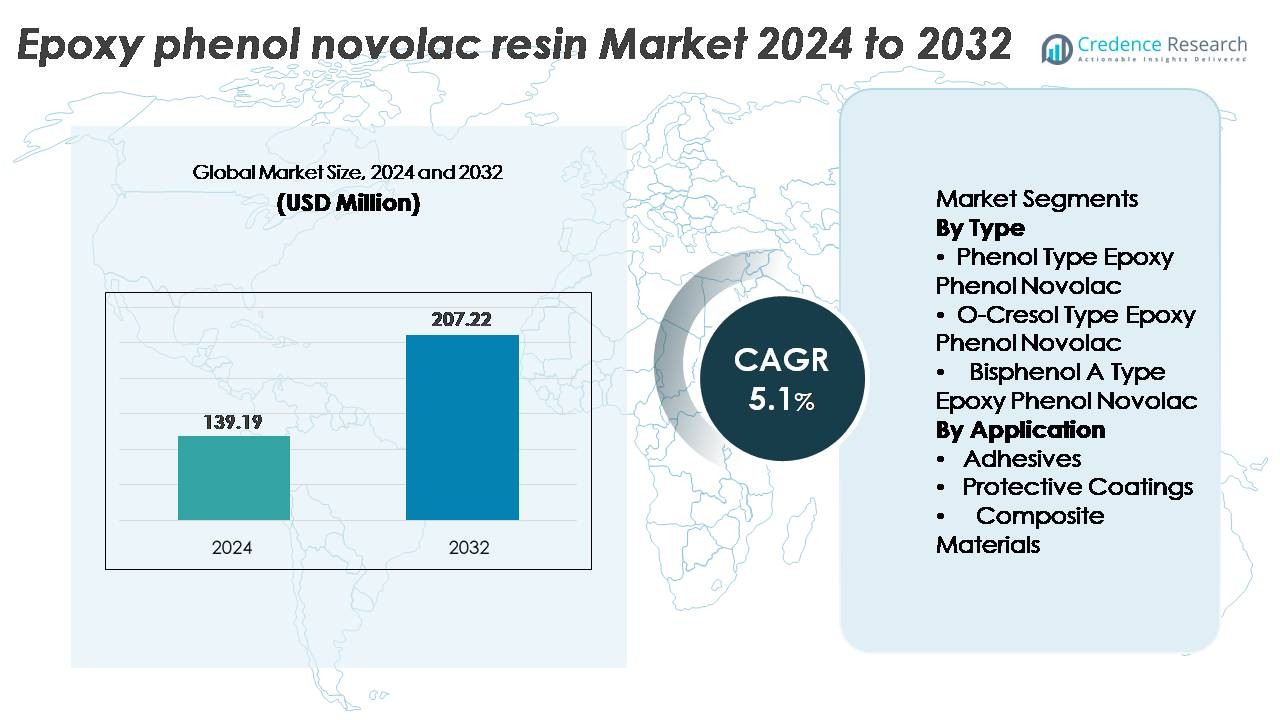
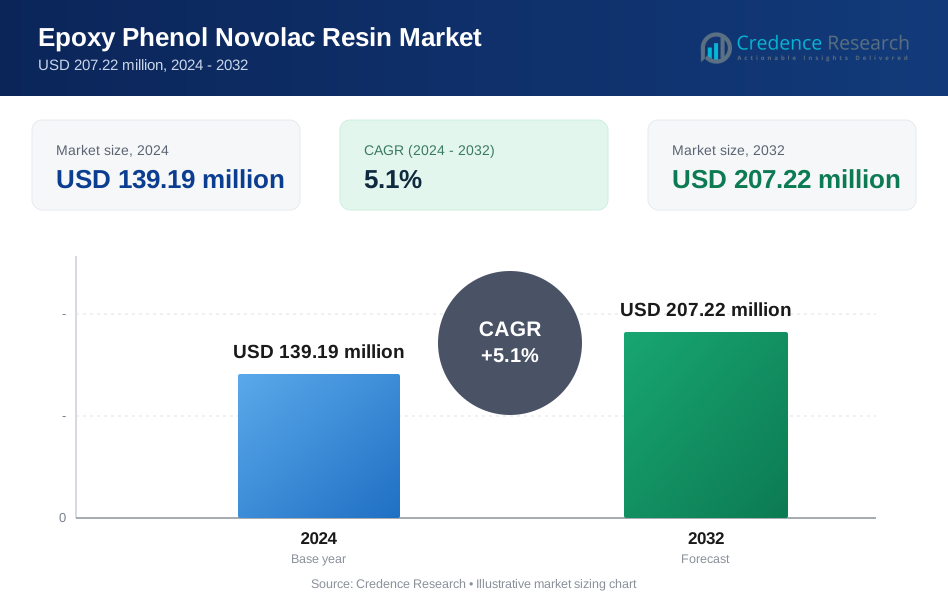
The epoxy phenol novolac resin market was valued at USD 139.19 million in 2024 and is projected to reach USD 207.22 million by 2032, expanding at a CAGR of 5.1% throughout the forecast period.
| REPORT ATTRIBUTE | DETAILS |
|---|---|
| Historical Period | 2020-2023 |
| Base Year | 2024 |
| Forecast Period | 2025-2032 |
| Epoxy Phenol Novolac Resin Market Size 2024 | USD 139.19 Million |
| Epoxy Phenol Novolac Resin Market, CAGR | 5.1% |
| Epoxy Phenol Novolac Resin Market Size 2032 | USD 207.22 Million |
The epoxy phenol novolac resin market includes several prominent players, such as DIC, Hexion Inc., Kukdo Chemical Industry, CORCHEM, Aditya Birla Group, Huntsman, Momentive, GP Chemicals, DowDuPont, and Emerald Performance Materials, each competing through advancements in resin customization, heat resistance optimization, and supply chain reach. Asia-Pacific remains the leading regional market with approximately 37% share, driven by its dominance in semiconductor packaging, electronics manufacturing, and industrial coatings demand. North America and Europe follow as significant contributors due to stringent industrial safety standards and ongoing infrastructure rehabilitation. Strategic partnerships, technical-grade formulation development, and expansion into high-growth sectors continue to define competitive positioning in this market.
Market Insights
- The epoxy phenol novolac resin market was valued at USD 139.19 million in 2024 and is projected to reach USD 207.22 million by 2032, expanding at a 5.1% CAGR.
- Market growth is driven by increasing demand for high-temperature, chemical-resistant materials used in semiconductor packaging, industrial coatings, and structural repair applications across heavy industrial sectors.
- Trends highlight rising adoption in composite manufacturing and advanced protective coatings, supported by expansion in electronics miniaturization, offshore infrastructure, and long-life corrosion-control systems.
- Competitive momentum centers on resin formulation innovation, sustainability compliance, and supply chain reliability, while restraints include raw material price volatility and evolving environmental regulatory pressures.
- Asia-Pacific leads the market with 37% share, followed by North America at 32% and Europe at 26%, while Phenol Type Epoxy Phenol Novolac remains the dominant segment due to its superior heat resistance and higher crosslinking performance.
Market Segmentation Analysis:
By Type
The epoxy phenol novolac resin market by type is categorized into Phenol Type, O-Cresol Type, and Bisphenol A Type Epoxy Phenol Novolac. The Phenol Type segment holds the dominant market share, supported by its higher thermal stability and stronger mechanical strength compared with alternatives. Its dense crosslinking capacity enables enhanced resistance to corrosive chemicals and moisture, which drives usage in printed circuit boards, semiconductor sealing compounds, and structural adhesives. Growing demand in electronics manufacturing and corrosion-resistant industrial coatings continues to reinforce this segment’s leading market position.
- For instance, DIC Corporation manufactures phenolic novolac epoxy resins designed for high-temperature electronics and industrial coatings, offering glass-transition temperatures above 200°C and strong chemical resistance. These materials are widely used in semiconductor encapsulation and corrosion-resistant coatings where thermal stability and long service life are critical.
By application
The market is segmented into Adhesives, Protective Coatings, and Composite Materials. Protective Coatings stand as the leading sub-segment, attributed to increasing requirements for high-performance coatings in oil & gas infrastructure, marine vessels, and chemical processing equipment. The resin’s ability to withstand elevated temperatures, solvents, and highly acidic environments makes it a preferred material for heavy-duty corrosion prevention solutions. Expansion in industrial refurbishment and long-term asset maintenance strategies further drives the adoption of epoxy phenol novolac coatings, sustaining its dominant share in the application landscape.
- For instance, CORCHEM’s CORCHEM 207 Phenol Novolac Tank Lining is based on an epoxy phenol novolac resin system designed for severe chemical immersion service. The lining is widely used in oilfield tanks, separators, and pressure vessels due to its strong resistance to hydrocarbons, acids, and abrasion under high-temperature operating conditions.
Key Growth Drivers
Rising Demand for High-Temperature and Chemical-Resistant Materials
Growing industrial requirements for resins with enhanced resistance to corrosive chemicals and elevated temperatures serve as a major catalyst for the epoxy phenol novolac resin market. Industries such as petrochemicals, electronics, aerospace, and marine construction are prioritizing resins capable of providing long service life under demanding conditions. The superior crosslinking structure of epoxy phenol novolac resin delivers high heat deflection temperature, robust solvent resistance, and strong bonding strength, supporting its integration into semiconductor encapsulation, composite structures, and protective linings. The global push toward extending asset lifecycle through advanced corrosion protection also drives usage in tank linings, pipelines, and offshore rigs. As infrastructure investments surge in emerging economies, demand for industrial coatings and engineered materials further accelerates resin adoption. The evolution of high-performance manufacturing environments, particularly in electronics miniaturization and high-temperature mechanical assemblies, reinforces recurring demand for this resin type.
- For instance, Hexion’s EPON™ SU phenolic novolac epoxy systems achieve glass transition temperatures above 200°C, supporting use in chemical tank linings, composite components, and high-temperature industrial coating applications.
Expansion of Electronics and Semiconductor Manufacturing
The rapid scaling of semiconductor packaging, PCB manufacturing, and electronic component protection continues to propel epoxy phenol novolac resin demand. Miniaturization trends require materials with superior electrical insulation, flame retardance, and resistance to delamination under thermal cycling. Epoxy phenol novolac resins offer strong dimensional stability and dielectric capabilities that are critical for use in solder resists, underfill compounds, and chip encapsulation. Growth in electric vehicles, consumer electronics, and renewable energy systems presents additional pathways for adoption due to increasing sensor integration and board density. The expansion of wafer fabrication plants, outsourced semiconductor assembly, and advanced packaging technologies reinforces the need for resins compatible with high-reliability microelectronic manufacturing. With automation and IoT connectivity driving component proliferation, demand for resilient encapsulating and PCB protective materials remains a long-term growth factor.
- For instance, Olin’s D.E.N.™ Novolac epoxy resins are widely used in semiconductor encapsulation and PCB laminates, where formulated systems achieve UL 94 V-0 flame ratings and high dielectric performance required for dense electronic assemblies.
Infrastructure Rehabilitation and Corrosion-Control Investments
The increasing emphasis on maintenance, repair, and service-life extension of aging industrial assets underpins strong market momentum. Epoxy phenol novolac resins provide the mechanical durability, heat resistance, and corrosion performance needed for long-term protective coatings in industrial pipelines, chemical storage facilities, wastewater treatment plants, and marine structures. Governments and private-sector operators are investing heavily in corrosion management and asset protection to reduce downtime and extend operational safety. These resins are widely used in internal tank linings, reinforced composite wraps, and structural repair formulations, supporting infrastructure upgrades and environmental compliance. The shift toward green and sustainable construction practices also supports the use of higher-quality, longer-lasting protective solutions that minimize maintenance cycles. As energy, petrochemical, and marine operations expand into harsher climates and deeper offshore locations, demand for high-performance protective epoxy systems continues to rise.
Key Trends & Opportunities
Shift Toward High-Performance Composite Adoption
Lightweight and performance-driven composite materials are emerging as a significant opportunity within the epoxy phenol novolac resin market. These resins serve as critical matrix materials for fiber-reinforced composites utilized in aerospace components, automotive lightweighting, high-speed rail, and industrial structural applications. Their ability to deliver thermal stability, structural rigidity, and chemical resistance expands their suitability as a replacement for metal components. The increasing design flexibility and weight reduction benefits of composites align with global regulatory and efficiency targets. With the adoption of hydrogen storage tanks, advanced rotating equipment, and engineered structural reinforcements, demand for resin-based composite systems is positioned for long-term growth. Advancements in continuous carbon fiber processing and resin infusion techniques further widen commercialization potential.
- For instance, Momentive’s fast-cure epoxy systems for RTM and liquid compression molding enable cycle times below 2 minutes, supporting high-volume production of structural composite components in automotive manufacturing.
Emergence of Advanced Coating Formulations
The coatings industry presents expanding opportunities as specialized resin formulations evolve for extreme temperature, abrasion, and chemical exposure environments. Epoxy phenol novolac systems enable enhanced film hardness, prolonged corrosion protection, and improved resistance to solvents and acids, making them suitable for industrial flooring, marine applications, and chemical tank insulation. Renewable energy facilities, including offshore wind turbines and geothermal plants, require protective coatings capable of withstanding severe operational conditions, opening new demand segments. Technological progress in solvent-less and waterborne epoxy novolac systems also aligns with emission reduction mandates. The shift toward low-VOC and high-solid coating formulations presents a market opportunity for manufacturers capable of delivering environmentally compliant yet high-performance solutions.
- For instance, Hexion’s waterborne epoxy coating systems are formulated to achieve VOC levels below 100 g/L while delivering corrosion protection suitable for industrial and infrastructure applications under global emission regulations.
Key Challenges
Raw Material Cost Volatility and Supply Uncertainty
Volatility in raw material pricing, particularly phenolic feedstocks and epoxy precursors, presents a significant challenge for market stability. Fluctuations driven by petrochemical capacity constraints, geopolitical issues, and global trade dynamics impact resin production costs and margins. Additionally, competitive pressures from alternative thermoset and composite resins may restrict pricing flexibility. Many resin producers face supply chain disruptions tied to chemical plant shutdowns, transportation bottlenecks, or environmental regulatory tightening affecting phenol production. Long-term contracts and backward integration strategies help mitigate risk, but smaller manufacturers remain exposed. Consistent availability and cost management of monomers and curing agents are essential to maintain profitability and meet demand reliably.
Stringent Environmental Regulations and Compliance Pressures
Environmental regulations related to VOC emissions, chemical handling, and industrial waste disposal continue to challenge resin producers. As regulatory bodies push for low-toxicity and reduced-emission formulations, manufacturers must innovate without compromising performance characteristics that define epoxy phenol novolac resins. This requires costly R&D investments and reformulation cycles that may limit smaller market participants. Restrictions affecting phenolic chemistry, hazardous disposal protocols, and workplace exposure standards also increase compliance-related operational costs. Shifts toward bio-based and low-solvent alternatives create competitive pressure and potential substitution risks. Balancing sustainability expectations with performance-intensive applications remains a key barrier to widespread adoption and cost-efficient production.
Regional Analysis
North America
North America holds approximately 32% of the epoxy phenol novolac resin market share, driven by strong consumption in protective coatings, semiconductor packaging, and industrial repair systems. The U.S. leads regional demand due to established petrochemical, aerospace, and marine infrastructure requiring high-temperature and corrosion-resistant materials. Investments in semiconductor assembly and EV component manufacturing sustain application growth in electronic encapsulation and PCB protection. Ongoing refurbishment of pipelines and chemical storage facilities increases deployment in heavy-duty coatings and composite wraps. Environmental compliance standards also encourage adoption of long-lasting, maintenance-reducing resin systems across industrial operators.
Europe
Europe accounts for nearly 26% of the market share, supported by stringent environmental and asset safety regulations that accelerate demand for high-performance coatings and composite repairs. Countries such as Germany, France, and the Netherlands drive usage in chemical processing, offshore wind energy, and industrial coatings aligned with sustainability targets. Growth in aerospace lightweighting and industrial 3D printing applications reinforces resin demand in composite matrices. Pipeline rehabilitation across Eastern Europe further elevates requirements for chemically resistant epoxy systems. Regulatory frameworks for low-VOC and corrosion-resistant formulations contribute to continued regional adoption.
Asia-Pacific
Asia-Pacific represents the largest market with approximately 37% share, attributed to rapid industrialization, infrastructure expansion, and dominant electronics manufacturing output in China, South Korea, and Japan. The region’s strong role in semiconductor packaging and PCB fabrication drives resin adoption for heat-resistant encapsulation and solder mask coatings. Large-scale petrochemical plants, marine construction, and offshore operations expand utilization in corrosion-resistant coatings. Rising investments in transportation, renewable energy, and urban infrastructure reinforce protective resin requirements. Increasing domestic production capabilities support cost-competitive manufacturing and strengthen Asia-Pacific’s position as the fastest-growing consumer and supplier.
Latin America
Latin America holds around 3% of the market share, with demand concentrated in Brazil, Mexico, and Chile across petrochemical processing, mining infrastructure, and marine coatings. The replacement of aging industrial assets and expansion of offshore projects stimulate adoption of corrosion-resistant epoxy novolac systems. Growth remains steady due to refinery upgrades and protective coatings used in fertilizers, pulp and paper, and chemical storage facilities. Although pricing sensitivity and import dependency constrain market penetration, opportunities are emerging through regional investments in composite pipe systems and industrial flooring solutions for manufacturing expansions.
Middle East & Africa
Middle East & Africa account for nearly 2% market share, primarily driven by oil & gas infrastructure, desalination facilities, and chemical-resistant coatings for extreme temperature and saline environments. The Gulf region relies heavily on corrosion control materials for pipelines, offshore drilling structures, and refinery assets. Rising industrial diversification in Saudi Arabia and the UAE supports demand for advanced coatings and composite repair technologies. In Africa, adoption remains gradual but increasing with mining sector expansion and urban infrastructure development. Limited local manufacturing capacity creates scope for strategic distribution and joint ventures.
Market Segmentations:
By Type
- Phenol Type Epoxy Phenol Novolac
- O-Cresol Type Epoxy Phenol Novolac
- Bisphenol A Type Epoxy Phenol Novolac
By Application
- Adhesives
- Protective Coatings
- Composite Materials
By Geography
- North America
- U.S.
- Canada
- Mexico
- Europe
- Germany
- France
- U.K.
- Italy
- Spain
- Rest of Europe
- Asia Pacific
- China
- Japan
- India
- South Korea
- South-east Asia
- Rest of Asia Pacific
- Latin America
- Brazil
- Argentina
- Rest of Latin America
- Middle East & Africa
- GCC Countries
- South Africa
- Rest of the Middle East and Africa
Competitive Landscape
The competitive landscape of the epoxy phenol novolac resin market is moderately consolidated, with competition shaped by technology capabilities, formulation expertise, and application-specific customization. Leading manufacturers focus on enhancing thermal stability, chemical resistance, and adhesion performance to strengthen their product portfolios in electronics, protective coatings, and composite applications. Strategic priorities include scaling production capacity, optimizing manufacturing efficiencies, and expanding distribution networks across high-growth industrial regions. Partnerships with semiconductor packaging firms, coating formulators, and composite producers support value-added integration. Companies increasingly invest in low-VOC, solvent-free, and advanced curing systems in response to environmental regulations and sustainability expectations. Competitive differentiation also stems from technical service support, custom resin development, and reliability in supply chain performance. Market participants continue to pursue mergers, licensing arrangements, and long-term contracts with industrial operators to safeguard market presence and reinforce application relevance in evolving high-performance sectors.
Key Player Analysis
- DIC
- Hexion Inc.
- Kukdo Chemical Industry
- CORCHEM
- Aditya Birla Group
- Huntsman
- Momentive
- GP Chemicals
- DowDuPont
- Emerald Performance Materials
Recent Developments
- In August 2024, Hexion introduced fire-retardant epoxy resins, expanding its product range for high-safety applications.
- In June 2024, Aditya Birla Group the company announced plans to build a new epoxy resin manufacturing and R&D facility on a 35-acre site at Beaumont, Texas, USA, aiming to address demand in North America.
Report Coverage
The research report offers an in-depth analysis based on Type, Application and Geography. It details leading market players, providing an overview of their business, product offerings, investments, revenue streams, and key applications. Additionally, the report includes insights into the competitive environment, SWOT analysis, current market trends, as well as the primary drivers and constraints. Furthermore, it discusses various factors that have driven market expansion in recent years. The report also explores market dynamics, regulatory scenarios, and technological advancements that are shaping the industry. It assesses the impact of external factors and global economic changes on market growth. Lastly, it provides strategic recommendations for new entrants and established companies to navigate the complexities of the market.
Future Outlook
- Demand for epoxy phenol novolac resin will strengthen as industries prioritize long-life corrosion protection and heat-resistant materials.
- Semiconductor packaging and miniaturized electronics will continue driving the need for high-performance encapsulation and PCB insulation.
- Growth in renewable energy infrastructure will expand opportunities in advanced coatings and composite applications.
- Adoption of lightweight composite components will increase in automotive, rail, and aerospace sectors.
- Regulatory focus on safety and durability will support higher-quality resin formulations for industrial infrastructure.
- Emerging offshore and deepwater projects will elevate requirements for chemically resistant epoxy coatings.
- Low-VOC and eco-optimized resin development will gain traction due to sustainability standards.
- Expansion of chemical storage and processing facilities will boost demand for high-resistance tank linings.
- Manufacturers will invest more in custom formulations tailored to specialized end-user requirements.
- Strategic partnerships between resin producers and coating or composite systems manufacturers will intensify.
Request a Free Sample
Fill in your details and we'll send you a free sample report.
- Sample data tables & charts
- Research methodology
Need a Custom Version of This Report?
Tailor the scope, geography, or segments to your exact requirements.
- Custom geography or segment scope
- Direct access to our analyst team
Frequently Asked Questions
What is the current market size for the Epoxy phenol novolac resin market, and what is its projected size in 2032?
At what Compound Annual Growth Rate is the Epoxy phenol novolac resin market projected to grow between 2024 and 2032?
Which Epoxy phenol novolac resin segment held the largest share in 2024?
What are the primary factors fueling the growth of the Epoxy phenol novolac resin market?
Who are the leading companies in the Epoxy phenol novolac resin market?
Which region commanded the largest share of the Epoxy phenol novolac resin market in 2024?
Table of Content
Chapter 1. Report Introduction
- 1.1 Report Description & Purpose
- 1.1.1 Report Title & Market Definition
- 1.1.2 Unique Selling Propositions (USP) & Key Differentiators
- 1.1.3 Value Proposition for Stakeholders
- 1.2 Research Objectives
- 1.2.1 Market Sizing Objectives (Volume & Revenue)
- 1.2.2 Segmentation Objectives
- 1.2.3 Competitive Intelligence Objectives
- 1.2.4 Forecast & Scenario Objectives
- 1.3 Report Scope
- 1.3.1 Epoxy Phenol Novolac Resin Scope – Types & Subtypes Covered
- 1.3.2 Geographic Scope – Regions & Countries Covered
- 1.3.3 Historical Period, Base Year & Forecast Period (2024; forecast to 2032)
- 1.3.4 Inclusions & Exclusions
- 1.4 HS Code & Classification Framework
- 1.5 Currency, Units & Pricing Basis
- 1.6 Target Stakeholders
- 1.7 Limitations & Assumptions
Chapter 2. Executive Summary
- 2.1 Global Epoxy Phenol Novolac Resin Market Snapshot
- 2.1.1 Market Size – Historical (2024) & Forecast (2024-2032) (2024: USD 139.19 million → 2032: USD 207.22 million)
- 2.1.2 Volume & Revenue – Global Totals
- 2.1.3 Key Market Highlights – Top Five Facts
- 2.2 Epoxy Phenol Novolac Resin Market Segmentation Snapshot
- 2.2.1 Market Split by Region – 2024 vs. 2032
- 2.3 Competitive Snapshot
- 2.3.1 Top 10 Players by Revenue Share – 2024
- 2.3.2 Top 10 Players by Volume Share – 2024
- 2.3.3 Recent Strategic Developments (18-Month Summary)
- 2.4 Key Investment Highlights & Strategic Conclusions
Chapter 3. Epoxy Phenol Novolac Resin Market Dynamics & Industry Analysis
- 3.1 Market Overview & Context
- 3.1.1 Epoxy Phenol Novolac Resin Market Position in the Broader Automotive Value Chain
- 3.1.2 OEM vs. Replacement Market Dynamics
- 3.1.3 Market Maturity & Development Stage by Region
- 3.2 Epoxy Phenol Novolac Resin Market Drivers
- 3.3 Epoxy Phenol Novolac Resin Market Restraints & Challenges
- 3.4 Epoxy Phenol Novolac Resin Market Opportunities
- 3.5 Porter's Five Forces Analysis
- 3.5.1 Threat of New Entrants
- 3.5.2 Bargaining Power of Suppliers
- 3.5.3 Bargaining Power of Buyers
- 3.5.4 Threat of Substitutes
- 3.5.5 Competitive Rivalry – Intensity Assessment
- 3.6 Epoxy Phenol Novolac Resin Value Chain Analysis
- 3.6.1 Upstream – Raw Material/Input Suppliers
- 3.6.1.1 Raw Material/Input 1
- 3.6.1.2 Raw Material/Input 2
- 3.6.1.3 Raw Material/Input 3
- 3.6.2 Midstream – Production/Manufacturing/Service Delivery
- 3.6.2.1 Production/Process Overview
- 3.6.2.2 Key Facility Locations & Capacity by Manufacturer
- 3.6.3 Downstream – Distribution & End Consumer
- 3.6.3.1 Primary Channel – B2B/OEM
- 3.6.3.2 Secondary Channels – Dealer, Retail, Online, Direct
- 3.6.4 Value Chain Profitability Analysis
- 3.6.1 Upstream – Raw Material/Input Suppliers
- 3.7 PESTEL Analysis
- 3.7.1 Political Factors
- 3.7.2 Economic Factors
- 3.7.3 Social Factors
- 3.7.4 Technological Factors
- 3.7.5 Environmental Factors
- 3.7.6 Legal Factors
- 3.8 Epoxy Phenol Novolac Resin Supply Chain Analysis
- 3.8.1 Raw Material/Input Supply Risk Assessment
- 3.8.2 Manufacturing Concentration Risk (Geographic Exposure)
- 3.8.3 Trade Disruption Impact Analysis
- 3.9 Regulatory & Policy Landscape
Note: The regulatory and policy landscape section covers regulations based on their applicability to the market, Epoxy Phenol Novolac Resin category, geography, and scope of the study. Only regulatory frameworks with a material impact on operations, compliance, trade, sustainability, or market access are analyzed in detail.
Chapter 4. Key Investment Pockets & Opportunity Analysis
- 4.1 Epoxy Phenol Novolac Resin Market Attractiveness Analysis
- 4.1.1 By Region – Investment Attractiveness Matrix (Volume × CAGR)
- 4.2 Absolute Revenue Growth Opportunity
- 4.2.1 By Region – Absolute USD Growth Through 2032
- 4.3 Incremental Volume Opportunity
- 4.3.1 By Region – Incremental Volume Through 2032
- 4.3.2 Segment – Incremental Volume
- 4.4 Emerging Submarket Opportunity Deep Dive (Subject to Applicability)
- 4.5 Emerging Market Opportunity Scorecards
- 4.5.1 United States
- 4.5.2 Europe
- 4.5.3 Asia
- 4.5.4 Middle East & Africa
Note: Emerging Market Opportunity Scorecards will be included based on relevance and strategic importance. Regions listed are indicative and may vary depending on data availability and market dynamics.
Chapter 5. Epoxy Phenol Novolac Resin Import-Export Analysis & Trade Flows
- 5.1 Global Trade Overview
- 5.1.1 Global Export Value by Country (2024)
- 5.1.2 Global Export Volume by Country (2024)
- 5.1.3 Global Import Value by Country (2024)
- 5.1.4 Global Import Volume by Country (2024)
- 5.1.5 Net Trade Balance by Country (2024)
- 5.2 Export Analysis – Segment
- 5.2.1 Type 1 (HS Code)
- 5.2.2 Type 2 (HS Code)
- 5.2.3 Type 3 (HS Code)
- 5.2.4 Type 4 (HS Code)
- 5.2.5 Type 5 (HS Code)
- 5.3 Import Analysis – Segment
- 5.3.1 Type 1 (HS Code)
- 5.3.2 Type 2 (HS Code)
- 5.3.3 Type 3 (HS Code)
- 5.3.4 Type 4 (HS Code)
- 5.3.5 Type 5 (HS Code)
- 5.4 Average Unit Trade Prices
- 5.4.1 Average Export Price – Segment & Country
- 5.4.2 Average Import Price – Segment & Source Country
- 5.4.3 Price Trends (2024)
- 5.5 Key Trade Route Analysis
- 5.5.1 Trade Route 1
- 5.5.2 Trade Route 2
- 5.5.3 Trade Route 3
- 5.5.4 Trade Route 4
- 5.5.5 Trade Route 5
- 5.6 Trade Policy Impact Assessment
- 5.6.1 US Anti-Dumping & Section 301 Tariffs
- 5.6.2 EU Customs Union Impact
- 5.6.3 Major Free Trade Agreements
- 5.6.4 USMCA Rules of Origin
Note: Trade policy analysis will be included only where relevant to the Epoxy Phenol Novolac Resin market.
Chapter 6. Competitive Landscape & Company Benchmarking
- 6.1 Epoxy Phenol Novolac Resin Market Concentration & Structure
- 6.1.1 Herfindahl-Hirschman Index (HHI) – vs. 2024
- 6.1.2 Tier 1, Tier 2 & Tier 3 Market Structure
- 6.1.3 Global, Regional & Local Player Dynamics
- 6.2 Epoxy Phenol Novolac Resin Market Share Analysis – 2024
- 6.2.1 Global Revenue Share by Company
- 6.2.2 Global Volume Share by Company
- 6.2.3 Regional Revenue Share
- 6.2.4 Market Share Evolution ( vs. 2024)
- 6.2.5 OEM Segment Share by Company
- 6.2.6 Replacement Segment Share by Company
- 6.3 Production/Delivery Capacity & Facility Analysis
- 6.3.1 Global Installed Capacity
- 6.3.2 Capacity Utilization Rates
- 6.3.3 Production/Output Volume
- 6.3.4 Facility Locations & Capacity Map
- 6.3.5 Planned Capacity Additions
- 6.4 Epoxy Phenol Novolac Resin Competitive Benchmarking Matrix
- 6.4.1 Revenue, Volume, CAGR & Profitability Comparison
- 6.4.2 Channel Revenue Mix
- 6.4.3 Geographic Revenue Exposure
- 6.4.4 R&D Intensity
- 6.4.5 Sustainability Maturity
- 6.5 Strategic Developments in Epoxy Phenol Novolac Resin (Last 24 Months)
- 6.5.1 Mergers, Acquisitions & Divestments
- 6.5.2 New Epoxy Phenol Novolac Resin Launches
- 6.5.3 Facility Expansions
- 6.5.4 Strategic Alliances, Joint Ventures & Partnerships
- 6.5.5 Distribution Expansion & Market Entry
- 6.5.6 Sustainability & ESG Initiatives
- 6.6 Competitive Strategy Mapping
- 6.6.1 Leader, Challenger, Follower & Niche Classification
- 6.6.2 Pricing Strategy Comparison
- 6.6.3 Channel Strategy Matrix
Note: Strategic developments are included based on their materiality and the availability of reliable information.
Chapter 7. Global Epoxy Phenol Novolac Resin Market – By Distribution Channel
- 7.1 Segment Overview
- 7.1.1 Volume & Revenue Split by Channel (2024 & 2032)
- 7.1.2 Channel Mix Evolution (2024-2032)
Chapter 8. Regional Market Analysis – Global Overview
- 8.1 Global Regional Overview
- 8.1.1 Regional Volume Share
- 8.1.2 Regional Revenue Share
- 8.1.3 Regional Volume by Region
- 8.1.4 Regional Revenue by Region
- 8.1.5 Regional Forecast Through 2032
- 8.2 Cross-Regional Segment Analysis
- 8.2.1 By Distribution Channel
- 8.2.2 By Brand/Price Tier
Chapter 9. North America Epoxy Phenol Novolac Resin Market
- 9.1 United States
- 9.2 Canada
- 9.3 Mexico
Chapter 10. Europe Epoxy Phenol Novolac Resin Market
- 10.1 Germany
- 10.2 France
- 10.3 Italy
- 10.4 United Kingdom
- 10.5 Spain
- 10.6 Poland
- 10.7 Russia
- 10.8 Netherlands
- 10.9 Belgium
- 10.10 Sweden
- 10.11 Denmark
- 10.12 Norway
- 10.13 Rest of Europe
Chapter 11. Asia Pacific Epoxy Phenol Novolac Resin Market
- 11.1 China
- 11.2 India
- 11.3 Japan
- 11.4 South Korea
- 11.5 Thailand
- 11.6 Indonesia
- 11.7 Vietnam
- 11.8 Malaysia
- 11.9 Australia
- 11.10 Rest of Asia Pacific
Chapter 12. Latin America Epoxy Phenol Novolac Resin Market
- 12.1 Brazil
- 12.2 Argentina
- 12.3 Colombia
- 12.4 Chile
- 12.5 Rest of Latin America
Chapter 13. Middle East Epoxy Phenol Novolac Resin Market
- 13.1 Saudi Arabia
- 13.2 United Arab Emirates
- 13.3 Turkey
- 13.4 Israel
- 13.5 Iran
- 13.6 Rest of the Middle East
Chapter 14. Africa Epoxy Phenol Novolac Resin Market
- 14.1 South Africa
- 14.2 Egypt
- 14.3 Nigeria
- 14.4 Morocco
- 14.5 Rest of Africa
Chapter 15. Epoxy Phenol Novolac Resin Company Profiles
- 15.1 [Company 01]
- 15.1.1 Company Overview
- 15.1.2 Key Management Personnel
- 15.1.3 Products & Services Portfolio
- 15.1.4 Financial Performance
- 15.1.5 Key Market Focus & Geographic Presence
- 15.1.6 Recent Developments & Strategic Initiatives
Note: The company profile list is preliminary and may change based on research findings, market developments, data availability, and client requirements.
Chapter 16. Appendices
- Appendix A – List of Abbreviations & Acronyms
- Appendix B – Industry Classification Code Reference – Full Series
- Appendix C – Production & Capacity Data Tables
- Appendix D – End-Use & Demand Base Tables
- Appendix E – Consumption & Replacement Rate Assumptions
- Appendix F – ASP Reference Tables
- Appendix G – Manufacturing & Facility Database
- Appendix H – Import-Export Data Tables
- Appendix I – Regulatory Summary Tables
- Appendix J – Primary Research Participant List (Anonymized)
- Appendix K – Primary Research Questionnaire Framework
- Appendix L – Data Sources & Bibliography
- Appendix M – Market Size Divergence & Source Comparison
Chapter 17. Research Methodology
- 17.1 Research Framework & Philosophy
- 17.2 Secondary Research – Sources, Hierarchy & Data Extraction
- 17.3 Data Modeling – Bottom-Up & Top-Down Market Sizing
- 17.4 Primary Research – Stakeholder Framework, LOI & Sample Sizes
- 17.5 Forecast Methodology – Regression, Scenario & Sensitivity Analysis
- 17.6 Quality Control – Four-Layer Validation Framework
- 17.7 Limitations & Standard Assumptions
- 17.8 Disclaimer
