
Market Overview
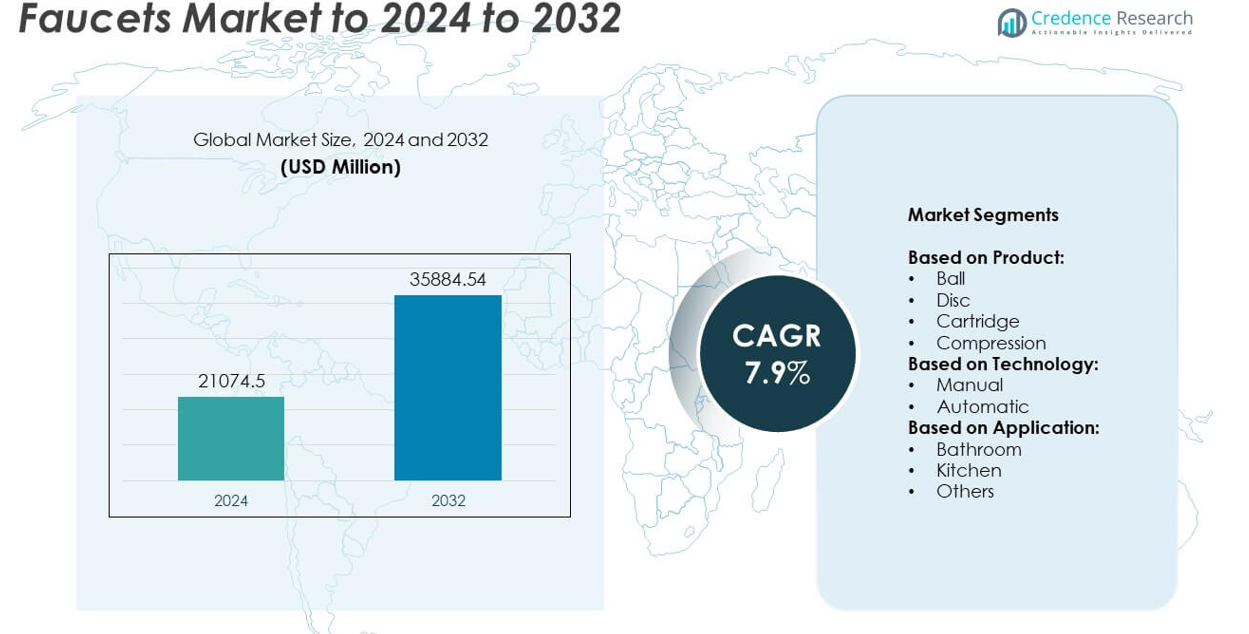
The Faucets Market size was valued at USD 21,074.5 million in 2024 and is anticipated to reach USD 35,884.54 million by 2032, at a CAGR of 7.9% during the forecast period.
| REPORT ATTRIBUTE | DETAILS |
|---|---|
| Historical Period | 2020-2023 |
| Base Year | 2024 |
| Forecast Period | 2025-2032 |
| Faucets Market Size 2024 | USD 21,074.5 million |
| Faucets Market, CAGR | 7.9% |
| Faucets Market Size 2032 | USD 35,884.54 million |
The faucets market is shaped by leading players such as Grohe America Inc., Delta Faucet Company, Kohler Co., Danze Inc., American Standard Brands, Moen Incorporated, Aqua Source Faucet, Masko Corporation, Kraus, USA, and Pfister. These companies focus on expanding product portfolios with smart technologies, sustainable designs, and premium finishes to meet evolving consumer needs. Competitive strategies include investments in research, branding, and global distribution networks. Regionally, Asia Pacific led the market in 2024 with 34% share, supported by rapid urbanization, large-scale infrastructure development, and rising consumer demand for modern housing solutions, making it the fastest-growing region.
Market Insights
- The faucets market size was valued at USD 21,074.5 million in 2024 and is projected to reach USD 35,884.54 million by 2032, growing at a CAGR of 7.9%.
- Growing urbanization, rising residential construction, and demand for water-efficient fixtures are key drivers boosting market expansion across both developed and emerging economies.
- Smart and touchless faucets are gaining traction, driven by hygiene awareness, premiumization trends, and consumer preference for modern, multifunctional designs in bathrooms and kitchens.
- The market is highly competitive, with leading global and regional players focusing on innovation, sustainable product designs, and strengthening distribution through retail and e-commerce, though intense rivalry and raw material price volatility act as restraints.
- Asia Pacific led the market with 34% share in 2024, followed by North America at 32% and Europe at 27%, while the bathroom segment dominated applications with 55% share and ball faucets led product categories with over 35%.
Market Segmentation Analysis:
By Product
Ball faucets held the dominant share of the faucets market in 2024, accounting for over 35% of global demand. Their simple design, durability, and cost-effectiveness make them widely preferred in residential and commercial settings. The one-handle mechanism that controls both temperature and flow ensures user convenience, further boosting adoption. Cartridge faucets are gaining momentum with increased use in modern households due to low maintenance and precise control. Disc and compression faucets remain niche, primarily used in specific applications, but ball faucets continue to drive market leadership through affordability and ease of installation.
- For instance, Delta’s RP70 ball assembly measures a 2-inch stem and 1.5-inch diameter.
By Technology
Manual faucets dominated the market in 2024, capturing more than 70% share, owing to their lower cost, widespread availability, and compatibility across bathrooms and kitchens. Their reliability and simpler installation make them the first choice in developing regions. However, automatic faucets are steadily expanding in share, supported by rising hygiene awareness, water conservation initiatives, and growing smart home adoption. The demand from commercial establishments such as airports, malls, and hotels further strengthens the automatic segment’s growth, yet manual faucets maintain dominance through affordability and long-standing consumer familiarity.
- For instance, the battery life of Sloan BASYS sensor faucets varies. Some models are rated for 3 years at 8,000 cycles per month, while a 5-year service life is possible under certain conditions of 8,000 cycles per month and high water pressure.
By Application
Bathroom applications led the faucets market in 2024, representing nearly 55% of total demand. The dominance is driven by large-scale residential construction, urban housing projects, and remodeling activities focused on improving bathroom aesthetics and water efficiency. Consumers prefer multi-functional faucets with sleek designs, pushing manufacturers to innovate within this segment. Kitchen faucets follow, supported by growing demand for pull-down and touchless features in modern households. The “Others” category, including outdoor and utility faucets, shows steady adoption, but bathroom applications remain the key driver of growth, benefitting from both residential and commercial infrastructure development.
Key Growth Drivers
Rising Urbanization and Residential Construction
Rapid urbanization and expansion of residential projects remain the key growth driver for the faucets market. Growing middle-class populations, increasing disposable incomes, and preference for modern housing fuel demand for advanced bathroom and kitchen fittings. Real estate growth in emerging economies, along with renovation activities in developed markets, supports strong uptake. Consumers are increasingly prioritizing aesthetics, convenience, and water-efficient designs, driving steady adoption across both new installations and replacement markets.
- For instance, Jaquar produces over 45.9 million bath fittings annually and equips 3.3 million bathrooms yearly.
Technological Advancements and Smart Faucets Adoption
The integration of touchless and sensor-based technologies has significantly boosted faucet demand. Automatic faucets that reduce water wastage and enhance hygiene align well with sustainability goals. Commercial spaces such as hotels, malls, and airports are adopting smart faucet systems, creating new revenue streams. Residential customers are also shifting toward digital and voice-activated faucets that integrate with smart home ecosystems. This trend not only enhances convenience but also strengthens manufacturers’ ability to differentiate in a competitive market.
- For instance, while some TOTO EcoPower faucets have a 0.5 GPM flow rate and use 0.09 gallons per 10-second cycle, other models also with a 0.5 GPM flow rate use 0.08 gallons per 10-second cycle.
Water Conservation Regulations and Sustainability Focus
Increasing regulatory pressures and sustainability initiatives strongly drive faucet innovation. Governments and organizations worldwide promote water-efficient fixtures to address water scarcity challenges. Faucets with flow restrictors, aerators, and eco-friendly designs gain traction among environmentally conscious consumers. Certifications such as WaterSense in the U.S. push manufacturers to comply with stricter efficiency standards. This driver accelerates adoption across both commercial and residential sectors, making water conservation a critical factor influencing product development and purchase decisions.
Key Trends & Opportunities
Premiumization and Aesthetic Demand
Rising consumer preference for premium home décor drives demand for stylish and customized faucets. Luxury finishes, designer collections, and multi-functional features are increasingly integrated into modern kitchens and bathrooms. Manufacturers are leveraging this trend by offering differentiated product lines that enhance both utility and aesthetics. This premiumization trend creates strong opportunities for global brands in urban and high-income markets.
- For instance, the Physical Vapour Deposition (PVD) process used for some GROHE StarLight finishes, such as gold or stainless-steel finishes, ensures that the surface composition is 3 times harder and 10 times more scratch-resistant compared to galvanized finishes. The classic chrome finish is produced using a traditional plating process.
Expansion in Emerging Economies
Emerging markets present strong growth opportunities as rising urban populations demand improved sanitation and modern living standards. Governments’ infrastructure investments, especially in Asia-Pacific, fuel faucet adoption in both residential and commercial sectors. Growing retail penetration and e-commerce platforms also increase accessibility for consumers. As disposable incomes rise, adoption of both affordable and advanced faucet systems accelerates in these regions.
- For instance, Roca is present in more than 170 markets, but the number of its factories varies depending on the reporting date. A June 2024 news report mentioned 79 manufacturing facilities, while Roca's history page on their Indian website states 81 production plants as of a more recent date.
Key Challenges
High Competition and Price Pressure
The faucets market faces intense competition among global and regional manufacturers, leading to price pressure. Large-scale players continuously invest in R&D and branding, while regional suppliers offer cost-effective alternatives. This dynamic squeezes profit margins and creates challenges in product differentiation. To overcome this, companies must focus on innovation, smart technology integration, and effective after-sales services to maintain competitiveness.
Raw Material Price Volatility
Fluctuating costs of raw materials such as brass, stainless steel, and chrome significantly impact production expenses. Price instability affects manufacturers’ profitability, especially in regions with limited supply chain flexibility. Smaller players are particularly vulnerable, as they lack the scale to absorb cost fluctuations. Addressing this challenge requires strategic sourcing, recycling initiatives, and stronger supplier relationships to ensure stable production and cost management.
Regional Analysis
North America
North America accounted for nearly 32% of the faucets market share in 2024, driven by high adoption in residential remodeling and premium housing projects. Strong consumer inclination toward modern designs and smart faucets enhances market expansion in the United States and Canada. The region also benefits from strict water conservation regulations such as WaterSense, pushing demand for eco-efficient products. The commercial sector, including hospitality and retail, further contributes to steady growth. With advanced distribution channels and strong presence of global brands, North America continues to lead in revenue contribution and technological adoption.
Europe
Europe held around 27% of the faucets market share in 2024, supported by rising demand for energy-efficient and sustainable fixtures. Countries such as Germany, the United Kingdom, and France focus on green building standards and aesthetic bathroom upgrades, fueling growth. Renovation activities dominate the regional market, with premium product designs gaining traction among urban consumers. Automatic and touchless faucets are increasingly popular in commercial spaces due to heightened hygiene awareness. European consumers also show strong preference for customized designs and luxury finishes, reinforcing the region’s position as a key market for innovative faucet products.
Asia Pacific
Asia Pacific represented the largest share of the faucets market in 2024, accounting for nearly 34% of global demand. Rapid urbanization, infrastructure expansion, and rising disposable incomes across China, India, and Southeast Asia drive adoption. Large-scale residential construction projects and growing investments in commercial establishments such as hotels and malls enhance demand. The region also benefits from expanding e-commerce distribution channels, increasing accessibility for consumers. Affordable yet durable products dominate sales, while premium faucet demand rises with lifestyle upgrades. Asia Pacific is expected to remain the fastest-growing region, supported by population growth and government housing initiatives.
Latin America
Latin America accounted for close to 4% of the faucets market share in 2024, with Brazil and Mexico leading regional growth. Urbanization, rising middle-class income, and housing development programs support steady adoption of bathroom and kitchen faucets. The demand is primarily driven by affordable products, although premium faucets are gaining ground in high-income groups. Infrastructure development in commercial spaces, including hotels and restaurants, also contributes to growth. However, economic instability and price sensitivity remain limiting factors. Despite challenges, Latin America offers long-term opportunities for manufacturers focusing on cost-effective, stylish, and sustainable faucet solutions.
Middle East and Africa
The Middle East and Africa region held around 3% of the faucets market share in 2024, with growth supported by ongoing infrastructure development and luxury real estate projects in countries such as the United Arab Emirates and Saudi Arabia. High demand for premium and designer faucets stems from strong investments in hospitality and commercial spaces. Africa shows growing potential with increasing urbanization and gradual improvement in housing infrastructure. However, limited consumer awareness and fluctuating economic conditions constrain adoption. The region presents niche opportunities for global and regional players offering innovative, water-efficient, and cost-effective faucet solutions.
Market Segmentations:
By Product:
- Ball
- Disc
- Cartridge
- Compression
By Technology:
- Manual
- Automatic
By Application:
- Bathroom
- Kitchen
- Others
By Geography
- North America
- U.S.
- Canada
- Mexico
- Europe
- Germany
- France
- U.K.
- Italy
- Spain
- Rest of Europe
- Asia Pacific
- China
- Japan
- India
- South Korea
- South-east Asia
- Rest of Asia Pacific
- Latin America
- Brazil
- Argentina
- Rest of Latin America
- Middle East & Africa
- GCC Countries
- South Africa
- Rest of the Middle East and Africa
Competitive Landscape
The faucets market is highly competitive, with major players including Grohe America Inc., Delta Faucet Company, Kohler Co., Danze Inc., American Standard Brands, Moen Incorporated, Aqua Source Faucet, Masko Corporation, Kraus, USA, and Pfister. These companies operate in a dynamic environment characterized by continuous innovation, product differentiation, and brand positioning. Competition is shaped by rising consumer demand for advanced designs, smart technologies, and sustainable solutions that meet evolving preferences in both residential and commercial segments. Manufacturers focus on integrating water-saving features, premium finishes, and touchless technologies to gain a competitive edge. Strong distribution networks, global retail partnerships, and expanding e-commerce platforms further intensify competition, ensuring greater product accessibility across regions. Additionally, investment in research and development, sustainability initiatives, and after-sales services play a crucial role in retaining market share. The landscape is expected to remain highly dynamic, with companies increasingly adopting strategies that balance affordability, performance, and design innovation.
Key Player Analysis
- Grohe America Inc.
- Delta Faucet Company
- Kohler Co.
- Danze Inc.
- American Standard Brands
- Moen Incorporated
- Aqua Source Faucet
- Masko Corporation
- Kraus, USA
- Pfister
Recent Developments
- In 2025, Kohler unveiled the Anthem Digital Valve system as part of its smart home ecosystem, showcased at the Kitchen and Bath Industry Show (KBIS) earlier in the year. This system, available as part of the new Anthem+ smart showering system, allows for digital controls over aspects like water flow, temperature, lighting, and sound through a single interface and the KOHLER Konnect® app.
- In 2025, Moen Incorporated Launched its Instant Hot SIP™ faucets and Instant Hot tank, providing near-boiling water directly from the sink for convenience.
- In 2024, Delta Faucet Company (a Masco Corporation company) Introduced Touch2O with Touchless Technology, a versatile kitchen faucet showcased at the KBIS.
Report Coverage
The research report offers an in-depth analysis based on Product, Technology, Application and Geography. It details leading market players, providing an overview of their business, product offerings, investments, revenue streams, and key applications. Additionally, the report includes insights into the competitive environment, SWOT analysis, current market trends, as well as the primary drivers and constraints. Furthermore, it discusses various factors that have driven market expansion in recent years. The report also explores market dynamics, regulatory scenarios, and technological advancements that are shaping the industry. It assesses the impact of external factors and global economic changes on market growth. Lastly, it provides strategic recommendations for new entrants and established companies to navigate the complexities of the market.
Future Outlook
- The faucets market will expand steadily, driven by rising urbanization and housing demand.
- Smart faucets with touchless and sensor technologies will gain wider household adoption.
- Bathroom applications will continue to dominate, supported by remodeling and aesthetic upgrades.
- Kitchen faucet demand will rise due to multifunctional designs and advanced pull-down models.
- Water-saving regulations will push manufacturers to design eco-efficient faucet systems.
- Asia Pacific will remain the fastest-growing region, led by infrastructure development and urban growth.
- Premium and luxury faucet designs will attract high-income consumers in developed regions.
- E-commerce platforms will boost market reach and enhance accessibility in emerging economies.
- Competition will intensify, encouraging players to focus on innovation and brand differentiation.
- Rising raw material costs will challenge profitability, pushing manufacturers toward sustainable sourcing.

Request a Free Sample
Fill in your details and we'll send you a free sample report.
- Sample data tables & charts
- Research methodology
Market Dynamics
Rising Urbanization and Residential Construction
Rapid urbanization and the expansion of residential projects, especially in emerging economies, are fueling demand for modern bathroom and kitchen fittings. Increased disposable incomes and a growing middle class are driving the adoption of advanced and aesthetically pleasing faucets in both new constructions and renovations.
Technological Advancements and Smart Faucets Adoption
The integration of touchless, sensor-based, and digital technologies is boosting faucet demand, particularly in commercial and high-end residential settings. These innovations enhance hygiene, convenience, and water efficiency, aligning with consumer preferences for smart home solutions.
Water Conservation Regulations and Sustainability Focus
Stricter government regulations and sustainability initiatives are pushing manufacturers to develop water-efficient faucets with features like flow restrictors and aerators. Certifications such as WaterSense in the U.S. are accelerating the adoption of eco-friendly products across both residential and commercial sectors.
Premiumization and Aesthetic Demand
Consumers are increasingly seeking premium, stylish, and customized faucets to complement modern home décor. The demand for luxury finishes, designer collections, and multifunctional features is driving manufacturers to innovate and differentiate their product offerings.
Expansion in Emerging Economies
Infrastructure investments and rising urban populations in Asia Pacific and Latin America are creating strong growth opportunities. Improved retail and e-commerce penetration are making advanced and affordable faucet solutions more accessible to a broader consumer base.
Need a Custom Version of This Report?
Tailor the scope, geography, or segments to your exact requirements.
- Custom geography or segment scope
- Direct access to our analyst team
Frequently Asked Questions
What is the current market size for Faucets Market, and what is its projected size in 2032?
Which Faucets Market segment held the largest share in 2024?
What are the primary factors fueling the growth of the Faucets Market?
Who are the leading companies in the Faucets Market?
Table of Content
Chapter 1 Market Segmentation
- 1.1 Segmentation Framework
- 1.1.1 Product and Service Classification
- 1.1.2 Application and End-Use Classification
- 1.1.3 Technology and Solution Classification
- 1.1.4 Customer and Distribution Channel Classification
- 1.1.5 Geographic Segmentation
- 1.1.6 Market Segment Definitions and Boundaries
- 1.2 By Product
- 1.2.1 Ball
- 1.2.2 Disc
- 1.2.3 Cartridge
- 1.2.4 Compression
- 1.3 By Technology
- 1.3.1 Manual
- 1.3.2 Automatic
- 1.4 By Application
- 1.4.1 Bathroom
- 1.4.2 Kitchen
- 1.4.3 Others
Chapter 2 Introduction
- 2.1 Report Objectives and Scope
- 2.2 Product Definition and Industry Terminology
- 2.3 Market Inclusions and Exclusions
- 2.4 Research Process
- 2.4.1 Primary Research and Expert Interviews
- 2.4.2 Secondary Research and Source Review
- 2.4.3 Top-Down and Bottom-Up Estimation
- 2.4.4 Data Triangulation and Verification
- 2.5 Market Size Measurement Basis
- 2.5.1 2024: USD 21,074.5 million → 2032: USD 35,884.54 million
- 2.6 Historical and Forecast Reference Periods
- 2.6.1 Base Year: 2024
- 2.6.2 Forecast Period: 2024-2032
- 2.7 Research Assumptions and Limitations
Chapter 3 Executive Summary
- 3.1 Market Snapshot and Key Findings
- 3.2 Base-Year Market Size, 2024
- 3.3 Forecast Market Size, 2032
- 3.4 Revenue and Volume Growth Outlook
- 3.5 Key Demand and Supply Indicators
- 3.6 Leading Market Segments
- 3.7 Fastest-Growing Market Opportunities
- 3.8 Regional Performance Highlights
- 3.9 Technology and Industry Transformation
- 3.10 Competitive Landscape Summary
- 3.11 Analyst View and Strategic Implications
Chapter 4 Global Faucets Market Trends and Developments
- 4.1 Historical Industry Development
- 4.2 Recent Market Trends and Developments
- 4.3 Demand and Customer Behavior Trends
- 4.4 Technology and Product Innovation
- 4.5 Artificial Intelligence, Automation and Digitalization
- 4.6 Local Manufacturing and Supply Chain Realignment
- 4.7 Industry Partnerships, Mergers and Acquisitions
- 4.8 Sustainability and Circular Economy Developments
- 4.9 Government and Private Sector Investment Trends
- 4.10 Emerging Business Models and Commercialization
- 4.11 Industry Developments and Announcements
Chapter 5 Global Faucets Market Production, Supply and Demand Analysis
- 5.1 Demand Trend and Consumption Analysis
- 5.2 Demand Forecast, 2024-2032
- 5.3 Production and Output Trend
- 5.4 Production and Output Forecast, 2024-2032
- 5.5 Installed Capacity and Capacity Utilization
- 5.6 Company-Wise Production Plants and Statistics
- 5.6.1 Installed Production Capacity
- 5.6.2 Actual Production
- 5.6.3 Planned Capacity and Expansion Targets
- 5.7 Supply Chain Structure and Procurement Trends
- 5.8 Supply-Demand Gap and Bottlenecks
- 5.9 Import Dependence and Sourcing Structure
- 5.10 Contract Manufacturing and Outsourcing
- 5.11 Regional Supply and Demand Concentration
Chapter 6 Global Faucets Market Pricing Analysis
- 6.1 Pricing Structure and Measurement
- 6.2 Historical Pricing Trends
- 6.3 Pricing Outlook, 2024-2032
- 6.4 Average Selling Price and Unit Economics
- 6.5 Pricing by Product and Market Segment
- 6.6 Geographic Pricing Differences
- 6.7 Key Input, Energy, Labor and Logistics Costs
- 6.8 Contract Pricing and Purchasing Models
- 6.9 Pricing Sensitivity and Competitive Positioning
- 6.10 Price, Margin and Profitability Implications
Chapter 7 Global Faucets Market Dynamics
- 7.1 Market Growth Drivers
- 7.1.1 Demand-Side Drivers
- 7.1.2 Technology and Innovation Drivers
- 7.1.3 Infrastructure and Investment Drivers
- 7.1.4 Regulatory and Policy Drivers
- 7.2 Market Restraints
- 7.2.1 Cost and Affordability Constraints
- 7.2.2 Technology and Adoption Barriers
- 7.2.3 Supply Chain and Operational Constraints
- 7.3 Market Challenges
- 7.3.1 Competitive Pressure and Margin Erosion
- 7.3.2 Skills, Infrastructure and Implementation Gaps
- 7.4 Emerging Market Opportunities
- 7.5 Market Dynamics Impact and Time-Horizon Assessment
Chapter 8 Global Faucets Value Chain Analysis
- 8.1 Industry Value Chain Overview
- 8.2 Upstream Suppliers and Critical Inputs
- 8.3 Technology and Component Providers
- 8.4 Manufacturing or Service Delivery
- 8.5 Distribution, Channel Partners and Integrators
- 8.6 Downstream Applications and End Users
- 8.7 Value Addition and Profit Pools
- 8.8 Vertical Integration and Outsourcing
- 8.9 Supplier Concentration and Risk
- 8.10 Supply Chain Localization and Resilience
Chapter 9 Global Faucets Market Regulations and Policies
- 9.1 Relevant Laws, Standards and Compliance Frameworks
- 9.2 Product, Service, Safety and Quality Requirements
- 9.3 Government Policies, Incentives and Subsidies
- 9.4 Imports, Exports and Trade Barriers
- 9.5 Public Procurement and Local Content Requirements
- 9.6 Environmental and Sustainability Compliance
- 9.7 Upcoming Policy Changes and Market Implications
Chapter 10 Global Faucets Market Hotspots and Opportunities
- 10.1 Market Opportunity Mapping and Growth Hotspots
- 10.2 High-Growth Applications and Customer Groups
- 10.3 Underserved Markets and White-Space Opportunities
- 10.4 Emerging Technology and Product Opportunities
- 10.5 New Capacity and Investment Hotspots
- 10.6 Market Entry and Expansion Opportunities
- 10.7 Distribution and Partnership Opportunities
- 10.8 Near-Term and Long-Term Commercial Potential
- 10.9 Opportunity Attractiveness and Execution Risks
Chapter 11 Global Faucets Market Outlook, 2024-2032
- 11.1 Market Size and Analysis
- 11.1.1 Revenue (Market Measurement: 2024: USD 21,074.5 million → 2032: USD 35,884.54 million)
- 11.1.2 Market Volume and Quantity Sold
- 11.1.3 Historical Market Size
- 11.1.4 Base-Year Market Size, 2024
- 11.2 Market Forecast, 2024-2032
- 11.2.1 Revenue Forecast to 2032
- 11.2.2 Volume Forecast to 2032
- 11.2.3 CAGR and Year-on-Year Growth
- 11.2.4 Incremental Revenue Opportunity
- 11.3 Forecast Assumptions and Scenario Analysis
- 11.3.1 Base-Case Forecast
- 11.3.2 Optimistic and Conservative Scenarios
- 11.3.3 Technology, Pricing and Policy Sensitivities
- 11.4 Market Attractiveness and Growth Outlook
Chapter 12 Global Faucets Market Segmentation and Outlook
- 12.1 Segmentation Summary and Market Shares, 2024
- 12.2 Largest and Fastest-Growing Segments
- 12.3 By Product - Market Size and Forecast, 2024-2032
- 12.3.1 Segment Definition and Scope
- 12.3.2 Historical Market Size
- 12.3.3 Revenue Forecast, 2024-2032
- 12.3.4 Volume Forecast, 2024-2032
- 12.3.5 Base-Year Market Share, 2024
- 12.3.6 Segment CAGR and Growth Drivers
- 12.3.7 Subsegment Market Size and Forecast
- 12.3.7.1 Ball
- 12.3.7.2 Disc
- 12.3.7.3 Cartridge
- 12.3.7.4 Compression
- 12.3.8 Subsegment Pricing and Adoption Trends
- 12.3.9 Leading Suppliers and Competition
- 12.3.10 Regional Demand and Opportunities
- 12.4 By Technology - Market Size and Forecast, 2024-2032
- 12.4.1 Segment Definition and Scope
- 12.4.2 Historical Market Size
- 12.4.3 Revenue Forecast, 2024-2032
- 12.4.4 Volume Forecast, 2024-2032
- 12.4.5 Base-Year Market Share, 2024
- 12.4.6 Segment CAGR and Growth Drivers
- 12.4.7 Subsegment Market Size and Forecast
- 12.4.7.1 Manual
- 12.4.7.2 Automatic
- 12.4.8 Subsegment Pricing and Adoption Trends
- 12.4.9 Leading Suppliers and Competition
- 12.4.10 Regional Demand and Opportunities
- 12.5 By Application - Market Size and Forecast, 2024-2032
- 12.5.1 Segment Definition and Scope
- 12.5.2 Historical Market Size
- 12.5.3 Revenue Forecast, 2024-2032
- 12.5.4 Volume Forecast, 2024-2032
- 12.5.5 Base-Year Market Share, 2024
- 12.5.6 Segment CAGR and Growth Drivers
- 12.5.7 Subsegment Market Size and Forecast
- 12.5.7.1 Bathroom
- 12.5.7.2 Kitchen
- 12.5.7.3 Others
- 12.5.8 Subsegment Pricing and Adoption Trends
- 12.5.9 Leading Suppliers and Competition
- 12.5.10 Regional Demand and Opportunities
- 12.6 Segment Growth Comparison
- 12.7 Segment Attractiveness and Priority Matrix
Chapter 13 Global Faucets End-Use and Application Market Outlook
- 13.1 End-Use Industry and Customer Demand Structure
- 13.2 Leading Applications and Customer Groups
- 13.3 End-Use Market Size, Share and Forecast
- 13.4 Major End-Use Industry Deep Dives
- 13.4.1 Customer Requirements and Use Cases
- 13.4.2 Demand and Replacement Cycles
- 13.4.3 Technical and Regulatory Considerations
- 13.4.4 Purchasing and Procurement Models
- 13.4.5 Leading Vendors and Distribution Channels
- 13.4.6 Forecast and Commercial Opportunities
- 13.5 Emerging Applications and Cross-Segment Demand
- 13.6 End-Use Industry Investment Priorities
Chapter 14 Global Faucets Geographic Market Outlook, 2024-2032
- 14.1 Regional Market Size and Share, 2024
- 14.2 Regional Market Forecast, 2024-2032
- 14.3 Regional Pricing, Production and Demand Differences
- 14.4 North America
- 14.4.1 United States
- 14.4.2 Canada
- 14.4.3 Mexico
- 14.5 Europe
- 14.5.1 Germany
- 14.5.2 France
- 14.5.3 Italy
- 14.5.4 United Kingdom
- 14.5.5 Spain
- 14.5.6 Poland
- 14.5.7 Russia
- 14.5.8 Netherlands
- 14.5.9 Belgium
- 14.5.10 Sweden
- 14.5.11 Denmark
- 14.5.12 Norway
- 14.5.13 Rest of Europe
- 14.6 Asia Pacific
- 14.6.1 China
- 14.6.2 India
- 14.6.3 Japan
- 14.6.4 South Korea
- 14.6.5 Thailand
- 14.6.6 Indonesia
- 14.6.7 Vietnam
- 14.6.8 Malaysia
- 14.6.9 Australia
- 14.6.10 Rest of Asia Pacific
- 14.7 Latin America
- 14.7.1 Brazil
- 14.7.2 Argentina
- 14.7.3 Colombia
- 14.7.4 Chile
- 14.7.5 Rest of Latin America
- 14.8 Middle East
- 14.8.1 Saudi Arabia
- 14.8.2 United Arab Emirates
- 14.8.3 Turkey
- 14.8.4 Israel
- 14.8.5 Iran
- 14.8.6 Rest of the Middle East
- 14.9 Africa
- 14.9.1 South Africa
- 14.9.2 Egypt
- 14.9.3 Nigeria
- 14.9.4 Morocco
- 14.9.5 Rest of Africa
- 14.10 Regional Investment, Policy and Supply Chain Differences
- 14.11 Regional Competitive Landscape
- 14.12 Geographic Growth Hotspots
Chapter 15 Global Faucets Technology, Innovation and Sustainability Outlook
- 15.1 Technology Landscape and Maturity
- 15.2 Product, Process and Service Innovation
- 15.3 AI, Automation and Digital Tools in the Industry
- 15.4 Technology Adoption and Performance Benchmarking
- 15.5 Innovation Pipeline and R&D Investment
- 15.6 Patent and Intellectual Property Trends
- 15.7 Energy Efficiency and Resource Management
- 15.8 Sustainability, Recycling and Circularity
- 15.9 Technology Roadmap, 2024-2032
- 15.10 Risks of Obsolescence and Technology Substitution
Chapter 16 Global Faucets Market Key Strategic Imperatives
- 16.1 Growth and Market Entry Priorities
- 16.2 High-Return Products and Segments
- 16.3 Pricing, Profitability and Cost Optimization
- 16.4 Technology Investment and Product Differentiation
- 16.5 Supply Chain Localization and Resilience
- 16.6 Distribution and Customer Acquisition
- 16.7 Partnership, Acquisition and Capacity Strategy
- 16.8 Regional Expansion Priorities
- 16.9 Short-, Medium- and Long-Term Actions
Chapter 17 Competition Outlook
- 17.1 Industry Competition Characteristics
- 17.2 Market Structure and Concentration
- 17.3 Market Share and Competitive Positioning, 2024
- 17.4 Company-Wise Revenue and Product Benchmarking
- 17.5 Production and Service Capacity Benchmarking
- 17.6 Technology, Pricing and Differentiation
- 17.7 Regional Footprint and Distribution Strength
- 17.8 Mergers, Acquisitions and Strategic Alliances
- 17.9 New Entrants and Competitive Threats
- 17.10 Porter's Five Forces and Industry Attractiveness
- 17.11 Competitive Outlook, 2024-2032
Chapter 18 Company Profiles
- 18.1 Company Coverage and Selection Criteria
- 18.2 Grohe America Inc.
- 18.2.1 Business Description
- 18.2.2 Company Ownership and Geographic Presence
- 18.2.3 Product and Service Portfolio
- 18.2.4 Manufacturing and Operating Footprint
- 18.2.5 Production Capacity and Expansion Plans
- 18.2.6 Financial Performance and Investment
- 18.2.7 Market Share and Competitive Position
- 18.2.8 Technology and Innovation Capabilities
- 18.2.9 Strategic Alliances or Partnerships
- 18.2.10 Recent Developments
- 18.2.11 Growth Strategy and Outlook
- 18.3 Delta Faucet Company
- 18.4 Kohler Co.
- 18.5 Danze Inc.
- 18.6 American Standard Brands
- 18.7 Moen Incorporated
- 18.8 Aqua Source Faucet
- 18.9 Masko Corporation
- 18.10 Kraus, USA
- 18.11 Pfister
- 18.12 Other Relevant Market Participants
Note: Every listed company is profiled on the structure shown under the first company. The company list is preliminary and may change based on research findings, market developments, data availability and client requirements.
Chapter 19 Disclaimer
- 19.1 Research and Forecast Disclaimer
- 19.2 Data Source and Estimation Limitations
Note: The depth of individual sections depends on data availability for this market. Volume, capacity, trade and other unit-based metrics are included where applicable.

