
| REPORT ATTRIBUTE | DETAILS |
|---|---|
| Historical Period | 2020-2023 |
| Base Year | 2024 |
| Forecast Period | 2025-2032 |
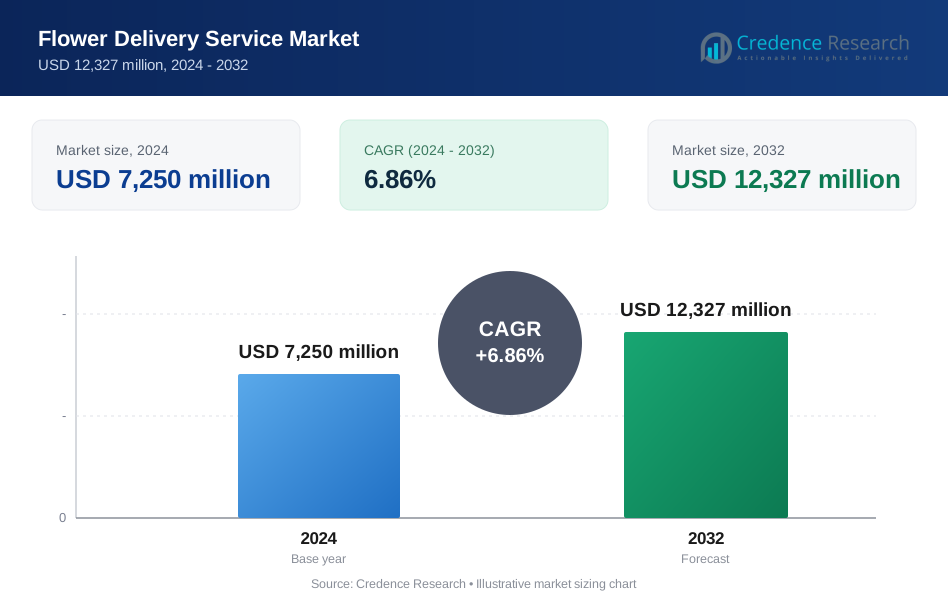
| Flower Delivery Service Market Size 2024 | USD 7,250 Million |
| Flower Delivery Service Market, CAGR | 6.86% |
| Flower Delivery Service Market Size 2032 | USD 12,327 Million |
Market Overview:
The Global Flower Delivery Service Market is projected to grow from USD 7,250 million in 2024 to USD 12,327 million by 2032, at a compound annual growth rate (CAGR) of 6.86%.
The flower delivery service market is driven by increasing consumer demand for convenient and quick gifting solutions, especially for special occasions such as birthdays, weddings, and holidays. The growing trend of e-commerce and mobile applications has made it easier for consumers to order fresh flowers online, boosting market growth. Additionally, businesses are increasingly offering same-day and express delivery services to meet the expectations of time-sensitive customers. Rising disposable incomes and a growing preference for premium, personalized flower arrangements have further fueled demand. The market is also witnessing a shift towards eco-friendly and sustainable floral products, aligning with global environmental concerns. Technological advancements, such as route optimization and real-time tracking, are enhancing operational efficiency and customer satisfaction.
The flower delivery service market shows regional variations in growth, driven by factors like e-commerce adoption and disposable income levels. North America, with about 35% market share, is led by companies like 1-800-FLOWERS.COM Inc. and UrbanStems, Inc., while Europe, holding 30%, sees strong demand in countries like Germany and the UK. In the Asia-Pacific region, accounting for 20%, fast-growing markets like India and China are benefiting from expanding digital platforms, with players such as Floward and FNP E Retail Private Limited. Latin America (8%) and the Middle East & Africa (7%) are smaller markets but are experiencing growth, especially in countries like Brazil, Colombia, the UAE, and South Africa. Key players across these regions compete on speed of delivery, product variety, and customer experience to capture market share.
Market Insights:
- The global flower delivery service market is projected to grow from USD 7,250 million in 2024 to USD 12,327 million by 2032, at a CAGR of 6.86%.
- Rising consumer demand for convenient gifting solutions, particularly for special occasions like birthdays, weddings, and holidays, drives the flower delivery service market.
- E-commerce and mobile applications have revolutionized the market, making it easier for customers to order fresh flowers online, boosting demand.
- Businesses are increasingly offering same-day and express delivery services, catering to time-sensitive customers and enhancing customer satisfaction.
- Rising disposable incomes, especially in developing regions, are fueling demand for premium and personalized flower arrangements.
- Technological advancements in delivery logistics, including route optimization and real-time tracking, are improving operational efficiency and customer experience.
- Regional market variations exist, with North America holding 35% market share, Europe 30%, Asia-Pacific 20%, Latin America 8%, and the Middle East & Africa 7%.
Market Drivers:
Increasing Consumer Demand for Convenient Gifting Solutions:
The rising need for convenient and quick gifting options is a significant driver in the flower delivery service market. Consumers are increasingly opting for flowers as an ideal gift choice for various occasions, including birthdays, anniversaries, and holidays. FTD Companies offers on-demand flower delivery through its mobile app, enabling customers to send flowers even on short notice. For instance, FTD Companies controlled 29.0% of flower sales during early February 2025, up from 27.4% in 2024, reflecting increased consumer preference for convenient gifting solutions. The ease of ordering through mobile applications and online platforms has led to consistent market growth. Additionally, the trend of sending flowers as a gesture of appreciation or sympathy is further expanding the customer base.
Expanding E-commerce and Digitalization:
The growth of e-commerce has transformed the flower delivery industry, providing consumers with easy access to a wide range of floral products. Online platforms allow customers to browse different arrangements, compare prices, and read reviews, resulting in more informed purchasing decisions. For example, 1-800-Flowers.com integrated its e-commerce operations across more than a dozen brands using Contentstack's content management platform in July 2024, significantly enhancing website stability and enabling faster content updates without downtime. The increasing penetration of smartphones and high-speed internet is enabling users to place orders from any location, making the process seamless and user-friendly. Businesses are capitalizing on this trend by offering user-friendly mobile applications and websites with enhanced customer interfaces.
Rising Disposable Income and Premiumization:
A key driver of growth in the flower delivery service market is the increase in disposable income, particularly in developing regions. As consumers' purchasing power increases, there is a greater demand for premium and customized flower arrangements, often featuring exotic or rare blooms. The Bouqs Company specializes in premium floral arrangements with rare and exotic blooms, catering to customers seeking unique designs. This shift towards personalized and luxury floral offerings has created a new market segment that caters to discerning customers willing to pay more for unique and aesthetically pleasing floral designs.
Technological Advancements in Delivery Services:
Technological innovations in delivery logistics are significantly driving the market. Features such as same-day or express delivery, route optimization, real-time order tracking, and proof of delivery have improved the speed, reliability, and efficiency of flower delivery services. ProFlowers has implemented real-time order tracking and optimized delivery routes to enhance customer satisfaction and reduce delivery times. These advancements ensure customer satisfaction, reduce delivery costs, and enhance the overall service experience, thereby boosting market growth.
Market Trends:
Rise of Same-Day and Express Delivery:
A growing trend in the flower delivery service market is the increasing availability of same-day and express delivery options. Consumers today expect faster services, and businesses are responding by offering efficient, time-sensitive deliveries to meet customer demands. For instance, FTD offers guaranteed same-day flower delivery across the U.S., provided orders are placed by 2 p.m. on weekdays and 1 p.m. on weekends in the recipient's time zone. This trend is particularly significant during peak gifting seasons such as Valentine’s Day and Mother’s Day, where timely delivery is crucial.
Growth of Eco-Friendly and Sustainable Products:
The demand for eco-friendly and sustainable floral products is on the rise as environmentally conscious consumers seek options that align with their values. Flower delivery companies are increasingly offering organic, locally sourced, and sustainably grown flowers, along with biodegradable or recyclable packaging. For instance, The Bouqs Company focuses on providing eco-friendly floral arrangements by sourcing flowers from sustainable farms and using recyclable packaging. This shift towards sustainability not only helps reduce the environmental impact but also appeals to a growing segment of consumers who prioritize eco-friendly purchases.
Personalization and Customization:
Customers are showing a growing preference for personalized and customized floral arrangements. Flower delivery services are now offering options for tailor-made bouquets that reflect individual tastes and preferences, from selecting specific flower types to customizing packaging and messages. For instance, Blossom Flower, a California-based flower delivery service, implemented personalized website features in October 2024, resulting in a 9% incremental revenue increase compared to their control group and collecting 7,836 new customer leads within one month. This trend drives higher customer satisfaction and loyalty.
Integration of Technology and Digital Tools:
Technology continues to play a vital role in the evolution of the flower delivery service market. The use of mobile apps, real-time tracking systems, and AI-powered recommendation engines has enhanced the customer experience by providing seamless ordering, tracking, and personalized product suggestions. For instance, ProFlowers uses AI-powered tools to recommend floral arrangements based on customer preferences, making the purchasing process more convenient and engaging. Additionally, the integration of payment gateways and virtual assistance tools further simplifies ordering flowers online.
Market Challenges Analysis:
Perishability and Logistics Complexities:
One of the primary challenges faced by the flower delivery service market is the perishable nature of flowers. Ensuring that fresh flowers reach customers in perfect condition requires careful handling, efficient storage, and precise logistics. Delays in transportation or improper handling can lead to damaged or wilted products, resulting in customer dissatisfaction, returns, and potential business loss. The logistics of delivering fresh flowers, especially for same-day or express services, adds complexity, as maintaining product freshness throughout the process is crucial. Companies need to maintain a cold chain system and optimize routes to ensure timely delivery while preserving flower quality. Additionally, managing high demand during peak seasons, such as Valentine’s Day or Mother’s Day, can strain delivery networks, cause bottlenecks, and affect service reliability. Without proper logistical infrastructure, businesses risk failing to meet customer expectations, impacting their reputation and long-term profitability.
Intense Competition and Price Sensitivity:
The flower delivery service market is highly competitive, with numerous players, from large e-commerce platforms to small local florists, vying for market share. This intense competition often leads to price wars and the need to offer competitive pricing, which can significantly squeeze profit margins. Smaller businesses, in particular, may struggle to keep up with the large-scale operations, advanced technology, and marketing budgets of bigger players, making it difficult to stand out and differentiate themselves in a crowded market. For instance, a report published in November 2024 revealed that price sensitivity among consumers is high, with 65% of customers prioritizing price over other factors when selecting a flower delivery service. Moreover, consumers in this market tend to be highly price-sensitive, often comparing different platforms and services to secure the best deals. As a result, companies are under pressure to offer premium products, quick deliveries, and exceptional customer service while maintaining affordable pricing. Achieving this balance can be particularly challenging, especially as operating costs for logistics, flower procurement, and marketing continue to rise. The need for continuous innovation in delivery efficiency and product differentiation adds further strain to maintaining profitability in this dynamic and competitive environment.
Market Opportunities:
The flower delivery service market presents significant growth opportunities driven by the increasing adoption of digital platforms and mobile applications. As more consumers shift towards online shopping for convenience, businesses can expand their reach by investing in user-friendly websites and mobile apps. Offering personalized customer experiences, such as customized flower arrangements, occasion-specific bundles, and tailored recommendations through data analytics, can enhance consumer engagement and satisfaction. Moreover, expanding same-day and express delivery services in underserved regions or cities can attract new customers and create a competitive advantage. Partnering with local florists to streamline delivery operations and reduce logistical challenges can also lead to better service efficiency and broader market penetration.
Additionally, the growing demand for eco-friendly and sustainable products offers a promising opportunity for businesses to differentiate themselves. Companies can capitalize on this trend by offering organic, locally sourced flowers, and eco-conscious packaging, aligning with environmentally conscious consumer preferences. Investing in sustainable practices, such as reducing carbon footprints in delivery processes or minimizing waste, can enhance brand reputation and appeal to a broader audience. Furthermore, expanding into new markets, particularly in developing regions with rising disposable incomes, provides an opportunity for growth. Businesses that innovate in logistics, product offerings, and sustainability stand to capture a larger share of the market and solidify their presence in this evolving industry.
Market Segmentation Analysis:
By Product
The flower delivery service market is segmented by product into bouquets, floral arrangements, and single stems. Bouquets and floral arrangements account for the majority of the market due to their popularity for gifting and special occasions. Single stems, often used for decorative purposes or minimalist gifting, cater to niche customers and are steadily growing in demand.
By Occasion
The market is also segmented by occasion, including birthdays, weddings, holidays, and corporate events. Special occasions like Valentine’s Day, Mother’s Day, and weddings drive the bulk of flower orders. Corporate events and ceremonies contribute to a smaller yet growing segment, especially with businesses increasingly incorporating floral arrangements for office décor and events.
By Type
By type, the market is divided into same-day delivery, scheduled delivery, and subscription services. Same-day delivery services are in high demand for time-sensitive orders, while subscription services are growing in popularity among consumers seeking regular deliveries for home décor or gifting. Scheduled deliveries cater to customers planning in advance.
Segments:
Based on Product
- Rose
- Tulip
- Orchid
- Lily
- Gerbera
- Sunflower
- Carnations
- Others
Based on Occasion
- Corporate Event
- Wedding
- Personal & Gifting
- Sympathy
Based on Type
- Bouquets
- Flower for Vases
- Cut Flowers
- Plants
Based on Application
- Commercial
- Household
Based on the Geography:
- North America
- U.S.
- Canada
- Mexico
- Europe
- Germany
- France
- U.K.
- Italy
- Spain
- Rest of Europe
- Asia Pacific
- China
- Japan
- India
- South Korea
- South-east Asia
- Rest of Asia Pacific
- Latin America
- Brazil
- Argentina
- Rest of Latin America
- Middle East & Africa
- GCC Countries
- South Africa
- Rest of the Middle East and Africa
Regional Analysis:
North America
North America holds a significant share of the flower delivery service market, accounting for 35% of the global market share in 2024. The region’s mature e-commerce infrastructure and the high disposable income of consumers drive demand for flower delivery services. The U.S. dominates the North American market, with consumers increasingly relying on online platforms for gifting during special occasions such as Valentine’s Day, Mother’s Day, and weddings. The growing trend of personalized floral arrangements and same-day delivery services has further bolstered market growth. Additionally, major players like 1-800-Flowers and UrbanStems continue to expand their service offerings, ensuring strong competition within the region.
Europe
Europe holds 30% of the global flower delivery service market share in 2024. Countries such as Germany, the UK, and the Netherlands lead the market due to their well-established floral industries and the cultural significance of gifting flowers. E-commerce is rapidly growing in the region, contributing to the increased use of flower delivery services. The rising demand for eco-friendly, locally sourced flowers also aligns with the region’s sustainability initiatives, further driving growth. Flower subscription services are gaining popularity in Europe, allowing customers to receive regular flower deliveries for home or office use.
Asia-Pacific
Asia-Pacific is expected to account for 20% of the global flower delivery service market share in 2024, with significant growth potential in emerging economies like China, India, and Japan. Rising disposable incomes and the growing adoption of e-commerce platforms are major factors fueling demand for flower delivery services in this region. India, in particular, is experiencing rapid growth in its e-commerce sector, with local players like Flipkart entering the market with same-day and express delivery options. As consumers increasingly shift towards online gifting solutions, companies in the region are expected to see significant market expansion.
Latin America
Latin America accounts for 8% of the global flower delivery service market share in 2024. Brazil, Mexico, and Colombia are key contributors to the region’s growth, with the local floral industry playing a crucial role in driving demand. Colombia, known for its flower exports, is witnessing an increase in domestic demand for flower delivery services. The rise of mobile internet usage and digital platforms has enabled consumers in Latin America to access convenient flower delivery services, boosting market growth in the region.
Middle East & Africa
The Middle East and Africa region holds 7% of the global flower delivery service market share in 2024. The market in this region is still developing, with increasing demand for online services and e-commerce infrastructure growth contributing to market expansion. The UAE and South Africa are key markets where the flower delivery service industry is gaining traction, primarily driven by growing disposable incomes and an increasing preference for online gifting solutions.
Key Player Analysis:
- UrbanStems, Inc.
- 1-800-FLOWERS.COM Inc
- From You Flowers, LLC
- Venus ET Fleur
- Bloomex
- The Wonderful Company LLC
- Floward
- The Bouqs Company
- The Sill, Inc.
- FNP E Retail Private Limited
Competitive Analysis:
The flower delivery service market is highly competitive, with leading players such as 1-800-FLOWERS.COM Inc, UrbanStems, Inc., From You Flowers, LLC, The Sill, Inc., Bloomex, Floward, The Bouqs Company, The Wonderful Company LLC, Venus ET Fleur, and FNP E Retail Private Limited dominating the space. These companies focus on offering a wide range of floral products and services, from same-day delivery to premium, personalized arrangements, catering to diverse customer preferences. Venus ET Fleur is renowned for its luxury, long-lasting arrangements, which appeal to consumers seeking unique and premium floral gifts. E-commerce platforms and mobile apps play a crucial role in their strategies, enabling seamless customer experiences and broader market reach. Competitive differentiation arises from factors like product quality, speed of delivery, and sustainability practices. Companies that invest in route optimization, innovative marketing, and technology-driven customer service tend to maintain a competitive edge. The rising demand for eco-friendly and luxury floral products presents further opportunities for market leaders to capture and retain customer loyalty in this growing sector.
Recent Developments:
- In February 2024, Flipkart, the Indian e-commerce giant, introduced a 3-hour fresh flower delivery service. This offering allows customers to order premium flower arrangements at competitive prices, with deliveries across 450+ pin codes through Flipkart's reliable network. With holidays such as Valentine's Day and Rose Day approaching, Flipkart promised delivery within three hours for orders placed between 9:00 AM and 6:00 PM daily.
- In January 2024, UrbanStems, a prominent modern floral gifting company, secured $5 million in Series C extension funding from existing investors. The round was led by DF Enterprises and SWaN & Legend, with the funds supporting the company's expansion of same-day delivery to more U.S. cities. The announcement coincided with UrbanStems' entry into Miami, the world's largest floral market, for same-day deliveries.
- In May 2023, a merger between From You Flowers, LLC (FYF), a leading U.S. floral e-commerce company, and FTD, LLC, a pioneer in the floral industry, was finalized. This strategic merger forms a global platform for the floral and gifting industry, enhancing consumer experiences by offering a wider range of products and services. FTD member florists are expected to benefit from increased business, enhanced support, and a nearly doubled volume of orders through the network.
- In April 2024, Walmart GoLocal introduced route optimization and batched delivery capabilities for 1-800-Flowers, enabling more efficient order processing at lower costs. The service also improves order handling speed and features such as proof of delivery, enhancing reliability and customer satisfaction. As a white-label service, Walmart GoLocal allows 1-800-Flowers to maintain full control of the customer experience, including real-time tracking from order initiation to delivery, reducing cancellations and complaints.
Market Concentration & Characteristics:
The flower delivery service market is moderately concentrated, with a mix of large players and local florists competing for market share. Leading companies like 1-800-FLOWERS.COM Inc., UrbanStems, and Floward dominate the market with their extensive digital platforms and wide product offerings. However, the presence of numerous small and regional players ensures a competitive landscape. These smaller businesses often cater to local markets, offering personalized services and unique floral arrangements. Market concentration is characterized by high competition, especially in terms of pricing, delivery speed, and customer experience. Companies focus on leveraging e-commerce and mobile applications to enhance convenience for customers, with innovations like same-day and express deliveries becoming standard offerings. The market is also witnessing a shift towards eco-friendly and sustainable products, driven by consumer preferences. As competition intensifies, businesses that invest in technology, logistics, and customer engagement will continue to thrive.
Report Coverage:
The research report offers an in-depth analysis based on Product, Application, Occasion, Type, End-User and Geography. It details leading market players, providing an overview of their business, product offerings, investments, revenue streams, and key applications. Additionally, the report includes insights into the competitive environment, SWOT analysis, current market trends, as well as the primary drivers and constraints. Furthermore, it discusses various factors that have driven market expansion in recent years. The report also explores market dynamics, regulatory scenarios, and technological advancements that are shaping the industry. It assesses the impact of external factors and global economic changes on market growth. Lastly, it provides strategic recommendations for new entrants and established companies to navigate the complexities of the market.
Future Outlook:
- The flower delivery service market is expected to witness significant growth due to rising demand for online gifting solutions.
- Increasing disposable incomes will lead to higher demand for premium and personalized floral arrangements.
- Technological advancements, such as real-time order tracking and route optimization, will improve operational efficiency.
- Same-day and express delivery services will become increasingly common to meet customer expectations.
- The trend toward eco-friendly and sustainable floral products is likely to grow, aligning with consumer preferences for green practices.
- E-commerce and mobile applications will continue to drive market expansion by providing convenient ordering platforms.
- The North American market will maintain its leadership due to strong e-commerce infrastructure and high consumer spending.
- Emerging markets in Asia-Pacific, particularly India and China, will offer significant growth opportunities.
- Smaller local players will focus on niche markets and personalized services to differentiate themselves from larger competitors.
- The growing trend of flower subscription services will add a new dimension to the market's long-term growth potential.
Request a Free Sample
Fill in your details and we'll send you a free sample report.
- Sample data tables & charts
- Research methodology
Need a Custom Version of This Report?
Tailor the scope, geography, or segments to your exact requirements.
- Custom geography or segment scope
- Direct access to our analyst team
Frequently Asked Questions
What is the current size of the Flower Delivery Service Market?
What factors are driving the growth of the Flower Delivery Service Market?
What are the key segments within the Flower Delivery Service Market?
What are some challenges faced by the Flower Delivery Service Market?
Who are the major players in the Flower Delivery Service Market?
Table of Content
Chapter 1. Report Introduction
- 1.1 Report Description & Purpose
- 1.1.1 Report Title & Market Definition
- 1.1.2 Unique Selling Propositions (USP) & Key Differentiators
- 1.1.3 Value Proposition for Stakeholders
- 1.2 Research Objectives
- 1.2.1 Market Sizing Objectives (Volume & Revenue) (Volume Where Applicable)
- 1.2.2 Segmentation Objectives
- 1.2.3 Competitive Intelligence Objectives
- 1.2.4 Forecast & Scenario Objectives
- 1.3 Report Scope
- 1.3.1 Flower Delivery Service Scope – Segments & Subsegments Covered
- 1.3.2 Geographic Scope – Regions & Countries Covered
- 1.3.3 Historical Period, Base Year & Forecast Period (2024; forecast to 2032)
- 1.3.4 Inclusions & Exclusions
- 1.4 Industry Classification & Applicable Codes
- 1.5 Currency, Measurement Units & Valuation Basis
- 1.6 Target Stakeholders
- 1.7 Limitations & Assumptions
Chapter 2. Executive Summary
- 2.1 Global Flower Delivery Service Market Snapshot
- 2.1.1 Market Size – Historical (2024) & Forecast (2024-2032) (2024: USD 7,250 million → 2032: USD 12,327 million)
- 2.1.2 Volume & Revenue – Global Totals (Volume Where Applicable)
- 2.1.3 Key Market Highlights – Top Five Facts
- 2.2 Flower Delivery Service Market Segmentation Snapshot
- 2.2.1 Market Split by Region – 2024 vs. 2032
- 2.3 Competitive Snapshot
- 2.3.1 Top 10 Players by Revenue Share – 2024
- 2.3.2 Top 10 Players by Volume Share – 2024 (Volume Where Applicable)
- 2.3.3 Recent Strategic Developments (18-Month Summary)
- 2.4 Key Investment Highlights & Strategic Conclusions
Chapter 3. Flower Delivery Service Market Dynamics & Industry Analysis
- 3.1 Market Overview & Context
- 3.1.1 Flower Delivery Service Market Position in the Broader Industry Value Chain
- 3.1.2 Demand Structure & Purchasing Dynamics
- 3.1.3 Market Maturity & Development Stage by Region
- 3.2 Flower Delivery Service Market Drivers
- 3.3 Flower Delivery Service Market Restraints & Challenges
- 3.4 Flower Delivery Service Market Opportunities
- 3.5 Porter's Five Forces Analysis
- 3.5.1 Threat of New Entrants
- 3.5.2 Bargaining Power of Suppliers
- 3.5.3 Bargaining Power of Buyers
- 3.5.4 Threat of Substitutes
- 3.5.5 Competitive Rivalry – Intensity Assessment
- 3.6 Flower Delivery Service Value Chain Analysis
- 3.6.1 Upstream – Key Inputs, Resources & Suppliers
- 3.6.1.1 Key Input/Resource 1
- 3.6.1.2 Key Input/Resource 2
- 3.6.1.3 Key Input/Resource 3
- 3.6.2 Midstream – Core Operations & Value Creation
- 3.6.2.1 Operating Model & Process Overview
- 3.6.2.2 Key Operating Locations & Capabilities by Company
- 3.6.3 Downstream – Market Channels & End Users
- 3.6.3.1 Direct Sales & Customer Engagement Channels
- 3.6.3.2 Indirect Sales, Intermediaries & Partner Channels
- 3.6.4 Value Chain Profitability Analysis
- 3.6.1 Upstream – Key Inputs, Resources & Suppliers
- 3.7 PESTEL Analysis
- 3.7.1 Political Factors
- 3.7.2 Economic Factors
- 3.7.3 Social Factors
- 3.7.4 Technological Factors
- 3.7.5 Environmental Factors
- 3.7.6 Legal Factors
- 3.8 Flower Delivery Service Supply Chain Analysis
- 3.8.1 Critical Input & Resource Availability Risk Assessment
- 3.8.2 Supplier & Operational Concentration Risk (Geographic Exposure)
- 3.8.3 Supply & Service Disruption Impact Analysis
- 3.9 Regulatory & Policy Landscape
Note: The regulatory and policy landscape section covers regulations based on their applicability to the market, Flower Delivery Service category, geography, and scope of the study. Only regulatory frameworks with a material impact on operations, compliance, trade, sustainability, or market access are analyzed in detail.
Chapter 4. Key Investment Pockets & Opportunity Analysis
- 4.1 Flower Delivery Service Market Attractiveness Analysis
- 4.1.1 By Region – Investment Attractiveness Matrix (Market Size × CAGR)
- 4.2 Absolute Revenue Growth Opportunity
- 4.2.1 By Region – Absolute Revenue Growth Through 2032
- 4.3 Incremental Demand Opportunity
- 4.3.1 By Region – Incremental Demand Through 2032
- 4.3.2 Segment – Incremental Demand
- 4.4 Emerging Submarket Opportunity Deep Dive (Subject to Applicability)
- 4.5 Priority Market Opportunity Scorecards
- 4.5.1 United States
- 4.5.2 Europe
- 4.5.3 Asia
- 4.5.4 Middle East & Africa
Note: Priority market opportunity scorecards reflect the geographic scope and strategic relevance of the study. Listed markets are indicative and may be adapted to the industry.
Chapter 5. Flower Delivery Service Cross-Border Trade & Market Access Analysis
- 5.1 International Trade & Cross-Border Activity Overview
- 5.1.1 Global Export Value by Country (2024)
- 5.1.2 Global Export Volume by Country (2024) (Volume Where Applicable)
- 5.1.3 Global Import Value by Country (2024)
- 5.1.4 Global Import Volume by Country (2024) (Volume Where Applicable)
- 5.1.5 Net Trade Balance by Country (2024)
- 5.2 Export Analysis – Segment
- 5.2.1 Category 1 (Applicable Classification Code)
- 5.2.2 Category 2 (Applicable Classification Code)
- 5.2.3 Category 3 (Applicable Classification Code)
- 5.2.4 Category 4 (Applicable Classification Code)
- 5.2.5 Category 5 (Applicable Classification Code)
- 5.3 Import Analysis – Segment
- 5.3.1 Category 1 (Applicable Classification Code)
- 5.3.2 Category 2 (Applicable Classification Code)
- 5.3.3 Category 3 (Applicable Classification Code)
- 5.3.4 Category 4 (Applicable Classification Code)
- 5.3.5 Category 5 (Applicable Classification Code)
- 5.4 Cross-Border Pricing & Transaction Benchmarks
- 5.4.1 Export Pricing – Segment & Country
- 5.4.2 Import Pricing – Segment & Source Country
- 5.4.3 Price Trends (2024)
- 5.5 Key Cross-Border Trade & Delivery Routes
- 5.5.1 Cross-Border Trade/Delivery Route 1
- 5.5.2 Cross-Border Trade/Delivery Route 2
- 5.5.3 Cross-Border Trade/Delivery Route 3
- 5.5.4 Cross-Border Trade/Delivery Route 4
- 5.5.5 Cross-Border Trade/Delivery Route 5
- 5.6 Trade Policy & Market Access Impact Assessment
- 5.6.1 Tariff & Non-Tariff Barriers
- 5.6.2 Regional Trade & Economic Integration Frameworks
- 5.6.3 Bilateral & Multilateral Trade Agreements
- 5.6.4 Cross-Border Operating, Licensing & Localization Requirements
Note: This chapter applies where cross-border trade or delivery is relevant to Flower Delivery Service. Goods, services, and digital offerings are assessed using applicable classifications and transaction measures. Import-export volumes, trade balances, and route analyses are included only where meaningful to the market.
Chapter 6. Competitive Landscape & Company Benchmarking
- 6.1 Flower Delivery Service Market Concentration & Structure
- 6.1.1 Herfindahl-Hirschman Index (HHI) – vs. 2024
- 6.1.2 Leading, Mid-Sized & Emerging Player Structure
- 6.1.3 Global, Regional & Local Player Dynamics
- 6.2 Flower Delivery Service Market Share Analysis – 2024
- 6.2.1 Global Revenue Share by Company
- 6.2.2 Global Volume Share by Company (Volume Where Applicable)
- 6.2.3 Regional Revenue Share
- 6.2.4 Market Share Evolution ( vs. 2024)
- 6.2.5 Company Market Share by Key Segment
- 6.2.6 Company Market Share by Customer Group
- 6.3 Operating Scale, Capacity & Infrastructure Analysis
- 6.3.1 Global Operating Scale & Supply Capacity
- 6.3.2 Resource Utilization & Operating Efficiency
- 6.3.3 Output, Service Delivery & Activity Metrics
- 6.3.4 Operating Footprint & Infrastructure Map
- 6.3.5 Planned Operational & Capacity Expansion
- 6.4 Flower Delivery Service Competitive Benchmarking Matrix
- 6.4.1 Revenue, Growth, Profitability & Operating Metric Comparison
- 6.4.2 Channel Revenue Mix
- 6.4.3 Geographic Revenue Exposure
- 6.4.4 R&D Intensity
- 6.4.5 Sustainability Maturity
- 6.5 Strategic Developments in Flower Delivery Service (Last 24 Months)
- 6.5.1 Mergers, Acquisitions & Divestments
- 6.5.2 New Products, Services & Solutions in Flower Delivery Service
- 6.5.3 Operational & Infrastructure Expansions
- 6.5.4 Strategic Alliances, Joint Ventures & Partnerships
- 6.5.5 Distribution Expansion & Market Entry
- 6.5.6 Sustainability & ESG Initiatives
- 6.6 Competitive Strategy Mapping
- 6.6.1 Leader, Challenger, Follower & Niche Classification
- 6.6.2 Pricing Strategy Comparison
- 6.6.3 Channel Strategy Matrix
Note: Strategic developments are included based on their materiality and the availability of reliable information.
Chapter 7. Global Flower Delivery Service Market – By Sales & Delivery Channel
- 7.1 Segment Overview
- 7.1.1 Volume & Revenue Split by Channel (2024 & 2032) (Volume Where Applicable)
- 7.1.2 Channel Mix Evolution (2024-2032)
Chapter 8. Regional Market Analysis – Global Overview
- 8.1 Global Regional Overview
- 8.1.1 Regional Volume Share (Volume Where Applicable)
- 8.1.2 Regional Revenue Share
- 8.1.3 Regional Volume by Region (Volume Where Applicable)
- 8.1.4 Regional Revenue by Region
- 8.1.5 Regional Forecast Through 2032
- 8.2 Cross-Regional Segment Analysis
- 8.2.1 By Sales & Delivery Channel
- 8.2.2 By Competitive Positioning & Price Tier
Chapter 9. North America Flower Delivery Service Market
- 9.1 United States
- 9.2 Canada
- 9.3 Mexico
Chapter 10. Europe Flower Delivery Service Market
- 10.1 Germany
- 10.2 France
- 10.3 Italy
- 10.4 United Kingdom
- 10.5 Spain
- 10.6 Poland
- 10.7 Russia
- 10.8 Netherlands
- 10.9 Belgium
- 10.10 Sweden
- 10.11 Denmark
- 10.12 Norway
- 10.13 Rest of Europe
Chapter 11. Asia Pacific Flower Delivery Service Market
- 11.1 China
- 11.2 India
- 11.3 Japan
- 11.4 South Korea
- 11.5 Thailand
- 11.6 Indonesia
- 11.7 Vietnam
- 11.8 Malaysia
- 11.9 Australia
- 11.10 Rest of Asia Pacific
Chapter 12. Latin America Flower Delivery Service Market
- 12.1 Brazil
- 12.2 Argentina
- 12.3 Colombia
- 12.4 Chile
- 12.5 Rest of Latin America
Chapter 13. Middle East Flower Delivery Service Market
- 13.1 Saudi Arabia
- 13.2 United Arab Emirates
- 13.3 Turkey
- 13.4 Israel
- 13.5 Iran
- 13.6 Rest of the Middle East
Chapter 14. Africa Flower Delivery Service Market
- 14.1 South Africa
- 14.2 Egypt
- 14.3 Nigeria
- 14.4 Morocco
- 14.5 Rest of Africa
Chapter 15. Flower Delivery Service Company Profiles
- 15.1 [Company 01]
- 15.1.1 Company Overview
- 15.1.2 Key Management Personnel
- 15.1.3 Products & Services Portfolio
- 15.1.4 Financial Performance
- 15.1.5 Key Market Focus & Geographic Presence
- 15.1.6 Recent Developments & Strategic Initiatives
Note: The company profile list is preliminary and may change based on research findings, market developments, data availability, and client requirements.
Chapter 16. Appendices
- Appendix A – List of Abbreviations & Acronyms
- Appendix B – Industry Classification Code Reference – Full Series
- Appendix C – Supply, Output & Operating Capacity Data Tables
- Appendix D – End-Use & Demand Base Tables
- Appendix E – Demand, Adoption & Usage Assumptions
- Appendix F – Pricing & Revenue Metric Reference Tables
- Appendix G – Company Operations & Infrastructure Database
- Appendix H – Cross-Border Trade & Activity Data Tables (Where Applicable)
- Appendix I – Regulatory Summary Tables
- Appendix J – Primary Research Participant List (Anonymized)
- Appendix K – Primary Research Questionnaire Framework
- Appendix L – Data Sources & Bibliography
- Appendix M – Market Size Divergence & Source Comparison
Chapter 17. Research Methodology
- 17.1 Research Framework & Philosophy
- 17.2 Secondary Research – Sources, Hierarchy & Data Extraction
- 17.3 Data Modeling – Bottom-Up & Top-Down Market Sizing
- 17.4 Primary Research – Stakeholder Framework, LOI & Sample Sizes
- 17.5 Forecast Methodology – Regression, Scenario & Sensitivity Analysis
- 17.6 Quality Control – Four-Layer Validation Framework
- 17.7 Limitations & Standard Assumptions
- 17.8 Disclaimer
