
Fluorinated Compounds Market Overview:
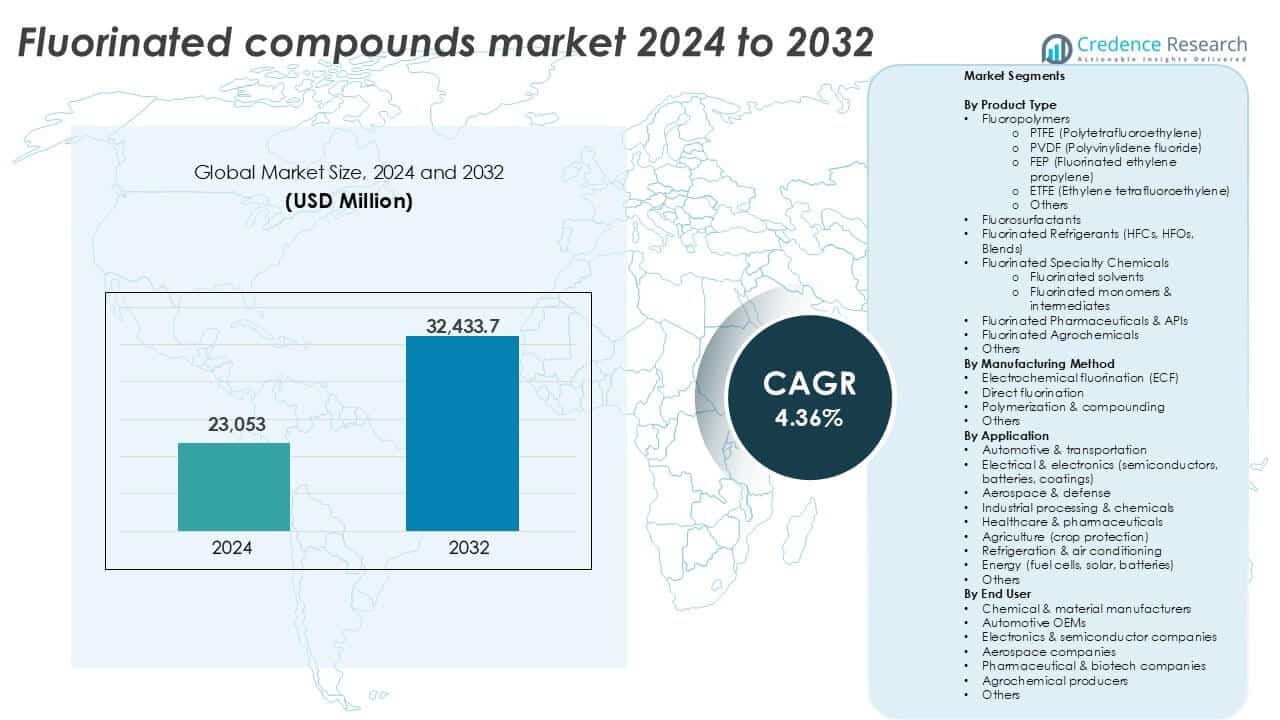
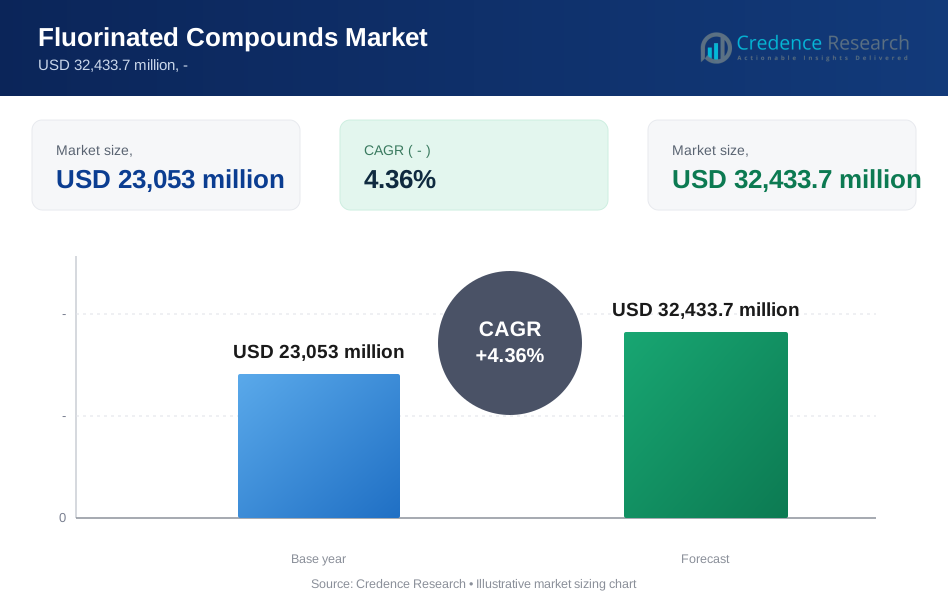
The Fluorinated Compounds Market size was valued at USD 23,053 million in 2024 and is anticipated to reach USD 32,433.7 million by 2032, at a CAGR of 4.36% during the forecast period.
| REPORT ATTRIBUTE | DETAILS |
|---|---|
| Historical Period | 2020-2023 |
| Base Year | 2024 |
| Forecast Period | 2025-2032 |
| Fluorinated Compounds Market Size 2024 | USD 23,053 million |
| Fluorinated Compounds Market, CAGR | 4.36% |
| Fluorinated Compounds Market Size 2032 | USD 32,433.7 million |
Top players in the fluorinated compounds market include 3M Company, Daikin Industries Ltd., Chemours Company, Solvay S.A., and Arkema S.A., all of which maintain strong global distribution networks and diversified product portfolios. These companies lead in fluoropolymers, refrigerants, and specialty chemicals through continuous R&D and regulatory adaptation. Daikin and Chemours dominate in low-GWP refrigerants, while Solvay and Arkema focus on high-performance fluoropolymers. Asian producers like Dongyue Group and Gujarat Fluorochemicals are expanding their global footprint with cost-efficient offerings. Regionally, Asia Pacific leads the market with a 36% share in 2024, driven by robust electronics, automotive, and industrial manufacturing bases across China, Japan, South Korea, and India.
Fluorinated Compounds Market Insights
- The fluorinated compounds market was valued at USD 23,053 million in 2024 and is projected to reach USD 32,433.7 million by 2032, growing at a CAGR of 4.36%.
- Rising demand from electronics, EV batteries, and pharmaceuticals is driving the use of fluoropolymers, refrigerants, and specialty chemicals across key industries.
- A major trend includes the shift toward low-GWP refrigerants and high-performance coatings, supported by regulatory policies and clean energy adoption.
- The market is moderately consolidated, with 3M, Daikin, Chemours, Solvay, and Arkema leading, while Asian players like Dongyue and Gujarat Fluorochemicals gain global traction.
- Asia Pacific holds the largest regional share at 36%, followed by North America at 28% and Europe at 24%; among product segments, fluoropolymers dominate due to their wide industrial use, with PTFE holding the largest share.
Market Segmentation Analysis:
By Product Type
Fluoropolymers lead the product category, with PTFE capturing the largest share due to its non-stick, chemical-resistant, and thermal stability properties. PTFE is widely used in coatings, gaskets, wires, and chemical processing. PVDF follows closely with growing demand from battery separators and membranes. FEP and ETFE also witness steady use in electronics and architectural films. Fluorosurfactants see uptake in coatings and fire-fighting foams, while fluorinated refrigerants like HFCs and HFOs dominate in HVAC systems. Fluorinated specialty chemicals, including solvents and intermediates, support industrial synthesis. Pharmaceuticals and agrochemicals continue expanding due to targeted drug delivery and crop protection efficiency.
- For instance, Gujarat Fluorochemicals Limited operates a PTFE production facility at Dahej, supplying high‑performance PTFE resins to wiring and chemical processing customers.
By Manufacturing Method
Electrochemical fluorination (ECF) holds the dominant share in manufacturing, primarily due to its high fluorine selectivity and widespread adoption in making stable perfluorinated compounds. Direct fluorination is used for producing partially fluorinated intermediates at lower cost but requires strict control. Polymerization and compounding methods support the production of tailored fluoropolymers like PTFE and PVDF. Others include niche synthetic routes for specialty or custom compounds. Increasing regulatory pressure to replace legacy HFCs and PFOAs drives innovation in eco-friendly ECF-based compounds. Process scalability, fluorine conversion rate, and safety remain key decision factors in technology selection.
- For instance, China’s fluoropolymer industry had a PTFE production capacity of about 223,000 tons per year and PVDF capacity near 197,000 tons per year in 2023, reflecting scaled ECF and polymerization usage.
By Application
The electrical and electronics segment leads with high consumption of fluoropolymers in semiconductors, batteries, and cable insulation. Automotive and transportation follow, using fluorinated materials in seals, gaskets, and refrigerants to meet performance and emission standards. Aerospace and defense sectors demand high-performance, lightweight, and heat-resistant materials. Healthcare and pharmaceuticals grow due to increasing use of fluorinated APIs. Agriculture benefits from fluorinated agrochemicals for long-lasting crop protection. Refrigeration and air conditioning see strong replacement demand for low-GWP refrigerants. Energy applications expand with PVDF in batteries and fuel cells. Industrial chemicals and niche applications continue to adopt fluorinated compounds for performance advantages.
Fluorinated Compounds Market Key Growth Drivers
Expanding Demand from the Electronics and Semiconductor Industry
The electronics and semiconductor sectors are driving significant demand for fluorinated compounds due to their high thermal stability, dielectric strength, and chemical resistance. Materials like fluoropolymers are essential for insulation in high-speed cables, semiconductor etching, and lithium-ion battery components. With the growth in 5G infrastructure, electric vehicles, and advanced computing, these industries require increasingly sophisticated fluorinated materials to ensure performance and safety. PVDF, for instance, is widely used in battery binders and separators, especially in energy storage systems. The need for miniaturized, high-performance electronic devices further supports consumption of fluorinated solvents and specialty chemicals. The rise of AI chips, IoT devices, and EV batteries ensures long-term demand from this vertical. Regional electronics manufacturing expansions in East Asia and North America also reinforce sustained procurement cycles, cementing this segment as a key growth pillar.
- For instance, in 2022, PVDF accounted for 16.21% of total global fluoropolymer consumption across all sub-resin types, with the electrical and electronics sector serving as its largest individual application segment.
Rising Usage in Pharmaceuticals and Agrochemicals
Pharmaceutical and agrochemical industries are increasingly adopting fluorinated compounds due to their ability to enhance the bioavailability, stability, and efficacy of molecules. In pharmaceuticals, fluorinated active pharmaceutical ingredients (APIs) account for a growing share of new drug approvals, particularly in oncology, antivirals, and CNS treatments. The presence of fluorine in drug molecules often improves metabolic stability and receptor binding, driving demand for fluorinated intermediates. In agrochemicals, fluorinated pesticides and herbicides offer longer field persistence and improved effectiveness with lower dosages. This is crucial in regions facing labor shortages and climate-related challenges in crop protection. Increasing R&D investments, patent expirations, and expanding global food demand contribute to steady growth in these applications. Regulatory acceptance of fluorinated molecules with proven environmental profiles further promotes adoption in both fields.
- For instance, about 30 % of agrochemical compounds contain fluorine, reflecting strong adoption in crop protection chemistry.
Shift Toward Low-GWP Refrigerants and Green Alternatives
Environmental regulations targeting high global warming potential (GWP) substances are accelerating the adoption of next-generation fluorinated refrigerants such as HFOs and low-GWP blends. As traditional HFCs face phase-downs under the Kigali Amendment and national policies, demand is shifting toward sustainable alternatives that maintain performance while reducing climate impact. HVAC and refrigeration sectors, especially in commercial cooling, automotive AC, and cold chain logistics, are transitioning to these eco-friendlier options. Fluorinated refrigerants like R-1234yf and R-32 are gaining traction due to their balance between energy efficiency and low environmental footprint. Equipment manufacturers are redesigning systems to support these new fluids, creating long-term demand. Retrofitting of existing infrastructure in developed regions and the installation of new units in emerging markets drive replacement cycles, positioning low-GWP refrigerants as a major growth lever.
Fluorinated Compounds Market Key Trends & Opportunities
Integration of Fluorinated Compounds in EV Battery Technologies
The electric vehicle revolution is generating strong interest in fluorinated materials, particularly in lithium-ion battery technology. PVDF is widely used as a binder in cathodes, while fluorinated electrolytes improve thermal and electrochemical stability. These features are vital for increasing battery lifespan, safety, and energy density. As EV production scales up globally, especially in China, Europe, and the U.S., the need for high-performance fluorinated compounds grows in tandem. Startups and major OEMs are investing in next-gen batteries like solid-state and silicon-anode technologies, where fluorinated compounds also play a key role. Supply chain partnerships and forward integration by chemical firms into battery materials signal strong future opportunity. This trend aligns with broader decarbonization and clean mobility targets, making battery-grade fluorinated materials a high-potential area for growth.
- For instance, polyvinylidene fluoride (PVDF) is the standard binder material in composite electrodes for lithium‑ion batteries, providing chemical stability over standard voltage ranges in EV battery cells.
Growing Interest in High-Performance Coatings and Films
Fluorinated compounds are increasingly used in specialty coatings and films due to their hydrophobic, oleophobic, UV-resistant, and anti-corrosive properties. These coatings are gaining traction in industries like aerospace, automotive, construction, and electronics, where material protection is critical. Fluoropolymer-based coatings extend product life, reduce maintenance, and perform under extreme conditions. Rising investments in infrastructure, industrial machinery, and renewable energy installations are boosting demand for such high-performance coatings. In electronics, fluorinated films support protective layers for flexible displays and solar panels. Additionally, architectural applications such as ETFE membranes for stadiums and large-span structures highlight design flexibility and durability. Innovation in water-based, solvent-free, and low-VOC formulations opens new regulatory-compliant growth paths, particularly in Europe and North America.
Fluorinated Compounds Market Key Challenges
Environmental and Regulatory Pressures on Persistent Fluorinated Chemicals
Persistent fluorinated compounds, especially per- and polyfluoroalkyl substances (PFAS), face increasing scrutiny due to their environmental persistence, bioaccumulation, and potential health risks. Regulatory agencies in Europe, North America, and parts of Asia are imposing tighter controls on PFAS production, use, and disposal. The EU's proposed PFAS ban under REACH could significantly limit applications of long-chain fluorinated products. These restrictions pressure manufacturers to reformulate products and develop safer alternatives, increasing R&D and compliance costs. Lawsuits, cleanup liabilities, and public awareness campaigns are further shaping corporate decisions. Companies must proactively invest in non-toxic or short-chain alternatives while ensuring performance parity. This challenge demands rapid innovation and adaptability across the fluorinated chemicals supply chain.
High Manufacturing Costs and Complex Synthesis Processes
The production of fluorinated compounds involves complex synthesis routes, high energy consumption, and the use of hazardous raw materials like elemental fluorine or HF. Electrochemical fluorination and direct fluorination require specialized infrastructure and strict safety protocols, raising capital and operating costs. Scaling production while maintaining purity and safety remains a persistent hurdle. Limited access to fluorine feedstocks, especially outside major producers like China and the U.S., impacts supply stability. These factors hinder the entry of small players and restrict the expansion of new capacity. As demand rises, pricing volatility and raw material constraints could affect profit margins, especially for downstream users like coatings, electronics, and pharma firms seeking cost-effective yet high-performance materials.
Regional Analysis
North America
North America holds a significant share of the fluorinated compounds market, accounting for approximately 28% in 2024. The U.S. leads regional consumption, driven by robust demand from electronics, pharmaceuticals, aerospace, and refrigerant segments. The presence of major chemical producers and technology innovators supports material development across applications. Regulatory frameworks like SNAP in the U.S. encourage low-GWP refrigerants and eco-friendly fluoropolymers. Pharmaceutical R&D spending further accelerates demand for fluorinated APIs. The growing electric vehicle sector boosts consumption of battery-grade fluoropolymers like PVDF. Canada contributes through agrochemical use and semiconductor packaging applications, although on a smaller scale.
Europe
Europe represents around 24% of the global fluorinated compounds market, with Germany, France, and the UK as major contributors. The region is heavily driven by demand from the automotive, aerospace, and industrial coatings sectors. Stringent environmental regulations, especially concerning PFAS and high-GWP refrigerants, are reshaping product preferences. There’s growing adoption of fluorinated specialty chemicals in high-performance coatings and battery applications. The EU's energy transition and carbon neutrality goals further support demand for efficient, low-emission refrigerants and energy-storage materials. Local innovation and sustainability commitments create strong momentum for safer fluorinated alternatives with reduced environmental impact.
Asia Pacific
Asia Pacific dominates the fluorinated compounds market with over 36% share in 2024, led by China, Japan, South Korea, and India. Rapid industrialization, expansion in electronics manufacturing, and rising EV production underpin demand across multiple sub-segments. China serves as a major manufacturing hub for fluoropolymers, fluorinated refrigerants, and agrochemicals. Japan and South Korea lead in advanced electronics and semiconductor materials, driving high-purity fluorinated chemical use. India sees rising consumption in pharmaceuticals and crop protection sectors. Regional infrastructure growth and strong domestic markets support sustained volume growth. Government support for clean energy and e-mobility also strengthens regional uptake.
Latin America
Latin America holds a modest share of about 6% in the global fluorinated compounds market. Brazil and Mexico lead demand, particularly in agrochemicals, automotive, and industrial refrigeration. Fluorinated agrochemicals are critical in supporting large-scale crop production across the region’s agricultural economies. Adoption of air conditioning systems in urban areas supports the use of refrigerants, though regulatory shifts toward low-GWP alternatives are still in early stages. The pharmaceutical sector also contributes, with growing demand for fluorinated intermediates in generic drug production. Market growth is moderate but supported by gradual industrial expansion and imports of specialty fluorinated products.
Middle East & Africa (MEA)
The Middle East & Africa account for approximately 6% of the global fluorinated compounds market. GCC countries drive demand in industrial processing, HVAC, and infrastructure coatings. The UAE and Saudi Arabia adopt fluorinated refrigerants for climate control systems in residential and commercial buildings. South Africa contributes through mining-related industrial processes and pharmaceuticals. However, limited local production capabilities constrain supply chains, increasing reliance on imports. Growth remains steady as governments invest in industrial zones, healthcare, and environmental efficiency. Rising adoption of fluorinated compounds in solar energy and water-repellent coatings offers emerging opportunities in this developing regional market.
Fluorinated Compounds Market Segmentations:
By Product Type
- Fluoropolymers
- PTFE (Polytetrafluoroethylene)
- PVDF (Polyvinylidene fluoride)
- FEP (Fluorinated ethylene propylene)
- ETFE (Ethylene tetrafluoroethylene)
- Others
- Fluorosurfactants
- Fluorinated Refrigerants (HFCs, HFOs, Blends)
- Fluorinated Specialty Chemicals
- Fluorinated solvents
- Fluorinated monomers & intermediates
- Fluorinated Pharmaceuticals & APIs
- Fluorinated Agrochemicals
- Others
By Manufacturing Method
- Electrochemical fluorination (ECF)
- Direct fluorination
- Polymerization & compounding
- Others
By Application
- Automotive & transportation
- Electrical & electronics (semiconductors, batteries, coatings)
- Aerospace & defense
- Industrial processing & chemicals
- Healthcare & pharmaceuticals
- Agriculture (crop protection)
- Refrigeration & air conditioning
- Energy (fuel cells, solar, batteries)
- Others
By End User
- Chemical & material manufacturers
- Automotive OEMs
- Electronics & semiconductor companies
- Aerospace companies
- Pharmaceutical & biotech companies
- Agrochemical producers
- Others
By Geography
- North America
- U.S.
- Canada
- Mexico
- Europe
- Germany
- France
- U.K.
- Italy
- Spain
- Rest of Europe
- Asia Pacific
- China
- Japan
- India
- South Korea
- South-east Asia
- Rest of Asia Pacific
- Latin America
- Brazil
- Argentina
- Rest of Latin America
- Middle East & Africa
- GCC Countries
- South Africa
- Rest of the Middle East and Africa
Competitive Landscape
The competitive landscape of the fluorinated compounds market is consolidated, with key players focusing on product innovation, regulatory compliance, and capacity expansion to strengthen their global presence. Companies such as 3M, Chemours, Daikin, and Solvay lead the market through broad portfolios that span fluoropolymers, refrigerants, and specialty fluorochemicals. Asian firms like Dongyue Group, Shanghai 3F, and Gujarat Fluorochemicals are expanding rapidly, offering cost-competitive solutions and increasing exports. Strategic collaborations, mergers, and vertical integration are common, particularly in the battery, pharmaceutical, and electronics sectors. Regulatory pressures on PFAS and high-GWP materials are pushing firms to develop sustainable alternatives and invest in R&D for next-generation fluorinated products. Market leaders prioritize downstream partnerships with OEMs in electronics, healthcare, and automotive to secure long-term contracts. Regional diversification, backward integration, and strong technical expertise remain key competitive differentiators, as companies aim to balance cost, performance, and environmental compliance in a highly regulated and performance-driven industry.
Key Player Analysis
- 3M Company
- AGC Inc.
- Arkema S.A.
- Asahi Glass Co. (AGC Chemicals)
- BASF SE (fluorine intermediates)
- Chemours Company
- Daikin Industries Ltd.
- Dongyue Group
- Gujarat Fluorochemicals Ltd. (InoxGFL Group)
- Halocarbon Products Corporation
- Honeywell International Inc.
- Navin Fluorine International Ltd.
- Pelchem SOC Ltd.
- Shanghai 3F New Materials Co., Ltd.
- Sinochem Lantian Co. Ltd.
- Solvay S.A.
Recent Developments
- In September 2025, Dr. Ryi Shin-kun and his research team from the CCS Research Department at the Korea Institute of Energy Research (President Yi, Chang-Keun, hereinafter referred to as KIER) have succeeded in developing a new catalyst capable of stably decomposing greenhouse gases generated in semiconductor and display manufacturing processes, even at low temperatures. Flagship industries of the Republic of Korea, semiconductors and displays, are expected to continue their growth as the importance of AI and virtual reality increases. However, during semiconductor and display production, gases such as carbon tetrafluoride (CF₄) and hexafluoroethane (C₂F₆), which have a greenhouse effect more than 5,000 times greater than carbon dioxide, are emitted, causing negative impacts on the environment.
- In November 2024, Syensqo launched innovative fluoro-ionomer Aquivion® N+ 125D, the first grade in Syensqo’s Aquivion® N+ series for hydrogen applications with eco-friendly technology. The new grade is commercially available worldwide and is intended for use in select hydrogen-related applications.
- In August 2024, AGC Inc. developed a new surfactant-free manufacturing process for fluoropolymers, aiming to ensure a stable, sustainable supply of these essential materials for advancing carbon-neutral and digital technologies.
Report Coverage
The research report offers an in-depth analysis based on Product Type, Manufacturing Method, Application, End-User and Geography. It details leading market players, providing an overview of their business, product offerings, investments, revenue streams, and key applications. Additionally, the report includes insights into the competitive environment, SWOT analysis, current market trends, as well as the primary drivers and constraints. Furthermore, it discusses various factors that have driven market expansion in recent years. The report also explores market dynamics, regulatory scenarios, and technological advancements that are shaping the industry. It assesses the impact of external factors and global economic changes on market growth. Lastly, it provides strategic recommendations for new entrants and established companies to navigate the complexities of the market.
Future Outlook
- Demand for fluoropolymers will grow due to rising use in EV batteries and electronics.
- Low-GWP refrigerants will see wider adoption as regulations tighten across global markets.
- Asia Pacific will continue to lead market share, driven by manufacturing growth and exports.
- Pharmaceutical and agrochemical sectors will expand use of fluorinated intermediates and APIs.
- Companies will increase R&D investments to develop PFAS-free and eco-friendly alternatives.
- High-performance coatings and films will gain traction in construction, aerospace, and solar applications.
- Semiconductor and 5G infrastructure growth will support demand for fluorinated specialty chemicals.
- Strategic collaborations will rise as firms seek vertical integration and regional diversification.
- Energy storage technologies will drive consumption of PVDF and fluorinated binders.
- Regulatory scrutiny will reshape product portfolios, pushing innovation in sustainable fluorination methods
Request a Free Sample
Fill in your details and we'll send you a free sample report.
- Sample data tables & charts
- Research methodology
Need a Custom Version of This Report?
Tailor the scope, geography, or segments to your exact requirements.
- Custom geography or segment scope
- Direct access to our analyst team
Frequently Asked Questions
What is the current market size for the Fluorinated compounds market, and what is its projected size in 2032?
At what Compound Annual Growth Rate is the Fluorinated compounds market projected to grow between 2024 and 2032?
Which Fluorinated compounds market segment held the largest share in 2024?
What are the primary factors fueling the growth of the Fluorinated compounds market?
Who are the leading companies in the Fluorinated compounds market?
Which region commanded the largest share of the Fluorinated compounds market in 2024?
Table of Content
Chapter 1. Report Introduction
- 1.1 Report Description & Purpose
- 1.1.1 Report Title & Market Definition
- 1.1.2 Unique Selling Propositions (USP) & Key Differentiators
- 1.1.3 Value Proposition for Stakeholders
- 1.2 Research Objectives
- 1.2.1 Market Sizing Objectives (Volume & Revenue)
- 1.2.2 Segmentation Objectives
- 1.2.3 Competitive Intelligence Objectives
- 1.2.4 Forecast & Scenario Objectives
- 1.3 Report Scope
- 1.3.1 Fluorinated Compounds Scope – Types & Subtypes Covered
- 1.3.2 Geographic Scope – Regions & Countries Covered
- 1.3.3 Historical Period, Base Year & Forecast Period (the historical period; forecast to the forecast period)
- 1.3.4 Inclusions & Exclusions
- 1.4 HS Code & Classification Framework
- 1.5 Currency, Units & Pricing Basis
- 1.6 Target Stakeholders
- 1.7 Limitations & Assumptions
Chapter 2. Executive Summary
- 2.1 Global Fluorinated Compounds Market Snapshot
- 2.1.1 Market Size – Historical (the historical period) & Forecast (the forecast period) (base year: USD 23,053 million → forecast year: USD 32,433.7 million)
- 2.1.2 Volume & Revenue – Global Totals
- 2.1.3 Key Market Highlights – Top Five Facts
- 2.2 Fluorinated Compounds Market Segmentation Snapshot
- 2.2.1 Market Split by Region – vs.
- 2.3 Competitive Snapshot
- 2.3.1 Top 10 Players by Revenue Share –
- 2.3.2 Top 10 Players by Volume Share –
- 2.3.3 Recent Strategic Developments (18-Month Summary)
- 2.4 Key Investment Highlights & Strategic Conclusions
Chapter 3. Fluorinated Compounds Market Dynamics & Industry Analysis
- 3.1 Market Overview & Context
- 3.1.1 Fluorinated Compounds Market Position in the Broader Automotive Value Chain
- 3.1.2 OEM vs. Replacement Market Dynamics
- 3.1.3 Market Maturity & Development Stage by Region
- 3.2 Fluorinated Compounds Market Drivers
- 3.3 Fluorinated Compounds Market Restraints & Challenges
- 3.4 Fluorinated Compounds Market Opportunities
- 3.5 Porter's Five Forces Analysis
- 3.5.1 Threat of New Entrants
- 3.5.2 Bargaining Power of Suppliers
- 3.5.3 Bargaining Power of Buyers
- 3.5.4 Threat of Substitutes
- 3.5.5 Competitive Rivalry – Intensity Assessment
- 3.6 Fluorinated Compounds Value Chain Analysis
- 3.6.1 Upstream – Raw Material/Input Suppliers
- 3.6.1.1 Raw Material/Input 1
- 3.6.1.2 Raw Material/Input 2
- 3.6.1.3 Raw Material/Input 3
- 3.6.2 Midstream – Production/Manufacturing/Service Delivery
- 3.6.2.1 Production/Process Overview
- 3.6.2.2 Key Facility Locations & Capacity by Manufacturer
- 3.6.3 Downstream – Distribution & End Consumer
- 3.6.3.1 Primary Channel – B2B/OEM
- 3.6.3.2 Secondary Channels – Dealer, Retail, Online, Direct
- 3.6.4 Value Chain Profitability Analysis
- 3.6.1 Upstream – Raw Material/Input Suppliers
- 3.7 PESTEL Analysis
- 3.7.1 Political Factors
- 3.7.2 Economic Factors
- 3.7.3 Social Factors
- 3.7.4 Technological Factors
- 3.7.5 Environmental Factors
- 3.7.6 Legal Factors
- 3.8 Fluorinated Compounds Supply Chain Analysis
- 3.8.1 Raw Material/Input Supply Risk Assessment
- 3.8.2 Manufacturing Concentration Risk (Geographic Exposure)
- 3.8.3 Trade Disruption Impact Analysis
- 3.9 Regulatory & Policy Landscape
Note: The regulatory and policy landscape section covers regulations based on their applicability to the market, Fluorinated Compounds category, geography, and scope of the study. Only regulatory frameworks with a material impact on operations, compliance, trade, sustainability, or market access are analyzed in detail.
Chapter 4. Key Investment Pockets & Opportunity Analysis
- 4.1 Fluorinated Compounds Market Attractiveness Analysis
- 4.1.1 By Region – Investment Attractiveness Matrix (Volume × CAGR)
- 4.2 Absolute Revenue Growth Opportunity
- 4.2.1 By Region – Absolute USD Growth Through the forecast period
- 4.3 Incremental Volume Opportunity
- 4.3.1 By Region – Incremental Volume Through the forecast period
- 4.3.2 Segment – Incremental Volume
- 4.4 Emerging Submarket Opportunity Deep Dive (Subject to Applicability)
- 4.5 Emerging Market Opportunity Scorecards
- 4.5.1 United States
- 4.5.2 Europe
- 4.5.3 Asia
- 4.5.4 Middle East & Africa
Note: Emerging Market Opportunity Scorecards will be included based on relevance and strategic importance. Regions listed are indicative and may vary depending on data availability and market dynamics.
Chapter 5. Fluorinated Compounds Import-Export Analysis & Trade Flows
- 5.1 Global Trade Overview
- 5.1.1 Global Export Value by Country (the historical period)
- 5.1.2 Global Export Volume by Country (the historical period)
- 5.1.3 Global Import Value by Country (the historical period)
- 5.1.4 Global Import Volume by Country (the historical period)
- 5.1.5 Net Trade Balance by Country (the historical period)
- 5.2 Export Analysis – Segment
- 5.2.1 Type 1 (HS Code)
- 5.2.2 Type 2 (HS Code)
- 5.2.3 Type 3 (HS Code)
- 5.2.4 Type 4 (HS Code)
- 5.2.5 Type 5 (HS Code)
- 5.3 Import Analysis – Segment
- 5.3.1 Type 1 (HS Code)
- 5.3.2 Type 2 (HS Code)
- 5.3.3 Type 3 (HS Code)
- 5.3.4 Type 4 (HS Code)
- 5.3.5 Type 5 (HS Code)
- 5.4 Average Unit Trade Prices
- 5.4.1 Average Export Price – Segment & Country
- 5.4.2 Average Import Price – Segment & Source Country
- 5.4.3 Price Trends (the historical period)
- 5.5 Key Trade Route Analysis
- 5.5.1 Trade Route 1
- 5.5.2 Trade Route 2
- 5.5.3 Trade Route 3
- 5.5.4 Trade Route 4
- 5.5.5 Trade Route 5
- 5.6 Trade Policy Impact Assessment
- 5.6.1 US Anti-Dumping & Section 301 Tariffs
- 5.6.2 EU Customs Union Impact
- 5.6.3 Major Free Trade Agreements
- 5.6.4 USMCA Rules of Origin
Note: Trade policy analysis will be included only where relevant to the Fluorinated Compounds market.
Chapter 6. Competitive Landscape & Company Benchmarking
- 6.1 Fluorinated Compounds Market Concentration & Structure
- 6.1.1 Herfindahl-Hirschman Index (HHI) – vs.
- 6.1.2 Tier 1, Tier 2 & Tier 3 Market Structure
- 6.1.3 Global, Regional & Local Player Dynamics
- 6.2 Fluorinated Compounds Market Share Analysis –
- 6.2.1 Global Revenue Share by Company
- 6.2.2 Global Volume Share by Company
- 6.2.3 Regional Revenue Share
- 6.2.4 Market Share Evolution ( vs. )
- 6.2.5 OEM Segment Share by Company
- 6.2.6 Replacement Segment Share by Company
- 6.3 Production/Delivery Capacity & Facility Analysis
- 6.3.1 Global Installed Capacity
- 6.3.2 Capacity Utilization Rates
- 6.3.3 Production/Output Volume
- 6.3.4 Facility Locations & Capacity Map
- 6.3.5 Planned Capacity Additions
- 6.4 Fluorinated Compounds Competitive Benchmarking Matrix
- 6.4.1 Revenue, Volume, CAGR & Profitability Comparison
- 6.4.2 Channel Revenue Mix
- 6.4.3 Geographic Revenue Exposure
- 6.4.4 R&D Intensity
- 6.4.5 Sustainability Maturity
- 6.5 Strategic Developments in Fluorinated Compounds (Last 24 Months)
- 6.5.1 Mergers, Acquisitions & Divestments
- 6.5.2 New Fluorinated Compounds Launches
- 6.5.3 Facility Expansions
- 6.5.4 Strategic Alliances, Joint Ventures & Partnerships
- 6.5.5 Distribution Expansion & Market Entry
- 6.5.6 Sustainability & ESG Initiatives
- 6.6 Competitive Strategy Mapping
- 6.6.1 Leader, Challenger, Follower & Niche Classification
- 6.6.2 Pricing Strategy Comparison
- 6.6.3 Channel Strategy Matrix
Note: Strategic developments are included based on their materiality and the availability of reliable information.
Chapter 7. Global Fluorinated Compounds Market – By Distribution Channel
- 7.1 Segment Overview
- 7.1.1 Volume & Revenue Split by Channel ( & )
- 7.1.2 Channel Mix Evolution (the forecast period)
Chapter 8. Regional Market Analysis – Global Overview
- 8.1 Global Regional Overview
- 8.1.1 Regional Volume Share
- 8.1.2 Regional Revenue Share
- 8.1.3 Regional Volume by Region
- 8.1.4 Regional Revenue by Region
- 8.1.5 Regional Forecast Through the forecast period
- 8.2 Cross-Regional Segment Analysis
- 8.2.1 By Distribution Channel
- 8.2.2 By Brand/Price Tier
Chapter 9. North America Fluorinated Compounds Market
- 9.1 United States
- 9.2 Canada
- 9.3 Mexico
Chapter 10. Europe Fluorinated Compounds Market
- 10.1 Germany
- 10.2 France
- 10.3 Italy
- 10.4 United Kingdom
- 10.5 Spain
- 10.6 Poland
- 10.7 Russia
- 10.8 Netherlands
- 10.9 Belgium
- 10.10 Sweden
- 10.11 Denmark
- 10.12 Norway
- 10.13 Rest of Europe
Chapter 11. Asia Pacific Fluorinated Compounds Market
- 11.1 China
- 11.2 India
- 11.3 Japan
- 11.4 South Korea
- 11.5 Thailand
- 11.6 Indonesia
- 11.7 Vietnam
- 11.8 Malaysia
- 11.9 Australia
- 11.10 Rest of Asia Pacific
Chapter 12. Latin America Fluorinated Compounds Market
- 12.1 Brazil
- 12.2 Argentina
- 12.3 Colombia
- 12.4 Chile
- 12.5 Rest of Latin America
Chapter 13. Middle East Fluorinated Compounds Market
- 13.1 Saudi Arabia
- 13.2 United Arab Emirates
- 13.3 Turkey
- 13.4 Israel
- 13.5 Iran
- 13.6 Rest of the Middle East
Chapter 14. Africa Fluorinated Compounds Market
- 14.1 South Africa
- 14.2 Egypt
- 14.3 Nigeria
- 14.4 Morocco
- 14.5 Rest of Africa
Chapter 15. Fluorinated Compounds Company Profiles
- 15.1 [Company 01]
- 15.1.1 Company Overview
- 15.1.2 Key Management Personnel
- 15.1.3 Products & Services Portfolio
- 15.1.4 Financial Performance
- 15.1.5 Key Market Focus & Geographic Presence
- 15.1.6 Recent Developments & Strategic Initiatives
Note: The company profile list is preliminary and may change based on research findings, market developments, data availability, and client requirements.
Chapter 16. Appendices
- Appendix A – List of Abbreviations & Acronyms
- Appendix B – Industry Classification Code Reference – Full Series
- Appendix C – Production & Capacity Data Tables
- Appendix D – End-Use & Demand Base Tables
- Appendix E – Consumption & Replacement Rate Assumptions
- Appendix F – ASP Reference Tables
- Appendix G – Manufacturing & Facility Database
- Appendix H – Import-Export Data Tables
- Appendix I – Regulatory Summary Tables
- Appendix J – Primary Research Participant List (Anonymized)
- Appendix K – Primary Research Questionnaire Framework
- Appendix L – Data Sources & Bibliography
- Appendix M – Market Size Divergence & Source Comparison
Chapter 17. Research Methodology
- 17.1 Research Framework & Philosophy
- 17.2 Secondary Research – Sources, Hierarchy & Data Extraction
- 17.3 Data Modeling – Bottom-Up & Top-Down Market Sizing
- 17.4 Primary Research – Stakeholder Framework, LOI & Sample Sizes
- 17.5 Forecast Methodology – Regression, Scenario & Sensitivity Analysis
- 17.6 Quality Control – Four-Layer Validation Framework
- 17.7 Limitations & Standard Assumptions
- 17.8 Disclaimer
