
Market Overview:
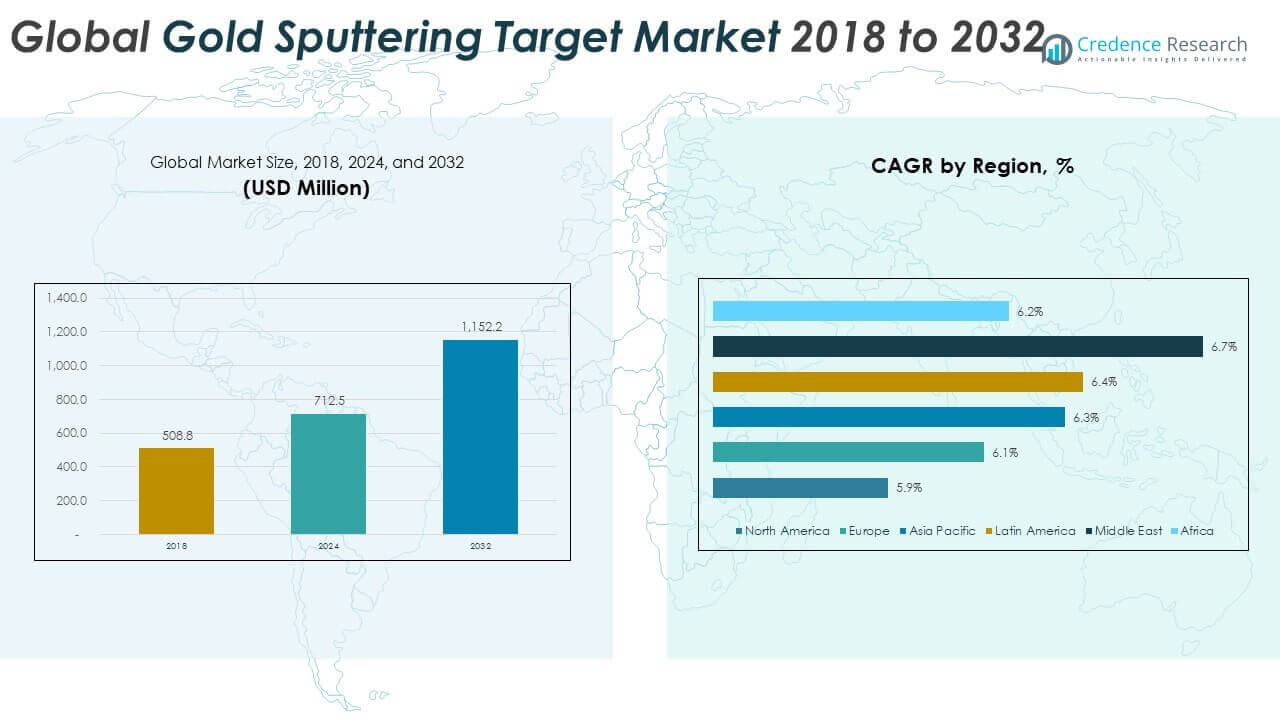
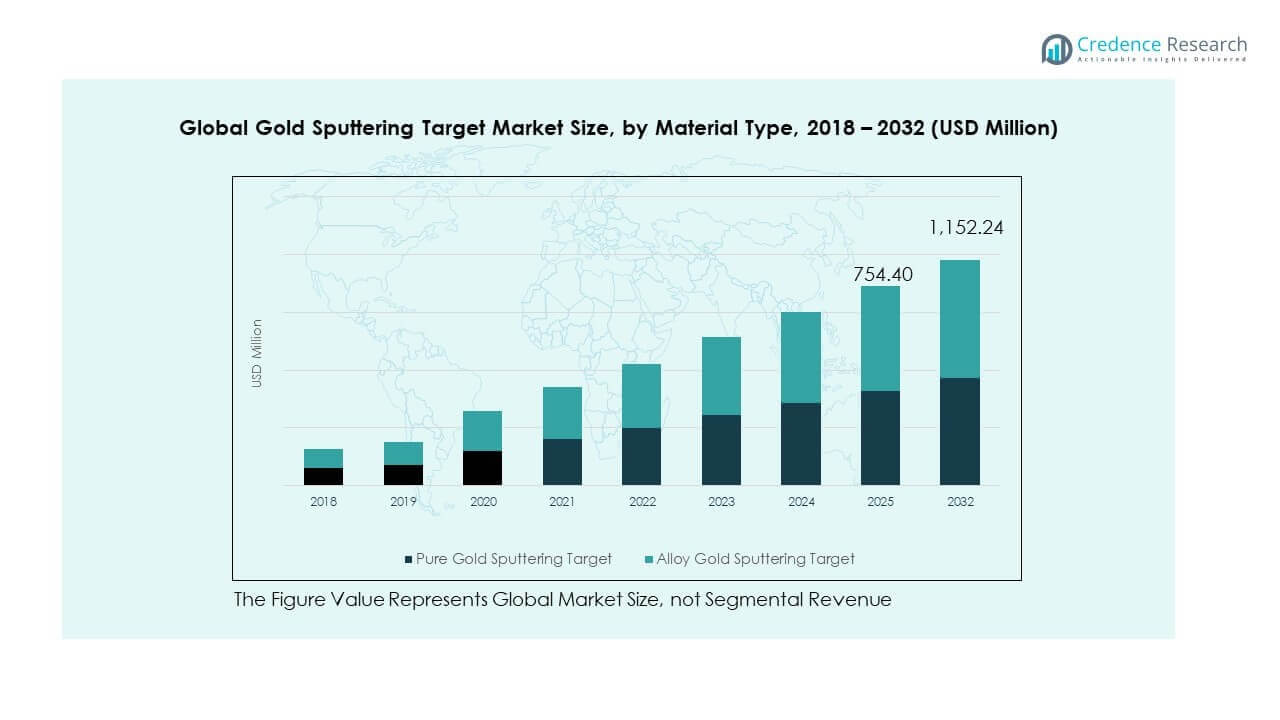
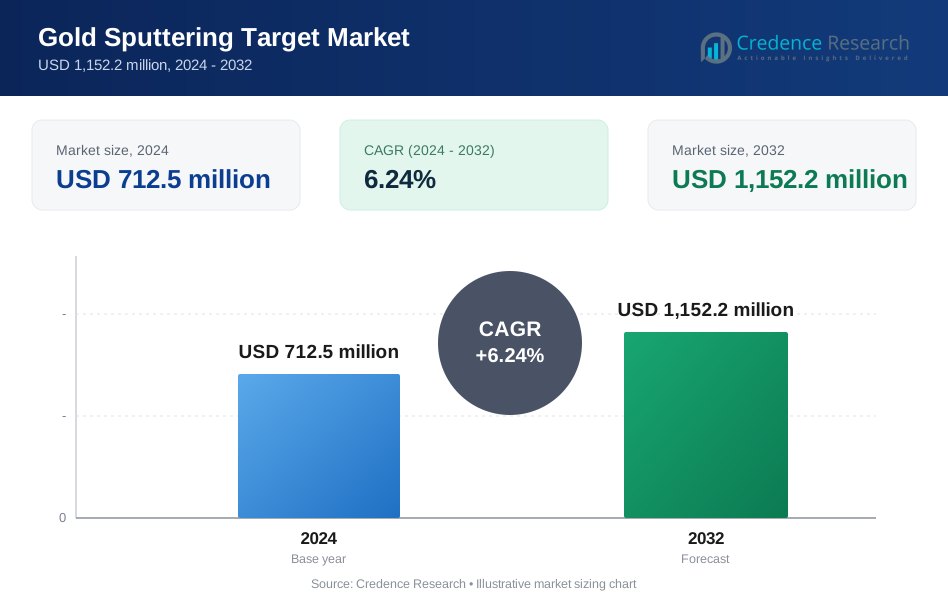
The Global Gold Sputtering Target Market size was valued at USD 508.8 million in 2018 to USD 712.5 million in 2024 and is anticipated to reach USD 1,152.2 million by 2032, at a CAGR of 6.24% during the forecast period.
| REPORT ATTRIBUTE | DETAILS |
|---|---|
| Historical Period | 2020-2023 |
| Base Year | 2024 |
| Forecast Period | 2025-2032 |
| Gold Sputtering Target Market Size 2024 | USD 712.5 million |
| Gold Sputtering Target Market, CAGR | 6.24% |
| Gold Sputtering Target Market Size 2032 | USD 1,152.2 million |
The market grows due to rising semiconductor fabrication and advanced electronics production worldwide. Gold sputtering targets support high conductivity and corrosion resistance in microelectronic layers. Strong demand comes from MEMS, sensors, and optoelectronic device manufacturing. Expansion of display panels and OLED technologies increases thin film deposition needs. Medical devices also drive adoption through reliable coating requirements. Aerospace and defense applications favor gold targets for stable performance. Continuous chip miniaturization sustains long-term material demand.
Asia Pacific leads due to large semiconductor fabs in China, Taiwan, South Korea, and Japan. These countries invest heavily in foundries, packaging, and display manufacturing capacity. North America remains strong, supported by advanced R&D and defense electronics production. Europe shows steady demand from automotive electronics and industrial sensors. Emerging growth appears in Southeast Asia with new fabs and OSAT facilities. India gains relevance through electronics manufacturing incentives and supply chain localization. Overall leadership reflects technology depth and manufacturing scale.
Market Insights:
- The Global Gold Sputtering Target Market was valued at USD 508.8 million in 2018, reached USD 712.5 million in 2024, and is projected to hit USD 1,152.2 million by 2032, expanding at a CAGR of 6.24%, driven by sustained demand from high‑precision electronics manufacturing.
- Asia Pacific (~38%), Europe (~24%), and North America (~18.5%) represent the top three regional shares, supported by strong semiconductor fabrication capacity, advanced automotive electronics, aerospace demand, and established supplier ecosystems.
- The Middle East (~7%) is the fastest‑growing region, supported by expanding defense electronics, medical technology investments, and national programs focused on advanced manufacturing and research infrastructure.
- By material type, pure gold sputtering targets account for approximately 65% share, reflecting preference for ultra‑high purity coatings in semiconductors, aerospace, and medical devices.
- Alloy gold sputtering targets hold about 35% share, driven by cost efficiency and mechanical stability requirements in display panels, data storage, and select industrial electronics applications.
Market Drivers:
Rising Semiconductor Fabrication And Advanced Microelectronics Demand
The Global Gold Sputtering Target Market benefits from steady semiconductor capacity expansion worldwide. Chipmakers increase wafer output for logic and memory devices. Gold targets support stable conductivity in fine interconnect layers. Miniaturized node structures raise precision coating needs. High yield requirements favor reliable sputtering materials. It supports deposition uniformity across complex chip designs. Foundry investments strengthen long-term procurement cycles. Electronics self-sufficiency programs reinforce this demand trend. Emerging foundries in Southeast Asia and India are adding backend packaging lines, fueling localized demand. Newer EUV lithography nodes also require tighter thin-film uniformity, raising target material precision.
- For instance, Materion consistently refines gold to 99.999% purity to maintain film integrity in high‑end semiconductor thin‑film applications. Foundry investments strengthen long‑term procurement cycles through customized target designs for 300 mm fabs.
Expanding Adoption Across MEMS Sensors And Precision Electronics
The Global Gold Sputtering Target Market gains traction from MEMS and sensor integration. Automotive, medical, and industrial systems rely on precise sensing layers. Gold coatings provide chemical stability and signal accuracy. It supports pressure, motion, and biosensor reliability. Smart devices raise sensor density per unit. OEMs prefer proven materials with predictable performance. High-volume sensor output sustains recurring demand. This driver remains strong across multiple end uses. Integration of sensors in wearable devices, AR/VR headsets, and environmental monitors boosts consumption. Foundries working with fabless sensor developers rely on low-defect sputtering targets for volume assurance.
- For instance, JX Advanced Metals supplies high‑purity targets tailored to semiconductor and sensor device manufacturing, backed by technology in high purification and low inclusion casting.
Growing Role of High-End Display and Optoelectronics Manufacturing
The Global Gold Sputtering Target Market advances with premium display production growth. OLED and microdisplay panels require high-quality thin films. Gold targets support electrode and reflective layer deposition. It ensures uniform brightness and long device life. Display makers focus on yield control and defect reduction. Advanced fabs rely on consistent sputtering quality. Consumer electronics cycles sustain panel output. This driver links closely with premium device launches. Emerging microLED pilot lines in Korea and Taiwan now specify gold layers in interconnect and pixel structures. Augmented reality and heads-up display systems accelerate precision coating requirements in compact formats.
Increasing Use in Medical Devices and Aerospace Electronics
The Global Gold Sputtering Target Market expands through regulated application areas. Medical implants and diagnostic tools require biocompatible coatings. Gold meets strict safety and durability standards. It supports stable signal transmission in critical devices. Aerospace electronics demand resistance to heat and corrosion. Defense systems rely on proven material performance. Certification processes favor established sputtering inputs. These sectors ensure stable baseline demand. Miniaturized implantable sensors and catheter-based diagnostics require ultra-thin gold films with verified performance. Aerospace OEMs use gold-coated components in avionic sensors and high-altitude communications hardware for thermal stability.
Market Trends:
Shift Toward Ultra High Purity And Customized Target Grades
The Global Gold Sputtering Target Market shows a clear move toward higher purity grades. Semiconductor nodes demand tighter contamination control. Target suppliers refine material processing methods. It enables better film consistency and yield stability. Customers request tailored dimensions and bonding formats. Custom targets reduce downtime during tool changes. Long-term supply contracts grow common. This trend reflects higher fab process sophistication. Smaller grain sizes and directional grain orientation now form key product differentiators for Tier I fabs. Some manufacturers also offer enhanced bonding compatibility for use in high-powered sputter tools.
- For instance, Materion’s engineered targets refine grain size and orientation to enhance lifetime and film uniformity, supporting complex applications like power semiconductors and communications devices. Long‑term supply contracts grow common, reflecting higher fab process sophistication.
Integration Of Recycling And Precious Metal Recovery Practices
The Global Gold Sputtering Target Market aligns with material recovery initiatives. Manufacturers reclaim unused gold from spent targets. Closed-loop recycling lowers raw material exposure. It supports cost control in volatile metal pricing cycles. Sustainability goals influence procurement decisions. Large fabs partner with recovery specialists. Recovered gold meets strict reuse standards. This trend improves supply resilience. Automated recovery systems now process sputter shields and scrap with over 98% gold retrieval efficiency. Integrated reclamation services reduce turnaround time and lower customers’ reliance on fresh metal sourcing.
Rising Preference for Long-Term Supplier Partnerships
The Global Gold Sputtering Target Market reflects deeper buyer-supplier collaboration. Fabrication plants seek stable quality and delivery assurance. Multi-year agreements reduce sourcing risk. It supports synchronized capacity planning. Technical support becomes part of contracts. Suppliers assist with process optimization. Trust-based relationships limit supplier switching. This trend favors established vendors. Tier I suppliers now co-develop sputtering solutions aligned with clients’ roadmap cycles. Performance validation and sample targets are included in early-stage tool qualification programs.
- For instance, Heraeus collaborates with leading semiconductor customers through multi-year material supply agreements that include joint process validation and customized target engineering, supporting early tool qualification and faster ramp-up.
Gradual Localization of Target Manufacturing Near Major Fabs
The Global Gold Sputtering Target Market trends toward regional production hubs. Proximity shortens lead times and logistics risk. Local manufacturing supports fast customization. It aligns with national semiconductor strategies. Trade uncertainties encourage regional sourcing. Suppliers invest near large fab clusters. Asia Pacific leads this shift. Localization improves operational agility. Localized sputter target bonding centers now operate in South Korea, India, and the UAE. Government-backed incentives support facility setup near electronics special economic zones (SEZs).
Market Challenges Analysis:
Exposure To Gold Price Volatility And Cost Sensitivity
The Global Gold Sputtering Target Market faces pricing pressure from raw gold fluctuations. Sudden price shifts affect procurement budgets. It complicates long-term contract pricing. End users resist frequent price revisions. Margin management becomes complex for suppliers. Hedging strategies raise financial planning needs. Smaller buyers face higher exposure. Cost stability remains a key challenge.
Strict Quality Control And High Certification Barriers
The Global Gold Sputtering Target Market operates under tight quality demands. Semiconductor fabs enforce rigorous material standards. It requires advanced testing and traceability. Certification timelines extend product launch cycles. Process failures risk major financial loss. Smaller suppliers struggle with compliance costs. Customer audits demand continuous investment. Entry barriers limit new competition.
Market Opportunities:
Expansion Of Advanced Semiconductor Fabs In Emerging Economies
The Global Gold Sputtering Target Market gains opportunity from new fab investments. Emerging countries promote local chip manufacturing. It supports demand for high-grade sputtering materials. Governments offer incentives for electronics production. New fabs diversify global supply chains. Equipment installation drives initial target demand. Ongoing operations ensure repeat orders. This expansion opens new customer bases.
Growth Of Next-Generation Electronics And Specialized Coatings
The Global Gold Sputtering Target Market benefits from advanced electronics innovation. Quantum devices and photonics need precise coatings. It supports research-scale and pilot production demand. Specialized applications favor gold reliability. Universities and labs increase deposition activity. Start-ups adopt thin film technologies. Custom target solutions gain relevance. Innovation-driven demand strengthens future prospects.
Market Segmentation Analysis:
By Material Type: Dominance of Pure Gold Targets in High-Purity Applications
Pure gold sputtering targets dominate demand due to their unmatched purity and conductivity. They are widely used in semiconductor, aerospace, and medical device coatings where precision is critical. It supports applications requiring uniform thin films and corrosion resistance. Alloy gold sputtering targets offer cost benefits and mechanical strength for less sensitive uses. These alloys blend gold with elements like silver or copper to enhance film properties. Usage is growing in sectors like displays and data storage. The Global Gold Sputtering Target Market balances high-purity needs with volume-driven alloy applications. Each material type supports distinct technical and commercial requirements.
- For instance, industry targets often achieve 99.999% (5N) purity levels for critical semiconductor processes to meet stringent electrical and film quality standards. Alloy gold sputtering targets offer cost benefits and mechanical strength for less sensitive uses.
By Application: Semiconductors and Displays Drive Major Consumption
Semiconductors lead application usage due to widespread integration of gold layers in advanced chips. It supports interconnects and bonding pads where stability and conductivity are vital. Display panels follow with strong growth in OLED and microLED formats. Gold enables reflective and conductive layers in high-end panels. Data storage applications use gold for magnetic layering and read/write head components. Solar energy deployments benefit from gold's durability and conductivity in concentrated photovoltaic cells. The Global Gold Sputtering Target Market aligns with performance-intensive application domains requiring precision coating behavior.
- For instance, manufacturers in the HDD segment integrate gold sputtered materials to enhance signal integrity in high‑speed read/write operations. The market aligns with performance‑intensive application domains requiring precision coating behavior across advanced electronics.
By End Use: Electronics Sector Commands Majority Share
The electronics sector accounts for the largest share, backed by consumer devices, computing, and communications hardware. It demands consistent sputtering materials for high-volume production. Automotive applications grow due to advanced driver-assistance systems and sensor integration. Aerospace favors gold sputtering for mission-critical electronic assemblies. Medical devices adopt gold coatings in implants, imaging, and diagnostic systems. The Global Gold Sputtering Target Market caters to industries where reliability, biocompatibility, and thermal resistance drive material choices. End users prioritize quality assurance, yield stability, and supply continuity.
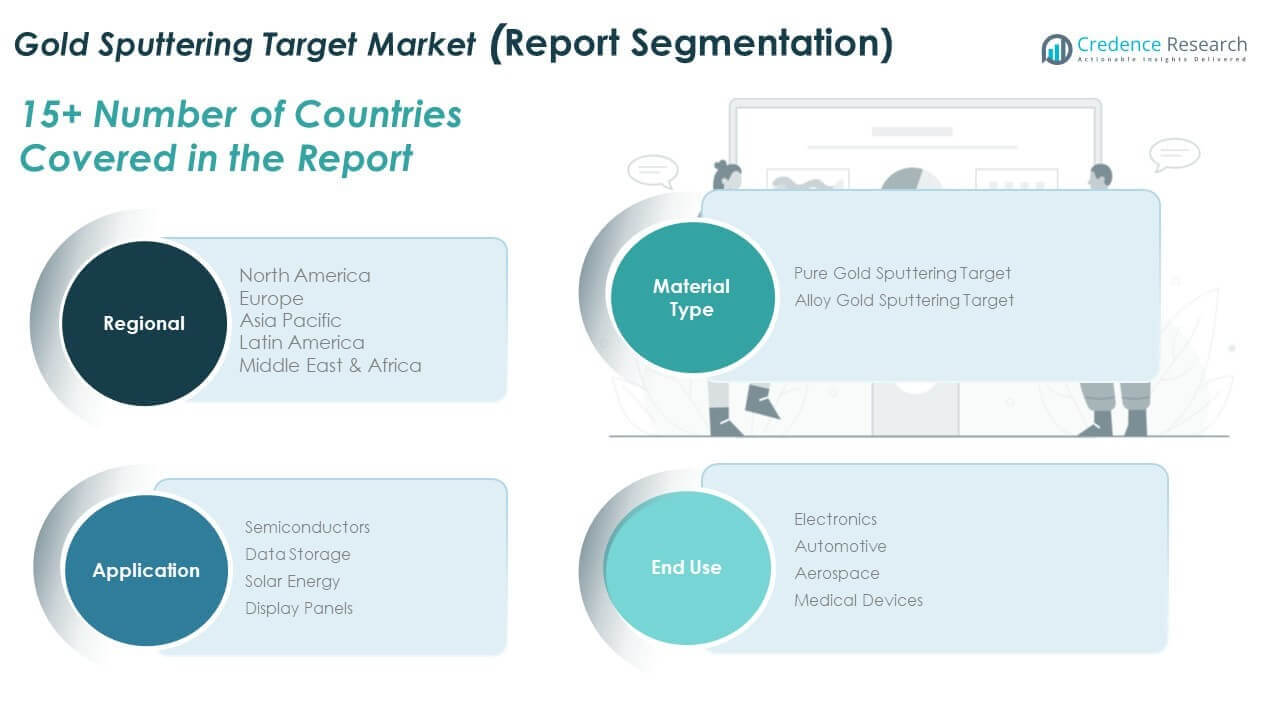
Segmentation:
By Material Type
- Pure Gold Sputtering Target
- Alloy Gold Sputtering Target
By Application
- Semiconductors
- Data Storage
- Solar Energy
- Display Panels
By End Use
- Electronics
- Automotive
- Aerospace
- Medical Devices
By Region
- North America
- U.S.
- Canada
- Mexico
- Europe
- Germany
- France
- U.K.
- Italy
- Spain
- Rest of Europe
- Asia Pacific
- China
- Japan
- India
- South Korea
- South-east Asia
- Rest of Asia Pacific
- Latin America
- Brazil
- Argentina
- Rest of Latin America
- Middle East & Africa
- GCC Countries
- South Africa
- Rest of the Middle East and Africa
Regional Analysis:
North America
The North America Gold Sputtering Target Market size was valued at USD 96.17 million in 2018 to USD 131.97 million in 2024 and is anticipated to reach USD 207.63 million by 2032, at a CAGR of 5.9% during the forecast period. North America holds an estimated 18.5% share of the Global Gold Sputtering Target Market. The region’s leadership stems from strong semiconductor manufacturing and aerospace electronics sectors. The U.S. drives most of the demand, with ongoing investment in defense-grade electronics and high-end medical device manufacturing. It supports early adoption of high-purity gold targets in regulated sectors. Canadian firms also contribute through R&D activities and niche electronics. Local suppliers maintain partnerships with aerospace primes and healthcare OEMs. Demand stability links to quality assurance and supply chain resilience. Growth continues with localized fabrication and sensor technology advances.
Europe
The Europe Gold Sputtering Target Market size was valued at USD 122.73 million in 2018 to USD 170.81 million in 2024 and is anticipated to reach USD 274.00 million by 2032, at a CAGR of 6.1% during the forecast period. Europe accounts for approximately 24% share of the Global Gold Sputtering Target Market. The region benefits from robust automotive electronics and renewable energy programs. Germany, France, and the UK lead in adopting sputtering targets for sensors, advanced displays, and solar coatings. It also supports legacy aerospace and industrial applications that require high-reliability components. European vendors emphasize sustainability and closed-loop recycling of sputtering materials. Strong regulatory frameworks drive certification-compliant production. Research institutions increase gold target usage in pilot-scale microelectronics. Demand expands with e-mobility and digital health investments.
Asia Pacific
The Asia Pacific Gold Sputtering Target Market size was valued at USD 191.07 million in 2018 to USD 269.21 million in 2024 and is anticipated to reach USD 439.00 million by 2032, at a CAGR of 6.3% during the forecast period. Asia Pacific holds the largest market share at nearly 38% of the Global Gold Sputtering Target Market. Major growth originates from China, Japan, South Korea, and Taiwan. These countries house the world’s largest semiconductor and display fabrication facilities. It sees rising volume consumption due to advanced packaging, OLED panel production, and sensor integration. Governments back strategic electronics and chip sovereignty programs. Local suppliers scale to meet high-volume target needs. Demand also grows in India and Southeast Asia through EMS and OSAT expansions. Stronger intra-regional trade further strengthens supply reliability.
Latin America
The Latin America Gold Sputtering Target Market size was valued at USD 54.85 million in 2018 to USD 77.51 million in 2024 and is anticipated to reach USD 126.86 million by 2032, at a CAGR of 6.4% during the forecast period. Latin America contributes around 11% to the Global Gold Sputtering Target Market. Brazil and Mexico lead adoption through automotive electronics, diagnostic device assembly, and local chip testing units. The region relies on imports to meet material specifications. It benefits from global supply partnerships and technical collaborations. Universities and R&D labs expand thin-film deposition usage in pilot projects. Government-led digitization and healthcare modernization support gold sputtering consumption. It remains a developing market with long-term growth potential in industrial electronics.
Middle East
The Middle East Gold Sputtering Target Market size was valued at USD 34.50 million in 2018 to USD 49.68 million in 2024 and is anticipated to reach USD 83.31 million by 2032, at a CAGR of 6.7% during the forecast period. The Middle East holds a 7% share of the Global Gold Sputtering Target Market. Demand is driven by aerospace electronics, defense manufacturing, and medical imaging technologies. GCC countries invest in research hubs and smart city systems with sensor integration. Israel leads regional innovation with a strong presence in microelectronics and biomedical devices. It supports procurement of gold sputtering targets for precision applications. Localization programs promote material access and advanced manufacturing tools. Regional initiatives align with digital infrastructure and healthcare diagnostics.
Africa
The Africa Gold Sputtering Target Market size was valued at USD 9.52 million in 2018 to USD 13.29 million in 2024 and is anticipated to reach USD 21.43 million by 2032, at a CAGR of 6.2% during the forecast period. Africa represents the smallest share at approximately 2% of the Global Gold Sputtering Target Market. Most demand centers in South Africa and Egypt through academic research, solar innovation, and telecommunications. It relies heavily on imports for specialized materials. University labs and applied science institutions increasingly adopt thin film deposition systems. Regional electronics production remains limited but growing. Medical technology and solar projects drive select demand. It remains an emerging region with long-term promise for niche applications and sustainable tech use.
Key Player Analysis:
- Praxair Technology, Inc.
- JX Nippon Mining & Metals Corporation
- Materion Corporation
- Heraeus Holding GmbH
- Hitachi Metals, Ltd.
- Sumitomo Chemical Co., Ltd.
- Fujimi Incorporated
- Honeywell International Inc.
- American Elements
- Other Key Players
Competitive Analysis:
The Global Gold Sputtering Target Market features moderate consolidation with a mix of global material specialists and niche precision suppliers. Leading players compete on purity control, target bonding quality, and delivery reliability. It rewards firms with long-standing semiconductor and aerospace customer relationships. Technical expertise and certification capability create strong entry barriers. Companies invest in refining processes and recycling systems to manage raw material exposure. Long-term supply contracts strengthen customer retention. Competitive intensity remains steady due to strict qualification cycles. Innovation focuses on purity enhancement rather than price competition.
Recent Developments:
- In October 2024, Materion sold its large area targets business to RSCS, contributing to broader precious and base metals sputtering target manufacturing in the Americas. Additionally, in July 2025, Materion acquired manufacturing assets for tantalum sputtering targets in Asia, expanding its semiconductor supply footprint.
- In June 2024, Heraeus acquired McCol Metals, a Canadian iridium recovery specialist, to advance precious metals recycling. In January 2025, it further acquired Umicore's platinum-containing APIs business, entering medical technology while leveraging precious metals expertise.
Report Coverage:
The research report offers an in-depth analysis based on material type, application and end use segments. It details leading market players, providing an overview of their business, product offerings, investments, revenue streams, and key applications. Additionally, the report includes insights into the competitive environment, SWOT analysis, current market trends, as well as the primary drivers and constraints. Furthermore, it discusses various factors that have driven market expansion in recent years. The report also explores market dynamics, regulatory scenarios, and technological advancements that are shaping the industry. It assesses the impact of external factors and global economic changes on market growth. Lastly, it provides strategic recommendations for new entrants and established companies to navigate the complexities of the market.
Future Outlook:
- Semiconductor miniaturization and chip complexity will push demand for ultra-high-purity gold targets.
- Rising adoption of MEMS, IoT sensors, and flexible electronics will expand coating needs across sectors.
- Increasing use of gold layers in OLED, microLED, and quantum displays will elevate thin-film usage.
- Automotive ADAS and electrification trends will strengthen demand for sputtered sensor components.
- Gold-coated components in aerospace, satellites, and space electronics will support specialized use cases.
- Medical applications will grow with demand for gold-based biocompatible and diagnostic device coatings.
- Regional fab development in India, Southeast Asia, and the Middle East will diversify sourcing hubs.
- Precious metal recovery and circular production models will become key to cost stability.
- Long-term supply partnerships and localization efforts will reduce procurement risk and delivery delays.
- Material innovation will focus on hybrid alloy targets that balance cost with conductivity and durability.
Request a Free Sample
Fill in your details and we'll send you a free sample report.
- Sample data tables & charts
- Research methodology
Need a Custom Version of This Report?
Tailor the scope, geography, or segments to your exact requirements.
- Custom geography or segment scope
- Direct access to our analyst team
Frequently Asked Questions
What is the current market size for Global Gold Sputtering Target Market, and what is its projected size in 2032?
At what Compound Annual Growth Rate is the Global Gold Sputtering Target Market projected to grow between 2025 and 2032?
Which Global Gold Sputtering Target Market segment held the largest share in 2024?
What are the primary factors fueling the growth of the Global Gold Sputtering Target Market?
Who are the leading companies in the Global Gold Sputtering Target Market?
Which region commanded the largest share of the Global Gold Sputtering Target Market in 2024?
Table of Content
Chapter 1. Report Introduction
- 1.1 Report Description & Purpose
- 1.1.1 Report Title & Market Definition
- 1.1.2 Unique Selling Propositions (USP) & Key Differentiators
- 1.1.3 Value Proposition for Stakeholders
- 1.2 Research Objectives
- 1.2.1 Market Sizing Objectives (Volume & Revenue)
- 1.2.2 Segmentation Objectives
- 1.2.3 Competitive Intelligence Objectives
- 1.2.4 Forecast & Scenario Objectives
- 1.3 Report Scope
- 1.3.1 Gold Sputtering Target Scope – Types & Subtypes Covered
- 1.3.2 Geographic Scope – Regions & Countries Covered
- 1.3.3 Historical Period, Base Year & Forecast Period (2024; forecast to 2032)
- 1.3.4 Inclusions & Exclusions
- 1.4 HS Code & Classification Framework
- 1.5 Currency, Units & Pricing Basis
- 1.6 Target Stakeholders
- 1.7 Limitations & Assumptions
Chapter 2. Executive Summary
- 2.1 Global Gold Sputtering Target Market Snapshot
- 2.1.1 Market Size – Historical (2024) & Forecast (2024-2032) (2024: USD 712.5 million → 2032: USD 1,152.2 million)
- 2.1.2 Volume & Revenue – Global Totals
- 2.1.3 Key Market Highlights – Top Five Facts
- 2.2 Gold Sputtering Target Market Segmentation Snapshot
- 2.2.1 Market Split by Region – 2024 vs. 2032
- 2.3 Competitive Snapshot
- 2.3.1 Top 10 Players by Revenue Share – 2024
- 2.3.2 Top 10 Players by Volume Share – 2024
- 2.3.3 Recent Strategic Developments (18-Month Summary)
- 2.4 Key Investment Highlights & Strategic Conclusions
Chapter 3. Gold Sputtering Target Market Dynamics & Industry Analysis
- 3.1 Market Overview & Context
- 3.1.1 Gold Sputtering Target Market Position in the Broader Automotive Value Chain
- 3.1.2 OEM vs. Replacement Market Dynamics
- 3.1.3 Market Maturity & Development Stage by Region
- 3.2 Gold Sputtering Target Market Drivers
- 3.3 Gold Sputtering Target Market Restraints & Challenges
- 3.4 Gold Sputtering Target Market Opportunities
- 3.5 Porter's Five Forces Analysis
- 3.5.1 Threat of New Entrants
- 3.5.2 Bargaining Power of Suppliers
- 3.5.3 Bargaining Power of Buyers
- 3.5.4 Threat of Substitutes
- 3.5.5 Competitive Rivalry – Intensity Assessment
- 3.6 Gold Sputtering Target Value Chain Analysis
- 3.6.1 Upstream – Raw Material/Input Suppliers
- 3.6.1.1 Raw Material/Input 1
- 3.6.1.2 Raw Material/Input 2
- 3.6.1.3 Raw Material/Input 3
- 3.6.2 Midstream – Production/Manufacturing/Service Delivery
- 3.6.2.1 Production/Process Overview
- 3.6.2.2 Key Facility Locations & Capacity by Manufacturer
- 3.6.3 Downstream – Distribution & End Consumer
- 3.6.3.1 Primary Channel – B2B/OEM
- 3.6.3.2 Secondary Channels – Dealer, Retail, Online, Direct
- 3.6.4 Value Chain Profitability Analysis
- 3.6.1 Upstream – Raw Material/Input Suppliers
- 3.7 PESTEL Analysis
- 3.7.1 Political Factors
- 3.7.2 Economic Factors
- 3.7.3 Social Factors
- 3.7.4 Technological Factors
- 3.7.5 Environmental Factors
- 3.7.6 Legal Factors
- 3.8 Gold Sputtering Target Supply Chain Analysis
- 3.8.1 Raw Material/Input Supply Risk Assessment
- 3.8.2 Manufacturing Concentration Risk (Geographic Exposure)
- 3.8.3 Trade Disruption Impact Analysis
- 3.9 Regulatory & Policy Landscape
Note: The regulatory and policy landscape section covers regulations based on their applicability to the market, Gold Sputtering Target category, geography, and scope of the study. Only regulatory frameworks with a material impact on operations, compliance, trade, sustainability, or market access are analyzed in detail.
Chapter 4. Key Investment Pockets & Opportunity Analysis
- 4.1 Gold Sputtering Target Market Attractiveness Analysis
- 4.1.1 By Region – Investment Attractiveness Matrix (Volume × CAGR)
- 4.2 Absolute Revenue Growth Opportunity
- 4.2.1 By Region – Absolute USD Growth Through 2032
- 4.3 Incremental Volume Opportunity
- 4.3.1 By Region – Incremental Volume Through 2032
- 4.3.2 Segment – Incremental Volume
- 4.4 Emerging Submarket Opportunity Deep Dive (Subject to Applicability)
- 4.5 Emerging Market Opportunity Scorecards
- 4.5.1 United States
- 4.5.2 Europe
- 4.5.3 Asia
- 4.5.4 Middle East & Africa
Note: Emerging Market Opportunity Scorecards will be included based on relevance and strategic importance. Regions listed are indicative and may vary depending on data availability and market dynamics.
Chapter 5. Gold Sputtering Target Import-Export Analysis & Trade Flows
- 5.1 Global Trade Overview
- 5.1.1 Global Export Value by Country (2024)
- 5.1.2 Global Export Volume by Country (2024)
- 5.1.3 Global Import Value by Country (2024)
- 5.1.4 Global Import Volume by Country (2024)
- 5.1.5 Net Trade Balance by Country (2024)
- 5.2 Export Analysis – Segment
- 5.2.1 Type 1 (HS Code)
- 5.2.2 Type 2 (HS Code)
- 5.2.3 Type 3 (HS Code)
- 5.2.4 Type 4 (HS Code)
- 5.2.5 Type 5 (HS Code)
- 5.3 Import Analysis – Segment
- 5.3.1 Type 1 (HS Code)
- 5.3.2 Type 2 (HS Code)
- 5.3.3 Type 3 (HS Code)
- 5.3.4 Type 4 (HS Code)
- 5.3.5 Type 5 (HS Code)
- 5.4 Average Unit Trade Prices
- 5.4.1 Average Export Price – Segment & Country
- 5.4.2 Average Import Price – Segment & Source Country
- 5.4.3 Price Trends (2024)
- 5.5 Key Trade Route Analysis
- 5.5.1 Trade Route 1
- 5.5.2 Trade Route 2
- 5.5.3 Trade Route 3
- 5.5.4 Trade Route 4
- 5.5.5 Trade Route 5
- 5.6 Trade Policy Impact Assessment
- 5.6.1 US Anti-Dumping & Section 301 Tariffs
- 5.6.2 EU Customs Union Impact
- 5.6.3 Major Free Trade Agreements
- 5.6.4 USMCA Rules of Origin
Note: Trade policy analysis will be included only where relevant to the Gold Sputtering Target market.
Chapter 6. Competitive Landscape & Company Benchmarking
- 6.1 Gold Sputtering Target Market Concentration & Structure
- 6.1.1 Herfindahl-Hirschman Index (HHI) – vs. 2024
- 6.1.2 Tier 1, Tier 2 & Tier 3 Market Structure
- 6.1.3 Global, Regional & Local Player Dynamics
- 6.2 Gold Sputtering Target Market Share Analysis – 2024
- 6.2.1 Global Revenue Share by Company
- 6.2.2 Global Volume Share by Company
- 6.2.3 Regional Revenue Share
- 6.2.4 Market Share Evolution ( vs. 2024)
- 6.2.5 OEM Segment Share by Company
- 6.2.6 Replacement Segment Share by Company
- 6.3 Production/Delivery Capacity & Facility Analysis
- 6.3.1 Global Installed Capacity
- 6.3.2 Capacity Utilization Rates
- 6.3.3 Production/Output Volume
- 6.3.4 Facility Locations & Capacity Map
- 6.3.5 Planned Capacity Additions
- 6.4 Gold Sputtering Target Competitive Benchmarking Matrix
- 6.4.1 Revenue, Volume, CAGR & Profitability Comparison
- 6.4.2 Channel Revenue Mix
- 6.4.3 Geographic Revenue Exposure
- 6.4.4 R&D Intensity
- 6.4.5 Sustainability Maturity
- 6.5 Strategic Developments in Gold Sputtering Target (Last 24 Months)
- 6.5.1 Mergers, Acquisitions & Divestments
- 6.5.2 New Gold Sputtering Target Launches
- 6.5.3 Facility Expansions
- 6.5.4 Strategic Alliances, Joint Ventures & Partnerships
- 6.5.5 Distribution Expansion & Market Entry
- 6.5.6 Sustainability & ESG Initiatives
- 6.6 Competitive Strategy Mapping
- 6.6.1 Leader, Challenger, Follower & Niche Classification
- 6.6.2 Pricing Strategy Comparison
- 6.6.3 Channel Strategy Matrix
Note: Strategic developments are included based on their materiality and the availability of reliable information.
Chapter 7. Global Gold Sputtering Target Market – By Distribution Channel
- 7.1 Segment Overview
- 7.1.1 Volume & Revenue Split by Channel (2024 & 2032)
- 7.1.2 Channel Mix Evolution (2024-2032)
Chapter 8. Regional Market Analysis – Global Overview
- 8.1 Global Regional Overview
- 8.1.1 Regional Volume Share
- 8.1.2 Regional Revenue Share
- 8.1.3 Regional Volume by Region
- 8.1.4 Regional Revenue by Region
- 8.1.5 Regional Forecast Through 2032
- 8.2 Cross-Regional Segment Analysis
- 8.2.1 By Distribution Channel
- 8.2.2 By Brand/Price Tier
Chapter 9. North America Gold Sputtering Target Market
- 9.1 United States
- 9.2 Canada
- 9.3 Mexico
Chapter 10. Europe Gold Sputtering Target Market
- 10.1 Germany
- 10.2 France
- 10.3 Italy
- 10.4 United Kingdom
- 10.5 Spain
- 10.6 Poland
- 10.7 Russia
- 10.8 Netherlands
- 10.9 Belgium
- 10.10 Sweden
- 10.11 Denmark
- 10.12 Norway
- 10.13 Rest of Europe
Chapter 11. Asia Pacific Gold Sputtering Target Market
- 11.1 China
- 11.2 India
- 11.3 Japan
- 11.4 South Korea
- 11.5 Thailand
- 11.6 Indonesia
- 11.7 Vietnam
- 11.8 Malaysia
- 11.9 Australia
- 11.10 Rest of Asia Pacific
Chapter 12. Latin America Gold Sputtering Target Market
- 12.1 Brazil
- 12.2 Argentina
- 12.3 Colombia
- 12.4 Chile
- 12.5 Rest of Latin America
Chapter 13. Middle East Gold Sputtering Target Market
- 13.1 Saudi Arabia
- 13.2 United Arab Emirates
- 13.3 Turkey
- 13.4 Israel
- 13.5 Iran
- 13.6 Rest of the Middle East
Chapter 14. Africa Gold Sputtering Target Market
- 14.1 South Africa
- 14.2 Egypt
- 14.3 Nigeria
- 14.4 Morocco
- 14.5 Rest of Africa
Chapter 15. Gold Sputtering Target Company Profiles
- 15.1 [Company 01]
- 15.1.1 Company Overview
- 15.1.2 Key Management Personnel
- 15.1.3 Products & Services Portfolio
- 15.1.4 Financial Performance
- 15.1.5 Key Market Focus & Geographic Presence
- 15.1.6 Recent Developments & Strategic Initiatives
Note: The company profile list is preliminary and may change based on research findings, market developments, data availability, and client requirements.
Chapter 16. Appendices
- Appendix A – List of Abbreviations & Acronyms
- Appendix B – Industry Classification Code Reference – Full Series
- Appendix C – Production & Capacity Data Tables
- Appendix D – End-Use & Demand Base Tables
- Appendix E – Consumption & Replacement Rate Assumptions
- Appendix F – ASP Reference Tables
- Appendix G – Manufacturing & Facility Database
- Appendix H – Import-Export Data Tables
- Appendix I – Regulatory Summary Tables
- Appendix J – Primary Research Participant List (Anonymized)
- Appendix K – Primary Research Questionnaire Framework
- Appendix L – Data Sources & Bibliography
- Appendix M – Market Size Divergence & Source Comparison
Chapter 17. Research Methodology
- 17.1 Research Framework & Philosophy
- 17.2 Secondary Research – Sources, Hierarchy & Data Extraction
- 17.3 Data Modeling – Bottom-Up & Top-Down Market Sizing
- 17.4 Primary Research – Stakeholder Framework, LOI & Sample Sizes
- 17.5 Forecast Methodology – Regression, Scenario & Sensitivity Analysis
- 17.6 Quality Control – Four-Layer Validation Framework
- 17.7 Limitations & Standard Assumptions
- 17.8 Disclaimer
