
| REPORT ATTRIBUTE | DETAILS |
|---|---|
| Historical Period | 2020-2023 |
| Base Year | 2024 |
| Forecast Period | 2025-2032 |
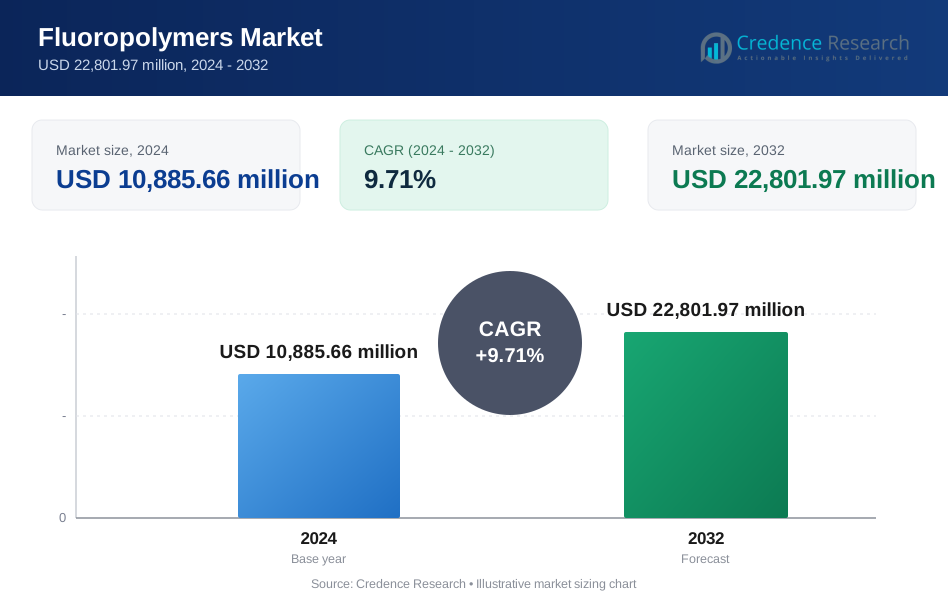
| Fluoropolymers Market Size 2024 | USD 10,885.66 million |
| Fluoropolymers Market, CAGR | 9.71% |
| Fluoropolymers Market Size 2032 | USD 22,801.97 million |
Market Overview
Fluoropolymers Market size was valued at USD 7,890.00 million in 2018 to USD 10,885.66 million in 2024 and is anticipated to reach USD 22,801.97 million by 2032, at a CAGR of 9.71% during the forecast period.
The fluoropolymers market is experiencing robust growth driven by increasing demand across key industries such as automotive, electronics, construction, and chemical processing. Superior chemical resistance, high thermal stability, and excellent electrical insulation properties make fluoropolymers a preferred choice for high-performance applications, particularly in wiring, cabling, coatings, and gaskets. Stringent regulatory standards for emission control and rising adoption of lightweight, durable materials in automotive and aerospace sectors are accelerating market expansion. Technological advancements in polymer processing and the development of innovative, application-specific fluoropolymer grades further fuel market trends. The growing shift toward clean energy, including fuel cells and solar panels, presents new growth avenues. At the same time, manufacturers are increasingly focusing on sustainability by developing recyclable and environmentally friendly fluoropolymer products. However, fluctuating raw material prices and regulatory concerns regarding environmental impact remain ongoing challenges in the market landscape.
The Fluoropolymers Market exhibits significant geographical diversity, with strong growth evident across North America, Europe, and Asia Pacific. North America benefits from advanced technological infrastructure and sustained demand in automotive, electronics, and industrial processing, while Europe’s adoption of high-performance materials is driven by stringent environmental regulations and innovation in specialty applications. Asia Pacific stands out as the fastest-growing region, supported by rapid industrialization in China, India, Japan, and South Korea, alongside expanding automotive and electronics sectors. Among the leading players in the Fluoropolymers Market are Chemours, recognized for its extensive product portfolio and global reach; Daikin Industries, known for continuous innovation and strong presence in Asia; and Solvay, which leverages advanced research and strategic collaborations. Companies such as 3M also play a key role, focusing on the development of high-value specialty polymers and tailored solutions for diverse end-use industries.
Market Insights
The Fluoropolymers Market was valued at USD 10,885.66 million in 2024 and is projected to reach USD 22,801.97 million by 2032, registering a CAGR of 9.71% during the forecast period.
· Robust demand in automotive, electronics, and chemical processing sectors drives the need for high-performance fluoropolymers due to their chemical resistance, thermal stability, and superior durability.
· The market is experiencing a trend toward sustainable and eco-friendly fluoropolymer solutions, with manufacturers investing in recyclable and bio-based product development.
· Leading companies such as Chemours, Daikin Industries, Solvay, and 3M continue to innovate by expanding their product portfolios and forging strategic partnerships to strengthen their global presence.
· Stringent environmental regulations and fluctuating raw material prices remain key restraints, impacting both production costs and compliance strategies for manufacturers.
· Asia Pacific leads market growth with rapid industrialization in China, India, and South Korea, while North America and Europe benefit from advanced manufacturing capabilities and technological adoption.
· The competitive landscape remains dynamic, with major players focusing on R&D investment, product innovation, and strategic collaborations to capture emerging opportunities in clean energy, healthcare, and advanced electronics.
Market Drivers
Rising Demand from Automotive and Aerospace Industries Fueling Market Growth
The automotive and aerospace industries are significant drivers for the Fluoropolymers Market due to their need for lightweight, high-performance materials. Increasing production of electric vehicles and advanced aircraft has led to higher usage of fluoropolymer components in fuel hoses, gaskets, and wiring insulation. These materials offer excellent chemical resistance, low friction, and durability under extreme temperatures, supporting the stringent performance requirements in both sectors. The industry’s focus on enhancing fuel efficiency and reducing emissions further boosts the adoption of fluoropolymers in lightweight designs. Regulatory mandates for emission control and improved safety standards encourage manufacturers to seek advanced polymer solutions. The push toward sustainability and energy-efficient vehicles also strengthens the demand for high-quality fluoropolymer products.
- For instance, the European Union is experiencing a surge in fluoropolymer demand, particularly in electric vehicle batteries and aerospace components, due to their high-temperature stability and durability,
Advancements in Electronics and Electrical Applications Creating New Opportunities
Technological advancements and the expansion of the electronics sector have created strong opportunities in the Fluoropolymers Market. Fluoropolymers provide excellent dielectric properties and reliability in insulation, which are crucial for high-speed data transmission and miniaturization in electronic devices. The market benefits from rising consumer demand for smartphones, tablets, and wearable technology, all requiring robust and compact components. Growth in the 5G network infrastructure and electric vehicle electronics drives further adoption. Manufacturers continue to innovate by developing grades suitable for flexible circuits, semiconductors, and battery separators. The increasing complexity and performance requirements of electronics have cemented fluoropolymers as essential materials in the industry.
- For instance, the electronics industry contributes approximately 28% of total fluoropolymer consumption, particularly in high-performance insulation for 5G networks and semiconductors.
Stringent Regulatory Requirements and Environmental Standards Driving Adoption
Regulatory agencies across the globe have implemented strict standards for emission reduction, product safety, and environmental sustainability. The Fluoropolymers Market responds to these regulations by offering solutions that meet or exceed compliance demands, especially in the automotive, industrial, and construction sectors. Its chemical inertness, non-flammability, and low toxicity make fluoropolymers attractive for applications subject to rigorous oversight. Many governments support the adoption of advanced materials that extend product lifecycles and minimize maintenance needs. Industrial customers seek materials that enhance workplace safety and reduce environmental risks. Regulatory pressures accelerate the transition toward high-performance, compliant fluoropolymer-based solutions.
Expansion of Clean Energy and Renewable Technologies Supporting Market Growth
The global shift toward clean energy and renewable technologies has supported new growth avenues in the Fluoropolymers Market. Demand for solar panels, wind turbines, and fuel cell technologies has surged, as these industries require materials that can withstand harsh environments and maintain performance over extended periods. Fluoropolymers play a key role in ensuring the reliability and efficiency of renewable energy systems, particularly in sealing, cabling, and protective coatings. The focus on decarbonization and energy efficiency promotes further market expansion. It meets the technical requirements of next-generation energy systems by offering thermal and chemical stability. The transition to greener technologies positions fluoropolymers as indispensable materials for future innovation.
Market Trends
Growing Emphasis on Sustainable and Eco-Friendly Fluoropolymer Solutions
The Fluoropolymers Market is witnessing a pronounced shift toward sustainable and environmentally responsible materials. Manufacturers are investing in research to develop recyclable and low-impact fluoropolymer products to address growing concerns about environmental pollution and regulatory pressures. Companies have begun to introduce bio-based and partially recyclable fluoropolymers to cater to industries seeking to reduce their carbon footprint. The trend toward green chemistry and circular economy models is influencing procurement strategies and supplier partnerships. Sustainability certifications and transparent supply chains have become essential criteria in vendor selection processes. The move toward eco-friendly alternatives supports long-term competitiveness for industry players.
- For instance, manufacturers are increasingly focusing on developing eco-friendly production processes and sustainable product alternatives to address environmental concerns.
Rising Integration of Fluoropolymers in Advanced Electronics and High-Tech Applications
Fluoropolymers Market participants are leveraging the rapid growth in the electronics sector to expand application portfolios. The demand for high-performance, miniaturized components in 5G infrastructure, electric vehicles, and IoT devices drives increased use of fluoropolymer-based insulation, coatings, and films. It responds to these trends by providing materials that offer superior dielectric properties and reliability in demanding conditions. Miniaturization in electronic devices requires flexible, heat-resistant polymers, making fluoropolymers indispensable for next-generation products. Partnerships between electronics manufacturers and fluoropolymer suppliers are becoming more common to accelerate product innovation. The continuous evolution of electronics technology sustains demand for high-quality materials.
- For instance, fluoropolymers are widely used in wire coatings, insulating materials, and semiconductors due to their excellent electrical insulation properties.
Advancements in Processing Technologies and Customization of Fluoropolymers
Innovations in processing technologies enable customization and expansion of fluoropolymer applications across multiple industries. The Fluoropolymers Market benefits from developments in extrusion, molding, and compounding methods that improve product consistency and functional properties. Manufacturers can now offer tailored solutions for specific requirements in sectors such as automotive, chemical processing, and energy. These advancements lead to more efficient production and a broader range of end-use applications, strengthening the market position of fluoropolymer producers. The focus on customization ensures adaptability to emerging customer needs. Collaboration between material scientists and end-users continues to drive further breakthroughs in product development.
Globalization of Supply Chains and Strategic Collaborations Accelerating Market Expansion
The Fluoropolymers Market is experiencing expansion through globalized supply chains and increased strategic collaborations. Companies are forming partnerships with raw material suppliers, technology developers, and end-users to secure a stable supply of high-quality fluoropolymers. It supports the development of innovative products and accelerates time-to-market for new applications. Global distribution networks enable manufacturers to respond quickly to shifts in regional demand and regulatory environments. Strategic investments in production capacity and R&D facilities in key regions support market growth. The interconnected nature of supply chains enhances resilience and flexibility in addressing market dynamics.
Market Challenges Analysis
Volatility in Raw Material Prices and Supply Chain Constraints Impacting Profitability
The Fluoropolymers Market faces significant challenges from fluctuating raw material prices and ongoing supply chain disruptions. Volatility in the prices of key feedstocks such as fluorspar and hydrocarbons directly impacts production costs and erodes profit margins for manufacturers. The market experiences periodic shortages caused by geopolitical instability, trade restrictions, and limited availability of high-purity raw materials. It must navigate increased transportation costs and longer lead times, which complicate inventory management and project planning. These factors collectively place pressure on pricing strategies and threaten the stability of long-term supply agreements. Manufacturers often pass higher input costs to end-users, creating resistance in price-sensitive sectors.
- For instance, the North American PTFE market observed a 0.64% price decrease, primarily influenced by weakening demand from key downstream sectors and stable yet sufficient supply levels.
Stringent Environmental Regulations and Waste Management Concerns Hindering Market Expansion
Environmental regulations targeting the production, use, and disposal of fluoropolymers present another major challenge for the Fluoropolymers Market. Regulatory bodies in North America, Europe, and Asia have imposed strict controls on emissions and waste generated during manufacturing, as well as the use of certain fluorinated chemicals. Compliance demands significant investments in pollution control technologies and operational modifications, raising costs for producers. The industry also faces scrutiny regarding the environmental persistence of some fluoropolymer products, fueling calls for more sustainable alternatives. It must address evolving public concerns and regulatory requirements to maintain market access. These constraints slow new product introductions and can limit growth potential in regions with the most stringent oversight.
Market Opportunities
Emerging Applications in Clean Energy and Healthcare Sectors Creating New Growth Avenues
The Fluoropolymers Market holds substantial opportunities through the rapid expansion of clean energy and healthcare industries. Growing investments in solar power, wind energy, and fuel cell technologies require advanced materials that provide durability, chemical resistance, and longevity in challenging environments. The unique properties of fluoropolymers position them as essential materials for photovoltaic modules, fuel cell membranes, and insulation in renewable energy systems. Healthcare innovations drive further demand, with fluoropolymers increasingly used in medical devices, tubing, and implantable products due to their biocompatibility and inertness. It stands to benefit from rising healthcare expenditures and accelerated development of advanced diagnostics and treatments. Strategic partnerships with energy and healthcare companies can further expand market reach.
Innovation in High-Performance and Sustainable Product Development Supporting Market Expansion
Opportunities in the Fluoropolymers Market also arise from ongoing innovation in high-performance and sustainable product development. Research efforts target new grades of fluoropolymers that offer enhanced mechanical, thermal, and chemical properties to meet evolving industry standards. Companies are investing in environmentally friendly manufacturing processes and recyclable fluoropolymer products, addressing regulatory and customer demands for sustainability. It can leverage these innovations to access markets with strict environmental standards and position itself as a leader in green chemistry. The shift toward specialty applications such as electronics, membranes, and coatings creates additional pathways for growth. Expanding product portfolios and diversifying end-use segments support long-term competitiveness.
Market Segmentation Analysis:
By Production:
The Fluoropolymers Market demonstrates a diverse production landscape, with several product types addressing the needs of various end-use industries. Polytetrafluoroethylene (PTFE) holds a leading share due to its exceptional chemical resistance, non-stick properties, and thermal stability. It serves as the material of choice for applications ranging from gaskets and seals to non-stick coatings in cookware and industrial processing equipment. Polyvinylidene fluoride (PVDF) has gained strong momentum, driven by increasing demand in electrical insulation, chemical processing, and membrane filtration technologies. PVDF’s mechanical strength and flame resistance support its adoption in wire and cable insulation, lithium-ion batteries, and piping systems. Fluorinated Ethylene Propylene (FEP) finds favor for its superior transparency, flexibility, and resistance to stress cracking, making it ideal for applications such as tubing, cable jacketing, and medical devices. Polyvinylfluoride (PVF) is preferred for protective films, especially in construction and photovoltaic modules due to its weatherability and UV resistance. The ‘Others’ segment, which includes specialty fluoropolymers, addresses niche requirements where unique combinations of properties are necessary.
By Application:
From an application perspective, the Fluoropolymers Market is strongly represented in the automotive sector. It supports the growing trend toward electric vehicles and lightweight design, supplying materials for fuel hoses, gaskets, seals, and under-the-hood components that must perform in harsh environments. Electric and electronics applications form another key segment, with fluoropolymers being widely used in wire insulation, semiconductors, connectors, and printed circuit boards. Their dielectric properties and high-temperature resistance ensure reliability and safety in modern electronic devices and infrastructure. The construction sector leverages fluoropolymers for coatings, architectural membranes, and protective films, capitalizing on their weather resistance and long-term durability. Industrial processing applications benefit from fluoropolymers in valves, pumps, linings, and pipes exposed to corrosive chemicals and extreme conditions. The ‘Others’ category includes emerging uses in healthcare, renewable energy, and specialty manufacturing, where unique performance characteristics are critical. The broad applicability across production types and end-use segments reinforces the market’s resilient growth trajectory and highlights the critical role of innovation in expanding future opportunities.
Segments:
Based on Production:
- Polytetrafluoroethylene (PTFE)
- Polyvinylidene fluoride (PVDF)
- Fluorinated Ethylene Propylene (FEP)
- Polyvinylfluoride (PVF)
- Others
Based on Application:
- Automotive
- Electric & Electronics
- Construction
- Industrial Processing
- Others
Based on the Geography:
- North America
- U.S.
- Canada
- Mexico
- Europe
- UK
- France
- Germany
- Italy
- Spain
- Russia
- Belgium
- Netherlands
- Austria
- Sweden
- Poland
- Denmark
- Switzerland
- Rest of Europe
- Asia Pacific
- China
- Japan
- South Korea
- India
- Australia
- Thailand
- Indonesia
- Vietnam
- Malaysia
- Philippines
- Taiwan
- Rest of Asia Pacific
- Latin America
- Brazil
- Argentina
- Peru
- Chile
- Colombia
- Rest of Latin America
- Middle East
- UAE
- KSA
- Israel
- Turkey
- Iran
- Rest of Middle East
- Africa
- Egypt
- Nigeria
- Algeria
- Morocco
- Rest of Africa
Regional Analysis
North America Fluoropolymers Market
North America Fluoropolymers Market grew from USD 1,675.05 million in 2018 to USD 2,269.93 million in 2024 and is projected to reach USD 4,782.14 million by 2032, reflecting a compound annual growth rate (CAGR) of 9.8%. North America is holding a 21% market share. The United States and Canada remain key contributors, driven by robust demand in automotive, electronics, and industrial processing. Strong technological advancements and the presence of leading manufacturers position North America as a mature yet dynamic market. Regulatory compliance, a focus on innovation, and investment in clean energy initiatives continue to support regional growth. Expansion in healthcare and renewable energy applications is expected to further accelerate demand.
Europe Fluoropolymers Market
Europe Fluoropolymers Market grew from USD 2,030.10 million in 2018 to USD 2,689.55 million in 2024 and is expected to reach USD 5,268.91 million by 2032, registering a CAGR of 8.8%. Europe is holding a 23% market share. Germany, France, and the United Kingdom drive regional demand, underpinned by strong automotive, aerospace, and construction industries. Stringent environmental regulations and sustainability initiatives propel the adoption of advanced fluoropolymer products. Research and development investments by multinational companies foster innovation in high-performance materials. The region continues to advance applications in electronics, green building, and specialty manufacturing sectors.
Asia Pacific Fluoropolymers Market
Asia Pacific Fluoropolymers Market grew from USD 3,387.18 million in 2018 to USD 4,791.27 million in 2024 and is set to achieve USD 10,666.42 million by 2032, reflecting the highest CAGR of 10.5%. Asia Pacific is holding a 47% market share, making it the largest regional market. China, Japan, South Korea, and India dominate regional consumption, supported by rapid industrialization and expanding automotive, electronics, and construction sectors. Local manufacturing capacity, cost advantages, and a surge in renewable energy projects drive demand. Investments in high-tech industries and infrastructure further bolster growth prospects.
Latin America Fluoropolymers Market
Latin America Fluoropolymers Market grew from USD 325.07 million in 2018 to USD 441.85 million in 2024 and is projected to reach USD 803.31 million by 2032, recording a CAGR of 7.8%. Latin America is holding a 4% market share. Brazil and Mexico lead regional growth, driven by investments in automotive, chemicals, and oil & gas industries. Rising industrialization and infrastructure projects contribute to a steady increase in fluoropolymer consumption. The region benefits from evolving supply chain networks and new market entrants seeking growth opportunities.
Middle East Fluoropolymers Market
Middle East Fluoropolymers Market grew from USD 249.32 million in 2018 to USD 317.79 million in 2024 and is forecasted to reach USD 574.46 million by 2032, at a CAGR of 7.7%. The Middle East holds a 3% market share. The United Arab Emirates and Saudi Arabia remain the primary markets, fueled by investment in petrochemicals, construction, and industrial processing. Demand is further supported by efforts to diversify economies and modernize manufacturing capabilities. Strategic partnerships with global suppliers are enhancing the region’s access to advanced materials.
Africa Fluoropolymers Market
Africa Fluoropolymers Market grew from USD 223.29 million in 2018 to USD 375.27 million in 2024 and is estimated to reach USD 706.72 million by 2032, growing at a CAGR of 8.3%. Africa holds a 2% market share. South Africa and Egypt are the key countries contributing to regional growth, supported by investments in construction, mining, and energy sectors. Rising demand for infrastructure development and industrial processing applications fuels market expansion. The region continues to attract global suppliers looking to tap into emerging market opportunities.
Key Player Analysis
- Chemours
- Daikin Industries
- 3M
- Solvay
- Arkema
- AGC Chemicals
- Gujarat Fluorochemicals
- Dongyue Group
- Halopolymer
- Kureha Corporation
Competitive Analysis
The competitive landscape of the Fluoropolymers Market is characterized by the presence of prominent global players such as Chemours, Daikin Industries, 3M, Solvay, Arkema, AGC Chemicals, Gujarat Fluorochemicals, Dongyue Group, Halopolymer, and Kureha Corporation. These companies leverage their advanced manufacturing capabilities, expansive product portfolios, and significant investments in research and development to maintain strong market positions. Leading companies focus on advanced manufacturing technologies and significant investments in research and development to introduce high-performance and specialty fluoropolymer products that address evolving customer needs in automotive, electronics, healthcare, and renewable energy. Firms actively pursue strategic collaborations, joint ventures, and mergers to enhance their technological capabilities and broaden their global reach. Sustainability has become a core area of competition, with market leaders accelerating efforts to develop recyclable, eco-friendly fluoropolymers to meet regulatory and consumer expectations. The industry also sees a growing emphasis on operational excellence and cost efficiency, enabling companies to adapt quickly to supply chain disruptions and fluctuating raw material prices. Dynamic competition encourages continuous innovation, ensuring that the market remains vibrant and responsive to new opportunities and regulatory changes.
Recent Developments
- In August 2023, The Kureha Group announced plans to increase its production capacity for polyvinylidene fluoride (PVDF) at its Iwaki Plant in Fukushima, Japan. The expansion has been planned to align with the growing demand for PVDF, used as an adhesive material for lithium-ion batteries (LiB) and as an engineering plastic for various industrial applications.
- In October 2022, Dongyue Group finalized the construction of its PVDF project in China, with an annual production capacity of approximately 10,000 tons. This addition brought the company’s total PVDF production capacity to 25,000 tons per year.
- In January 2022, Arkema revealed its decision to increase the capacity expansion of its fluoropolymer production at the Changshu site in China. Initially set at 35%, the expansion was revised to 50% in response to the growing demand for materials used in lithium-ion batteries.
Market Concentration & Characteristics
The Fluoropolymers Market demonstrates a moderate to high degree of market concentration, with a handful of multinational corporations holding substantial shares due to their advanced manufacturing capabilities, broad product portfolios, and established global networks. It is characterized by high entry barriers, stemming from significant capital requirements, specialized technical expertise, and stringent regulatory standards governing production and environmental compliance. The market places a strong emphasis on product innovation, quality consistency, and customized solutions tailored to the demands of industries such as automotive, electronics, construction, and healthcare. Firms compete on the basis of technological advancements, reliability, and long-term customer relationships. It exhibits a dynamic nature, driven by continuous research and development, the introduction of sustainable materials, and a strong focus on operational excellence to manage fluctuating input costs and supply chain complexities.
Report Coverage
The research report offers an in-depth analysis based on Production, Application and Geography. It details leading market players, providing an overview of their business, product offerings, investments, revenue streams, and key applications. Additionally, the report includes insights into the competitive environment, SWOT analysis, current market trends, as well as the primary drivers and constraints. Furthermore, it discusses various factors that have driven market expansion in recent years. The report also explores market dynamics, regulatory scenarios, and technological advancements that are shaping the industry. It assesses the impact of external factors and global economic changes on market growth. Lastly, it provides strategic recommendations for new entrants and established companies to navigate the complexities of the market.
Future Outlook
- The fluoropolymers market is projected to experience steady growth, driven by increasing demand across various industries, including automotive, electronics, and healthcare.
- Rising adoption of electric vehicles and renewable energy systems is expected to boost the use of fluoropolymers due to their high thermal stability and chemical resistance.
- The electronics sector's expansion, particularly in semiconductors and 5G infrastructure, will likely increase the demand for fluoropolymer-based components.
- Growth in the healthcare industry, with applications in medical devices and pharmaceutical packaging, is anticipated to contribute to market expansion.
- Development of bio-based and recyclable fluoropolymers is gaining traction, aligning with global sustainability goals and regulatory requirements.
- Asia-Pacific is expected to maintain its position as the largest market, supported by rapid industrialization and infrastructure development.
- North America and Europe are projected to witness moderate growth, focusing on technological advancements and environmental compliance.
- Stringent environmental regulations concerning per- and polyfluoroalkyl substances (PFAS) may pose challenges, prompting the industry to innovate safer alternatives.
- Continuous research and development efforts are essential to enhance product performance and discover new applications for fluoropolymers.
- Strategic collaborations and mergers among key players are anticipated to shape the competitive landscape and drive market consolidation.
Request a Free Sample
Fill in your details and we'll send you a free sample report.
- Sample data tables & charts
- Research methodology
Need a Custom Version of This Report?
Tailor the scope, geography, or segments to your exact requirements.
- Custom geography or segment scope
- Direct access to our analyst team
Frequently Asked Questions
What is the current size of the Fluoropolymers Market?
What factors are driving the growth of the Fluoropolymers Market?
Who are the major players in the Fluoropolymers Market?
What are some challenges faced by the Fluoropolymers Market?
Table of Content
Chapter 1. Report Introduction
- 1.1 Report Description & Purpose
- 1.1.1 Report Title & Market Definition
- 1.1.2 Unique Selling Propositions (USP) & Key Differentiators
- 1.1.3 Value Proposition for Stakeholders
- 1.2 Research Objectives
- 1.2.1 Market Sizing Objectives (Volume & Revenue)
- 1.2.2 Segmentation Objectives
- 1.2.3 Competitive Intelligence Objectives
- 1.2.4 Forecast & Scenario Objectives
- 1.3 Report Scope
- 1.3.1 Fluoropolymers Scope – Types & Subtypes Covered
- 1.3.2 Geographic Scope – Regions & Countries Covered
- 1.3.3 Historical Period, Base Year & Forecast Period (2024; forecast to 2032)
- 1.3.4 Inclusions & Exclusions
- 1.4 HS Code & Classification Framework
- 1.5 Currency, Units & Pricing Basis
- 1.6 Target Stakeholders
- 1.7 Limitations & Assumptions
Chapter 2. Executive Summary
- 2.1 Global Fluoropolymers Market Snapshot
- 2.1.1 Market Size – Historical (2024) & Forecast (2024-2032) (2024: USD 10,885.66 million → 2032: USD 22,801.97 million)
- 2.1.2 Volume & Revenue – Global Totals
- 2.1.3 Key Market Highlights – Top Five Facts
- 2.2 Fluoropolymers Market Segmentation Snapshot
- 2.2.1 Market Split by Region – 2024 vs. 2032
- 2.3 Competitive Snapshot
- 2.3.1 Top 10 Players by Revenue Share – 2024
- 2.3.2 Top 10 Players by Volume Share – 2024
- 2.3.3 Recent Strategic Developments (18-Month Summary)
- 2.4 Key Investment Highlights & Strategic Conclusions
Chapter 3. Fluoropolymers Market Dynamics & Industry Analysis
- 3.1 Market Overview & Context
- 3.1.1 Fluoropolymers Market Position in the Broader Automotive Value Chain
- 3.1.2 OEM vs. Replacement Market Dynamics
- 3.1.3 Market Maturity & Development Stage by Region
- 3.2 Fluoropolymers Market Drivers
- 3.3 Fluoropolymers Market Restraints & Challenges
- 3.4 Fluoropolymers Market Opportunities
- 3.5 Porter's Five Forces Analysis
- 3.5.1 Threat of New Entrants
- 3.5.2 Bargaining Power of Suppliers
- 3.5.3 Bargaining Power of Buyers
- 3.5.4 Threat of Substitutes
- 3.5.5 Competitive Rivalry – Intensity Assessment
- 3.6 Fluoropolymers Value Chain Analysis
- 3.6.1 Upstream – Raw Material/Input Suppliers
- 3.6.1.1 Raw Material/Input 1
- 3.6.1.2 Raw Material/Input 2
- 3.6.1.3 Raw Material/Input 3
- 3.6.2 Midstream – Production/Manufacturing/Service Delivery
- 3.6.2.1 Production/Process Overview
- 3.6.2.2 Key Facility Locations & Capacity by Manufacturer
- 3.6.3 Downstream – Distribution & End Consumer
- 3.6.3.1 Primary Channel – B2B/OEM
- 3.6.3.2 Secondary Channels – Dealer, Retail, Online, Direct
- 3.6.4 Value Chain Profitability Analysis
- 3.6.1 Upstream – Raw Material/Input Suppliers
- 3.7 PESTEL Analysis
- 3.7.1 Political Factors
- 3.7.2 Economic Factors
- 3.7.3 Social Factors
- 3.7.4 Technological Factors
- 3.7.5 Environmental Factors
- 3.7.6 Legal Factors
- 3.8 Fluoropolymers Supply Chain Analysis
- 3.8.1 Raw Material/Input Supply Risk Assessment
- 3.8.2 Manufacturing Concentration Risk (Geographic Exposure)
- 3.8.3 Trade Disruption Impact Analysis
- 3.9 Regulatory & Policy Landscape
Note: The regulatory and policy landscape section covers regulations based on their applicability to the market, Fluoropolymers category, geography, and scope of the study. Only regulatory frameworks with a material impact on operations, compliance, trade, sustainability, or market access are analyzed in detail.
Chapter 4. Key Investment Pockets & Opportunity Analysis
- 4.1 Fluoropolymers Market Attractiveness Analysis
- 4.1.1 By Region – Investment Attractiveness Matrix (Volume × CAGR)
- 4.2 Absolute Revenue Growth Opportunity
- 4.2.1 By Region – Absolute USD Growth Through 2032
- 4.3 Incremental Volume Opportunity
- 4.3.1 By Region – Incremental Volume Through 2032
- 4.3.2 Segment – Incremental Volume
- 4.4 Emerging Submarket Opportunity Deep Dive (Subject to Applicability)
- 4.5 Emerging Market Opportunity Scorecards
- 4.5.1 United States
- 4.5.2 Europe
- 4.5.3 Asia
- 4.5.4 Middle East & Africa
Note: Emerging Market Opportunity Scorecards will be included based on relevance and strategic importance. Regions listed are indicative and may vary depending on data availability and market dynamics.
Chapter 5. Fluoropolymers Import-Export Analysis & Trade Flows
- 5.1 Global Trade Overview
- 5.1.1 Global Export Value by Country (2024)
- 5.1.2 Global Export Volume by Country (2024)
- 5.1.3 Global Import Value by Country (2024)
- 5.1.4 Global Import Volume by Country (2024)
- 5.1.5 Net Trade Balance by Country (2024)
- 5.2 Export Analysis – Segment
- 5.2.1 Type 1 (HS Code)
- 5.2.2 Type 2 (HS Code)
- 5.2.3 Type 3 (HS Code)
- 5.2.4 Type 4 (HS Code)
- 5.2.5 Type 5 (HS Code)
- 5.3 Import Analysis – Segment
- 5.3.1 Type 1 (HS Code)
- 5.3.2 Type 2 (HS Code)
- 5.3.3 Type 3 (HS Code)
- 5.3.4 Type 4 (HS Code)
- 5.3.5 Type 5 (HS Code)
- 5.4 Average Unit Trade Prices
- 5.4.1 Average Export Price – Segment & Country
- 5.4.2 Average Import Price – Segment & Source Country
- 5.4.3 Price Trends (2024)
- 5.5 Key Trade Route Analysis
- 5.5.1 Trade Route 1
- 5.5.2 Trade Route 2
- 5.5.3 Trade Route 3
- 5.5.4 Trade Route 4
- 5.5.5 Trade Route 5
- 5.6 Trade Policy Impact Assessment
- 5.6.1 US Anti-Dumping & Section 301 Tariffs
- 5.6.2 EU Customs Union Impact
- 5.6.3 Major Free Trade Agreements
- 5.6.4 USMCA Rules of Origin
Note: Trade policy analysis will be included only where relevant to the Fluoropolymers market.
Chapter 6. Competitive Landscape & Company Benchmarking
- 6.1 Fluoropolymers Market Concentration & Structure
- 6.1.1 Herfindahl-Hirschman Index (HHI) – vs. 2024
- 6.1.2 Tier 1, Tier 2 & Tier 3 Market Structure
- 6.1.3 Global, Regional & Local Player Dynamics
- 6.2 Fluoropolymers Market Share Analysis – 2024
- 6.2.1 Global Revenue Share by Company
- 6.2.2 Global Volume Share by Company
- 6.2.3 Regional Revenue Share
- 6.2.4 Market Share Evolution ( vs. 2024)
- 6.2.5 OEM Segment Share by Company
- 6.2.6 Replacement Segment Share by Company
- 6.3 Production/Delivery Capacity & Facility Analysis
- 6.3.1 Global Installed Capacity
- 6.3.2 Capacity Utilization Rates
- 6.3.3 Production/Output Volume
- 6.3.4 Facility Locations & Capacity Map
- 6.3.5 Planned Capacity Additions
- 6.4 Fluoropolymers Competitive Benchmarking Matrix
- 6.4.1 Revenue, Volume, CAGR & Profitability Comparison
- 6.4.2 Channel Revenue Mix
- 6.4.3 Geographic Revenue Exposure
- 6.4.4 R&D Intensity
- 6.4.5 Sustainability Maturity
- 6.5 Strategic Developments in Fluoropolymers (Last 24 Months)
- 6.5.1 Mergers, Acquisitions & Divestments
- 6.5.2 New Fluoropolymers Launches
- 6.5.3 Facility Expansions
- 6.5.4 Strategic Alliances, Joint Ventures & Partnerships
- 6.5.5 Distribution Expansion & Market Entry
- 6.5.6 Sustainability & ESG Initiatives
- 6.6 Competitive Strategy Mapping
- 6.6.1 Leader, Challenger, Follower & Niche Classification
- 6.6.2 Pricing Strategy Comparison
- 6.6.3 Channel Strategy Matrix
Note: Strategic developments are included based on their materiality and the availability of reliable information.
Chapter 7. Global Fluoropolymers Market – By Distribution Channel
- 7.1 Segment Overview
- 7.1.1 Volume & Revenue Split by Channel (2024 & 2032)
- 7.1.2 Channel Mix Evolution (2024-2032)
Chapter 8. Regional Market Analysis – Global Overview
- 8.1 Global Regional Overview
- 8.1.1 Regional Volume Share
- 8.1.2 Regional Revenue Share
- 8.1.3 Regional Volume by Region
- 8.1.4 Regional Revenue by Region
- 8.1.5 Regional Forecast Through 2032
- 8.2 Cross-Regional Segment Analysis
- 8.2.1 By Distribution Channel
- 8.2.2 By Brand/Price Tier
Chapter 9. North America Fluoropolymers Market
- 9.1 United States
- 9.2 Canada
- 9.3 Mexico
Chapter 10. Europe Fluoropolymers Market
- 10.1 Germany
- 10.2 France
- 10.3 Italy
- 10.4 United Kingdom
- 10.5 Spain
- 10.6 Poland
- 10.7 Russia
- 10.8 Netherlands
- 10.9 Belgium
- 10.10 Sweden
- 10.11 Denmark
- 10.12 Norway
- 10.13 Rest of Europe
Chapter 11. Asia Pacific Fluoropolymers Market
- 11.1 China
- 11.2 India
- 11.3 Japan
- 11.4 South Korea
- 11.5 Thailand
- 11.6 Indonesia
- 11.7 Vietnam
- 11.8 Malaysia
- 11.9 Australia
- 11.10 Rest of Asia Pacific
Chapter 12. Latin America Fluoropolymers Market
- 12.1 Brazil
- 12.2 Argentina
- 12.3 Colombia
- 12.4 Chile
- 12.5 Rest of Latin America
Chapter 13. Middle East Fluoropolymers Market
- 13.1 Saudi Arabia
- 13.2 United Arab Emirates
- 13.3 Turkey
- 13.4 Israel
- 13.5 Iran
- 13.6 Rest of the Middle East
Chapter 14. Africa Fluoropolymers Market
- 14.1 South Africa
- 14.2 Egypt
- 14.3 Nigeria
- 14.4 Morocco
- 14.5 Rest of Africa
Chapter 15. Fluoropolymers Company Profiles
- 15.1 [Company 01]
- 15.1.1 Company Overview
- 15.1.2 Key Management Personnel
- 15.1.3 Products & Services Portfolio
- 15.1.4 Financial Performance
- 15.1.5 Key Market Focus & Geographic Presence
- 15.1.6 Recent Developments & Strategic Initiatives
Note: The company profile list is preliminary and may change based on research findings, market developments, data availability, and client requirements.
Chapter 16. Appendices
- Appendix A – List of Abbreviations & Acronyms
- Appendix B – Industry Classification Code Reference – Full Series
- Appendix C – Production & Capacity Data Tables
- Appendix D – End-Use & Demand Base Tables
- Appendix E – Consumption & Replacement Rate Assumptions
- Appendix F – ASP Reference Tables
- Appendix G – Manufacturing & Facility Database
- Appendix H – Import-Export Data Tables
- Appendix I – Regulatory Summary Tables
- Appendix J – Primary Research Participant List (Anonymized)
- Appendix K – Primary Research Questionnaire Framework
- Appendix L – Data Sources & Bibliography
- Appendix M – Market Size Divergence & Source Comparison
Chapter 17. Research Methodology
- 17.1 Research Framework & Philosophy
- 17.2 Secondary Research – Sources, Hierarchy & Data Extraction
- 17.3 Data Modeling – Bottom-Up & Top-Down Market Sizing
- 17.4 Primary Research – Stakeholder Framework, LOI & Sample Sizes
- 17.5 Forecast Methodology – Regression, Scenario & Sensitivity Analysis
- 17.6 Quality Control – Four-Layer Validation Framework
- 17.7 Limitations & Standard Assumptions
- 17.8 Disclaimer
