
Market Overview
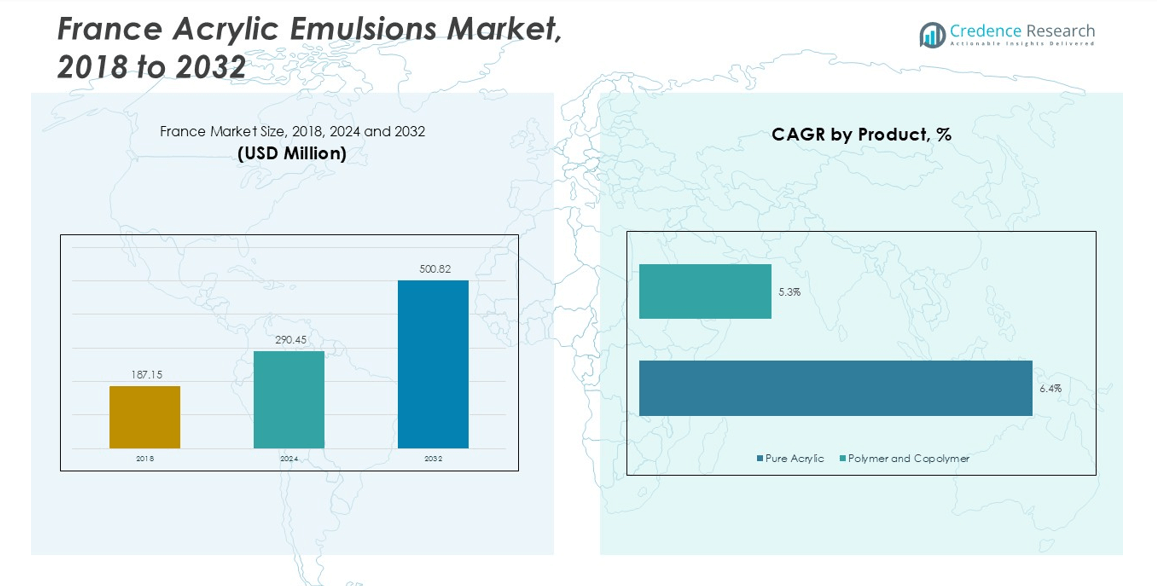
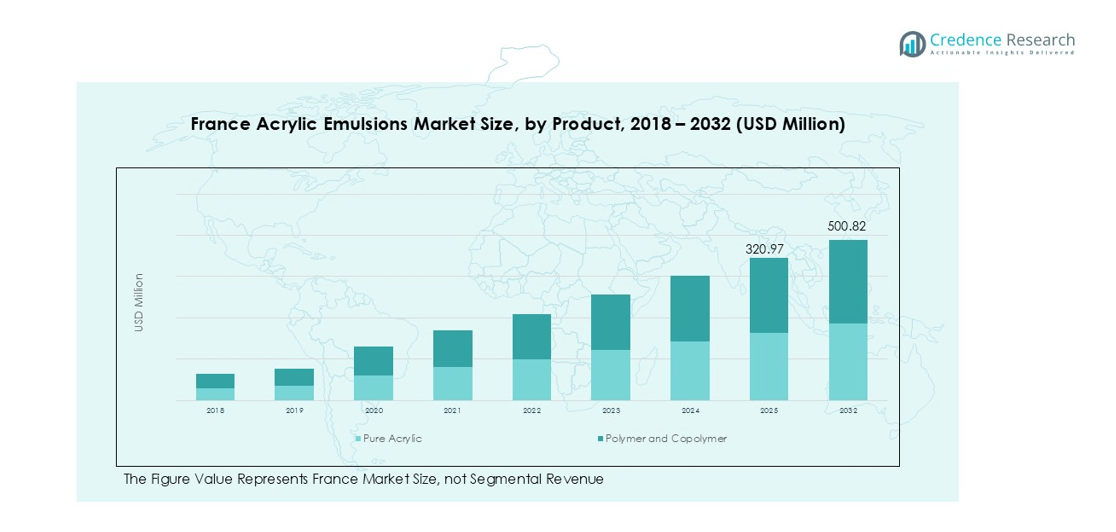
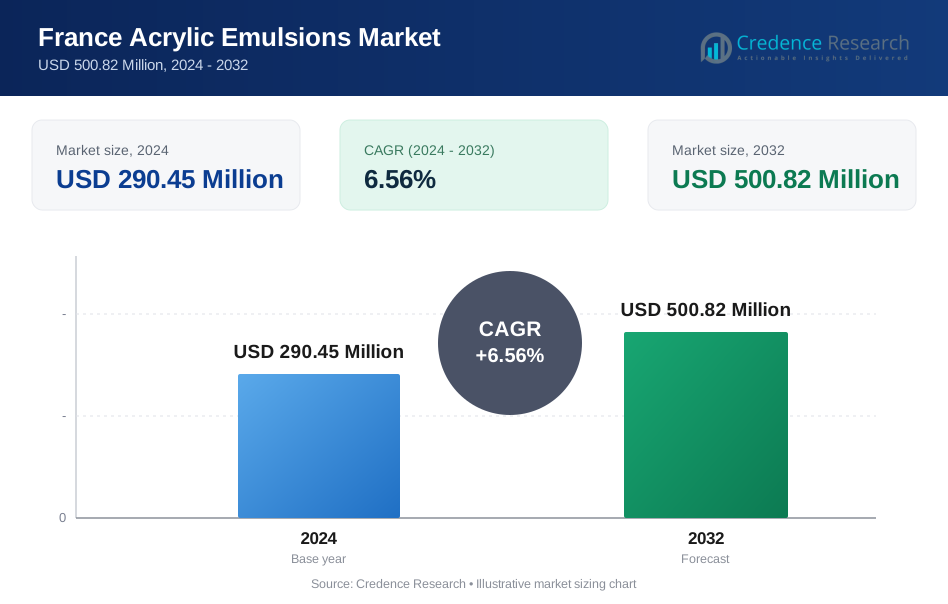
France Acrylic Emulsions market size was valued at USD 187.15 Million in 2018, increasing to USD 290.45 Million in 2024, and is anticipated to reach USD 500.82 Million by 2032, at a CAGR of 6.56% during the forecast period.
| REPORT ATTRIBUTE | DETAILS |
|---|---|
| Historical Period | 2020-2023 |
| Base Year | 2024 |
| Forecast Period | 2025-2032 |
| France Acrylic Emulsions Market Size 2024 | USD 290.45 Million |
| France Acrylic Emulsions Market, CAGR | 6.56% |
| France Acrylic Emulsions Market Size 2032 | USD 500.82 Million |
The France Acrylic Emulsions market is dominated by key players including Arkema, BASF SE, Akzo Nobel N.V., Covestro AG, and Synthomer plc, who lead through innovation, strategic partnerships, and expansion of production capacities. These companies focus on developing high-performance, low-VOC, and eco-friendly emulsions tailored for paints, coatings, adhesives, and construction material applications. Regionally, Île-de-France leads with a 28% market share, driven by intense construction and commercial activities, followed by Provence-Alpes-Côte d'Azur at 15% and Auvergne-Rhône-Alpes at 13%, both benefiting from urbanization and industrial growth. Other significant regions include Occitanie (10%), Hauts-de-France (9%), and Nouvelle-Aquitaine (8%). Together, these regions account for the majority of demand, reflecting the concentration of architectural, industrial, and commercial end users. The top players strategically target these regions to maximize market penetration and capitalize on growing infrastructure, residential, and industrial developments.
Market Insights
- In 2024, the France Acrylic Emulsions market is valued at USD 290.45 Million and is projected to reach USD 500.82 Million by 2032, growing at a CAGR of 6.56%.
- Growth is driven by rising construction and infrastructure projects, increasing demand for eco-friendly paints and coatings, and expanding industrial applications such as adhesives, paper coatings, and specialty formulations.
- Market trends include a shift toward low-VOC and sustainable emulsions, innovation in polymer and copolymer formulations for high-performance applications, and growing adoption of multifunctional emulsions across paints, coatings, and industrial uses.
- The competitive landscape is led by Arkema, BASF SE, Akzo Nobel N.V., Covestro AG, and Synthomer plc, focusing on product innovation, strategic partnerships, and regional expansion to maintain market leadership.
- Regionally, Île-de-France leads with a 28% share, followed by Provence-Alpes-Côte d'Azur (15%) and Auvergne-Rhône-Alpes (13%), while product-wise, Pure Acrylic holds 62% of the market, dominating applications in paints and coatings.
Market Segmentation Analysis:
By Product:
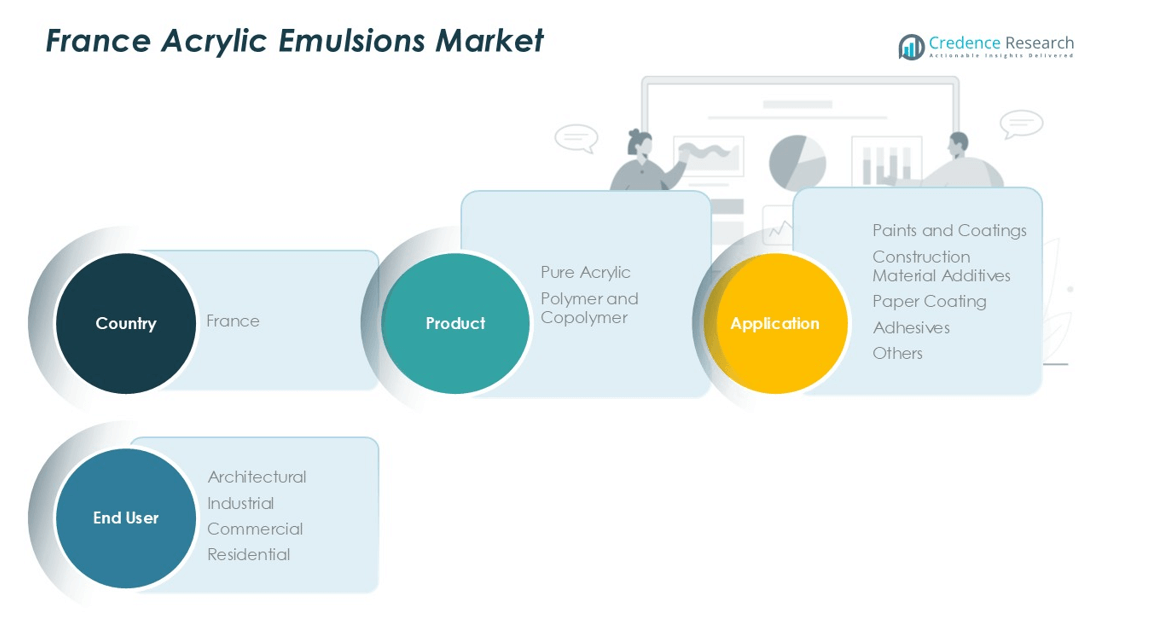
The France Acrylic Emulsions market by product is primarily divided into Pure Acrylic and Polymer & Copolymer. Pure Acrylic dominates the segment, accounting for approximately 62% of the market share, driven by its superior film-forming properties, durability, and resistance to environmental stress. This product is highly favored in premium paints and high-performance coatings. Polymer and Copolymer emulsions, while capturing around 38% of the segment, are increasingly used in specialized adhesives and paper coatings due to their customizable polymer structures, which enhance flexibility, adhesion, and compatibility with diverse substrates.
- For instance, specialty paper coatings by companies like Synthomer employ copolymer emulsions to improve printability and moisture resistance in packaging materials.
By Application:
In terms of application, paints and coatings hold the largest share of around 55% in the France Acrylic Emulsions market. The growth is fueled by rising demand for eco-friendly, low-VOC coatings in residential and commercial construction. Construction material additives follow with a 20% share, benefiting from the increased infrastructure development and modernization projects across France. Paper coatings and adhesives represent 15% and 8%, respectively, supported by the packaging and printing industries. The remaining 2% is contributed by other applications, including textiles and specialty formulations, emphasizing the versatility of acrylic emulsions.
- For instance, Dow's PRIMAL™ AC-2337 acrylic emulsion is specifically designed for the European climate, enhancing durability and weather resistance in residential coatings.
By End User:
The market segmentation by end user is led by the architectural segment, commanding roughly 50% of the total market share. The dominance is supported by heightened construction activities and the growing preference for sustainable, weather-resistant coatings in both residential and commercial buildings. Industrial users contribute 25% of the market, leveraging emulsions in adhesives, coatings, and composites. Commercial and residential end users account for 15% and 10%, respectively, driven by renovation projects, interior finishes, and increasing awareness of quality and durability in paints and coatings.
Key Growth Drivers
Rising Construction and Infrastructure Development
The rapid growth in France’s residential, commercial, and industrial construction projects is fueling demand for acrylic emulsions. High-performance coatings, adhesives, and construction material additives rely on these emulsions for durability, weather resistance, and aesthetic finishes. Urbanization, modernization of infrastructure, and government-backed housing projects are driving demand, with the architectural end-user segment contributing nearly 50% of market consumption. The need for environmentally friendly, low-VOC, and long-lasting materials further reinforces the adoption of acrylic emulsions across building and construction applications.
- For instance, companies like Engineered Polymer Solutions have developed all-acrylic emulsions offering flat-through semi-gloss finishes for interior and exterior architectural coatings with enhanced weather resistance.
Increasing Demand in Paints and Coatings
Paints and coatings remain the largest application segment, accounting for over 55% of the market. Rising consumer awareness of eco-friendly, sustainable, and high-quality coating solutions has led manufacturers to integrate acrylic emulsions for superior performance, durability, and versatility. The surge in residential renovations, commercial building projects, and industrial coatings is driving growth, while stringent regulatory standards for low-VOC and safe coatings are encouraging adoption. The superior adhesion, color retention, and chemical resistance of acrylic emulsions make them a preferred choice across multiple coating applications.
- For instance, Dow Inc. has introduced advanced acrylic emulsion formulations offering enhanced chemical resistance and weatherability for industrial and automotive coatings.
Expanding Industrial Applications
France’s growing industrial sector is creating demand for acrylic emulsions in adhesives, paper coatings, textiles, and specialty formulations. Emulsions enhance product performance, flexibility, and compatibility, making them essential in packaging, automotive, and manufacturing industries. Industrial end users contribute roughly 25% of total market share. Continuous innovation in polymer and copolymer emulsions allows manufacturers to develop customized solutions for niche industrial needs, further propelling market growth. Strategic partnerships and technological advancements in polymer chemistry support broader application adoption and higher demand in the industrial segment.
Key Trends & Opportunities
Shift Toward Eco-Friendly and Sustainable Products
Environmental awareness and strict regulatory norms in France are pushing the market toward low-VOC and bio-based acrylic emulsions. Manufacturers are increasingly focusing on sustainable formulations to reduce carbon footprint and comply with green building standards. This shift presents opportunities for premium and eco-conscious products in paints, coatings, and adhesives. The growing preference for environmentally responsible products among architects, industrial players, and homeowners is driving innovation, providing a competitive edge for companies offering sustainable and high-performance acrylic emulsion solutions.
- For instance, Trinseo launched LIGOS C 9031, a styrene acrylic emulsion for interior wall paints that meets Blue Angel and Nordic Swan eco-label standards while delivering high scrub resistance and excellent washability, supporting low VOC compliance in architectural coatings.
Innovation in Specialty Emulsions and Additives
The demand for high-performance and specialized emulsions is rising across industrial and construction applications. Innovations in polymer and copolymer formulations are enabling enhanced adhesion, water resistance, and thermal stability, creating opportunities in niche applications such as packaging, automotive coatings, and advanced construction materials. Companies focusing on R&D and customized solutions are gaining market share. Additionally, the development of multifunctional emulsions allows broader application across paints, coatings, adhesives, and paper, further expanding the market potential and creating a diversified revenue stream for manufacturers.
- For instance, Arkema produces specialized asphalt/bitumen emulsifier technologies that provide high-performance emulsions used in road paving, improving the stability and durability of construction materials.
Key Challenges
Raw Material Price Volatility
Fluctuating prices of acrylic monomers, solvents, and other raw materials present a significant challenge for manufacturers in France. Volatility affects production costs, profit margins, and pricing strategies, particularly in a competitive market where cost-efficiency is critical. Dependence on petrochemical derivatives exposes the market to global supply chain disruptions and geopolitical uncertainties. Smaller manufacturers may struggle to absorb these cost fluctuations, while larger players must strategically manage procurement and inventory to maintain consistent supply, quality, and competitive pricing in the acrylic emulsions market.
Regulatory Compliance and Environmental Constraints
Stringent environmental regulations and chemical safety standards in France pose challenges for acrylic emulsion manufacturers. Compliance with low-VOC content, hazardous chemical restrictions, and waste management requirements increases operational complexity and costs. Non-compliance can result in penalties, product recalls, or restricted market access. Additionally, transitioning existing product lines to environmentally safe formulations requires significant R&D investment. Companies must continuously innovate to balance performance, cost, and sustainability while meeting regulatory mandates, which can slow product development and limit rapid expansion in certain applications.
Regional Analysis
Île-de-France
Île-de-France leads the France Acrylic Emulsions market, holding a 28% share, driven by the high concentration of commercial and residential construction projects in Paris and surrounding areas. The region’s robust infrastructure development and urbanization create strong demand for paints, coatings, and construction material additives. Architectural end users dominate consumption, while industrial applications, including adhesives and paper coatings, are also significant. The growing preference for eco-friendly, durable, and high-performance emulsions further boosts demand. Manufacturers focus on this region for product launches and partnerships due to its strong economic activity and high density of construction and industrial operations.
Provence-Alpes-Côte d'Azur
Provence-Alpes-Côte d'Azur accounts for 15% of the France Acrylic Emulsions market, driven by expanding residential developments, luxury real estate projects, and tourism-related infrastructure. Paints and coatings remain the dominant application, with architectural end users representing the majority of demand. Industrial applications, such as adhesives and specialty emulsions for packaging, contribute modestly to growth. The region benefits from rising consumer awareness of sustainable and low-VOC products, encouraging manufacturers to supply premium acrylic emulsions. Increasing renovation and refurbishment activities in commercial and residential spaces further reinforce market demand, making Provence-Alpes-Côte d'Azur a key focus area for market expansion.
Auvergne-Rhône-Alpes
Auvergne-Rhône-Alpes holds a 13% market share, driven by the region’s rapid industrialization and infrastructure projects. Industrial end users dominate, leveraging acrylic emulsions for adhesives, coatings, and construction material additives. Paints and coatings continue to lead applications, supported by residential and commercial construction. The demand for sustainable, high-performance, and long-lasting emulsions is rising, reflecting a trend toward eco-friendly products. Government initiatives promoting urban development, modernization of industrial facilities, and investment in high-quality construction materials further drive growth. Manufacturers are increasingly focusing on product innovation and strategic partnerships to meet the diverse needs of this economically vibrant and industrially active region.
Occitanie
Occitanie contributes 10% of the France Acrylic Emulsions market, driven by growth in residential construction and infrastructure development, particularly in Toulouse and Montpellier. Architectural end users lead consumption, primarily for paints and coatings, while industrial applications, including adhesives and paper coatings, are growing steadily. The rising adoption of low-VOC, sustainable, and high-durability emulsions is boosting demand. Regional investments in commercial and public infrastructure projects further expand market potential. Manufacturers are responding with tailored products and localized distribution strategies to strengthen their presence, focusing on both urban construction projects and emerging industrial applications within Occitanie’s diverse economic landscape.
Hauts-de-France
Hauts-de-France holds 9% of the market share, driven by strong industrial and commercial activities, particularly in Lille and surrounding industrial zones. Industrial end users dominate, utilizing acrylic emulsions for adhesives, coatings, and paper coatings. Paints and coatings remain a significant application for architectural and residential projects. The growing demand for durable, sustainable, and eco-friendly emulsions is encouraging manufacturers to invest in innovative formulations. Infrastructure development, renovation of commercial spaces, and increasing construction of energy-efficient buildings further support growth. Key manufacturers focus on strategic partnerships and localized supply to capture the region’s industrial and residential demand effectively.
Market Segmentations:
By Product:
- Pure Acrylic
- Polymer and Copolymer
By Application:
- Paints and Coatings
- Construction Material Additives
- Paper Coating
- Adhesives
- Others
By End User:
- Architectural
- Industrial
- Commercial
- Residential
By Region
- Île-de-France
- Provence-Alpes-Côte d'Azur
- Auvergne-Rhône-Alpes
- Occitanie
- Hauts-de-France
Competitive Landscape
The competitive landscape of the France Acrylic Emulsions market is led by key players such as Arkema, BASF SE, Akzo Nobel N.V., Covestro AG, and Synthomer plc. These companies focus on strengthening their market positions through strategic partnerships, product innovations, and expansion of production capacities. Market leaders leverage advanced polymer technologies to develop high-performance, eco-friendly, and low-VOC emulsions, catering to diverse applications across paints, coatings, adhesives, and construction materials. Intense competition drives continuous R&D, ensuring superior quality and customization for architectural, industrial, and commercial end users. Smaller regional players focus on niche products, flexible supply chains, and localized services to capture emerging opportunities. The market remains highly dynamic, with mergers, acquisitions, and collaborations shaping competitive strategies, while sustainability and regulatory compliance increasingly influence company positioning and long-term growth in France.
Key Player Analysis
- Arkema
- BASF SE
- Akzo Nobel N.V.
- Covestro AG
- Synthomer plc
- DIC Group
- Trinseo PLC
- Clariant AG
- The Lubrizol Corporation
- Avery Dennison
Recent Developments
- In October 2025, Roquette expanded its presence in Europe following the acquisition of IFF Pharma Solutions and Qualicaps. The company also launched KLEPTOSE® Crysmeb Methyl-Beta-Cyclodextrin, enhancing its portfolio for oral and parenteral formulations.
- In June 2025, H.I.G. Capital acquired ITH Group Limited, a UK-based provider of aseptic pharmaceutical compounding services, specializing in injectable medications including chemotherapy and total parenteral nutrition.
- In June 2025, Hims & Hers Health acquired Zava, a European telehealth provider operating in the UK, Germany, France, and Ireland, aiming to expand access to personalized treatments including weight-loss medications
Report Coverage
The research report offers an in-depth analysis based on Product, Application, End User and Region. It details leading market players, providing an overview of their business, product offerings, investments, revenue streams, and key applications. Additionally, the report includes insights into the competitive environment, SWOT analysis, current market trends, as well as the primary drivers and constraints. Furthermore, it discusses various factors that have driven market expansion in recent years. The report also explores market dynamics, regulatory scenarios, and technological advancements that are shaping the industry. It assesses the impact of external factors and global economic changes on market growth. Lastly, it provides strategic recommendations for new entrants and established companies to navigate the complexities of the market.
Future Outlook
- The market will continue to grow steadily, driven by increasing construction and infrastructure projects across France.
- Demand for eco-friendly, low-VOC, and sustainable emulsions will rise among architectural and industrial end users.
- Paints and coatings will remain the dominant application, supported by residential, commercial, and industrial developments.
- Pure Acrylic will continue to lead the product segment, while Polymer and Copolymer emulsions will gain traction in specialty applications.
- Industrial applications such as adhesives, paper coatings, and packaging will see expanding adoption.
- Leading players will focus on R&D to develop high-performance and customized emulsion solutions.
- Strategic collaborations, mergers, and partnerships will drive competitive advantage and market expansion.
- Emerging regions outside traditional urban hubs will present new growth opportunities.
- Technological innovations will enable multifunctional and durable emulsions for diverse applications.
- Regulatory compliance and sustainability standards will shape product development and market strategies.
Request a Free Sample
Fill in your details and we'll send you a free sample report.
- Sample data tables & charts
- Research methodology
Need a Custom Version of This Report?
Tailor the scope, geography, or segments to your exact requirements.
- Custom geography or segment scope
- Direct access to our analyst team
Frequently Asked Questions
What is the current market size for France Acrylic Emulsions market, and what is its projected size in 2032?
At what Compound Annual Growth Rate is the France Acrylic Emulsions market projected to grow between 2025 and 2032?
Which France Acrylic Emulsions market segment held the largest share in 2024?
What are the primary factors fueling the growth of the France Acrylic Emulsions market?
Who are the leading companies in the France Acrylic Emulsions market?
Table of Content
Chapter 1. Report Introduction
- 1.1 Report Description & Purpose
- 1.1.1 Report Title & Market Definition
- 1.1.2 Unique Selling Propositions (USP) & Key Differentiators
- 1.1.3 Value Proposition for Stakeholders
- 1.2 Research Objectives
- 1.2.1 Market Sizing Objectives (Volume & Revenue)
- 1.2.2 Segmentation Objectives
- 1.2.3 Competitive Intelligence Objectives
- 1.2.4 Forecast & Scenario Objectives
- 1.3 Report Scope
- 1.3.1 France Acrylic Emulsions Scope – Types & Subtypes Covered
- 1.3.2 Geographic Scope – Regions & Countries Covered
- 1.3.3 Historical Period, Base Year & Forecast Period (2024; forecast to 2032)
- 1.3.4 Inclusions & Exclusions
- 1.4 HS Code & Classification Framework
- 1.5 Currency, Units & Pricing Basis
- 1.6 Target Stakeholders
- 1.7 Limitations & Assumptions
Chapter 2. Executive Summary
- 2.1 Global France Acrylic Emulsions Market Snapshot
- 2.1.1 Market Size – Historical (2024) & Forecast (2024-2032) (2024: USD 290.45 Million → 2032: USD 500.82 Million)
- 2.1.2 Volume & Revenue – Global Totals
- 2.1.3 Key Market Highlights – Top Five Facts
- 2.2 France Acrylic Emulsions Market Segmentation Snapshot
- 2.2.1 Market Split by Region – 2024 vs. 2032
- 2.3 Competitive Snapshot
- 2.3.1 Top 10 Players by Revenue Share – 2024
- 2.3.2 Top 10 Players by Volume Share – 2024
- 2.3.3 Recent Strategic Developments (18-Month Summary)
- 2.4 Key Investment Highlights & Strategic Conclusions
Chapter 3. France Acrylic Emulsions Market Dynamics & Industry Analysis
- 3.1 Market Overview & Context
- 3.1.1 France Acrylic Emulsions Market Position in the Broader Automotive Value Chain
- 3.1.2 OEM vs. Replacement Market Dynamics
- 3.1.3 Market Maturity & Development Stage by Region
- 3.2 France Acrylic Emulsions Market Drivers
- 3.3 France Acrylic Emulsions Market Restraints & Challenges
- 3.4 France Acrylic Emulsions Market Opportunities
- 3.5 Porter's Five Forces Analysis
- 3.5.1 Threat of New Entrants
- 3.5.2 Bargaining Power of Suppliers
- 3.5.3 Bargaining Power of Buyers
- 3.5.4 Threat of Substitutes
- 3.5.5 Competitive Rivalry – Intensity Assessment
- 3.6 France Acrylic Emulsions Value Chain Analysis
- 3.6.1 Upstream – Raw Material/Input Suppliers
- 3.6.1.1 Raw Material/Input 1
- 3.6.1.2 Raw Material/Input 2
- 3.6.1.3 Raw Material/Input 3
- 3.6.2 Midstream – Production/Manufacturing/Service Delivery
- 3.6.2.1 Production/Process Overview
- 3.6.2.2 Key Facility Locations & Capacity by Manufacturer
- 3.6.3 Downstream – Distribution & End Consumer
- 3.6.3.1 Primary Channel – B2B/OEM
- 3.6.3.2 Secondary Channels – Dealer, Retail, Online, Direct
- 3.6.4 Value Chain Profitability Analysis
- 3.6.1 Upstream – Raw Material/Input Suppliers
- 3.7 PESTEL Analysis
- 3.7.1 Political Factors
- 3.7.2 Economic Factors
- 3.7.3 Social Factors
- 3.7.4 Technological Factors
- 3.7.5 Environmental Factors
- 3.7.6 Legal Factors
- 3.8 France Acrylic Emulsions Supply Chain Analysis
- 3.8.1 Raw Material/Input Supply Risk Assessment
- 3.8.2 Manufacturing Concentration Risk (Geographic Exposure)
- 3.8.3 Trade Disruption Impact Analysis
- 3.9 Regulatory & Policy Landscape
Note: The regulatory and policy landscape section covers regulations based on their applicability to the market, France Acrylic Emulsions category, geography, and scope of the study. Only regulatory frameworks with a material impact on operations, compliance, trade, sustainability, or market access are analyzed in detail.
Chapter 4. Key Investment Pockets & Opportunity Analysis
- 4.1 France Acrylic Emulsions Market Attractiveness Analysis
- 4.1.1 By Region – Investment Attractiveness Matrix (Volume × CAGR)
- 4.2 Absolute Revenue Growth Opportunity
- 4.2.1 By Region – Absolute USD Growth Through 2032
- 4.3 Incremental Volume Opportunity
- 4.3.1 By Region – Incremental Volume Through 2032
- 4.3.2 Segment – Incremental Volume
- 4.4 Emerging Submarket Opportunity Deep Dive (Subject to Applicability)
- 4.5 Emerging Market Opportunity Scorecards
- 4.5.1 United States
- 4.5.2 Europe
- 4.5.3 Asia
- 4.5.4 Middle East & Africa
Note: Emerging Market Opportunity Scorecards will be included based on relevance and strategic importance. Regions listed are indicative and may vary depending on data availability and market dynamics.
Chapter 5. France Acrylic Emulsions Import-Export Analysis & Trade Flows
- 5.1 Global Trade Overview
- 5.1.1 Global Export Value by Country (2024)
- 5.1.2 Global Export Volume by Country (2024)
- 5.1.3 Global Import Value by Country (2024)
- 5.1.4 Global Import Volume by Country (2024)
- 5.1.5 Net Trade Balance by Country (2024)
- 5.2 Export Analysis – Segment
- 5.2.1 Type 1 (HS Code)
- 5.2.2 Type 2 (HS Code)
- 5.2.3 Type 3 (HS Code)
- 5.2.4 Type 4 (HS Code)
- 5.2.5 Type 5 (HS Code)
- 5.3 Import Analysis – Segment
- 5.3.1 Type 1 (HS Code)
- 5.3.2 Type 2 (HS Code)
- 5.3.3 Type 3 (HS Code)
- 5.3.4 Type 4 (HS Code)
- 5.3.5 Type 5 (HS Code)
- 5.4 Average Unit Trade Prices
- 5.4.1 Average Export Price – Segment & Country
- 5.4.2 Average Import Price – Segment & Source Country
- 5.4.3 Price Trends (2024)
- 5.5 Key Trade Route Analysis
- 5.5.1 Trade Route 1
- 5.5.2 Trade Route 2
- 5.5.3 Trade Route 3
- 5.5.4 Trade Route 4
- 5.5.5 Trade Route 5
- 5.6 Trade Policy Impact Assessment
- 5.6.1 US Anti-Dumping & Section 301 Tariffs
- 5.6.2 EU Customs Union Impact
- 5.6.3 Major Free Trade Agreements
- 5.6.4 USMCA Rules of Origin
Note: Trade policy analysis will be included only where relevant to the France Acrylic Emulsions market.
Chapter 6. Competitive Landscape & Company Benchmarking
- 6.1 France Acrylic Emulsions Market Concentration & Structure
- 6.1.1 Herfindahl-Hirschman Index (HHI) – vs. 2024
- 6.1.2 Tier 1, Tier 2 & Tier 3 Market Structure
- 6.1.3 Global, Regional & Local Player Dynamics
- 6.2 France Acrylic Emulsions Market Share Analysis – 2024
- 6.2.1 Global Revenue Share by Company
- 6.2.2 Global Volume Share by Company
- 6.2.3 Regional Revenue Share
- 6.2.4 Market Share Evolution ( vs. 2024)
- 6.2.5 OEM Segment Share by Company
- 6.2.6 Replacement Segment Share by Company
- 6.3 Production/Delivery Capacity & Facility Analysis
- 6.3.1 Global Installed Capacity
- 6.3.2 Capacity Utilization Rates
- 6.3.3 Production/Output Volume
- 6.3.4 Facility Locations & Capacity Map
- 6.3.5 Planned Capacity Additions
- 6.4 France Acrylic Emulsions Competitive Benchmarking Matrix
- 6.4.1 Revenue, Volume, CAGR & Profitability Comparison
- 6.4.2 Channel Revenue Mix
- 6.4.3 Geographic Revenue Exposure
- 6.4.4 R&D Intensity
- 6.4.5 Sustainability Maturity
- 6.5 Strategic Developments in France Acrylic Emulsions (Last 24 Months)
- 6.5.1 Mergers, Acquisitions & Divestments
- 6.5.2 New France Acrylic Emulsions Launches
- 6.5.3 Facility Expansions
- 6.5.4 Strategic Alliances, Joint Ventures & Partnerships
- 6.5.5 Distribution Expansion & Market Entry
- 6.5.6 Sustainability & ESG Initiatives
- 6.6 Competitive Strategy Mapping
- 6.6.1 Leader, Challenger, Follower & Niche Classification
- 6.6.2 Pricing Strategy Comparison
- 6.6.3 Channel Strategy Matrix
Note: Strategic developments are included based on their materiality and the availability of reliable information.
Chapter 7. Global France Acrylic Emulsions Market – By Distribution Channel
- 7.1 Segment Overview
- 7.1.1 Volume & Revenue Split by Channel (2024 & 2032)
- 7.1.2 Channel Mix Evolution (2024-2032)
Chapter 8. Regional Market Analysis – Global Overview
- 8.1 Global Regional Overview
- 8.1.1 Regional Volume Share
- 8.1.2 Regional Revenue Share
- 8.1.3 Regional Volume by Region
- 8.1.4 Regional Revenue by Region
- 8.1.5 Regional Forecast Through 2032
- 8.2 Cross-Regional Segment Analysis
- 8.2.1 By Distribution Channel
- 8.2.2 By Brand/Price Tier
Chapter 9. North America France Acrylic Emulsions Market
- 9.1 United States
- 9.2 Canada
- 9.3 Mexico
Chapter 10. Europe France Acrylic Emulsions Market
- 10.1 Germany
- 10.2 France
- 10.3 Italy
- 10.4 United Kingdom
- 10.5 Spain
- 10.6 Poland
- 10.7 Russia
- 10.8 Netherlands
- 10.9 Belgium
- 10.10 Sweden
- 10.11 Denmark
- 10.12 Norway
- 10.13 Rest of Europe
Chapter 11. Asia Pacific France Acrylic Emulsions Market
- 11.1 China
- 11.2 India
- 11.3 Japan
- 11.4 South Korea
- 11.5 Thailand
- 11.6 Indonesia
- 11.7 Vietnam
- 11.8 Malaysia
- 11.9 Australia
- 11.10 Rest of Asia Pacific
Chapter 12. Latin America France Acrylic Emulsions Market
- 12.1 Brazil
- 12.2 Argentina
- 12.3 Colombia
- 12.4 Chile
- 12.5 Rest of Latin America
Chapter 13. Middle East France Acrylic Emulsions Market
- 13.1 Saudi Arabia
- 13.2 United Arab Emirates
- 13.3 Turkey
- 13.4 Israel
- 13.5 Iran
- 13.6 Rest of the Middle East
Chapter 14. Africa France Acrylic Emulsions Market
- 14.1 South Africa
- 14.2 Egypt
- 14.3 Nigeria
- 14.4 Morocco
- 14.5 Rest of Africa
Chapter 15. France Acrylic Emulsions Company Profiles
- 15.1 [Company 01]
- 15.1.1 Company Overview
- 15.1.2 Key Management Personnel
- 15.1.3 Products & Services Portfolio
- 15.1.4 Financial Performance
- 15.1.5 Key Market Focus & Geographic Presence
- 15.1.6 Recent Developments & Strategic Initiatives
Note: The company profile list is preliminary and may change based on research findings, market developments, data availability, and client requirements.
Chapter 16. Appendices
- Appendix A – List of Abbreviations & Acronyms
- Appendix B – Industry Classification Code Reference – Full Series
- Appendix C – Production & Capacity Data Tables
- Appendix D – End-Use & Demand Base Tables
- Appendix E – Consumption & Replacement Rate Assumptions
- Appendix F – ASP Reference Tables
- Appendix G – Manufacturing & Facility Database
- Appendix H – Import-Export Data Tables
- Appendix I – Regulatory Summary Tables
- Appendix J – Primary Research Participant List (Anonymized)
- Appendix K – Primary Research Questionnaire Framework
- Appendix L – Data Sources & Bibliography
- Appendix M – Market Size Divergence & Source Comparison
Chapter 17. Research Methodology
- 17.1 Research Framework & Philosophy
- 17.2 Secondary Research – Sources, Hierarchy & Data Extraction
- 17.3 Data Modeling – Bottom-Up & Top-Down Market Sizing
- 17.4 Primary Research – Stakeholder Framework, LOI & Sample Sizes
- 17.5 Forecast Methodology – Regression, Scenario & Sensitivity Analysis
- 17.6 Quality Control – Four-Layer Validation Framework
- 17.7 Limitations & Standard Assumptions
- 17.8 Disclaimer
