Market Overview:
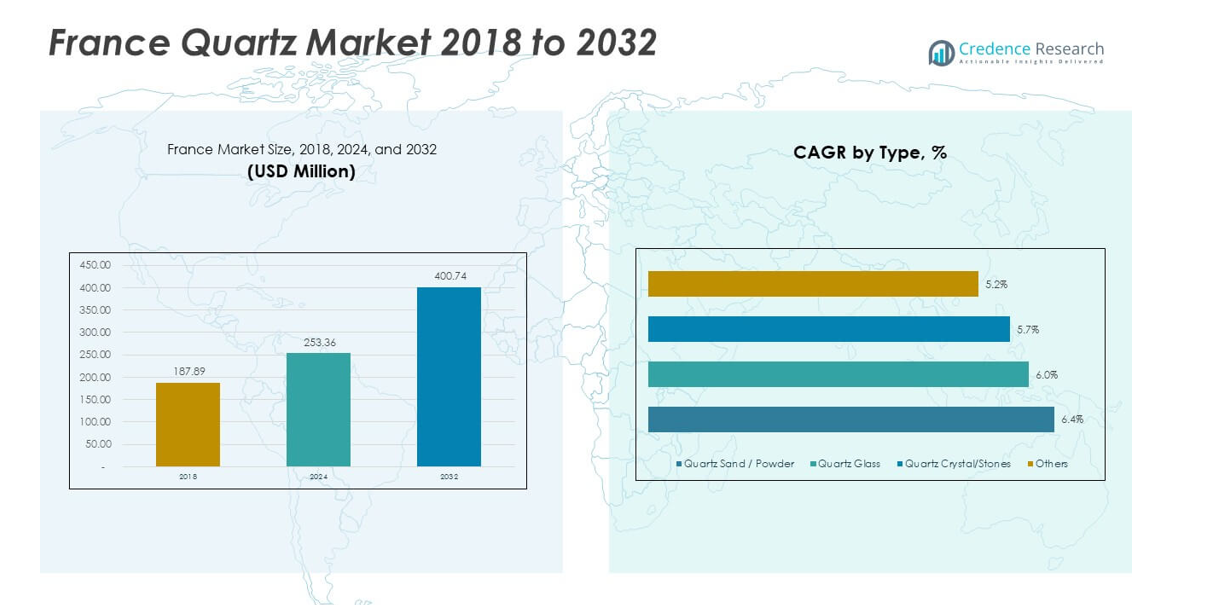
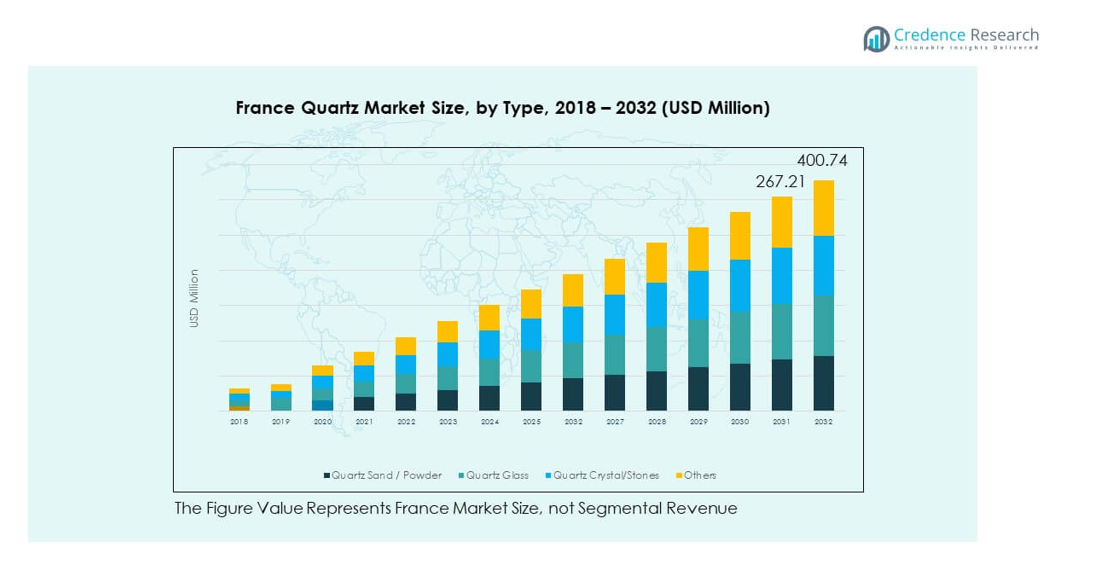
The France Quartz Market size was valued at USD 187.89 million in 2018 to USD 253.36 million in 2024 and is anticipated to reach USD 400.74 million by 2032, at a CAGR of 5.99% during the forecast period.
| REPORT ATTRIBUTE | DETAILS |
|---|---|
| Historical Period | 2020-2023 |
| Base Year | 2024 |
| Forecast Period | 2025-2032 |
| France Quartz Market Size 2024 | USD 253.36 million |
| France Quartz Market, CAGR | 5.99% |
| France Quartz Market Size 2032 | USD 400.74 million |
Growth in the France Quartz Market is supported by increasing use of quartz in residential and commercial interiors. Rising demand for durable kitchen countertops, flooring, and decorative applications strengthens adoption. Expanding construction activity, coupled with consumer preference for premium and low-maintenance surfaces, drives consumption. Sustainability practices and the availability of quartz-based alternatives to natural stone also add to market growth. The rise in remodelling activities and innovation in engineered quartz products continue to create new opportunities for manufacturers and distributors.
Regionally, France plays a strong role in shaping quartz demand within Europe due to its architectural trends and design focus. The northern and urban regions lead adoption with significant investments in modern housing and commercial infrastructure. Emerging demand is also evident in suburban areas, where remodelling and upscale interior projects are rising. France’s proximity to Italy and Spain further supports supply and design innovation, while Paris remains a hub for luxury-driven demand, expanding the market’s overall influence across the continent.
Market Insights:
- The France Quartz Market was valued at USD 187.89 million in 2018, reached USD 253.36 million in 2024, and is projected to attain USD 400.74 million by 2032, growing at a CAGR of 5.99%.
- Northern France led with 34% share in 2024, driven by urban housing projects and commercial development. Western and Central France accounted for 28%, supported by renovation activities, while Southern and Eastern France held 38% due to luxury housing and hospitality demand.
- Southern and Eastern France represent the fastest-growing regions with 38% share, fueled by luxury tourism, premium residential adoption, and industrial applications in optics and semiconductors.
- Quartz sand and powder dominated the market with nearly 42% share in 2024, driven by broad use in construction and industrial processes.
- Quartz glass accounted for around 27% share in 2024, supported by demand from electronics, optics, and semiconductor industries.
Market Drivers:
Rising Use of Quartz in Residential Remodelling Projects
The France Quartz Market is benefiting from strong growth in residential remodelling activities across urban areas. Consumers are opting for quartz surfaces due to their durability, non-porous properties, and easy maintenance. Kitchen and bathroom remodelling remains the core driver, with quartz countertops replacing natural stone and laminate options. Increasing disposable income supports the trend of investing in stylish and functional interiors. Interior designers recommend quartz for its aesthetic versatility, offering a wide range of colors and patterns. It also caters to eco-conscious consumers through engineered stone solutions. Builders and contractors prefer quartz because of reliable supply and consistent quality, further boosting its role in residential applications. Demand continues to rise in both large housing projects and smaller individual renovations.
- For instance, in 2024, the Cosentino Group launched several new products and expanded ranges, including the Silestone Suma and Le Chic collections, and the Dekton Pietra Kode series. These products, which are promoted for residential projects like kitchen and bathroom remodels, contribute to the company's brand portfolio, which saw global sales of the Dekton brand grow by 13% in 2024.
Growing Popularity of Quartz in Commercial Infrastructure Development
The France Quartz Market also gains momentum from investments in commercial real estate. Hotels, restaurants, and office complexes are adopting quartz for reception areas, bars, and flooring applications. The material’s resistance to stains and scratches makes it ideal for high-traffic spaces. Developers value quartz’s long lifespan, reducing long-term maintenance costs. Aesthetic appeal is another driver, with contemporary designs meeting modern architectural requirements. Expansion of retail and hospitality projects is accelerating demand across urban centers. Sustainability initiatives in construction promote engineered stone, positioning quartz as a preferred option. Contractors benefit from quartz’s ease of installation and consistent performance across multiple applications. Its adoption in luxury commercial spaces further strengthens its market demand.
- For instance, Caesarstone, a major supplier of engineered quartz, offers products known for their scratch resistance, with quartz itself rating at 7 on the Mohs scale, and their materials are frequently used in commercial projects, including hotels across Europe.
Technological Advancements in Quartz Surface Manufacturing
Technological progress in quartz processing supports significant growth within the France Quartz Market. Automated machinery has enhanced the precision and efficiency of production. Digital printing technology enables the creation of intricate patterns and textures that mimic natural stone. Manufacturers are producing thinner yet stronger slabs, expanding applications beyond countertops into cladding and furniture. Improved resin formulations enhance durability, heat resistance, and eco-friendliness. Energy-efficient production lines reduce operational costs, encouraging wider market penetration. These advances help producers expand product portfolios and cater to diverse design requirements. Growing investments in research and development ensure continuous innovation in product offerings. It positions quartz as a future-ready material in both residential and commercial markets.
Rising Consumer Preference for Sustainable and Eco-Friendly Materials
The France Quartz Market experiences growth due to the rising importance of sustainable construction practices. Consumers and developers are increasingly rejecting natural stone with high environmental extraction costs. Engineered quartz aligns with green building standards, using recycled content and eco-friendly resins. Builders highlight quartz’s long lifecycle and recyclability in their sustainability initiatives. Energy-efficient homes integrate quartz as part of modern, low-impact designs. Government regulations and certifications further encourage adoption of eco-conscious materials. Younger buyers favor quartz due to awareness of environmental issues, strengthening its long-term role. Producers also highlight reduced water consumption and waste in modern manufacturing processes. This shift positions quartz as a responsible choice for sustainable development.
Market Trends:
Integration of Smart Surface Technology in Quartz Products
The France Quartz Market is witnessing a shift towards smart surfaces with embedded technology. Manufacturers are exploring quartz slabs that integrate wireless charging and touch controls. These innovations aim to combine functionality with premium aesthetics in modern kitchens and offices. The concept appeals to younger consumers who value convenience and connectivity. Designers highlight quartz’s ability to incorporate such features without compromising durability. Smart quartz products align with the growing smart home ecosystem in France. Early adopters in luxury housing projects are setting the trend for broader acceptance. This technology-driven innovation adds a new dimension to quartz applications in interiors.
- For instance, LX Hausys (formerly LG Hausys) has featured wireless charging technology in its non-porous HI-MACS solid surfaces, with integrations like the one demonstrated in a 2017 furniture collaboration with ZENS.
Expansion of Customized Design Options and Patterns
Personalization is becoming a significant trend shaping the France Quartz Market. Customers increasingly demand unique designs, colors, and finishes tailored to their interiors. Manufacturers are offering bespoke solutions with advanced digital printing and cutting technologies. Patterns inspired by marble, granite, and even wood gain popularity in premium segments. Minimalist and contemporary designs appeal to urban homeowners seeking modern aesthetics. Builders also adopt customized quartz solutions for branding in commercial spaces. The trend expands market reach by offering products suited for both traditional and modern tastes. Customization strengthens brand loyalty and provides a competitive edge to manufacturers.
- For instance, the Compac Genesis Collection was initially created in collaboration with designer Arik Levy, with elements such as Ice of Genesisbeing in circulation since at least 2017. The collection features engineered quartz surfaces inspired by natural ice formations and has won design awards.
Adoption of Quartz in Outdoor and Non-Traditional Applications
The France Quartz Market is extending beyond conventional indoor applications. Advances in UV-resistant formulations allow quartz use in outdoor kitchens, terraces, and façades. Designers and architects embrace quartz cladding for contemporary building exteriors. Furniture makers are experimenting with quartz surfaces for tables and luxury fittings. Outdoor living trends in suburban and luxury housing projects fuel demand for durable materials. Builders highlight quartz’s resistance to weather conditions, stains, and fading in outdoor applications. Growth in landscape architecture also boosts adoption of quartz-based solutions. This diversification expands market opportunities across multiple segments beyond countertops.
Collaboration Between Quartz Producers and Luxury Interior Brands
The France Quartz Market is evolving through collaborations between producers and luxury design houses. Co-branded collections emphasize exclusivity, targeting high-end residential and commercial projects. Designers influence trends by selecting quartz for luxury kitchens and boutiques. Such partnerships highlight premium finishes and limited-edition patterns. The strategy helps manufacturers penetrate upscale segments and build brand prestige. Luxury retail and hospitality projects in Paris are showcasing quartz installations. Growing consumer awareness of designer-endorsed products strengthens demand. These collaborations create differentiation and enhance the premium positioning of quartz surfaces.
Market Challenges Analysis:
Volatility in Raw Material Supply and Rising Cost Pressures
The France Quartz Market faces constraints from fluctuations in raw material availability and pricing. Dependence on quartz crystals and resins exposes manufacturers to supply chain disruptions. Import reliance increases vulnerability to international trade barriers and freight costs. Price volatility in petrochemical resins raises production expenses, reducing profit margins. Smaller players struggle to maintain competitiveness under rising costs. Energy price hikes further add to operational challenges for manufacturers. It creates difficulties in offering competitively priced products to meet consumer expectations. These challenges influence both production planning and long-term strategic growth.
High Competition and Limited Differentiation Among Producers
The France Quartz Market also encounters intense competition due to the presence of global and regional players. Many manufacturers provide similar designs and product qualities, leading to commoditization. Price competition weakens profitability and impacts investments in innovation. Differentiation through branding and marketing becomes essential to attract customers. Smaller firms struggle to compete against established brands with wide distribution networks. Consumer loyalty shifts towards recognizable global names offering consistent quality. It increases market concentration and pressures mid-tier players to consolidate. Limited differentiation hinders long-term growth and weakens value capture across the market.
Market Opportunities:
Emerging Potential in Affordable Housing and Mid-Range Projects
The France Quartz Market holds opportunities within the affordable housing sector. Rising demand for mid-range apartments and suburban housing supports quartz adoption at scale. Developers seek durable, low-maintenance, and cost-effective materials for high-volume projects. Modern consumers want stylish surfaces even at affordable price points. Producers introducing mid-tier quartz lines can capture this growing demand. Government incentives for residential development create additional opportunities in suburban and urban areas. It expands quartz adoption beyond premium applications into mainstream housing markets.
Growth in Exports and Cross-Border Collaborations in Europe
The France Quartz Market benefits from opportunities linked to Europe’s integrated trade environment. France’s proximity to Italy, Spain, and Germany supports collaboration with leading producers. Cross-border partnerships enhance product diversity and strengthen distribution channels. Export potential grows as European demand for sustainable building materials expands. French firms can leverage design expertise to create unique collections for international markets. Integration with European green building standards provides additional export credibility. It opens pathways for French quartz producers to expand presence across the continent.
Market Segmentation Analysis:
By Type
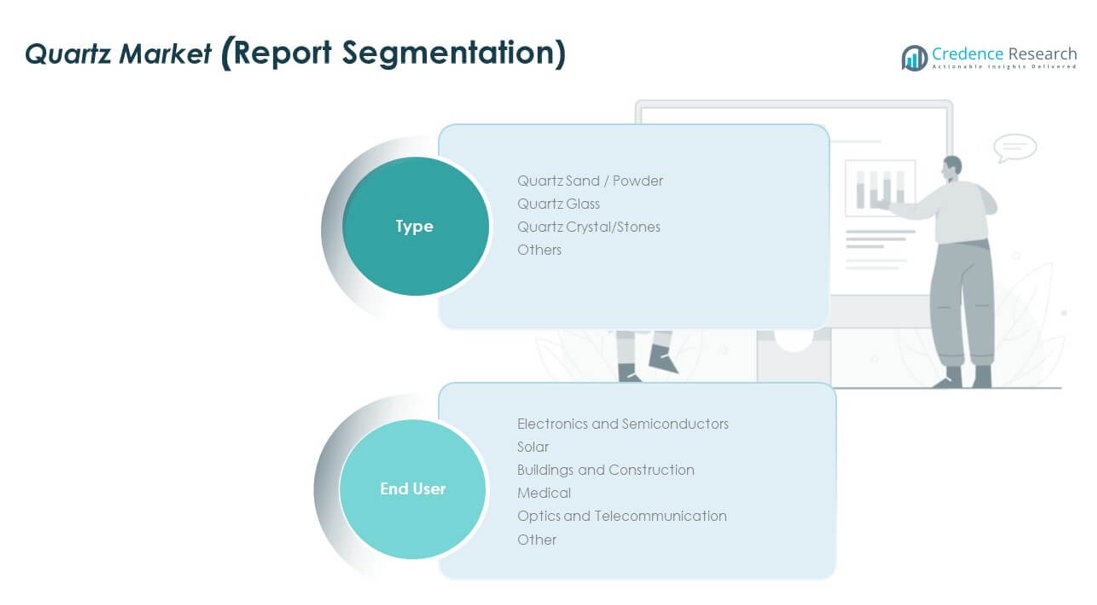
The France Quartz Market is segmented into quartz sand/powder, quartz glass, quartz crystal/stone, and others. Quartz sand and powder dominate applications in construction materials and industrial processes due to their wide availability and cost efficiency. Quartz glass secures strong demand in high-tech applications, including optics, semiconductors, and laboratory equipment. Quartz crystal and stone maintain relevance in luxury surfaces, interior décor, and precision instruments. Other niche segments support specialized applications across industrial and consumer uses. It reflects balanced growth across traditional and advanced categories, driven by innovation and steady consumption.
By End User
The France Quartz Market is divided into electronics and semiconductor, solar, buildings and construction, medical, optics and telecommunication, and others. Electronics and semiconductor industries drive significant demand through quartz’s role in circuit boards, sensors, and precision components. Solar applications expand with government-backed renewable initiatives, where quartz supports panel manufacturing. Buildings and construction remain a key end-use, with quartz surfaces gaining traction in residential and commercial interiors. Medical applications rely on quartz’s biocompatibility and durability for devices and diagnostic tools. Optics and telecommunication represent a growing segment, using quartz glass and crystals in fiber optics and advanced communication systems. Other industries provide consistent but smaller contributions to overall growth.
- For instance, Saint-Gobain Advanced Ceramic Composites continued its production and development of high-purity quartz crucibles for the semiconductor industry in 2025, supported by the strength of the company's High Performance Solutions division.
Segmentation:
By Type- Quartz Sand / Powder
- Quartz Glass
- Quartz Crystal/Stone
- Others
- Electronics and Semiconductor
- Solar
- Buildings and Construction
- Medical
- Optics and Telecommunication
- Others
Regional Analysis:
Northern France
Northern France holds the largest share of the France Quartz Market, supported by strong residential construction and urban development projects. Cities such as Lille and surrounding areas have seen rising adoption of quartz surfaces in housing and commercial interiors. The presence of manufacturing facilities and distributors in this region ensures consistent supply and better access for contractors. Consumer preference for durable and stylish interiors reinforces quartz’s popularity in modern housing. The hospitality sector also contributes to demand, using quartz in restaurants, hotels, and office buildings. It remains a dominant hub due to a mix of industrial base and consumer activity.
Western and Central France
Western and Central France account for a notable portion of the France Quartz Market share, driven by a balance of residential, institutional, and commercial demand. The region benefits from steady renovation activities in mid-sized cities, along with increasing investments in infrastructure. Builders and developers integrate quartz in flooring, countertops, and decorative applications to meet changing consumer expectations. The availability of mid-tier quartz products appeals to middle-income households, supporting consistent adoption. The region’s emphasis on sustainable housing also boosts demand for engineered quartz solutions. It reflects a stable and growing market segment supported by diverse applications.
Southern and Eastern France
Southern and Eastern France collectively contribute significantly to the France Quartz Market, supported by tourism and luxury-driven developments. High-end residential projects in cities such as Nice, Lyon, and Marseille prefer quartz for its premium finish and long-term durability. The luxury housing market and hospitality sector fuel steady growth, particularly in coastal and tourist-heavy areas. Eastern France, with its industrial base, contributes through applications in optics and semiconductors. Growing renewable energy projects also support demand for quartz in solar applications. It showcases regional diversity, with both luxury adoption and industrial applications driving expansion.
Key Player Analysis:
- Imerys
- MSI Q Quartz
- Silestone
- Elkem ASA
- Caesarstone
- Compac
- HanStone Quartz
- Santa Margherita Quartz
- Cristal-Innov
- Cambria
- Other Key Players
Competitive Analysis:
The France Quartz Market reflects a competitive structure marked by the presence of both international and domestic producers. Key companies such as Imerys, Caesarstone, Silestone, Compac, and HanStone Quartz hold strong positions due to their diverse product portfolios and wide distribution networks. Smaller firms compete by offering tailored designs, affordable price points, and sustainable product lines. Innovation in quartz finishes and patterns allows leading brands to differentiate themselves in premium residential and commercial applications. It also demonstrates increasing competition in mid-range and affordable segments, driven by rising consumer adoption. Strategic partnerships and design collaborations further intensify rivalry among established players.
Recent Developments:
- In July 2025, Imerys decided to explore partnership options for its lithium and quartz assets in France, aiming to align with the Group's long-term vision and take advantage of European funding available for strategic raw materials projects. The permitting process for an industrial pilot plant is targeted for completion by the end of Q3 2025, with further engineering improvements underway to reduce investment costs and maximize commercial potential.
- In April 2025, Elkem ASA's Silicones division launched two new products in its SILCOLEASE® range for release liners at its French facilities, as part of a larger push towards recycled and sustainable silicone solutions for industrial customers. This expansion supports the company’s ongoing sustainability initiatives and strengthens its position in the label and release liner industry.
- In April 2025, Caesarstone introduced its ICON™ Advanced Fusion surface, a pioneering silica-free quartz line crafted with approximately 80% recycled materials. This launch in Europe-and soon in France-sets a new standard for sustainable and safe surface products by prioritizing recycled content and industry-leading performance, meeting tighter air quality standards for indoor environments.
- In April 2025, Caesarstone introduced its ICON™ Advanced Fusion surface, a pioneering silica-free quartz line crafted with approximately 80% recycled materials. This launch in Europe-and soon in France-sets a new standard for sustainable and safe surface products by prioritizing recycled content and industry-leading performance, meeting tighter air quality standards for indoor environments.
Report Coverage:
The research report offers an in-depth analysis based on type and end-user segments. It details leading market players, providing an overview of their business, product offerings, investments, revenue streams, and key applications. Additionally, the report includes insights into the competitive environment, SWOT analysis, current market trends, as well as the primary drivers and constraints. Furthermore, it discusses various factors that have driven market expansion in recent years. The report also explores market dynamics, regulatory scenarios, and technological advancements that are shaping the industry. It assesses the impact of external factors and global economic changes on market growth. Lastly, it provides strategic recommendations for new entrants and established companies to navigate the complexities of the market.
Future Outlook:
- Demand for quartz surfaces will expand across residential and commercial projects in France.
- Premium finishes and luxury-driven designs will remain a strong growth driver.
- Sustainability certifications will influence consumer and builder preferences.
- Quartz adoption will rise in suburban housing through mid-tier product lines.
- Technological innovation will enhance surface durability and eco-efficiency.
- Local distributors will play a larger role in broadening accessibility.
- Industrial use in electronics and optics will gain further traction.
- Solar industry growth will support additional quartz consumption.
- Competitive collaborations will strengthen branding and portfolio expansion.
- France will continue positioning quartz as a sustainable and versatile material.

Request a Free Sample
Fill in your details and we'll send you a free sample report.
- Sample data tables & charts
- Research methodology
Market Dynamics
Rising Use of Quartz in Residential Remodelling Projects
Strong growth in residential remodelling across urban France is driving demand for quartz surfaces, as consumers seek durable, non-porous, and low-maintenance materials for kitchens and bathrooms. Increased disposable income and a preference for stylish, functional interiors further accelerate quartz adoption in both large housing projects and individual renovations.
Growing Popularity of Quartz in Commercial Infrastructure Development
Hotels, restaurants, and office complexes are increasingly specifying quartz for high-traffic areas due to its stain and scratch resistance, long lifespan, and contemporary aesthetics. The expansion of retail and hospitality projects, especially in urban centers, is boosting commercial demand for quartz surfaces.
Technological Advancements in Quartz Surface Manufacturing
Innovations such as digital printing, improved resin formulations, and automated production lines are enabling the creation of thinner, stronger, and more visually diverse quartz products. These advancements expand quartz applications beyond countertops to cladding, furniture, and smart surfaces, supporting broader market penetration.
Rising Consumer Preference for Sustainable and Eco-Friendly Materials
Engineered quartz aligns with green building standards by incorporating recycled content and eco-friendly resins, appealing to environmentally conscious consumers and developers. Government regulations and sustainability certifications are further encouraging the shift from natural stone to quartz in both residential and commercial projects.
Expansion of Customized and Luxury Quartz Solutions
The trend toward personalized interiors and luxury-driven design in France is fueling demand for bespoke quartz surfaces with unique patterns, finishes, and collaborations with high-end brands. This supports premium market growth, especially in luxury housing, hospitality, and designer-led commercial spaces.
Need a Custom Version of This Report?
Tailor the scope, geography, or segments to your exact requirements.
- Custom geography or segment scope
- Direct access to our analyst team
Frequently Asked Questions
What is the current market size for France Quartz Market, and what is its projected size in 2032?
At what Compound Annual Growth Rate is the France Quartz Market projected to grow between 2024 and 2032?
Which France Quartz Market segment held the largest share in 2024?
What are the primary factors fueling the growth of the France Quartz Market?
Who are the leading companies in the France Quartz Market?
Table of Content
Chapter 1 Market Segmentation
- 1.1 Segmentation Framework
- 1.1.1 Product and Service Classification
- 1.1.2 Application and End-Use Classification
- 1.1.3 Technology and Solution Classification
- 1.1.4 Customer and Distribution Channel Classification
- 1.1.5 Geographic Segmentation
- 1.1.6 Market Segment Definitions and Boundaries
- 1.2 By Type
- 1.2.1 Quartz Sand / Powder
- 1.2.2 Quartz Glass
- 1.2.3 Quartz Crystal/Stone
- 1.2.4 Others
- 1.3 By End User
- 1.3.1 Electronics and Semiconductor
- 1.3.2 Solar
- 1.3.3 Buildings and Construction
- 1.3.4 Medical
- 1.3.5 Optics and Telecommunication
- 1.3.6 Others
- 1.4 By Application
- 1.4.1 Countertops & Surfaces
- 1.4.2 Flooring
- 1.4.3 Cladding & Facades
- 1.4.4 Industrial Components
- 1.4.5 Decorative & Furniture
- 1.5 By Region (France)
- 1.5.1 Northern France
- 1.5.2 Western and Central France
- 1.5.3 Southern and Eastern France
Chapter 2 Introduction
- 2.1 Report Objectives and Scope
- 2.2 Product Definition and Industry Terminology
- 2.3 Market Inclusions and Exclusions
- 2.4 Research Process
- 2.4.1 Primary Research and Expert Interviews
- 2.4.2 Secondary Research and Source Review
- 2.4.3 Top-Down and Bottom-Up Estimation
- 2.4.4 Data Triangulation and Verification
- 2.5 Market Size Measurement Basis
- 2.5.1 2024: USD 253.36 million → 2032: USD 400.74 million
- 2.6 Historical and Forecast Reference Periods
- 2.6.1 Base Year: 2024
- 2.6.2 Forecast Period: 2024-2032
- 2.7 Research Assumptions and Limitations
Chapter 3 Executive Summary
- 3.1 Market Snapshot and Key Findings
- 3.2 Base-Year Market Size, 2024
- 3.3 Forecast Market Size, 2032
- 3.4 Revenue and Volume Growth Outlook
- 3.5 Key Demand and Supply Indicators
- 3.6 Leading Market Segments
- 3.7 Fastest-Growing Market Opportunities
- 3.8 Regional Performance Highlights
- 3.9 Technology and Industry Transformation
- 3.10 Competitive Landscape Summary
- 3.11 Analyst View and Strategic Implications
Chapter 4 France Quartz Market Trends and Developments
- 4.1 Historical Industry Development
- 4.2 Recent Market Trends and Developments
- 4.3 Demand and Customer Behavior Trends
- 4.4 Technology and Product Innovation
- 4.5 Artificial Intelligence, Automation and Digitalization
- 4.6 Local Manufacturing and Supply Chain Realignment
- 4.7 Industry Partnerships, Mergers and Acquisitions
- 4.8 Sustainability and Circular Economy Developments
- 4.9 Government and Private Sector Investment Trends
- 4.10 Emerging Business Models and Commercialization
- 4.11 Industry Developments and Announcements
Chapter 5 France Quartz Market Production, Supply and Demand Analysis
- 5.1 Demand Trend and Consumption Analysis
- 5.2 Demand Forecast, 2024-2032
- 5.3 Production and Output Trend
- 5.4 Production and Output Forecast, 2024-2032
- 5.5 Installed Capacity and Capacity Utilization
- 5.6 Company-Wise Production Plants and Statistics
- 5.6.1 Installed Production Capacity
- 5.6.2 Actual Production
- 5.6.3 Planned Capacity and Expansion Targets
- 5.7 Supply Chain Structure and Procurement Trends
- 5.8 Supply-Demand Gap and Bottlenecks
- 5.9 Import Dependence and Sourcing Structure
- 5.10 Contract Manufacturing and Outsourcing
- 5.11 Regional Supply and Demand Concentration
Chapter 6 France Quartz Market Pricing Analysis
- 6.1 Pricing Structure and Measurement
- 6.2 Historical Pricing Trends
- 6.3 Pricing Outlook, 2024-2032
- 6.4 Average Selling Price and Unit Economics
- 6.5 Pricing by Product and Market Segment
- 6.6 Geographic Pricing Differences
- 6.7 Key Input, Energy, Labor and Logistics Costs
- 6.8 Contract Pricing and Purchasing Models
- 6.9 Pricing Sensitivity and Competitive Positioning
- 6.10 Price, Margin and Profitability Implications
Chapter 7 France Quartz Market Dynamics
- 7.1 Market Growth Drivers
- 7.1.1 Demand-Side Drivers
- 7.1.2 Technology and Innovation Drivers
- 7.1.3 Infrastructure and Investment Drivers
- 7.1.4 Regulatory and Policy Drivers
- 7.2 Market Restraints
- 7.2.1 Cost and Affordability Constraints
- 7.2.2 Technology and Adoption Barriers
- 7.2.3 Supply Chain and Operational Constraints
- 7.3 Market Challenges
- 7.3.1 Competitive Pressure and Margin Erosion
- 7.3.2 Skills, Infrastructure and Implementation Gaps
- 7.4 Emerging Market Opportunities
- 7.5 Market Dynamics Impact and Time-Horizon Assessment
Chapter 8 France Quartz Value Chain Analysis
- 8.1 Industry Value Chain Overview
- 8.2 Upstream Suppliers and Critical Inputs
- 8.3 Technology and Component Providers
- 8.4 Manufacturing or Service Delivery
- 8.5 Distribution, Channel Partners and Integrators
- 8.6 Downstream Applications and End Users
- 8.7 Value Addition and Profit Pools
- 8.8 Vertical Integration and Outsourcing
- 8.9 Supplier Concentration and Risk
- 8.10 Supply Chain Localization and Resilience
Chapter 9 France Quartz Market Regulations and Policies
- 9.1 Relevant Laws, Standards and Compliance Frameworks
- 9.2 Product, Service, Safety and Quality Requirements
- 9.3 Government Policies, Incentives and Subsidies
- 9.4 Imports, Exports and Trade Barriers
- 9.5 Public Procurement and Local Content Requirements
- 9.6 Environmental and Sustainability Compliance
- 9.7 Upcoming Policy Changes and Market Implications
Chapter 10 France Quartz Market Hotspots and Opportunities
- 10.1 Market Opportunity Mapping and Growth Hotspots
- 10.2 High-Growth Applications and Customer Groups
- 10.3 Underserved Markets and White-Space Opportunities
- 10.4 Emerging Technology and Product Opportunities
- 10.5 New Capacity and Investment Hotspots
- 10.6 Market Entry and Expansion Opportunities
- 10.7 Distribution and Partnership Opportunities
- 10.8 Near-Term and Long-Term Commercial Potential
- 10.9 Opportunity Attractiveness and Execution Risks
Chapter 11 France Quartz Market Outlook, 2024-2032
- 11.1 Market Size and Analysis
- 11.1.1 Revenue (Market Measurement: 2024: USD 253.36 million → 2032: USD 400.74 million)
- 11.1.2 Market Volume and Quantity Sold
- 11.1.3 Historical Market Size
- 11.1.4 Base-Year Market Size, 2024
- 11.2 Market Forecast, 2024-2032
- 11.2.1 Revenue Forecast to 2032
- 11.2.2 Volume Forecast to 2032
- 11.2.3 CAGR and Year-on-Year Growth
- 11.2.4 Incremental Revenue Opportunity
- 11.3 Forecast Assumptions and Scenario Analysis
- 11.3.1 Base-Case Forecast
- 11.3.2 Optimistic and Conservative Scenarios
- 11.3.3 Technology, Pricing and Policy Sensitivities
- 11.4 Market Attractiveness and Growth Outlook
Chapter 12 France Quartz Market Segmentation and Outlook
- 12.1 Segmentation Summary and Market Shares, 2024
- 12.2 Largest and Fastest-Growing Segments
- 12.3 By Type - Market Size and Forecast, 2024-2032
- 12.3.1 Segment Definition and Scope
- 12.3.2 Historical Market Size
- 12.3.3 Revenue Forecast, 2024-2032
- 12.3.4 Volume Forecast, 2024-2032
- 12.3.5 Base-Year Market Share, 2024
- 12.3.6 Segment CAGR and Growth Drivers
- 12.3.7 Subsegment Market Size and Forecast
- 12.3.7.1 Quartz Sand / Powder
- 12.3.7.2 Quartz Glass
- 12.3.7.3 Quartz Crystal/Stone
- 12.3.7.4 Others
- 12.3.8 Subsegment Pricing and Adoption Trends
- 12.3.9 Leading Suppliers and Competition
- 12.3.10 Regional Demand and Opportunities
- 12.4 By End User - Market Size and Forecast, 2024-2032
- 12.4.1 Segment Definition and Scope
- 12.4.2 Historical Market Size
- 12.4.3 Revenue Forecast, 2024-2032
- 12.4.4 Volume Forecast, 2024-2032
- 12.4.5 Base-Year Market Share, 2024
- 12.4.6 Segment CAGR and Growth Drivers
- 12.4.7 Subsegment Market Size and Forecast
- 12.4.7.1 Electronics and Semiconductor
- 12.4.7.2 Solar
- 12.4.7.3 Buildings and Construction
- 12.4.7.4 Medical
- 12.4.7.5 Optics and Telecommunication
- 12.4.7.6 Others
- 12.4.8 Subsegment Pricing and Adoption Trends
- 12.4.9 Leading Suppliers and Competition
- 12.4.10 Regional Demand and Opportunities
- 12.5 By Application - Market Size and Forecast, 2024-2032
- 12.5.1 Segment Definition and Scope
- 12.5.2 Historical Market Size
- 12.5.3 Revenue Forecast, 2024-2032
- 12.5.4 Volume Forecast, 2024-2032
- 12.5.5 Base-Year Market Share, 2024
- 12.5.6 Segment CAGR and Growth Drivers
- 12.5.7 Subsegment Market Size and Forecast
- 12.5.7.1 Countertops & Surfaces
- 12.5.7.2 Flooring
- 12.5.7.3 Cladding & Facades
- 12.5.7.4 Industrial Components
- 12.5.7.5 Decorative & Furniture
- 12.5.8 Subsegment Pricing and Adoption Trends
- 12.5.9 Leading Suppliers and Competition
- 12.5.10 Regional Demand and Opportunities
- 12.6 By Region (France) - Market Size and Forecast, 2024-2032
- 12.6.1 Segment Definition and Scope
- 12.6.2 Historical Market Size
- 12.6.3 Revenue Forecast, 2024-2032
- 12.6.4 Volume Forecast, 2024-2032
- 12.6.5 Base-Year Market Share, 2024
- 12.6.6 Segment CAGR and Growth Drivers
- 12.6.7 Subsegment Market Size and Forecast
- 12.6.7.1 Northern France
- 12.6.7.2 Western and Central France
- 12.6.7.3 Southern and Eastern France
- 12.6.8 Subsegment Pricing and Adoption Trends
- 12.6.9 Leading Suppliers and Competition
- 12.6.10 Regional Demand and Opportunities
- 12.7 Segment Growth Comparison
- 12.8 Segment Attractiveness and Priority Matrix
Chapter 13 France Quartz End-Use and Application Market Outlook
- 13.1 End-Use Industry and Customer Demand Structure
- 13.2 Leading Applications and Customer Groups
- 13.3 End-Use Market Size, Share and Forecast
- 13.4 Major End-Use Industry Deep Dives
- 13.4.1 Customer Requirements and Use Cases
- 13.4.2 Demand and Replacement Cycles
- 13.4.3 Technical and Regulatory Considerations
- 13.4.4 Purchasing and Procurement Models
- 13.4.5 Leading Vendors and Distribution Channels
- 13.4.6 Forecast and Commercial Opportunities
- 13.5 Emerging Applications and Cross-Segment Demand
- 13.6 End-Use Industry Investment Priorities
Chapter 14 France Quartz Geographic Market Outlook, 2024-2032
- 14.1 Domestic Market Distribution and Demand Clusters
- 14.2 State- or Province-Wise Market Size and Forecast, 2024-2032
- 14.3 City and Metropolitan Market Outlook
- 14.4 Industrial, Manufacturing and Commercial Clusters
- 14.5 Geographic Concentration of Key End Users
- 14.6 Local Pricing and Purchasing Differences
- 14.7 Domestic Production Facilities and Capacity Map
- 14.8 Local Infrastructure and Project Pipeline
- 14.9 State-Level Policy and Incentive Differences
- 14.10 Subnational Investment Hotspots and Opportunities
- 14.11 Distribution and Logistics Networks
- 14.12 Domestic Competitive Footprint
Chapter 15 France Quartz Technology, Innovation and Sustainability Outlook
- 15.1 Technology Landscape and Maturity
- 15.2 Product, Process and Service Innovation
- 15.3 AI, Automation and Digital Tools in the Industry
- 15.4 Technology Adoption and Performance Benchmarking
- 15.5 Innovation Pipeline and R&D Investment
- 15.6 Patent and Intellectual Property Trends
- 15.7 Energy Efficiency and Resource Management
- 15.8 Sustainability, Recycling and Circularity
- 15.9 Technology Roadmap, 2024-2032
- 15.10 Risks of Obsolescence and Technology Substitution
Chapter 16 France Quartz Market Key Strategic Imperatives
- 16.1 Growth and Market Entry Priorities
- 16.2 High-Return Products and Segments
- 16.3 Pricing, Profitability and Cost Optimization
- 16.4 Technology Investment and Product Differentiation
- 16.5 Supply Chain Localization and Resilience
- 16.6 Distribution and Customer Acquisition
- 16.7 Partnership, Acquisition and Capacity Strategy
- 16.8 Regional Expansion Priorities
- 16.9 Short-, Medium- and Long-Term Actions
Chapter 17 Competition Outlook
- 17.1 Industry Competition Characteristics
- 17.2 Market Structure and Concentration
- 17.3 Market Share and Competitive Positioning, 2024
- 17.4 Company-Wise Revenue and Product Benchmarking
- 17.5 Production and Service Capacity Benchmarking
- 17.6 Technology, Pricing and Differentiation
- 17.7 Regional Footprint and Distribution Strength
- 17.8 Mergers, Acquisitions and Strategic Alliances
- 17.9 New Entrants and Competitive Threats
- 17.10 Porter's Five Forces and Industry Attractiveness
- 17.11 Competitive Outlook, 2024-2032
Chapter 18 Company Profiles
- 18.1 Company Coverage and Selection Criteria
- 18.2 Imerys
- 18.2.1 Business Description
- 18.2.2 Company Ownership and Geographic Presence
- 18.2.3 Product and Service Portfolio
- 18.2.4 Manufacturing and Operating Footprint
- 18.2.5 Production Capacity and Expansion Plans
- 18.2.6 Financial Performance and Investment
- 18.2.7 Market Share and Competitive Position
- 18.2.8 Technology and Innovation Capabilities
- 18.2.9 Strategic Alliances or Partnerships
- 18.2.10 Recent Developments
- 18.2.11 Growth Strategy and Outlook
- 18.3 MSI Q Quartz
- 18.4 Silestone (Cosentino Group)
- 18.5 Elkem ASA
- 18.6 Caesarstone
- 18.7 Compac
- 18.8 HanStone Quartz
- 18.9 Santa Margherita Quartz
- 18.10 Cristal-Innov
- 18.11 Cambria
- 18.12 Other Relevant Market Participants
Note: Every listed company is profiled on the structure shown under the first company. The company list is preliminary and may change based on research findings, market developments, data availability and client requirements.
Chapter 19 Disclaimer
- 19.1 Research and Forecast Disclaimer
- 19.2 Data Source and Estimation Limitations
Note: The depth of individual sections depends on data availability for this market. Volume, capacity, trade and other unit-based metrics are included where applicable.