Market Overview
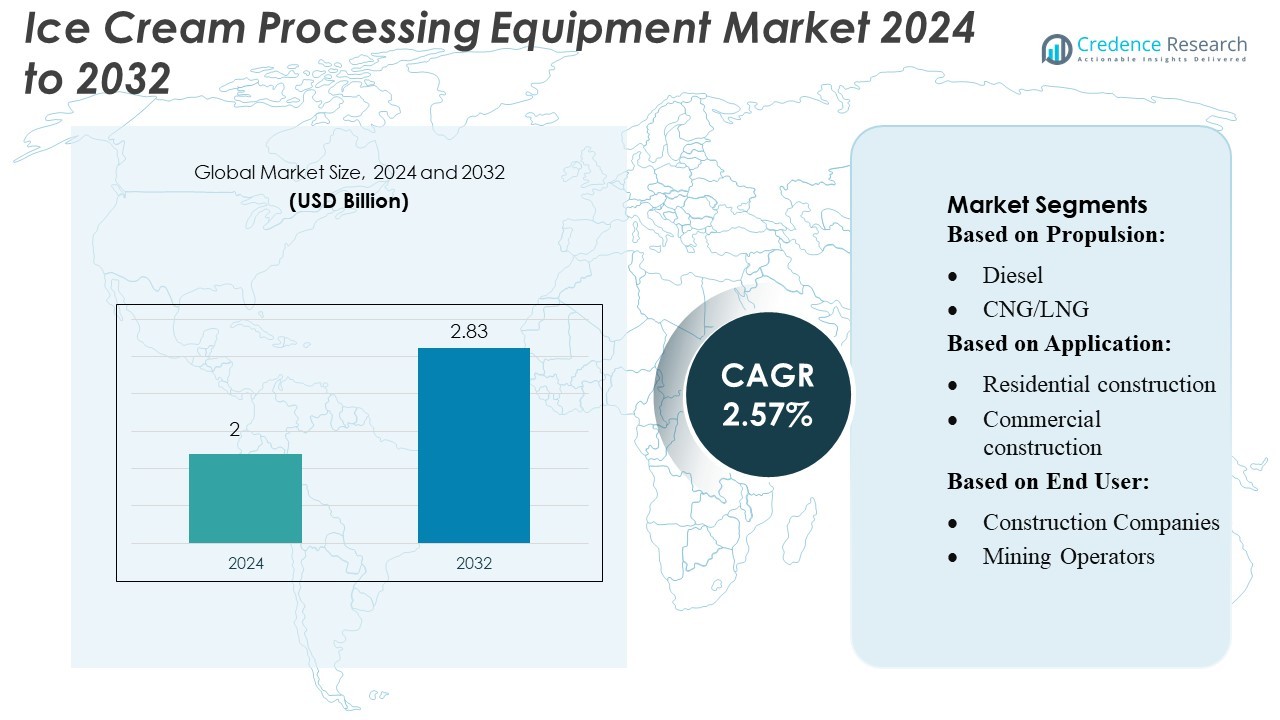
Ice Cream Processing Equipment Market size was valued USD 2 billion in 2024 and is anticipated to reach USD 2.83 billion by 2032, at a CAGR of 2.57% during the forecast period.
| REPORT ATTRIBUTE | DETAILS |
|---|---|
| Historical Period | 2020-2023 |
| Base Year | 2024 |
| Forecast Period | 2025-2032 |
| Ice Cream Processing Equipment Market Size 2024 | USD 2 Billion |
| Ice Cream Processing Equipment Market, CAGR | 2.57% |
| Ice Cream Processing Equipment Market Size 2032 | USD 2.83 Billion |
The Ice Cream Processing Equipment Market is shaped by strong competition among leading global manufacturers such as Tetra Pak, GEA Group, Carpigiani, SPX FLOW, and Alfa Laval, all of which continue to expand their portfolios with automated, energy-efficient freezing, mixing, and filling technologies. These players focus on modular system design, digital monitoring capabilities, and sustainability-led innovations to support producers’ demand for flexibility and operational reliability. Asia-Pacific leads the global market with an approximate 32% share, driven by rapid urbanization, expanding cold-chain infrastructure, and rising investments in high-capacity processing lines across China, India, and Southeast Asia, positioning the region as the dominant growth hub.
Market Insights
- The Ice Cream Processing Equipment Market was valued at USD 2 billion in 2024 and is expected to reach USD 2.83 billion by 2032, growing at a CAGR of 2.57%, supported by steady upgrades in processing automation and rising global production capacity.
- Rising demand for premium, plant-based, and clean-label ice cream drives the adoption of advanced freezing, homogenizing, and continuous mixing technologies across industrial facilities.
- Automation, digital monitoring, modular system design, and sustainability-focused processing trends continue to dominate as manufacturers prioritize energy efficiency and improved hygiene standards.
- Competitive intensity strengthens as Tetra Pak, GEA Group, Carpigiani, SPX FLOW, and Alfa Laval expand product lines, while high capital investment requirements and limited technical expertise in developing regions act as key restraints.
- Asia-Pacific leads with 32% regional share, while continuous freezers remain the top-performing equipment segment with about 28% share, driven by expanding cold-chain networks and high-capacity production investments across China, India, and Southeast Asia.
Market Segmentation Analysis:
By Propulsion
Diesel-powered units dominate the ice cream processing equipment market with an estimated 45–50% share, supported by their high torque output and suitability for continuous, heavy-duty operations such as large-batch freezing, mixing, and hardening. Manufacturers favor diesel systems for their reliability in environments with fluctuating power supply and the ability to maintain consistent RPM for uniform texture formation. While CNG/LNG units gain traction for lower emissions and operational costs, and electric systems expand with advancements in high-efficiency variable-speed drives, diesel remains the preferred choice due to its performance stability and long service intervals.
- For instance, Blue Bell Creameries adopted an electrically-powered continuous ice cream freezer early on that could produce 80 US gallons per hour, illustrating the type of reliable, high-throughput performance that electric motors and industrial power grids support in long-running production environments.
By Application
Commercial construction applications hold the dominant position with a 40–45% share, driven by rapid expansion of foodservice manufacturing units, cold chain hubs, and mid-scale processing facilities requiring modular ice cream production lines. These users prefer equipment that integrates automated blast freezing, continuous mixers, and CIP-enabled sanitation systems to support high throughput and regulatory compliance. Industrial construction follows closely as large-scale dairy plants invest heavily in automated hardening tunnels and energy-optimized refrigeration units. Meanwhile, residential construction and mining/quarrying segments remain niche as they involve limited or specialized deployment of cooling and processing systems.
- For instance, NadaMoo! applied Foodberry’s patented coating technology-backed by more than 20 utility patents-to create frozen snack bites, each of which encapsulates its coconut-milk ice cream and weighs just 25–35 calories per piece.
By End User
Construction companies lead this segment with approximately 35–40% market share, as they directly procure and install ice cream processing systems during new facility setup and expansion projects. Their demand is driven by the rising number of greenfield dairy plants, QSR-linked manufacturing units, and cold-chain infrastructure upgrades requiring integrated freezing, mixing, and packaging solutions. Mining operators and industrial users hold smaller shares with specialized needs for industrial cooling systems. Rental companies expand gradually due to growing preference for temporary equipment during seasonal production peaks, while government and municipal bodies contribute through infrastructure modernization initiatives.
Key Growth Drivers
- Rising Global Demand for Premium and Artisanal Ice Cream
The growing popularity of premium, artisanal, and specialty ice cream varieties drives higher investments in advanced processing equipment. Consumers increasingly prefer products with unique flavors, clean-label ingredients, and customizable textures, prompting manufacturers to adopt equipment with precise mixing, continuous freezing, and automated inclusion technology. This shift accelerates the need for machines capable of delivering consistent quality, improved overrun control, and reduced batch variability. As premium segments expand globally, equipment suppliers benefit from higher-value sales and demand for flexible, modular production systems.
- For instance, Unilever made 12 of its ice cream reformulation patents freely available to the wider industry in late 2023. This technology allows ice cream products to remain stable at a warmer freezer temperature of –12 °C (10.4 °F), instead of the industry standard –18 °C (–0.4 °F).
- Expansion of Large-Scale Industrial Production Capacities
Increasing industrial-scale production of packaged ice cream boosts demand for high-throughput equipment capable of sustaining continuous operations. Global brands are expanding capacity to serve urbanizing populations, driving adoption of automated homogenizers, pasteurizers, filling lines, and extrusion systems. The need to improve productivity, reduce operational downtime, and minimize waste encourages manufacturers to upgrade to energy-efficient and digitally monitored equipment. This industrial expansion particularly favors integrated processing lines that support rapid changeovers and consistent product quality across high-volume production cycles.
- For instance,Wells Enterprises also operates is a 12-storey, free-standing freezer (a high-bay warehouse). It is located at their production plant in Le Mars, Iowa. It has the capacity to hold over 70,000 pallets of frozen product.
- Advancements in Automation and Hygiene-Centric Technologies
Automation-driven improvements such as PLC-based controls, real-time monitoring, and predictive maintenance increase equipment reliability and reduce labor dependence. Increasing regulatory emphasis on food safety pushes the adoption of hygienic-design equipment featuring CIP/SIP capability, stainless-steel construction, and reduced contamination risk. These technologies enable manufacturers to maintain strict quality standards while optimizing energy and water usage. As production environments shift toward digitalized and connected factories, automated ice cream processing systems become essential for ensuring compliance, operational efficiency, and uniform product quality.
Key Trends & Opportunities
- Growing Shift Toward Energy-Efficient and Sustainable Equipment
Energy optimization and sustainability have become central purchasing criteria, creating opportunities for equipment with heat-recovery systems, low-energy compressors, and eco-friendly refrigerants. Manufacturers are investing in technologies that reduce carbon footprint while maintaining output efficiency. The rise in ESG reporting and regulatory pressure regarding refrigerants accelerates the adoption of advanced cooling systems that meet global environmental standards. This trend opens significant opportunities for suppliers offering green technology solutions that reduce long-term operational costs for ice cream producers.
- For instance, Snow and Avalanche Research in Switzerland, using an X-ray tomography machine that observes ice crystals in ice cream at temperatures between 0 °C and –20 °C, enabling analysis of crystal size and shape to improve texture stability.
- Customization and Flexibility in Production Lines
Manufacturers increasingly seek flexible equipment platforms capable of producing multiple product types, including dairy-free, high-protein, low-sugar, and functional ice creams. This demand drives the adoption of modular systems that support rapid recipe changeovers, adjustable overrun settings, and enhanced ingredient-inclusion mechanisms. The shift toward diversified product portfolios creates opportunities for equipment suppliers specializing in scalable, customizable, and multi-format production solutions. As product innovation accelerates, flexible lines become essential for achieving speed-to-market advantages.
- For instance, Paris-Saclay Research & Innovation Center, employing over 550 scientists, includes a pilot-scale production site for new formulations, making rapid changeovers between dairy and plant-based products possible.
- Integration of Digital Monitoring and Smart Manufacturing
The adoption of Industry 4.0 technologies is rising as producers seek better control of production parameters, quality consistency, and asset performance. Sensors, smart analytics, IoT connectivity, and cloud-based dashboards are increasingly incorporated into ice cream processing lines. These capabilities enable predictive maintenance, reduced downtime, and optimized resource use. Equipment manufacturers offering digitally integrated solutions gain a competitive edge as producers shift toward data-driven manufacturing environments.
Key Challenges
- High Initial Investment and Maintenance Costs
Ice cream processing equipment involves substantial upfront costs due to the need for high-precision components, hygienic construction, and automation features. Small and mid-sized producers often struggle with capital constraints, delaying upgrades or limiting adoption of advanced technologies. Ongoing maintenance and energy costs further increase the total cost of ownership, presenting a barrier for emerging businesses. This financial challenge slows equipment modernization and pushes buyers to opt for refurbished systems, influencing the market’s growth trajectory.
- Compliance with Strict Food Safety and Refrigeration Regulations
Global food safety standards, including HACCP, FDA, and EU hygiene directives, impose strict requirements on processing equipment design, materials, and operational protocols. Additionally, evolving refrigerant regulations under frameworks such as the Kigali Amendment require manufacturers to redesign systems to reduce environmental impact. Meeting these requirements increases design complexity and development costs for equipment suppliers. Non-compliance risks production disruptions, recalls, and financial penalties, making regulatory alignment a major challenge for both equipment manufacturers and end users.
Regional Analysis
North America
North America holds roughly 30% of the global ice cream processing equipment market, driven by strong demand for premium, artisanal, and functional ice cream varieties. Manufacturers in the U.S. and Canada increasingly invest in automated continuous freezers, high-efficiency homogenizers, and advanced pasteurizers to improve operational throughput and product consistency. The region benefits from well-established dairy infrastructure and high per-capita ice cream consumption, encouraging equipment upgrades and capacity expansion. Rising investments by mid-scale producers and the rapid adoption of hygienic, energy-efficient designs further accelerate market penetration across both retail and foodservice applications.
Europe
Europe accounts for nearly 28% of the market, supported by robust dairy processing standards, strong export-oriented manufacturing, and high consumer preference for clean-label and plant-based ice cream. Equipment demand grows due to tightening EU food safety regulations that push producers to adopt automated CIP systems, advanced blending units, and precision-controlled aging tanks. Italy, Germany, and France lead adoption as producers modernize legacy lines to improve efficiency and reduce operational energy costs. The region also observes increasing investment in customizable equipment that supports flavor innovation, dietary-specific formulations, and small-batch production flexibility.
Asia-Pacific
Asia-Pacific leads the market with around 32% share, driven by rapid urbanization, expanding cold-chain networks, and rising disposable incomes across China, India, and Southeast Asia. Manufacturers increasingly install high-capacity freezers, automated ingredient dosing systems, and continuous mixing technologies to meet mass-market ice cream demand. Local producers invest heavily in line modernization to support premium categories, including low-sugar and fruit-based products. Government incentives for food processing modernization further accelerate regional adoption. Strong growth of quick-service restaurants and modern retail formats also boosts demand for standardized, high-output production lines across emerging economies.
Latin America
Latin America holds close to 6% of the global market, with demand rising steadily in Brazil, Mexico, Argentina, and Colombia. Growth is supported by expanding dairy processing capacity and rising consumer interest in affordable packaged ice cream products. Manufacturers increasingly adopt modular equipment, energy-efficient mixing systems, and semi-automated filling machines to optimize production costs in price-sensitive markets. Seasonal demand peaks drive higher uptake of flexible equipment capable of quick flavor changeovers. Investments by international food processing firms and government support for modernization also strengthen regional adoption, though supply chain limitations moderate growth.
Middle East & Africa
Middle East & Africa represent nearly 4% of the market, supported by growing demand for packaged frozen desserts in the Gulf countries and emerging urban centers across Africa. The region experiences increasing adoption of compact and automated equipment suited for small-to-mid-scale production, driven by expanding retail distribution and rising tourism activity. Investments in cold-chain infrastructure, especially in UAE, Saudi Arabia, and South Africa, enhance the feasibility of large-scale production. Manufacturers focus on integrating hygienic stainless-steel processing systems and energy-efficient refrigeration units to meet safety standards and optimize cost structures.
Market Segmentations:
By Propulsion:
- Diesel
- CNG/LNG
By Application:
- Residential construction
- Commercial construction
By End User:
- Construction Companies
- Mining Operators
By Geography
- North America
- U.S.
- Canada
- Mexico
- Europe
- Germany
- France
- U.K.
- Italy
- Spain
- Rest of Europe
- Asia Pacific
- China
- Japan
- India
- South Korea
- South-east Asia
- Rest of Asia Pacific
- Latin America
- Brazil
- Argentina
- Rest of Latin America
- Middle East & Africa
- GCC Countries
- South Africa
- Rest of the Middle East and Africa
Competitive Landscape
The competitive landscape of the Ice Cream Processing Equipment Market remains moderately consolidated, with leading food and dairy producers such as Blue Bell Creameries, NadaMoo, General Mills, Inc., Unilever PLC, Cold Stone Creamery, Wells Enterprises, Inspire Brands, Inc. (Baskin Robbins), Nestlé SA, Danone S.A., and American Dairy Queen Corporation. The Ice Cream Processing Equipment Market remains defined by steady innovation, rising automation, and increasing emphasis on production efficiency. Manufacturers focus on developing high-capacity continuous freezers, precision-controlled pasteurizers, and automated ingredient-dosing systems that enhance product consistency and reduce operational costs. Competition intensifies as suppliers integrate digital monitoring, IoT-enabled performance tracking, and predictive maintenance tools to improve line reliability and minimize downtime. Sustainability is becoming a core differentiator, with companies introducing energy-efficient refrigeration technologies and hygienic designs that support faster cleaning cycles and reduced water consumption. Additionally, growing demand for clean-label, premium, and plant-based ice cream drives equipment providers to offer flexible, modular systems capable of supporting rapid formulation changes and scalable production.
Key Player Analysis
- Blue Bell Creameries
- NadaMoo
- General Mills, Inc.
- Unilever PLC
- Cold Stone Creamery
- Wells Enterprises
- Inspire Brands, Inc. (Baskin Robbins)
- Nestlé SA
- Danone S.A.
- American Dairy Queen Corporation
Recent Developments
- In May 2024, GEA Farm Technologies acquired South West Dairy Services, a family-owned business in Cullompton, Devon. The acquisition strengthens GEA's market position in South West England, enhances its product and service offerings to local dairy farmers, and complements its previous acquisition of Venture Dairy Services.
- In April 2024, Unilever’s Magnum brand introduced the Magnum Pleasure Express, a trio of mood-inspired ice cream flavors. This range represents a significant innovation as Magnum's first foray into "mood-food" ice creams with a surprising core.
- In March 2024, Dairy Queen Announces Inaugural Opening of the DQ FREEZER, an Extraordinary Freezer Holding All Blizzard Treat Flavors of the Past Blizzard Treat flavors. To celebrate, two iconic flavors-Frosted Animal Cookie and Brownie Batter-will return for a limited time as part of the Summer Blizzard Treat Menu.
- In March 2024, Krones AG’s subsidiary Milkron presented its latest membrane filtration systems at Anuga Food Tec Germany. The latest system is developed to cater to various applications, including dairy products and plant-based alternatives.
Report Coverage
The research report offers an in-depth analysis based on Propulsion, Application, End-User and Geography. It details leading market players, providing an overview of their business, product offerings, investments, revenue streams, and key applications. Additionally, the report includes insights into the competitive environment, SWOT analysis, current market trends, as well as the primary drivers and constraints. Furthermore, it discusses various factors that have driven market expansion in recent years. The report also explores market dynamics, regulatory scenarios, and technological advancements that are shaping the industry. It assesses the impact of external factors and global economic changes on market growth. Lastly, it provides strategic recommendations for new entrants and established companies to navigate the complexities of the market.
Future Outlook
- The market will increasingly adopt automated and digitally connected processing lines to enhance throughput and reduce labor dependency.
- Manufacturers will prioritize energy-efficient refrigeration and low-carbon processing technologies to meet rising sustainability expectations.
- Demand for flexible, modular equipment will grow as producers expand premium, seasonal, and limited-edition product portfolios.
- Adoption of hygienic, quick-clean designs will accelerate to support faster changeovers and higher compliance with global safety standards.
- Integration of AI-based quality monitoring and predictive maintenance will strengthen operational reliability across facilities.
- Plant-based and functional ice cream products will drive the need for specialized mixing, texturizing, and freezing technologies.
- Mid-scale and emerging-market producers will increasingly upgrade lines to compete with multinational brands.
- Equipment suppliers will expand customization options to support diverse formulations and regional taste profiles.
- Cold-chain expansion in developing economies will stimulate higher investments in advanced processing systems.
- Strategic collaborations between equipment manufacturers and dairy producers will accelerate technology commercialization and innovation.

Request a Free Sample
Fill in your details and we'll send you a free sample report.
- Sample data tables & charts
- Research methodology
Market Dynamics
Expansion of Large-Scale Industrial Production
Global brands are increasing their production capacities to meet urbanizing populations and rising ice cream consumption, driving demand for high-throughput, automated processing equipment that can sustain continuous operations and ensure consistent product quality.
Demand for Premium, Artisanal, and Plant-Based Ice Cream
The shift toward premium, clean-label, and plant-based ice cream varieties requires advanced equipment capable of precise mixing, continuous freezing, and flexible ingredient inclusion, prompting manufacturers to invest in new technologies for product differentiation.
Advancements in Automation and Digital Monitoring
Automation, PLC-based controls, and real-time digital monitoring are increasingly adopted to improve operational efficiency, reduce labor dependency, and ensure food safety compliance, making modernized equipment essential for competitive production environments.
Sustainability and Energy Efficiency Requirements
Rising energy costs and stricter environmental regulations are pushing producers to adopt equipment with energy-efficient refrigeration, eco-friendly refrigerants, and heat-recovery systems, supporting both cost savings and sustainability goals.
Cold-Chain Infrastructure Development in Emerging Markets
Rapid urbanization and investments in cold-chain logistics across Asia-Pacific and other developing regions are enabling the installation of high-capacity, modern ice cream processing lines, fueling market growth and regional expansion.
Need a Custom Version of This Report?
Tailor the scope, geography, or segments to your exact requirements.
- Custom geography or segment scope
- Direct access to our analyst team
Frequently Asked Questions
What is the current market size for the Ice Cream Processing Equipment Market, and what is its projected size in 2032?
At what Compound Annual Growth Rate is the Ice Cream Processing Equipment Market projected to grow between 2025 and 2032?
Which Ice Cream Processing Equipment Market segment held the largest share in 2024?
What are the primary factors fueling the growth of the Ice Cream Processing Equipment Market?
Who are the leading companies in the Ice Cream Processing Equipment Market?
Which region commanded the largest share of the Ice Cream Processing Equipment Market in 2024?
Table of Content
Chapter 1 Market Segmentation
- 1.1 Segmentation Framework
- 1.1.1 Product and Service Classification
- 1.1.2 Application and End-Use Classification
- 1.1.3 Technology and Solution Classification
- 1.1.4 Customer and Distribution Channel Classification
- 1.1.5 Geographic Segmentation
- 1.1.6 Market Segment Definitions and Boundaries
- 1.2 By End User
- 1.2.1 Construction Companies
- 1.2.2 Mining Operators
- 1.2.3 Industrial Users
- 1.2.4 Rental Companies
- 1.2.5 Government/Municipal Bodies
- 1.3 By Propulsion
- 1.3.1 Diesel
- 1.3.2 CNG/LNG
- 1.3.3 Electric
- 1.4 By Application
- 1.4.1 Residential construction
- 1.4.2 Commercial construction
- 1.4.3 Industrial construction
- 1.4.4 Mining/Quarrying
- 1.5 By Equipment Type
- 1.5.1 Continuous Freezers
- 1.5.2 Mixers & Blenders
- 1.5.3 Pasteurizers & Homogenizers
- 1.5.4 Filling & Packaging Machines
- 1.5.5 Ingredient Dosing Systems
Chapter 2 Introduction
- 2.1 Report Objectives and Scope
- 2.2 Product Definition and Industry Terminology
- 2.3 Market Inclusions and Exclusions
- 2.4 Research Process
- 2.4.1 Primary Research and Expert Interviews
- 2.4.2 Secondary Research and Source Review
- 2.4.3 Top-Down and Bottom-Up Estimation
- 2.4.4 Data Triangulation and Verification
- 2.5 Market Size Measurement Basis
- 2.5.1 2024: USD 2 billion → 2032: USD 2.83 billion
- 2.6 Historical and Forecast Reference Periods
- 2.6.1 Base Year: 2024
- 2.6.2 Forecast Period: 2024-2032
- 2.7 Research Assumptions and Limitations
Chapter 3 Executive Summary
- 3.1 Market Snapshot and Key Findings
- 3.2 Base-Year Market Size, 2024
- 3.3 Forecast Market Size, 2032
- 3.4 Revenue and Volume Growth Outlook
- 3.5 Key Demand and Supply Indicators
- 3.6 Leading Market Segments
- 3.7 Fastest-Growing Market Opportunities
- 3.8 Regional Performance Highlights
- 3.9 Technology and Industry Transformation
- 3.10 Competitive Landscape Summary
- 3.11 Analyst View and Strategic Implications
Chapter 4 Global Ice-Cream Processing Equipment Market Trends and Developments
- 4.1 Historical Industry Development
- 4.2 Recent Market Trends and Developments
- 4.3 Demand and Customer Behavior Trends
- 4.4 Technology and Product Innovation
- 4.5 Artificial Intelligence, Automation and Digitalization
- 4.6 Local Manufacturing and Supply Chain Realignment
- 4.7 Industry Partnerships, Mergers and Acquisitions
- 4.8 Sustainability and Circular Economy Developments
- 4.9 Government and Private Sector Investment Trends
- 4.10 Emerging Business Models and Commercialization
- 4.11 Industry Developments and Announcements
Chapter 5 Global Ice-Cream Processing Equipment Market Production, Supply and Demand Analysis
- 5.1 Demand Trend and Consumption Analysis
- 5.2 Demand Forecast, 2024-2032
- 5.3 Production and Output Trend
- 5.4 Production and Output Forecast, 2024-2032
- 5.5 Installed Capacity and Capacity Utilization
- 5.6 Company-Wise Production Plants and Statistics
- 5.6.1 Installed Production Capacity
- 5.6.2 Actual Production
- 5.6.3 Planned Capacity and Expansion Targets
- 5.7 Supply Chain Structure and Procurement Trends
- 5.8 Supply-Demand Gap and Bottlenecks
- 5.9 Import Dependence and Sourcing Structure
- 5.10 Contract Manufacturing and Outsourcing
- 5.11 Regional Supply and Demand Concentration
Chapter 6 Global Ice-Cream Processing Equipment Market Pricing Analysis
- 6.1 Pricing Structure and Measurement
- 6.2 Historical Pricing Trends
- 6.3 Pricing Outlook, 2024-2032
- 6.4 Average Selling Price and Unit Economics
- 6.5 Pricing by Product and Market Segment
- 6.6 Geographic Pricing Differences
- 6.7 Key Input, Energy, Labor and Logistics Costs
- 6.8 Contract Pricing and Purchasing Models
- 6.9 Pricing Sensitivity and Competitive Positioning
- 6.10 Price, Margin and Profitability Implications
Chapter 7 Global Ice-Cream Processing Equipment Market Dynamics
- 7.1 Market Growth Drivers
- 7.1.1 Demand-Side Drivers
- 7.1.2 Technology and Innovation Drivers
- 7.1.3 Infrastructure and Investment Drivers
- 7.1.4 Regulatory and Policy Drivers
- 7.2 Market Restraints
- 7.2.1 Cost and Affordability Constraints
- 7.2.2 Technology and Adoption Barriers
- 7.2.3 Supply Chain and Operational Constraints
- 7.3 Market Challenges
- 7.3.1 Competitive Pressure and Margin Erosion
- 7.3.2 Skills, Infrastructure and Implementation Gaps
- 7.4 Emerging Market Opportunities
- 7.5 Market Dynamics Impact and Time-Horizon Assessment
Chapter 8 Global Ice-Cream Processing Equipment Value Chain Analysis
- 8.1 Industry Value Chain Overview
- 8.2 Upstream Suppliers and Critical Inputs
- 8.3 Technology and Component Providers
- 8.4 Manufacturing or Service Delivery
- 8.5 Distribution, Channel Partners and Integrators
- 8.6 Downstream Applications and End Users
- 8.7 Value Addition and Profit Pools
- 8.8 Vertical Integration and Outsourcing
- 8.9 Supplier Concentration and Risk
- 8.10 Supply Chain Localization and Resilience
Chapter 9 Global Ice-Cream Processing Equipment Market Regulations and Policies
- 9.1 Relevant Laws, Standards and Compliance Frameworks
- 9.2 Product, Service, Safety and Quality Requirements
- 9.3 Government Policies, Incentives and Subsidies
- 9.4 Imports, Exports and Trade Barriers
- 9.5 Public Procurement and Local Content Requirements
- 9.6 Environmental and Sustainability Compliance
- 9.7 Upcoming Policy Changes and Market Implications
Chapter 10 Global Ice-Cream Processing Equipment Market Hotspots and Opportunities
- 10.1 Market Opportunity Mapping and Growth Hotspots
- 10.2 High-Growth Applications and Customer Groups
- 10.3 Underserved Markets and White-Space Opportunities
- 10.4 Emerging Technology and Product Opportunities
- 10.5 New Capacity and Investment Hotspots
- 10.6 Market Entry and Expansion Opportunities
- 10.7 Distribution and Partnership Opportunities
- 10.8 Near-Term and Long-Term Commercial Potential
- 10.9 Opportunity Attractiveness and Execution Risks
Chapter 11 Global Ice-Cream Processing Equipment Market Outlook, 2024-2032
- 11.1 Market Size and Analysis
- 11.1.1 Revenue (Market Measurement: 2024: USD 2 billion → 2032: USD 2.83 billion)
- 11.1.2 Market Volume and Quantity Sold
- 11.1.3 Historical Market Size
- 11.1.4 Base-Year Market Size, 2024
- 11.2 Market Forecast, 2024-2032
- 11.2.1 Revenue Forecast to 2032
- 11.2.2 Volume Forecast to 2032
- 11.2.3 CAGR and Year-on-Year Growth
- 11.2.4 Incremental Revenue Opportunity
- 11.3 Forecast Assumptions and Scenario Analysis
- 11.3.1 Base-Case Forecast
- 11.3.2 Optimistic and Conservative Scenarios
- 11.3.3 Technology, Pricing and Policy Sensitivities
- 11.4 Market Attractiveness and Growth Outlook
Chapter 12 Global Ice-Cream Processing Equipment Market Segmentation and Outlook
- 12.1 Segmentation Summary and Market Shares, 2024
- 12.2 Largest and Fastest-Growing Segments
- 12.3 By End User - Market Size and Forecast, 2024-2032
- 12.3.1 Segment Definition and Scope
- 12.3.2 Historical Market Size
- 12.3.3 Revenue Forecast, 2024-2032
- 12.3.4 Volume Forecast, 2024-2032
- 12.3.5 Base-Year Market Share, 2024
- 12.3.6 Segment CAGR and Growth Drivers
- 12.3.7 Subsegment Market Size and Forecast
- 12.3.7.1 Construction Companies
- 12.3.7.2 Mining Operators
- 12.3.7.3 Industrial Users
- 12.3.7.4 Rental Companies
- 12.3.7.5 Government/Municipal Bodies
- 12.3.8 Subsegment Pricing and Adoption Trends
- 12.3.9 Leading Suppliers and Competition
- 12.3.10 Regional Demand and Opportunities
- 12.4 By Propulsion - Market Size and Forecast, 2024-2032
- 12.4.1 Segment Definition and Scope
- 12.4.2 Historical Market Size
- 12.4.3 Revenue Forecast, 2024-2032
- 12.4.4 Volume Forecast, 2024-2032
- 12.4.5 Base-Year Market Share, 2024
- 12.4.6 Segment CAGR and Growth Drivers
- 12.4.7 Subsegment Market Size and Forecast
- 12.4.7.1 Diesel
- 12.4.7.2 CNG/LNG
- 12.4.7.3 Electric
- 12.4.8 Subsegment Pricing and Adoption Trends
- 12.4.9 Leading Suppliers and Competition
- 12.4.10 Regional Demand and Opportunities
- 12.5 By Application - Market Size and Forecast, 2024-2032
- 12.5.1 Segment Definition and Scope
- 12.5.2 Historical Market Size
- 12.5.3 Revenue Forecast, 2024-2032
- 12.5.4 Volume Forecast, 2024-2032
- 12.5.5 Base-Year Market Share, 2024
- 12.5.6 Segment CAGR and Growth Drivers
- 12.5.7 Subsegment Market Size and Forecast
- 12.5.7.1 Residential construction
- 12.5.7.2 Commercial construction
- 12.5.7.3 Industrial construction
- 12.5.7.4 Mining/Quarrying
- 12.5.8 Subsegment Pricing and Adoption Trends
- 12.5.9 Leading Suppliers and Competition
- 12.5.10 Regional Demand and Opportunities
- 12.6 By Equipment Type - Market Size and Forecast, 2024-2032
- 12.6.1 Segment Definition and Scope
- 12.6.2 Historical Market Size
- 12.6.3 Revenue Forecast, 2024-2032
- 12.6.4 Volume Forecast, 2024-2032
- 12.6.5 Base-Year Market Share, 2024
- 12.6.6 Segment CAGR and Growth Drivers
- 12.6.7 Subsegment Market Size and Forecast
- 12.6.7.1 Continuous Freezers
- 12.6.7.2 Mixers & Blenders
- 12.6.7.3 Pasteurizers & Homogenizers
- 12.6.7.4 Filling & Packaging Machines
- 12.6.7.5 Ingredient Dosing Systems
- 12.6.8 Subsegment Pricing and Adoption Trends
- 12.6.9 Leading Suppliers and Competition
- 12.6.10 Regional Demand and Opportunities
- 12.7 Segment Growth Comparison
- 12.8 Segment Attractiveness and Priority Matrix
Chapter 13 Global Ice-Cream Processing Equipment End-Use and Application Market Outlook
- 13.1 End-Use Industry and Customer Demand Structure
- 13.2 Leading Applications and Customer Groups
- 13.3 End-Use Market Size, Share and Forecast
- 13.4 Major End-Use Industry Deep Dives
- 13.4.1 Customer Requirements and Use Cases
- 13.4.2 Demand and Replacement Cycles
- 13.4.3 Technical and Regulatory Considerations
- 13.4.4 Purchasing and Procurement Models
- 13.4.5 Leading Vendors and Distribution Channels
- 13.4.6 Forecast and Commercial Opportunities
- 13.5 Emerging Applications and Cross-Segment Demand
- 13.6 End-Use Industry Investment Priorities
Chapter 14 Global Ice-Cream Processing Equipment Geographic Market Outlook, 2024-2032
- 14.1 Regional Market Size and Share, 2024
- 14.2 Regional Market Forecast, 2024-2032
- 14.3 Regional Pricing, Production and Demand Differences
- 14.4 North America
- 14.4.1 United States
- 14.4.2 Canada
- 14.4.3 Mexico
- 14.5 Europe
- 14.5.1 Germany
- 14.5.2 France
- 14.5.3 Italy
- 14.5.4 United Kingdom
- 14.5.5 Spain
- 14.5.6 Poland
- 14.5.7 Russia
- 14.5.8 Netherlands
- 14.5.9 Belgium
- 14.5.10 Sweden
- 14.5.11 Denmark
- 14.5.12 Norway
- 14.5.13 Rest of Europe
- 14.6 Asia Pacific
- 14.6.1 China
- 14.6.2 India
- 14.6.3 Japan
- 14.6.4 South Korea
- 14.6.5 Thailand
- 14.6.6 Indonesia
- 14.6.7 Vietnam
- 14.6.8 Malaysia
- 14.6.9 Australia
- 14.6.10 Rest of Asia Pacific
- 14.7 Latin America
- 14.7.1 Brazil
- 14.7.2 Argentina
- 14.7.3 Colombia
- 14.7.4 Chile
- 14.7.5 Rest of Latin America
- 14.8 Middle East
- 14.8.1 Saudi Arabia
- 14.8.2 United Arab Emirates
- 14.8.3 Turkey
- 14.8.4 Israel
- 14.8.5 Iran
- 14.8.6 Rest of the Middle East
- 14.9 Africa
- 14.9.1 South Africa
- 14.9.2 Egypt
- 14.9.3 Nigeria
- 14.9.4 Morocco
- 14.9.5 Rest of Africa
- 14.10 Regional Investment, Policy and Supply Chain Differences
- 14.11 Regional Competitive Landscape
- 14.12 Geographic Growth Hotspots
Chapter 15 Global Ice-Cream Processing Equipment Technology, Innovation and Sustainability Outlook
- 15.1 Technology Landscape and Maturity
- 15.2 Product, Process and Service Innovation
- 15.3 AI, Automation and Digital Tools in the Industry
- 15.4 Technology Adoption and Performance Benchmarking
- 15.5 Innovation Pipeline and R&D Investment
- 15.6 Patent and Intellectual Property Trends
- 15.7 Energy Efficiency and Resource Management
- 15.8 Sustainability, Recycling and Circularity
- 15.9 Technology Roadmap, 2024-2032
- 15.10 Risks of Obsolescence and Technology Substitution
Chapter 16 Global Ice-Cream Processing Equipment Market Key Strategic Imperatives
- 16.1 Growth and Market Entry Priorities
- 16.2 High-Return Products and Segments
- 16.3 Pricing, Profitability and Cost Optimization
- 16.4 Technology Investment and Product Differentiation
- 16.5 Supply Chain Localization and Resilience
- 16.6 Distribution and Customer Acquisition
- 16.7 Partnership, Acquisition and Capacity Strategy
- 16.8 Regional Expansion Priorities
- 16.9 Short-, Medium- and Long-Term Actions
Chapter 17 Competition Outlook
- 17.1 Industry Competition Characteristics
- 17.2 Market Structure and Concentration
- 17.3 Market Share and Competitive Positioning, 2024
- 17.4 Company-Wise Revenue and Product Benchmarking
- 17.5 Production and Service Capacity Benchmarking
- 17.6 Technology, Pricing and Differentiation
- 17.7 Regional Footprint and Distribution Strength
- 17.8 Mergers, Acquisitions and Strategic Alliances
- 17.9 New Entrants and Competitive Threats
- 17.10 Porter's Five Forces and Industry Attractiveness
- 17.11 Competitive Outlook, 2024-2032
Chapter 18 Company Profiles
- 18.1 Company Coverage and Selection Criteria
- 18.2 Tetra Pak
- 18.2.1 Business Description
- 18.2.2 Company Ownership and Geographic Presence
- 18.2.3 Product and Service Portfolio
- 18.2.4 Manufacturing and Operating Footprint
- 18.2.5 Production Capacity and Expansion Plans
- 18.2.6 Financial Performance and Investment
- 18.2.7 Market Share and Competitive Position
- 18.2.8 Technology and Innovation Capabilities
- 18.2.9 Strategic Alliances or Partnerships
- 18.2.10 Recent Developments
- 18.2.11 Growth Strategy and Outlook
- 18.3 GEA Group
- 18.4 Carpigiani
- 18.5 SPX FLOW
- 18.6 Alfa Laval
- 18.7 Krones AG
- 18.8 Unilever PLC
- 18.9 Nestlé SA
- 18.10 Wells Enterprises
- 18.11 General Mills, Inc.
- 18.12 Other Relevant Market Participants
Note: Every listed company is profiled on the structure shown under the first company. The company list is preliminary and may change based on research findings, market developments, data availability and client requirements.
Chapter 19 Disclaimer
- 19.1 Research and Forecast Disclaimer
- 19.2 Data Source and Estimation Limitations
Note: The depth of individual sections depends on data availability for this market. Volume, capacity, trade and other unit-based metrics are included where applicable.