
Market Overview:
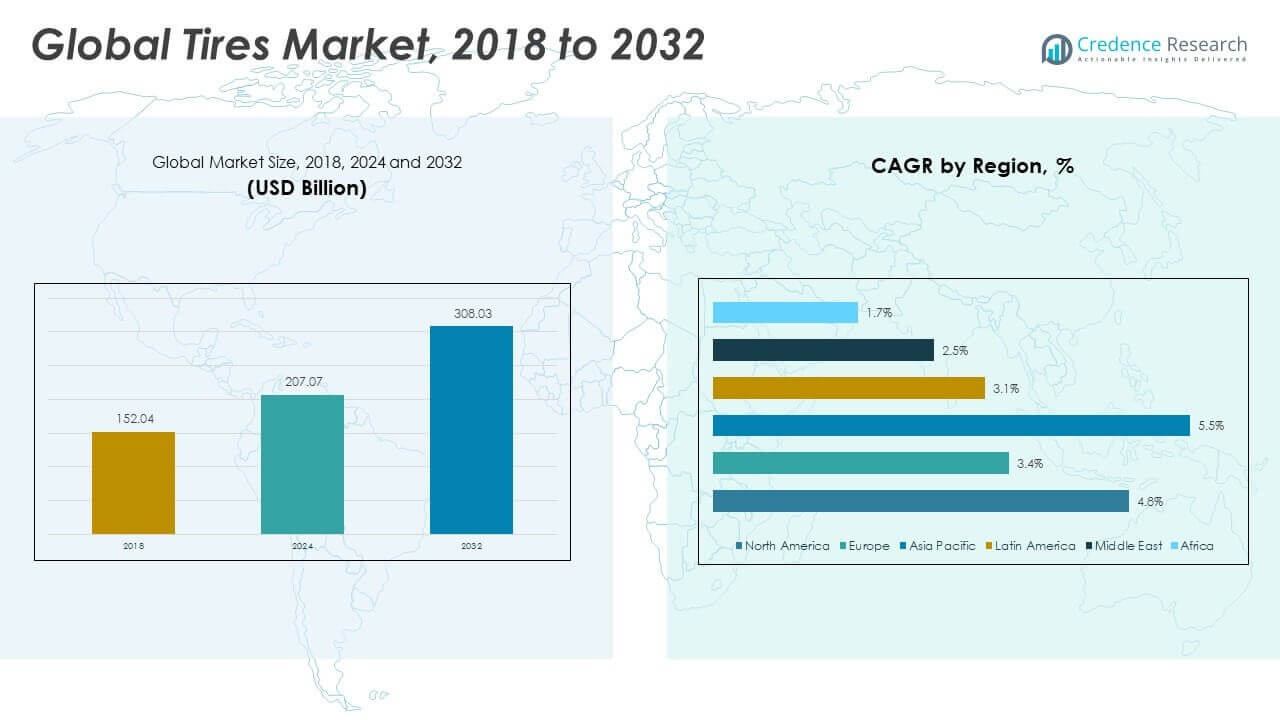
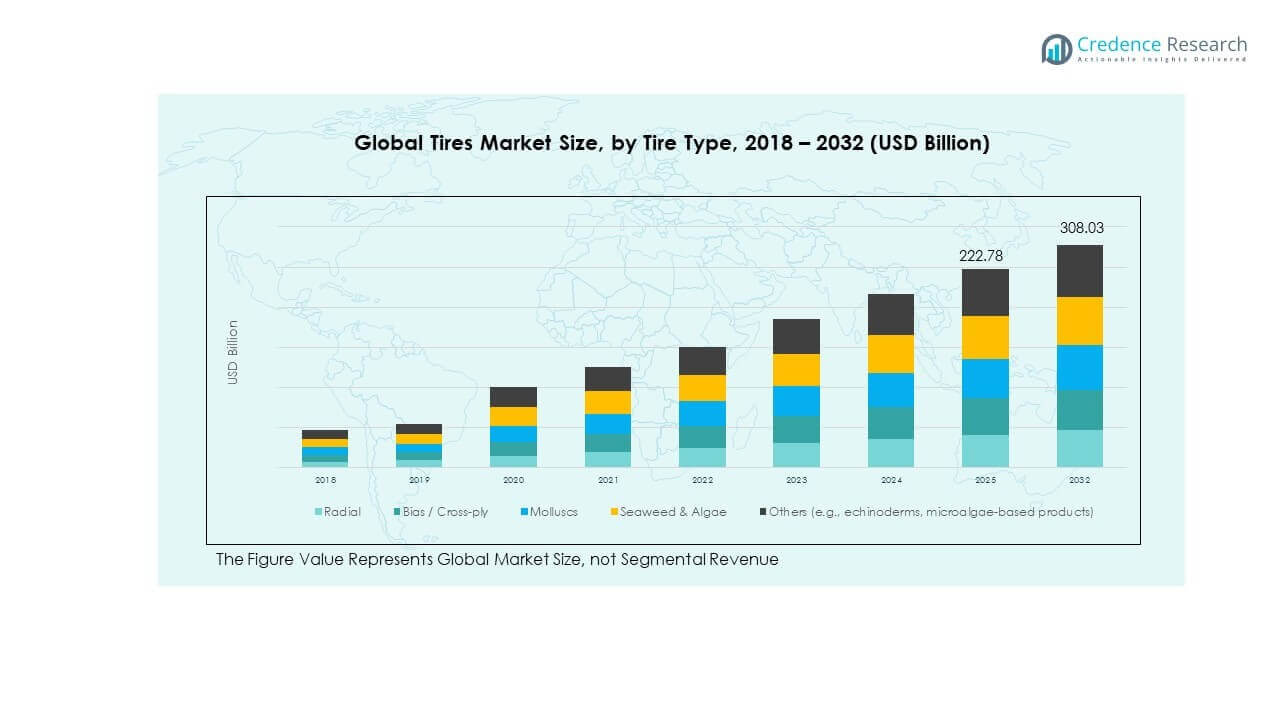
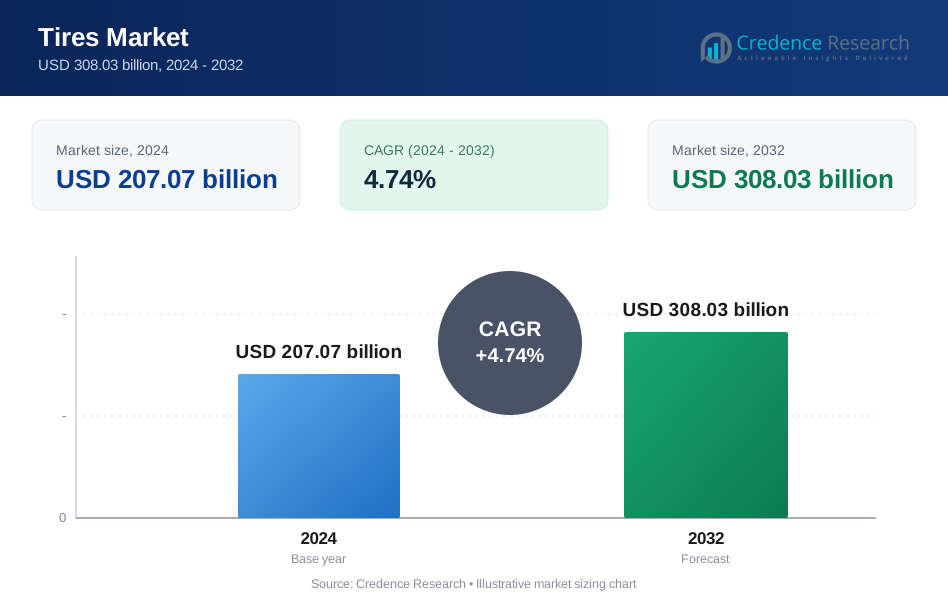
The Global Tires Market size was valued at USD 152.04 billion in 2018 to USD 207.07 billion in 2024 and is anticipated to reach USD 308.03 billion by 2032, at a CAGR of 4.74% during the forecast period.
| REPORT ATTRIBUTE | DETAILS |
|---|---|
| Historical Period | 2020-2023 |
| Base Year | 2024 |
| Forecast Period | 2025-2032 |
| Tires Market Size 2024 | USD 207.07 billion |
| Tires Market, CAGR | 4.74% |
| Tires Market Size 2032 | USD 308.03 billion |
The market grows due to steady vehicle production across passenger and commercial segments. Rising urban travel increases tire replacement cycles in daily use vehicles. Fleet operators focus on safety and fuel efficiency, boosting demand for advanced tires. Growth in electric vehicles supports demand for low-rolling-resistance tires. Infrastructure expansion raises freight movement and heavy-duty tire use. Consumers show higher preference for premium and all-season tires. Strict safety rules push regular tire replacement. Improved retail networks increase product reach. Technology advances enhance durability and mileage performance.
Asia Pacific leads the market due to strong vehicle manufacturing and large vehicle fleets. China and India drive volume demand from passenger and commercial vehicles. North America remains strong due to high replacement rates and premium tire adoption. Europe shows stable demand supported by safety standards and winter tire usage. Southeast Asia emerges with rising vehicle ownership and road projects. Latin America shows gradual growth as mobility improves. The Middle East and Africa gain traction from logistics expansion and off-road vehicle demand.
Market Insights:
- The Global Tires Market was valued at USD 152.04 billion in 2018, reached USD 207.07 billion in 2024, and is projected to hit USD 308.03 billion by 2032, growing at a CAGR of 4.74%, supported by steady vehicle usage and replacement demand.
- Asia Pacific leads with about 49% share, driven by high vehicle production and two-wheeler volumes, followed by North America at nearly 28% due to strong replacement cycles, and Europe at around 15% supported by safety norms and seasonal tire usage.
- Asia Pacific remains the fastest-growing region with nearly 49% share, supported by rising urbanization, expanding logistics fleets, and growing personal mobility across China, India, and Southeast Asia.
- Radial tires account for the dominant segment share at roughly 75%, reflecting preference for fuel efficiency, longer tread life, and wide adoption across passenger and commercial vehicles.
- Bias tires hold close to 25% share, supported by use in off-the-road, agricultural, and industrial vehicles where load strength and rugged performance remain critical.
Market Drivers:
Rising Global Vehicle Production Across Passenger And Commercial Segments
Vehicle production growth supports steady tire demand across regions. Passenger cars drive high-volume tire consumption worldwide. Commercial vehicles require durable tires for long-distance operations. The Global Tires Market benefits from expanding logistics fleets. Urban mobility growth increases daily vehicle usage. Higher mileage accelerates tire wear cycles. Automakers maintain stable output despite economic shifts. This pattern sustains original equipment demand. Replacement demand remains strong across mature markets.
Expansion Of Road Infrastructure And Freight Transportation Networks
Road infrastructure expansion boosts vehicle movement across regions. Freight transport relies on trucks with frequent tire replacement needs. Highway projects increase long-haul transport activity. Construction vehicles require heavy-duty tire solutions. Fleet operators prioritize tire reliability and load capacity. Tire makers align products with road quality variations. Public infrastructure spending supports sustained vehicle usage. This driver strengthens demand across commercial segments.
- For instance, DHL Group operates a global delivery fleet where over 40% approximately 39,100 vehicles as of early 2025 are electric, part of a broader strategy to increase the share of electric vehicles in its pick-up and delivery fleet to 66% by 2030.
Growing Focus On Vehicle Safety And Regulatory Compliance Standards
Safety rules influence regular tire inspection and replacement cycles. Regulators enforce tread depth and performance standards. Vehicle owners replace tires earlier to meet safety norms. The Global Tires Market aligns with stricter compliance needs. OEMs integrate approved tires to meet certification rules. Consumer awareness of road safety continues to rise. Insurance norms also support timely tire replacement. These factors support consistent aftermarket demand.
Increasing Consumer Preference For Personal Mobility And Car Ownership
Personal mobility demand remains strong in developing economies. Rising income levels support first-time vehicle purchases. Urban commuters prefer private transport for convenience. This trend supports steady tire sales growth. Used vehicle markets also expand replacement demand. Shared mobility still requires frequent tire changes. Seasonal travel patterns increase wear intensity. This behavior sustains long-term tire consumption.
Market Trends:
Shift Toward Premium Tires With Enhanced Performance Characteristics
Consumers show higher interest in premium tire categories. Performance features attract buyers in urban markets. Tire brands focus on comfort and noise reduction. The Global Tires Market reflects growing value-based purchasing. Buyers seek longer tread life and stability. Premium segments gain share in replacement markets. Brand trust plays a strong role in selection. Retailers promote value-added tire features actively.
- For instance, Michelin states its premium tire ranges deliver up to 20% longer tread life through advanced silica compound technology.
Growing Adoption Of Tires Designed For Electric And Hybrid Vehicles
Electric vehicles require tires with lower rolling resistance. Manufacturers design tires to support battery efficiency. Noise reduction remains a key product focus. Weight optimization also gains importance for EV tires. This trend differs from traditional vehicle demand drivers. OEM partnerships support early adoption of EV-specific tires. Technology refinement improves product acceptance. EV growth supports niche but rising tire demand.
- For instance, Continental reports its EcoContact 6 tire reduces rolling resistance by about 15%, helping extend electric vehicle driving range under standardized testing.
Rising Demand For All-Season And Climate-Adaptive Tire Solutions
Weather variability increases demand for versatile tire options. All-season tires reduce the need for multiple sets. Consumers value convenience and year-round usability. Tire makers invest in adaptable tread designs. The Global Tires Market reflects climate-driven buying behavior. Regions with mild winters favor all-season products. Retailers educate buyers on performance balance. This trend reshapes product mix strategies.
Expansion Of Organized Tire Retail And Digital Sales Channels
Organized retail chains expand service reach and trust. Online platforms simplify tire selection and comparison. Digital tools support fitment accuracy and pricing clarity. Consumers prefer transparent purchase experiences. Installation partnerships strengthen online sales growth. Brands invest in direct-to-consumer platforms. This trend improves market accessibility. Distribution efficiency continues to improve steadily.
Market Challenges Analysis:
Volatility In Raw Material Prices And Supply Chain Uncertainty
Tire manufacturing depends on rubber and petrochemical inputs. Price volatility affects cost planning for producers. Supply chain disruptions impact timely raw material sourcing. The Global Tires Market faces margin pressure from cost swings. Manufacturers struggle to pass costs to buyers quickly. Long-term contracts limit short-term price flexibility. Inventory management becomes complex during fluctuations. This challenge affects both OEM and aftermarket segments.
Environmental Regulations And Disposal Concerns For End-Of-Life Tires
Environmental rules tighten waste management requirements. Tire disposal creates regulatory and compliance burdens. Recycling infrastructure remains uneven across regions. Manufacturers face higher compliance and processing costs. Public scrutiny of environmental impact continues to rise. Sustainable disposal methods require capital investment. Smaller players face higher operational strain. This challenge influences long-term industry practices.
Market Opportunities:
Growth Potential In Emerging Automotive Markets And Untapped Regions
Emerging economies show rising vehicle ownership rates. Road development supports wider vehicle usage. The Global Tires Market can expand through local production. Affordable tire models suit cost-sensitive buyers. Distribution expansion improves rural market access. Partnerships with regional dealers enhance penetration. Aftermarket demand grows with vehicle aging. These regions offer long-term volume potential.
Advancement In Sustainable And High-Performance Tire Technologies
Sustainable materials create new product differentiation paths. Manufacturers invest in recyclable and low-impact tires. High-performance designs attract premium buyers. Technology innovation supports longer tire life cycles. OEM collaboration accelerates product adoption. Smart tire concepts improve monitoring and safety. These innovations open new revenue streams. Future demand favors advanced and sustainable solutions.
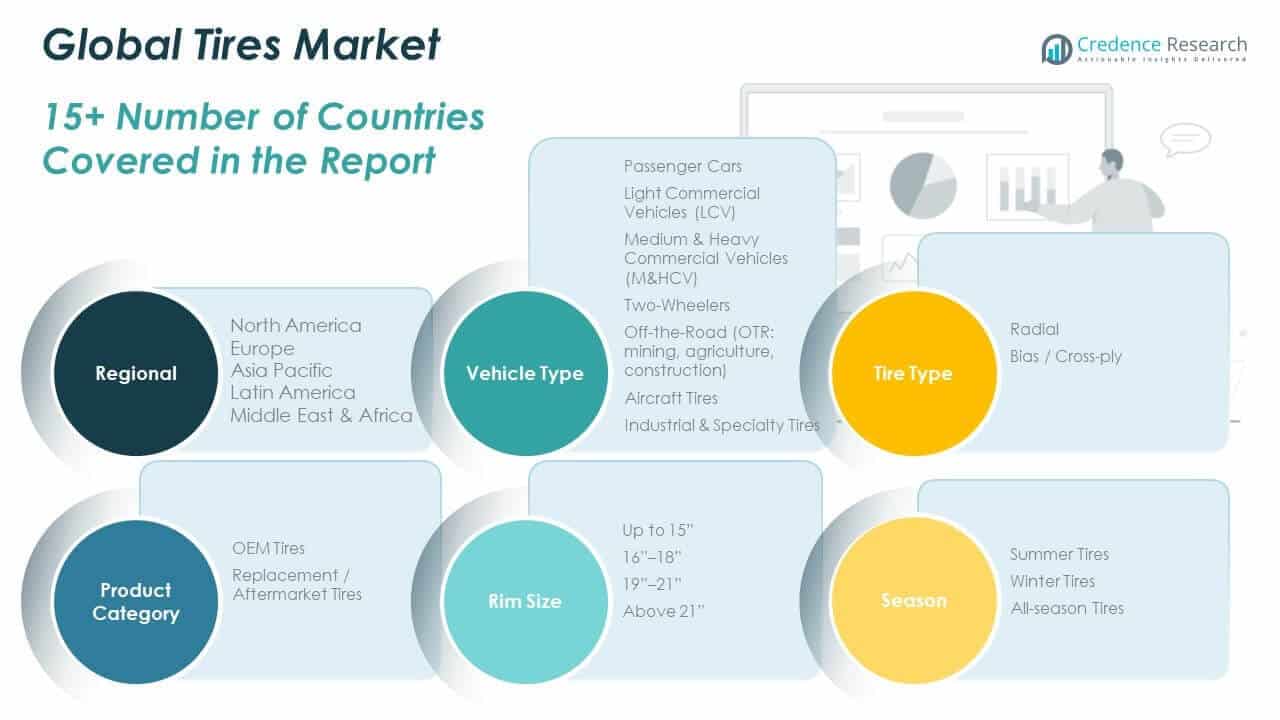
Market Segmentation Analysis:
By Vehicle Type
Passenger cars account for the largest tire demand due to high ownership levels. Light commercial vehicles support steady replacement cycles in urban logistics. Heavy commercial vehicles require durable tires for long-haul operations. Two-wheelers drive volume demand in cost-sensitive markets. Off-the-road vehicles serve construction, mining, and agriculture needs. Each vehicle class demands distinct load and durability features. Product design aligns closely with usage intensity. This segmentation shapes production priorities.
- For instance, Bajaj Auto sold approximately 3.44 million two-wheelers in FY2023, supporting sustained demand for motorcycle tires in emerging markets. The figure was precisely 3,442,839 units across both domestic and export markets, a 10% decline from the previous fiscal year.
By Tire Type
Radial tires dominate due to fuel efficiency and longer tread life. Bias tires retain relevance in off-road and industrial use. Radial designs suit passenger and commercial fleets. Bias structures support heavy loads on rough terrain. Manufacturers balance cost and performance across both types. Technology upgrades favor radial adoption. Regional usage patterns guide product mix. This split defines material selection.
- For instance, Bridgestone reports radial tires deliver up to 10% lower rolling resistance compared to bias tires, improving fleet fuel efficiency.
By Product Category
OEM tires depend on vehicle production trends. Replacement tires generate stable recurring demand. Vehicle aging supports aftermarket growth. The Global Tires Market relies on replacement cycles for volume stability. OEM partnerships support brand positioning. Replacement buyers value durability and price balance. Distribution reach influences category performance. Both segments sustain revenue flow.
By Rim Size
Up to 12 inches serve two-wheelers and compact vehicles. 13–15 inches dominate mass passenger cars. 16–18 inches support SUVs and premium sedans. 19–21 inches address high-performance vehicles. Above 21 inches target specialty and off-road use. Rim size reflects vehicle design evolution. Premiumization lifts larger rim demand. This segment guides capacity planning.
By Season
Summer tires lead in warm climates. Winter tires remain essential in cold regions. All-season tires gain traction for convenience. Buyers prefer year-round usability. Climate variability shapes seasonal demand. Retail guidance influences selection. Performance balance drives adoption. Seasonality affects inventory planning.
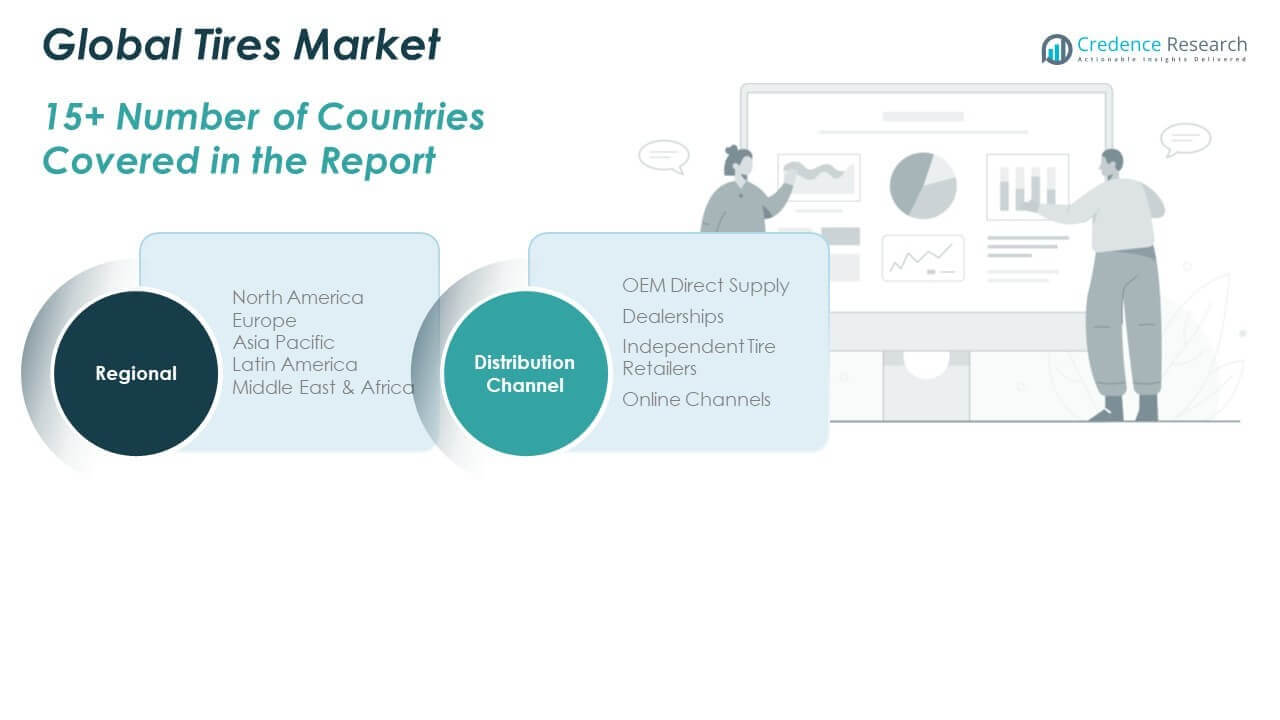
By Distribution Channel
OEM channels secure factory-fit volumes. Tire dealers and retail chains dominate replacement sales. Online channels grow through convenience and price transparency. Supermarkets serve budget buyers in select regions. Channel mix affects brand visibility. Service support strengthens offline sales. Digital tools enhance buyer confidence. Distribution strategy drives market reach.
Segmentation:
By Vehicle Type- Passenger Cars
- Light Commercial Vehicles
- Heavy Commercial Vehicles
- Two-Wheelers
- Off-The-Road Vehicles
- Radial Tires
- Bias Tires
- OEM Tires
- Replacement Tires
- Up To 12 Inches
- 13–15 Inches
- 16–18 Inches
- 19–21 Inches
- Above 21 Inches
- Summer Tires
- Winter Tires
- All-Season Tires
- OEM Channel
- Tire Dealers And Retail Chains
- Online Sales Channels
- Supermarkets And Hypermarkets
- North America
- U.S.
- Canada
- Mexico
- Europe
- Germany
- France
- U.K.
- Italy
- Spain
- Rest of Europe
- Asia Pacific
- China
- Japan
- India
- South Korea
- South-east Asia
- Rest of Asia Pacific
- Latin America
- Brazil
- Argentina
- Rest of Latin America
- Middle East & Africa
- GCC Countries
- South Africa
- Rest of the Middle East and Africa
Regional Analysis:
North America
The North America Global Tires Market size was valued at USD 43.56 billion in 2018 to USD 58.39 billion in 2024 and is anticipated to reach USD 87.23 billion by 2032, at a CAGR of 4.8% during the forecast period. North America accounts for nearly 28% share of the global market by 2032. High vehicle ownership supports steady replacement demand. Pickup trucks and SUVs drive larger rim size adoption. Strong highway freight activity sustains commercial tire demand. Safety standards encourage timely tire replacement. Premium tire penetration remains high. Organized retail networks improve access. Technology-focused consumers support advanced tire adoption.
Europe
The Europe Global Tires Market size was valued at USD 26.81 billion in 2018 to USD 34.40 billion in 2024 and is anticipated to reach USD 46.24 billion by 2032, at a CAGR of 3.4% during the forecast period. Europe contributes about 15% of the global market share. Passenger cars dominate regional demand patterns. Seasonal tire regulations support winter tire usage. Strong focus on safety and performance influences buying behavior. Replacement cycles remain stable across mature economies. Premium and all-season tires gain acceptance. Environmental norms shape product development. OEM demand stays consistent.
Asia Pacific
The Asia Pacific Global Tires Market size was valued at USD 67.89 billion in 2018 to USD 95.81 billion in 2024 and is anticipated to reach USD 151.03 billion by 2032, at a CAGR of 5.5% during the forecast period. Asia Pacific holds the largest share at nearly 49% by 2032. High vehicle production drives OEM demand. Two-wheelers generate large volume sales. Expanding logistics fleets support commercial tire demand. Urbanization increases personal mobility needs. Replacement demand grows with vehicle aging. Local manufacturing improves cost efficiency. Emerging economies fuel long-term growth.
Latin America
The Latin America Global Tires Market size was valued at USD 7.18 billion in 2018 to USD 9.66 billion in 2024 and is anticipated to reach USD 12.72 billion by 2032, at a CAGR of 3.1% during the forecast period. Latin America represents about 4% of global market share. Passenger vehicles lead regional consumption. Road infrastructure upgrades support vehicle usage. Replacement demand remains the primary revenue source. Price sensitivity influences buying decisions. Local production supports supply stability. Import dependence shapes pricing trends. Growth remains gradual but steady.
Middle East
The Middle East Global Tires Market size was valued at USD 4.31 billion in 2018 to USD 5.37 billion in 2024 and is anticipated to reach USD 6.76 billion by 2032, at a CAGR of 2.5% during the forecast period. The region holds nearly 2% of global share. High SUV usage drives demand for durable tires. Extreme climate conditions affect wear rates. Construction activity supports off-the-road tire demand. Replacement cycles remain frequent. Import reliance influences market pricing. Fleet expansion supports commercial demand. Market growth stays moderate.
Africa
The Africa Global Tires Market size was valued at USD 2.28 billion in 2018 to USD 3.44 billion in 2024 and is anticipated to reach USD 4.05 billion by 2032, at a CAGR of 1.7% during the forecast period. Africa contributes around 1% of the global market. Used vehicle imports shape replacement demand. Road conditions increase tire wear frequency. Cost-focused buying dominates consumer behavior. Commercial transport supports steady demand. Distribution networks remain fragmented. Local production remains limited. Long-term potential exists with infrastructure development.
Key Player Analysis:
- Michelin Group
- Bridgestone Corporation
- Goodyear Tire & Rubber Company
- Continental AG
- Pirelli & C. S.p.A
Competitive Analysis:
The Global Tires Market features strong competition among multinational and regional manufacturers. Leading players compete on product quality, durability, and brand trust. It reflects high entry barriers due to capital-intensive manufacturing and scale needs. Major companies maintain broad product portfolios across vehicle segments. OEM partnerships remain a critical competitive lever. Replacement market presence supports long-term revenue stability. Technology differentiation strengthens premium positioning. Geographic expansion helps firms balance regional demand cycles. Strategic investments focus on efficiency and sustainability.
Recent Developments:
- Gemspring Capital Management, LLC completed the acquisition of Goodyear's Polymer Chemicals Business on November 3, 2025. The transaction included two manufacturing plants in Houston and Beaumont, Texas, as well as a research and development facility in Akron, Ohio. The Polymer Chemical Business is a leading producer of synthetic rubber serving major tire manufacturers and diverse end markets including food, medical, sporting goods, thermoset plastics, adhesives, and packaging sectors. Goodyear retained its chemical facilities in Niagara Falls, New York, and Bayport, Texas, positioning itself to focus on core tire operations while unlocking standalone growth potential for the polymer chemicals segment under new private equity ownership.
- Pirelli launched the Cinturato Winter 3, a high-performance winter tire for sedans and crossovers, on October 7, 2025. The tire was developed using advanced virtual development techniques and independent testing by Dekra and TÜV, which verified superior snow and wet performance characteristics. The Cinturato Winter 3 features an optimized tread pattern with a central zig-zag channel for improved water evacuation, optimized sipes, and Snow Keeper Teeth on the blocks for enhanced snow-on-snow grip. The development process reconciled historically opposing performance characteristics through sophisticated simulation methodologies, reducing the need for physical prototypes while achieving more precise engineering results and minimizing development timelines.
- The Goodyear Tire & Rubber Company announced on October 22, 2025, the launch of three new all-terrain tires designed to meet diverse consumer demands across multiple vehicle segments and usage conditions. The Wrangler Outbound AT targets adventure-ready SUVs and light trucks, featuring DuPont Kevlar reinforcement for enhanced durability and a 65,000-mile tread life limited warranty. This tire combines aggressive traction on dirt and gravel with refined on-road comfort. The Wrangler Workhorse AT 2 is engineered for commercial and heavy-use applications, offering improved wet-weather grip with a Three-Peak Mountain Snowflake winter designation and 55,000-mile tread life warranty. Finally, the Wrangler ElectricDrive AT is specifically designed for electric SUVs and pickup trucks, incorporating Aramid-reinforced sidewalls, a low-rolling-resistance compound to preserve driving range, Arctic Grip Crystals for ice performance, and the Green Trace compound with recycled and renewable materials. The new lineup strengthens Goodyear's competitive position in the rapidly growing all-terrain tire segment.
Report Coverage:
The research report offers an in-depth analysis based on By Vehicle Type, By Tire Type, By Product Category, By Rim Size, By Season, and By Distribution Channel segments. It details leading market players, providing an overview of their business, product offerings, investments, revenue streams, and key applications. Additionally, the report includes insights into the competitive environment, SWOT analysis, current market trends, as well as the primary drivers and constraints. Furthermore, it discusses various factors that have driven market expansion in recent years. The report also explores market dynamics, regulatory scenarios, and technological advancements that are shaping the industry. It assesses the impact of external factors and global economic changes on market growth. Lastly, it provides strategic recommendations for new entrants and established companies to navigate the complexities of the market.
Future Outlook:
- Vehicle parc expansion will continue to support stable replacement tire demand across regions.
- Premium tire adoption will increase as consumers prioritize comfort, safety, and durability.
- Electric vehicle growth will drive demand for low-noise and low-rolling-resistance tires.
- Asia Pacific will remain the primary growth engine due to rising vehicle ownership.
- Digital sales platforms will improve access and pricing transparency for buyers.
- Sustainability goals will influence tire materials and production processes.
- Fleet expansion will sustain demand for commercial and heavy-duty tires.
- Larger rim sizes will gain wider acceptance with increasing SUV penetration.
- Organized retail networks will strengthen aftermarket distribution efficiency.
- Continuous product innovation will support long-term competitiveness and margin stability.
Request a Free Sample
Fill in your details and we'll send you a free sample report.
- Sample data tables & charts
- Research methodology
Need a Custom Version of This Report?
Tailor the scope, geography, or segments to your exact requirements.
- Custom geography or segment scope
- Direct access to our analyst team
Frequently Asked Questions
What is the current market size for Global Tires Market, and what is its projected size in 2032?
At what Compound Annual Growth Rate is the Global Tires Market projected to grow between 2025 and 2032?
Which Global Tires Market segment held the largest share in 2024?
What are the primary factors fueling the growth of the Global Tires Market?
Who are the leading companies in the Global Tires Market?
Which region commanded the largest share of the Global Tires Market in 2024?
Table of Content
Chapter 1. Report Introduction
- 1.1 Report Description & Purpose
- 1.1.1 Report Title & Market Definition
- 1.1.2 Unique Selling Propositions (USP) & Key Differentiators
- 1.1.3 Value Proposition for Stakeholders
- 1.2 Research Objectives
- 1.2.1 Market Sizing Objectives (Volume & Revenue)
- 1.2.2 Segmentation Objectives
- 1.2.3 Competitive Intelligence Objectives
- 1.2.4 Forecast & Scenario Objectives
- 1.3 Report Scope
- 1.3.1 Tires Scope – Types & Subtypes Covered
- 1.3.2 Geographic Scope – Regions & Countries Covered
- 1.3.3 Historical Period, Base Year & Forecast Period (2024; forecast to 2032)
- 1.3.4 Inclusions & Exclusions
- 1.4 HS Code & Classification Framework
- 1.5 Currency, Units & Pricing Basis
- 1.6 Target Stakeholders
- 1.7 Limitations & Assumptions
Chapter 2. Executive Summary
- 2.1 Global Tires Market Snapshot
- 2.1.1 Market Size – Historical (2024) & Forecast (2024-2032) (2024: USD 207.07 billion → 2032: USD 308.03 billion)
- 2.1.2 Volume & Revenue – Global Totals
- 2.1.3 Key Market Highlights – Top Five Facts
- 2.2 Tires Market Segmentation Snapshot
- 2.2.1 Market Split by Region – 2024 vs. 2032
- 2.3 Competitive Snapshot
- 2.3.1 Top 10 Players by Revenue Share – 2024
- 2.3.2 Top 10 Players by Volume Share – 2024
- 2.3.3 Recent Strategic Developments (18-Month Summary)
- 2.4 Key Investment Highlights & Strategic Conclusions
Chapter 3. Tires Market Dynamics & Industry Analysis
- 3.1 Market Overview & Context
- 3.1.1 Tires Market Position in the Broader Automotive Value Chain
- 3.1.2 OEM vs. Replacement Market Dynamics
- 3.1.3 Market Maturity & Development Stage by Region
- 3.2 Tires Market Drivers
- 3.3 Tires Market Restraints & Challenges
- 3.4 Tires Market Opportunities
- 3.5 Porter's Five Forces Analysis
- 3.5.1 Threat of New Entrants
- 3.5.2 Bargaining Power of Suppliers
- 3.5.3 Bargaining Power of Buyers
- 3.5.4 Threat of Substitutes
- 3.5.5 Competitive Rivalry – Intensity Assessment
- 3.6 Tires Value Chain Analysis
- 3.6.1 Upstream – Raw Material/Input Suppliers
- 3.6.1.1 Raw Material/Input 1
- 3.6.1.2 Raw Material/Input 2
- 3.6.1.3 Raw Material/Input 3
- 3.6.2 Midstream – Production/Manufacturing/Service Delivery
- 3.6.2.1 Production/Process Overview
- 3.6.2.2 Key Facility Locations & Capacity by Manufacturer
- 3.6.3 Downstream – Distribution & End Consumer
- 3.6.3.1 Primary Channel – B2B/OEM
- 3.6.3.2 Secondary Channels – Dealer, Retail, Online, Direct
- 3.6.4 Value Chain Profitability Analysis
- 3.6.1 Upstream – Raw Material/Input Suppliers
- 3.7 PESTEL Analysis
- 3.7.1 Political Factors
- 3.7.2 Economic Factors
- 3.7.3 Social Factors
- 3.7.4 Technological Factors
- 3.7.5 Environmental Factors
- 3.7.6 Legal Factors
- 3.8 Tires Supply Chain Analysis
- 3.8.1 Raw Material/Input Supply Risk Assessment
- 3.8.2 Manufacturing Concentration Risk (Geographic Exposure)
- 3.8.3 Trade Disruption Impact Analysis
- 3.9 Regulatory & Policy Landscape
Note: The regulatory and policy landscape section covers regulations based on their applicability to the market, Tires category, geography, and scope of the study. Only regulatory frameworks with a material impact on operations, compliance, trade, sustainability, or market access are analyzed in detail.
Chapter 4. Key Investment Pockets & Opportunity Analysis
- 4.1 Tires Market Attractiveness Analysis
- 4.1.1 By Region – Investment Attractiveness Matrix (Volume × CAGR)
- 4.2 Absolute Revenue Growth Opportunity
- 4.2.1 By Region – Absolute USD Growth Through 2032
- 4.3 Incremental Volume Opportunity
- 4.3.1 By Region – Incremental Volume Through 2032
- 4.3.2 Segment – Incremental Volume
- 4.4 Emerging Submarket Opportunity Deep Dive (Subject to Applicability)
- 4.5 Emerging Market Opportunity Scorecards
- 4.5.1 United States
- 4.5.2 Europe
- 4.5.3 Asia
- 4.5.4 Middle East & Africa
Note: Emerging Market Opportunity Scorecards will be included based on relevance and strategic importance. Regions listed are indicative and may vary depending on data availability and market dynamics.
Chapter 5. Tires Import-Export Analysis & Trade Flows
- 5.1 Global Trade Overview
- 5.1.1 Global Export Value by Country (2024)
- 5.1.2 Global Export Volume by Country (2024)
- 5.1.3 Global Import Value by Country (2024)
- 5.1.4 Global Import Volume by Country (2024)
- 5.1.5 Net Trade Balance by Country (2024)
- 5.2 Export Analysis – Segment
- 5.2.1 Type 1 (HS Code)
- 5.2.2 Type 2 (HS Code)
- 5.2.3 Type 3 (HS Code)
- 5.2.4 Type 4 (HS Code)
- 5.2.5 Type 5 (HS Code)
- 5.3 Import Analysis – Segment
- 5.3.1 Type 1 (HS Code)
- 5.3.2 Type 2 (HS Code)
- 5.3.3 Type 3 (HS Code)
- 5.3.4 Type 4 (HS Code)
- 5.3.5 Type 5 (HS Code)
- 5.4 Average Unit Trade Prices
- 5.4.1 Average Export Price – Segment & Country
- 5.4.2 Average Import Price – Segment & Source Country
- 5.4.3 Price Trends (2024)
- 5.5 Key Trade Route Analysis
- 5.5.1 Trade Route 1
- 5.5.2 Trade Route 2
- 5.5.3 Trade Route 3
- 5.5.4 Trade Route 4
- 5.5.5 Trade Route 5
- 5.6 Trade Policy Impact Assessment
- 5.6.1 US Anti-Dumping & Section 301 Tariffs
- 5.6.2 EU Customs Union Impact
- 5.6.3 Major Free Trade Agreements
- 5.6.4 USMCA Rules of Origin
Note: Trade policy analysis will be included only where relevant to the Tires market.
Chapter 6. Competitive Landscape & Company Benchmarking
- 6.1 Tires Market Concentration & Structure
- 6.1.1 Herfindahl-Hirschman Index (HHI) – vs. 2024
- 6.1.2 Tier 1, Tier 2 & Tier 3 Market Structure
- 6.1.3 Global, Regional & Local Player Dynamics
- 6.2 Tires Market Share Analysis – 2024
- 6.2.1 Global Revenue Share by Company
- 6.2.2 Global Volume Share by Company
- 6.2.3 Regional Revenue Share
- 6.2.4 Market Share Evolution ( vs. 2024)
- 6.2.5 OEM Segment Share by Company
- 6.2.6 Replacement Segment Share by Company
- 6.3 Production/Delivery Capacity & Facility Analysis
- 6.3.1 Global Installed Capacity
- 6.3.2 Capacity Utilization Rates
- 6.3.3 Production/Output Volume
- 6.3.4 Facility Locations & Capacity Map
- 6.3.5 Planned Capacity Additions
- 6.4 Tires Competitive Benchmarking Matrix
- 6.4.1 Revenue, Volume, CAGR & Profitability Comparison
- 6.4.2 Channel Revenue Mix
- 6.4.3 Geographic Revenue Exposure
- 6.4.4 R&D Intensity
- 6.4.5 Sustainability Maturity
- 6.5 Strategic Developments in Tires (Last 24 Months)
- 6.5.1 Mergers, Acquisitions & Divestments
- 6.5.2 New Tires Launches
- 6.5.3 Facility Expansions
- 6.5.4 Strategic Alliances, Joint Ventures & Partnerships
- 6.5.5 Distribution Expansion & Market Entry
- 6.5.6 Sustainability & ESG Initiatives
- 6.6 Competitive Strategy Mapping
- 6.6.1 Leader, Challenger, Follower & Niche Classification
- 6.6.2 Pricing Strategy Comparison
- 6.6.3 Channel Strategy Matrix
Note: Strategic developments are included based on their materiality and the availability of reliable information.
Chapter 7. Global Tires Market – By Distribution Channel
- 7.1 Segment Overview
- 7.1.1 Volume & Revenue Split by Channel (2024 & 2032)
- 7.1.2 Channel Mix Evolution (2024-2032)
Chapter 8. Regional Market Analysis – Global Overview
- 8.1 Global Regional Overview
- 8.1.1 Regional Volume Share
- 8.1.2 Regional Revenue Share
- 8.1.3 Regional Volume by Region
- 8.1.4 Regional Revenue by Region
- 8.1.5 Regional Forecast Through 2032
- 8.2 Cross-Regional Segment Analysis
- 8.2.1 By Distribution Channel
- 8.2.2 By Brand/Price Tier
Chapter 9. North America Tires Market
- 9.1 United States
- 9.2 Canada
- 9.3 Mexico
Chapter 10. Europe Tires Market
- 10.1 Germany
- 10.2 France
- 10.3 Italy
- 10.4 United Kingdom
- 10.5 Spain
- 10.6 Poland
- 10.7 Russia
- 10.8 Netherlands
- 10.9 Belgium
- 10.10 Sweden
- 10.11 Denmark
- 10.12 Norway
- 10.13 Rest of Europe
Chapter 11. Asia Pacific Tires Market
- 11.1 China
- 11.2 India
- 11.3 Japan
- 11.4 South Korea
- 11.5 Thailand
- 11.6 Indonesia
- 11.7 Vietnam
- 11.8 Malaysia
- 11.9 Australia
- 11.10 Rest of Asia Pacific
Chapter 12. Latin America Tires Market
- 12.1 Brazil
- 12.2 Argentina
- 12.3 Colombia
- 12.4 Chile
- 12.5 Rest of Latin America
Chapter 13. Middle East Tires Market
- 13.1 Saudi Arabia
- 13.2 United Arab Emirates
- 13.3 Turkey
- 13.4 Israel
- 13.5 Iran
- 13.6 Rest of the Middle East
Chapter 14. Africa Tires Market
- 14.1 South Africa
- 14.2 Egypt
- 14.3 Nigeria
- 14.4 Morocco
- 14.5 Rest of Africa
Chapter 15. Tires Company Profiles
- 15.1 [Company 01]
- 15.1.1 Company Overview
- 15.1.2 Key Management Personnel
- 15.1.3 Products & Services Portfolio
- 15.1.4 Financial Performance
- 15.1.5 Key Market Focus & Geographic Presence
- 15.1.6 Recent Developments & Strategic Initiatives
Note: The company profile list is preliminary and may change based on research findings, market developments, data availability, and client requirements.
Chapter 16. Appendices
- Appendix A – List of Abbreviations & Acronyms
- Appendix B – Industry Classification Code Reference – Full Series
- Appendix C – Production & Capacity Data Tables
- Appendix D – End-Use & Demand Base Tables
- Appendix E – Consumption & Replacement Rate Assumptions
- Appendix F – ASP Reference Tables
- Appendix G – Manufacturing & Facility Database
- Appendix H – Import-Export Data Tables
- Appendix I – Regulatory Summary Tables
- Appendix J – Primary Research Participant List (Anonymized)
- Appendix K – Primary Research Questionnaire Framework
- Appendix L – Data Sources & Bibliography
- Appendix M – Market Size Divergence & Source Comparison
Chapter 17. Research Methodology
- 17.1 Research Framework & Philosophy
- 17.2 Secondary Research – Sources, Hierarchy & Data Extraction
- 17.3 Data Modeling – Bottom-Up & Top-Down Market Sizing
- 17.4 Primary Research – Stakeholder Framework, LOI & Sample Sizes
- 17.5 Forecast Methodology – Regression, Scenario & Sensitivity Analysis
- 17.6 Quality Control – Four-Layer Validation Framework
- 17.7 Limitations & Standard Assumptions
- 17.8 Disclaimer
