Wedding orders and fitted shirts anchor made-to-order demand
The India custom apparel market was valued at USD 612.4 million in 2025 and is projected to increase from USD 675.8 million in 2026 to USD 1.64 billion by 2035, registering a CAGR of 10.36% during 2026–2035. Demand comes from wedding and festive outfits, made-to-measure shirts and suits for office wear, and printed tees and team kits ordered online in small runs. West India held the largest regional share, 31.0% in 2025, because Mumbai is the largest market for made-to-measure menswear studios and Pune hosts dense tailor networks. South India is the fastest-growing region at 10.9% a year, as Bengaluru, Hyderabad and Chennai combine high urban spending with print-on-demand capacity in Coimbatore. The GST change of Sept. 22, 2025, cut tax on garments up to INR 2,500 a piece to 5%, while pieces above that line now pay a higher rate. As a result, studios now price shirts and uniforms under the threshold and treat suits and sherwanis as premium orders.
How large is the apparel sector in India and where does made-to-order fit?
India's textile sector grew from about INR 8.4 lakh crore in 2014 to INR 16 lakh crore by January 2026, according to Textiles Minister Giriraj Singh, and made-to-order clothing forms a small, higher-value layer inside that total. This report counts the value of finished garments made to a buyer's measurements or design, sold by tailoring brands, boutiques, print studios and online platforms. Buyers pay per piece, often after a fitting session or an online design step.
The study excludes labor-only stitching of fabric that customers buy elsewhere, alterations of ready-made clothes and export orders. The value chain runs from fabric mills and blank-garment suppliers to measurement, cutting, printing or embroidery, and delivery. Households spent 6.63% of rural monthly consumption on clothing, bedding and footwear in 2023–24, according to the Ministry of Statistics and Programme Implementation, which shows how large the base for upgrades to fitted pieces is.
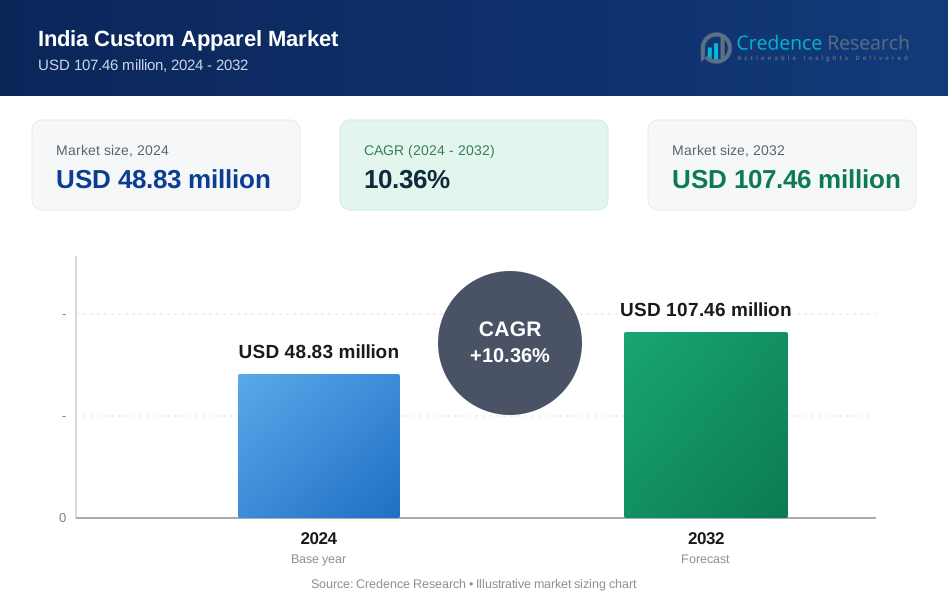
India Custom Apparel Market Insights
- The India custom apparel market grows from USD 612.4 million in 2025 to USD 1.64 billion by 2035, at a 10.36% CAGR, as wedding orders and made-to-measure store networks widen.
- West India held 31.0% of 2025 value, supported by Mumbai, which is the largest market for Bombay Shirt Company's 31-store network.
- Shirts led the type split with 38.0% of 2025 value, because fitted shirts and printed tees are the entry order for most buyers.
- GST on garments up to INR 2,500 a piece fell to 5% on Sept. 22, 2025, while pieces above that price moved to 18%.
- Bombay Shirt Company, Raymond Lifestyle, Qikink, Printrove and TailorSmart compete on fit, store reach and delivery speed, while millions of local tailors keep a large unorganized share.
Shirts lead while suits and online orders grow fastest
Shirts lead while suits grow fastest on wedding orders
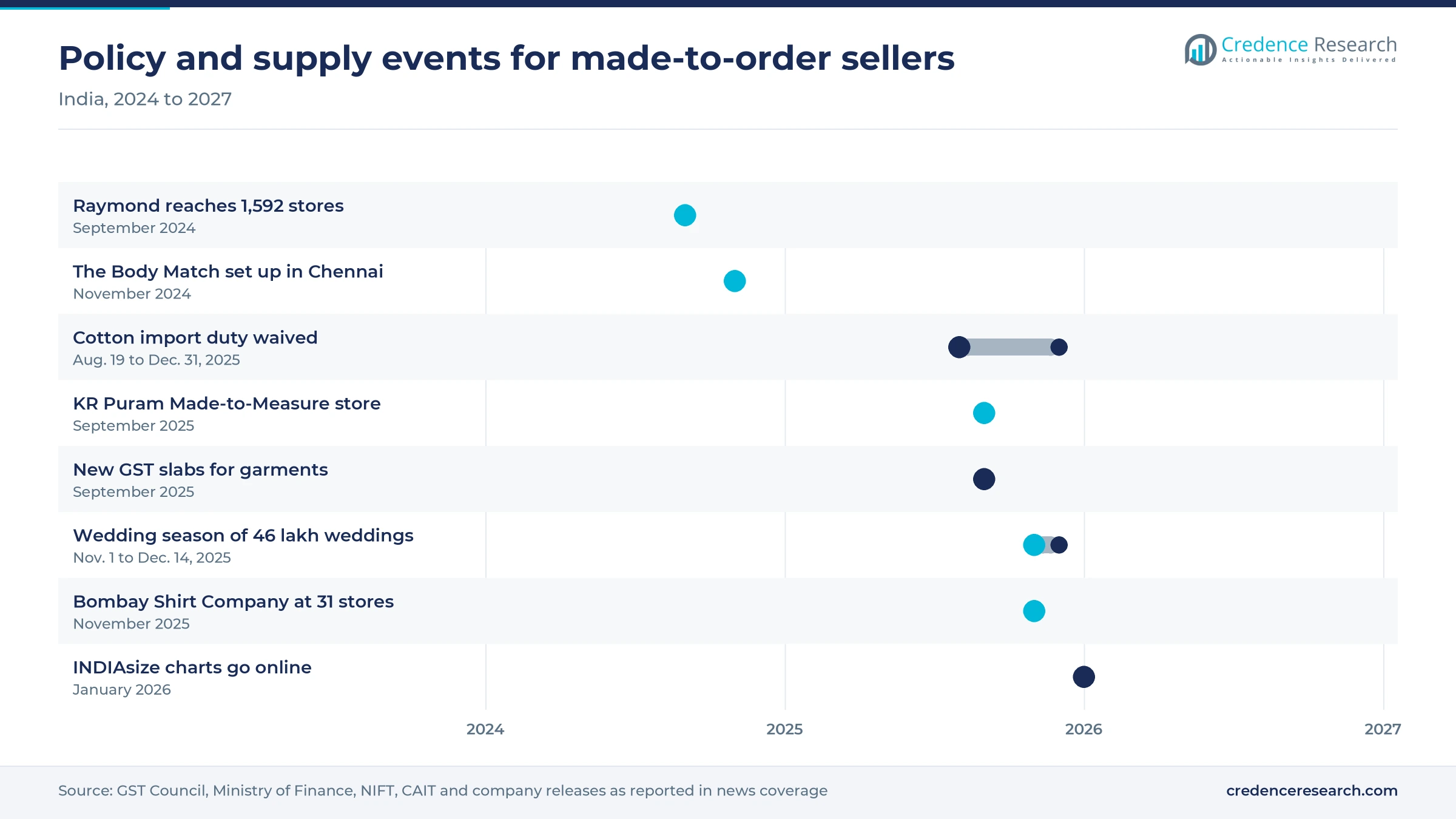
Based on type, the market is categorized into shirt, pants, suit, coat, skirt and others. Shirt led with 38.0% of 2025 value, because fitted shirts and printed tees are the first order for most buyers, and Bombay Shirt Company ran 31 made-to-measure stores across India in November 2025, according to The Tribune. Suits grow fastest at 11.2% a year, as the Confederation of All India Traders expected 46 lakh weddings between Nov. 1 and Dec. 14, 2025. The others group covers ethnic sets, jerseys and uniforms, while coats and skirts remain smaller made-to-order lines.
Women lead on occasion wear while men grow fastest
Based on end user, the market is categorized into women, men and children. Women led with 46.0% of 2025 value, because boutiques stitch blouses, lehengas and saree sets to measure, and apparel and sarees took 10% of wedding spending in the Confederation of All India Traders' 2025 survey of 75 cities. This made-to-order layer sits inside the wider market for women's clothing. Men grow fastest at 10.8% a year, as Raymond opened a KR Puram store in Bengaluru in September 2025 with Made-to-Measure at its core. Children's orders rest on school uniforms, which Samagra Shiksha funds at two sets per eligible child.
Offline fittings lead while online orders grow fastest
Based on distribution channel, the market is categorized into offline and online. Offline led with 68.0% of 2025 value, because most fitted pieces still need a measurement session, and the Periodic Labour Force Survey 2023–24 counted 12 million tailors across India. Pune-based TailorSmart alone works with more than 800 tailors in 25 cities. Online grows fastest at 11.9% a year, as non-metro regions supplied more than 70% of Myntra's new customers in 2025, according to ANI. Print partners such as Qikink in Coimbatore dispatch personalized orders within two to three business days.
| Segment Group | Leading Sub-segment | Share, 2025 | Fastest-growing Sub-segment | CAGR, 2026–2035 |
|---|---|---|---|---|
| By Type | Shirt | 38.0% | Suit | 11.2% |
| By End User | Women | 46.0% | Men | 10.8% |
| By Distribution Channel | Offline | 68.0% | Online | 11.9% |
Request a Free Sample
Fill in your details and we'll send you a free sample report.
- Sample data tables & charts
- Research methodology
Weddings, store networks and lower GST lift orders
Wedding seasons fill tailoring order books
Wedding and festive calendars create the largest single pool of made-to-fit orders in India. The Confederation of All India Traders expected 46 lakh weddings and INR 6.5 lakh crore of trade between Nov. 1 and Dec. 14, 2025, according to its season estimate. Apparel and sarees accounted for 10% of that wedding spending in the same survey of 75 cities. Delhi alone was expected to host 4.8 lakh weddings with about INR 1.8 lakh crore of trade, which keeps studios in the capital booked through the winter. As a result, suits, the fastest-growing type, rise at 11.2% a year, while women hold 46.0% of 2025 value on bridal and family orders.
Made-to-measure store networks reach more cities
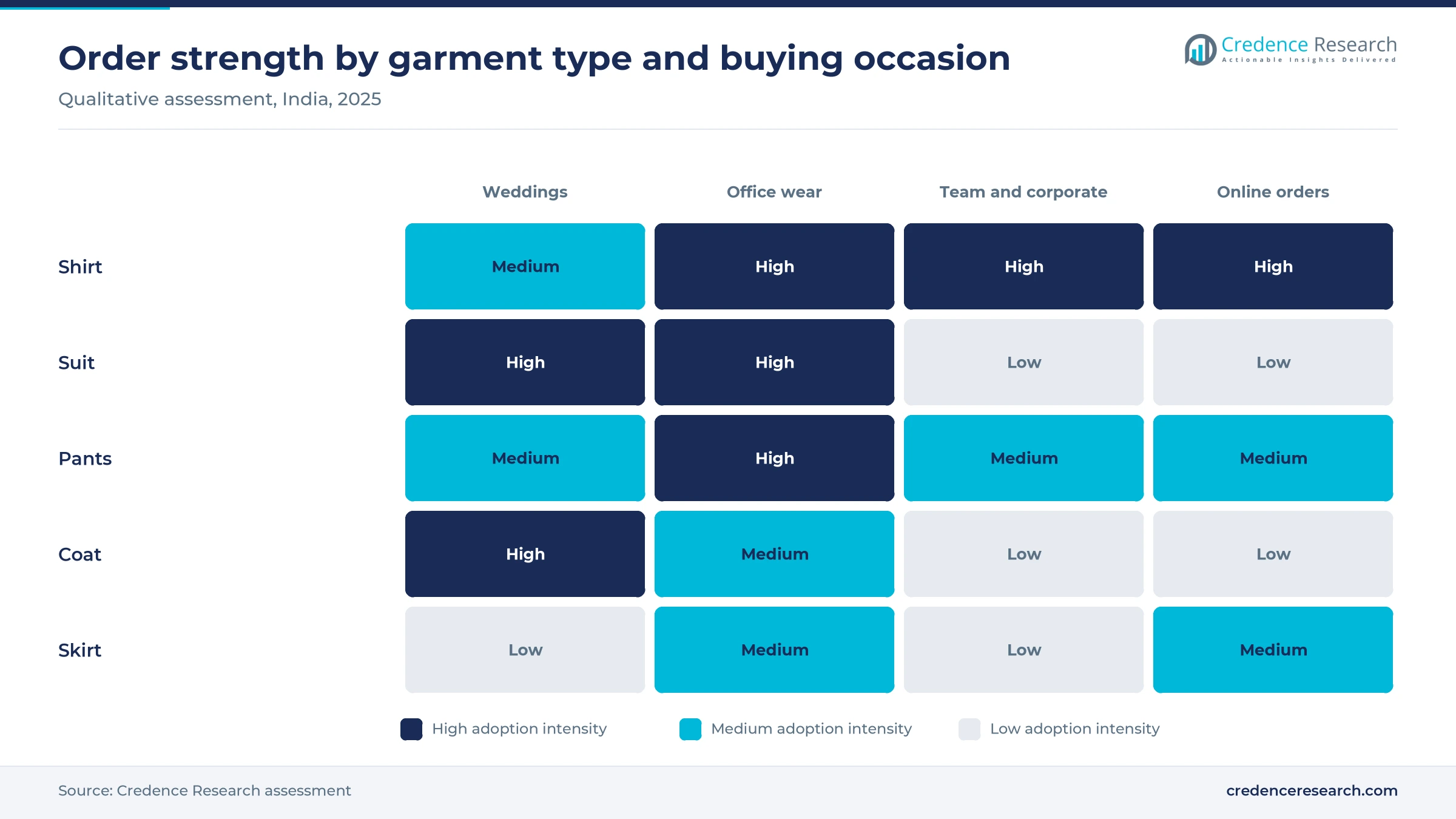
Made-to-measure store networks are moving from a few flagship studios to malls and high streets in many cities. Bombay Shirt Company ran 31 stores in November 2025, 13 in malls and 18 on high streets, and it opened more than 10 of them in 18 months. Its Delhi NCR network grew from four stores in 2023 to seven, which made the region its second-largest market after Mumbai. Raymond Lifestyle had 1,592 stores on Sept. 30, 2024, including 129 Ethnix by Raymond outlets, according to Fibre2Fashion and its KR Puram store opened in September 2025 with Made-to-Measure at its core. In turn, men grow at 10.8% a year through 2035.
Online reach brings smaller cities into personalized orders
Online reach lets a buyer in a smaller city order a printed tee or a fitted shirt without visiting a studio. TRAI counted 1,002.85 million internet subscribers at the end of June 2025, including 423.39 million rural subscribers. Myntra expected about 200 million annual active users in 2025, and non-metro regions supplied more than 70% of its new customers, according to an ANI report in December 2025. Print-on-demand partners such as Qikink, based in Coimbatore, dispatch orders within two to three business days, according to a UNI release. This growth in online retail lifts the online channel, which grows at 11.9% a year to 2035.
Lower GST on mid-priced garments cuts order costs
Lower tax on mid-priced garments makes small made-to-order purchases cheaper for households across India. From Sept. 22, 2025, garments priced up to INR 2,500 a piece attract 5% GST, after the GST Council's 56th meeting widened the slab from INR 1,000, according to Business Today. Pieces between INR 1,000 and INR 2,500 had paid 12% before the change, a band that covers most printed tees, fitted shirts and school uniform sets. Input costs also eased when the government waived the 11% cotton import duty from Aug. 19 to Dec. 31, 2025, according to Outlook Business. As a result, shirts keep 38.0% of 2025 value, the largest share of any type.
Body scans and tailor networks reshape made-to-order
Shift toward body scans and national size charts
Fit data is shifting from tape measures to 3D scans and national size charts that brands can reuse. NIFT scanned 26,324 people aged 15 and above for the Ministry of Textiles' INDIAsize project, and 14 male and 13 female size charts went online on Jan. 2, 2026. Chennai startup The Body Match, set up in November 2024, had about 1.3 lakh users of its body-model tool, according to YourStory in April 2025. Delhi's Samshek uses a scanner that records 110 body measurements in about five seconds, according to an earlier YourStory profile. This lowers the cost of a second order, because a stored profile replaces a fresh fitting session.
Rise of platforms that organize neighborhood tailors
Platforms are organizing neighborhood tailors into networks that take orders from retail stores and messaging apps. Pune-based TailorSmart, started in 2017, works with more than 800 tailors across 25 cities, according to ThePrint in December 2025. About half of its business comes from Reliance Retail's Avantra stores and most of the rest from WhatsApp groups. Nearly 50% of the work in partner units now comes through the platform, which gives tailors steadier orders between seasons. The Periodic Labour Force Survey 2023–24 counted 12 million tailors, which gives aggregators a large base to recruit from. In turn, offline channels keep 68.0% of 2025 value through these fitting networks.
Opportunity in corporate merchandise and team kits
Corporate merchandise and team kits offer an opening for printers that can handle logo work at volume. Hyderabad's eYantra Ventures expanded its brand merchandising division in the first nine months of FY2025–26, according to a January 2026 release carried by The Tribune. PUMA's experiential stores in Hyderabad and New Delhi include a PUMA x YOU studio with more than 100 design options for print and embroidery, according to Mediainfoline. India's women's cricket team won the World Cup on Nov. 2, 2025, and brands moved quickly to tie campaigns to the players, according to Impact. Suppliers that pair print-on-demand fulfillment with bulk embroidery can serve fan and corporate buyers alike.
Opportunity in fandom prints for smaller cities
Fandom and creator merchandise opens a route into smaller cities for personalized prints and short design runs. The Souled Store had 36 stores in 21 cities in December 2024 and planned 200 stores by December 2026, according to DFU Publications. Aditya Birla's TMRW, which owns Bewakoof, ran 16 stores across seven cities by November 2025, according to D2C Insider. Myntra counted 3.5 million shopper creators in its Glam Clan program in 2025, which shows how creator links now drive fashion discovery. These moves widen the printed tee business, where one design can sell through stores and creator pages.
Returns, premium GST and labor gaps squeeze margins
Fit returns turn online orders into losses
Poor fit is the most common reason a made-to-order purchase fails, and online fashion already carries high return rates. Fashion returns run at 25% to 40% in India, according to the India eCommerce Index Report 2023 cited by YourStory, while processing a return can cost 20% to 65% of the item's value. A tailored piece cannot be resold to another buyer, so each return is close to a total loss. Sellers respond with fit guarantees, video consultations and stored measurement profiles.
Premium tailored pieces now carry a higher GST rate
Premium tailored garments now face a heavier tax than before the September 2025 GST change. Garments priced above INR 2,500 a piece moved from 12% to 18% GST from Sept. 22, 2025, under Notification 9/2025 Central Tax (Rate) dated Sept. 17, 2025. Most made-to-measure suits, blazers and sherwanis sell above that line, so buyers pay six percentage points more tax on each order. Studios now split pricing, bundle alterations and promote mid-priced shirts to keep wedding customers.
Low tailor incomes thin the skilled workforce
Skilled tailoring depends on a workforce that earns little and mostly works alone. The Periodic Labour Force Survey 2023–24 counted 12 million tailors, about 80% of them self-employed, with an average monthly income of INR 6,000, according to ThePrint in December 2025. Low pay pushes younger workers toward factory or delivery jobs, which makes peak-season capacity hard to secure. Brands that cannot book master tailors before November risk missing wedding delivery dates.
Cotton costs swing with duty and tariff decisions
Fabric prices move with trade policy, which makes quotes for bulk uniform and merchandise orders hard to hold. The 11% cotton import duty was waived only from Aug. 19 to Dec. 31, 2025, according to Outlook Business, so mills face the duty again once the window closes. The same report linked the waiver to 50% U.S. tariffs on Indian goods from Aug. 27, 2025, which squeezed export garment makers. Printers that quote orders months ahead absorb these swings in their margins.
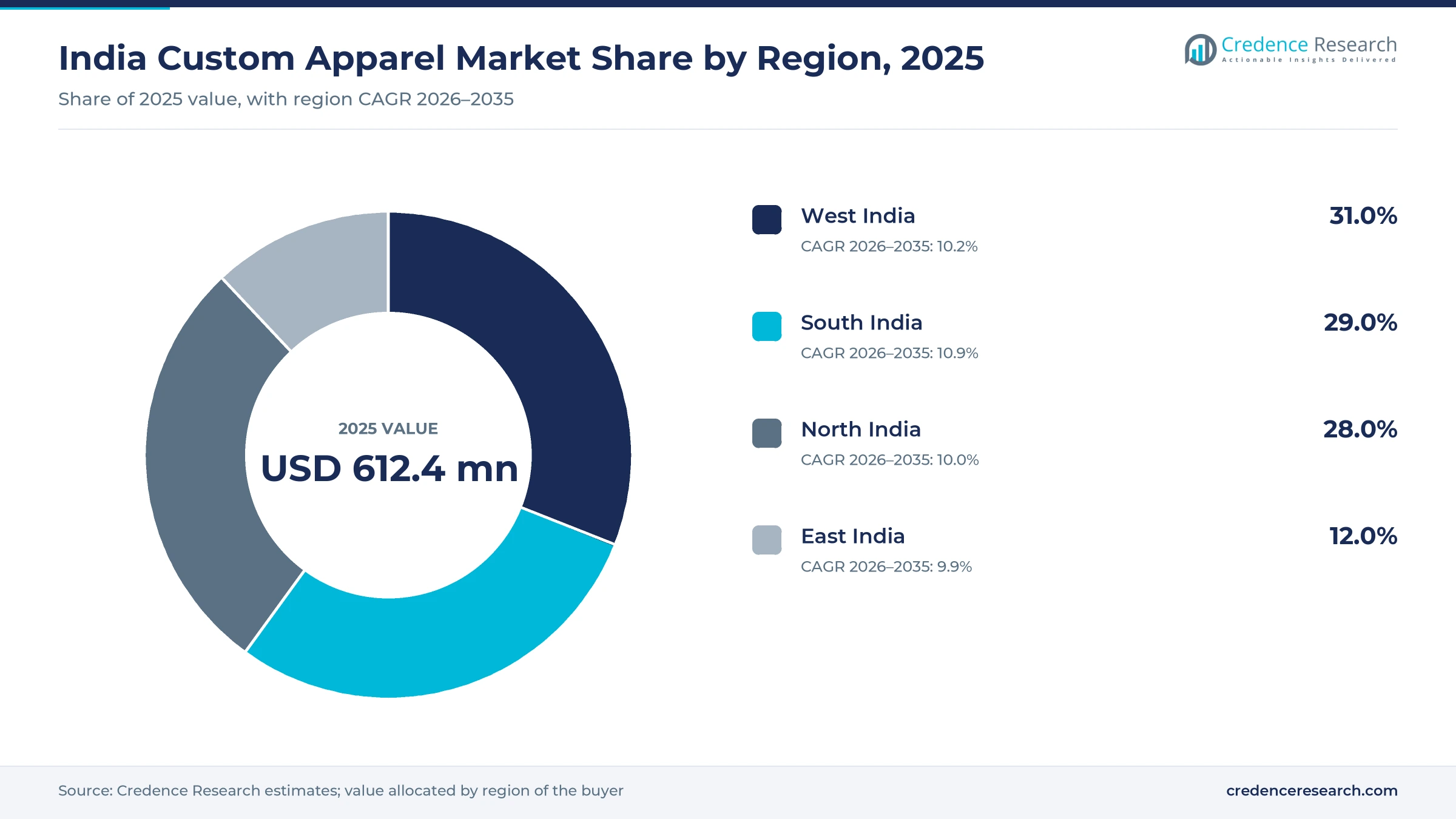
West India leads as South India adds orders fastest
| Region | Value, 2025 (USD million) | Share, 2025 | CAGR, 2026–2035 |
|---|---|---|---|
| West India | 189.8 | 31.0% | 10.2% |
| South India | 177.6 | 29.0% | 10.9% |
| North India | 171.5 | 28.0% | 10.0% |
| East India | 73.5 | 12.0% | 9.9% |
West India leads through Mumbai studios and Pune tailors
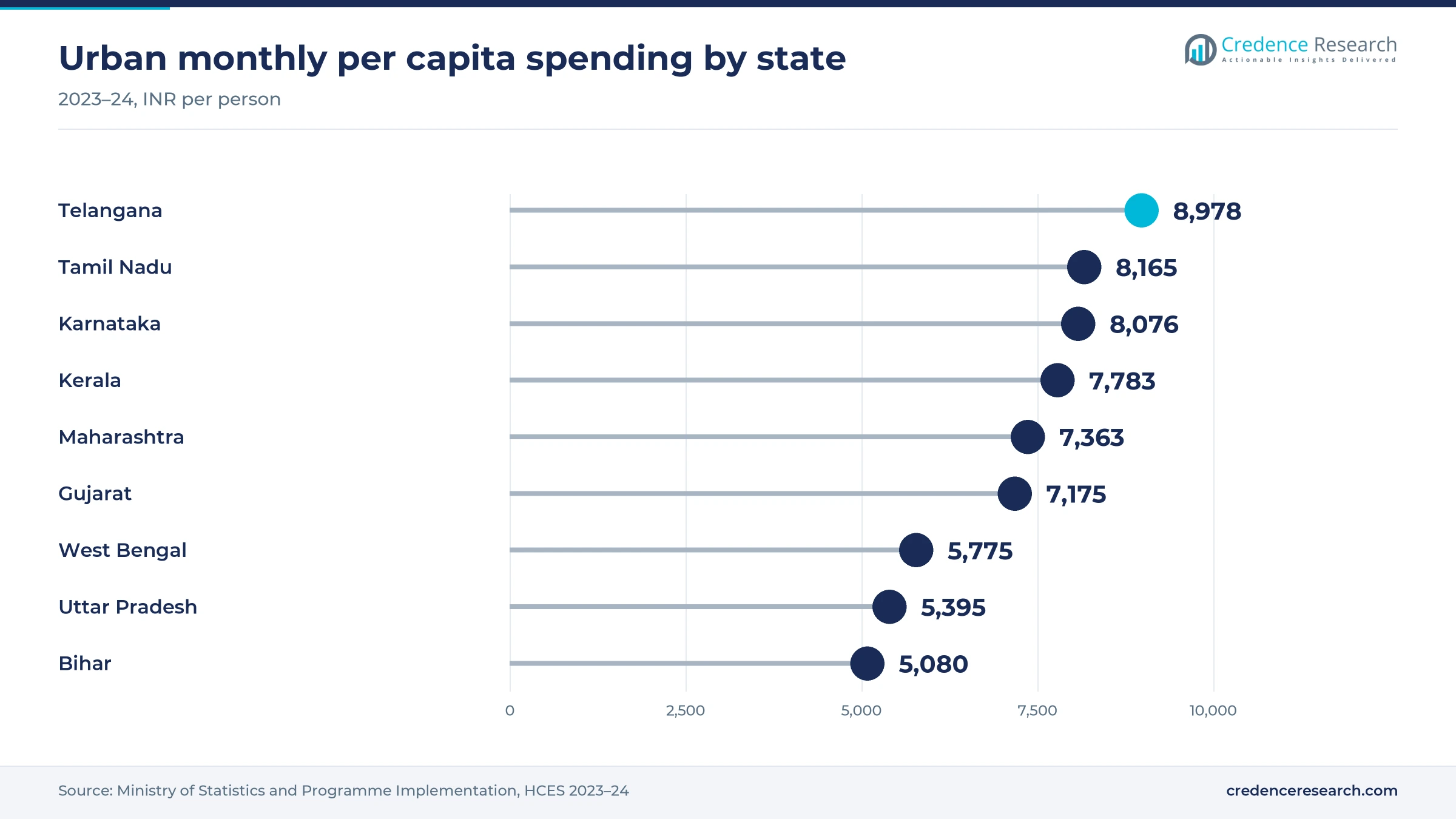
West India held 31.0% of 2025 value and grows at 10.2% a year, led by Mumbai, Pune and Ahmedabad. Mumbai is Bombay Shirt Company's largest market, and the brand runs its Den concept stores at Kemps Corner and Bandra. Urban monthly per capita spending reached INR 7,363 in Maharashtra and INR 7,175 in Gujarat in 2023–24, according to the Household Consumption Expenditure Survey. TailorSmart also counts Pune as its largest customer base, which ties neighborhood tailors to organized retail in the zone.
South India grows fastest on high urban spending
South India held 29.0% of 2025 value and is the fastest-growing zone at 10.9% a year. Telangana recorded urban monthly per capita spending of INR 8,978 in 2023–24, while Tamil Nadu reached INR 8,165 and Karnataka INR 8,076. Raymond opened a multi-brand store with Made-to-Measure at its core in KR Puram, Bengaluru, in September 2025. Coimbatore is home to print-on-demand partner Qikink, and Chennai's The Body Match draws most of its users from Hyderabad.
North India rides Delhi wedding demand
North India held 28.0% of 2025 value and grows at 10.0% a year, centered on Delhi NCR, Jaipur and Lucknow. The Confederation of All India Traders expected 4.8 lakh weddings in Delhi in the 2025 season, worth about INR 1.8 lakh crore of trade. Bombay Shirt Company grew its Delhi NCR network from four stores in 2023 to seven and opened its 17th store, in Jaipur, in November 2023. Uttar Pradesh's urban monthly per capita spending of INR 5,395 in 2023–24 shows a wide gap between metro and small-city budgets.
East India depends on school and festive orders
East India held 12.0% of 2025 value and grows at 9.9% a year, centered on Kolkata, Bhubaneswar and Patna. Urban monthly per capita spending was INR 5,775 in West Bengal and INR 5,080 in Bihar in 2023–24, below the national urban average of INR 6,996. Rural households spent 6.63% of their monthly budget on clothing, bedding and footwear, which matters in a zone with a large rural population. School uniform funding under Samagra Shiksha, at INR 600 for two sets per eligible child, keeps local tailors busy before each session.
Recent moves by brands, platforms and regulators
| Development | Status and market relevance |
|---|---|
| In September 2025, Raymond opened a multi-brand menswear store in KR Puram, Bengaluru, with Made-to-Measure at its core, according to Indian Retailer. | Operating; adds tailoring to a multi-brand format |
| In September 2025, GST on garments priced up to INR 2,500 a piece was set at 5%, while pieces above that price moved to 18%. | In force from Sept. 22, 2025; premium suits pay more tax |
| In November 2025, Bombay Shirt Company reported 31 stores across India and seven in Delhi NCR, with three more planned in Gurugram and West Delhi. | Expanding; Delhi NCR is now its second-largest market |
| In December 2025, Myntra said it expected about 200 million annual active users in 2025, with Gen Z at 50% of active customers. | Ongoing; widens reach for online personalized orders |
| In January 2026, NIFT put 14 male and 13 female INDIAsize body size charts online for brands and buyers. | Available; IN Tag size standards still under development |
Scanning, printing and studio tools behind each order
- 3D body scanners capture body shape without contact, and Samshek's scanner records 110 measurements in about five seconds.
- National size charts from NIFT's INDIAsize project give brands 27 body size charts built from 26,324 scanned people.
- Print-on-demand fulfillment lets partners such as Qikink print single orders and dispatch them within two to three business days.
- In-store design studios such as PUMA x YOU offer more than 100 print and embroidery options on footwear, apparel and accessories.
Need a Custom Version of This Report?
Tailor the scope, geography, or segments to your exact requirements.
- Custom geography or segment scope
- Direct access to our analyst team
Store-led tailoring brands compete with print platforms
Competition splits between millions of neighborhood tailors and a smaller group of organized brands and platforms. Bombay Shirt Company competes on made-to-measure shirts, trousers and blazers through 31 stores, with Mumbai and Delhi NCR as its largest markets. Raymond Lifestyle uses its large store network and Made-to-Measure service to sell fabric-led suits and ethnic wear, while Tailorman targets buyers who want British-style tailoring. TailorSmart works the other way, routing orders from retail stores and WhatsApp groups to more than 800 partner tailors. On the print side, Qikink and Printrove supply print-on-demand fulfillment to online sellers, while marketplaces such as Myntra add smaller-city reach as sales channels. The Souled Store and Bewakoof sell fandom and graphic designs through growing store networks, and PUMA India runs in-store personalization. As a result, fit accuracy, delivery time and store reach decide share.
Brands, studios and platforms active across India
| Company | Type | Role in the market |
|---|---|---|
| Bombay Shirt Company | Made-to-measure menswear brand | Runs 31 stores, seven of them in Delhi NCR as of November 2025 |
| Raymond Lifestyle | Fabric and menswear group | Offers Made-to-Measure in stores such as KR Puram, Bengaluru |
| Tailorman | Made-to-measure menswear label | Bengaluru-based brand with stores in southern cities and Delhi |
| TailorSmart | Tailoring aggregator | Links more than 800 tailors across 25 cities to store and WhatsApp orders |
| Qikink | Print-on-demand partner | Coimbatore facility that prints and dispatches single orders in two to three days |
| Printrove | Print-on-demand partner | Prints, packs and ships custom T-shirts for online sellers across India |
| The Souled Store | Fandom merchandise retailer | Planned 200 stores by December 2026 |
| Bewakoof | Graphic casualwear brand | Part of Aditya Birla's TMRW, which runs 16 stores in seven cities |
| PUMA India | Sportswear brand | PUMA x YOU studio offers print and embroidery personalization |
| Samshek | Fashion-tech brand | Uses 3D body scanning for made-to-fit garments from Delhi |
Fit data and store reach decide who wins orders
Credence Research's view is that the India custom apparel market will be won on fit data and store reach rather than on fabric choice alone. Wedding demand worth INR 6.5 lakh crore in one 2025 season keeps premium orders flowing, but the higher GST on pieces above INR 2,500 pushes studios to build volume in shirts and mid-priced sets. Sellers that store body profiles, through scans or the INDIAsize charts, can turn one fitting into repeat online orders. The main risk is labor, because tailor incomes near INR 6,000 a month make peak-season capacity scarce.
How Credence Research built the 2025 estimate
The report uses 2025 as the base year and 2026 to 2035 as the forecast period. Market values come from the Credence Research market model for this report. The earlier edition of this report was taken to 2025 at its own growth rate, and that value was then checked against wedding spending, household consumption and store network data and replaced with a new Credence Research estimate. Segment and zonal splits are Credence Research estimates built from public data. Sources include the Ministry of Statistics and Programme Implementation, TRAI, NIFT, the Confederation of All India Traders, GST notifications, company releases and news reports. No interviews or surveys were conducted for this edition of the report.
Online orders and suits gain share through 2035
The India custom apparel market is expected to grow from USD 675.8 million in 2026 to USD 1.64 billion by 2035, at a 10.36% CAGR over 2026–2035. Online orders will gain the most ground, as stored measurements and print-on-demand partners reach buyers beyond the metros. Shirts will keep the largest share, because a fitted shirt or printed tee remains the cheapest first order for a new buyer. Suits and wedding sets will add value each winter season, led by Delhi and the large southern cities. The main swing factors are GST thresholds, cotton costs and the supply of skilled tailors.
Frequently Asked Questions
How big is the India custom apparel market?
How large is the textile and apparel sector in India?
Which brands offer custom sizes and designs in India?
Which region leads the India custom apparel market?
Which type holds the largest share?
How fast is men's made-to-measure wear growing in India?
How did the 2025 GST change affect tailored clothing?
How fast are online orders growing?
Table of Content
Chapter 1 Market Segmentation
- 1.1 Segmentation Framework
- 1.1.1 Product and Service Classification
- 1.1.2 Application and End-Use Classification
- 1.1.3 Technology and Solution Classification
- 1.1.4 Customer and Distribution Channel Classification
- 1.1.5 Geographic Segmentation
- 1.1.6 Market Segment Definitions and Boundaries
- 1.2 By Type
- 1.2.1 Shirt
- 1.2.2 Suit
- 1.2.3 Pants
- 1.2.4 Coat
- 1.2.5 Skirt
- 1.2.6 Others
- 1.3 By End User
- 1.3.1 Women
- 1.3.2 Men
- 1.3.3 Children
Chapter 2 Introduction
- 2.1 Report Objectives and Scope
- 2.2 Product Definition and Industry Terminology
- 2.3 Market Inclusions and Exclusions
- 2.4 Research Process
- 2.4.1 Primary Research and Expert Interviews
- 2.4.2 Secondary Research and Source Review
- 2.4.3 Top-Down and Bottom-Up Estimation
- 2.4.4 Data Triangulation and Verification
- 2.5 Market Size Measurement Basis
- 2.5.1 2025: USD 612.4 million → 2035: USD 1.64 billion
- 2.6 Historical and Forecast Reference Periods
- 2.6.1 Historical Period: 2018-2025
- 2.6.2 Base Year: 2025
- 2.6.3 Forecast Period: 2025-2035
- 2.7 Research Assumptions and Limitations
Chapter 3 Executive Summary
- 3.1 Market Snapshot and Key Findings
- 3.2 Base-Year Market Size, 2025
- 3.3 Forecast Market Size, 2035
- 3.4 Revenue and Volume Growth Outlook
- 3.5 Key Demand and Supply Indicators
- 3.6 Leading Market Segments
- 3.7 Fastest-Growing Market Opportunities
- 3.8 Regional Performance Highlights
- 3.9 Technology and Industry Transformation
- 3.10 Competitive Landscape Summary
- 3.11 Analyst View and Strategic Implications
Chapter 4 India Custom Apparel Market Trends and Developments
- 4.1 Historical Industry Development, 2018-2025
- 4.2 Recent Market Trends and Developments
- 4.3 Demand and Customer Behavior Trends
- 4.4 Technology and Product Innovation
- 4.5 Artificial Intelligence, Automation and Digitalization
- 4.6 Local Manufacturing and Supply Chain Realignment
- 4.7 Industry Partnerships, Mergers and Acquisitions
- 4.8 Sustainability and Circular Economy Developments
- 4.9 Government and Private Sector Investment Trends
- 4.10 Emerging Business Models and Commercialization
- 4.11 Industry Developments and Announcements
Chapter 5 India Custom Apparel Market Production, Supply and Demand Analysis
- 5.1 Demand Trend and Consumption Analysis, 2018-2025
- 5.2 Demand Forecast, 2025-2035
- 5.3 Production and Output Trend, 2018-2025
- 5.4 Production and Output Forecast, 2025-2035
- 5.5 Installed Capacity and Capacity Utilization
- 5.6 Company-Wise Production Plants and Statistics
- 5.6.1 Installed Production Capacity
- 5.6.2 Actual Production
- 5.6.3 Planned Capacity and Expansion Targets
- 5.7 Supply Chain Structure and Procurement Trends
- 5.8 Supply-Demand Gap and Bottlenecks
- 5.9 Import Dependence and Sourcing Structure
- 5.10 Contract Manufacturing and Outsourcing
- 5.11 Regional Supply and Demand Concentration
Chapter 6 India Custom Apparel Market Pricing Analysis
- 6.1 Pricing Structure and Measurement
- 6.2 Historical Pricing Trends, 2018-2025
- 6.3 Pricing Outlook, 2025-2035
- 6.4 Average Selling Price and Unit Economics
- 6.5 Pricing by Product and Market Segment
- 6.6 Geographic Pricing Differences
- 6.7 Key Input, Energy, Labor and Logistics Costs
- 6.8 Contract Pricing and Purchasing Models
- 6.9 Pricing Sensitivity and Competitive Positioning
- 6.10 Price, Margin and Profitability Implications
Chapter 7 India Custom Apparel Market Dynamics
- 7.1 Market Growth Drivers
- 7.1.1 Demand-Side Drivers
- 7.1.2 Technology and Innovation Drivers
- 7.1.3 Infrastructure and Investment Drivers
- 7.1.4 Regulatory and Policy Drivers
- 7.2 Market Restraints
- 7.2.1 Cost and Affordability Constraints
- 7.2.2 Technology and Adoption Barriers
- 7.2.3 Supply Chain and Operational Constraints
- 7.3 Market Challenges
- 7.3.1 Competitive Pressure and Margin Erosion
- 7.3.2 Skills, Infrastructure and Implementation Gaps
- 7.4 Emerging Market Opportunities
- 7.5 Market Dynamics Impact and Time-Horizon Assessment
Chapter 8 India Custom Apparel Value Chain Analysis
- 8.1 Industry Value Chain Overview
- 8.2 Upstream Suppliers and Critical Inputs
- 8.3 Technology and Component Providers
- 8.4 Manufacturing or Service Delivery
- 8.5 Distribution, Channel Partners and Integrators
- 8.6 Downstream Applications and End Users
- 8.7 Value Addition and Profit Pools
- 8.8 Vertical Integration and Outsourcing
- 8.9 Supplier Concentration and Risk
- 8.10 Supply Chain Localization and Resilience
Chapter 9 India Custom Apparel Market Regulations and Policies
- 9.1 Relevant Laws, Standards and Compliance Frameworks
- 9.2 Product, Service, Safety and Quality Requirements
- 9.3 Government Policies, Incentives and Subsidies
- 9.4 Imports, Exports and Trade Barriers
- 9.5 Public Procurement and Local Content Requirements
- 9.6 Environmental and Sustainability Compliance
- 9.7 Upcoming Policy Changes and Market Implications
Chapter 10 India Custom Apparel Market Hotspots and Opportunities
- 10.1 Market Opportunity Mapping and Growth Hotspots
- 10.2 High-Growth Applications and Customer Groups
- 10.3 Underserved Markets and White-Space Opportunities
- 10.4 Emerging Technology and Product Opportunities
- 10.5 New Capacity and Investment Hotspots
- 10.6 Market Entry and Expansion Opportunities
- 10.7 Distribution and Partnership Opportunities
- 10.8 Near-Term and Long-Term Commercial Potential
- 10.9 Opportunity Attractiveness and Execution Risks
Chapter 11 India Custom Apparel Market Outlook, 2025-2035
- 11.1 Market Size and Analysis
- 11.1.1 Revenue (Market Measurement: 2025: USD 612.4 million → 2035: USD 1.64 billion)
- 11.1.2 Market Volume and Quantity Sold
- 11.1.3 Historical Market Size, 2018-2025
- 11.1.4 Base-Year Market Size, 2025
- 11.2 Market Forecast, 2025-2035
- 11.2.1 Revenue Forecast to 2035
- 11.2.2 Volume Forecast to 2035
- 11.2.3 CAGR and Year-on-Year Growth
- 11.2.4 Incremental Revenue Opportunity
- 11.3 Forecast Assumptions and Scenario Analysis
- 11.3.1 Base-Case Forecast
- 11.3.2 Optimistic and Conservative Scenarios
- 11.3.3 Technology, Pricing and Policy Sensitivities
- 11.4 Market Attractiveness and Growth Outlook
Chapter 12 India Custom Apparel Market Segmentation and Outlook
- 12.1 Segmentation Summary and Market Shares, 2025
- 12.2 Largest and Fastest-Growing Segments
- 12.3 By Type - Market Size and Forecast, 2025-2035
- 12.3.1 Segment Definition and Scope
- 12.3.2 Historical Market Size, 2018-2025
- 12.3.3 Revenue Forecast, 2025-2035
- 12.3.4 Volume Forecast, 2025-2035
- 12.3.5 Base-Year Market Share, 2025
- 12.3.6 Segment CAGR and Growth Drivers
- 12.3.7 Subsegment Market Size and Forecast
- 12.3.7.1 Shirt
- 12.3.7.2 Suit
- 12.3.7.3 Pants
- 12.3.7.4 Coat
- 12.3.7.5 Skirt
- 12.3.7.6 Others
- 12.3.8 Subsegment Pricing and Adoption Trends
- 12.3.9 Leading Suppliers and Competition
- 12.3.10 Regional Demand and Opportunities
- 12.4 By End User - Market Size and Forecast, 2025-2035
- 12.4.1 Segment Definition and Scope
- 12.4.2 Historical Market Size, 2018-2025
- 12.4.3 Revenue Forecast, 2025-2035
- 12.4.4 Volume Forecast, 2025-2035
- 12.4.5 Base-Year Market Share, 2025
- 12.4.6 Segment CAGR and Growth Drivers
- 12.4.7 Subsegment Market Size and Forecast
- 12.4.7.1 Women
- 12.4.7.2 Men
- 12.4.7.3 Children
- 12.4.8 Subsegment Pricing and Adoption Trends
- 12.4.9 Leading Suppliers and Competition
- 12.4.10 Regional Demand and Opportunities
- 12.5 Segment Growth Comparison
- 12.6 Segment Attractiveness and Priority Matrix
Chapter 13 India Custom Apparel End-Use and Application Market Outlook
- 13.1 End-Use Industry and Customer Demand Structure
- 13.2 Leading Applications and Customer Groups
- 13.3 End-Use Market Size, Share and Forecast
- 13.4 Major End-Use Industry Deep Dives
- 13.4.1 Customer Requirements and Use Cases
- 13.4.2 Demand and Replacement Cycles
- 13.4.3 Technical and Regulatory Considerations
- 13.4.4 Purchasing and Procurement Models
- 13.4.5 Leading Vendors and Distribution Channels
- 13.4.6 Forecast and Commercial Opportunities
- 13.5 Emerging Applications and Cross-Segment Demand
- 13.6 End-Use Industry Investment Priorities
Chapter 14 India Custom Apparel Geographic Market Outlook, 2025-2035
- 14.1 Domestic Market Distribution and Demand Clusters
- 14.2 State- or Province-Wise Market Size and Forecast, 2025-2035
- 14.3 City and Metropolitan Market Outlook
- 14.4 Industrial, Manufacturing and Commercial Clusters
- 14.5 Geographic Concentration of Key End Users
- 14.6 Local Pricing and Purchasing Differences
- 14.7 Domestic Production Facilities and Capacity Map
- 14.8 Local Infrastructure and Project Pipeline
- 14.9 State-Level Policy and Incentive Differences
- 14.10 Subnational Investment Hotspots and Opportunities
- 14.11 Distribution and Logistics Networks
- 14.12 Domestic Competitive Footprint
Chapter 15 India Custom Apparel Technology, Innovation and Sustainability Outlook
- 15.1 Technology Landscape and Maturity
- 15.2 Product, Process and Service Innovation
- 15.3 AI, Automation and Digital Tools in the Industry
- 15.4 Technology Adoption and Performance Benchmarking
- 15.5 Innovation Pipeline and R&D Investment
- 15.6 Patent and Intellectual Property Trends
- 15.7 Energy Efficiency and Resource Management
- 15.8 Sustainability, Recycling and Circularity
- 15.9 Technology Roadmap, 2025-2035
- 15.10 Risks of Obsolescence and Technology Substitution
Chapter 16 India Custom Apparel Market Key Strategic Imperatives
- 16.1 Growth and Market Entry Priorities
- 16.2 High-Return Products and Segments
- 16.3 Pricing, Profitability and Cost Optimization
- 16.4 Technology Investment and Product Differentiation
- 16.5 Supply Chain Localization and Resilience
- 16.6 Distribution and Customer Acquisition
- 16.7 Partnership, Acquisition and Capacity Strategy
- 16.8 Regional Expansion Priorities
- 16.9 Short-, Medium- and Long-Term Actions
Chapter 17 Competition Outlook
- 17.1 Industry Competition Characteristics
- 17.2 Market Structure and Concentration
- 17.3 Market Share and Competitive Positioning, 2025
- 17.4 Company-Wise Revenue and Product Benchmarking
- 17.5 Production and Service Capacity Benchmarking
- 17.6 Technology, Pricing and Differentiation
- 17.7 Regional Footprint and Distribution Strength
- 17.8 Mergers, Acquisitions and Strategic Alliances
- 17.9 New Entrants and Competitive Threats
- 17.10 Porter's Five Forces and Industry Attractiveness
- 17.11 Competitive Outlook, 2025-2035
Chapter 18 Company Profiles
- 18.1 Company Coverage and Selection Criteria
- 18.2 Bombay Shirt Company
- 18.2.1 Business Description
- 18.2.2 Company Ownership and Geographic Presence
- 18.2.3 Product and Service Portfolio
- 18.2.4 Manufacturing and Operating Footprint
- 18.2.5 Production Capacity and Expansion Plans
- 18.2.6 Financial Performance and Investment
- 18.2.7 Market Share and Competitive Position
- 18.2.8 Technology and Innovation Capabilities
- 18.2.9 Strategic Alliances or Partnerships
- 18.2.10 Recent Developments
- 18.2.11 Growth Strategy and Outlook
- 18.3 Raymond Lifestyle
- 18.4 Tailorman
- 18.5 TailorSmart
- 18.6 Qikink
- 18.7 Printrove
- 18.8 The Souled Store
- 18.9 Bewakoof
- 18.10 PUMA India
- 18.11 Samshek
- 18.12 Other Relevant Market Participants
Note: Every listed company is profiled on the structure shown under the first company. The company list is preliminary and may change based on research findings, market developments, data availability and client requirements.
Chapter 19 Disclaimer
- 19.1 Research and Forecast Disclaimer
- 19.2 Data Source and Estimation Limitations
Note: The depth of individual sections depends on data availability for this market. Volume, capacity, trade and other unit-based metrics are included where applicable.