
| REPORT ATTRIBUTE | DETAILS |
|---|---|
| Historical Period | 2020-2024 |
| Base Year | 2024 |
| Forecast Period | 2025-2032 |
| India Safety Gloves Market Size 2024 | USD 467.44 Million |
| India Safety Gloves Market, CAGR | 9.28% |
| India Safety Gloves Market Size 2032 | USD 1040.17 Million |
Market Insights
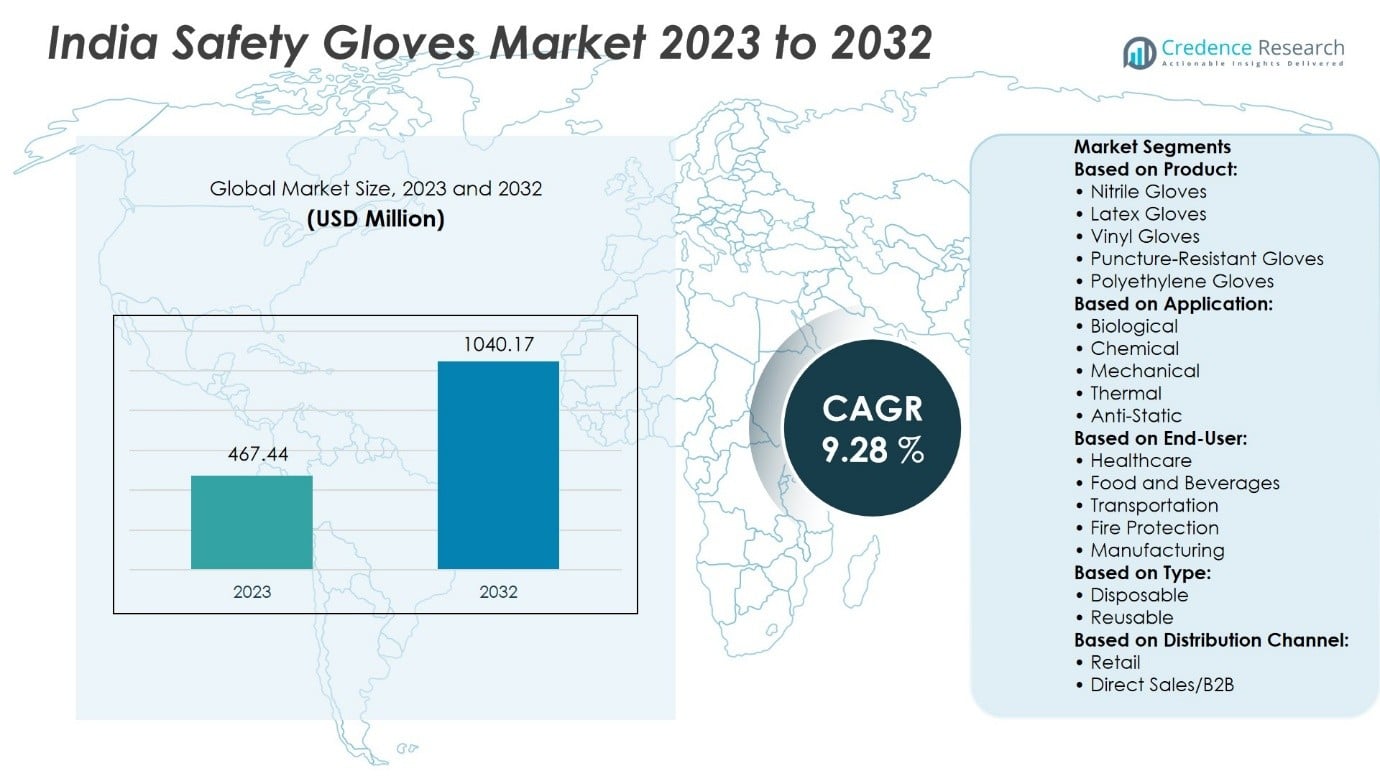
- India Safety Gloves Market size was valued at USD 467.44 million in 2023 and is expected to reach USD 1040.17 million by 2032, growing at a CAGR of 9.28%.
- Rising industrialization, stricter workplace safety norms, and healthcare sector expansion are driving consistent demand.
- Market trends indicate strong growth in disposable gloves for hygiene-sensitive sectors and reusable gloves for heavy industries.
- Competitive analysis shows global leaders competing with domestic manufacturers on quality, pricing, and distribution strength.
- Market restraints include fluctuating raw material prices, limited awareness in unorganized sectors, and high price sensitivity.
- Regional analysis highlights North India leading with industrial and healthcare demand, South India advancing with pharma and IT-driven industries, West India benefiting from petrochemicals and exports, and East India growing with mining and infrastructure.
- Continuous innovation in advanced materials, ergonomic designs, and sustainability practices is shaping the long-term growth outlook.
Market Drivers
Rising Industrial Safety Standards The India Safety Gloves Market is driven by strict enforcement of occupational health and safety regulations across manufacturing, construction, and mining sectors. Government initiatives and compliance requirements compel industries to invest in certified protective gear. It ensures that employers adopt personal protective equipment to reduce workplace hazards. Growing emphasis on workplace safety audits has reinforced glove adoption across heavy industries. International safety standards and certifications influence domestic players to upgrade their product quality. Expanding awareness among workers about occupational risks further strengthens market demand.- For instance, Honeywell International expanded its protective equipment portfolio in India by introducing industrial safety gloves that meet EN 388 standards, delivering cut resistance up to level 5, and reported supplying over 2 million pairs annually to construction and manufacturing clients across the country.
- For instance, Hartalega Holdings produced 44 billion medical gloves in 2022, with over 1.2 billion units supplied to India’s healthcare and pharmaceutical sectors to support infection control protocols across hospitals and laboratories.
Market Trends
Rising Shift Toward Disposable and Medical-Grade Gloves The India Safety Gloves Market is witnessing a rising preference for disposable gloves, particularly in healthcare, pharmaceuticals, and food processing sectors. Demand for nitrile and latex-based products is strengthening due to their superior barrier protection and comfort. It reflects heightened focus on hygiene and infection control across clinical and non-clinical environments. Medical-grade gloves have become standard in hospitals and laboratories, extending adoption beyond pandemic-driven surges. Manufacturers are expanding production capacity to cater to recurring institutional orders. Growing urbanization and public health initiatives are reinforcing this trend across multiple regions.- For instance, Top Glove Corporation manufactured 96 billion disposable gloves in 2022, with over 2.5 billion units exported to India, supporting hospitals, pharmaceutical companies, and food processors in meeting medical-grade safety requirements.
- For instance, Ansell Limited launched its HyFlex® 11-561 cut-resistant gloves with INTERCEPT™ yarn technology, delivering ANSI A6 cut protection, and distributed over 15 million pairs globally in 2022, with more than 500,000 units supplied to Indian automotive and electronics manufacturers.
Market Challenges Analysis
Fluctuating Raw Material Prices and Supply Chain Constraints The India Safety Gloves Market faces persistent challenges from volatility in raw material prices, particularly latex, nitrile, and synthetic fibers. Unstable cost structures impact manufacturers’ margins and limit their ability to maintain consistent pricing strategies. It creates uncertainty for small and medium enterprises that rely heavily on imported raw materials. Supply chain disruptions caused by global trade imbalances, shipping delays, and geopolitical tensions add further strain. Rising transportation costs and limited domestic sourcing options reduce competitiveness for local players. Sustained price fluctuations hinder long-term planning and restrict investments in product innovation. Low Awareness and High Price Sensitivity Among End Users Limited awareness of advanced protective gear among informal sector workers restricts demand growth. The India Safety Gloves Market is constrained by price-sensitive buyers who often opt for low-cost, low-quality alternatives instead of certified products. It reduces overall compliance with safety standards in small-scale industries and construction sectors. Lack of strict enforcement of occupational safety regulations further weakens adoption in unorganized markets. Inconsistent distribution networks across rural and semi-urban areas limit accessibility for potential users. Weak customer education on product benefits prevents the market from achieving its full growth potential.Market Opportunities
Rising Industrial Expansion and Growing Safety Compliance The India Safety Gloves Market presents strong opportunities through rapid industrialization and expanding infrastructure projects. Large-scale investments in construction, automotive, mining, and manufacturing are increasing workforce exposure to occupational hazards. It creates steady demand for protective gear that meets global safety standards. Government initiatives promoting workplace safety compliance further enhance adoption across both organized and semi-organized sectors. Increasing focus on skill development and worker training integrates safety gear as a mandatory requirement. Expanding industrial clusters across emerging cities provide a significant growth avenue for suppliers targeting new markets. Healthcare Growth and Innovation in Product Development Healthcare, pharmaceuticals, and biotechnology sectors are generating new opportunities for safety glove manufacturers. The India Safety Gloves Market benefits from rising healthcare investments, expansion of hospitals, and increased diagnostic testing that sustain long-term demand. It drives continuous need for disposable, sterile, and specialized gloves designed for medical use. Innovation in product design, such as cut-resistant, chemical-resistant, and touchscreen-compatible gloves, opens scope for premium offerings. Sustainability-focused innovations using biodegradable materials attract institutional buyers seeking eco-friendly solutions. Growing e-commerce adoption supports direct engagement with end users, strengthening brand visibility and market reach.Market Segmentation Analysis:
By Product The India Safety Gloves Market demonstrates strong product diversification across nitrile, latex, vinyl, puncture-resistant, and polyethylene gloves. Nitrile gloves dominate demand due to their superior durability, chemical resistance, and hypoallergenic properties, making them suitable for healthcare and industrial use. Latex gloves retain significant adoption across medical and food processing sectors, supported by their flexibility and cost-effectiveness. Vinyl gloves appeal to price-sensitive segments, while puncture-resistant gloves gain traction in construction, mining, and heavy industries. Polyethylene gloves remain common in food service and retail due to their disposable and low-cost nature. It reflects the market’s adaptability to varied safety requirements across industries.- For instance, in 2024, INTCO Medical achieved full production capacity for PVC (vinyl) gloves, while Ansell's HyFlex® 11-581 glove achieved a Cut A6 rating under ANSI/ISEA 105-2024 standards in a 21-gauge knit, positioning it as the lightest glove with that level of cut protection.
- For instance, Ansell Limited launched its Micro-Touch NitraFree gloves that achieved ASTM D6319 compliance and are distributed to more than 60,000 healthcare facilities worldwide. Chemical-resistant gloves hold strong relevance in pharmaceuticals, petrochemicals, and chemical processing sectors.
Segments:
Based on Product:- Nitrile Gloves
- Latex Gloves
- Vinyl Gloves
- Puncture-Resistant Gloves
- Polyethylene Gloves
- Biological
- Chemical
- Mechanical
- Thermal
- Anti-Static
- Healthcare
- Food and Beverages
- Transportation
- Fire Protection
- Manufacturing
- Disposable
- Reusable
- Retail
- Direct Sales/B2B
- North India
- South India
- West India
- East India
Regional Analysis
North India North India holds around 32% share of the India Safety Gloves Market, driven by strong industrial clusters, healthcare networks, and expanding infrastructure projects. The region benefits from the concentration of heavy industries in states such as Uttar Pradesh, Haryana, and Punjab, where manufacturing and construction sectors create steady demand for protective gloves. It has a strong base of healthcare institutions, with Delhi and NCR serving as a hub for hospitals and diagnostic centers, further strengthening consumption of medical-grade gloves. The food processing industry in Punjab and Haryana contributes to high demand for polyethylene and latex gloves, especially for hygiene-sensitive applications. Ongoing government initiatives for industrial corridors and smart cities in the region reinforce glove usage in construction and logistics. Rapid urbanization and higher safety awareness levels across organized sectors make North India one of the most dominant contributors to the market. South India South India accounts for nearly 28% share of the India Safety Gloves Market, supported by its strong presence in healthcare, pharmaceuticals, and information technology-driven industrial clusters. The states of Tamil Nadu, Karnataka, Telangana, and Andhra Pradesh house a large number of hospitals, pharmaceutical companies, and biotech firms, all of which drive steady demand for nitrile and disposable gloves. It also benefits from robust automotive and electronics manufacturing bases in Chennai, Bengaluru, and Hyderabad, where mechanical and anti-static gloves are widely used. Expanding export-oriented manufacturing in South India promotes compliance with global safety standards, further boosting adoption of certified gloves. The presence of port-based logistics hubs in Chennai and Kochi strengthens requirements for protective equipment across shipping and warehousing sectors. Rising workforce safety training programs in South India highlight a growing culture of compliance, positioning the region as a key growth center. West India West India captures nearly 24% share of the India Safety Gloves Market, with Maharashtra and Gujarat serving as the leading industrial hubs. The region’s dominance stems from its strong base in petrochemicals, chemicals, pharmaceuticals, and textiles, all of which create significant demand for chemical-resistant and mechanical safety gloves. It also benefits from a highly developed healthcare infrastructure in Mumbai, Pune, and Ahmedabad, which ensures steady consumption of disposable gloves. Industrial corridors such as the Delhi-Mumbai Industrial Corridor (DMIC) and port-based trade networks in Gujarat contribute to consistent demand across logistics and manufacturing sectors. It shows higher adoption of technologically advanced gloves due to the presence of multinational corporations and export-oriented industries. West India continues to display strong potential for premium glove categories, supported by higher levels of urbanization and industrial investment. East India East India represents around 16% share of the India Safety Gloves Market, reflecting relatively slower industrialization compared to other regions but steady growth prospects. The region includes states such as West Bengal, Odisha, Jharkhand, and Bihar, where coal mining, steel, and heavy industries dominate workforce requirements. It generates strong demand for puncture-resistant and thermal safety gloves to protect workers in mining and metallurgy sectors. Healthcare demand remains centered in Kolkata and Bhubaneswar, where hospitals and medical colleges contribute to usage of disposable gloves. Food processing and fisheries in Odisha and West Bengal also reinforce demand for polyethylene and latex variants. Limited awareness and weaker enforcement of safety compliance in unorganized sectors restrain higher adoption rates, but ongoing infrastructure projects and government-led industrial expansion create new opportunities. It continues to expand steadily, supported by rising safety awareness and gradual urbanization across the eastern states.Key Player Analysis
- 3M
- MCR Safety
- Ergodyne
- Saf-T-Gard International, Inc.
- Radians Inc.
- Protective Industrial Products, Inc.
- Lakeland Industries, Inc.
- Honeywell International Inc.
- Kanam Latex Industries Pvt.
- Balaji Industries
Recent Developments
- In June 2025, the European Union's REACH regulation imposed stricter guidelines on the use of certain chemicals in safety gloves, driving the market towards the adoption of alternative materials.
- In 2025, MCR Safety announced their 2025 New Products Guide featuring innovative gloves and safety gear designs. The guide includes advanced cut-resistant gloves, stylish safety glasses such as the Hulk® HK4 Series, and other personal protective equipment (PPE) solutions built for demanding work environments.
- In October 2024, Ansell Limited, a leading global provider of protective solutions, launched a new range of industrial safety gloves, the 'HyFlex 2.0', featuring enhanced grip and cut resistance properties.
- In August 2023, the Indian Rubber Gloves Manufacturers Association (IRGMA) announced its continual support to the government’s 2023 regulation to prevent substandard glove imports. This regulation also ensures BIS compliance, promotes Made-in-India nitrile gloves, reduces illegal dumping, strengthens domestic manufacturing, boosts exports, and creates jobs.
Market Concentration & Characteristics
The India Safety Gloves Market shows moderate concentration with the presence of global leaders and strong domestic manufacturers competing across product categories and price ranges. It is characterized by a dual structure where multinational companies dominate the premium and specialized segments, while local players capture significant share in cost-sensitive markets. The market demonstrates a high degree of product differentiation, with nitrile, latex, vinyl, and specialized gloves catering to industry-specific needs in healthcare, manufacturing, construction, and food processing. It is marked by rising demand for disposable gloves in medical and hygiene applications, while reusable variants remain important in industrial and heavy-duty sectors. Strong competition is supported by growing investments in research, sustainability, and compliance with safety standards. The market’s characteristics highlight a balance between affordability and innovation, making it both highly competitive and responsive to changing consumer and regulatory expectations.Report Coverage
The research report offers an in-depth analysis based on Product, Application, End-User Type, Distribution Channel and Geography. It details leading market players, providing an overview of their business, product offerings, investments, revenue streams, and key applications. Additionally, the report includes insights into the competitive environment, SWOT analysis, current market trends, as well as the primary drivers and constraints. Furthermore, it discusses various factors that have driven market expansion in recent years. The report also explores market dynamics, regulatory scenarios, and technological advancements that are shaping the industry. It assesses the impact of external factors and global economic changes on market growth. Lastly, it provides strategic recommendations for new entrants and established companies to navigate the complexities of the market.Future Outlook
- The India Safety Gloves Market will expand with rising industrialization and stricter workplace safety norms.
- Demand for disposable gloves will grow steadily in healthcare, pharmaceuticals, and food processing sectors.
- Reusable gloves will gain wider adoption in construction, mining, and heavy industries due to durability.
- E-commerce and digital procurement platforms will strengthen accessibility across urban and semi-urban regions.
- Innovation in materials such as nitrile, neoprene, and cut-resistant fibers will shape premium product demand.
- Sustainability initiatives will drive adoption of biodegradable gloves and eco-friendly packaging solutions.
- Increasing automation in glove manufacturing will improve efficiency and product consistency.
- Worker training programs and government compliance policies will boost long-term demand.
- Rising awareness in unorganized sectors will create new opportunities for affordable protective gear.
- International collaborations and capacity expansions will enhance product availability and competitiveness in the domestic market.

Request a Free Sample
Fill in your details and we'll send you a free sample report.
- Sample data tables & charts
- Research methodology
Market Dynamics
Rising Industrial Safety Standards
Strict enforcement of occupational health and safety regulations in manufacturing, construction, and mining sectors is compelling companies to invest in certified safety gloves, driving market growth as compliance becomes mandatory.
Expanding Healthcare and Pharmaceutical Demand
Growth in healthcare, biotechnology, and pharmaceutical industries, reinforced by infection control protocols and increased hospital infrastructure, is fueling sustained demand for disposable and specialized safety gloves.
Growth in Manufacturing and Construction Activities
Rapid expansion of infrastructure and industrial manufacturing, along with government projects and foreign investments, is increasing the need for protective gloves to manage occupational hazards across diverse sectors.
Technological Advancements and Ergonomic Designs
Innovation in advanced materials, ergonomic designs, and features like touchscreen compatibility is making safety gloves more appealing and functional, encouraging broader adoption across industries.
E-commerce and Distribution Expansion
The rise of e-commerce and digital procurement platforms is improving accessibility and distribution of safety gloves, enabling penetration into semi-urban and rural markets and supporting market expansion.
Need a Custom Version of This Report?
Tailor the scope, geography, or segments to your exact requirements.
- Custom geography or segment scope
- Direct access to our analyst team
Frequently Asked Questions
What is the current market size for India Safety Gloves Market, and what is its projected size in 2032?
At what Compound Annual Growth Rate is the India Safety Gloves Market projected to grow between 2025 and 2032?
Which India Safety Gloves Market segment held the largest share in 2023?
What are the primary factors fueling the growth of the India Safety Gloves Market?
Who are the leading companies in the India Safety Gloves Market?
Which region commanded the largest share of the India Safety Gloves Market in 2023?
Table of Content
Chapter 1 Market Segmentation
- 1.1 Segmentation Framework
- 1.1.1 Product and Service Classification
- 1.1.2 Application and End-Use Classification
- 1.1.3 Technology and Solution Classification
- 1.1.4 Customer and Distribution Channel Classification
- 1.1.5 Geographic Segmentation
- 1.1.6 Market Segment Definitions and Boundaries
- 1.2 By Type
- 1.2.1 Disposable
- 1.2.2 Reusable
- 1.3 By Product
- 1.3.1 Nitrile Gloves
- 1.3.2 Latex Gloves
- 1.3.3 Vinyl Gloves
- 1.3.4 Puncture-Resistant Gloves
- 1.3.5 Polyethylene Gloves
- 1.4 By End-User
- 1.4.1 Healthcare
- 1.4.2 Food and Beverages
- 1.4.3 Transportation
- 1.4.4 Fire Protection
- 1.4.5 Manufacturing
- 1.5 By Application
- 1.5.1 Biological
- 1.5.2 Chemical
- 1.5.3 Mechanical
- 1.5.4 Thermal
- 1.5.5 Anti-Static
Chapter 2 Introduction
- 2.1 Report Objectives and Scope
- 2.2 Product Definition and Industry Terminology
- 2.3 Market Inclusions and Exclusions
- 2.4 Research Process
- 2.4.1 Primary Research and Expert Interviews
- 2.4.2 Secondary Research and Source Review
- 2.4.3 Top-Down and Bottom-Up Estimation
- 2.4.4 Data Triangulation and Verification
- 2.5 Market Size Measurement Basis
- 2.5.1 2023: USD 467.44 million → 2032: USD 1040.17 million
- 2.6 Historical and Forecast Reference Periods
- 2.6.1 Base Year: 2023
- 2.6.2 Forecast Period: 2023-2032
- 2.7 Research Assumptions and Limitations
Chapter 3 Executive Summary
- 3.1 Market Snapshot and Key Findings
- 3.2 Base-Year Market Size, 2023
- 3.3 Forecast Market Size, 2032
- 3.4 Revenue and Volume Growth Outlook
- 3.5 Key Demand and Supply Indicators
- 3.6 Leading Market Segments
- 3.7 Fastest-Growing Market Opportunities
- 3.8 Regional Performance Highlights
- 3.9 Technology and Industry Transformation
- 3.10 Competitive Landscape Summary
- 3.11 Analyst View and Strategic Implications
Chapter 4 India Safety Gloves Market Trends and Developments
- 4.1 Historical Industry Development
- 4.2 Recent Market Trends and Developments
- 4.3 Demand and Customer Behavior Trends
- 4.4 Technology and Product Innovation
- 4.5 Artificial Intelligence, Automation and Digitalization
- 4.6 Local Manufacturing and Supply Chain Realignment
- 4.7 Industry Partnerships, Mergers and Acquisitions
- 4.8 Sustainability and Circular Economy Developments
- 4.9 Government and Private Sector Investment Trends
- 4.10 Emerging Business Models and Commercialization
- 4.11 Industry Developments and Announcements
Chapter 5 India Safety Gloves Market Production, Supply and Demand Analysis
- 5.1 Demand Trend and Consumption Analysis
- 5.2 Demand Forecast, 2023-2032
- 5.3 Production and Output Trend
- 5.4 Production and Output Forecast, 2023-2032
- 5.5 Installed Capacity and Capacity Utilization
- 5.6 Company-Wise Production Plants and Statistics
- 5.6.1 Installed Production Capacity
- 5.6.2 Actual Production
- 5.6.3 Planned Capacity and Expansion Targets
- 5.7 Supply Chain Structure and Procurement Trends
- 5.8 Supply-Demand Gap and Bottlenecks
- 5.9 Import Dependence and Sourcing Structure
- 5.10 Contract Manufacturing and Outsourcing
- 5.11 Regional Supply and Demand Concentration
Chapter 6 India Safety Gloves Market Pricing Analysis
- 6.1 Pricing Structure and Measurement
- 6.2 Historical Pricing Trends
- 6.3 Pricing Outlook, 2023-2032
- 6.4 Average Selling Price and Unit Economics
- 6.5 Pricing by Product and Market Segment
- 6.6 Geographic Pricing Differences
- 6.7 Key Input, Energy, Labor and Logistics Costs
- 6.8 Contract Pricing and Purchasing Models
- 6.9 Pricing Sensitivity and Competitive Positioning
- 6.10 Price, Margin and Profitability Implications
Chapter 7 India Safety Gloves Market Dynamics
- 7.1 Market Growth Drivers
- 7.1.1 Demand-Side Drivers
- 7.1.2 Technology and Innovation Drivers
- 7.1.3 Infrastructure and Investment Drivers
- 7.1.4 Regulatory and Policy Drivers
- 7.2 Market Restraints
- 7.2.1 Cost and Affordability Constraints
- 7.2.2 Technology and Adoption Barriers
- 7.2.3 Supply Chain and Operational Constraints
- 7.3 Market Challenges
- 7.3.1 Competitive Pressure and Margin Erosion
- 7.3.2 Skills, Infrastructure and Implementation Gaps
- 7.4 Emerging Market Opportunities
- 7.5 Market Dynamics Impact and Time-Horizon Assessment
Chapter 8 India Safety Gloves Value Chain Analysis
- 8.1 Industry Value Chain Overview
- 8.2 Upstream Suppliers and Critical Inputs
- 8.3 Technology and Component Providers
- 8.4 Manufacturing or Service Delivery
- 8.5 Distribution, Channel Partners and Integrators
- 8.6 Downstream Applications and End Users
- 8.7 Value Addition and Profit Pools
- 8.8 Vertical Integration and Outsourcing
- 8.9 Supplier Concentration and Risk
- 8.10 Supply Chain Localization and Resilience
Chapter 9 India Safety Gloves Market Regulations and Policies
- 9.1 Relevant Laws, Standards and Compliance Frameworks
- 9.2 Product, Service, Safety and Quality Requirements
- 9.3 Government Policies, Incentives and Subsidies
- 9.4 Imports, Exports and Trade Barriers
- 9.5 Public Procurement and Local Content Requirements
- 9.6 Environmental and Sustainability Compliance
- 9.7 Upcoming Policy Changes and Market Implications
Chapter 10 India Safety Gloves Market Hotspots and Opportunities
- 10.1 Market Opportunity Mapping and Growth Hotspots
- 10.2 High-Growth Applications and Customer Groups
- 10.3 Underserved Markets and White-Space Opportunities
- 10.4 Emerging Technology and Product Opportunities
- 10.5 New Capacity and Investment Hotspots
- 10.6 Market Entry and Expansion Opportunities
- 10.7 Distribution and Partnership Opportunities
- 10.8 Near-Term and Long-Term Commercial Potential
- 10.9 Opportunity Attractiveness and Execution Risks
Chapter 11 India Safety Gloves Market Outlook, 2023-2032
- 11.1 Market Size and Analysis
- 11.1.1 Revenue (Market Measurement: 2023: USD 467.44 million → 2032: USD 1040.17 million)
- 11.1.2 Market Volume and Quantity Sold
- 11.1.3 Historical Market Size
- 11.1.4 Base-Year Market Size, 2023
- 11.2 Market Forecast, 2023-2032
- 11.2.1 Revenue Forecast to 2032
- 11.2.2 Volume Forecast to 2032
- 11.2.3 CAGR and Year-on-Year Growth
- 11.2.4 Incremental Revenue Opportunity
- 11.3 Forecast Assumptions and Scenario Analysis
- 11.3.1 Base-Case Forecast
- 11.3.2 Optimistic and Conservative Scenarios
- 11.3.3 Technology, Pricing and Policy Sensitivities
- 11.4 Market Attractiveness and Growth Outlook
Chapter 12 India Safety Gloves Market Segmentation and Outlook
- 12.1 Segmentation Summary and Market Shares, 2023
- 12.2 Largest and Fastest-Growing Segments
- 12.3 By Type - Market Size and Forecast, 2023-2032
- 12.3.1 Segment Definition and Scope
- 12.3.2 Historical Market Size
- 12.3.3 Revenue Forecast, 2023-2032
- 12.3.4 Volume Forecast, 2023-2032
- 12.3.5 Base-Year Market Share, 2023
- 12.3.6 Segment CAGR and Growth Drivers
- 12.3.7 Subsegment Market Size and Forecast
- 12.3.7.1 Disposable
- 12.3.7.2 Reusable
- 12.3.8 Subsegment Pricing and Adoption Trends
- 12.3.9 Leading Suppliers and Competition
- 12.3.10 Regional Demand and Opportunities
- 12.4 By Product - Market Size and Forecast, 2023-2032
- 12.4.1 Segment Definition and Scope
- 12.4.2 Historical Market Size
- 12.4.3 Revenue Forecast, 2023-2032
- 12.4.4 Volume Forecast, 2023-2032
- 12.4.5 Base-Year Market Share, 2023
- 12.4.6 Segment CAGR and Growth Drivers
- 12.4.7 Subsegment Market Size and Forecast
- 12.4.7.1 Nitrile Gloves
- 12.4.7.2 Latex Gloves
- 12.4.7.3 Vinyl Gloves
- 12.4.7.4 Puncture-Resistant Gloves
- 12.4.7.5 Polyethylene Gloves
- 12.4.8 Subsegment Pricing and Adoption Trends
- 12.4.9 Leading Suppliers and Competition
- 12.4.10 Regional Demand and Opportunities
- 12.5 By End-User - Market Size and Forecast, 2023-2032
- 12.5.1 Segment Definition and Scope
- 12.5.2 Historical Market Size
- 12.5.3 Revenue Forecast, 2023-2032
- 12.5.4 Volume Forecast, 2023-2032
- 12.5.5 Base-Year Market Share, 2023
- 12.5.6 Segment CAGR and Growth Drivers
- 12.5.7 Subsegment Market Size and Forecast
- 12.5.7.1 Healthcare
- 12.5.7.2 Food and Beverages
- 12.5.7.3 Transportation
- 12.5.7.4 Fire Protection
- 12.5.7.5 Manufacturing
- 12.5.8 Subsegment Pricing and Adoption Trends
- 12.5.9 Leading Suppliers and Competition
- 12.5.10 Regional Demand and Opportunities
- 12.6 By Application - Market Size and Forecast, 2023-2032
- 12.6.1 Segment Definition and Scope
- 12.6.2 Historical Market Size
- 12.6.3 Revenue Forecast, 2023-2032
- 12.6.4 Volume Forecast, 2023-2032
- 12.6.5 Base-Year Market Share, 2023
- 12.6.6 Segment CAGR and Growth Drivers
- 12.6.7 Subsegment Market Size and Forecast
- 12.6.7.1 Biological
- 12.6.7.2 Chemical
- 12.6.7.3 Mechanical
- 12.6.7.4 Thermal
- 12.6.7.5 Anti-Static
- 12.6.8 Subsegment Pricing and Adoption Trends
- 12.6.9 Leading Suppliers and Competition
- 12.6.10 Regional Demand and Opportunities
- 12.7 Segment Growth Comparison
- 12.8 Segment Attractiveness and Priority Matrix
Chapter 13 India Safety Gloves End-Use and Application Market Outlook
- 13.1 End-Use Industry and Customer Demand Structure
- 13.2 Leading Applications and Customer Groups
- 13.3 End-Use Market Size, Share and Forecast
- 13.4 Major End-Use Industry Deep Dives
- 13.4.1 Customer Requirements and Use Cases
- 13.4.2 Demand and Replacement Cycles
- 13.4.3 Technical and Regulatory Considerations
- 13.4.4 Purchasing and Procurement Models
- 13.4.5 Leading Vendors and Distribution Channels
- 13.4.6 Forecast and Commercial Opportunities
- 13.5 Emerging Applications and Cross-Segment Demand
- 13.6 End-Use Industry Investment Priorities
Chapter 14 India Safety Gloves Geographic Market Outlook, 2023-2032
- 14.1 Domestic Market Distribution and Demand Clusters
- 14.2 State- or Province-Wise Market Size and Forecast, 2023-2032
- 14.3 City and Metropolitan Market Outlook
- 14.4 Industrial, Manufacturing and Commercial Clusters
- 14.5 Geographic Concentration of Key End Users
- 14.6 Local Pricing and Purchasing Differences
- 14.7 Domestic Production Facilities and Capacity Map
- 14.8 Local Infrastructure and Project Pipeline
- 14.9 State-Level Policy and Incentive Differences
- 14.10 Subnational Investment Hotspots and Opportunities
- 14.11 Distribution and Logistics Networks
- 14.12 Domestic Competitive Footprint
Chapter 15 India Safety Gloves Technology, Innovation and Sustainability Outlook
- 15.1 Technology Landscape and Maturity
- 15.2 Product, Process and Service Innovation
- 15.3 AI, Automation and Digital Tools in the Industry
- 15.4 Technology Adoption and Performance Benchmarking
- 15.5 Innovation Pipeline and R&D Investment
- 15.6 Patent and Intellectual Property Trends
- 15.7 Energy Efficiency and Resource Management
- 15.8 Sustainability, Recycling and Circularity
- 15.9 Technology Roadmap, 2023-2032
- 15.10 Risks of Obsolescence and Technology Substitution
Chapter 16 India Safety Gloves Market Key Strategic Imperatives
- 16.1 Growth and Market Entry Priorities
- 16.2 High-Return Products and Segments
- 16.3 Pricing, Profitability and Cost Optimization
- 16.4 Technology Investment and Product Differentiation
- 16.5 Supply Chain Localization and Resilience
- 16.6 Distribution and Customer Acquisition
- 16.7 Partnership, Acquisition and Capacity Strategy
- 16.8 Regional Expansion Priorities
- 16.9 Short-, Medium- and Long-Term Actions
Chapter 17 Competition Outlook
- 17.1 Industry Competition Characteristics
- 17.2 Market Structure and Concentration
- 17.3 Market Share and Competitive Positioning, 2023
- 17.4 Company-Wise Revenue and Product Benchmarking
- 17.5 Production and Service Capacity Benchmarking
- 17.6 Technology, Pricing and Differentiation
- 17.7 Regional Footprint and Distribution Strength
- 17.8 Mergers, Acquisitions and Strategic Alliances
- 17.9 New Entrants and Competitive Threats
- 17.10 Porter's Five Forces and Industry Attractiveness
- 17.11 Competitive Outlook, 2023-2032
Chapter 18 Company Profiles
- 18.1 Company Coverage and Selection Criteria
- 18.2 Top Glove Corporation
- 18.2.1 Business Description
- 18.2.2 Company Ownership and Geographic Presence
- 18.2.3 Product and Service Portfolio
- 18.2.4 Manufacturing and Operating Footprint
- 18.2.5 Production Capacity and Expansion Plans
- 18.2.6 Financial Performance and Investment
- 18.2.7 Market Share and Competitive Position
- 18.2.8 Technology and Innovation Capabilities
- 18.2.9 Strategic Alliances or Partnerships
- 18.2.10 Recent Developments
- 18.2.11 Growth Strategy and Outlook
- 18.3 Hartalega Holdings
- 18.4 Supermax Corporation
- 18.5 Honeywell International
- 18.6 3M Company
- 18.7 Karam Industries
- 18.8 Udyogi Safety
- 18.9 Mallcom India
- 18.10 Ansell Limited
- 18.11 Mapa Professional
- 18.12 Other Relevant Market Participants
Note: Every listed company is profiled on the structure shown under the first company. The company list is preliminary and may change based on research findings, market developments, data availability and client requirements.
Chapter 19 Disclaimer
- 19.1 Research and Forecast Disclaimer
- 19.2 Data Source and Estimation Limitations
Note: The depth of individual sections depends on data availability for this market. Volume, capacity, trade and other unit-based metrics are included where applicable.

