
| REPORT ATTRIBUTE | DETAILS |
|---|---|
| Historical Period | 2019-2022 |
| Base Year | 2023 |
| Forecast Period | 2024-2032 |
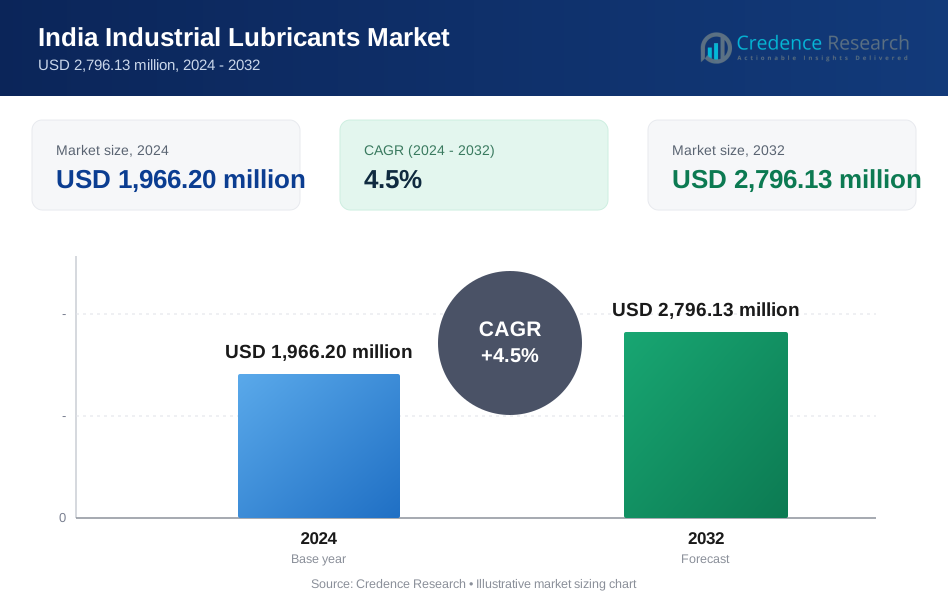
| India Industrial Lubricants Market Size 2024 | USD 1,966.20 Million |
| India Industrial Lubricants Market, CAGR | 4.5% |
| India Industrial Lubricants Market Size 2032 | USD 2796.13 Million |
Market Overview:
The India Industrial Lubricants Market is projected to grow from USD 1,966.20 million in 2024 to an estimated USD 2796.13 million by 2032, with a compound annual growth rate (CAGR) of 4.5% from 2024 to 2032.
Several key drivers are fueling the growth of the industrial lubricants market in India. The rapid industrialization in sectors such as automotive, manufacturing, and construction has led to a higher demand for lubricants to ensure the smooth operation of machinery and reduce wear and tear. The automotive sector, in particular, has witnessed significant growth, contributing to increased lubricant consumption due to higher vehicle production and sales. Furthermore, advancements in lubricant technologies, such as the development of synthetic and bio-based lubricants, have improved product performance and environmental sustainability, driving demand for high-quality lubricants.
Regionally, West India dominates the industrial lubricants market due to its strong industrial base, well-developed infrastructure, and thriving automotive sector. The region's manufacturing activities, coupled with its prominent automotive industry presence, contribute to its leading position in lubricant consumption. Other regions, such as North and South India, also show promising growth, driven by localized industrial activities and infrastructure development. Moreover, the market is supported by favorable government initiatives aimed at boosting manufacturing capabilities and promoting local production through schemes like "Make in India." These initiatives are expected to create additional opportunities for lubricant manufacturers as they adapt to evolving market needs. As the industrial landscape continues to evolve, the demand for innovative lubricant solutions will likely remain strong, positioning the India Industrial Lubricants Market for sustained growth in the coming years.
Market Drivers:
Industrialization and Manufacturing Growth
The rapid industrialization in India is one of the primary drivers of the industrial lubricants market. For instance, Castrol India's industrial lubricants are widely used in various sectors due to their high performance and reliability. As sectors like manufacturing, automotive, and construction expand, the demand for efficient and high-performance lubricants has surged. Industrial lubricants play a crucial role in enhancing machinery efficiency, reducing friction, and extending the life of equipment, thus driving their widespread adoption across industries. The growth of manufacturing facilities, coupled with the need for reliable lubrication in heavy machinery, fuels the market's expansion.
Automotive Sector Expansion
The automotive industry in India is a significant contributor to the increasing demand for industrial lubricants. For instance, Castrol India's industrial lubricants are widely used in various sectors due to their high performance and reliability. With rising vehicle production and sales, there is a growing need for lubricants that ensure the proper functioning of both passenger and commercial vehicles. Lubricants are essential for vehicle maintenance and performance, particularly in high-temperature conditions and high-stress environments. The robust growth of India's automotive sector directly impacts the demand for automotive lubricants, further boosting the industrial lubricants market.
Technological Advancements in Lubricants
Ongoing innovations in lubricant technology, including the development of synthetic and bio-based lubricants, have significantly enhanced product performance and sustainability. These advanced lubricants offer improved efficiency, longer service life, and better environmental performance, making them increasingly attractive to industries focused on reducing operational costs and minimizing environmental impact. For instance, Castrol India's synthetic lubricants are designed to provide superior performance and extended service life, helping industries achieve their sustainability goals. The shift towards more sustainable and high-performance lubricants is a key market driver, particularly as companies seek to meet stricter environmental regulations and improve operational productivity.
Regional Industrial Growth
The industrial lubricants market is also driven by regional growth in key industrial hubs such as West India, which is home to a strong manufacturing base and automotive sector. For instance, the Mumbai-Pune Industrial Region has seen significant growth due to its favorable geo-economic conditions and robust industrial activities. The region's infrastructure development and industrial diversification have made it the largest consumer of industrial lubricants. As other regions such as North and South India continue to develop their industrial capabilities, the demand for lubricants is expected to rise, further propelling market growth across the country.
Market Trends:
Shift Towards Synthetic and Bio-Based Lubricants
A significant trend in the India industrial lubricants market is the growing shift towards synthetic and bio-based lubricants. These advanced lubricants offer superior performance compared to conventional mineral oils, including enhanced efficiency, extended service life, and improved thermal stability. For instance, Shell's Naturelle range of bio-based lubricants is designed to meet the high-performance needs of industrial machinery while being biodegradable and environmentally friendly. The demand for environmentally friendly solutions is driving the adoption of bio-based lubricants, as they are biodegradable and have lower environmental impact. This trend aligns with the industry's increasing focus on sustainability and regulatory compliance, promoting the use of lubricants that support both operational and environmental goals.
Digitalization and IoT Integration
The integration of digital technologies and the Internet of Things (IoT) in industrial operations is another key trend shaping the Indian lubricants market. Smart sensors and monitoring systems are now being employed to track equipment conditions in real-time, enabling predictive maintenance and reducing downtime. For instance, Castrol's SmartControl™ is a digital monitoring system that allows for real-time tracking of lubricant levels and performance, improving operational efficiency. These systems can monitor lubricant levels, temperature, and performance, allowing for timely lubricant changes and improving operational efficiency. This trend enhances the demand for high-quality lubricants that are compatible with advanced monitoring technologies and that optimize equipment lifespan.
Customization and Specialized Products
The trend toward customization and specialized lubricants is gaining momentum in the Indian market. Industries such as automotive, aerospace, and heavy machinery are increasingly looking for lubricants that cater to their specific requirements, whether related to extreme temperatures, heavy loads, or high speeds. For instance, Mobil SHC 600 Series lubricants are tailored to meet the demands of heavy-duty industrial applications, offering superior performance under extreme conditions. Lubricant manufacturers are responding by developing tailored solutions that meet the unique needs of different sectors, offering products that enhance performance and reduce maintenance costs. This growing demand for tailored products reflects a shift towards more precise and efficient industrial operations.
Sustainability and Eco-Friendly Practices
As sustainability becomes a central concern for businesses worldwide, the Indian industrial lubricants market is also witnessing a shift towards eco-friendly practices. Companies are increasingly adopting lubricants that not only provide better performance but also have a lower environmental footprint. For instance, Fuchs' ECOCOOL range of lubricants is designed to offer high performance while reducing environmental impact, with lower toxicity and reduced VOCs.This includes lubricants with lower toxicity, reduced volatile organic compounds (VOCs), and those that are recyclable. This trend is driven by the growing awareness of environmental issues and the need to comply with stringent environmental regulations in various industries.
Market Challenges Analysis:
Price Volatility of Raw Materials
One of the key challenges facing the Indian industrial lubricants market is the price volatility of raw materials, particularly base oils and additives. Fluctuating crude oil prices directly impact the cost of manufacturing lubricants, leading to uncertainties in pricing. Manufacturers are often forced to adjust their prices in response to rising costs, which can affect their competitiveness in the market. This volatility poses a significant challenge for both lubricant producers and end-users, as it complicates long-term cost planning and budgeting. Another challenge in the industrial lubricants market is the increasing pressure to comply with stringent environmental regulations. As India strengthens its environmental policies, lubricant manufacturers are required to develop products that meet evolving sustainability standards, such as reduced emissions and lower toxicity. While the demand for eco-friendly and biodegradable lubricants is growing, meeting these regulatory requirements can be costly and complex. Manufacturers face the challenge of balancing regulatory compliance with maintaining product performance and affordability.
Lack of Awareness and Technical Expertise
The lack of awareness regarding the benefits of high-performance lubricants and the technical expertise required to optimize lubricant usage remains a challenge in the Indian market. Many industries still rely on traditional lubricants without fully understanding the potential advantages of more advanced formulations, such as synthetic or bio-based lubricants. Additionally, the absence of well-trained personnel in smaller and medium-sized enterprises (SMEs) limits the proper selection and application of lubricants, resulting in suboptimal machinery performance and higher maintenance costs. The Indian industrial lubricants market is highly competitive, with numerous global and domestic players vying for market share. This intense competition puts pressure on manufacturers to continuously innovate and offer cost-effective solutions. The presence of well-established multinational companies also challenges local players in terms of distribution networks, brand recognition, and pricing strategies, making it difficult for smaller companies to sustain growth in the long term.
Market Segmentation Analysis:
By Product Type
The India industrial lubricants market is segmented by product type into engine oils, hydraulic fluids, industrial oils, gear oils, and others. Industrial oils hold the largest share in the market due to their widespread use in manufacturing and heavy machinery applications. Gear oils and hydraulic fluids are also in high demand, particularly in sectors such as automotive, construction, and mining, where high-efficiency lubricants are crucial for machinery performance and durability. The demand for specialized lubricants, such as high-temperature oils and heavy-duty formulations, is also increasing as industries require more customized solutions.
By Base Oil
The market is also segmented by base oil into mineral oils, synthetic oils, and bio-based oils. Mineral oils dominate the market due to their cost-effectiveness and wide availability. However, synthetic oils are growing in popularity due to their superior performance, longer service life, and ability to function under extreme conditions. Bio-based oils, driven by environmental concerns, are witnessing an upward trend as industries look for sustainable alternatives that reduce their environmental footprint without compromising performance.
By End-Use
The industrial lubricants market is further segmented by end-use into automotive, manufacturing, construction, and others. The automotive sector is the largest consumer of industrial lubricants due to the growing vehicle production and the need for lubricants in both passenger and commercial vehicles. The manufacturing sector follows closely, driven by the need for efficient lubricants in machinery and production equipment, contributing significantly to the overall market growth.
Segmentations:
By Product Type
- Engine Oils
- Hydraulic Fluids
- Industrial Oils
- Gear Oils
- Others
By Base Oil
- Mineral Oils
- Synthetic Oils
- Bio-Based Oils
By End-Use
- Automotive
- Manufacturing
- Construction
- Others
By Region
- North India
- South India
- East India
- West India
Regional Analysis:
West India
West India holds the largest market share in the Indian industrial lubricants market, accounting for 35% of the total market. This region benefits from its strong industrial base, particularly in automotive, manufacturing, and construction sectors. Maharashtra, Gujarat, and Rajasthan are key contributors, with well-established industrial hubs such as Pune, Mumbai, and Ahmedabad driving lubricant demand. The region's developed infrastructure, robust manufacturing activities, and growing automotive sector significantly contribute to its dominance. Furthermore, West India’s proximity to key ports supports the smooth supply of raw materials, making it an attractive region for lubricant producers.
North India
North India holds a market share of 25% in the Indian industrial lubricants market. The region's diverse industrial landscape, including heavy manufacturing, automotive, and machinery industries, contributes significantly to lubricant consumption. Delhi, Haryana, and Uttar Pradesh are prominent states that support the demand for industrial lubricants due to their well-established industrial zones and increasing automotive production. The ongoing development in infrastructure and industrial parks in the region further strengthens the market position, driving future growth in lubricant consumption.
South India
South India captures 20% of the market share, with states like Tamil Nadu, Karnataka, and Andhra Pradesh playing a critical role. The region has a growing industrial base, with automotive manufacturing, engineering, and textile sectors contributing to the demand for industrial lubricants. Chennai, Coimbatore, and Bengaluru are central hubs for manufacturing and automotive industries, bolstering the need for high-quality lubricants to maintain machinery efficiency. The expansion of industrial activities and the establishment of more manufacturing units in the region further fuel lubricant demand.
East India
East India holds a market share of 15%, with West Bengal, Odisha, and Bihar contributing to the demand for industrial lubricants. The region's industrial activities are primarily focused on heavy industries such as steel, mining, and power generation, all of which require specialized lubricants to maintain equipment and improve efficiency. Although East India’s market share is smaller than other regions, the region is poised for growth due to increasing infrastructure projects and a rising number of manufacturing facilities.
Central India
Central India, while having a smaller market share of 5%, is showing promising growth. States like Madhya Pradesh and Chhattisgarh are seeing an uptick in industrial activity, particularly in the mining and steel sectors. As the region’s industrial base continues to develop, the demand for industrial lubricants is expected to rise, contributing to the overall market expansion in the coming years.
Key Player Analysis:
- Indian Oil Corporation Ltd.
- Bharat Petroleum Corporation Ltd.
- Hindustan Petroleum Corporation Ltd.
- Castrol India Ltd.
- Shell India Markets Pvt. Ltd.
- ExxonMobil Lubricants Pvt. Ltd.
- Chevron India Ltd.
- TotalEnergies Marketing India Pvt. Ltd.
- Fuchs Lubricants India Pvt. Ltd.
- Gulf Oil Lubricants India Ltd.
- Valvoline Cummins Pvt. Ltd.
- ENI India Ltd.
Competitive Analysis:
The India industrial lubricants market is highly competitive, with both global and domestic players striving for market share. Major multinational companies such as Indian Oil Corporation, Castrol India, and Shell India dominate the market, benefiting from established brand recognition, extensive distribution networks, and significant investments in research and development. These players offer a wide range of high-quality products, including synthetic and bio-based lubricants, to meet the diverse needs of industries. For instance, Indian Oil Corporation, Castrol India, and Shell India continue to leverage their strong market presence by launching advanced lubricant formulations and expanding their distribution networks. These initiatives have solidified their market dominance and positioned them as leaders in the industry. In addition to global players, local manufacturers such as Gulf Oil Lubricants and Fuchs Lubricants India have strengthened their positions by offering cost-effective and customized solutions tailored to specific industry needs. These regional players are focusing on expanding their product portfolios, improving customer service, and enhancing their manufacturing capabilities to compete effectively. The competition is intensifying as companies invest in technological innovations, sustainability initiatives, and strategic partnerships to maintain a competitive edge and meet evolving consumer demands in the Indian market.
Recent Developments:
- In January 2024, Indian Oil reported a revenue from operations of ₹8,66,345 crores for FY 2023-24, with a net profit of ₹39,619 crores, showcasing a significant increase from the previous year.
- In October 2024, BPCL reported a net profit of Rs. 5,412 crores in H1 FY 2024-25.
- In January 2024, Hindustan Petroleum Corporation Limited (HPCL) inaugurated a Biomass-based CBG Plant in Budaun, Uttar Pradesh, and laid the foundation stone for eight new CBG plants.
- In March 2024, HPCL's Visakh Refinery Modernisation Project (VRMP) was dedicated to the nation by the Hon'ble Prime Minister of India.
Market Concentration & Characteristics:
The Indian industrial lubricants market exhibits moderate concentration, with a handful of key players dominating the market share. This creates a competitive landscape where companies continually innovate to offer advanced and efficient solutions. The market is driven by industries such as power generation, automotive, manufacturing, and food processing, all of which require high-quality lubricants to optimize machinery performance and ensure long-term equipment reliability. The demand for industrial lubricants is also influenced by the growing industrial activities, particularly in sectors such as manufacturing and infrastructure development. Despite the presence of a few major players, the market sees the entry of regional and smaller companies, contributing to price competitiveness and diverse product offerings. This dynamic environment fosters innovation, with players focusing on improving lubricant performance, sustainability, and cost-effectiveness to cater to the unique needs of the Indian industrial landscape.
Report Coverage:
The research report offers an in-depth analysis based on product type, base oil, end-use and region. It details leading market players, providing an overview of their business, product offerings, investments, revenue streams, and key applications. Additionally, the report includes insights into the competitive environment, SWOT analysis, current market trends, as well as the primary drivers and constraints. Furthermore, it discusses various factors that have driven market expansion in recent years. The report also explores market dynamics, regulatory scenarios, and technological advancements that are shaping the industry. It assesses the impact of external factors and global economic changes on market growth. Lastly, it provides strategic recommendations for new entrants and established companies to navigate the complexities of the market.
Future Outlook:
- The Indian industrial lubricants market is expected to experience steady growth driven by the expansion of the manufacturing and infrastructure sectors.
- Increasing industrial automation across various sectors will fuel demand for high-performance lubricants to improve machinery efficiency.
- The growing emphasis on sustainability and eco-friendly lubricants will lead to a rise in demand for biodegradable and environmentally friendly products.
- The automotive sector’s robust growth, especially in the commercial vehicle segment, will continue to drive the demand for industrial lubricants.
- Technological advancements in lubrication systems and product formulations will lead to enhanced performance and longer service intervals for industrial machinery.
- The shift towards advanced manufacturing processes, such as 3D printing and precision machining, will necessitate specialized lubricants tailored for specific applications.
- Industrial lubricants for high-temperature and extreme pressure applications will witness increased demand in industries like metalworking, steel, and power generation.
- The expanding food and beverage industry will demand lubricants that meet stringent hygiene and food safety standards.
- Increased awareness regarding the benefits of preventive maintenance will drive greater adoption of high-quality lubricants among industrial operators.
- Rising industrialization and government initiatives to support manufacturing under the “Make in India” campaign will provide substantial growth opportunities for the market in the coming years.
Request a Free Sample
Fill in your details and we'll send you a free sample report.
- Sample data tables & charts
- Research methodology
Need a Custom Version of This Report?
Tailor the scope, geography, or segments to your exact requirements.
- Custom geography or segment scope
- Direct access to our analyst team
Frequently Asked Questions
What is the projected growth of the India Industrial Lubricants Market?
What factors are driving the growth of the industrial lubricants market in India?
Which sector contributes the most to the industrial lubricants market growth?
What types of lubricants are gaining popularity in India?
Which region dominates the industrial lubricants market in India?
Table of Content
Chapter 1. Report Introduction
- 1.1 Report Description & Purpose
- 1.1.1 Report Title & Market Definition
- 1.1.2 Unique Selling Propositions (USP) & Key Differentiators
- 1.1.3 Value Proposition for Stakeholders
- 1.2 Research Objectives
- 1.2.1 Market Sizing Objectives (Volume & Revenue)
- 1.2.2 Segmentation Objectives
- 1.2.3 Competitive Intelligence Objectives
- 1.2.4 Forecast & Scenario Objectives
- 1.3 Report Scope
- 1.3.1 India Industrial Lubricants Scope – Types & Subtypes Covered
- 1.3.2 Geographic Scope – Regions & Countries Covered
- 1.3.3 Historical Period, Base Year & Forecast Period (2024; forecast to 2032)
- 1.3.4 Inclusions & Exclusions
- 1.4 HS Code & Classification Framework
- 1.5 Currency, Units & Pricing Basis
- 1.6 Target Stakeholders
- 1.7 Limitations & Assumptions
Chapter 2. Executive Summary
- 2.1 Global India Industrial Lubricants Market Snapshot
- 2.1.1 Market Size – Historical (2024) & Forecast (2024-2032) (2024: USD 1,966.20 million → 2032: USD 2,796.13 million)
- 2.1.2 Volume & Revenue – Global Totals
- 2.1.3 Key Market Highlights – Top Five Facts
- 2.2 India Industrial Lubricants Market Segmentation Snapshot
- 2.2.1 Market Split by Region – 2024 vs. 2032
- 2.3 Competitive Snapshot
- 2.3.1 Top 10 Players by Revenue Share – 2024
- 2.3.2 Top 10 Players by Volume Share – 2024
- 2.3.3 Recent Strategic Developments (18-Month Summary)
- 2.4 Key Investment Highlights & Strategic Conclusions
Chapter 3. India Industrial Lubricants Market Dynamics & Industry Analysis
- 3.1 Market Overview & Context
- 3.1.1 India Industrial Lubricants Market Position in the Broader Automotive Value Chain
- 3.1.2 OEM vs. Replacement Market Dynamics
- 3.1.3 Market Maturity & Development Stage by Region
- 3.2 India Industrial Lubricants Market Drivers
- 3.3 India Industrial Lubricants Market Restraints & Challenges
- 3.4 India Industrial Lubricants Market Opportunities
- 3.5 Porter's Five Forces Analysis
- 3.5.1 Threat of New Entrants
- 3.5.2 Bargaining Power of Suppliers
- 3.5.3 Bargaining Power of Buyers
- 3.5.4 Threat of Substitutes
- 3.5.5 Competitive Rivalry – Intensity Assessment
- 3.6 India Industrial Lubricants Value Chain Analysis
- 3.6.1 Upstream – Raw Material/Input Suppliers
- 3.6.1.1 Raw Material/Input 1
- 3.6.1.2 Raw Material/Input 2
- 3.6.1.3 Raw Material/Input 3
- 3.6.2 Midstream – Production/Manufacturing/Service Delivery
- 3.6.2.1 Production/Process Overview
- 3.6.2.2 Key Facility Locations & Capacity by Manufacturer
- 3.6.3 Downstream – Distribution & End Consumer
- 3.6.3.1 Primary Channel – B2B/OEM
- 3.6.3.2 Secondary Channels – Dealer, Retail, Online, Direct
- 3.6.4 Value Chain Profitability Analysis
- 3.6.1 Upstream – Raw Material/Input Suppliers
- 3.7 PESTEL Analysis
- 3.7.1 Political Factors
- 3.7.2 Economic Factors
- 3.7.3 Social Factors
- 3.7.4 Technological Factors
- 3.7.5 Environmental Factors
- 3.7.6 Legal Factors
- 3.8 India Industrial Lubricants Supply Chain Analysis
- 3.8.1 Raw Material/Input Supply Risk Assessment
- 3.8.2 Manufacturing Concentration Risk (Geographic Exposure)
- 3.8.3 Trade Disruption Impact Analysis
- 3.9 Regulatory & Policy Landscape
Note: The regulatory and policy landscape section covers regulations based on their applicability to the market, India Industrial Lubricants category, geography, and scope of the study. Only regulatory frameworks with a material impact on operations, compliance, trade, sustainability, or market access are analyzed in detail.
Chapter 4. Key Investment Pockets & Opportunity Analysis
- 4.1 India Industrial Lubricants Market Attractiveness Analysis
- 4.1.1 By Region – Investment Attractiveness Matrix (Volume × CAGR)
- 4.2 Absolute Revenue Growth Opportunity
- 4.2.1 By Region – Absolute USD Growth Through 2032
- 4.3 Incremental Volume Opportunity
- 4.3.1 By Region – Incremental Volume Through 2032
- 4.3.2 Segment – Incremental Volume
- 4.4 Emerging Submarket Opportunity Deep Dive (Subject to Applicability)
- 4.5 Emerging Market Opportunity Scorecards
- 4.5.1 United States
- 4.5.2 Europe
- 4.5.3 Asia
- 4.5.4 Middle East & Africa
Note: Emerging Market Opportunity Scorecards will be included based on relevance and strategic importance. Regions listed are indicative and may vary depending on data availability and market dynamics.
Chapter 5. India Industrial Lubricants Import-Export Analysis & Trade Flows
- 5.1 Global Trade Overview
- 5.1.1 Global Export Value by Country (2024)
- 5.1.2 Global Export Volume by Country (2024)
- 5.1.3 Global Import Value by Country (2024)
- 5.1.4 Global Import Volume by Country (2024)
- 5.1.5 Net Trade Balance by Country (2024)
- 5.2 Export Analysis – Segment
- 5.2.1 Type 1 (HS Code)
- 5.2.2 Type 2 (HS Code)
- 5.2.3 Type 3 (HS Code)
- 5.2.4 Type 4 (HS Code)
- 5.2.5 Type 5 (HS Code)
- 5.3 Import Analysis – Segment
- 5.3.1 Type 1 (HS Code)
- 5.3.2 Type 2 (HS Code)
- 5.3.3 Type 3 (HS Code)
- 5.3.4 Type 4 (HS Code)
- 5.3.5 Type 5 (HS Code)
- 5.4 Average Unit Trade Prices
- 5.4.1 Average Export Price – Segment & Country
- 5.4.2 Average Import Price – Segment & Source Country
- 5.4.3 Price Trends (2024)
- 5.5 Key Trade Route Analysis
- 5.5.1 Trade Route 1
- 5.5.2 Trade Route 2
- 5.5.3 Trade Route 3
- 5.5.4 Trade Route 4
- 5.5.5 Trade Route 5
- 5.6 Trade Policy Impact Assessment
- 5.6.1 US Anti-Dumping & Section 301 Tariffs
- 5.6.2 EU Customs Union Impact
- 5.6.3 Major Free Trade Agreements
- 5.6.4 USMCA Rules of Origin
Note: Trade policy analysis will be included only where relevant to the India Industrial Lubricants market.
Chapter 6. Competitive Landscape & Company Benchmarking
- 6.1 India Industrial Lubricants Market Concentration & Structure
- 6.1.1 Herfindahl-Hirschman Index (HHI) – vs. 2024
- 6.1.2 Tier 1, Tier 2 & Tier 3 Market Structure
- 6.1.3 Global, Regional & Local Player Dynamics
- 6.2 India Industrial Lubricants Market Share Analysis – 2024
- 6.2.1 Global Revenue Share by Company
- 6.2.2 Global Volume Share by Company
- 6.2.3 Regional Revenue Share
- 6.2.4 Market Share Evolution ( vs. 2024)
- 6.2.5 OEM Segment Share by Company
- 6.2.6 Replacement Segment Share by Company
- 6.3 Production/Delivery Capacity & Facility Analysis
- 6.3.1 Global Installed Capacity
- 6.3.2 Capacity Utilization Rates
- 6.3.3 Production/Output Volume
- 6.3.4 Facility Locations & Capacity Map
- 6.3.5 Planned Capacity Additions
- 6.4 India Industrial Lubricants Competitive Benchmarking Matrix
- 6.4.1 Revenue, Volume, CAGR & Profitability Comparison
- 6.4.2 Channel Revenue Mix
- 6.4.3 Geographic Revenue Exposure
- 6.4.4 R&D Intensity
- 6.4.5 Sustainability Maturity
- 6.5 Strategic Developments in India Industrial Lubricants (Last 24 Months)
- 6.5.1 Mergers, Acquisitions & Divestments
- 6.5.2 New India Industrial Lubricants Launches
- 6.5.3 Facility Expansions
- 6.5.4 Strategic Alliances, Joint Ventures & Partnerships
- 6.5.5 Distribution Expansion & Market Entry
- 6.5.6 Sustainability & ESG Initiatives
- 6.6 Competitive Strategy Mapping
- 6.6.1 Leader, Challenger, Follower & Niche Classification
- 6.6.2 Pricing Strategy Comparison
- 6.6.3 Channel Strategy Matrix
Note: Strategic developments are included based on their materiality and the availability of reliable information.
Chapter 7. Global India Industrial Lubricants Market – By Distribution Channel
- 7.1 Segment Overview
- 7.1.1 Volume & Revenue Split by Channel (2024 & 2032)
- 7.1.2 Channel Mix Evolution (2024-2032)
Chapter 8. Regional Market Analysis – Global Overview
- 8.1 Global Regional Overview
- 8.1.1 Regional Volume Share
- 8.1.2 Regional Revenue Share
- 8.1.3 Regional Volume by Region
- 8.1.4 Regional Revenue by Region
- 8.1.5 Regional Forecast Through 2032
- 8.2 Cross-Regional Segment Analysis
- 8.2.1 By Distribution Channel
- 8.2.2 By Brand/Price Tier
Chapter 9. North America India Industrial Lubricants Market
- 9.1 United States
- 9.2 Canada
- 9.3 Mexico
Chapter 10. Europe India Industrial Lubricants Market
- 10.1 Germany
- 10.2 France
- 10.3 Italy
- 10.4 United Kingdom
- 10.5 Spain
- 10.6 Poland
- 10.7 Russia
- 10.8 Netherlands
- 10.9 Belgium
- 10.10 Sweden
- 10.11 Denmark
- 10.12 Norway
- 10.13 Rest of Europe
Chapter 11. Asia Pacific India Industrial Lubricants Market
- 11.1 China
- 11.2 India
- 11.3 Japan
- 11.4 South Korea
- 11.5 Thailand
- 11.6 Indonesia
- 11.7 Vietnam
- 11.8 Malaysia
- 11.9 Australia
- 11.10 Rest of Asia Pacific
Chapter 12. Latin America India Industrial Lubricants Market
- 12.1 Brazil
- 12.2 Argentina
- 12.3 Colombia
- 12.4 Chile
- 12.5 Rest of Latin America
Chapter 13. Middle East India Industrial Lubricants Market
- 13.1 Saudi Arabia
- 13.2 United Arab Emirates
- 13.3 Turkey
- 13.4 Israel
- 13.5 Iran
- 13.6 Rest of the Middle East
Chapter 14. Africa India Industrial Lubricants Market
- 14.1 South Africa
- 14.2 Egypt
- 14.3 Nigeria
- 14.4 Morocco
- 14.5 Rest of Africa
Chapter 15. India Industrial Lubricants Company Profiles
- 15.1 [Company 01]
- 15.1.1 Company Overview
- 15.1.2 Key Management Personnel
- 15.1.3 Products & Services Portfolio
- 15.1.4 Financial Performance
- 15.1.5 Key Market Focus & Geographic Presence
- 15.1.6 Recent Developments & Strategic Initiatives
Note: The company profile list is preliminary and may change based on research findings, market developments, data availability, and client requirements.
Chapter 16. Appendices
- Appendix A – List of Abbreviations & Acronyms
- Appendix B – Industry Classification Code Reference – Full Series
- Appendix C – Production & Capacity Data Tables
- Appendix D – End-Use & Demand Base Tables
- Appendix E – Consumption & Replacement Rate Assumptions
- Appendix F – ASP Reference Tables
- Appendix G – Manufacturing & Facility Database
- Appendix H – Import-Export Data Tables
- Appendix I – Regulatory Summary Tables
- Appendix J – Primary Research Participant List (Anonymized)
- Appendix K – Primary Research Questionnaire Framework
- Appendix L – Data Sources & Bibliography
- Appendix M – Market Size Divergence & Source Comparison
Chapter 17. Research Methodology
- 17.1 Research Framework & Philosophy
- 17.2 Secondary Research – Sources, Hierarchy & Data Extraction
- 17.3 Data Modeling – Bottom-Up & Top-Down Market Sizing
- 17.4 Primary Research – Stakeholder Framework, LOI & Sample Sizes
- 17.5 Forecast Methodology – Regression, Scenario & Sensitivity Analysis
- 17.6 Quality Control – Four-Layer Validation Framework
- 17.7 Limitations & Standard Assumptions
- 17.8 Disclaimer
