
Market Overview:
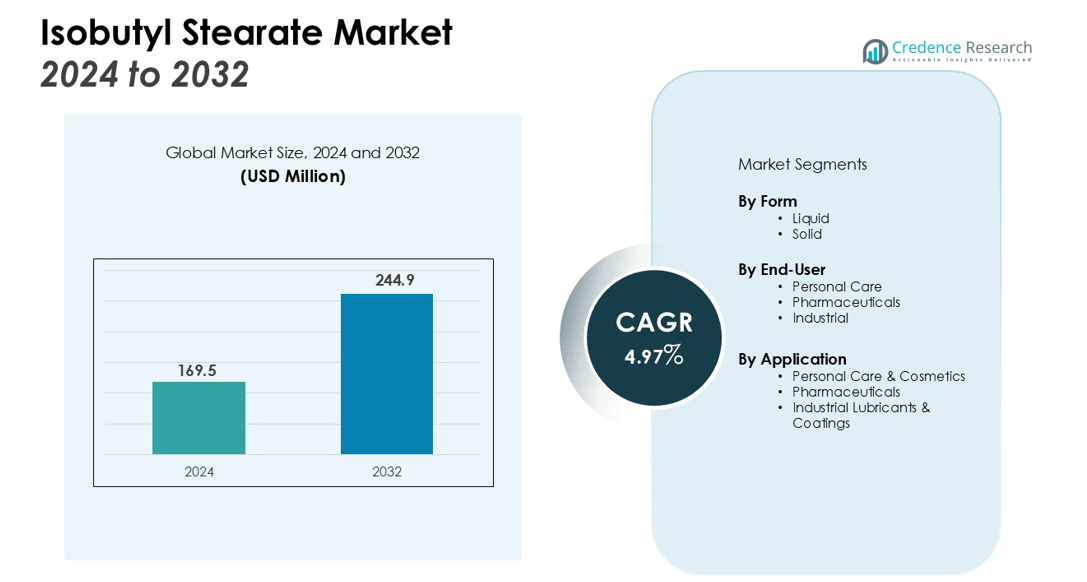
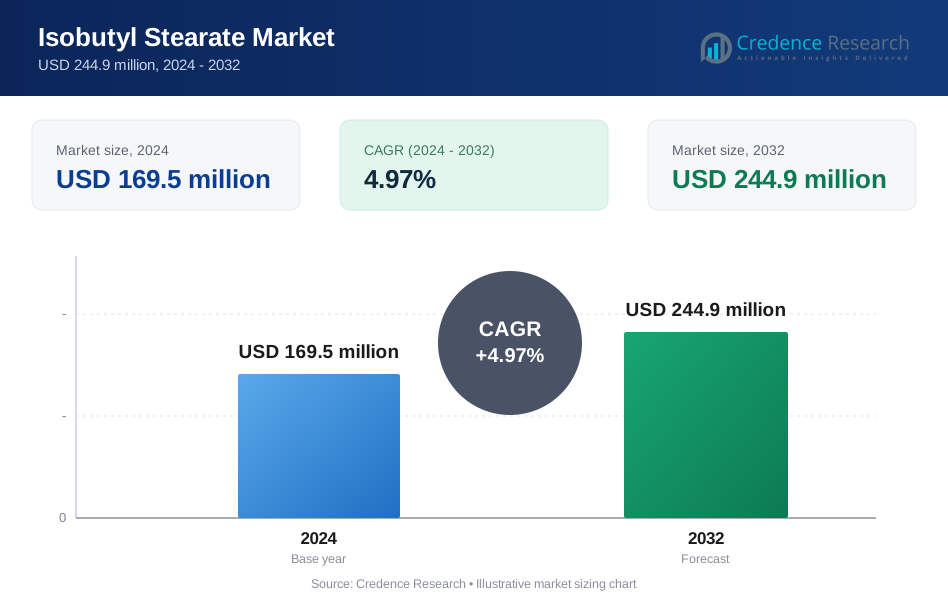
The Isobutyl Stearate Market size was valued at USD 169.5 million in 2024 and is anticipated to reach USD 244.9 million by 2032, at a CAGR of 4.97% during the forecast period (2024-2032).
| REPORT ATTRIBUTE | DETAILS |
|---|---|
| Historical Period | 2020-2023 |
| Base Year | 2024 |
| Forecast Period | 2025-2032 |
| Isobutyl Stearate Market Size 2024 | USD 169.5 million |
| Isobutyl Stearate Market, CAGR | 4.97% |
| Isobutyl Stearate Market Size 2032 | USD 244.9 million |
Key drivers of market growth include the expanding demand for personal care and cosmetic products, particularly in skincare formulations, where isobutyl stearate is valued for its ability to enhance texture and moisturization. The increasing trend toward bio-based and sustainable ingredients in formulations further boosts demand for isobutyl stearate, as it is often derived from renewable sources. Additionally, the growth of the pharmaceutical sector, especially in drug formulations, contributes significantly to the market's expansion. The rising consumer preference for eco-friendly and clean-label products further accelerates the adoption of isobutyl stearate in various industries.
Regionally, North America holds the largest market share due to the high demand for isobutyl stearate in the personal care and pharmaceutical industries. Europe follows closely, driven by its well-established chemical industry and regulatory support for sustainable ingredients. The Asia Pacific region is expected to witness the highest growth rate, fueled by expanding manufacturing capabilities and increasing consumer demand for personal care products in countries like China and India. The rapid industrialization and growth of the cosmetics sector in emerging markets also support regional growth.
Market Insights:
- The Isobutyl Stearate Market size was valued at USD 169.5 million in 2024 and is projected to reach USD 244.9 million by 2032, growing at a CAGR of 4.97% during the forecast period.
- The growing demand for personal care and cosmetic products, particularly in skincare formulations, is a key driver. Isobutyl stearate is valued for enhancing texture and providing moisturization, fueling its use in these industries.
- The trend toward bio-based and sustainable ingredients further boosts the market. As a renewable source, isobutyl stearate meets the increasing consumer preference for eco-friendly formulations in personal care products.
- The pharmaceutical sector's expansion also contributes significantly to the market. Isobutyl stearate's role as a solvent and emulsifying agent in drug formulations supports the growth of the market as the demand for drug delivery systems increases.
- Technological advancements in product development create new opportunities for the Isobutyl Stearate Market. Improved production techniques and growing R&D efforts allow manufacturers to scale production and introduce innovative applications across industries.
- Raw material supply fluctuations pose challenges to market stability. Price volatility, driven by disruptions in the natural raw material supply chain, impacts production costs and market growth, especially in price-sensitive regions.
- North America holds the largest market share of 40%, driven by strong demand in personal care, cosmetics, and pharmaceuticals. The United States leads in consumption, with regulatory support further enhancing isobutyl stearate’s adoption.
Market Drivers:
Growing Demand for Personal Care and Cosmetics
The increasing demand for personal care and cosmetic products is one of the primary drivers of the Isobutyl Stearate Market. It is highly valued in skincare formulations for its ability to enhance texture, improve spreadability, and provide moisturization. The rise of skincare routines among consumers, particularly in developed markets, has increased the demand for high-quality emollients and solvents, where isobutyl stearate is a preferred ingredient. This trend aligns with the growing focus on self-care and wellness, which further fuels market growth.
- For instance, The Hallstar Company produces HallStar® IBST, which becomes a viscous liquid at 24°C, a key property that allows it to function as a non-greasy emollient in skin care formulations.
Shift Toward Bio-Based and Sustainable Ingredients
Consumers are increasingly prioritizing bio-based and sustainable ingredients in their personal care and cosmetic products. Isobutyl stearate, being derived from renewable sources, benefits from this shift toward eco-friendly formulations. Manufacturers are adapting to this trend by incorporating sustainable materials to meet consumer demand for cleaner, greener products. This change enhances the appeal of isobutyl stearate, contributing to its growing adoption in the market.
- For instance, BASF has championed this shift with its biomass balance approach, a certified method that replaces fossil inputs with renewable raw materials and has been applied to more than 200 of its products.
Expansion of the Pharmaceutical Sector
The Isobutyl Stearate Market also experiences growth due to the pharmaceutical sector's expansion. It is used in various drug formulations, where its role as a solvent and emulsifying agent is crucial. The increase in chronic diseases, the aging population, and the demand for innovative drug delivery systems further stimulate the need for ingredients like isobutyl stearate. Its compatibility with different active pharmaceutical ingredients makes it an essential compound in drug formulation processes.
Technological Advancements in Product Development
Technological innovations in product development are also driving the growth of the Isobutyl Stearate Market. Advances in production techniques enable manufacturers to produce high-quality isobutyl stearate at scale, improving availability and reducing production costs. The growth of research and development efforts also results in new applications for isobutyl stearate across industries. These developments create new opportunities for its use, thereby expanding its market presence.
Market Trends:
Increasing Adoption of Eco-Friendly and Clean Label Products
The Isobutyl Stearate Market is experiencing a significant trend toward the adoption of eco-friendly and clean label products. Consumers are increasingly seeking products that are natural, non-toxic, and derived from sustainable sources. This demand is driving manufacturers to formulate products with ingredients like isobutyl stearate, which is bio-based and meets the rising consumer preference for sustainability. Brands that focus on transparency and product safety are gaining consumer trust, leading to higher demand for ingredients that support these clean label trends. As regulatory frameworks continue to tighten around product labeling, companies are likely to incorporate more bio-based ingredients, further supporting the growth of isobutyl stearate in various applications.
- For instance, in January 2018, Clariant and Global Bioenergies developed a new bio-based cosmetic polymer from renewable sources, creating a direct 1:1 replacement for petroleum-based equivalents that conforms to the ISO 16128:2016 standard for natural ingredients.
Technological Advancements in Cosmetic and Pharmaceutical Formulations
Technological advancements in cosmetic and pharmaceutical formulations are transforming the Isobutyl Stearate Market. New developments in delivery systems, such as enhanced emulsification and more efficient solubility, have expanded the use of isobutyl stearate in these sectors. In cosmetics, it is increasingly used in high-performance skincare, offering superior texture, long-lasting moisturization, and improved product stability. In pharmaceuticals, the compound's use as a solvent in drug formulations is becoming more prominent, driven by innovations in drug delivery methods. These technological improvements allow manufacturers to better meet the growing demand for more effective and versatile products, contributing to the increasing market potential of isobutyl stearate.
- For instance, specialty chemical company Hallstar offers HallStar® IBST, a grade of isobutyl stearate used to enhance high-performance skincare products, this ingredient demonstrates high stability with a flash point of over 93°C, a key technical specification that ensures the safety and integrity of the final cosmetic formulation.
Market Challenges Analysis:
Raw Material Supply and Price Fluctuations
One of the key challenges facing the Isobutyl Stearate Market is the fluctuation in raw material prices. The compound is derived from natural sources, and any disruptions in the supply chain for these raw materials can lead to price volatility. As global demand for bio-based ingredients rises, there is increasing pressure on suppliers to maintain consistent production at competitive prices. These fluctuations in raw material costs can directly impact the overall cost structure for manufacturers, which may hinder market growth, particularly in price-sensitive regions or applications. Ensuring a stable and cost-effective supply of raw materials remains a critical concern for the industry.
Regulatory Constraints and Compliance Requirements
The Isobutyl Stearate Market faces stringent regulatory requirements, particularly in the personal care and pharmaceutical industries. Compliance with international standards for ingredient safety, environmental impact, and manufacturing processes can be challenging. Regulations around labeling, sourcing, and the use of bio-based ingredients require companies to invest in certification processes and adapt their production methods to meet evolving standards. These regulatory hurdles can slow down the market adoption of isobutyl stearate, especially in regions with complex or frequently changing regulations, creating barriers for both new entrants and established players.
Market Opportunities:
Expansion in Emerging Markets Driven by Consumer Demand
The Isobutyl Stearate Market holds significant opportunities in emerging markets, where increasing disposable incomes and a growing middle class are driving demand for personal care and pharmaceutical products. As consumers in regions such as Asia-Pacific and Latin America become more aware of skincare and health product benefits, the demand for high-quality ingredients like isobutyl stearate rises. Companies can capitalize on this opportunity by expanding their market presence and tailoring products to meet the needs of these rapidly developing markets. The rising demand for sustainable and bio-based products in these regions further enhances the potential for isobutyl stearate’s adoption.
Rising Popularity of Sustainable and Clean Label Products
There is a growing trend towards sustainable and clean label products across various industries, including personal care, cosmetics, and pharmaceuticals. Consumers increasingly demand products that are transparent, eco-friendly, and free from harmful chemicals. This shift presents a key opportunity for the Isobutyl Stearate Market, as it is a renewable, bio-based ingredient that aligns with these consumer preferences. Manufacturers who emphasize sustainability and clean labeling can leverage this trend to enhance brand appeal and differentiate themselves in a competitive market, driving growth opportunities for isobutyl stearate.
Market Segmentation Analysis:
By Form
The Isobutyl Stearate Market is segmented by form into liquid and solid forms. Liquid forms dominate the market due to their versatility and ease of application in various industries, particularly in personal care and pharmaceuticals. It is widely used in liquid formulations for cosmetics, skincare, and drug solutions. The solid form is preferred in specific applications such as industrial lubricants and coatings, where consistency and stability are required.
- For instance, Hallstar manufactures its HallStar® IBST, which exists as a viscous liquid at temperatures above 24°C, enabling its versatile application as a skin-conditioning agent in various cosmetic products.
By End-User
The Isobutyl Stearate Market serves a diverse range of end-users, including personal care, pharmaceuticals, and industrial applications. The personal care sector leads demand, driven by increasing consumer interest in skincare products, cosmetics, and hair care formulations. The pharmaceutical industry also contributes significantly, utilizing isobutyl stearate in drug formulations and delivery systems. Industrial applications account for a smaller share but are essential, particularly in lubricants and coatings for machinery and other equipment.
- For instance, Henkel has launched LOCTITE ABLESTIK NCA 01UV, a specialized adhesive for bonding automotive camera modules that fully cures in just 3 seconds using UV LED light.
By Application
In terms of application, the Isobutyl Stearate Market is utilized across multiple sectors, with personal care and cosmetics leading. It is a key ingredient in skincare products, moisturizers, and emulsions due to its ability to improve texture and provide moisturization. The pharmaceutical sector uses it primarily in drug formulations, especially as a solvent and emulsifier. Industrial applications, including lubricants and coatings, are also important but account for a smaller portion of the market.
Segmentations:
- By Form
- Liquid
- Solid
- By End-User
- Personal Care
- Pharmaceuticals
- Industrial
- By Application
- Personal Care & Cosmetics
- Pharmaceuticals
- Industrial Lubricants & Coatings
- By Region
- North America
- U.S.
- Canada
- Mexico
- Europe
- UK
- France
- Germany
- Italy
- Spain
- Russia
- Belgium
- Netherlands
- Austria
- Sweden
- Poland
- Denmark
- Switzerland
- Rest of Europe
- Asia Pacific
- China
- Japan
- South Korea
- India
- Australia
- Thailand
- Indonesia
- Vietnam
- Malaysia
- Philippines
- Taiwan
- Rest of Asia Pacific
- Latin America
- Brazil
- Argentina
- Peru
- Chile
- Colombia
- Rest of Latin America
- Middle East
- UAE
- KSA
- Israel
- Turkey
- Iran
- Rest of Middle East
- Africa
- Egypt
- Nigeria
- Algeria
- Morocco
- Rest of Africa
- North America
Regional Analysis:
North America: Leading Market Driven by Personal Care and Pharmaceutical Demand
North America holds the largest market share of 40% in the Isobutyl Stearate Market, driven by high demand in personal care, cosmetics, and pharmaceutical industries. The region’s advanced healthcare infrastructure and well-established chemical industry support the consistent growth of bio-based ingredients like isobutyl stearate. The United States leads consumption, with personal care brands incorporating eco-friendly and sustainable ingredients. Regulatory support for clean label ingredients further enhances the adoption of isobutyl stearate, contributing to its widespread use. The growing trend toward sustainable consumer products strengthens the regional market presence.
Europe: Strong Focus on Sustainable Ingredients and Regulatory Support
Europe holds a significant market share of 30% of the Isobutyl Stearate Market, driven by its strong emphasis on sustainability and eco-friendly ingredients in personal care and cosmetics. Strict regulations around ingredient transparency and environmental impact drive the demand for bio-based alternatives like isobutyl stearate. Key markets such as Germany, France, and the United Kingdom lead this trend, with increasing consumer demand for natural ingredients. The pharmaceutical sector further contributes to growth, using isobutyl stearate in various drug formulations. The region’s regulatory environment and focus on product safety continue to shape the market’s dynamics.
Asia Pacific: Rapid Growth in Personal Care and Pharmaceutical Sectors
The Asia Pacific region holds a market share of 25% in the Isobutyl Stearate Market, driven by strong demand in personal care and pharmaceuticals. The region is witnessing rising disposable incomes and rapid urbanization in countries like China, India, and Japan, which increase demand for personal care products. This growth is further supported by the increasing preference for sustainable and bio-based ingredients. The pharmaceutical industry in Asia Pacific is expanding rapidly, providing significant opportunities for isobutyl stearate in drug formulations. As manufacturing capabilities increase, the region is expected to see continued market growth.
Key Player Analysis:
- Zhonglan Industry Co., Ltd
- Ataman Chemicals
- Zhengzhou Alfa Chemical Co., Ltd
- DAYANG CHEM (HANGZHOU) CO., LTD
- Oleon NV
- Emery Oleochemicals
- Merck KGaA
- Hairui Chemical
Competitive Analysis:
The Isobutyl Stearate Market is highly competitive, with key players like BASF, Stepan Company, and Kraton Polymers leading by offering high-quality, bio-based products. These companies invest in research and development to meet the rising demand for eco-friendly solutions across personal care, pharmaceuticals, and industrial applications. Smaller players also contribute by targeting niche markets and offering specialized formulations. Strategic partnerships and acquisitions are common for expanding production capacity and entering emerging markets, particularly in Asia Pacific. The competitive landscape is shaped by a focus on innovation, sustainability, regulatory compliance, and clean-label ingredients, which are increasingly sought by consumers and manufacturers alike.
Recent Developments:
- In August 2025, Merck KGaA entered into a strategic collaboration with Skyhawk Therapeutics to discover and develop novel RNA-targeting small molecules for neurological disorders.
- In May 2025, Emery Oleochemicals announced it would deliver a technical presentation at the STLE 2025 Annual Meeting in Atlanta, GA, and showcase its portfolio of ester base stocks and additives.
Report Coverage:
The research report offers an in-depth analysis based on Form, End-User, Application and Region. It details leading market players, providing an overview of their business, product offerings, investments, revenue streams, and key applications. Additionally, the report includes insights into the competitive environment, SWOT analysis, current market trends, as well as the primary drivers and constraints. Furthermore, it discusses various factors that have driven market expansion in recent years. The report also explores market dynamics, regulatory scenarios, and technological advancements that are shaping the industry. It assesses the impact of external factors and global economic changes on market growth. Lastly, it provides strategic recommendations for new entrants and established companies to navigate the complexities of the market.
Future Outlook:
- The Isobutyl Stearate Market will continue to see strong growth driven by increasing consumer demand for sustainable and bio-based ingredients.
- Personal care and cosmetics will remain the largest application segment, with a rising focus on skincare products that enhance texture and moisturization.
- The pharmaceutical sector will expand its use of isobutyl stearate, particularly in drug formulations and delivery systems, as demand for more efficient and sustainable solutions grows.
- Bio-based and clean-label ingredients will see higher adoption across all industries, fueling demand for isobutyl stearate in eco-friendly formulations.
- The Asia Pacific region will experience the fastest growth, with increasing disposable incomes and a shift towards premium personal care products in countries like China and India.
- Manufacturers will invest in advanced production technologies to improve the efficiency and scalability of isobutyl stearate production.
- Regulatory frameworks will continue to evolve, pushing companies to adopt more transparent and sustainable practices in the sourcing and production of ingredients.
- North America will remain a dominant market, driven by high demand in personal care, pharmaceuticals, and regulatory support for clean-label products.
- New applications will emerge as companies explore innovative uses for isobutyl stearate in industrial sectors such as lubricants and coatings.
- Competitive pressure will lead to more strategic partnerships and collaborations among key players to expand market reach and improve product offerings.
Request a Free Sample
Fill in your details and we'll send you a free sample report.
- Sample data tables & charts
- Research methodology
Need a Custom Version of This Report?
Tailor the scope, geography, or segments to your exact requirements.
- Custom geography or segment scope
- Direct access to our analyst team
Frequently Asked Questions
What is the current market size for Isobutyl Stearate, and what is its projected size in 2032?
Which Isobutyl Stearate market segment held the largest share in 2024?
What are the primary factors fueling the growth of the Isobutyl Stearate market?
Who are the leading companies in the Isobutyl Stearate market?
Table of Content
Chapter 1. Report Introduction
- 1.1 Report Description & Purpose
- 1.1.1 Report Title & Market Definition
- 1.1.2 Unique Selling Propositions (USP) & Key Differentiators
- 1.1.3 Value Proposition for Stakeholders
- 1.2 Research Objectives
- 1.2.1 Market Sizing Objectives (Volume & Revenue)
- 1.2.2 Segmentation Objectives
- 1.2.3 Competitive Intelligence Objectives
- 1.2.4 Forecast & Scenario Objectives
- 1.3 Report Scope
- 1.3.1 Isobutyl Stearate Scope – Types & Subtypes Covered
- 1.3.2 Geographic Scope – Regions & Countries Covered
- 1.3.3 Historical Period, Base Year & Forecast Period (2024; forecast to 2032)
- 1.3.4 Inclusions & Exclusions
- 1.4 HS Code & Classification Framework
- 1.5 Currency, Units & Pricing Basis
- 1.6 Target Stakeholders
- 1.7 Limitations & Assumptions
Chapter 2. Executive Summary
- 2.1 Global Isobutyl Stearate Market Snapshot
- 2.1.1 Market Size – Historical (2024) & Forecast (2024-2032) (2024: USD 169.5 million → 2032: USD 244.9 million)
- 2.1.2 Volume & Revenue – Global Totals
- 2.1.3 Key Market Highlights – Top Five Facts
- 2.2 Isobutyl Stearate Market Segmentation Snapshot
- 2.2.1 Market Split by Region – 2024 vs. 2032
- 2.3 Competitive Snapshot
- 2.3.1 Top 10 Players by Revenue Share – 2024
- 2.3.2 Top 10 Players by Volume Share – 2024
- 2.3.3 Recent Strategic Developments (18-Month Summary)
- 2.4 Key Investment Highlights & Strategic Conclusions
Chapter 3. Isobutyl Stearate Market Dynamics & Industry Analysis
- 3.1 Market Overview & Context
- 3.1.1 Isobutyl Stearate Market Position in the Broader Automotive Value Chain
- 3.1.2 OEM vs. Replacement Market Dynamics
- 3.1.3 Market Maturity & Development Stage by Region
- 3.2 Isobutyl Stearate Market Drivers
- 3.3 Isobutyl Stearate Market Restraints & Challenges
- 3.4 Isobutyl Stearate Market Opportunities
- 3.5 Porter's Five Forces Analysis
- 3.5.1 Threat of New Entrants
- 3.5.2 Bargaining Power of Suppliers
- 3.5.3 Bargaining Power of Buyers
- 3.5.4 Threat of Substitutes
- 3.5.5 Competitive Rivalry – Intensity Assessment
- 3.6 Isobutyl Stearate Value Chain Analysis
- 3.6.1 Upstream – Raw Material/Input Suppliers
- 3.6.1.1 Raw Material/Input 1
- 3.6.1.2 Raw Material/Input 2
- 3.6.1.3 Raw Material/Input 3
- 3.6.2 Midstream – Production/Manufacturing/Service Delivery
- 3.6.2.1 Production/Process Overview
- 3.6.2.2 Key Facility Locations & Capacity by Manufacturer
- 3.6.3 Downstream – Distribution & End Consumer
- 3.6.3.1 Primary Channel – B2B/OEM
- 3.6.3.2 Secondary Channels – Dealer, Retail, Online, Direct
- 3.6.4 Value Chain Profitability Analysis
- 3.6.1 Upstream – Raw Material/Input Suppliers
- 3.7 PESTEL Analysis
- 3.7.1 Political Factors
- 3.7.2 Economic Factors
- 3.7.3 Social Factors
- 3.7.4 Technological Factors
- 3.7.5 Environmental Factors
- 3.7.6 Legal Factors
- 3.8 Isobutyl Stearate Supply Chain Analysis
- 3.8.1 Raw Material/Input Supply Risk Assessment
- 3.8.2 Manufacturing Concentration Risk (Geographic Exposure)
- 3.8.3 Trade Disruption Impact Analysis
- 3.9 Regulatory & Policy Landscape
Note: The regulatory and policy landscape section covers regulations based on their applicability to the market, Isobutyl Stearate category, geography, and scope of the study. Only regulatory frameworks with a material impact on operations, compliance, trade, sustainability, or market access are analyzed in detail.
Chapter 4. Key Investment Pockets & Opportunity Analysis
- 4.1 Isobutyl Stearate Market Attractiveness Analysis
- 4.1.1 By Region – Investment Attractiveness Matrix (Volume × CAGR)
- 4.2 Absolute Revenue Growth Opportunity
- 4.2.1 By Region – Absolute USD Growth Through 2032
- 4.3 Incremental Volume Opportunity
- 4.3.1 By Region – Incremental Volume Through 2032
- 4.3.2 Segment – Incremental Volume
- 4.4 Emerging Submarket Opportunity Deep Dive (Subject to Applicability)
- 4.5 Emerging Market Opportunity Scorecards
- 4.5.1 United States
- 4.5.2 Europe
- 4.5.3 Asia
- 4.5.4 Middle East & Africa
Note: Emerging Market Opportunity Scorecards will be included based on relevance and strategic importance. Regions listed are indicative and may vary depending on data availability and market dynamics.
Chapter 5. Isobutyl Stearate Import-Export Analysis & Trade Flows
- 5.1 Global Trade Overview
- 5.1.1 Global Export Value by Country (2024)
- 5.1.2 Global Export Volume by Country (2024)
- 5.1.3 Global Import Value by Country (2024)
- 5.1.4 Global Import Volume by Country (2024)
- 5.1.5 Net Trade Balance by Country (2024)
- 5.2 Export Analysis – Segment
- 5.2.1 Type 1 (HS Code)
- 5.2.2 Type 2 (HS Code)
- 5.2.3 Type 3 (HS Code)
- 5.2.4 Type 4 (HS Code)
- 5.2.5 Type 5 (HS Code)
- 5.3 Import Analysis – Segment
- 5.3.1 Type 1 (HS Code)
- 5.3.2 Type 2 (HS Code)
- 5.3.3 Type 3 (HS Code)
- 5.3.4 Type 4 (HS Code)
- 5.3.5 Type 5 (HS Code)
- 5.4 Average Unit Trade Prices
- 5.4.1 Average Export Price – Segment & Country
- 5.4.2 Average Import Price – Segment & Source Country
- 5.4.3 Price Trends (2024)
- 5.5 Key Trade Route Analysis
- 5.5.1 Trade Route 1
- 5.5.2 Trade Route 2
- 5.5.3 Trade Route 3
- 5.5.4 Trade Route 4
- 5.5.5 Trade Route 5
- 5.6 Trade Policy Impact Assessment
- 5.6.1 US Anti-Dumping & Section 301 Tariffs
- 5.6.2 EU Customs Union Impact
- 5.6.3 Major Free Trade Agreements
- 5.6.4 USMCA Rules of Origin
Note: Trade policy analysis will be included only where relevant to the Isobutyl Stearate market.
Chapter 6. Competitive Landscape & Company Benchmarking
- 6.1 Isobutyl Stearate Market Concentration & Structure
- 6.1.1 Herfindahl-Hirschman Index (HHI) – vs. 2024
- 6.1.2 Tier 1, Tier 2 & Tier 3 Market Structure
- 6.1.3 Global, Regional & Local Player Dynamics
- 6.2 Isobutyl Stearate Market Share Analysis – 2024
- 6.2.1 Global Revenue Share by Company
- 6.2.2 Global Volume Share by Company
- 6.2.3 Regional Revenue Share
- 6.2.4 Market Share Evolution ( vs. 2024)
- 6.2.5 OEM Segment Share by Company
- 6.2.6 Replacement Segment Share by Company
- 6.3 Production/Delivery Capacity & Facility Analysis
- 6.3.1 Global Installed Capacity
- 6.3.2 Capacity Utilization Rates
- 6.3.3 Production/Output Volume
- 6.3.4 Facility Locations & Capacity Map
- 6.3.5 Planned Capacity Additions
- 6.4 Isobutyl Stearate Competitive Benchmarking Matrix
- 6.4.1 Revenue, Volume, CAGR & Profitability Comparison
- 6.4.2 Channel Revenue Mix
- 6.4.3 Geographic Revenue Exposure
- 6.4.4 R&D Intensity
- 6.4.5 Sustainability Maturity
- 6.5 Strategic Developments in Isobutyl Stearate (Last 24 Months)
- 6.5.1 Mergers, Acquisitions & Divestments
- 6.5.2 New Isobutyl Stearate Launches
- 6.5.3 Facility Expansions
- 6.5.4 Strategic Alliances, Joint Ventures & Partnerships
- 6.5.5 Distribution Expansion & Market Entry
- 6.5.6 Sustainability & ESG Initiatives
- 6.6 Competitive Strategy Mapping
- 6.6.1 Leader, Challenger, Follower & Niche Classification
- 6.6.2 Pricing Strategy Comparison
- 6.6.3 Channel Strategy Matrix
Note: Strategic developments are included based on their materiality and the availability of reliable information.
Chapter 7. Global Isobutyl Stearate Market – By Distribution Channel
- 7.1 Segment Overview
- 7.1.1 Volume & Revenue Split by Channel (2024 & 2032)
- 7.1.2 Channel Mix Evolution (2024-2032)
Chapter 8. Regional Market Analysis – Global Overview
- 8.1 Global Regional Overview
- 8.1.1 Regional Volume Share
- 8.1.2 Regional Revenue Share
- 8.1.3 Regional Volume by Region
- 8.1.4 Regional Revenue by Region
- 8.1.5 Regional Forecast Through 2032
- 8.2 Cross-Regional Segment Analysis
- 8.2.1 By Distribution Channel
- 8.2.2 By Brand/Price Tier
Chapter 9. North America Isobutyl Stearate Market
- 9.1 United States
- 9.2 Canada
- 9.3 Mexico
Chapter 10. Europe Isobutyl Stearate Market
- 10.1 Germany
- 10.2 France
- 10.3 Italy
- 10.4 United Kingdom
- 10.5 Spain
- 10.6 Poland
- 10.7 Russia
- 10.8 Netherlands
- 10.9 Belgium
- 10.10 Sweden
- 10.11 Denmark
- 10.12 Norway
- 10.13 Rest of Europe
Chapter 11. Asia Pacific Isobutyl Stearate Market
- 11.1 China
- 11.2 India
- 11.3 Japan
- 11.4 South Korea
- 11.5 Thailand
- 11.6 Indonesia
- 11.7 Vietnam
- 11.8 Malaysia
- 11.9 Australia
- 11.10 Rest of Asia Pacific
Chapter 12. Latin America Isobutyl Stearate Market
- 12.1 Brazil
- 12.2 Argentina
- 12.3 Colombia
- 12.4 Chile
- 12.5 Rest of Latin America
Chapter 13. Middle East Isobutyl Stearate Market
- 13.1 Saudi Arabia
- 13.2 United Arab Emirates
- 13.3 Turkey
- 13.4 Israel
- 13.5 Iran
- 13.6 Rest of the Middle East
Chapter 14. Africa Isobutyl Stearate Market
- 14.1 South Africa
- 14.2 Egypt
- 14.3 Nigeria
- 14.4 Morocco
- 14.5 Rest of Africa
Chapter 15. Isobutyl Stearate Company Profiles
- 15.1 [Company 01]
- 15.1.1 Company Overview
- 15.1.2 Key Management Personnel
- 15.1.3 Products & Services Portfolio
- 15.1.4 Financial Performance
- 15.1.5 Key Market Focus & Geographic Presence
- 15.1.6 Recent Developments & Strategic Initiatives
Note: The company profile list is preliminary and may change based on research findings, market developments, data availability, and client requirements.
Chapter 16. Appendices
- Appendix A – List of Abbreviations & Acronyms
- Appendix B – Industry Classification Code Reference – Full Series
- Appendix C – Production & Capacity Data Tables
- Appendix D – End-Use & Demand Base Tables
- Appendix E – Consumption & Replacement Rate Assumptions
- Appendix F – ASP Reference Tables
- Appendix G – Manufacturing & Facility Database
- Appendix H – Import-Export Data Tables
- Appendix I – Regulatory Summary Tables
- Appendix J – Primary Research Participant List (Anonymized)
- Appendix K – Primary Research Questionnaire Framework
- Appendix L – Data Sources & Bibliography
- Appendix M – Market Size Divergence & Source Comparison
Chapter 17. Research Methodology
- 17.1 Research Framework & Philosophy
- 17.2 Secondary Research – Sources, Hierarchy & Data Extraction
- 17.3 Data Modeling – Bottom-Up & Top-Down Market Sizing
- 17.4 Primary Research – Stakeholder Framework, LOI & Sample Sizes
- 17.5 Forecast Methodology – Regression, Scenario & Sensitivity Analysis
- 17.6 Quality Control – Four-Layer Validation Framework
- 17.7 Limitations & Standard Assumptions
- 17.8 Disclaimer
