
Market Overview:
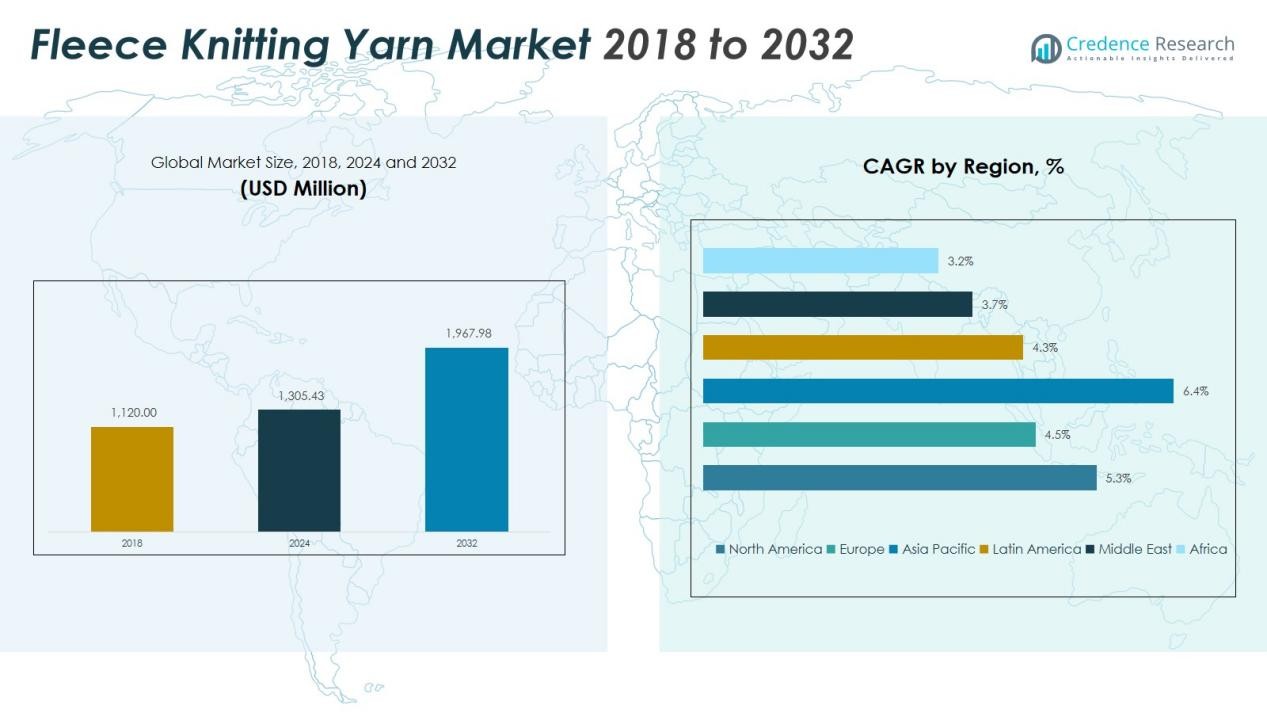
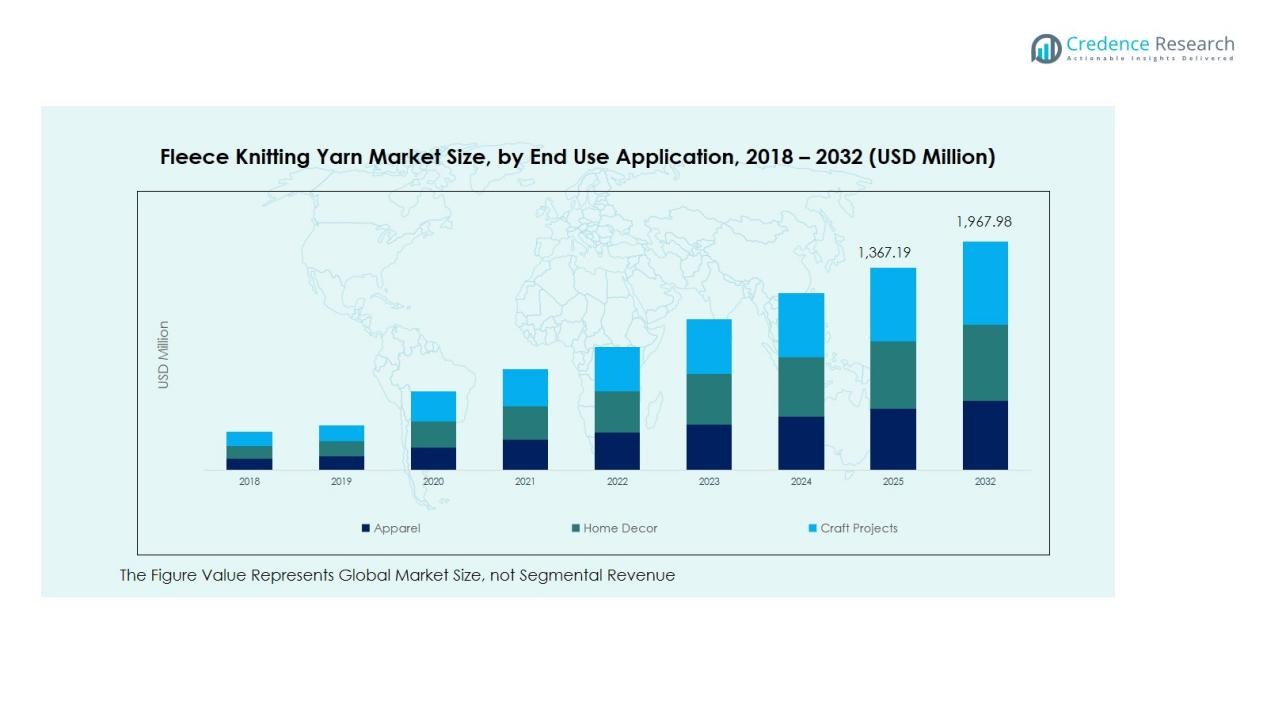
The Global Fleece Knitting Yarn Market size was valued at USD 1,120.00 million in 2018 to USD 1,305.43 million in 2024 and is anticipated to reach USD 1,967.98 million by 2032, at a CAGR of 5.34% during the forecast period.
| REPORT ATTRIBUTE | DETAILS |
|---|---|
| Historical Period | 2020-2023 |
| Base Year | 2024 |
| Forecast Period | 2025-2032 |
| Fleece Knitting Yarn Market Size 2024 | USD 1,305.43 Million |
| Fleece Knitting Yarn Market, CAGR | 5.34% |
| Fleece Knitting Yarn Market Size 2032 | USD 1,967.98 Million |
Major growth drivers include increasing popularity of DIY knitting and crafting, expanding availability of fleece yarn blends and synthetic-natural fibre combinations, and growing interest in sustainable textile materials. As fashion shifts toward comfortable, casual and athleisure wear, demand for fleece-based knitted fabrics has gained traction across both apparel and home décor segments.
Regionally, North America currently leads the market with strong consumer spending on home crafting and high disposable income levels. Europe follows with a robust heritage in premium textiles and sustainable sourcing. Meanwhile, Asia-Pacific is emerging rapidly, supported by growing middle classes, increased online retail penetration and rising craft hobby participation in countries such as China and India.
Market Insights:
- The Global Fleece Knitting Yarn Market was valued at USD 1,120.00 million in 2018, reached USD 1,305.43 million in 2024, and is expected to reach USD 1,967.98 million by 2032, growing at a CAGR of 5.34% during the forecast period.
- North America holds 29% of the market share, driven by strong consumer spending on premium apparel and DIY knitting culture, while Europe follows with 26% due to its established textile heritage and focus on sustainable fiber innovation.
- Asia Pacific leads globally with 33% market share, supported by large-scale manufacturing, digital retail growth, and rising craft hobby participation in China and India.
- Asia Pacific is also the fastest-growing region, expanding at a CAGR of 6.4%, fueled by expanding middle-class income levels and rapid urbanization across emerging economies.
- By segment, lightweight fleece yarn accounts for 38% of total revenue, while the apparel segment dominates with 42% share, supported by rising athleisure and casual wear trends worldwide.
Market Drivers:
Rising Demand for Comfortable and Functional Apparel
The Global Fleece Knitting Yarn Market benefits from the increasing popularity of comfortable and functional clothing. Consumers prefer soft, lightweight, and thermally efficient fabrics for casual, sportswear, and outdoor apparel. It supports the trend toward athleisure and everyday performance wear, where fleece fabrics offer warmth without excess weight. Brands emphasize breathable, stretchable, and easy-care yarns to meet this growing comfort demand. The shift toward year-round fleece usage continues to strengthen product adoption across global fashion segments.
- For Instance, Erdos Group reported a total operating revenue of approximately $4.2 billion (30.55 billion CNY).
Expanding Interest in DIY Crafting and Home Knitting Activities
Growing engagement in home-based crafts and do-it-yourself (DIY) projects drives strong demand for fleece yarns. Social media communities and online tutorials encourage beginners to explore creative knitting applications. It enables consumers to design personalized blankets, scarves, and decorative items. Major retailers offer fleece yarn kits and subscription boxes, expanding market reach. This trend aligns with rising interest in handmade, customized, and sustainable textile goods.
- For instance, the online knitting platform Ravelry maintains a database of 11 million registered users who actively share patterns and tutorials within the community, with the platform recording an average of 1.1 million website visits monthly.
Technological Advancements in Yarn Blending and Manufacturing
Continuous innovation in yarn manufacturing enhances softness, strength, and color retention. Modern spinning technologies enable efficient blending of polyester, acrylic, and wool fibers to improve texture and durability. It helps manufacturers produce high-quality yarns suited for both industrial and domestic applications. Companies invest in eco-friendly dyes and low-impact production processes to appeal to environmentally conscious buyers. Such advancements support product diversification and quality consistency.
Rising Focus on Sustainable and Ethical Textile Production
Sustainability plays a crucial role in shaping the fleece knitting yarn landscape. Consumers prefer yarns made from recycled, organic, or responsibly sourced materials. It encourages brands to adopt circular textile strategies and transparent sourcing practices. Manufacturers integrate biodegradable fibers and reduce chemical waste during production. Growing environmental awareness positions sustainability as a long-term competitive advantage for industry participants.
Market Trends:
Growing Popularity of Blended and Specialty Yarn Formulations
The Global Fleece Knitting Yarn Market is witnessing an increasing shift toward innovative fiber blends that improve performance and aesthetics. Manufacturers develop advanced polyester, acrylic, and wool combinations to enhance softness, stretch, and durability. It allows brands to cater to both luxury and mass-market consumers seeking high-comfort materials. Specialty fleece yarns with anti-pilling, moisture-wicking, and quick-dry properties are gaining traction in activewear and outdoor clothing. Custom color options and textural finishes appeal to crafters and small apparel makers. Product diversification through hybrid fiber compositions strengthens competitiveness across both industrial and consumer knitting sectors.
- For instance, Salud Style specializes in 85% acrylic and 15% polyester blended yarn formulations that achieve yarn strength ratings of ≥15 cn/Tex with elongation at break capabilities of 15-20%, delivering superior durability while maintaining the softness properties required for premium knitwear applications.
Accelerating Adoption of Eco-Friendly and Digitally Driven Production Practices
Sustainability continues to define the evolving direction of the fleece yarn industry. Companies integrate recycled fibers and eco-certified dyes to reduce environmental impact. It supports the global push toward responsible textile sourcing and low-carbon manufacturing. Automation and digital color-matching tools improve efficiency and precision in yarn production. Smart inventory management and e-commerce distribution platforms expand accessibility across emerging markets. The growing collaboration between textile innovators and technology firms fosters continuous improvement in quality, traceability, and waste reduction. These trends position sustainable innovation as a core growth pillar for the industry’s future.
- For instance, Polartec by Milliken & Company has transitioned more than 1.5 billion plastic bottles into recycled fleece yarns as of July 2023, significantly reducing landfill waste while ensuring high product standards.
Market Challenges Analysis:
Fluctuating Raw Material Prices and Supply Chain Constraints
The Global Fleece Knitting Yarn Market faces consistent pressure from volatile raw material costs. Prices of polyester, acrylic, and wool often fluctuate due to energy costs and supply shortages. It affects production budgets and limits profit margins for both large and small manufacturers. Global logistics disruptions and uneven fiber availability create delivery delays and inventory issues. Dependence on synthetic materials increases exposure to oil price variations. Manufacturers must adopt flexible sourcing strategies and inventory planning to maintain stability in operations.
Environmental Concerns and Regulatory Compliance Barriers
Environmental regulations and waste management standards continue to challenge fleece yarn producers. The use of synthetic fibers contributes to microplastic pollution and recycling difficulties. It compels companies to invest in greener technologies and sustainable certifications. Compliance with international environmental laws increases operational costs and requires ongoing audits. Consumer expectations for eco-conscious products add further pressure on traditional manufacturing models. The push toward full transparency and ethical sourcing demands significant financial and process adaptation.
Market Opportunities:
Expansion of Sustainable and Bio-Based Yarn Alternatives
The Global Fleece Knitting Yarn Market presents significant potential in eco-friendly and bio-based materials. Growing consumer preference for sustainable textiles creates opportunities for innovation in biodegradable yarns. It encourages manufacturers to explore plant-based fibers, recycled polyester, and organic wool. Brands adopting closed-loop production models can strengthen their environmental positioning. Investment in green chemistry and low-emission dyeing processes enhances brand value among eco-conscious buyers. The shift toward circular textile systems opens new avenues for long-term growth and differentiation.
Rising Demand from Emerging E-Commerce and Customization Platforms
Digital retail platforms are transforming how consumers access fleece knitting yarns. E-commerce expansion allows direct-to-consumer brands to reach global craft communities. It supports small-scale designers and home-based creators seeking diverse yarn options and customization tools. Online marketplaces provide visibility for niche and artisanal yarn producers. Integration of AI-driven product recommendations and virtual color selection improves customer experience. The growing digital ecosystem positions online retail as a major channel for future market expansion.
Market Segmentation Analysis:
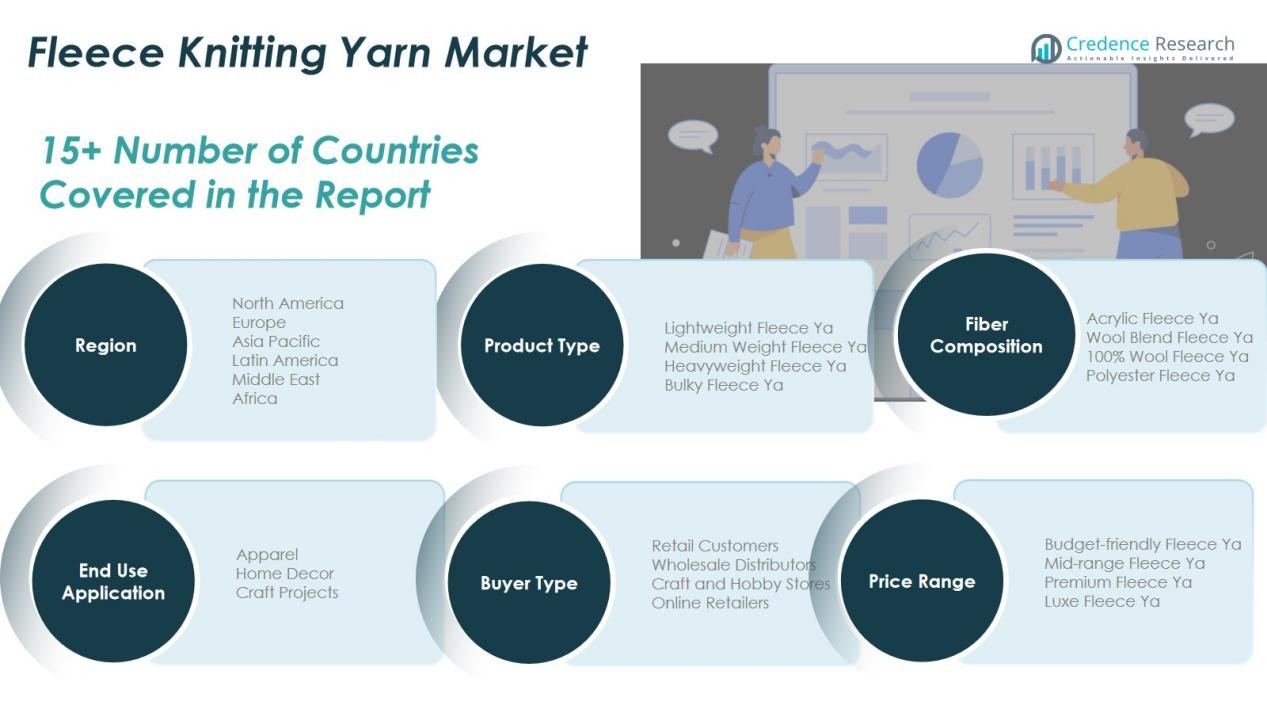
By Product Type
The Global Fleece Knitting Yarn Market is segmented into lightweight, medium weight, heavyweight, and bulky fleece yarns. Lightweight yarn dominates due to its wide use in everyday apparel and accessories. It offers comfort, flexibility, and easy handling, making it ideal for beginners and casual knitters. Medium and heavyweight yarns find strong demand in outerwear and blankets due to better warmth retention. Bulky yarns appeal to niche users seeking textured, high-volume designs for home décor projects.
- For instance, Bernat Forever Fleece Finer, a lightweight fleece yarn variant, delivers 352 meters of knitting length per 280g ball at a gauge specification of #5 bulky, providing extended usability for accessory projects including beanies, cowls, and lightweight sweater construction with optimal drapability for everyday garments.
By Application
Apparel remains the leading application segment, driven by the global rise in casual and athleisure fashion. It contributes a major share due to the versatility and softness of fleece materials. Home décor applications, including blankets and cushion covers, continue to gain traction among DIY consumers. It supports market growth through expanding craft projects and personalized knitting trends. Craft enthusiasts value fleece yarn for its affordability and broad creative potential across small-scale products.
- For instance, The Company Store's Company Plush™ decorative pillow cover collection features ultra-plush microfleece construction with a density of 530 GSM (grams per square meter), providing premium texture for home interiors, while coordinating with matching blankets and throws that demonstrate the versatility of fleece materials in creating complete bedroom and living space solutions.
By Fiber Composition
Fiber composition includes acrylic, wool blend, 100% wool, and polyester fleece yarns. Acrylic yarn leads the segment due to low cost, easy dyeing, and durability. Wool blends cater to premium buyers seeking warmth and breathability. It balances performance with comfort for mid-range fashion products. Polyester yarn remains preferred in sportswear and outdoor apparel for its resilience and quick-dry characteristics.
Segmentations:
By Product Type
- Lightweight Fleece Yarn
- Medium Weight Fleece Yarn
- Heavyweight Fleece Yarn
- Bulky Fleece Yarn
By Application
- Apparel
- Home Décor
- Craft Projects
By Fiber Composition
- Acrylic Fleece Yarn
- Wool Blend Fleece Yarn
- 100% Wool Fleece Yarn
- Polyester Fleece Yarn
By Buyer Type
- Retail Customers
- Wholesale Distributors
- Craft and Hobby Stores
- Online Retailers
By Price Range
- Budget-Friendly Fleece Yarn
- Mid-Range Fleece Yarn
- Premium Fleece Yarn
- Luxe Fleece Yarn
By Region
- North America
- U.S.
- Canada
- Mexico
- Europe
- Germany
- France
- U.K.
- Italy
- Spain
- Rest of Europe
- Asia Pacific
- China
- Japan
- India
- South Korea
- South-east Asia
- Rest of Asia Pacific
- Latin America
- Brazil
- Argentina
- Rest of Latin America
- Middle East & Africa
- GCC Countries
- South Africa
- Rest of the Middle East and Africa
Regional Analysis:
North America
The North America Fleece Knitting Yarn Market size was valued at USD 383.04 million in 2018, reached USD 440.71 million in 2024, and is anticipated to reach USD 663.41 million by 2032, at a CAGR of 5.3% during the forecast period. The Global Fleece Knitting Yarn Market in this region benefits from high consumer interest in premium apparel and DIY crafts. The United States leads regional demand due to strong home knitting trends and growing adoption of sustainable yarn products. It gains traction through online retail expansion and widespread social media influence promoting handcrafting. Canada contributes steadily with rising awareness of eco-friendly textiles. Local manufacturers emphasize recycled and organic materials to attract sustainability-focused consumers. North America holds 29% of the global market share.
Europe
The Europe Fleece Knitting Yarn Market size was valued at USD 265.22 million in 2018, reached USD 295.77 million in 2024, and is projected to reach USD 418.30 million by 2032, growing at a CAGR of 4.5%. The Global Fleece Knitting Yarn Market in Europe is shaped by strong textile traditions and innovation in fiber technologies. Germany, Italy, and the UK remain key markets for premium yarn production. It experiences rising demand for wool blends and organic materials supported by regional sustainability policies. European consumers prefer high-quality yarns for fashion and home décor. The presence of established luxury brands strengthens product visibility. Europe accounts for 26% of the total market share.
Asia Pacific
The Asia Pacific Fleece Knitting Yarn Market size was valued at USD 341.04 million in 2018, reached USD 411.66 million in 2024, and is expected to reach USD 672.66 million by 2032, registering a CAGR of 6.4%. The Global Fleece Knitting Yarn Market in this region benefits from industrial expansion and growing consumer bases in China, India, and Japan. It experiences strong demand from apparel manufacturers and the e-commerce sector. Rapid urbanization and lifestyle shifts drive growth in crafting and home décor projects. Local production facilities support cost efficiency and large-scale exports. Expanding digital retail platforms enhance market penetration. Asia Pacific leads globally with a 33% market share.
Latin America
The Latin America Fleece Knitting Yarn Market size was valued at USD 68.54 million in 2018, reached USD 79.10 million in 2024, and is projected to reach USD 110.34 million by 2032, expanding at a CAGR of 4.3%. The Global Fleece Knitting Yarn Market in this region gains momentum through increasing adoption of leisure knitting activities. Brazil and Argentina dominate with a strong base of fashion and home textile industries. It benefits from improving retail distribution and expanding online sales channels. Crafting communities contribute to steady product uptake among young consumers. Local yarn producers explore sustainable fiber sourcing to align with global market trends. Latin America captures 7% of global revenue.
Middle East
The Middle East Fleece Knitting Yarn Market size was valued at USD 34.72 million in 2018, reached USD 37.33 million in 2024, and is anticipated to reach USD 49.41 million by 2032, at a CAGR of 3.7%. The Global Fleece Knitting Yarn Market in this region develops steadily through luxury fashion demand and tourism-driven retail. The UAE and Turkey represent key markets due to their advanced textile infrastructure. It witnesses gradual growth in customized garment and boutique production. Local manufacturers focus on high-end and blended fleece yarns catering to premium buyers. The adoption of eco-friendly fabrics is emerging slowly but steadily. The Middle East holds 3% of the overall market.
Africa
The Africa Fleece Knitting Yarn Market size was valued at USD 27.44 million in 2018, reached USD 40.87 million in 2024, and is projected to reach USD 53.86 million by 2032, growing at a CAGR of 3.2%. The Global Fleece Knitting Yarn Market in this region is supported by growing textile manufacturing and artisan crafts. South Africa remains the main contributor with an expanding handmade and DIY market. It benefits from rising consumer interest in affordable and durable yarns. Government support for local textile production strengthens regional capacity. Import dependence limits growth but encourages domestic investments in synthetic yarns. Africa accounts for 2% of global market revenue.
Key Player Analysis:
- Hengyuanxiang
- MEZ Crafts
- Karbel Group
- Erdos Group
- Artyas
- Brown Sheep Company
- Snow Lotus Group
- Shibui Knits
- Blacker Yarns
- Malabrigo
Competitive Analysis:
The Global Fleece Knitting Yarn Market features a mix of established manufacturers and emerging craft-oriented brands. Key players include Hengyuanxiang, MEZ Crafts, Karbel Group, Erdos Group, Artyas, Brown Sheep Company, and Snow Lotus Group. It demonstrates moderate market concentration with regional and international firms competing through product innovation, fiber quality, and sustainability practices. Leading companies invest in eco-friendly yarn production and advanced spinning technologies to enhance softness and durability. Strategic partnerships with textile retailers and e-commerce distributors strengthen brand reach. It focuses on premiumization and customization to meet changing consumer preferences for high-performance and ethical yarns. Continuous innovation in material blending and color processing supports long-term competitiveness across major markets.
Recent Developments:
- In April 2025, Erdos Group signs a strategic cooperation framework agreement with Dormeuil, a renowned French fabric brand, to collaborate across design, manufacturing, supply chain, brand building, and expansion into high-end markets.
- In September 2025, Erdos Technologies, a division of Ramsey Theory Group, announces enhanced software capabilities focusing on inventory optimization and intelligent decision-support tools, including Erdos Logistics for end-to-end visibility across stores, franchises, distributors, and manufacturers
Report Coverage:
The research report offers an in-depth analysis based on Product Type, Application, Fiber Composition, Buyer Type, Price Range and Region. It details leading market players, providing an overview of their business, product offerings, investments, revenue streams, and key applications. Additionally, the report includes insights into the competitive environment, SWOT analysis, current market trends, as well as the primary drivers and constraints. Furthermore, it discusses various factors that have driven market expansion in recent years. The report also explores market dynamics, regulatory scenarios, and technological advancements that are shaping the industry. It assesses the impact of external factors and global economic changes on market growth. Lastly, it provides strategic recommendations for new entrants and established companies to navigate the complexities of the market.
Future Outlook:
- The Global Fleece Knitting Yarn Market will witness strong growth driven by expanding demand for sustainable and soft-textured fibers.
- Rising consumer interest in DIY knitting and home-based craft activities will create steady product demand.
- Manufacturers will focus on introducing eco-friendly yarn blends made from recycled or bio-based materials.
- E-commerce platforms will strengthen global product accessibility and promote independent craft brands.
- Technological advancements in spinning and dyeing will improve yarn quality, texture, and color stability.
- Fashion trends favoring athleisure and casual comfort wear will sustain high fleece yarn consumption.
- Collaborations between textile producers and apparel brands will boost innovation in design and fabric performance.
- Regional manufacturers in Asia Pacific will benefit from cost advantages and export opportunities.
- Automation and smart inventory systems will enhance production efficiency and reduce waste.
- Sustainability certifications and traceability standards will become key differentiators in global competition.

Request a Free Sample
Fill in your details and we'll send you a free sample report.
- Sample data tables & charts
- Research methodology
Market Dynamics
Growth of DIY Knitting and Crafting Culture
The increasing popularity of home-based crafts and DIY knitting, fueled by social media communities and online tutorials, is driving demand for fleece knitting yarns as consumers seek to create personalized apparel and home décor items.
Rising Demand for Comfortable and Functional Apparel
Fashion trends favoring athleisure, casual wear, and performance clothing are boosting the use of fleece yarns, which offer softness, warmth, and lightweight comfort, making them ideal for year-round apparel.
Expansion of Sustainable and Eco-Friendly Yarn Options
Growing consumer preference for sustainable textiles is encouraging manufacturers to develop fleece yarns from recycled, organic, and bio-based fibers, supporting market growth as brands adopt greener production practices.
Technological Advancements in Yarn Manufacturing
Innovations in fiber blending, spinning, and dyeing technologies are enhancing the softness, durability, and colorfastness of fleece yarns, enabling manufacturers to offer higher-quality and more diverse products for both industrial and consumer markets.
E-Commerce and Digital Retail Expansion
The rise of online retail platforms and digital marketplaces is making fleece knitting yarns more accessible to global consumers, supporting the growth of independent craft brands and enabling greater product customization and reach.
Need a Custom Version of This Report?
Tailor the scope, geography, or segments to your exact requirements.
- Custom geography or segment scope
- Direct access to our analyst team
Frequently Asked Questions
What is the current market size for the Global Fleece Knitting Yarn Market, and what is its projected size in 2032?
At what Compound Annual Growth Rate is the Global Fleece Knitting Yarn Market projected to grow between 2024 and 2032?
Which product segment held the largest share in the Global Fleece Knitting Yarn Market in 2024?
What are the primary factors fueling the growth of the Global Fleece Knitting Yarn Market?
Who are the leading companies in the Global Fleece Knitting Yarn Market?
Which region commanded the largest share of the Global Fleece Knitting Yarn Market in 2024?
Table of Content
Chapter 1 Market Segmentation
- 1.1 Segmentation Framework
- 1.1.1 Product and Service Classification
- 1.1.2 Application and End-Use Classification
- 1.1.3 Technology and Solution Classification
- 1.1.4 Customer and Distribution Channel Classification
- 1.1.5 Geographic Segmentation
- 1.1.6 Market Segment Definitions and Boundaries
- 1.2 By Buyer Type
- 1.2.1 Retail Customers
- 1.2.2 Wholesale Distributors
- 1.2.3 Craft and Hobby Stores
- 1.2.4 Online Retailers
- 1.3 By Application
- 1.3.1 Apparel
- 1.3.2 Home Décor
- 1.3.3 Craft Projects
- 1.4 By Product Type
- 1.4.1 Lightweight Fleece Yarn
- 1.4.2 Medium Weight Fleece Yarn
- 1.4.3 Heavyweight Fleece Yarn
- 1.4.4 Bulky Fleece Yarn
- 1.5 By Fiber Composition
- 1.5.1 Acrylic Fleece Yarn
- 1.5.2 Wool Blend Fleece Yarn
- 1.5.3 100% Wool Fleece Yarn
- 1.5.4 Polyester Fleece Yarn
Chapter 2 Introduction
- 2.1 Report Objectives and Scope
- 2.2 Product Definition and Industry Terminology
- 2.3 Market Inclusions and Exclusions
- 2.4 Research Process
- 2.4.1 Primary Research and Expert Interviews
- 2.4.2 Secondary Research and Source Review
- 2.4.3 Top-Down and Bottom-Up Estimation
- 2.4.4 Data Triangulation and Verification
- 2.5 Market Size Measurement Basis
- 2.5.1 2018: USD 1,120.00 million → 2032: USD 1,967.98 million
- 2.6 Historical and Forecast Reference Periods
- 2.6.1 Base Year: 2018
- 2.6.2 Forecast Period: 2018-2032
- 2.7 Research Assumptions and Limitations
Chapter 3 Executive Summary
- 3.1 Market Snapshot and Key Findings
- 3.2 Base-Year Market Size, 2018
- 3.3 Forecast Market Size, 2032
- 3.4 Revenue and Volume Growth Outlook
- 3.5 Key Demand and Supply Indicators
- 3.6 Leading Market Segments
- 3.7 Fastest-Growing Market Opportunities
- 3.8 Regional Performance Highlights
- 3.9 Technology and Industry Transformation
- 3.10 Competitive Landscape Summary
- 3.11 Analyst View and Strategic Implications
Chapter 4 Global Fleece Knitting Yarn Market Trends and Developments
- 4.1 Historical Industry Development
- 4.2 Recent Market Trends and Developments
- 4.3 Demand and Customer Behavior Trends
- 4.4 Technology and Product Innovation
- 4.5 Artificial Intelligence, Automation and Digitalization
- 4.6 Local Manufacturing and Supply Chain Realignment
- 4.7 Industry Partnerships, Mergers and Acquisitions
- 4.8 Sustainability and Circular Economy Developments
- 4.9 Government and Private Sector Investment Trends
- 4.10 Emerging Business Models and Commercialization
- 4.11 Industry Developments and Announcements
Chapter 5 Global Fleece Knitting Yarn Market Production, Supply and Demand Analysis
- 5.1 Demand Trend and Consumption Analysis
- 5.2 Demand Forecast, 2018-2032
- 5.3 Production and Output Trend
- 5.4 Production and Output Forecast, 2018-2032
- 5.5 Installed Capacity and Capacity Utilization
- 5.6 Company-Wise Production Plants and Statistics
- 5.6.1 Installed Production Capacity
- 5.6.2 Actual Production
- 5.6.3 Planned Capacity and Expansion Targets
- 5.7 Supply Chain Structure and Procurement Trends
- 5.8 Supply-Demand Gap and Bottlenecks
- 5.9 Import Dependence and Sourcing Structure
- 5.10 Contract Manufacturing and Outsourcing
- 5.11 Regional Supply and Demand Concentration
Chapter 6 Global Fleece Knitting Yarn Market Pricing Analysis
- 6.1 Pricing Structure and Measurement
- 6.2 Historical Pricing Trends
- 6.3 Pricing Outlook, 2018-2032
- 6.4 Average Selling Price and Unit Economics
- 6.5 Pricing by Product and Market Segment
- 6.6 Geographic Pricing Differences
- 6.7 Key Input, Energy, Labor and Logistics Costs
- 6.8 Contract Pricing and Purchasing Models
- 6.9 Pricing Sensitivity and Competitive Positioning
- 6.10 Price, Margin and Profitability Implications
Chapter 7 Global Fleece Knitting Yarn Market Dynamics
- 7.1 Market Growth Drivers
- 7.1.1 Demand-Side Drivers
- 7.1.2 Technology and Innovation Drivers
- 7.1.3 Infrastructure and Investment Drivers
- 7.1.4 Regulatory and Policy Drivers
- 7.2 Market Restraints
- 7.2.1 Cost and Affordability Constraints
- 7.2.2 Technology and Adoption Barriers
- 7.2.3 Supply Chain and Operational Constraints
- 7.3 Market Challenges
- 7.3.1 Competitive Pressure and Margin Erosion
- 7.3.2 Skills, Infrastructure and Implementation Gaps
- 7.4 Emerging Market Opportunities
- 7.5 Market Dynamics Impact and Time-Horizon Assessment
Chapter 8 Global Fleece Knitting Yarn Value Chain Analysis
- 8.1 Industry Value Chain Overview
- 8.2 Upstream Suppliers and Critical Inputs
- 8.3 Technology and Component Providers
- 8.4 Manufacturing or Service Delivery
- 8.5 Distribution, Channel Partners and Integrators
- 8.6 Downstream Applications and End Users
- 8.7 Value Addition and Profit Pools
- 8.8 Vertical Integration and Outsourcing
- 8.9 Supplier Concentration and Risk
- 8.10 Supply Chain Localization and Resilience
Chapter 9 Global Fleece Knitting Yarn Market Regulations and Policies
- 9.1 Relevant Laws, Standards and Compliance Frameworks
- 9.2 Product, Service, Safety and Quality Requirements
- 9.3 Government Policies, Incentives and Subsidies
- 9.4 Imports, Exports and Trade Barriers
- 9.5 Public Procurement and Local Content Requirements
- 9.6 Environmental and Sustainability Compliance
- 9.7 Upcoming Policy Changes and Market Implications
Chapter 10 Global Fleece Knitting Yarn Market Hotspots and Opportunities
- 10.1 Market Opportunity Mapping and Growth Hotspots
- 10.2 High-Growth Applications and Customer Groups
- 10.3 Underserved Markets and White-Space Opportunities
- 10.4 Emerging Technology and Product Opportunities
- 10.5 New Capacity and Investment Hotspots
- 10.6 Market Entry and Expansion Opportunities
- 10.7 Distribution and Partnership Opportunities
- 10.8 Near-Term and Long-Term Commercial Potential
- 10.9 Opportunity Attractiveness and Execution Risks
Chapter 11 Global Fleece Knitting Yarn Market Outlook, 2018-2032
- 11.1 Market Size and Analysis
- 11.1.1 Revenue (Market Measurement: 2018: USD 1,120.00 million → 2032: USD 1,967.98 million)
- 11.1.2 Market Volume and Quantity Sold
- 11.1.3 Historical Market Size
- 11.1.4 Base-Year Market Size, 2018
- 11.2 Market Forecast, 2018-2032
- 11.2.1 Revenue Forecast to 2032
- 11.2.2 Volume Forecast to 2032
- 11.2.3 CAGR and Year-on-Year Growth
- 11.2.4 Incremental Revenue Opportunity
- 11.3 Forecast Assumptions and Scenario Analysis
- 11.3.1 Base-Case Forecast
- 11.3.2 Optimistic and Conservative Scenarios
- 11.3.3 Technology, Pricing and Policy Sensitivities
- 11.4 Market Attractiveness and Growth Outlook
Chapter 12 Global Fleece Knitting Yarn Market Segmentation and Outlook
- 12.1 Segmentation Summary and Market Shares, 2018
- 12.2 Largest and Fastest-Growing Segments
- 12.3 By Buyer Type - Market Size and Forecast, 2018-2032
- 12.3.1 Segment Definition and Scope
- 12.3.2 Historical Market Size
- 12.3.3 Revenue Forecast, 2018-2032
- 12.3.4 Volume Forecast, 2018-2032
- 12.3.5 Base-Year Market Share, 2018
- 12.3.6 Segment CAGR and Growth Drivers
- 12.3.7 Subsegment Market Size and Forecast
- 12.3.7.1 Retail Customers
- 12.3.7.2 Wholesale Distributors
- 12.3.7.3 Craft and Hobby Stores
- 12.3.7.4 Online Retailers
- 12.3.8 Subsegment Pricing and Adoption Trends
- 12.3.9 Leading Suppliers and Competition
- 12.3.10 Regional Demand and Opportunities
- 12.4 By Application - Market Size and Forecast, 2018-2032
- 12.4.1 Segment Definition and Scope
- 12.4.2 Historical Market Size
- 12.4.3 Revenue Forecast, 2018-2032
- 12.4.4 Volume Forecast, 2018-2032
- 12.4.5 Base-Year Market Share, 2018
- 12.4.6 Segment CAGR and Growth Drivers
- 12.4.7 Subsegment Market Size and Forecast
- 12.4.7.1 Apparel
- 12.4.7.2 Home Décor
- 12.4.7.3 Craft Projects
- 12.4.8 Subsegment Pricing and Adoption Trends
- 12.4.9 Leading Suppliers and Competition
- 12.4.10 Regional Demand and Opportunities
- 12.5 By Product Type - Market Size and Forecast, 2018-2032
- 12.5.1 Segment Definition and Scope
- 12.5.2 Historical Market Size
- 12.5.3 Revenue Forecast, 2018-2032
- 12.5.4 Volume Forecast, 2018-2032
- 12.5.5 Base-Year Market Share, 2018
- 12.5.6 Segment CAGR and Growth Drivers
- 12.5.7 Subsegment Market Size and Forecast
- 12.5.7.1 Lightweight Fleece Yarn
- 12.5.7.2 Medium Weight Fleece Yarn
- 12.5.7.3 Heavyweight Fleece Yarn
- 12.5.7.4 Bulky Fleece Yarn
- 12.5.8 Subsegment Pricing and Adoption Trends
- 12.5.9 Leading Suppliers and Competition
- 12.5.10 Regional Demand and Opportunities
- 12.6 By Fiber Composition - Market Size and Forecast, 2018-2032
- 12.6.1 Segment Definition and Scope
- 12.6.2 Historical Market Size
- 12.6.3 Revenue Forecast, 2018-2032
- 12.6.4 Volume Forecast, 2018-2032
- 12.6.5 Base-Year Market Share, 2018
- 12.6.6 Segment CAGR and Growth Drivers
- 12.6.7 Subsegment Market Size and Forecast
- 12.6.7.1 Acrylic Fleece Yarn
- 12.6.7.2 Wool Blend Fleece Yarn
- 12.6.7.3 100% Wool Fleece Yarn
- 12.6.7.4 Polyester Fleece Yarn
- 12.6.8 Subsegment Pricing and Adoption Trends
- 12.6.9 Leading Suppliers and Competition
- 12.6.10 Regional Demand and Opportunities
- 12.7 Segment Growth Comparison
- 12.8 Segment Attractiveness and Priority Matrix
Chapter 13 Global Fleece Knitting Yarn End-Use and Application Market Outlook
- 13.1 End-Use Industry and Customer Demand Structure
- 13.2 Leading Applications and Customer Groups
- 13.3 End-Use Market Size, Share and Forecast
- 13.4 Major End-Use Industry Deep Dives
- 13.4.1 Customer Requirements and Use Cases
- 13.4.2 Demand and Replacement Cycles
- 13.4.3 Technical and Regulatory Considerations
- 13.4.4 Purchasing and Procurement Models
- 13.4.5 Leading Vendors and Distribution Channels
- 13.4.6 Forecast and Commercial Opportunities
- 13.5 Emerging Applications and Cross-Segment Demand
- 13.6 End-Use Industry Investment Priorities
Chapter 14 Global Fleece Knitting Yarn Geographic Market Outlook, 2018-2032
- 14.1 Regional Market Size and Share, 2018
- 14.2 Regional Market Forecast, 2018-2032
- 14.3 Regional Pricing, Production and Demand Differences
- 14.4 North America
- 14.4.1 United States
- 14.4.2 Canada
- 14.4.3 Mexico
- 14.5 Europe
- 14.5.1 Germany
- 14.5.2 France
- 14.5.3 Italy
- 14.5.4 United Kingdom
- 14.5.5 Spain
- 14.5.6 Poland
- 14.5.7 Russia
- 14.5.8 Netherlands
- 14.5.9 Belgium
- 14.5.10 Sweden
- 14.5.11 Denmark
- 14.5.12 Norway
- 14.5.13 Rest of Europe
- 14.6 Asia Pacific
- 14.6.1 China
- 14.6.2 India
- 14.6.3 Japan
- 14.6.4 South Korea
- 14.6.5 Thailand
- 14.6.6 Indonesia
- 14.6.7 Vietnam
- 14.6.8 Malaysia
- 14.6.9 Australia
- 14.6.10 Rest of Asia Pacific
- 14.7 Latin America
- 14.7.1 Brazil
- 14.7.2 Argentina
- 14.7.3 Colombia
- 14.7.4 Chile
- 14.7.5 Rest of Latin America
- 14.8 Middle East
- 14.8.1 Saudi Arabia
- 14.8.2 United Arab Emirates
- 14.8.3 Turkey
- 14.8.4 Israel
- 14.8.5 Iran
- 14.8.6 Rest of the Middle East
- 14.9 Africa
- 14.9.1 South Africa
- 14.9.2 Egypt
- 14.9.3 Nigeria
- 14.9.4 Morocco
- 14.9.5 Rest of Africa
- 14.10 Regional Investment, Policy and Supply Chain Differences
- 14.11 Regional Competitive Landscape
- 14.12 Geographic Growth Hotspots
Chapter 15 Global Fleece Knitting Yarn Technology, Innovation and Sustainability Outlook
- 15.1 Technology Landscape and Maturity
- 15.2 Product, Process and Service Innovation
- 15.3 AI, Automation and Digital Tools in the Industry
- 15.4 Technology Adoption and Performance Benchmarking
- 15.5 Innovation Pipeline and R&D Investment
- 15.6 Patent and Intellectual Property Trends
- 15.7 Energy Efficiency and Resource Management
- 15.8 Sustainability, Recycling and Circularity
- 15.9 Technology Roadmap, 2018-2032
- 15.10 Risks of Obsolescence and Technology Substitution
Chapter 16 Global Fleece Knitting Yarn Market Key Strategic Imperatives
- 16.1 Growth and Market Entry Priorities
- 16.2 High-Return Products and Segments
- 16.3 Pricing, Profitability and Cost Optimization
- 16.4 Technology Investment and Product Differentiation
- 16.5 Supply Chain Localization and Resilience
- 16.6 Distribution and Customer Acquisition
- 16.7 Partnership, Acquisition and Capacity Strategy
- 16.8 Regional Expansion Priorities
- 16.9 Short-, Medium- and Long-Term Actions
Chapter 17 Competition Outlook
- 17.1 Industry Competition Characteristics
- 17.2 Market Structure and Concentration
- 17.3 Market Share and Competitive Positioning, 2018
- 17.4 Company-Wise Revenue and Product Benchmarking
- 17.5 Production and Service Capacity Benchmarking
- 17.6 Technology, Pricing and Differentiation
- 17.7 Regional Footprint and Distribution Strength
- 17.8 Mergers, Acquisitions and Strategic Alliances
- 17.9 New Entrants and Competitive Threats
- 17.10 Porter's Five Forces and Industry Attractiveness
- 17.11 Competitive Outlook, 2018-2032
Chapter 18 Company Profiles
- 18.1 Company Coverage and Selection Criteria
- 18.2 Hengyuanxiang
- 18.2.1 Business Description
- 18.2.2 Company Ownership and Geographic Presence
- 18.2.3 Product and Service Portfolio
- 18.2.4 Manufacturing and Operating Footprint
- 18.2.5 Production Capacity and Expansion Plans
- 18.2.6 Financial Performance and Investment
- 18.2.7 Market Share and Competitive Position
- 18.2.8 Technology and Innovation Capabilities
- 18.2.9 Strategic Alliances or Partnerships
- 18.2.10 Recent Developments
- 18.2.11 Growth Strategy and Outlook
- 18.3 MEZ Crafts
- 18.4 Karbel Group
- 18.5 Erdos Group
- 18.6 Artyas
- 18.7 Brown Sheep Company
- 18.8 Snow Lotus Group
- 18.9 Shibui Knits
- 18.10 Blacker Yarns
- 18.11 Malabrigo
- 18.12 Other Relevant Market Participants
Note: Every listed company is profiled on the structure shown under the first company. The company list is preliminary and may change based on research findings, market developments, data availability and client requirements.
Chapter 19 Disclaimer
- 19.1 Research and Forecast Disclaimer
- 19.2 Data Source and Estimation Limitations
Note: The depth of individual sections depends on data availability for this market. Volume, capacity, trade and other unit-based metrics are included where applicable.

