
Market Overview:
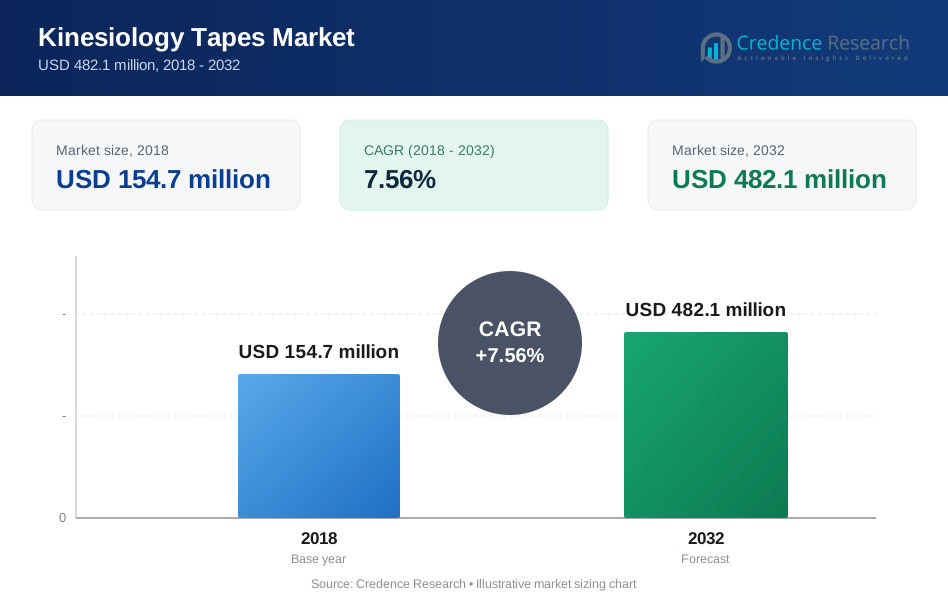
The Global Kinesiology Tapes Market size was valued at USD 154.7 million in 2018 to USD 267.2 million in 2024 and is anticipated to reach USD 482.1 million by 2032, at a CAGR of 7.56% during the forecast period.
| REPORT ATTRIBUTE | DETAILS |
|---|---|
| Historical Period | 2020-2023 |
| Base Year | 2024 |
| Forecast Period | 2025-2032 |
| Kinesiology Tapes Market Size 2024 | USD 267.2 Million |
| Kinesiology Tapes Market, CAGR | 7.56% |
| Kinesiology Tapes Market Size 2032 | USD 482.1 Million |
The market growth is driven by rising awareness of sports-related injuries and preventive healthcare. Growing participation in athletics, fitness activities, and rehabilitation programs is fueling demand. Kinesiology tapes are increasingly adopted by physiotherapists and healthcare providers for pain relief and muscle support. Expanding use among amateur and professional athletes enhances acceptance. Consumer interest in non-invasive treatment options is further supporting market expansion. Innovation in adhesive technologies and breathable materials also contributes to improved product performance and wider adoption.
Regionally, North America leads the Global Kinesiology Tapes Market due to strong sports culture and advanced healthcare infrastructure. Europe follows closely, supported by rehabilitation programs and widespread fitness awareness. Asia-Pacific is emerging rapidly, driven by growing sports participation, increasing injuries, and rising health consciousness across countries such as China, Japan, and India. Latin America shows steady growth due to expanding fitness trends, while the Middle East and Africa hold untapped potential, supported by gradual healthcare advancements and lifestyle changes.
Market Insights:
- The Global Kinesiology Tapes Market was valued at USD 154.7 million in 2018, reached USD 267.2 million in 2024, and is projected to achieve USD 482.1 million by 2032, growing at a CAGR of 7.56% between 2025 and 2032.
- Asia Pacific accounted for 34.48% of the market in 2024, followed by Europe at 29.75% and North America at 21.63%. These regions dominate due to strong sports culture, rehabilitation infrastructure, and consumer awareness of non-invasive therapies.
- Latin America is the fastest-growing region with a 7.77% share in 2024, driven by expanding sports participation, fitness awareness, and improved healthcare access across Brazil and Argentina.
- Rolls remained the largest product segment in 2024, holding about 63% of the market share, favored for their flexibility and customizable applications.
- Pre-shaped kinesiology tapes accounted for around 37% of the market in 2024, with faster growth expected due to convenience, targeted design, and higher adoption among amateur users.
Market Drivers:
Growing Awareness of Sports Injuries and Preventive Healthcare:
The Global Kinesiology Tapes Market is driven by rising awareness of sports-related injuries and prevention methods. Athletes, fitness enthusiasts, and medical professionals increasingly rely on kinesiology tapes for muscle support and injury management. The tapes are designed to improve circulation, reduce swelling, and relieve pain, which makes them highly popular in sports medicine. Increased participation in recreational and professional sports has further boosted their adoption. Rehabilitation programs also emphasize their use for muscle recovery and joint stability. Rising awareness of preventive healthcare adds to demand beyond sports. It is being positioned as a vital tool for injury avoidance in training and competition. This growing awareness continues to fuel widespread adoption across markets.
- For instance, Mueller Sports Medicine’s Typhoon Elite Kinesiology Tape, endorsed by Olympians, supports athletes by offering up to 5 days of breathable, water-resistant wear with wave pattern adhesive technology that maintains flexibility and pain reduction during intense activity.
Increased Adoption in Physiotherapy and Rehabilitation Clinics:
Physiotherapists and rehabilitation centers widely recommend kinesiology tapes for patients recovering from injuries. They are used for chronic conditions, post-surgical recovery, and musculoskeletal problems. Demand is growing in clinical practices as patients prefer non-invasive and supportive treatments. The tapes enhance patient mobility and reduce reliance on painkillers or invasive procedures. Clinics and hospitals are investing in large-scale usage due to proven therapeutic benefits. It also helps in strengthening recovery outcomes while improving quality of care. The Global Kinesiology Tapes Market benefits directly from integration into physical therapy practices. This widespread adoption among healthcare providers ensures steady demand growth.
- For instance, clinical reports show that kinesiology tape is used in rehabilitation programs as a complementary tool to manage edema (swelling) and relieve pain in specific conditions, such as after certain surgeries. While research on its effectiveness is mixed and some studies show no difference from a placebo, its use is guided by a therapist as part of a comprehensive treatment plan that includes other modalities like exercise and manual therapy.
Rising Consumer Preference for Non-Invasive and Drug-Free Solutions:
Consumers are increasingly looking for alternatives to medications for pain relief and injury management. Kinesiology tapes meet this demand by offering a drug-free and easy-to-use solution. Their lightweight, skin-friendly design allows continuous use during daily activities and sports. People with chronic pain, sprains, and strains adopt them as cost-effective options. Growing awareness of side effects linked to long-term medication use has accelerated adoption. The Global Kinesiology Tapes Market benefits from this shift toward safe and natural care options. It is gaining acceptance as part of holistic wellness trends worldwide. This strong consumer preference is expected to maintain momentum in the coming years.
Expanding Applications in Fitness, Athletics, and Everyday Wellness:
The use of kinesiology tapes extends beyond professional athletes to fitness enthusiasts and everyday users. They are increasingly adopted in gyms, training centers, and by wellness-conscious individuals. Tapes support enhanced performance by reducing fatigue and stabilizing muscles during exercise. Rising popularity of home workouts also creates higher adoption rates. Athletes rely on them for faster recovery after intense training sessions. The Global Kinesiology Tapes Market grows as more consumers adopt active lifestyles. It is also benefiting from product availability through online platforms and retail stores. This expansion into broader consumer groups continues to strengthen long-term market growth.
 Market Trends:
Innovations in Adhesive Materials and Breathable Fabric Designs:
Manufacturers are introducing advanced adhesives and fabrics that improve product performance and comfort. Breathable and hypoallergenic materials reduce irritation, allowing extended wear during sports or daily use. Waterproof designs enable athletes to perform in various environments without losing tape effectiveness. Innovations are tailored to suit sensitive skin and improve durability. Companies are investing in product customization, offering different colors, patterns, and elasticity. The Global Kinesiology Tapes Market is increasingly shaped by these innovations, making products more appealing to wider demographics. It is ensuring longer wear times, better patient compliance, and broader acceptance. Continuous advancements position tapes as premium products in wellness and sports medicine.
- For instance, RockTape GO Standard Adhesive combines 97% cotton with 3% nylon to provide a 180% stretch and water resistance, maintaining adhesion for 3-5 days even during intense sweating, thus enhancing user comfort and durability.
Integration of Kinesiology Tapes Into Sports and Fitness Culture:
The rising fitness culture and growth of sports communities have supported wider adoption. Tapes are becoming symbols of athletic preparation and recovery, frequently seen in competitive sports. Social media and influencer promotion amplify their visibility across fitness enthusiasts. Sporting events broadcast their usage by professionals, further boosting consumer interest. The Global Kinesiology Tapes Market gains visibility from endorsements and awareness campaigns. It is increasingly viewed as part of professional sports gear, not just medical equipment. This cultural integration helps normalize everyday use beyond injuries. Such visibility drives long-term demand across mainstream and niche sports.
- For instance, RockTape's promotion of its RockTapeX product, a kinesiology tape featuring Rheon Labs technology designed to stiffen based on movement speed, highlights how brands can combine innovative features and athlete endorsements to drive market adoption. However, the broader mainstream success of kinesiology tape stems more from marketing and anecdotal evidence than conclusive scientific proof of effectiveness.
Digital Marketing and E-Commerce Expansion Strengthening Market Reach:
E-commerce platforms and online distribution channels are crucial for market expansion. Consumers prefer buying kinesiology tapes online due to accessibility, variety, and discounts. Digital marketing strategies such as tutorials, influencer promotions, and wellness campaigns enhance awareness. Manufacturers partner with sports brands and online fitness communities to promote usage. The Global Kinesiology Tapes Market benefits from these channels by reaching wider audiences quickly. It is particularly strong in emerging regions where online shopping dominates consumer behavior. These strategies are reshaping consumer purchasing patterns and improving brand recognition. Enhanced reach through digital channels solidifies long-term growth.
Personalization and Lifestyle-Oriented Product Development:
Consumers are showing interest in personalized and lifestyle-focused products. Companies respond by offering kinesiology tapes in stylish designs and color variations. Functional aesthetics, such as branded or team-specific prints, are gaining traction. Wellness-driven consumers prefer products that align with their lifestyle choices. The Global Kinesiology Tapes Market is adopting personalization to increase engagement and brand loyalty. It is not only catering to athletes but also targeting fitness-conscious and wellness-oriented individuals. Brands focus on merging performance benefits with attractive appearances. This trend creates stronger consumer attachment and diversifies demand sources.
Market Challenges Analysis:
Lack of Awareness Among Non-Athletic Population and Product Misuse:
The Global Kinesiology Tapes Market faces challenges due to limited awareness outside athletic communities. Many consumers remain unfamiliar with its therapeutic benefits or proper usage methods. Misuse or incorrect application often leads to limited effectiveness, reducing trust among first-time users. Lack of guidance in retail environments makes adoption difficult for non-athletes. Misconceptions that tapes are only for professionals further limit broader acceptance. It is essential for manufacturers to invest in awareness campaigns and instructional content. Without education, untapped consumer groups may avoid or underutilize products. Addressing this challenge is vital to unlock widespread adoption.
Price Sensitivity and Availability of Alternative Treatment Methods:
Another major challenge is consumer price sensitivity, especially in emerging markets. High-quality tapes are often considered premium products, limiting affordability for some consumers. Cheaper alternatives like elastic bandages or conventional supports compete strongly in these regions. The Global Kinesiology Tapes Market is also impacted by the availability of alternative therapies like physiotherapy devices and braces. It is important for manufacturers to balance cost with performance and accessibility. Lack of insurance coverage for these products further restricts adoption in clinical settings. Price-sensitive markets require tailored strategies to sustain growth. Without addressing affordability, the market may face slower expansion rates.
 Market Opportunities:
Expansion Into Preventive Healthcare and Everyday Wellness Segments:
The Global Kinesiology Tapes Market holds strong opportunities in preventive healthcare and wellness. Consumers increasingly use tapes not only for injuries but also for daily fitness routines. The shift toward healthier lifestyles supports adoption in gyms, yoga, and recreational activities. It is also being marketed as a wellness product rather than a medical-only item. Growing popularity among non-athletes expands the consumer base. Healthcare practitioners encourage preventive usage to minimize risks of strain and fatigue. Rising consumer focus on long-term wellness creates opportunities for continuous adoption. Expanding into lifestyle-driven categories offers significant market potential.
Opportunities in Emerging Markets With Rising Sports and Fitness Culture:
Emerging markets in Asia-Pacific, Latin America, and parts of Africa present growth opportunities. Rising participation in sports, fitness awareness, and youth engagement are fueling demand. The Global Kinesiology Tapes Market benefits from increasing government initiatives promoting physical activity. It is gaining momentum as local distributors expand product availability in retail and e-commerce. Affordable product lines tailored to these regions can help tap into larger populations. Marketing through sports events, community fitness programs, and influencers strengthens brand recognition. Rapid urbanization and rising disposable incomes also support expansion. These markets provide fertile ground for sustained and scalable growth.
Market Segmentation Analysis:
By Material
Cotton dominates the market due to its breathability, comfort, and affordability, making it suitable for both clinical and athletic use. Synthetic tapes are gaining traction with superior elasticity, water resistance, and longer wear duration. Other materials cater to niche applications, often combining durability with specialized performance features.
- For example, Nexcare’s Absolute Waterproof Tape utilizes hydrocolloid and waterproof technology to secure dressings effectively during water activities, demonstrating enhanced functional use beyond basic kinesiology applications.
By Product
Rolls remain the preferred choice due to their flexibility and customizable usage across various injuries. Pre-shaped products are expanding rapidly, offering convenience and precision for targeted muscle groups, particularly for consumers with limited training in tape application.
- For instance, Mueller’s Typhoon offers 20 pre-cut strips designed for easy application and effective muscle, tendon, and ligament support without limiting motion, promoting better compliance and therapeutic outcomes in both sports and clinical settings.
By Application
Musculoskeletal pain management leads demand, driven by rising sports injuries and chronic conditions. Post-operative and lymphedema management segments are growing steadily, supported by wider clinical adoption. Posture correction appeals to younger and wellness-focused consumers, while neurological and pediatric uses expand the scope of medical rehabilitation. The Global Kinesiology Tapes Market continues to benefit from this diverse application base.
By End User
Hospitals and clinics drive consumption with extensive use in post-surgical and therapeutic care. Rehabilitation and physiotherapy centers follow closely, as tapes play a central role in recovery protocols. Home-care settings are expanding, supported by self-application guides and increased retail availability.
 Segmentation:
By Material
-
- Cotton
- Synthetic
- Others
-
- Rolls
- Pre-shaped
-
- Musculoskeletal Pain Management
- Post-operative & Lymphedema Management
- Posture Correction
- Neurological & Pediatric Uses
-
- Hospitals & Clinics
- Rehabilitation & Physiotherapy Centers
- Home-care Settings
-
- North America
- U.S.
- Canada
- Mexico
- Europe
- UK
- France
- Germany
- Italy
- Spain
- Russia
- Belgium
- Netherlands
- Austria
- Sweden
- Poland
- Denmark
- Switzerland
- Rest of Europe
- Asia Pacific
- China
- Japan
- South Korea
- India
- Australia
- Thailand
- Indonesia
- Vietnam
- Malaysia
- Philippines
- Taiwan
- Rest of Asia Pacific
- Latin America
- Brazil
- Argentina
- Peru
- Chile
- Colombia
- Rest of Latin America
- Middle East
- UAE
- KSA
- Israel
- Turkey
- Iran
- Rest of Middle East
- Africa
- Egypt
- Nigeria
- Algeria
- Morocco
- Rest of Africa
- North America
Regional Analysis:
North America
The North America Global Kinesiology Tapes Market size was valued at USD 34.20 million in 2018 to USD 57.81 million in 2024 and is anticipated to reach USD 101.24 million by 2032, at a CAGR of 7.2% during the forecast period. North America holds a market share of 21.63% in 2024. Strong sports culture, rising fitness awareness, and advanced healthcare infrastructure drive demand. The U.S. dominates regional adoption due to professional sports leagues and broad rehabilitation services. Canada and Mexico also contribute through growing fitness communities and healthcare improvements. Hospitals and clinics continue to account for significant usage across orthopedic and rehabilitation care. It is supported by high consumer awareness of non-invasive treatments. Growing availability of products across retail and online channels enhances accessibility. North America remains a leading hub for innovation and early adoption.
Europe
The Europe Global Kinesiology Tapes Market size was valued at USD 45.21 million in 2018 to USD 79.50 million in 2024 and is anticipated to reach USD 146.79 million by 2032, at a CAGR of 7.9% during the forecast period. Europe commands a 29.75% share in 2024. High adoption is supported by strong rehabilitation programs and government-backed healthcare systems. Germany, France, and the UK lead the region, with athletes and physiotherapy clinics driving usage. Italy and Spain also show rising demand due to expanding fitness activities. Russia contributes through sports-driven demand and medical rehabilitation usage. It is witnessing robust growth in posture correction and chronic pain management. Wider acceptance across hospitals and physiotherapy centers ensures consistent demand. Europe strengthens its role as a critical growth region for premium and innovative tapes.
Asia Pacific
The Asia Pacific Global Kinesiology Tapes Market size was valued at USD 52.70 million in 2018 to USD 92.10 million in 2024 and is anticipated to reach USD 168.73 million by 2032, at a CAGR of 7.8% during the forecast period. Asia Pacific accounts for 34.48% of the 2024 market share. China, Japan, and South Korea lead consumption with strong sports culture and rehabilitation practices. India shows rising demand due to expanding physiotherapy infrastructure and sports participation. Australia and Southeast Asia contribute through growing wellness and fitness adoption. It benefits from expanding middle-class populations and rising disposable incomes. Digital retail platforms are making kinesiology tapes widely accessible. Growing emphasis on injury prevention supports product acceptance. Asia Pacific emerges as the fastest-growing regional market.
Latin America
The Latin America Global Kinesiology Tapes Market size was valued at USD 11.52 million in 2018 to USD 20.78 million in 2024 and is anticipated to reach USD 39.58 million by 2032, at a CAGR of 8.3% during the forecast period. Latin America represents a 7.77% market share in 2024. Brazil dominates demand, supported by sports culture and rising fitness awareness. Argentina follows with steady adoption in physiotherapy and rehabilitation settings. Expanding healthcare access improves opportunities across other countries. It benefits from government campaigns promoting sports and physical health. Rising participation in athletics increases adoption across younger demographics. The region is showing strong interest in preventive healthcare. Latin America provides opportunities for long-term growth through increased product availability.
Middle East
The Middle East Global Kinesiology Tapes Market size was valued at USD 5.00 million in 2018 to USD 8.12 million in 2024 and is anticipated to reach USD 13.40 million by 2032, at a CAGR of 6.4% during the forecast period. The region holds a 3.04% market share in 2024. GCC countries lead adoption, supported by investments in healthcare and sports facilities. Israel contributes with advanced rehabilitation practices and technology integration. Turkey shows rising awareness and usage in fitness sectors. It remains a niche market compared to global leaders but is expanding steadily. Growth is driven by increasing focus on non-invasive therapies. Rising participation in sports, including football, strengthens demand. Distribution expansion across clinics and retail stores improves market presence.
Africa
The Africa Global Kinesiology Tapes Market size was valued at USD 6.05 million in 2018 to USD 8.90 million in 2024 and is anticipated to reach USD 12.34 million by 2032, at a CAGR of 4.0% during the forecast period. Africa holds a 3.33% share in 2024. South Africa leads regional consumption, supported by stronger healthcare infrastructure. Egypt contributes steadily with growing rehabilitation adoption. Other African nations show gradual awareness, creating a long-term growth base. It is limited by price sensitivity and restricted access to physiotherapy services. Rising sports participation across youth communities supports demand. International brands expand through distributors in urban centers. Growth opportunities exist through education and training of healthcare professionals. Africa remains an emerging market with untapped potential.
Key Player Analysis:
- KT Health LLC
- Kinesio Holding Corporation
- Nitto Denko Corporation
- 3B Scientific GmbH
- Performance Health Holding Inc.
- DL Medical & Health Co. Ltd.
- BSN medical GmbH
- 3M
- Össur hf
- Other Key Players
Competitive Analysis:
The Global Kinesiology Tapes Market is characterized by strong competition among international and regional players. Leading companies such as KT Health, Kinesio Holding Corporation, Nitto Denko Corporation, 3M, and Performance Health dominate with extensive product portfolios and global distribution. It is driven by continuous innovation in adhesive technology, breathable fabrics, and pre-shaped designs that improve usability. Smaller firms and new entrants compete by offering cost-effective alternatives and specialized designs. Strategic collaborations with sports organizations, rehabilitation centers, and retail platforms enhance brand presence. Companies also strengthen their market positions through acquisitions, product launches, and regional expansions. It continues to evolve with rising demand for non-invasive solutions in healthcare and fitness.
Recent Developments:
- In May 2025, KT Health also released a Plantar Fasciitis Tape featuring a dual-strip system providing effective relief for plantar fasciitis, a condition affecting millions. The tape became a top seller on their website and Amazon due to targeted all-day relief and ease of use, making it a notable new product in therapeutic taping.
- In May 2025, KT Health also released a Plantar Fasciitis Tape featuring a dual-strip system providing effective relief for plantar fasciitis, a condition affecting millions. The tape became a top seller on their website and Amazon due to targeted all-day relief and ease of use, making it a notable new product in therapeutic taping.
- Nitto Denko Corporation extended their partnership with the ATP until 2025, becoming a year-round Gold Partner and the Official Athletic Tape Sponsor for the ATP Tour. This strategic partnership supports elite athletes with taping products throughout the tennis season, highlighting their market presence and commitment to sports taping.
Report Coverage:
The research report offers an in-depth analysis based on material, product, application, end user, and region. It details leading market players, providing an overview of their business, product offerings, investments, revenue streams, and key applications. Additionally, the report includes insights into the competitive environment, SWOT analysis, current market trends, as well as the primary drivers and constraints. Furthermore, it discusses various factors that have driven market expansion in recent years. The report also explores market dynamics, regulatory scenarios, and technological advancements that are shaping the industry. It assesses the impact of external factors and global economic changes on market growth. Lastly, it provides strategic recommendations for new entrants and established companies to navigate the complexities of the market.
Future Outlook:
- Rising fitness culture will expand adoption across recreational and professional athletes.
- Growth in preventive healthcare will boost demand for non-invasive solutions.
- Product innovation will focus on eco-friendly and sustainable tape materials.
- Expansion of online retail channels will strengthen global product accessibility.
- Clinical adoption in rehabilitation will continue to support long-term demand.
- Emerging markets in Asia and Latin America will record strong growth opportunities.
- Partnerships with sports organizations will enhance brand visibility.
- Increasing awareness of posture correction will broaden consumer adoption.
- Customization and lifestyle-oriented designs will attract new consumer segments.
- Continuous R&D in adhesive and fabric technology will define competitive advantage.
Request a Free Sample
Fill in your details and we'll send you a free sample report.
- Sample data tables & charts
- Research methodology
Market Dynamics
Growing Awareness of Sports Injuries and Preventive Healthcare
Increasing participation in sports and fitness activities, along with a focus on injury prevention, is driving demand for kinesiology tapes among athletes, fitness enthusiasts, and healthcare professionals for muscle support and pain management.
Increased Adoption in Physiotherapy and Rehabilitation Clinics
Physiotherapists and rehabilitation centers are widely recommending kinesiology tapes for injury recovery, chronic pain, and post-surgical care, boosting clinical usage and supporting steady market growth.
Rising Consumer Preference for Non-Invasive and Drug-Free Solutions
Consumers are seeking alternatives to medication for pain relief and injury management, and kinesiology tapes offer a drug-free, easy-to-use, and skin-friendly solution, aligning with holistic wellness trends.
Innovation in Adhesive Technologies and Breathable Materials
Manufacturers are introducing advanced adhesives and breathable, hypoallergenic fabrics that improve comfort, durability, and wear time, making kinesiology tapes more appealing and expanding their adoption.
Expansion of Online Retail and Digital Marketing
The growth of e-commerce platforms and digital marketing campaigns has made kinesiology tapes more accessible to a wider audience, especially in emerging markets, accelerating global market penetration.
Need a Custom Version of This Report?
Tailor the scope, geography, or segments to your exact requirements.
- Custom geography or segment scope
- Direct access to our analyst team
Frequently Asked Questions
What is the current market size for Global Kinesiology Tapes Market, and what is its projected size in 2032?
At what Compound Annual Growth Rate is the Global Kinesiology Tapes Market projected to grow between 2025 and 2032?
Which Global Kinesiology Tapes Market segment held the largest share in 2024?
What are the primary factors fueling the growth of the Global Kinesiology Tapes Market?
Who are the leading companies in the Global Kinesiology Tapes Market?
Which region commanded the largest share of the Global Kinesiology Tapes Market in 2024?
Table of Content
Chapter 1 Market Segmentation
- 1.1 Segmentation Framework
- 1.1.1 Product and Service Classification
- 1.1.2 Application and End-Use Classification
- 1.1.3 Technology and Solution Classification
- 1.1.4 Customer and Distribution Channel Classification
- 1.1.5 Geographic Segmentation
- 1.1.6 Market Segment Definitions and Boundaries
- 1.2 By Product
- 1.2.1 Rolls
- 1.2.2 Pre-shaped
- 1.3 By End User
- 1.3.1 Hospitals & Clinics
- 1.3.2 Rehabilitation & Physiotherapy Centers
- 1.3.3 Home-care Settings
- 1.4 By Material
- 1.4.1 Cotton
- 1.4.2 Synthetic
- 1.4.3 Others
- 1.5 By Application
- 1.5.1 Musculoskeletal Pain Management
- 1.5.2 Post-operative & Lymphedema Management
- 1.5.3 Posture Correction
- 1.5.4 Neurological & Pediatric Uses
Chapter 2 Introduction
- 2.1 Report Objectives and Scope
- 2.2 Product Definition and Industry Terminology
- 2.3 Market Inclusions and Exclusions
- 2.4 Research Process
- 2.4.1 Primary Research and Expert Interviews
- 2.4.2 Secondary Research and Source Review
- 2.4.3 Top-Down and Bottom-Up Estimation
- 2.4.4 Data Triangulation and Verification
- 2.5 Market Size Measurement Basis
- 2.5.1 2018: USD 154.7 million → 2032: USD 482.1 million
- 2.6 Historical and Forecast Reference Periods
- 2.6.1 Base Year: 2018
- 2.6.2 Forecast Period: 2018-2032
- 2.7 Research Assumptions and Limitations
Chapter 3 Executive Summary
- 3.1 Market Snapshot and Key Findings
- 3.2 Base-Year Market Size, 2018
- 3.3 Forecast Market Size, 2032
- 3.4 Revenue and Volume Growth Outlook
- 3.5 Key Demand and Supply Indicators
- 3.6 Leading Market Segments
- 3.7 Fastest-Growing Market Opportunities
- 3.8 Regional Performance Highlights
- 3.9 Technology and Industry Transformation
- 3.10 Competitive Landscape Summary
- 3.11 Analyst View and Strategic Implications
Chapter 4 Global Kinesiology Tapes Market Trends and Developments
- 4.1 Historical Industry Development
- 4.2 Recent Market Trends and Developments
- 4.3 Demand and Customer Behavior Trends
- 4.4 Technology and Product Innovation
- 4.5 Artificial Intelligence, Automation and Digitalization
- 4.6 Local Manufacturing and Supply Chain Realignment
- 4.7 Industry Partnerships, Mergers and Acquisitions
- 4.8 Sustainability and Circular Economy Developments
- 4.9 Government and Private Sector Investment Trends
- 4.10 Emerging Business Models and Commercialization
- 4.11 Industry Developments and Announcements
Chapter 5 Global Kinesiology Tapes Market Production, Supply and Demand Analysis
- 5.1 Demand Trend and Consumption Analysis
- 5.2 Demand Forecast, 2018-2032
- 5.3 Production and Output Trend
- 5.4 Production and Output Forecast, 2018-2032
- 5.5 Installed Capacity and Capacity Utilization
- 5.6 Company-Wise Production Plants and Statistics
- 5.6.1 Installed Production Capacity
- 5.6.2 Actual Production
- 5.6.3 Planned Capacity and Expansion Targets
- 5.7 Supply Chain Structure and Procurement Trends
- 5.8 Supply-Demand Gap and Bottlenecks
- 5.9 Import Dependence and Sourcing Structure
- 5.10 Contract Manufacturing and Outsourcing
- 5.11 Regional Supply and Demand Concentration
Chapter 6 Global Kinesiology Tapes Market Pricing Analysis
- 6.1 Pricing Structure and Measurement
- 6.2 Historical Pricing Trends
- 6.3 Pricing Outlook, 2018-2032
- 6.4 Average Selling Price and Unit Economics
- 6.5 Pricing by Product and Market Segment
- 6.6 Geographic Pricing Differences
- 6.7 Key Input, Energy, Labor and Logistics Costs
- 6.8 Contract Pricing and Purchasing Models
- 6.9 Pricing Sensitivity and Competitive Positioning
- 6.10 Price, Margin and Profitability Implications
Chapter 7 Global Kinesiology Tapes Market Dynamics
- 7.1 Market Growth Drivers
- 7.1.1 Demand-Side Drivers
- 7.1.2 Technology and Innovation Drivers
- 7.1.3 Infrastructure and Investment Drivers
- 7.1.4 Regulatory and Policy Drivers
- 7.2 Market Restraints
- 7.2.1 Cost and Affordability Constraints
- 7.2.2 Technology and Adoption Barriers
- 7.2.3 Supply Chain and Operational Constraints
- 7.3 Market Challenges
- 7.3.1 Competitive Pressure and Margin Erosion
- 7.3.2 Skills, Infrastructure and Implementation Gaps
- 7.4 Emerging Market Opportunities
- 7.5 Market Dynamics Impact and Time-Horizon Assessment
Chapter 8 Global Kinesiology Tapes Value Chain Analysis
- 8.1 Industry Value Chain Overview
- 8.2 Upstream Suppliers and Critical Inputs
- 8.3 Technology and Component Providers
- 8.4 Manufacturing or Service Delivery
- 8.5 Distribution, Channel Partners and Integrators
- 8.6 Downstream Applications and End Users
- 8.7 Value Addition and Profit Pools
- 8.8 Vertical Integration and Outsourcing
- 8.9 Supplier Concentration and Risk
- 8.10 Supply Chain Localization and Resilience
Chapter 9 Global Kinesiology Tapes Market Regulations and Policies
- 9.1 Relevant Laws, Standards and Compliance Frameworks
- 9.2 Product, Service, Safety and Quality Requirements
- 9.3 Government Policies, Incentives and Subsidies
- 9.4 Imports, Exports and Trade Barriers
- 9.5 Public Procurement and Local Content Requirements
- 9.6 Environmental and Sustainability Compliance
- 9.7 Upcoming Policy Changes and Market Implications
Chapter 10 Global Kinesiology Tapes Market Hotspots and Opportunities
- 10.1 Market Opportunity Mapping and Growth Hotspots
- 10.2 High-Growth Applications and Customer Groups
- 10.3 Underserved Markets and White-Space Opportunities
- 10.4 Emerging Technology and Product Opportunities
- 10.5 New Capacity and Investment Hotspots
- 10.6 Market Entry and Expansion Opportunities
- 10.7 Distribution and Partnership Opportunities
- 10.8 Near-Term and Long-Term Commercial Potential
- 10.9 Opportunity Attractiveness and Execution Risks
Chapter 11 Global Kinesiology Tapes Market Outlook, 2018-2032
- 11.1 Market Size and Analysis
- 11.1.1 Revenue (Market Measurement: 2018: USD 154.7 million → 2032: USD 482.1 million)
- 11.1.2 Market Volume and Quantity Sold
- 11.1.3 Historical Market Size
- 11.1.4 Base-Year Market Size, 2018
- 11.2 Market Forecast, 2018-2032
- 11.2.1 Revenue Forecast to 2032
- 11.2.2 Volume Forecast to 2032
- 11.2.3 CAGR and Year-on-Year Growth
- 11.2.4 Incremental Revenue Opportunity
- 11.3 Forecast Assumptions and Scenario Analysis
- 11.3.1 Base-Case Forecast
- 11.3.2 Optimistic and Conservative Scenarios
- 11.3.3 Technology, Pricing and Policy Sensitivities
- 11.4 Market Attractiveness and Growth Outlook
Chapter 12 Global Kinesiology Tapes Market Segmentation and Outlook
- 12.1 Segmentation Summary and Market Shares, 2018
- 12.2 Largest and Fastest-Growing Segments
- 12.3 By Product - Market Size and Forecast, 2018-2032
- 12.3.1 Segment Definition and Scope
- 12.3.2 Historical Market Size
- 12.3.3 Revenue Forecast, 2018-2032
- 12.3.4 Volume Forecast, 2018-2032
- 12.3.5 Base-Year Market Share, 2018
- 12.3.6 Segment CAGR and Growth Drivers
- 12.3.7 Subsegment Market Size and Forecast
- 12.3.7.1 Rolls
- 12.3.7.2 Pre-shaped
- 12.3.8 Subsegment Pricing and Adoption Trends
- 12.3.9 Leading Suppliers and Competition
- 12.3.10 Regional Demand and Opportunities
- 12.4 By End User - Market Size and Forecast, 2018-2032
- 12.4.1 Segment Definition and Scope
- 12.4.2 Historical Market Size
- 12.4.3 Revenue Forecast, 2018-2032
- 12.4.4 Volume Forecast, 2018-2032
- 12.4.5 Base-Year Market Share, 2018
- 12.4.6 Segment CAGR and Growth Drivers
- 12.4.7 Subsegment Market Size and Forecast
- 12.4.7.1 Hospitals & Clinics
- 12.4.7.2 Rehabilitation & Physiotherapy Centers
- 12.4.7.3 Home-care Settings
- 12.4.8 Subsegment Pricing and Adoption Trends
- 12.4.9 Leading Suppliers and Competition
- 12.4.10 Regional Demand and Opportunities
- 12.5 By Material - Market Size and Forecast, 2018-2032
- 12.5.1 Segment Definition and Scope
- 12.5.2 Historical Market Size
- 12.5.3 Revenue Forecast, 2018-2032
- 12.5.4 Volume Forecast, 2018-2032
- 12.5.5 Base-Year Market Share, 2018
- 12.5.6 Segment CAGR and Growth Drivers
- 12.5.7 Subsegment Market Size and Forecast
- 12.5.7.1 Cotton
- 12.5.7.2 Synthetic
- 12.5.7.3 Others
- 12.5.8 Subsegment Pricing and Adoption Trends
- 12.5.9 Leading Suppliers and Competition
- 12.5.10 Regional Demand and Opportunities
- 12.6 By Application - Market Size and Forecast, 2018-2032
- 12.6.1 Segment Definition and Scope
- 12.6.2 Historical Market Size
- 12.6.3 Revenue Forecast, 2018-2032
- 12.6.4 Volume Forecast, 2018-2032
- 12.6.5 Base-Year Market Share, 2018
- 12.6.6 Segment CAGR and Growth Drivers
- 12.6.7 Subsegment Market Size and Forecast
- 12.6.7.1 Musculoskeletal Pain Management
- 12.6.7.2 Post-operative & Lymphedema Management
- 12.6.7.3 Posture Correction
- 12.6.7.4 Neurological & Pediatric Uses
- 12.6.8 Subsegment Pricing and Adoption Trends
- 12.6.9 Leading Suppliers and Competition
- 12.6.10 Regional Demand and Opportunities
- 12.7 Segment Growth Comparison
- 12.8 Segment Attractiveness and Priority Matrix
Chapter 13 Global Kinesiology Tapes End-Use and Application Market Outlook
- 13.1 End-Use Industry and Customer Demand Structure
- 13.2 Leading Applications and Customer Groups
- 13.3 End-Use Market Size, Share and Forecast
- 13.4 Major End-Use Industry Deep Dives
- 13.4.1 Customer Requirements and Use Cases
- 13.4.2 Demand and Replacement Cycles
- 13.4.3 Technical and Regulatory Considerations
- 13.4.4 Purchasing and Procurement Models
- 13.4.5 Leading Vendors and Distribution Channels
- 13.4.6 Forecast and Commercial Opportunities
- 13.5 Emerging Applications and Cross-Segment Demand
- 13.6 End-Use Industry Investment Priorities
Chapter 14 Global Kinesiology Tapes Geographic Market Outlook, 2018-2032
- 14.1 Regional Market Size and Share, 2018
- 14.2 Regional Market Forecast, 2018-2032
- 14.3 Regional Pricing, Production and Demand Differences
- 14.4 North America
- 14.4.1 United States
- 14.4.2 Canada
- 14.4.3 Mexico
- 14.5 Europe
- 14.5.1 Germany
- 14.5.2 France
- 14.5.3 Italy
- 14.5.4 United Kingdom
- 14.5.5 Spain
- 14.5.6 Poland
- 14.5.7 Russia
- 14.5.8 Netherlands
- 14.5.9 Belgium
- 14.5.10 Sweden
- 14.5.11 Denmark
- 14.5.12 Norway
- 14.5.13 Rest of Europe
- 14.6 Asia Pacific
- 14.6.1 China
- 14.6.2 India
- 14.6.3 Japan
- 14.6.4 South Korea
- 14.6.5 Thailand
- 14.6.6 Indonesia
- 14.6.7 Vietnam
- 14.6.8 Malaysia
- 14.6.9 Australia
- 14.6.10 Rest of Asia Pacific
- 14.7 Latin America
- 14.7.1 Brazil
- 14.7.2 Argentina
- 14.7.3 Colombia
- 14.7.4 Chile
- 14.7.5 Rest of Latin America
- 14.8 Middle East
- 14.8.1 Saudi Arabia
- 14.8.2 United Arab Emirates
- 14.8.3 Turkey
- 14.8.4 Israel
- 14.8.5 Iran
- 14.8.6 Rest of the Middle East
- 14.9 Africa
- 14.9.1 South Africa
- 14.9.2 Egypt
- 14.9.3 Nigeria
- 14.9.4 Morocco
- 14.9.5 Rest of Africa
- 14.10 Regional Investment, Policy and Supply Chain Differences
- 14.11 Regional Competitive Landscape
- 14.12 Geographic Growth Hotspots
Chapter 15 Global Kinesiology Tapes Technology, Innovation and Sustainability Outlook
- 15.1 Technology Landscape and Maturity
- 15.2 Product, Process and Service Innovation
- 15.3 AI, Automation and Digital Tools in the Industry
- 15.4 Technology Adoption and Performance Benchmarking
- 15.5 Innovation Pipeline and R&D Investment
- 15.6 Patent and Intellectual Property Trends
- 15.7 Energy Efficiency and Resource Management
- 15.8 Sustainability, Recycling and Circularity
- 15.9 Technology Roadmap, 2018-2032
- 15.10 Risks of Obsolescence and Technology Substitution
Chapter 16 Global Kinesiology Tapes Market Key Strategic Imperatives
- 16.1 Growth and Market Entry Priorities
- 16.2 High-Return Products and Segments
- 16.3 Pricing, Profitability and Cost Optimization
- 16.4 Technology Investment and Product Differentiation
- 16.5 Supply Chain Localization and Resilience
- 16.6 Distribution and Customer Acquisition
- 16.7 Partnership, Acquisition and Capacity Strategy
- 16.8 Regional Expansion Priorities
- 16.9 Short-, Medium- and Long-Term Actions
Chapter 17 Competition Outlook
- 17.1 Industry Competition Characteristics
- 17.2 Market Structure and Concentration
- 17.3 Market Share and Competitive Positioning, 2018
- 17.4 Company-Wise Revenue and Product Benchmarking
- 17.5 Production and Service Capacity Benchmarking
- 17.6 Technology, Pricing and Differentiation
- 17.7 Regional Footprint and Distribution Strength
- 17.8 Mergers, Acquisitions and Strategic Alliances
- 17.9 New Entrants and Competitive Threats
- 17.10 Porter's Five Forces and Industry Attractiveness
- 17.11 Competitive Outlook, 2018-2032
Chapter 18 Company Profiles
- 18.1 Company Coverage and Selection Criteria
- 18.2 KT Health LLC
- 18.2.1 Business Description
- 18.2.2 Company Ownership and Geographic Presence
- 18.2.3 Product and Service Portfolio
- 18.2.4 Manufacturing and Operating Footprint
- 18.2.5 Production Capacity and Expansion Plans
- 18.2.6 Financial Performance and Investment
- 18.2.7 Market Share and Competitive Position
- 18.2.8 Technology and Innovation Capabilities
- 18.2.9 Strategic Alliances or Partnerships
- 18.2.10 Recent Developments
- 18.2.11 Growth Strategy and Outlook
- 18.3 Kinesio Holding Corporation
- 18.4 Nitto Denko Corporation
- 18.5 3M
- 18.6 Performance Health Holding Inc.
- 18.7 BSN medical GmbH
- 18.8 3B Scientific GmbH
- 18.9 DL Medical & Health Co. Ltd.
- 18.10 Össur hf
- 18.11 Other Relevant Market Participants
Note: Every listed company is profiled on the structure shown under the first company. The company list is preliminary and may change based on research findings, market developments, data availability and client requirements.
Chapter 19 Disclaimer
- 19.1 Research and Forecast Disclaimer
- 19.2 Data Source and Estimation Limitations
Note: The depth of individual sections depends on data availability for this market. Volume, capacity, trade and other unit-based metrics are included where applicable.
