
Market Overview
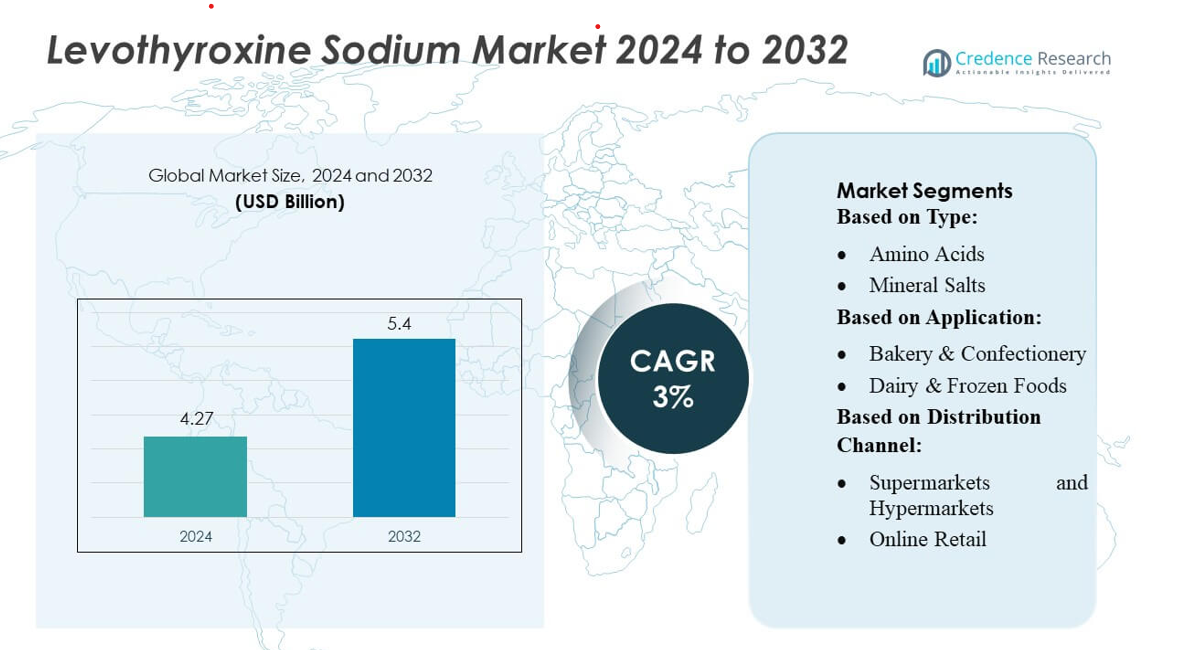
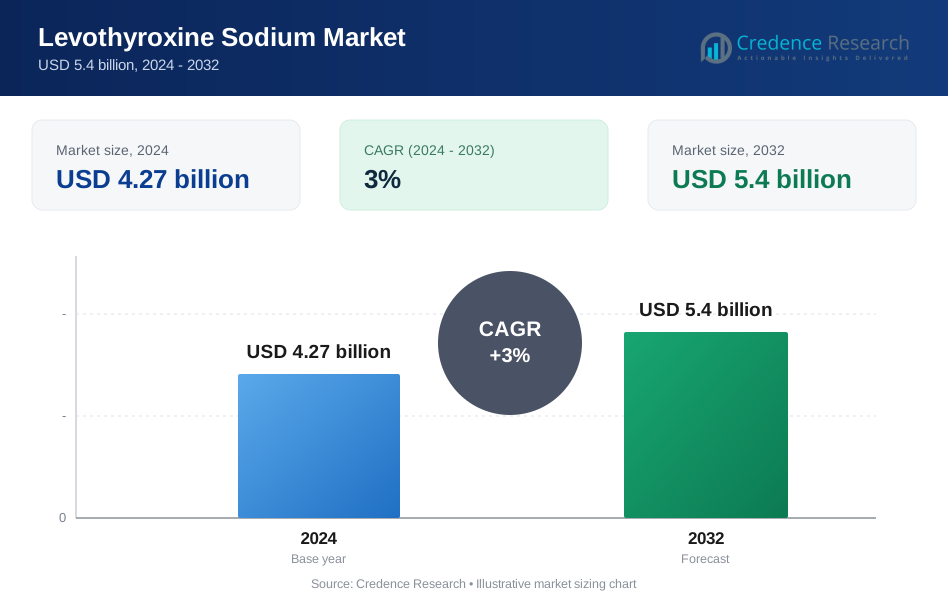
Levothyroxine Sodium Market size was valued USD 4.27 billion in 2024 and is anticipated to reach USD 5.4 billion by 2032, at a CAGR of 3% during the forecast period.
| REPORT ATTRIBUTE | DETAILS |
|---|---|
| Historical Period | 2020-2023 |
| Base Year | 2024 |
| Forecast Period | 2025-2032 |
| Levothyroxine Sodium Market Size 2024 | USD 4.27 billion |
| Levothyroxine Sodium Market, CAGR | 3% |
| Levothyroxine Sodium Market Size 2032 | USD 5.4 billion |
The Levothyroxine Sodium market is led by key players including Nouryon, K+S Aktiengesellschaft, Compass Minerals, Rio Tinto, Swiss Salt Works AG, Maldon Crystal Salt Company Ltd, Cargill, Incorporated, Südwestdeutsche Salzwerke AG, INEOS, and Kishida Chemical Co., Ltd. These companies focus on expanding production capacity, enhancing formulation quality, and strengthening distribution networks to maintain competitive advantage. Strategic partnerships, mergers, and acquisitions enable efficient raw material sourcing and entry into emerging markets, while investments in research and development support innovation in bioavailable and patient-friendly formulations. North America remains the leading region, accounting for approximately 42% of the global market, driven by high diagnosis rates, advanced healthcare infrastructure, and widespread access to both branded and generic levothyroxine. The region’s robust regulatory framework and strong distribution channels further consolidate its market dominance, setting a benchmark for growth across other regions.
Market Insights
- The Levothyroxine Sodium market size was valued at USD 4.27 billion in 2024 and is expected to reach USD 5.4 billion by 2032, growing at a CAGR of 3% during the forecast period.
- North America leads the market with approximately 42% share, supported by high diagnosis rates, strong healthcare infrastructure, and easy access to both branded and generic formulations, followed by Europe and Asia-Pacific with significant regional contributions.
- Increasing prevalence of thyroid disorders, rising awareness, and expanding healthcare access drive market growth globally.
- Market trends include growing adoption of generic formulations, advancements in bioavailable and patient-friendly products, and integration of digital health solutions for better treatment adherence.
- Competitive strategies focus on production expansion, partnerships, mergers, and research investments, while challenges include regulatory hurdles, price sensitivity, and limited access in rural regions, which may restrain growth in some areas.
Market Segmentation Analysis:
By Type:
In the Levothyroxine Sodium market, the Amino Acids segment holds the dominant share, driven by its high bioavailability and effectiveness in thyroid hormone synthesis. Mineral Salts and Yeast Extract segments also contribute to growth, supported by their role in enhancing the stability and absorption of levothyroxine formulations. The “Others” category, including flavor enhancers and preservatives, experiences moderate demand, primarily in specialty formulations. Increasing prevalence of thyroid disorders and the rising preference for pharmaceutical products with superior efficacy are key factors fueling the dominance of amino acid-based levothyroxine across global markets.
- For instance, Compass Minerals reports an underground‑mining capacity of up to 12,500,000 short tons annually from its rock-salt mines, using continuous‑mining with steel cutting picks (no explosives).
By Application:
The Bakery & Confectionery segment leads the application category, accounting for the largest market share due to the integration of levothyroxine in functional food products aimed at health-conscious consumers. Dairy & Frozen Foods and Sweet & Savory Snacks follow, benefiting from innovation in fortified and enriched foods. Meat, Seafood & Poultry, Soups, Dressings & Salads, and other niche food applications are witnessing incremental adoption. Market growth is propelled by increasing awareness of thyroid health and consumer preference for convenient, nutrient-enhanced food products, encouraging manufacturers to expand fortified offerings in mainstream and specialty food categories.
- For instance, LG Chem Ltd. the product Hyruan ONE® Inj. uses a BDDE cross-linked sodium hyaluronate gel at a dose of 60 mg in 3.0 mL per syringe, intended for a one-time intra-articular injection into the knee.
By Distribution Channel:
Supermarkets and Hypermarkets dominate the distribution channel segment, supported by extensive reach, competitive pricing, and convenient consumer access. Online Retail is experiencing rapid growth due to rising e-commerce adoption and the ability to provide specialty formulations directly to consumers. Specialty Stores and Food Service channels contribute steadily, catering to targeted demographics seeking health-focused products. Direct Sales and Other channels, including wholesalers and distributors, enable strategic market penetration. Key drivers include evolving consumer buying patterns, demand for accessibility, and the increasing availability of levothyroxine-fortified products across multiple retail touchpoints.
Key Growth Drivers
Rising Prevalence of Thyroid Disorders:
The increasing incidence of hypothyroidism and other thyroid-related disorders worldwide is a primary growth driver for the Levothyroxine Sodium market. Aging populations, lifestyle changes, and iodine-deficient diets contribute to growing demand for thyroid hormone replacement therapies. Healthcare providers are increasingly prescribing levothyroxine for long-term management, fueling consistent market expansion. For instance, routine thyroid screening and early diagnosis initiatives in both developed and emerging regions are driving the adoption of levothyroxine-based treatments.
- For instance, Hyacyst® is a medical device containing a sterile solution of sodium hyaluronate. Hyacyst® (sodium hyaluronate), which is offered in pre-filled syringes of 40 mg in 50 mL and 120 mg in 50 mL.
Advancements in Pharmaceutical Formulations:
Innovations in drug formulation, including sustained-release tablets and liquid preparations, enhance patient compliance and therapeutic efficacy. These technological advancements reduce dosing frequency and improve absorption, making treatment more convenient and effective. Pharmaceutical companies are also developing combination therapies to address multiple thyroid conditions simultaneously. Such formulation improvements are creating a competitive advantage, attracting both prescribers and patients, and significantly boosting market demand across different regions.
- For instance, Ferring B.V.’s product EUFLEXXA® is formulated at 1% sodium hyaluronate (i.e., 10 mg per mL) for intra-articular knee injection.The material’s ability to reduce friction and promote tissue healing enhances treatment outcomes.
Rising Awareness and Health-Conscious Consumer Behavior:
Growing consumer awareness regarding thyroid health and preventive care is contributing to market growth. Educational campaigns and digital health initiatives encourage routine testing and proactive management of thyroid disorders. This has led to increased adoption of levothyroxine, particularly in regions with expanding healthcare access. In addition, the rising trend of functional foods and fortified products containing levothyroxine or thyroid-supporting compounds is expanding the market beyond conventional pharmaceutical channels, driving broader consumption.
Key Trends & Opportunities
Expansion of E-Commerce and Direct-to-Consumer Channels:
The increasing adoption of online pharmacies and direct-to-consumer sales platforms presents significant market opportunities. Consumers can access specialty formulations conveniently, improving adherence to prescribed regimens. This trend also allows manufacturers to reach underserved regions and niche patient populations, fostering market penetration. Integration of telemedicine consultations and online prescription fulfillment further strengthens this channel, creating a seamless healthcare experience while boosting levothyroxine sales globally.
- For instance, Ashland’s hyalurotech™ portfolio includes grades such as Hyalurotech™ 1000" refers to a high molecular weight variant of approximately 1000 kDa."Hyalurotech™ 1800" refers to an even higher molecular weight variant of approximately 1800 kDa.
Rising Focus on Personalized Therapy:
Personalized medicine is gaining traction in thyroid management, creating opportunities for tailored levothyroxine dosages based on genetic, metabolic, and lifestyle factors. Advanced diagnostic tools enable physicians to optimize therapy for individual patients, enhancing treatment efficacy and reducing adverse effects. Pharmaceutical companies are exploring precision dosing solutions, including digital adherence monitoring and adjustable tablet strengths, positioning themselves to meet evolving consumer expectations and capture market share in a patient-centric healthcare landscape.
- For instance, ophthalmic product line (e.g., Ophteis®/OphteisMax®), each mL Contains 10.0 mg sodium hyaluronate per mL, which is a concentration of 1.0%. Contains 14.0 mg sodium hyaluronate per mL, which is a concentration of 1.4%.
Integration with Functional Foods and Nutraceuticals:
Manufacturers are increasingly exploring fortification of food products with thyroid-supporting nutrients and levothyroxine derivatives. This trend aligns with rising consumer preference for functional foods that promote overall wellness and thyroid health. Opportunities exist in bakery, dairy, and snack segments, where convenient delivery formats can expand patient reach beyond conventional pharmaceuticals. Such integration not only drives product innovation but also encourages long-term adoption among health-conscious consumers seeking preventive approaches.
Key Challenges
Stringent Regulatory Compliance:
Levothyroxine sodium products are subject to strict regulatory oversight in major markets, including safety, efficacy, and quality standards. Compliance with multiple regional regulatory frameworks can slow product launches and increase operational costs. Manufacturers must invest in robust clinical trials, accurate labeling, and rigorous quality control, which may pose barriers for new entrants and small-scale producers. Regulatory delays can also impact market growth, particularly for innovative formulations seeking approval in highly regulated regions.
Dosage Sensitivity and Patient Adherence Issues:
Levothyroxine requires precise dosing, and even minor deviations can lead to under-treatment or adverse effects. Patient adherence is often challenged by complex dosing schedules, dietary restrictions, and interactions with other medications. Ensuring consistent therapeutic outcomes necessitates ongoing physician supervision and patient education, which can limit widespread adoption. Addressing adherence challenges remains a critical hurdle for manufacturers and healthcare providers, impacting both clinical success and market expansion.
Regional Analysis
North America
North America leads the Levothyroxine Sodium market with around 40–45% share. Strong healthcare infrastructure, high diagnosis of thyroid disorders, and easy access to medications drive the market. The United States is the largest contributor, supported by insurance coverage and well-established distribution networks. Canada also shows steady demand. The availability of both branded and generic formulations ensures patients have treatment options, maintaining market stability. Overall, North America continues to dominate due to high awareness, reliable supply, and widespread medical services.
Europe
Europe holds about 30% of the global market. The region benefits from high thyroid disorder prevalence, strong healthcare systems, and effective pharmacy networks. Countries like Germany, France, the UK, and Italy are major contributors. Generics play an important role in improving accessibility and affordability. Europe’s stable regulatory framework and advanced diagnostic services support consistent treatment, keeping demand steady. Growing awareness of thyroid health and improved patient compliance further drive market growth.
Asia-Pacific
Asia-Pacific accounts for roughly 23–25% of the global market. Rising healthcare access, increasing thyroid disorder cases, and growing availability of generics drive demand. China and India are key contributors, with expanding public health awareness boosting diagnosis and treatment. The region shows strong growth potential due to population size and improving healthcare infrastructure. Access to affordable medications is increasing, particularly in urban areas, supporting steady market expansion in Asia-Pacific.
Latin America
Latin America holds around 5–8% of the market. Growth is gradual but steady, supported by improving healthcare infrastructure and increasing awareness of thyroid disorders. Brazil leads the region, followed by other South American countries. Expanding access to generic levothyroxine helps reach more patients. Urban areas show higher uptake, while rural regions face access challenges. Overall, the market in Latin America is small but growing steadily.
Middle East & Africa
Middle East & Africa also account for about 5–8% of the market. The region is seeing gradual growth due to increasing healthcare investment, better diagnostics, and rising awareness of thyroid disorders. Urban areas are the main markets, with more pharmacies and hospitals offering levothyroxine. Rural areas still face access challenges. While the market is smaller than in North America or Europe, it is slowly expanding with improvements in healthcare infrastructure and patient awareness.
Market Segmentations:
By Type:
- Amino Acids
- Mineral Salts
By Application:
- Bakery & Confectionery
- Dairy & Frozen Foods
By Distribution Channel:
- Supermarkets and Hypermarkets
- Online Retail
By Geography
- North America
- U.S.
- Canada
- Mexico
- Europe
- Germany
- France
- U.K.
- Italy
- Spain
- Rest of Europe
- Asia Pacific
- China
- Japan
- India
- South Korea
- South-east Asia
- Rest of Asia Pacific
- Latin America
- Brazil
- Argentina
- Rest of Latin America
- Middle East & Africa
- GCC Countries
- South Africa
- Rest of the Middle East and Africa
Competitive Landscape
The Levothyroxine Sodium market include Nouryon, K+S Aktiengesellschaft, Compass Minerals, Rio Tinto, Swiss Salt Works AG, Maldon Crystal Salt Company Ltd, Cargill, Incorporated, Südwestdeutsche Salzwerke AG, INEOS, and Kishida Chemical Co., Ltd. The Levothyroxine Sodium market is moderately competitive, driven by strong demand for both branded and generic formulations. Companies focus on expanding manufacturing capabilities, improving product purity, and enhancing distribution networks to maintain market presence. Strategic initiatives such as mergers, acquisitions, and partnerships are commonly adopted to secure raw materials and enter emerging markets. Investment in research and development supports innovation in high-bioavailability formulations and patient-friendly dosage forms. Competitive pricing, regulatory compliance, and efficient supply chain management are critical factors influencing market share. Overall, market players prioritize technological advancements, quality assurance, and regional expansion to strengthen their position and capture growth opportunities in a steadily expanding global market.
Key Player Analysis
- Nouryon
- K+S Aktiengesellschaft
- Compass Minerals
- Rio Tinto
- Swiss Salt Works AG
- Maldon Crystal Salt Company Ltd
- Cargill, Incorporated
- Südwestdeutsche Salzwerke AG
- INEOS
- Kishida Chemical Co., Ltd.
Recent Developments
- In December 2024, Goyal Salt Limited announced an investment to establish a new manufacturing plant in India, aimed at enhancing its production capacity and market reach. This strategic expansion aligns with the company's growth plans to meet the rising demand for high-quality salt across various industries, including food processing, pharmaceuticals, and industrial applications.
- In September 2024, QatarEnergy announced a joint venture to develop a industrial salt production plant with a planned capacity of tons per annum in Qatar. The facility will produce table and industrial salts, catering to various sectors. This initiative aims to strengthen Qatar’s domestic production capabilities and reduce reliance on imports.
- In May 2024, Altris and Clarios formed a Joint Development Agreement to advance sodium-ion (Na-ion) battery technology for low-voltage vehicle applications. Altris will focus on developing the Na-ion cells, while Clarios will use its expertise in Battery Management Systems (BMS), software, and system integration to create the complete battery system
Report Coverage
The research report offers an in-depth analysis based on Type, Application, Distribution Channel and Geography. It details leading market players, providing an overview of their business, product offerings, investments, revenue streams, and key applications. Additionally, the report includes insights into the competitive environment, SWOT analysis, current market trends, as well as the primary drivers and constraints. Furthermore, it discusses various factors that have driven market expansion in recent years. The report also explores market dynamics, regulatory scenarios, and technological advancements that are shaping the industry. It assesses the impact of external factors and global economic changes on market growth. Lastly, it provides strategic recommendations for new entrants and established companies to navigate the complexities of the market.
Future Outlook
- The market is expected to grow steadily due to increasing thyroid disorder prevalence.
- Expansion of generic formulations will enhance accessibility and affordability for patients.
- Rising awareness about hypothyroidism will drive higher diagnosis and treatment rates.
- Improved healthcare infrastructure in emerging regions will support market growth.
- Research and development will focus on more stable and bioavailable formulations.
- Digital health initiatives and telemedicine will boost patient adherence and treatment monitoring.
- Regulatory approvals for new formulations will open additional market opportunities.
- Strategic collaborations and partnerships will strengthen global distribution networks.
- Urbanization and lifestyle changes will continue to increase demand for thyroid therapies.
- Technological advancements in drug manufacturing will enhance production efficiency and consistency.
Request a Free Sample
Fill in your details and we'll send you a free sample report.
- Sample data tables & charts
- Research methodology
Need a Custom Version of This Report?
Tailor the scope, geography, or segments to your exact requirements.
- Custom geography or segment scope
- Direct access to our analyst team
Frequently Asked Questions
What is the current market size for Levothyroxine Sodium Market, and what is its projected size in 2032?
At what Compound Annual Growth Rate is the Levothyroxine Sodium Market projected to grow between 2025 and 2032?
Who are the major players in this market?
What are the primary factors fueling the growth of the Levothyroxine Sodium Market?
Who are the leading companies in the Levothyroxine Sodium Market?
Table of Content
Chapter 1. Report Introduction
- 1.1 Report Description & Purpose
- 1.1.1 Report Title & Market Definition
- 1.1.2 Unique Selling Propositions (USP) & Key Differentiators
- 1.1.3 Value Proposition for Stakeholders
- 1.2 Research Objectives
- 1.2.1 Market Sizing Objectives (Volume & Revenue)
- 1.2.2 Segmentation Objectives
- 1.2.3 Competitive Intelligence Objectives
- 1.2.4 Forecast & Scenario Objectives
- 1.3 Report Scope
- 1.3.1 Levothyroxine Sodium Scope – Types & Subtypes Covered
- 1.3.2 Geographic Scope – Regions & Countries Covered
- 1.3.3 Historical Period, Base Year & Forecast Period (2024; forecast to 2032)
- 1.3.4 Inclusions & Exclusions
- 1.4 HS Code & Classification Framework
- 1.5 Currency, Units & Pricing Basis
- 1.6 Target Stakeholders
- 1.7 Limitations & Assumptions
Chapter 2. Executive Summary
- 2.1 Global Levothyroxine Sodium Market Snapshot
- 2.1.1 Market Size – Historical (2024) & Forecast (2024-2032) (2024: USD 4.27 billion → 2032: USD 5.4 billion)
- 2.1.2 Volume & Revenue – Global Totals
- 2.1.3 Key Market Highlights – Top Five Facts
- 2.2 Levothyroxine Sodium Market Segmentation Snapshot
- 2.2.1 Market Split by Region – 2024 vs. 2032
- 2.3 Competitive Snapshot
- 2.3.1 Top 10 Players by Revenue Share – 2024
- 2.3.2 Top 10 Players by Volume Share – 2024
- 2.3.3 Recent Strategic Developments (18-Month Summary)
- 2.4 Key Investment Highlights & Strategic Conclusions
Chapter 3. Levothyroxine Sodium Market Dynamics & Industry Analysis
- 3.1 Market Overview & Context
- 3.1.1 Levothyroxine Sodium Market Position in the Broader Automotive Value Chain
- 3.1.2 OEM vs. Replacement Market Dynamics
- 3.1.3 Market Maturity & Development Stage by Region
- 3.2 Levothyroxine Sodium Market Drivers
- 3.3 Levothyroxine Sodium Market Restraints & Challenges
- 3.4 Levothyroxine Sodium Market Opportunities
- 3.5 Porter's Five Forces Analysis
- 3.5.1 Threat of New Entrants
- 3.5.2 Bargaining Power of Suppliers
- 3.5.3 Bargaining Power of Buyers
- 3.5.4 Threat of Substitutes
- 3.5.5 Competitive Rivalry – Intensity Assessment
- 3.6 Levothyroxine Sodium Value Chain Analysis
- 3.6.1 Upstream – Raw Material/Input Suppliers
- 3.6.1.1 Raw Material/Input 1
- 3.6.1.2 Raw Material/Input 2
- 3.6.1.3 Raw Material/Input 3
- 3.6.2 Midstream – Production/Manufacturing/Service Delivery
- 3.6.2.1 Production/Process Overview
- 3.6.2.2 Key Facility Locations & Capacity by Manufacturer
- 3.6.3 Downstream – Distribution & End Consumer
- 3.6.3.1 Primary Channel – B2B/OEM
- 3.6.3.2 Secondary Channels – Dealer, Retail, Online, Direct
- 3.6.4 Value Chain Profitability Analysis
- 3.6.1 Upstream – Raw Material/Input Suppliers
- 3.7 PESTEL Analysis
- 3.7.1 Political Factors
- 3.7.2 Economic Factors
- 3.7.3 Social Factors
- 3.7.4 Technological Factors
- 3.7.5 Environmental Factors
- 3.7.6 Legal Factors
- 3.8 Levothyroxine Sodium Supply Chain Analysis
- 3.8.1 Raw Material/Input Supply Risk Assessment
- 3.8.2 Manufacturing Concentration Risk (Geographic Exposure)
- 3.8.3 Trade Disruption Impact Analysis
- 3.9 Regulatory & Policy Landscape
Note: The regulatory and policy landscape section covers regulations based on their applicability to the market, Levothyroxine Sodium category, geography, and scope of the study. Only regulatory frameworks with a material impact on operations, compliance, trade, sustainability, or market access are analyzed in detail.
Chapter 4. Key Investment Pockets & Opportunity Analysis
- 4.1 Levothyroxine Sodium Market Attractiveness Analysis
- 4.1.1 By Region – Investment Attractiveness Matrix (Volume × CAGR)
- 4.2 Absolute Revenue Growth Opportunity
- 4.2.1 By Region – Absolute USD Growth Through 2032
- 4.3 Incremental Volume Opportunity
- 4.3.1 By Region – Incremental Volume Through 2032
- 4.3.2 Segment – Incremental Volume
- 4.4 Emerging Submarket Opportunity Deep Dive (Subject to Applicability)
- 4.5 Emerging Market Opportunity Scorecards
- 4.5.1 United States
- 4.5.2 Europe
- 4.5.3 Asia
- 4.5.4 Middle East & Africa
Note: Emerging Market Opportunity Scorecards will be included based on relevance and strategic importance. Regions listed are indicative and may vary depending on data availability and market dynamics.
Chapter 5. Levothyroxine Sodium Import-Export Analysis & Trade Flows
- 5.1 Global Trade Overview
- 5.1.1 Global Export Value by Country (2024)
- 5.1.2 Global Export Volume by Country (2024)
- 5.1.3 Global Import Value by Country (2024)
- 5.1.4 Global Import Volume by Country (2024)
- 5.1.5 Net Trade Balance by Country (2024)
- 5.2 Export Analysis – Segment
- 5.2.1 Type 1 (HS Code)
- 5.2.2 Type 2 (HS Code)
- 5.2.3 Type 3 (HS Code)
- 5.2.4 Type 4 (HS Code)
- 5.2.5 Type 5 (HS Code)
- 5.3 Import Analysis – Segment
- 5.3.1 Type 1 (HS Code)
- 5.3.2 Type 2 (HS Code)
- 5.3.3 Type 3 (HS Code)
- 5.3.4 Type 4 (HS Code)
- 5.3.5 Type 5 (HS Code)
- 5.4 Average Unit Trade Prices
- 5.4.1 Average Export Price – Segment & Country
- 5.4.2 Average Import Price – Segment & Source Country
- 5.4.3 Price Trends (2024)
- 5.5 Key Trade Route Analysis
- 5.5.1 Trade Route 1
- 5.5.2 Trade Route 2
- 5.5.3 Trade Route 3
- 5.5.4 Trade Route 4
- 5.5.5 Trade Route 5
- 5.6 Trade Policy Impact Assessment
- 5.6.1 US Anti-Dumping & Section 301 Tariffs
- 5.6.2 EU Customs Union Impact
- 5.6.3 Major Free Trade Agreements
- 5.6.4 USMCA Rules of Origin
Note: Trade policy analysis will be included only where relevant to the Levothyroxine Sodium market.
Chapter 6. Competitive Landscape & Company Benchmarking
- 6.1 Levothyroxine Sodium Market Concentration & Structure
- 6.1.1 Herfindahl-Hirschman Index (HHI) – vs. 2024
- 6.1.2 Tier 1, Tier 2 & Tier 3 Market Structure
- 6.1.3 Global, Regional & Local Player Dynamics
- 6.2 Levothyroxine Sodium Market Share Analysis – 2024
- 6.2.1 Global Revenue Share by Company
- 6.2.2 Global Volume Share by Company
- 6.2.3 Regional Revenue Share
- 6.2.4 Market Share Evolution ( vs. 2024)
- 6.2.5 OEM Segment Share by Company
- 6.2.6 Replacement Segment Share by Company
- 6.3 Production/Delivery Capacity & Facility Analysis
- 6.3.1 Global Installed Capacity
- 6.3.2 Capacity Utilization Rates
- 6.3.3 Production/Output Volume
- 6.3.4 Facility Locations & Capacity Map
- 6.3.5 Planned Capacity Additions
- 6.4 Levothyroxine Sodium Competitive Benchmarking Matrix
- 6.4.1 Revenue, Volume, CAGR & Profitability Comparison
- 6.4.2 Channel Revenue Mix
- 6.4.3 Geographic Revenue Exposure
- 6.4.4 R&D Intensity
- 6.4.5 Sustainability Maturity
- 6.5 Strategic Developments in Levothyroxine Sodium (Last 24 Months)
- 6.5.1 Mergers, Acquisitions & Divestments
- 6.5.2 New Levothyroxine Sodium Launches
- 6.5.3 Facility Expansions
- 6.5.4 Strategic Alliances, Joint Ventures & Partnerships
- 6.5.5 Distribution Expansion & Market Entry
- 6.5.6 Sustainability & ESG Initiatives
- 6.6 Competitive Strategy Mapping
- 6.6.1 Leader, Challenger, Follower & Niche Classification
- 6.6.2 Pricing Strategy Comparison
- 6.6.3 Channel Strategy Matrix
Note: Strategic developments are included based on their materiality and the availability of reliable information.
Chapter 7. Global Levothyroxine Sodium Market – By Distribution Channel
- 7.1 Segment Overview
- 7.1.1 Volume & Revenue Split by Channel (2024 & 2032)
- 7.1.2 Channel Mix Evolution (2024-2032)
Chapter 8. Regional Market Analysis – Global Overview
- 8.1 Global Regional Overview
- 8.1.1 Regional Volume Share
- 8.1.2 Regional Revenue Share
- 8.1.3 Regional Volume by Region
- 8.1.4 Regional Revenue by Region
- 8.1.5 Regional Forecast Through 2032
- 8.2 Cross-Regional Segment Analysis
- 8.2.1 By Distribution Channel
- 8.2.2 By Brand/Price Tier
Chapter 9. North America Levothyroxine Sodium Market
- 9.1 United States
- 9.2 Canada
- 9.3 Mexico
Chapter 10. Europe Levothyroxine Sodium Market
- 10.1 Germany
- 10.2 France
- 10.3 Italy
- 10.4 United Kingdom
- 10.5 Spain
- 10.6 Poland
- 10.7 Russia
- 10.8 Netherlands
- 10.9 Belgium
- 10.10 Sweden
- 10.11 Denmark
- 10.12 Norway
- 10.13 Rest of Europe
Chapter 11. Asia Pacific Levothyroxine Sodium Market
- 11.1 China
- 11.2 India
- 11.3 Japan
- 11.4 South Korea
- 11.5 Thailand
- 11.6 Indonesia
- 11.7 Vietnam
- 11.8 Malaysia
- 11.9 Australia
- 11.10 Rest of Asia Pacific
Chapter 12. Latin America Levothyroxine Sodium Market
- 12.1 Brazil
- 12.2 Argentina
- 12.3 Colombia
- 12.4 Chile
- 12.5 Rest of Latin America
Chapter 13. Middle East Levothyroxine Sodium Market
- 13.1 Saudi Arabia
- 13.2 United Arab Emirates
- 13.3 Turkey
- 13.4 Israel
- 13.5 Iran
- 13.6 Rest of the Middle East
Chapter 14. Africa Levothyroxine Sodium Market
- 14.1 South Africa
- 14.2 Egypt
- 14.3 Nigeria
- 14.4 Morocco
- 14.5 Rest of Africa
Chapter 15. Levothyroxine Sodium Company Profiles
- 15.1 [Company 01]
- 15.1.1 Company Overview
- 15.1.2 Key Management Personnel
- 15.1.3 Products & Services Portfolio
- 15.1.4 Financial Performance
- 15.1.5 Key Market Focus & Geographic Presence
- 15.1.6 Recent Developments & Strategic Initiatives
Note: The company profile list is preliminary and may change based on research findings, market developments, data availability, and client requirements.
Chapter 16. Appendices
- Appendix A – List of Abbreviations & Acronyms
- Appendix B – Industry Classification Code Reference – Full Series
- Appendix C – Production & Capacity Data Tables
- Appendix D – End-Use & Demand Base Tables
- Appendix E – Consumption & Replacement Rate Assumptions
- Appendix F – ASP Reference Tables
- Appendix G – Manufacturing & Facility Database
- Appendix H – Import-Export Data Tables
- Appendix I – Regulatory Summary Tables
- Appendix J – Primary Research Participant List (Anonymized)
- Appendix K – Primary Research Questionnaire Framework
- Appendix L – Data Sources & Bibliography
- Appendix M – Market Size Divergence & Source Comparison
Chapter 17. Research Methodology
- 17.1 Research Framework & Philosophy
- 17.2 Secondary Research – Sources, Hierarchy & Data Extraction
- 17.3 Data Modeling – Bottom-Up & Top-Down Market Sizing
- 17.4 Primary Research – Stakeholder Framework, LOI & Sample Sizes
- 17.5 Forecast Methodology – Regression, Scenario & Sensitivity Analysis
- 17.6 Quality Control – Four-Layer Validation Framework
- 17.7 Limitations & Standard Assumptions
- 17.8 Disclaimer
