
Market Overview:
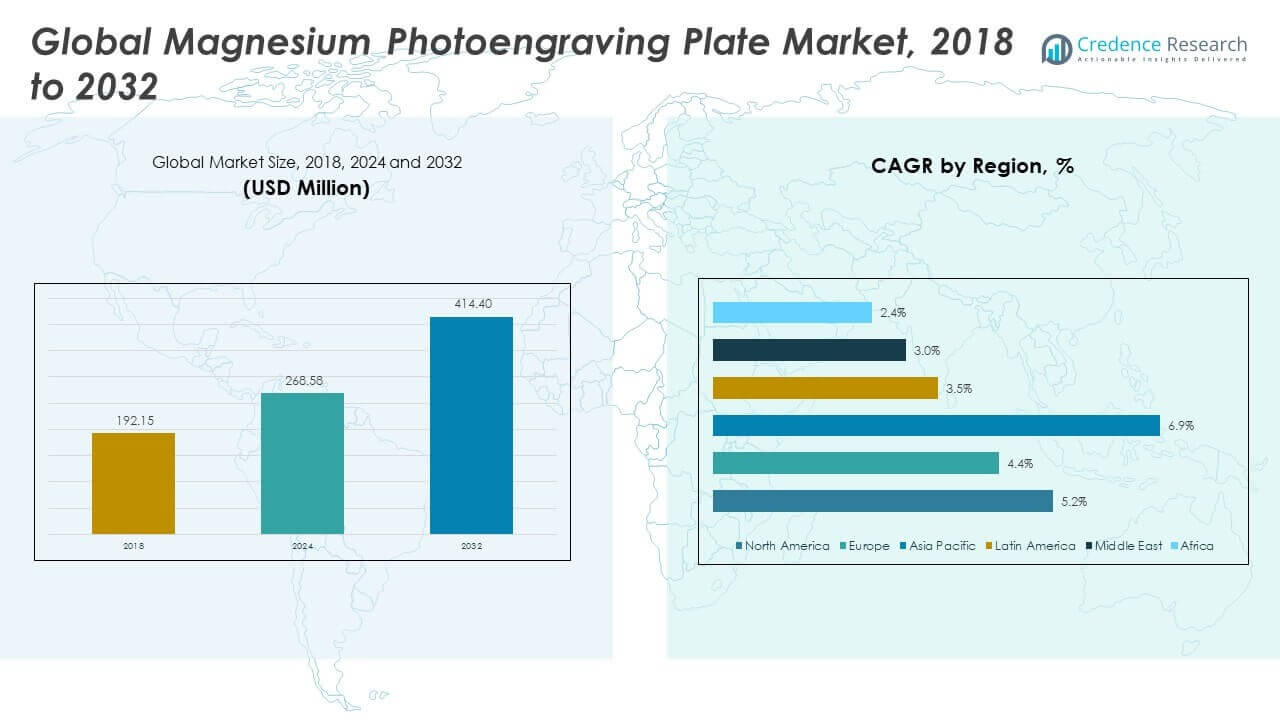
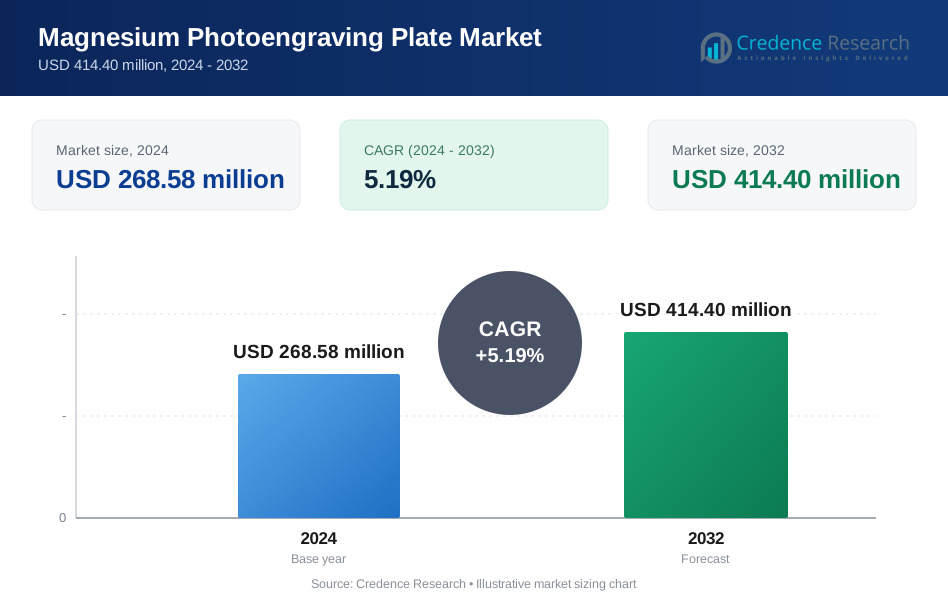
The Global Magnesium Photoengraving Plate Market size was valued at USD 192.15 million in 2018 to USD 268.58 million in 2024 and is anticipated to reach USD 414.40 million by 2032, at a CAGR of 5.19% during the forecast period.
| REPORT ATTRIBUTE | DETAILS |
|---|---|
| Historical Period | 2020-2023 |
| Base Year | 2024 |
| Forecast Period | 2025-2032 |
| Magnesium Photoengraving Plate Market Size 2024 | USD 268.58 million |
| Magnesium Photoengraving Plate Market, CAGR | 5.19% |
| Magnesium Photoengraving Plate Market Size 2032 | USD 414.40 million |
Market growth is driven by steady demand from printing and graphic industries. Packaging producers prefer magnesium plates for sharp image transfer. Commercial printers value fast etching and consistent quality. The plates support fine text and detailed designs. Growth in flexible packaging supports higher usage volumes. Branding needs across consumer goods remain strong. Short print runs increase adoption rates. Cost efficiency versus alternative metals attracts small printers. Stable supply chains also support market expansion.
Asia Pacific leads the market due to strong printing activity. China and India benefit from packaging and publishing growth. Rising consumer goods output supports plate demand. Europe holds a mature position with stable replacement demand. Germany and Italy show strong print quality standards. North America remains technology driven with premium printing needs. Emerging regions include Southeast Asia and Latin America. These markets benefit from industrialization and branding growth. Local printing investments accelerate regional adoption.
Market Insights:
- The Global Magnesium Photoengraving Plate Market was valued at USD 192.15 million in 2018, reached USD 268.58 million in 2024, and is projected to hit USD 414.40 million by 2032, expanding at a CAGR of 5.19% over the forecast period.
- North America led with about 43.4% share in 2024 due to strong commercial printing demand, followed by Europe at nearly 27.7% supported by quality-focused printing, and Asia Pacific at around 20.1% driven by packaging expansion.
- Asia Pacific is the fastest-growing region with a CAGR of 6.9% and about 20.1% share in 2024, supported by rising consumer goods output, expanding print capacity, and cost-efficient production bases.
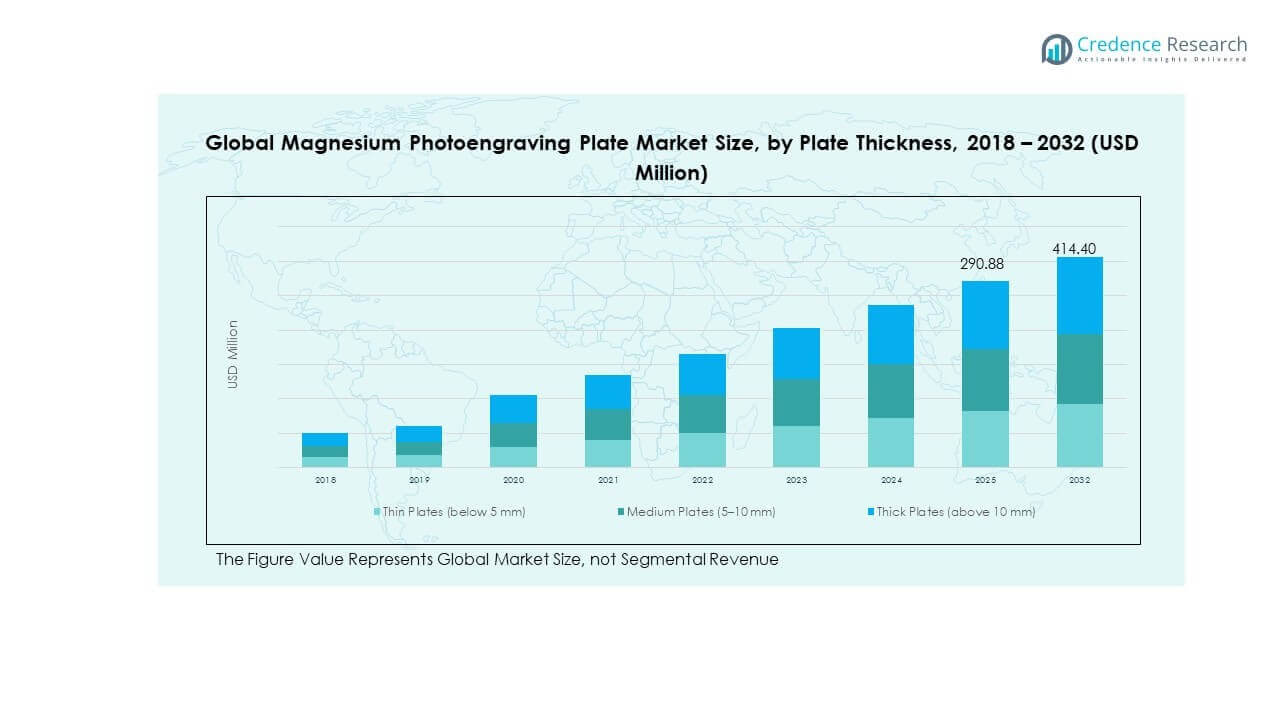
- By plate thickness in 2024, thick plates (above 10 mm) accounted for roughly 38% share, medium plates (5–10 mm) held about 34%, and thin plates (below 5 mm) represented nearly 28%, reflecting balanced demand across applications.
- By 2032, thick plates are expected to hold close to 40% share, medium plates around 33%, and thin plates near 27%, indicating stronger preference for durability and deeper relief in premium printing uses.
Market Drivers:
Rising Demand From Commercial And Packaging Printing Applications
The Global Magnesium Photoengraving Plate Market gains support from steady commercial printing demand. Packaging producers require sharp and consistent image output. Magnesium plates support fine lines and clear text reproduction. Brand owners focus on strong shelf appeal. Short print runs favor fast plate preparation cycles. Printers value reliable engraving quality. High repeat order volumes sustain material usage. Stable demand from labels and cartons supports growth.
- For instance, Luxfer MEL Technologies (formerly Magnesium Elektron Ltd.) provides specialized magnesium photoengraving plates, such as the Elektron 675 grade, which are engineered for high-precision packaging embossing and hot foil stamping to achieve the fine detail required for premium carton graphics.
Cost Efficiency And Ease Of Processing Compared To Alternative Metals
Magnesium plates offer cost advantages over copper alternatives. Etching processes require less time and fewer steps. Lower energy use improves production efficiency. Smaller workshops prefer simple processing workflows. Reduced tooling costs support adoption. Quick plate turnaround improves printer capacity use. Consistent material behavior limits waste. Cost control remains a strong purchase factor.
- For instance, Toyo Koki documentation shows magnesium plates reducing etching time by nearly 30% compared with copper plates in hot stamping applications.
Wide Acceptance Across Traditional And Specialty Printing Segments
Magnesium plates serve offset and letterpress printing needs. Specialty printers use them for embossing tasks. Foil stamping applications rely on precise engraving depth. The plates handle detailed artistic designs. Commercial printers value predictable output quality. Diverse use cases reduce dependency risks. Broad acceptance supports steady order flow. Industry familiarity reinforces long-term demand.
Stable Supply Chain And Established Manufacturing Standards
Magnesium plate production follows mature manufacturing practices. Raw material availability remains stable. Suppliers maintain consistent quality control standards. Long-term vendor relationships reduce sourcing risks. Global distribution networks support timely delivery. Predictable lead times aid printer planning. Technical support improves user confidence. Supply reliability strengthens market stability.
Market Trends:
Shift Toward High-Precision And Fine-Detail Engraving Requirements
Printers demand higher detail resolution in plates. Branding trends favor complex graphics and micro text. Magnesium supports precise depth control. Advanced engraving equipment improves output consistency. Print buyers expect premium visual quality. Specialized design work increases plate customization. Quality-focused printing gains traction. Precision demand shapes product development.
Growing Preference For Short-Run And Customized Print Jobs
Short-run printing gains importance across sectors. Marketing campaigns demand frequent design updates. Magnesium plates support quick job changes. Custom packaging drives varied plate requirements. Printers adapt to flexible production models. Faster setup improves responsiveness. Variable demand patterns influence ordering cycles. Customization trends reshape usage behavior.
- For instance, Heidelberg user case studies note that aluminum plates, combined with advanced automation like Push-to-Stop and AutoPlate XL, enable total makeready times of under 10 minutes for short-run promotional packaging. While magnesium plates are widely used in the packaging industry for foil stamping and embossing, standard high-speed offset printing on Heidelberg presses utilizes aluminum plates for these rapid changeovers.
Integration Of Digital Design Tools With Plate Preparation
Design software integration streamlines engraving workflows. Digital files transfer directly to plate processing. Error rates decline with automated steps. Workflow efficiency improves across print shops. Skilled labor dependence reduces gradually. Digital compatibility enhances productivity. Process control gains importance. Technology alignment shapes operational practices.
Rising Focus On Consistent Quality For Brand Protection
Brands emphasize uniform print output across batches. Magnesium plates deliver repeatable engraving results. Quality assurance becomes a priority for printers. Plate durability supports consistent impressions. Reduced defects lower reprint risks. Print audits drive material selection. Brand owners influence printer material choices. Quality focus guides purchasing behavior.
Market Challenges Analysis:
Competition From Alternative Printing Plates And Digital Printing Methods
The Global Magnesium Photoengraving Plate Market faces pressure from digital printing growth. Digital systems reduce plate usage for some jobs. Polymer plates attract cost-sensitive users. Hybrid printing models change demand patterns. Small printers shift toward plate-free options. Technology upgrades require capital investment. Adoption rates vary by print type. Competitive pressure affects volume growth.
Sensitivity To Raw Material Prices And Environmental Regulations
Magnesium price fluctuations impact production costs. Suppliers face margin pressure during volatility periods. Environmental rules affect chemical usage in etching. Compliance raises operational expenses. Smaller producers face adaptation challenges. Waste handling standards require process upgrades. Regulatory differences complicate global operations. Cost control remains a persistent challenge.
Market Opportunities:
Expansion Of Packaging And Label Printing In Emerging Economies
The Global Magnesium Photoengraving Plate Market can benefit from emerging market growth. Consumer goods output rises steadily. Local brands increase packaging investments. Print infrastructure expands in developing regions. Magnesium plates suit growing commercial print needs. Entry-level printers adopt proven materials. Regional suppliers gain new customers. Market penetration potential remains strong.
Innovation In Plate Quality And Processing Efficiency
Manufacturers invest in improved plate formulations. Enhanced surface quality supports better engraving results. Faster processing methods reduce turnaround time. Automation improves consistency across batches. Technical upgrades attract quality-focused printers. Product differentiation strengthens supplier positioning. Innovation supports premium pricing strategies. Long-term value creation remains achievable.
Market Segmentation Analysis:
Plate Thickness
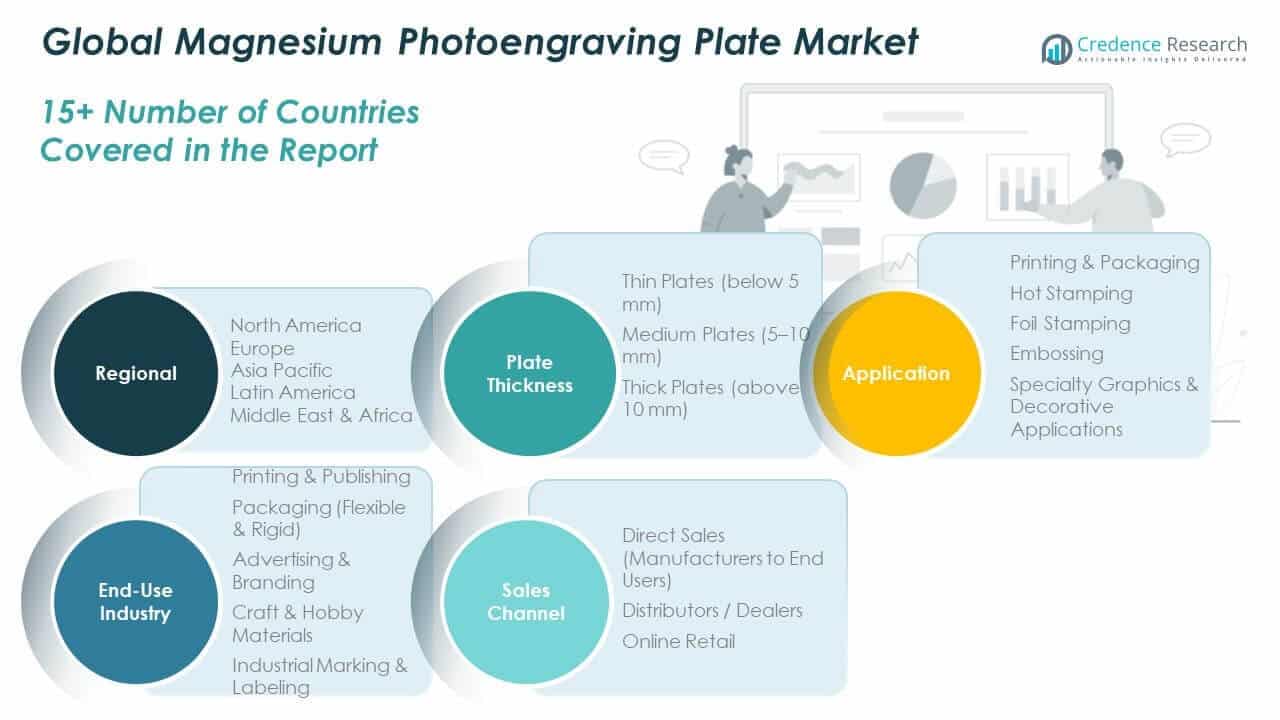
Thin Plates (below 5 mm) suit fine-detail work and faster etch cycles. Medium Plates (5–10 mm) balance rigidity and processing speed for general jobs. Thick Plates (above 10 mm) support deeper relief needs for durable impressions. Buyers choose thickness based on press type and required depth. Plate selection also depends on tool wear and run length. Shops favor standard sizes to reduce setup time. Producers keep multiple gauges to match mixed order books. This segmentation links directly to print quality targets.
- For instance, industrial suppliers of Grade AZ31B magnesium photoengraving plates such as Easonnm typically provide plate thicknesses ranging from 4 mm to 7 mm for deep embossing applications. This thickness is specifically utilized to ensure structural integrity and prevent thermal deformation or warping when relief depths exceed 1.5 mm under high-pressure stamping conditions.
Application
Printing & Packaging drives steady demand due to high job frequency. Hot Stamping relies on clean edges for crisp transfer. Foil Stamping needs stable plates that hold fine detail under pressure. Embossing uses deeper relief for tactile effects on labels and cartons. Specialty Graphics & Decorative Applications support premium design work. Printers align plate choice with finish type and substrate. Brand owners push complex designs that raise plate precision needs. Application diversity keeps demand balanced.
End-Use Industry
Printing & Publishing supports routine plate use in commercial jobs. Packaging (Flexible & Rigid) expands with consumer goods branding needs. Advertising & Branding uses plates for premium print effects. Craft & Hobby Materials support small-batch orders and custom designs. Industrial Marking & Labeling needs durability and consistent output. Each end-use segment values reliability and repeatability. Quality standards vary by industry and shape buying decisions. The Global Magnesium Photoengraving Plate Market benefits from this broad demand base.
Sales Channel
Direct Sales (Manufacturers to End Users) suits large buyers with stable volume. Distributors / Dealers serve fragmented printer bases and local support needs. Online Retail supports fast replenishment for small shops. Channel choice depends on order size and delivery speed. Buyers use distributors for mixed SKUs and short lead times. Direct contracts support pricing control and technical guidance. Online channels improve access in smaller cities. Channel mix shapes supplier reach and service depth.
Segmentation:
Plate Thickness- Thin Plates (below 5 mm)
- Medium Plates (5–10 mm)
- Thick Plates (above 10 mm)
- Printing & Packaging
- Hot Stamping
- Foil Stamping
- Embossing
- Specialty Graphics & Decorative Applications
- Printing & Publishing
- Packaging (Flexible & Rigid)
- Advertising & Branding
- Craft & Hobby Materials
- Industrial Marking & Labeling
- Direct Sales (Manufacturers to End Users)
- Distributors / Dealers
- Online Retail
- North America (U.S., Canada, Mexico)
- Europe (UK, France, Germany, Italy, Spain, Russia, Belgium, Netherland, Austria, Sweden, Poland, Denmark, Switzerland, Rest of Europe)
- Asia Pacific (China, Japan, South Korea, India, Australia, Thailand, Indonesia, Vietnam, Malaysia, Philippines, Taiwan, Rest of Asia Pacific)
- Latin America (Brazil, Argentina, Peru, Chile, Colombia, Rest of Latin America)
- Middle East (UAE, KSA, Israel, Turkey, Iran, Rest of Middle East)
- Africa (South Africa, Egypt, Nigeria, Algeria, Morocco, Rest of Africa)
Regional Analysis:
North America
The North America Global Magnesium Photoengraving Plate Market size was valued at USD 84.23 million in 2018 to USD 116.51 million in 2024 and is anticipated to reach USD 180.27 million by 2032, at a CAGR of 5.2 during the forecast period. North America holds the largest regional share at about 43.4% in 2024. The region benefits from a mature printing and packaging industry. Strong demand for premium labels and cartons supports plate usage. Brand owners focus on high print quality and consistency. Commercial printers prefer reliable engraving materials. Technology adoption supports efficient plate processing. The United States leads regional demand due to scale. Canada supports steady replacement demand. It shows stable long-term consumption patterns.
Europe
The Europe Global Magnesium Photoengraving Plate Market size was valued at USD 55.21 million in 2018 to USD 74.43 million in 2024 and is anticipated to reach USD 108.21 million by 2032, at a CAGR of 4.4 during the forecast period. Europe accounts for nearly 27.7% market share in 2024. The region shows strong focus on print quality standards. Germany, Italy, and France lead regional demand. Packaging and publishing sectors remain well established. Specialty printing supports steady plate consumption. Environmental compliance shapes production practices. Printers favor precision and repeatability. Replacement demand sustains volumes. It reflects a stable and quality-driven market.
Asia Pacific
The Asia Pacific Global Magnesium Photoengraving Plate Market size was valued at USD 35.57 million in 2018 to USD 54.05 million in 2024 and is anticipated to reach USD 94.85 million by 2032, at a CAGR of 6.9 during the forecast period. Asia Pacific holds around 20.1% market share in 2024. The region shows the fastest growth pace. China and India drive volume expansion. Rising consumer goods output supports packaging needs. Local printing capacity expands rapidly. Cost-effective production attracts investment. Short-run printing gains popularity. Southeast Asia shows rising adoption. It reflects strong future growth potential.
Latin America
The Latin America Global Magnesium Photoengraving Plate Market size was valued at USD 8.50 million in 2018 to USD 11.72 million in 2024 and is anticipated to reach USD 15.87 million by 2032, at a CAGR of 3.5 during the forecast period. Latin America represents about 4.4% share in 2024. Brazil leads regional consumption. Packaging demand supports gradual growth. Printing infrastructure continues to improve. Import dependence affects supply dynamics. Local distributors play a key role. Brand development supports plate usage. Adoption remains selective across countries. It shows moderate growth prospects.
Middle East
The Middle East Global Magnesium Photoengraving Plate Market size was valued at USD 5.40 million in 2018 to USD 6.91 million in 2024 and is anticipated to reach USD 9.00 million by 2032, at a CAGR of 3.0 during the forecast period. The Middle East holds nearly 2.6% share in 2024. UAE and KSA lead regional demand. Packaging and labeling drive usage. Import-based supply dominates the market. Commercial printing supports steady orders. Industrial branding gains importance. Market expansion remains gradual. Investment in print services supports demand. It shows stable but limited scale.
Africa
The Africa Global Magnesium Photoengraving Plate Market size was valued at USD 3.23 million in 2018 to USD 4.96 million in 2024 and is anticipated to reach USD 6.20 million by 2032, at a CAGR of 2.4 during the forecast period. Africa accounts for about 1.8% share in 2024. South Africa leads regional activity. Printing infrastructure remains developing. Demand focuses on basic packaging needs. Import reliance shapes pricing trends. Local production remains limited. Craft and labeling uses support small volumes. Growth remains slow but steady. It reflects an emerging market stage.
Key Player Analysis:
- Magnesium Elektron Ltd. (Luxfer Group)
- Zonle Magnetic Magnesium Material Co., Ltd.
- Anhui Magnesium Photoengraving Technology Co., Ltd.
- Dongguan Xincheng Photoengraving Material Co., Ltd.
- Fushi Magnesium Alloy Materials Co., Ltd.
- Tianyuan Magnesium Plate Co., Ltd.
- Toyo Koki Co., Ltd.
- Amisco Industrial Co., Ltd.
- Shanxi Yinguang Huasheng Magnesium Co., Ltd.
- Nippon Light Metal Holdings Co., Ltd.
Competitive Analysis:
The Global Magnesium Photoengraving Plate Market shows moderate competition with a mix of global and regional suppliers. Leading players focus on consistent plate quality and stable supply. Product standardization supports repeat orders from commercial printers. Companies compete on processing accuracy and delivery reliability. Pricing remains competitive due to material sensitivity. Long-term contracts help secure demand from large print houses. Regional players serve local distributors and small printers. Market entry barriers remain moderate due to established production know-how. It reflects a balance between scale and specialization.
Recent Developments:
- In August 2025, Luxfer MEL Technologies announced the introduction of the Elektron® Finished Parts Machined Magnesium Service, a one-stop solution that combines integrated production of magnesium alloys with expert machining tailored for aerospace, defense, and land-based military systems. This new offering streamlines delivery through integrated supply chain and production processes while incorporating sustainable practices including recycling of machining waste to support eco-responsibility. The service is designed for complex components such as intricate gearbox housings and avionics casings. Additionally, in the third quarter of 2025, Luxfer Holdings reported strong sales growth in the defense and aerospace sector, with demand for Elektron's magnesium alloys notably increasing, attributed to elevated defense spending, backlogs in foundries, and ongoing aerospace build rates.
- In May 2025, the company announced progress in pursuing management reforms and the examination and formulation of its next medium-term management plan. Key initiatives include investments in Indian recycled aluminum company CMR NLM Eco and collaboration with SEC Carbon (accepting a 20% equity investment). The company is also executing a strategic partnership agreement with NTT Data Xam Technologies in the metal additive manufacturing (AM) business. Moreover, in May 2025, Nippon Light Metal acquired a 20% stake in Indian aluminum-scrap processor CMR Eco Aluminum, now CMR NLM Eco, from which it will import recycled aluminum.
Report Coverage:
The research report offers an in-depth analysis based on Plate Thickness, Application, End-Use Industry, Sales Channel, and Regional segments. It details leading market players, providing an overview of their business, product offerings, investments, revenue streams, and key applications. Additionally, the report includes insights into the competitive environment, SWOT analysis, current market trends, as well as the primary drivers and constraints. Furthermore, it discusses various factors that have driven market expansion in recent years. The report also explores market dynamics, regulatory scenarios, and technological advancements that are shaping the industry. It assesses the impact of external factors and global economic changes on market growth. Lastly, it provides strategic recommendations for new entrants and established companies to navigate the complexities of the market.
Future Outlook:
- Packaging demand will continue to support plate consumption.
- Short-run printing will shape product mix preferences.
- Quality-focused printing will favor precision plates.
- Asia Pacific will remain the fastest-growing region.
- Distributor networks will strengthen regional access.
- Product upgrades will focus on engraving accuracy.
- Environmental compliance will influence production methods.
- Specialty printing will support premium demand.
- Supply stability will remain a key buying factor.
- Competition will stay moderate with regional focus.
Request a Free Sample
Fill in your details and we'll send you a free sample report.
- Sample data tables & charts
- Research methodology
Need a Custom Version of This Report?
Tailor the scope, geography, or segments to your exact requirements.
- Custom geography or segment scope
- Direct access to our analyst team
Frequently Asked Questions
What is the current market size for Global Magnesium Photoengraving Plate Market, and what is its projected size in 2032?
At what Compound Annual Growth Rate is the Global Magnesium Photoengraving Plate Market projected to grow between 2025 and 2032?
Which Global Magnesium Photoengraving Plate Market segment held the largest share in 2024?
What are the primary factors fueling the growth of the Global Magnesium Photoengraving Plate Market?
Who are the leading companies in the Global Magnesium Photoengraving Plate Market?
Which region commanded the largest share of the Global Magnesium Photoengraving Plate Market in 2024?
Table of Content
Chapter 1. Report Introduction
- 1.1 Report Description & Purpose
- 1.1.1 Report Title & Market Definition
- 1.1.2 Unique Selling Propositions (USP) & Key Differentiators
- 1.1.3 Value Proposition for Stakeholders
- 1.2 Research Objectives
- 1.2.1 Market Sizing Objectives (Volume & Revenue)
- 1.2.2 Segmentation Objectives
- 1.2.3 Competitive Intelligence Objectives
- 1.2.4 Forecast & Scenario Objectives
- 1.3 Report Scope
- 1.3.1 Magnesium Photoengraving Plate Scope – Types & Subtypes Covered
- 1.3.2 Geographic Scope – Regions & Countries Covered
- 1.3.3 Historical Period, Base Year & Forecast Period (2024; forecast to 2032)
- 1.3.4 Inclusions & Exclusions
- 1.4 HS Code & Classification Framework
- 1.5 Currency, Units & Pricing Basis
- 1.6 Target Stakeholders
- 1.7 Limitations & Assumptions
Chapter 2. Executive Summary
- 2.1 Global Magnesium Photoengraving Plate Market Snapshot
- 2.1.1 Market Size – Historical (2024) & Forecast (2024-2032) (2024: USD 268.58 million → 2032: USD 414.40 million)
- 2.1.2 Volume & Revenue – Global Totals
- 2.1.3 Key Market Highlights – Top Five Facts
- 2.2 Magnesium Photoengraving Plate Market Segmentation Snapshot
- 2.2.1 Market Split by Region – 2024 vs. 2032
- 2.3 Competitive Snapshot
- 2.3.1 Top 10 Players by Revenue Share – 2024
- 2.3.2 Top 10 Players by Volume Share – 2024
- 2.3.3 Recent Strategic Developments (18-Month Summary)
- 2.4 Key Investment Highlights & Strategic Conclusions
Chapter 3. Magnesium Photoengraving Plate Market Dynamics & Industry Analysis
- 3.1 Market Overview & Context
- 3.1.1 Magnesium Photoengraving Plate Market Position in the Broader Automotive Value Chain
- 3.1.2 OEM vs. Replacement Market Dynamics
- 3.1.3 Market Maturity & Development Stage by Region
- 3.2 Magnesium Photoengraving Plate Market Drivers
- 3.3 Magnesium Photoengraving Plate Market Restraints & Challenges
- 3.4 Magnesium Photoengraving Plate Market Opportunities
- 3.5 Porter's Five Forces Analysis
- 3.5.1 Threat of New Entrants
- 3.5.2 Bargaining Power of Suppliers
- 3.5.3 Bargaining Power of Buyers
- 3.5.4 Threat of Substitutes
- 3.5.5 Competitive Rivalry – Intensity Assessment
- 3.6 Magnesium Photoengraving Plate Value Chain Analysis
- 3.6.1 Upstream – Raw Material/Input Suppliers
- 3.6.1.1 Raw Material/Input 1
- 3.6.1.2 Raw Material/Input 2
- 3.6.1.3 Raw Material/Input 3
- 3.6.2 Midstream – Production/Manufacturing/Service Delivery
- 3.6.2.1 Production/Process Overview
- 3.6.2.2 Key Facility Locations & Capacity by Manufacturer
- 3.6.3 Downstream – Distribution & End Consumer
- 3.6.3.1 Primary Channel – B2B/OEM
- 3.6.3.2 Secondary Channels – Dealer, Retail, Online, Direct
- 3.6.4 Value Chain Profitability Analysis
- 3.6.1 Upstream – Raw Material/Input Suppliers
- 3.7 PESTEL Analysis
- 3.7.1 Political Factors
- 3.7.2 Economic Factors
- 3.7.3 Social Factors
- 3.7.4 Technological Factors
- 3.7.5 Environmental Factors
- 3.7.6 Legal Factors
- 3.8 Magnesium Photoengraving Plate Supply Chain Analysis
- 3.8.1 Raw Material/Input Supply Risk Assessment
- 3.8.2 Manufacturing Concentration Risk (Geographic Exposure)
- 3.8.3 Trade Disruption Impact Analysis
- 3.9 Regulatory & Policy Landscape
Note: The regulatory and policy landscape section covers regulations based on their applicability to the market, Magnesium Photoengraving Plate category, geography, and scope of the study. Only regulatory frameworks with a material impact on operations, compliance, trade, sustainability, or market access are analyzed in detail.
Chapter 4. Key Investment Pockets & Opportunity Analysis
- 4.1 Magnesium Photoengraving Plate Market Attractiveness Analysis
- 4.1.1 By Region – Investment Attractiveness Matrix (Volume × CAGR)
- 4.2 Absolute Revenue Growth Opportunity
- 4.2.1 By Region – Absolute USD Growth Through 2032
- 4.3 Incremental Volume Opportunity
- 4.3.1 By Region – Incremental Volume Through 2032
- 4.3.2 Segment – Incremental Volume
- 4.4 Emerging Submarket Opportunity Deep Dive (Subject to Applicability)
- 4.5 Emerging Market Opportunity Scorecards
- 4.5.1 United States
- 4.5.2 Europe
- 4.5.3 Asia
- 4.5.4 Middle East & Africa
Note: Emerging Market Opportunity Scorecards will be included based on relevance and strategic importance. Regions listed are indicative and may vary depending on data availability and market dynamics.
Chapter 5. Magnesium Photoengraving Plate Import-Export Analysis & Trade Flows
- 5.1 Global Trade Overview
- 5.1.1 Global Export Value by Country (2024)
- 5.1.2 Global Export Volume by Country (2024)
- 5.1.3 Global Import Value by Country (2024)
- 5.1.4 Global Import Volume by Country (2024)
- 5.1.5 Net Trade Balance by Country (2024)
- 5.2 Export Analysis – Segment
- 5.2.1 Type 1 (HS Code)
- 5.2.2 Type 2 (HS Code)
- 5.2.3 Type 3 (HS Code)
- 5.2.4 Type 4 (HS Code)
- 5.2.5 Type 5 (HS Code)
- 5.3 Import Analysis – Segment
- 5.3.1 Type 1 (HS Code)
- 5.3.2 Type 2 (HS Code)
- 5.3.3 Type 3 (HS Code)
- 5.3.4 Type 4 (HS Code)
- 5.3.5 Type 5 (HS Code)
- 5.4 Average Unit Trade Prices
- 5.4.1 Average Export Price – Segment & Country
- 5.4.2 Average Import Price – Segment & Source Country
- 5.4.3 Price Trends (2024)
- 5.5 Key Trade Route Analysis
- 5.5.1 Trade Route 1
- 5.5.2 Trade Route 2
- 5.5.3 Trade Route 3
- 5.5.4 Trade Route 4
- 5.5.5 Trade Route 5
- 5.6 Trade Policy Impact Assessment
- 5.6.1 US Anti-Dumping & Section 301 Tariffs
- 5.6.2 EU Customs Union Impact
- 5.6.3 Major Free Trade Agreements
- 5.6.4 USMCA Rules of Origin
Note: Trade policy analysis will be included only where relevant to the Magnesium Photoengraving Plate market.
Chapter 6. Competitive Landscape & Company Benchmarking
- 6.1 Magnesium Photoengraving Plate Market Concentration & Structure
- 6.1.1 Herfindahl-Hirschman Index (HHI) – vs. 2024
- 6.1.2 Tier 1, Tier 2 & Tier 3 Market Structure
- 6.1.3 Global, Regional & Local Player Dynamics
- 6.2 Magnesium Photoengraving Plate Market Share Analysis – 2024
- 6.2.1 Global Revenue Share by Company
- 6.2.2 Global Volume Share by Company
- 6.2.3 Regional Revenue Share
- 6.2.4 Market Share Evolution ( vs. 2024)
- 6.2.5 OEM Segment Share by Company
- 6.2.6 Replacement Segment Share by Company
- 6.3 Production/Delivery Capacity & Facility Analysis
- 6.3.1 Global Installed Capacity
- 6.3.2 Capacity Utilization Rates
- 6.3.3 Production/Output Volume
- 6.3.4 Facility Locations & Capacity Map
- 6.3.5 Planned Capacity Additions
- 6.4 Magnesium Photoengraving Plate Competitive Benchmarking Matrix
- 6.4.1 Revenue, Volume, CAGR & Profitability Comparison
- 6.4.2 Channel Revenue Mix
- 6.4.3 Geographic Revenue Exposure
- 6.4.4 R&D Intensity
- 6.4.5 Sustainability Maturity
- 6.5 Strategic Developments in Magnesium Photoengraving Plate (Last 24 Months)
- 6.5.1 Mergers, Acquisitions & Divestments
- 6.5.2 New Magnesium Photoengraving Plate Launches
- 6.5.3 Facility Expansions
- 6.5.4 Strategic Alliances, Joint Ventures & Partnerships
- 6.5.5 Distribution Expansion & Market Entry
- 6.5.6 Sustainability & ESG Initiatives
- 6.6 Competitive Strategy Mapping
- 6.6.1 Leader, Challenger, Follower & Niche Classification
- 6.6.2 Pricing Strategy Comparison
- 6.6.3 Channel Strategy Matrix
Note: Strategic developments are included based on their materiality and the availability of reliable information.
Chapter 7. Global Magnesium Photoengraving Plate Market – By Distribution Channel
- 7.1 Segment Overview
- 7.1.1 Volume & Revenue Split by Channel (2024 & 2032)
- 7.1.2 Channel Mix Evolution (2024-2032)
Chapter 8. Regional Market Analysis – Global Overview
- 8.1 Global Regional Overview
- 8.1.1 Regional Volume Share
- 8.1.2 Regional Revenue Share
- 8.1.3 Regional Volume by Region
- 8.1.4 Regional Revenue by Region
- 8.1.5 Regional Forecast Through 2032
- 8.2 Cross-Regional Segment Analysis
- 8.2.1 By Distribution Channel
- 8.2.2 By Brand/Price Tier
Chapter 9. North America Magnesium Photoengraving Plate Market
- 9.1 United States
- 9.2 Canada
- 9.3 Mexico
Chapter 10. Europe Magnesium Photoengraving Plate Market
- 10.1 Germany
- 10.2 France
- 10.3 Italy
- 10.4 United Kingdom
- 10.5 Spain
- 10.6 Poland
- 10.7 Russia
- 10.8 Netherlands
- 10.9 Belgium
- 10.10 Sweden
- 10.11 Denmark
- 10.12 Norway
- 10.13 Rest of Europe
Chapter 11. Asia Pacific Magnesium Photoengraving Plate Market
- 11.1 China
- 11.2 India
- 11.3 Japan
- 11.4 South Korea
- 11.5 Thailand
- 11.6 Indonesia
- 11.7 Vietnam
- 11.8 Malaysia
- 11.9 Australia
- 11.10 Rest of Asia Pacific
Chapter 12. Latin America Magnesium Photoengraving Plate Market
- 12.1 Brazil
- 12.2 Argentina
- 12.3 Colombia
- 12.4 Chile
- 12.5 Rest of Latin America
Chapter 13. Middle East Magnesium Photoengraving Plate Market
- 13.1 Saudi Arabia
- 13.2 United Arab Emirates
- 13.3 Turkey
- 13.4 Israel
- 13.5 Iran
- 13.6 Rest of the Middle East
Chapter 14. Africa Magnesium Photoengraving Plate Market
- 14.1 South Africa
- 14.2 Egypt
- 14.3 Nigeria
- 14.4 Morocco
- 14.5 Rest of Africa
Chapter 15. Magnesium Photoengraving Plate Company Profiles
- 15.1 [Company 01]
- 15.1.1 Company Overview
- 15.1.2 Key Management Personnel
- 15.1.3 Products & Services Portfolio
- 15.1.4 Financial Performance
- 15.1.5 Key Market Focus & Geographic Presence
- 15.1.6 Recent Developments & Strategic Initiatives
Note: The company profile list is preliminary and may change based on research findings, market developments, data availability, and client requirements.
Chapter 16. Appendices
- Appendix A – List of Abbreviations & Acronyms
- Appendix B – Industry Classification Code Reference – Full Series
- Appendix C – Production & Capacity Data Tables
- Appendix D – End-Use & Demand Base Tables
- Appendix E – Consumption & Replacement Rate Assumptions
- Appendix F – ASP Reference Tables
- Appendix G – Manufacturing & Facility Database
- Appendix H – Import-Export Data Tables
- Appendix I – Regulatory Summary Tables
- Appendix J – Primary Research Participant List (Anonymized)
- Appendix K – Primary Research Questionnaire Framework
- Appendix L – Data Sources & Bibliography
- Appendix M – Market Size Divergence & Source Comparison
Chapter 17. Research Methodology
- 17.1 Research Framework & Philosophy
- 17.2 Secondary Research – Sources, Hierarchy & Data Extraction
- 17.3 Data Modeling – Bottom-Up & Top-Down Market Sizing
- 17.4 Primary Research – Stakeholder Framework, LOI & Sample Sizes
- 17.5 Forecast Methodology – Regression, Scenario & Sensitivity Analysis
- 17.6 Quality Control – Four-Layer Validation Framework
- 17.7 Limitations & Standard Assumptions
- 17.8 Disclaimer
