
| REPORT ATTRIBUTE | DETAILS |
|---|---|
| Historical Period | 2020-2023 |
| Base Year | 2024 |
| Forecast Period | 2025-2032 |
| Malaysia Plastic Welding Equipment Market Size 2024 | USD 24.57 million |
| Malaysia Plastic Welding Equipment Market, CAGR | 7.25% |
| Malaysia Plastic Welding Equipment Market Size 2032 | USD 43.02 million |
Market Overview
Malaysia Plastic Welding Equipment market size was valued at USD 24.57 million in 2024 and is anticipated to reach USD 43.02 million by 2032, at a CAGR of 7.25% during the forecast period (2024-2032).
The Malaysia plastic welding equipment market is driven by several key factors, including the increasing industrialization and growth in manufacturing sectors like automotive, packaging, and construction. As industries in Malaysia expand, the demand for efficient, high-quality plastic welding solutions rises, particularly for applications requiring durability and precision. The trend towards sustainable production methods is also a significant driver, with businesses seeking eco-friendly solutions to reduce waste and improve energy efficiency. Additionally, the rise of e-commerce and consumer goods manufacturing is further fueling the need for robust packaging solutions, which rely heavily on plastic welding technologies. Technological advancements, such as automation and improved welding techniques, are enhancing the performance and precision of plastic welding equipment, making it more appealing for various sectors. These factors, combined with favorable government regulations promoting industrial growth, position Malaysia’s plastic welding equipment market for continued expansion over the forecast period.
Geographically, the Malaysian plastic welding equipment market is concentrated in key regions such as the Central region, which includes Kuala Lumpur, and the Southern Peninsula, particularly Johor, both of which are industrial hubs with strong manufacturing and export activities. The Northern Peninsula, with Penang's electronics sector, and East Malaysia, including Sabah and Sarawak, also contribute to the market due to their growing industrialization. Key players in the Malaysian plastic welding equipment market include global companies such as Emerson Electric Co., Leister Technologies AG, Dukane Corporation, and Branson Ultrasonics Corporation. These companies dominate the market by offering a wide range of high-performance welding technologies, including ultrasonic, hot plate, and laser welding solutions. Local players and regional manufacturers, like CHN-TOP Machinery Group and Haitian International Holdings Ltd., also contribute to the competition by providing cost-effective and specialized solutions to meet the needs of various industries.
Market Insights
- The Malaysia plastic welding equipment market was valued at USD 24.57 million in 2024 and is projected to reach USD 43.02 million by 2032, growing at a CAGR of 7.25% from 2024 to 2032.
- The global plastic welding equipment market was valued at USD 11,340.00 million in 2024 and is projected to reach USD 19,842.36 million by 2032, growing at a CAGR of 7.24% from 2024 to 2032.
- Key drivers include the expanding manufacturing sectors like automotive, packaging, and electronics, which require efficient plastic welding technologies.
- Sustainability trends are pushing industries toward eco-friendly and energy-efficient plastic welding solutions.
- The growing demand for packaging solutions due to e-commerce growth is a significant market trend, especially in the food and beverage sector.
- Automation and advanced welding technologies, like ultrasonic and laser welding, are becoming increasingly popular among manufacturers.
- Competitive analysis reveals dominance from global players such as Emerson Electric Co. and Leister Technologies, with increasing local competition.
- Regional demand is highest in the Central and Southern Peninsula regions, driven by manufacturing hubs like Kuala Lumpur and Johor.
Report Scope
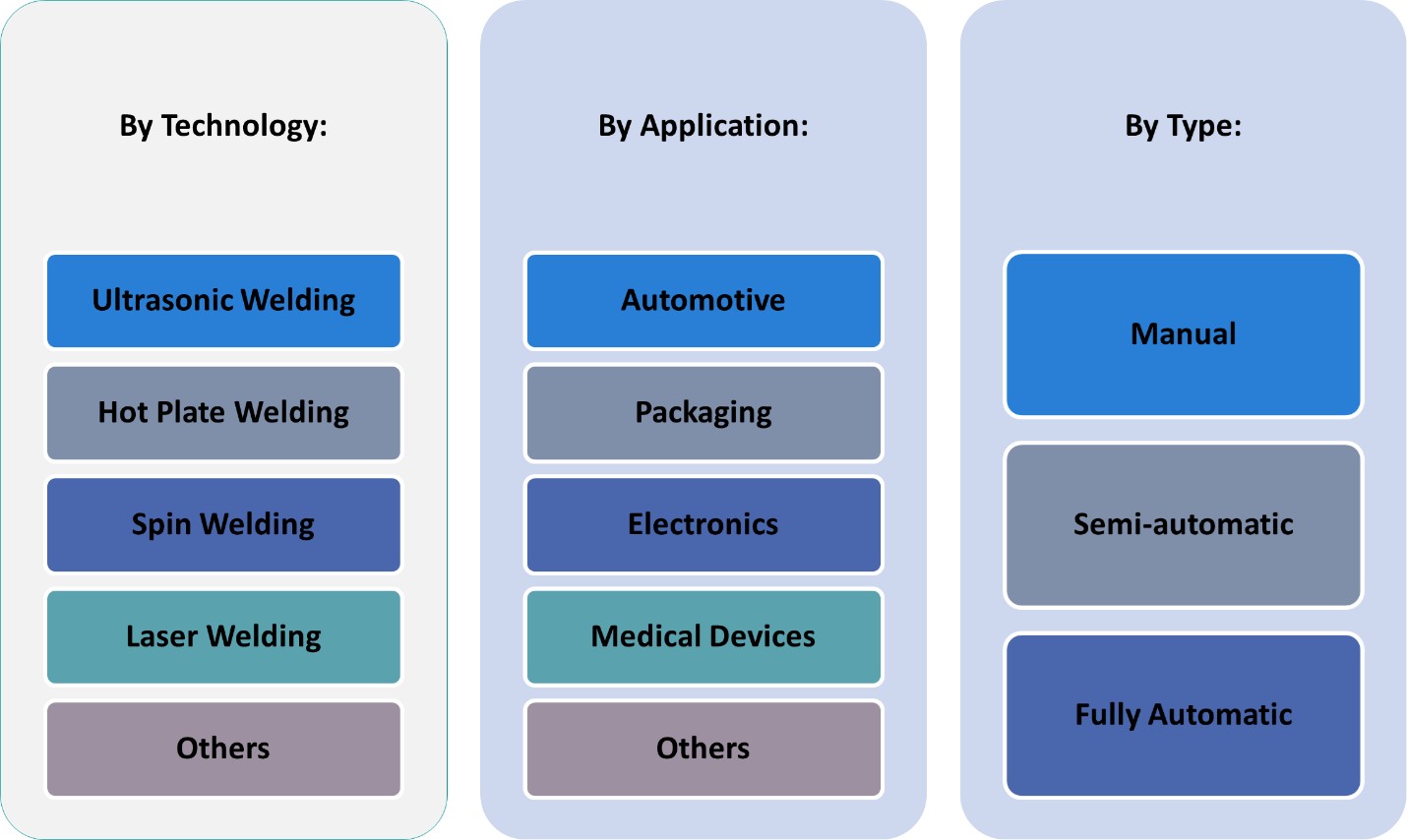
This report segments the Malaysia Plastic Welding Equipment Market as follows:
Market Drivers
Growing Industrialization and Manufacturing Sector
The rapid industrialization of Malaysia is one of the primary drivers behind the increasing demand for plastic welding equipment. For instance, Malaysia's automotive sector, which includes major manufacturers like Proton and Perodua, has increasingly adopted lightweight plastic components such as bumpers and dashboards to enhance fuel efficiency and reduce emissions. As Malaysia continues to evolve into a manufacturing hub in Southeast Asia, sectors such as automotive, packaging, and construction are expanding at a significant pace. In these industries, plastic welding technologies are crucial for creating durable, high-quality products that meet rigorous standards. As companies adopt advanced manufacturing techniques to remain competitive, the need for reliable and precise plastic welding solutions grows. The automotive sector, for example, relies heavily on lightweight plastic components, driving the demand for high-performance welding equipment. With the continuous development of manufacturing capabilities across these industries, plastic welding technologies will remain integral, further boosting market growth.
Demand for Sustainable Manufacturing Solutions
Environmental sustainability has become a critical focus for industries globally, and Malaysia is no exception. For instance, the Malaysian Plastics Recycling Industry Whitepaper highlights the adoption of energy-efficient and waste-reducing welding methods to support circular economy initiatives. The government and corporations are increasingly prioritizing sustainability, driving demand for eco-friendly manufacturing technologies. In plastic welding, this translates into the adoption of energy-efficient and waste-reducing welding methods. As industries seek to lower carbon footprints and improve the environmental footprint of their manufacturing processes, plastic welding technologies that minimize waste and energy consumption are becoming more appealing. Furthermore, with an increased emphasis on recycling, businesses in Malaysia are turning to plastic welding solutions that support the reuse and repurposing of plastic materials. This demand for sustainable solutions is expected to be a significant driver for the plastic welding equipment market in Malaysia during the forecast period.
Expanding Packaging Industry
The growth of Malaysia’s packaging industry is another crucial driver of the plastic welding equipment market. As e-commerce continues to expand, there is an increased demand for efficient and durable packaging solutions. Plastics, which are lightweight and versatile, are commonly used in packaging, and plastic welding is essential in creating airtight, secure, and tamper-proof seals. In particular, the food and beverage, pharmaceutical, and consumer goods industries rely heavily on plastic welding for packaging applications that require high precision and sterility. The growing need for packaging that can withstand logistics challenges, especially in global supply chains, further strengthens the demand for advanced plastic welding technologies. The ongoing expansion of the packaging sector, driven by rising consumer demand and increased online shopping, ensures sustained growth for plastic welding equipment in Malaysia.
Technological Advancements and Automation
Technological advancements in plastic welding are another key factor driving market growth. Innovations in welding equipment that incorporate automation, precision, and improved materials handling are enhancing the efficiency and effectiveness of the welding process. Automated plastic welding systems can increase production speeds while ensuring consistent, high-quality results, which is especially important in high-volume manufacturing environments. Additionally, advancements in ultrasonic, laser, and hot plate welding technologies provide more versatile solutions for diverse industrial applications. As Malaysian manufacturers continue to adopt Industry 4.0 practices, incorporating smart technologies and automated systems, the demand for advanced plastic welding equipment that supports these innovations will continue to rise. The ability to offer more precise and scalable solutions is thus a driving factor for market growth in the region.
Market Trends
Shift Towards Automated and Smart Welding Solutions
One of the key trends in Malaysia’s plastic welding equipment market is the growing shift towards automation and smart technologies. As industries across the country embrace the principles of Industry 4.0, manufacturers are increasingly adopting automated welding systems that enhance productivity and precision. Automated plastic welding equipment offers faster production times, improved quality consistency, and reduced human error. For instance, automotive manufacturers in Malaysia have implemented robotic welding systems to streamline production lines, ensuring consistent weld quality in high-volume operations. Furthermore, integrating sensors and data analytics into welding systems allows for real-time monitoring and optimization of the welding process. This trend is particularly evident in sectors such as automotive and electronics, where high-volume production and precision are critical. The demand for smart, automated welding solutions is set to continue growing, making it a dominant trend in the Malaysian market.
Rising Adoption of Eco-Friendly Welding Technologies
Another notable trend in the Malaysian plastic welding equipment market is the increasing emphasis on eco-friendly technologies. As sustainability becomes a focal point for businesses globally, the need for energy-efficient and waste-reducing plastic welding methods is rising in Malaysia. Technologies such as ultrasonic welding, which requires no consumables and generates minimal waste, are gaining traction among manufacturers looking to reduce their environmental impact. For instance, electronics manufacturers in Malaysia have adopted ultrasonic welding to assemble components with minimal environmental footprint. Additionally, plastic welding equipment that supports the recycling and reuse of plastic materials is becoming more popular, aligning with the country’s growing push towards a circular economy. This trend reflects broader global efforts to reduce plastic waste, and Malaysian companies are responding by adopting solutions that minimize both environmental and operational costs.
Focus on Precision and High-Quality Welds
The demand for high-quality, precise welds is another significant trend driving the plastic welding equipment market in Malaysia. As industries such as medical devices, electronics, and automotive continue to require more complex plastic components, the need for precision in welding technology is becoming even more important. Manufacturers are seeking welding solutions that can deliver consistent and flawless results, even in small, intricate parts. This trend is pushing companies to invest in advanced welding technologies, including laser and ultrasonic welding, which offer greater accuracy and finer control over the welding process. As industries place greater emphasis on quality assurance, the demand for high-performance welding equipment will continue to rise in the Malaysian market.
Expansion of the Packaging and Consumer Goods Sector
The packaging and consumer goods sector in Malaysia is undergoing rapid expansion, which is fueling the demand for plastic welding equipment. With the growth of e-commerce and changing consumer preferences, the packaging industry is increasingly focused on creating durable, lightweight, and secure packaging solutions. Plastic welding plays a vital role in ensuring the integrity of packaging materials, particularly in food, beverage, and pharmaceutical packaging. Trends in sustainable packaging, including the use of biodegradable or recyclable plastics, also drive innovation in plastic welding equipment. As manufacturers strive to meet the evolving demands of packaging, the trend towards more sophisticated, reliable, and energy-efficient plastic welding technologies is expected to grow in tandem with the packaging sector.
Market Challenges Analysis
High Initial Investment and Maintenance Costs
One of the primary challenges facing the plastic welding equipment market in Malaysia is the high initial investment and ongoing maintenance costs associated with advanced welding technologies. While automated and high-performance welding solutions offer improved efficiency and quality, their initial purchase price can be prohibitive for smaller manufacturers or those operating on tight budgets. Additionally, these systems often require specialized training and skilled operators, further increasing operational costs. For instance, small-scale manufacturers in Malaysia's packaging sector have reported difficulties in adopting automated welding systems due to the high upfront costs and the need for specialized training programs. The maintenance of sophisticated welding equipment also entails regular servicing, the replacement of parts, and potential upgrades, which can add to the overall cost burden. As a result, companies, particularly in small- and medium-sized industries, may hesitate to invest in these technologies despite the long-term benefits they offer.
Skill Gap and Technological Adaptation
Another significant challenge is the skill gap in the workforce when it comes to operating advanced plastic welding technologies. With the rapid adoption of automated and smart welding systems, there is a growing demand for skilled technicians who can effectively manage and maintain these complex systems. However, Malaysia faces a shortage of workers trained in advanced welding techniques and automation technologies. This lack of skilled personnel can hinder the adoption of new technologies, as manufacturers may struggle to find qualified workers to operate and maintain these systems. Additionally, there may be resistance to change among companies that are accustomed to traditional welding methods, making it more difficult to transition to newer, more efficient technologies. Addressing this skill gap and fostering workforce training programs will be critical to overcoming this challenge and enabling the continued growth of the plastic welding equipment market in Malaysia.
Market Opportunities
The Malaysia plastic welding equipment market presents significant opportunities driven by the country’s growing industrial and manufacturing sectors. As Malaysia continues to position itself as a manufacturing hub in Southeast Asia, the demand for advanced plastic welding solutions is expected to rise, particularly in the automotive, electronics, and packaging industries. With the increasing focus on lightweight materials in the automotive and aerospace industries, manufacturers are turning to plastic welding technologies for efficient and durable production of components. Additionally, the growing packaging sector, spurred by the rise in e-commerce and consumer goods production, presents substantial opportunities for plastic welding equipment to meet the need for secure, tamper-proof packaging. As these industries expand, the demand for high-quality and energy-efficient plastic welding solutions will continue to grow, providing companies with ample opportunities to capture market share.
Another significant opportunity lies in the growing trend toward sustainability and environmental responsibility, particularly in the areas of recycling and waste reduction. As businesses and governments across Malaysia emphasize sustainable practices, there is increasing demand for plastic welding technologies that support the reuse of plastic materials and minimize environmental impact. Technologies such as ultrasonic and laser welding, which reduce energy consumption and waste, are becoming more appealing to manufacturers looking to meet sustainability goals. Additionally, the ongoing push for eco-friendly packaging solutions is driving demand for efficient and reliable plastic welding systems. Companies that can provide solutions that align with these sustainability trends, along with the adoption of automation and smart technologies, are well-positioned to capitalize on these opportunities. Overall, the evolving landscape of manufacturing and sustainability in Malaysia offers strong growth potential for the plastic welding equipment market.
Market Segmentation Analysis:
By Type:
The Malaysia plastic welding equipment market is categorized into manual, semi-automatic, and fully automatic systems, each serving different operational needs and levels of complexity. Manual plastic welding equipment is typically used in smaller-scale operations or for less intricate welding tasks. It is often preferred for its lower upfront cost and simplicity, though it requires skilled operators to achieve precise results. Semi-automatic welding equipment provides a balance between manual control and automation, offering more efficiency and consistency while still requiring operator input. This type is favored by medium-sized enterprises seeking a compromise between cost and performance. Fully automatic plastic welding systems represent the most advanced segment, offering high levels of automation, precision, and speed. These systems are ideal for large-scale production environments where high volumes and tight quality control are essential, such as in the automotive and electronics sectors. As industries increasingly demand higher productivity and consistency, the fully automatic segment is expected to see significant growth in Malaysia.
By Application:
The application segment of the Malaysia plastic welding equipment market is diverse, with key industries including electronics, packaging, automotive, and medical devices. In the electronics sector, plastic welding is vital for producing durable and precise components used in devices like smartphones and computers. This sector is anticipated to grow as demand for advanced consumer electronics increases. The packaging industry is another major segment, driven by the growing e-commerce market and the need for secure, tamper-proof packaging solutions. Plastic welding technologies are critical for ensuring airtight seals and durability in packaging materials. In the automotive industry, the focus on lightweight materials and cost-effective production is boosting demand for plastic welding solutions, especially for interior components. The medical devices sector also presents significant opportunities, as plastic welding is essential for manufacturing sterile and precision-engineered medical products. Additionally, other applications, including construction and consumer goods, continue to drive growth in the market.
Segments:
Based on Type:
- Manual
- Semi-automatic
- Fully Automatic
Based on Application:
- Electronics
- Packaging
- Automotive
- Medical Devices
- Others
Based on Technology:
- Ultrasonic Welding
- Hot Plate Welding
- Spin Welding
- Laser Welding
- Others
Based on the Geography:
- Northern Peninsula
- Southern Peninsula
- Central
- East Coast
- East Malaysia
Regional Analysis
Central region
The Central region holds the largest market share in the Malaysian plastic welding equipment market, accounting for approximately 40% of the total market. This dominance is attributed to Kuala Lumpur, Malaysia’s capital and economic hub, which is home to a significant portion of the country's industrial base, including manufacturing, electronics, and automotive industries. The presence of major corporations and high-tech manufacturing facilities in this region fuels demand for advanced plastic welding technologies, particularly in sectors like automotive, electronics, and packaging. The Central region's robust infrastructure and proximity to major ports also contribute to its leading market position.
Southern Peninsula
The Southern Peninsula, contributing around 25% of the market share, is another key region driving growth in the plastic welding equipment market. The state of Johor, strategically located near Singapore, has become a key industrial and manufacturing center. It hosts numerous manufacturing plants, particularly in the automotive and electronics sectors. The region's strong trade connections, access to international markets, and growing industrial footprint have created a consistent demand for reliable and high-performance plastic welding equipment. The automotive industry, in particular, continues to thrive in this region, further supporting the growth of the market.
Northern Peninsula
The Northern Peninsula, with a market share of approximately 15%, is home to several key manufacturing and processing industries, especially in Penang, which is known for its electronics manufacturing. As an established industrial hub, the region's demand for plastic welding equipment is primarily driven by the electronics sector, where precision and quality are paramount. Penang, in particular, plays a critical role in Malaysia's global electronics supply chain, fostering significant demand for advanced plastic welding solutions.
East Coast and East Malaysia
The East Coast and East Malaysia regions, while smaller in terms of market share-around 10% and 10%, respectively-are still contributing to the overall market growth. The East Coast region, which includes states like Terengganu and Pahang, sees demand for plastic welding equipment primarily in the oil and gas sector, as well as in local manufacturing activities. East Malaysia, comprising Sabah and Sarawak, also shows potential for growth, with increasing industrialization in the palm oil and agriculture sectors driving the need for robust plastic welding solutions. Although these regions currently have a smaller market share, they hold significant growth potential due to ongoing infrastructural and industrial development.
Key Player Analysis
- Emerson Electric Co.
- Leister Technologies AG
- Dukane Corporation
- Herrmann Ultraschalltechnik GmbH & Co. KG
- Branson Ultrasonics Corporation
- Frimo Group GmbH
- Bielomatik Leuze GmbH & Co. KG
- CHN-TOP Machinery Group
- Haitian International Holdings Ltd.
- Xinpoint Corporation
Competitive Analysis
The competitive landscape of the Malaysia plastic welding equipment market is dominated by several global and regional players, each offering a range of innovative welding technologies. Leading companies in the market include Emerson Electric Co., Leister Technologies AG, Dukane Corporation, Herrmann Ultraschalltechnik GmbH & Co. KG, Branson Ultrasonics Corporation, Frimo Group GmbH, Bielomatik Leuze GmbH & Co. KG, CHN-TOP Machinery Group, Haitian International Holdings Ltd., and Xinpoint Corporation. Leading companies in the market are known for their strong focus on innovation, offering solutions such as ultrasonic, hot plate, laser, and friction welding to cater to diverse industrial applications, including automotive, packaging, medical devices, and electronics. Global players dominate the market with their high-quality and reliable welding systems, often focusing on precision and efficiency to meet the stringent requirements of large-scale manufacturing processes. In contrast, regional players focus on providing cost-effective and flexible solutions tailored to local manufacturing needs, allowing them to gain a foothold in the market by targeting small- and medium-sized enterprises. These companies often emphasize ease of use, low maintenance, and customization options, making them appealing for industries with more limited budgets. The competitive dynamics are driven by continuous innovation, with a strong emphasis on automation, energy efficiency, and eco-friendly technologies. The ability to provide scalable, reliable, and sustainable welding solutions plays a crucial role in maintaining a competitive edge in the Malaysian market.
Recent Developments
- In March 2025, Leister transferred its laser plastic welding business to Hymson Novolas AG, a subsidiary of Hymson Laser Technology Group Co. Ltd. The transition ensures continuity and further development of existing product lines, with a new Laser Technology Center established in Switzerland. Leister will now focus more on its core competencies: plastic welding (hot air, infrared) and industrial process heat.
- In February 2025, Herrmann continues to set industry standards with its ultrasonic welding solutions, particularly for medical devices and sensitive components. The company emphasizes individualized process development, intelligent process control, and digital quality monitoring for reproducible, high-strength welds. Herrmann will showcase new applications and integration options at K 2025, focusing on automation and sustainability in medical and packaging industries.
- In January 2025, Dukane highlighted its patented Q-Factor, Melt-Match®, Low Amplitude Preheat, and Ultra-High Frequency (260–400 Hz) vibration welding technologies, emphasizing their leadership in process control and diagnostics.
- In May 2024, Emerson launched the Branson™ GLX-1 Laser Welder, designed for the automated assembly of small, intricate plastic parts. The GLX-1 features a compact, modular design suitable for cleanroom environments, advanced servo-based actuation, and the ability to “un-weld” plastics for closed-loop recycling. It uses Simultaneous Through-Transmission Infrared® (STTlr) laser-welding technology for high efficiency, weld strength, and aesthetics. Enhanced connectivity, security, and data collection features support Industry 4.0 integration.
Market Concentration & Characteristics
The Malaysia plastic welding equipment market exhibits moderate market concentration, with a mix of global industry leaders and local players driving competition. Global companies with advanced technologies hold a significant share, offering high-end, specialized welding solutions for industries such as automotive, electronics, and packaging. These players often focus on precision, automation, and energy efficiency, catering to large-scale manufacturing needs. On the other hand, local manufacturers provide more cost-effective and adaptable solutions, targeting small- and medium-sized enterprises (SMEs) that require flexible and efficient systems. The market is characterized by continuous innovation, with a strong emphasis on sustainability, automation, and eco-friendly technologies. As demand for energy-efficient and waste-reducing solutions rises, both global and regional players are adapting their offerings to meet these emerging needs. Overall, the market is dynamic, with key companies focusing on both technological advancement and market accessibility to maintain competitive advantages.
Report Coverage
The research report offers an in-depth analysis based on Type, Application, Technology and Geography. It details leading market players, providing an overview of their business, product offerings, investments, revenue streams, and key applications. Additionally, the report includes insights into the competitive environment, SWOT analysis, current market trends, as well as the primary drivers and constraints. Furthermore, it discusses various factors that have driven market expansion in recent years. The report also explores market dynamics, regulatory scenarios, and technological advancements that are shaping the industry. It assesses the impact of external factors and global economic changes on market growth. Lastly, it provides strategic recommendations for new entrants and established companies to navigate the complexities of the market.
Future Outlook
- The Malaysia plastic welding equipment market is projected to grow steadily due to rising demand in automotive, packaging, and electronics industries.
- Manufacturers will increasingly adopt automation to improve welding precision and reduce labor dependency.
- The shift toward lightweight plastic components in vehicles will boost the use of advanced welding technologies.
- Sustainability initiatives will drive demand for energy-efficient and recyclable plastic welding solutions.
- Investments in smart manufacturing will lead to higher adoption of IoT-enabled and AI-integrated welding systems.
- The packaging sector will continue to generate demand for high-speed, durable plastic welding equipment.
- Growth in medical device manufacturing will support the need for sterile and precise welding processes.
- Local manufacturers will seek cost-effective semi-automatic systems to meet moderate production requirements.
- Ongoing infrastructure development will create opportunities in welding applications for plastic piping and fittings.
- Regional and global companies will compete by offering tailored, technology-driven solutions to meet evolving industry needs.

Request a Free Sample
Fill in your details and we'll send you a free sample report.
- Sample data tables & charts
- Research methodology
Market Dynamics
Growing Industrialization and Manufacturing Sector
Malaysia's rapid industrialization, especially in automotive, packaging, and construction, is increasing the demand for plastic welding equipment to produce durable, high-quality components and products.
Demand for Sustainable Manufacturing Solutions
Environmental regulations and corporate sustainability initiatives are pushing manufacturers to adopt energy-efficient and waste-reducing plastic welding technologies, supporting circular economy goals and reducing operational costs.
Expanding Packaging Industry
The surge in e-commerce and consumer goods manufacturing is driving the need for robust, tamper-proof, and efficient packaging solutions, which rely heavily on advanced plastic welding equipment for secure seals and durability.
Technological Advancements and Automation
The adoption of automated and smart welding systems, including ultrasonic and laser technologies, is enhancing production speed, precision, and consistency, making them attractive for high-volume manufacturing sectors.
Growth in Electronics and Medical Devices Manufacturing
Increasing production of electronics and medical devices in Malaysia requires precise and sterile plastic welding processes, fueling demand for advanced equipment capable of meeting stringent quality standards.
Need a Custom Version of This Report?
Tailor the scope, geography, or segments to your exact requirements.
- Custom geography or segment scope
- Direct access to our analyst team
Frequently Asked Questions
What is the current size of the Malaysia Plastic Welding Equipment?
What factors are driving the growth of the Malaysia Plastic Welding Equipment?
What are some challenges faced by the Malaysia Plastic Welding Equipment?
Who are the major players in the Malaysia Plastic Welding Equipment?
Table of Content
Chapter 1 Market Segmentation
- 1.1 Segmentation Framework
- 1.1.1 Product and Service Classification
- 1.1.2 Application and End-Use Classification
- 1.1.3 Technology and Solution Classification
- 1.1.4 Customer and Distribution Channel Classification
- 1.1.5 Geographic Segmentation
- 1.1.6 Market Segment Definitions and Boundaries
- 1.2 By Type
- 1.2.1 Manual
- 1.2.2 Semi-automatic
- 1.2.3 Fully Automatic
- 1.3 By Technology
- 1.3.1 Ultrasonic Welding
- 1.3.2 Hot Plate Welding
- 1.3.3 Spin Welding
- 1.3.4 Laser Welding
- 1.3.5 Others
- 1.4 By Application
- 1.4.1 Electronics
- 1.4.2 Packaging
- 1.4.3 Automotive
- 1.4.4 Medical Devices
- 1.4.5 Others
Chapter 2 Introduction
- 2.1 Report Objectives and Scope
- 2.2 Product Definition and Industry Terminology
- 2.3 Market Inclusions and Exclusions
- 2.4 Research Process
- 2.4.1 Primary Research and Expert Interviews
- 2.4.2 Secondary Research and Source Review
- 2.4.3 Top-Down and Bottom-Up Estimation
- 2.4.4 Data Triangulation and Verification
- 2.5 Market Size Measurement Basis
- 2.5.1 2024: USD 24.57 million → 2032: USD 43.02 million
- 2.6 Historical and Forecast Reference Periods
- 2.6.1 Base Year: 2024
- 2.6.2 Forecast Period: 2024-2032
- 2.7 Research Assumptions and Limitations
Chapter 3 Executive Summary
- 3.1 Market Snapshot and Key Findings
- 3.2 Base-Year Market Size, 2024
- 3.3 Forecast Market Size, 2032
- 3.4 Revenue and Volume Growth Outlook
- 3.5 Key Demand and Supply Indicators
- 3.6 Leading Market Segments
- 3.7 Fastest-Growing Market Opportunities
- 3.8 Regional Performance Highlights
- 3.9 Technology and Industry Transformation
- 3.10 Competitive Landscape Summary
- 3.11 Analyst View and Strategic Implications
Chapter 4 Malaysia Plastic Welding Equipment Market Trends and Developments
- 4.1 Historical Industry Development
- 4.2 Recent Market Trends and Developments
- 4.3 Demand and Customer Behavior Trends
- 4.4 Technology and Product Innovation
- 4.5 Artificial Intelligence, Automation and Digitalization
- 4.6 Local Manufacturing and Supply Chain Realignment
- 4.7 Industry Partnerships, Mergers and Acquisitions
- 4.8 Sustainability and Circular Economy Developments
- 4.9 Government and Private Sector Investment Trends
- 4.10 Emerging Business Models and Commercialization
- 4.11 Industry Developments and Announcements
Chapter 5 Malaysia Plastic Welding Equipment Market Production, Supply and Demand Analysis
- 5.1 Demand Trend and Consumption Analysis
- 5.2 Demand Forecast, 2024-2032
- 5.3 Production and Output Trend
- 5.4 Production and Output Forecast, 2024-2032
- 5.5 Installed Capacity and Capacity Utilization
- 5.6 Company-Wise Production Plants and Statistics
- 5.6.1 Installed Production Capacity
- 5.6.2 Actual Production
- 5.6.3 Planned Capacity and Expansion Targets
- 5.7 Supply Chain Structure and Procurement Trends
- 5.8 Supply-Demand Gap and Bottlenecks
- 5.9 Import Dependence and Sourcing Structure
- 5.10 Contract Manufacturing and Outsourcing
- 5.11 Regional Supply and Demand Concentration
Chapter 6 Malaysia Plastic Welding Equipment Market Pricing Analysis
- 6.1 Pricing Structure and Measurement
- 6.2 Historical Pricing Trends
- 6.3 Pricing Outlook, 2024-2032
- 6.4 Average Selling Price and Unit Economics
- 6.5 Pricing by Product and Market Segment
- 6.6 Geographic Pricing Differences
- 6.7 Key Input, Energy, Labor and Logistics Costs
- 6.8 Contract Pricing and Purchasing Models
- 6.9 Pricing Sensitivity and Competitive Positioning
- 6.10 Price, Margin and Profitability Implications
Chapter 7 Malaysia Plastic Welding Equipment Market Dynamics
- 7.1 Market Growth Drivers
- 7.1.1 Demand-Side Drivers
- 7.1.2 Technology and Innovation Drivers
- 7.1.3 Infrastructure and Investment Drivers
- 7.1.4 Regulatory and Policy Drivers
- 7.2 Market Restraints
- 7.2.1 Cost and Affordability Constraints
- 7.2.2 Technology and Adoption Barriers
- 7.2.3 Supply Chain and Operational Constraints
- 7.3 Market Challenges
- 7.3.1 Competitive Pressure and Margin Erosion
- 7.3.2 Skills, Infrastructure and Implementation Gaps
- 7.4 Emerging Market Opportunities
- 7.5 Market Dynamics Impact and Time-Horizon Assessment
Chapter 8 Malaysia Plastic Welding Equipment Value Chain Analysis
- 8.1 Industry Value Chain Overview
- 8.2 Upstream Suppliers and Critical Inputs
- 8.3 Technology and Component Providers
- 8.4 Manufacturing or Service Delivery
- 8.5 Distribution, Channel Partners and Integrators
- 8.6 Downstream Applications and End Users
- 8.7 Value Addition and Profit Pools
- 8.8 Vertical Integration and Outsourcing
- 8.9 Supplier Concentration and Risk
- 8.10 Supply Chain Localization and Resilience
Chapter 9 Malaysia Plastic Welding Equipment Market Regulations and Policies
- 9.1 Relevant Laws, Standards and Compliance Frameworks
- 9.2 Product, Service, Safety and Quality Requirements
- 9.3 Government Policies, Incentives and Subsidies
- 9.4 Imports, Exports and Trade Barriers
- 9.5 Public Procurement and Local Content Requirements
- 9.6 Environmental and Sustainability Compliance
- 9.7 Upcoming Policy Changes and Market Implications
Chapter 10 Malaysia Plastic Welding Equipment Market Hotspots and Opportunities
- 10.1 Market Opportunity Mapping and Growth Hotspots
- 10.2 High-Growth Applications and Customer Groups
- 10.3 Underserved Markets and White-Space Opportunities
- 10.4 Emerging Technology and Product Opportunities
- 10.5 New Capacity and Investment Hotspots
- 10.6 Market Entry and Expansion Opportunities
- 10.7 Distribution and Partnership Opportunities
- 10.8 Near-Term and Long-Term Commercial Potential
- 10.9 Opportunity Attractiveness and Execution Risks
Chapter 11 Malaysia Plastic Welding Equipment Market Outlook, 2024-2032
- 11.1 Market Size and Analysis
- 11.1.1 Revenue (Market Measurement: 2024: USD 24.57 million → 2032: USD 43.02 million)
- 11.1.2 Market Volume and Quantity Sold
- 11.1.3 Historical Market Size
- 11.1.4 Base-Year Market Size, 2024
- 11.2 Market Forecast, 2024-2032
- 11.2.1 Revenue Forecast to 2032
- 11.2.2 Volume Forecast to 2032
- 11.2.3 CAGR and Year-on-Year Growth
- 11.2.4 Incremental Revenue Opportunity
- 11.3 Forecast Assumptions and Scenario Analysis
- 11.3.1 Base-Case Forecast
- 11.3.2 Optimistic and Conservative Scenarios
- 11.3.3 Technology, Pricing and Policy Sensitivities
- 11.4 Market Attractiveness and Growth Outlook
Chapter 12 Malaysia Plastic Welding Equipment Market Segmentation and Outlook
- 12.1 Segmentation Summary and Market Shares, 2024
- 12.2 Largest and Fastest-Growing Segments
- 12.3 By Type - Market Size and Forecast, 2024-2032
- 12.3.1 Segment Definition and Scope
- 12.3.2 Historical Market Size
- 12.3.3 Revenue Forecast, 2024-2032
- 12.3.4 Volume Forecast, 2024-2032
- 12.3.5 Base-Year Market Share, 2024
- 12.3.6 Segment CAGR and Growth Drivers
- 12.3.7 Subsegment Market Size and Forecast
- 12.3.7.1 Manual
- 12.3.7.2 Semi-automatic
- 12.3.7.3 Fully Automatic
- 12.3.8 Subsegment Pricing and Adoption Trends
- 12.3.9 Leading Suppliers and Competition
- 12.3.10 Regional Demand and Opportunities
- 12.4 By Technology - Market Size and Forecast, 2024-2032
- 12.4.1 Segment Definition and Scope
- 12.4.2 Historical Market Size
- 12.4.3 Revenue Forecast, 2024-2032
- 12.4.4 Volume Forecast, 2024-2032
- 12.4.5 Base-Year Market Share, 2024
- 12.4.6 Segment CAGR and Growth Drivers
- 12.4.7 Subsegment Market Size and Forecast
- 12.4.7.1 Ultrasonic Welding
- 12.4.7.2 Hot Plate Welding
- 12.4.7.3 Spin Welding
- 12.4.7.4 Laser Welding
- 12.4.7.5 Others
- 12.4.8 Subsegment Pricing and Adoption Trends
- 12.4.9 Leading Suppliers and Competition
- 12.4.10 Regional Demand and Opportunities
- 12.5 By Application - Market Size and Forecast, 2024-2032
- 12.5.1 Segment Definition and Scope
- 12.5.2 Historical Market Size
- 12.5.3 Revenue Forecast, 2024-2032
- 12.5.4 Volume Forecast, 2024-2032
- 12.5.5 Base-Year Market Share, 2024
- 12.5.6 Segment CAGR and Growth Drivers
- 12.5.7 Subsegment Market Size and Forecast
- 12.5.7.1 Electronics
- 12.5.7.2 Packaging
- 12.5.7.3 Automotive
- 12.5.7.4 Medical Devices
- 12.5.7.5 Others
- 12.5.8 Subsegment Pricing and Adoption Trends
- 12.5.9 Leading Suppliers and Competition
- 12.5.10 Regional Demand and Opportunities
- 12.6 Segment Growth Comparison
- 12.7 Segment Attractiveness and Priority Matrix
Chapter 13 Malaysia Plastic Welding Equipment End-Use and Application Market Outlook
- 13.1 End-Use Industry and Customer Demand Structure
- 13.2 Leading Applications and Customer Groups
- 13.3 End-Use Market Size, Share and Forecast
- 13.4 Major End-Use Industry Deep Dives
- 13.4.1 Customer Requirements and Use Cases
- 13.4.2 Demand and Replacement Cycles
- 13.4.3 Technical and Regulatory Considerations
- 13.4.4 Purchasing and Procurement Models
- 13.4.5 Leading Vendors and Distribution Channels
- 13.4.6 Forecast and Commercial Opportunities
- 13.5 Emerging Applications and Cross-Segment Demand
- 13.6 End-Use Industry Investment Priorities
Chapter 14 Malaysia Plastic Welding Equipment Geographic Market Outlook, 2024-2032
- 14.1 Domestic Market Distribution and Demand Clusters
- 14.2 State- or Province-Wise Market Size and Forecast, 2024-2032
- 14.3 City and Metropolitan Market Outlook
- 14.4 Industrial, Manufacturing and Commercial Clusters
- 14.5 Geographic Concentration of Key End Users
- 14.6 Local Pricing and Purchasing Differences
- 14.7 Domestic Production Facilities and Capacity Map
- 14.8 Local Infrastructure and Project Pipeline
- 14.9 State-Level Policy and Incentive Differences
- 14.10 Subnational Investment Hotspots and Opportunities
- 14.11 Distribution and Logistics Networks
- 14.12 Domestic Competitive Footprint
Chapter 15 Malaysia Plastic Welding Equipment Technology, Innovation and Sustainability Outlook
- 15.1 Technology Landscape and Maturity
- 15.2 Product, Process and Service Innovation
- 15.3 AI, Automation and Digital Tools in the Industry
- 15.4 Technology Adoption and Performance Benchmarking
- 15.5 Innovation Pipeline and R&D Investment
- 15.6 Patent and Intellectual Property Trends
- 15.7 Energy Efficiency and Resource Management
- 15.8 Sustainability, Recycling and Circularity
- 15.9 Technology Roadmap, 2024-2032
- 15.10 Risks of Obsolescence and Technology Substitution
Chapter 16 Malaysia Plastic Welding Equipment Market Key Strategic Imperatives
- 16.1 Growth and Market Entry Priorities
- 16.2 High-Return Products and Segments
- 16.3 Pricing, Profitability and Cost Optimization
- 16.4 Technology Investment and Product Differentiation
- 16.5 Supply Chain Localization and Resilience
- 16.6 Distribution and Customer Acquisition
- 16.7 Partnership, Acquisition and Capacity Strategy
- 16.8 Regional Expansion Priorities
- 16.9 Short-, Medium- and Long-Term Actions
Chapter 17 Competition Outlook
- 17.1 Industry Competition Characteristics
- 17.2 Market Structure and Concentration
- 17.3 Market Share and Competitive Positioning, 2024
- 17.4 Company-Wise Revenue and Product Benchmarking
- 17.5 Production and Service Capacity Benchmarking
- 17.6 Technology, Pricing and Differentiation
- 17.7 Regional Footprint and Distribution Strength
- 17.8 Mergers, Acquisitions and Strategic Alliances
- 17.9 New Entrants and Competitive Threats
- 17.10 Porter's Five Forces and Industry Attractiveness
- 17.11 Competitive Outlook, 2024-2032
Chapter 18 Company Profiles
- 18.1 Company Coverage and Selection Criteria
- 18.2 Emerson Electric Co.
- 18.2.1 Business Description
- 18.2.2 Company Ownership and Geographic Presence
- 18.2.3 Product and Service Portfolio
- 18.2.4 Manufacturing and Operating Footprint
- 18.2.5 Production Capacity and Expansion Plans
- 18.2.6 Financial Performance and Investment
- 18.2.7 Market Share and Competitive Position
- 18.2.8 Technology and Innovation Capabilities
- 18.2.9 Strategic Alliances or Partnerships
- 18.2.10 Recent Developments
- 18.2.11 Growth Strategy and Outlook
- 18.3 Leister Technologies AG
- 18.4 Dukane Corporation
- 18.5 Herrmann Ultraschalltechnik GmbH & Co. KG
- 18.6 Branson Ultrasonics Corporation
- 18.7 Frimo Group GmbH
- 18.8 Bielomatik Leuze GmbH & Co. KG
- 18.9 CHN-TOP Machinery Group
- 18.10 Haitian International Holdings Ltd.
- 18.11 Xinpoint Corporation
- 18.12 Other Relevant Market Participants
Note: Every listed company is profiled on the structure shown under the first company. The company list is preliminary and may change based on research findings, market developments, data availability and client requirements.
Chapter 19 Disclaimer
- 19.1 Research and Forecast Disclaimer
- 19.2 Data Source and Estimation Limitations
Note: The depth of individual sections depends on data availability for this market. Volume, capacity, trade and other unit-based metrics are included where applicable.

