
Materials for PEM Fuel Cells Market Overview:
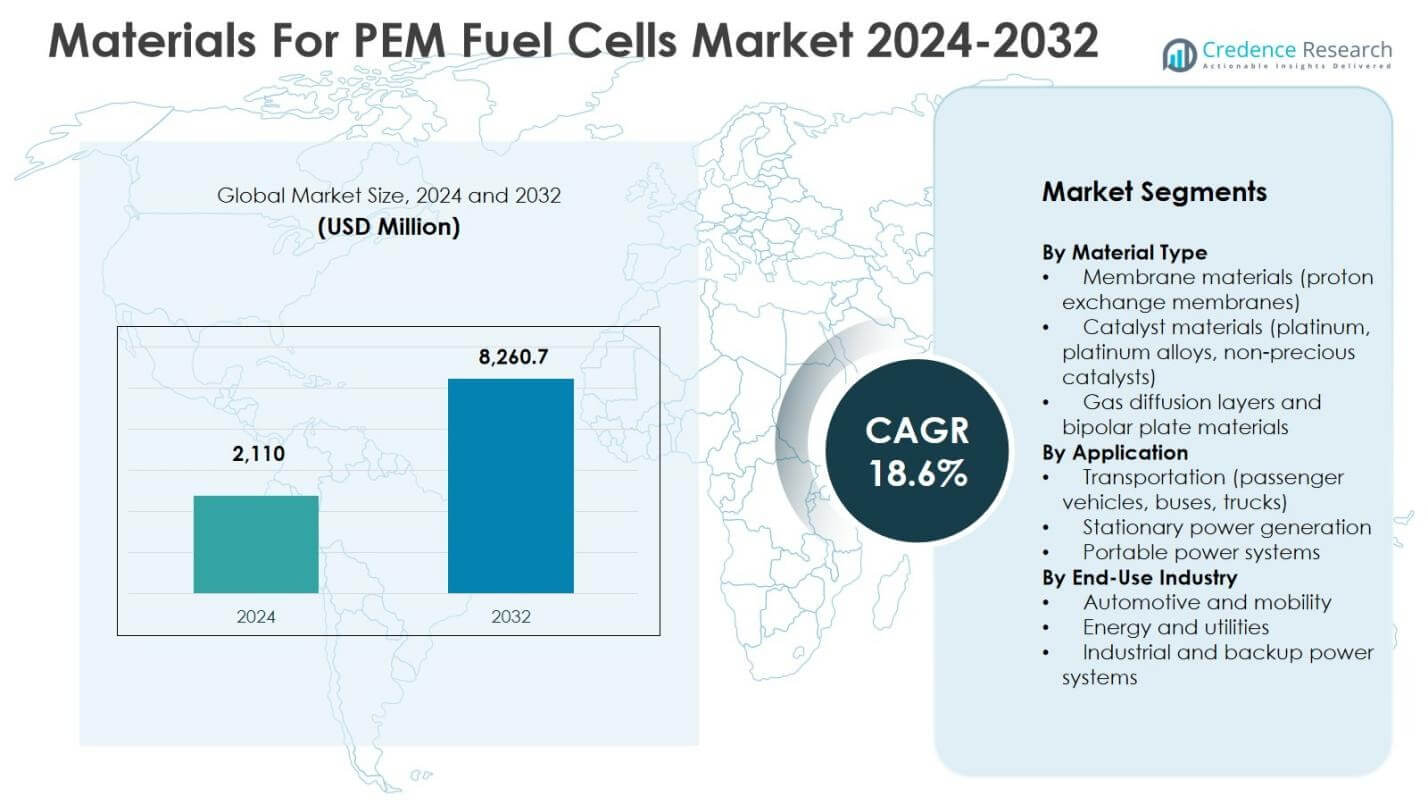
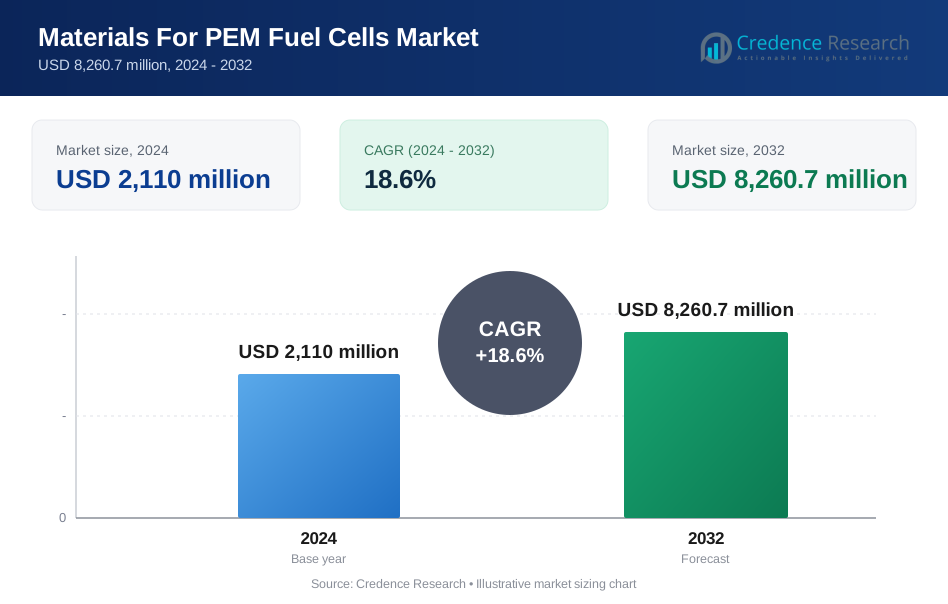
Materials for PEM Fuel Cells Market size was valued at USD 2,110 million in 2024 and is anticipated to reach USD 8,260.7 million by 2032, at a CAGR of 18.6% during the forecast period.
| REPORT ATTRIBUTE | DETAILS |
|---|---|
| Historical Period | 2020-2023 |
| Base Year | 2024 |
| Forecast Period | 2025-2032 |
| Materials for PEM Fuel Cells Market Size 2024 | USD 2,110 million |
| Materials for PEM Fuel Cells Market, CAGR | 18.6% |
| Materials for PEM Fuel Cells Market Size 2032 | USD 8,260.7 million |
Materials for PEM Fuel Cells Market Insights
- Market growth is driven by rising adoption of hydrogen fuel cell vehicles, strong government decarbonization policies, and increasing investments in hydrogen infrastructure, with membrane materials leading the market with a 42.6% segment share in 2024.
- Key market trends include reduced platinum catalyst loading, development of high-durability proton exchange membranes, and growing demand from stationary and backup power applications alongside transportation holding a 51.3% application share.
- Market restraints include high material costs, dependence on precious metals, durability challenges under real-world operating conditions, and limited infrastructure in emerging economies.
- Regionally, North America led the market with a 34.2% share in 2024, followed by Asia Pacific at 29.5% and Europe at 28.7%, supported by strong hydrogen policies, manufacturing capacity, and expanding fuel cell deployments.
Materials for PEM Fuel Cells Market Segmentation Analysis:
By Material Type:
In the Materials for PEM Fuel Cells Market, membrane materials (proton exchange membranes) represented the dominant sub-segment with a 42.6% market share in 2024, driven by their critical role in proton conductivity, durability, and overall fuel cell efficiency. Rising adoption of high-performance membranes such as PFSA-based and reinforced composite membranes continues to strengthen this segment. Catalyst materials accounted for 34.8%, supported by advancements in platinum alloy and low-loading catalysts to improve cost efficiency. Gas diffusion layers and bipolar plate materials held 22.6%, benefiting from increasing stack durability requirements and scaling of commercial PEM systems.
- For instance, TANAKA Precious Metals supplies high-activity platinum alloy electrocatalysts designed for PEM fuel cells, focusing on enhanced durability and performance in global commercialization efforts.
By Application:
By application, transportation emerged as the leading segment, holding a 51.3% market share in 2024, primarily driven by growing deployment of PEM fuel cells in passenger vehicles, buses, and heavy-duty trucks. Stringent emission regulations and government-backed hydrogen mobility programs significantly support this dominance. Stationary power generation followed with a 31.2% share, fueled by demand for clean backup and distributed power solutions in data centers and microgrids. Portable power systems accounted for 17.5%, supported by increasing use in defense, remote operations, and off-grid portable energy applications.
- For instance, Toyota's Mirai passenger vehicle employs a PEM fuel cell stack with 3.1 kW/L power density and 114 kW maximum output, enabling a 502 km range on a full hydrogen tank.
By End-Use Industry:
The automotive and mobility segment dominated the Materials for PEM Fuel Cells Market with a 49.8% market share in 2024, driven by strong OEM investments in hydrogen fuel cell electric vehicles and expanding refueling infrastructure. Energy and utilities captured 30.7%, supported by grid decarbonization initiatives and integration of fuel cells into stationary and hybrid energy systems. Industrial and backup power systems accounted for 19.5%, benefiting from rising demand for reliable, low-emission power solutions in industrial facilities, telecom towers, and critical infrastructure requiring uninterrupted power supply.
Key Growth Drivers
Rising Adoption of Hydrogen Mobility and Fuel Cell Vehicles
The Materials for PEM Fuel Cells Market is strongly driven by the accelerating adoption of hydrogen-powered mobility solutions across passenger vehicles, buses, and heavy-duty trucks. Governments worldwide are implementing stringent emission regulations and offering financial incentives to promote zero-emission transportation, directly boosting demand for PEM fuel cell stacks and their core materials. Automakers and commercial vehicle manufacturers are increasing investments in fuel cell electric vehicles, which significantly raises consumption of membranes, catalysts, gas diffusion layers, and bipolar plates. Expansion of hydrogen refueling infrastructure further supports long-term material demand and reinforces market growth.
- For instance, Hyundai Motor Company, in collaboration with Kia and Gore, develops advanced polymer electrolyte membranes (PEM) for next-generation fuel cell electric vehicles, focusing on improved proton conduction and durability in passenger cars and trucks.
Government Policies and Clean Energy Transition Initiatives
Supportive government policies focused on decarbonization and clean energy transition represent a major growth driver for the Materials for PEM Fuel Cells Market. National hydrogen strategies, public–private funding programs, and net-zero emission targets are accelerating deployment of fuel cell systems across transportation, stationary power, and backup power applications. These initiatives encourage large-scale production of PEM fuel cells, increasing demand for advanced materials with higher durability, efficiency, and cost performance. Regulatory backing also reduces investment risk, enabling manufacturers to scale material production capacities and invest in next-generation PEM material technologies.
- For instance, Cummins deployed a 1 MW stationary PEM fuel cell plant in South Korea, converting surplus hydrogen into clean prime power using rack-based PEM stacks in two 40-foot containers, supported by local government clean-energy incentives.
Technological Advancements in PEM Materials and Stack Performance
Continuous technological innovation in PEM fuel cell materials is significantly driving market expansion. Improvements in proton exchange membranes, such as reinforced and high-temperature membranes, enhance durability and operating efficiency. Advances in catalyst technologies, including platinum alloys and reduced precious metal loadings, improve performance while lowering system costs. Enhanced gas diffusion layers and corrosion-resistant bipolar plates increase stack lifespan and reliability. These innovations make PEM fuel cells more commercially viable across diverse applications, directly supporting higher adoption rates and sustained growth of the materials market.
Key Trends & Opportunities
Shift Toward Cost Reduction and Material Efficiency
A major trend in the Materials for PEM Fuel Cells Market is the strong focus on reducing system costs through material optimization. Manufacturers are investing in low-platinum and non-precious metal catalysts, thinner yet durable membranes, and lightweight bipolar plate materials. This shift improves cost competitiveness against battery and internal combustion technologies, particularly in transportation and stationary power segments. The trend creates significant opportunities for material suppliers developing high-performance, cost-efficient alternatives. As economies of scale improve and material innovations mature, PEM fuel cell adoption is expected to accelerate across both developed and emerging markets.
- For instance, Umicore piloted catalysts featuring 20% lower platinum content that maintained efficiency over 5,000 hours of operation. Korea Institute of Ceramic Engineering and Technology developed Pt catalysts on nano-SiC supports with epitaxial graphene from coffee grounds, achieving only 26.89% ECSA loss after 5,000 cycles versus 36.88% for commercial Pt/C.
Expansion of Stationary and Distributed Power Applications
The growing deployment of PEM fuel cells in stationary and distributed power generation presents a key opportunity for the materials market. Increasing demand for clean backup power in data centers, hospitals, telecom infrastructure, and microgrids is driving adoption of PEM systems. These applications require highly durable membranes and catalysts capable of long operating hours and variable load conditions. Integration of fuel cells with renewable energy and hydrogen storage systems further enhances opportunity potential, expanding material demand beyond transportation into energy and utility-focused applications.
- For instance, Honda installed a 500 kW stationary PEM fuel cell unit to supply clean emergency backup power specifically for data center operations
Key Challenges
High Material Costs and Dependence on Precious Metals
One of the primary challenges in the Materials for PEM Fuel Cells Market is the high cost associated with critical materials, particularly platinum-based catalysts. Dependence on precious metals exposes manufacturers to price volatility and supply constraints, increasing overall system costs. Despite progress in reducing platinum loadings, cost remains a barrier to large-scale commercialization. Material suppliers must balance performance, durability, and affordability, which limits rapid adoption in cost-sensitive markets and slows penetration in regions with limited policy support.
Durability and Performance Limitations Under Real-World Conditions
Ensuring long-term durability and stable performance of PEM fuel cell materials under real-world operating conditions remains a significant challenge. Membrane degradation, catalyst poisoning, and corrosion of bipolar plates can reduce system lifespan and reliability. These issues are particularly critical in heavy-duty transportation and stationary applications requiring extended operating hours. Addressing durability challenges requires continuous material innovation, rigorous testing, and higher R&D investments, which can increase development timelines and production costs for manufacturers across the PEM fuel cell materials value chain.
Regional Analysis
North America
North America held a 34.2% market share in 2024 in the Materials for PEM Fuel Cells Market, driven by strong government support for hydrogen technologies and advanced fuel cell commercialization. The United States leads regional demand due to large-scale investments in hydrogen mobility, stationary fuel cell projects, and defense applications. Federal funding programs and tax incentives accelerate deployment of PEM fuel cell systems, directly boosting demand for membranes, catalysts, and gas diffusion layers. The presence of established fuel cell manufacturers and material suppliers further strengthens the regional ecosystem, supporting continuous innovation and scaling of PEM material production.
Europe
Europe accounted for a 28.7% market share in 2024, supported by aggressive decarbonization targets and well-defined hydrogen strategies across major economies. Countries such as Germany, France, and the Netherlands are investing heavily in fuel cell vehicles, hydrogen corridors, and stationary power projects. Strong regulatory frameworks promoting zero-emission transport and renewable integration drive consistent demand for high-performance PEM materials. European focus on reducing platinum usage and improving material sustainability also supports advanced material development. Collaboration between automotive OEMs, energy companies, and material suppliers reinforces Europe’s strong position in the PEM fuel cell materials value chain.
Asia Pacific
Asia Pacific captured a 29.5% market share in 2024, driven by rapid adoption of fuel cell technologies in transportation and industrial applications. Japan, South Korea, and China dominate regional demand due to national hydrogen roadmaps and large-scale deployment of fuel cell vehicles and buses. Significant investments in domestic production of membranes, catalysts, and bipolar plates support supply chain localization. High manufacturing capacity, technological advancements, and cost-competitive production further strengthen the region’s growth. Asia Pacific continues to benefit from strong government backing and expanding hydrogen infrastructure, sustaining robust demand for PEM fuel cell materials.
Latin America
Latin America held a 4.2% market share in 2024, reflecting early-stage adoption of PEM fuel cell technologies. Regional growth is supported by increasing interest in green hydrogen production and clean energy diversification, particularly in Brazil and Chile. Pilot projects in stationary power and hydrogen mobility are gradually driving demand for PEM fuel cell materials. Government initiatives focused on renewable energy integration create long-term growth potential. However, limited infrastructure and higher technology costs currently restrain faster adoption, keeping the region’s market share relatively moderate compared to developed hydrogen markets.
Middle East & Africa
The Middle East & Africa accounted for a 3.4% market share in 2024, driven by emerging hydrogen economy initiatives and energy diversification strategies. Countries such as Saudi Arabia and the United Arab Emirates are investing in green hydrogen projects and fuel cell-based power solutions. Demand for PEM fuel cell materials is primarily linked to pilot-scale stationary power and industrial applications. Abundant renewable energy resources support future hydrogen production, creating long-term material demand potential. However, limited commercialization and infrastructure development currently constrain market expansion across the region.
Materials for PEM Fuel Cells Market Segmentations:
By Material Type
- Membrane materials (proton exchange membranes)
- Catalyst materials (platinum, platinum alloys, non-precious catalysts)
- Gas diffusion layers and bipolar plate materials
By Application
- Transportation (passenger vehicles, buses, trucks)
- Stationary power generation
- Portable power systems
By End-Use Industry
- Automotive and mobility
- Energy and utilities
- Industrial and backup power systems
By Geography
- North America
- U.S.
- Canada
- Mexico
- Europe
- Germany
- France
- U.K.
- Italy
- Spain
- Rest of Europe
- Asia Pacific
- China
- Japan
- India
- South Korea
- South-east Asia
- Rest of Asia Pacific
- Latin America
- Brazil
- Argentina
- Rest of Latin America
- Middle East & Africa
- GCC Countries
- South Africa
- Rest of the Middle East and Africa
Competitive Landscape
Competitive landscape analysis of the Materials for PEM Fuel Cells Market features key players such as Ballard Power Systems, Plug Power Inc., Cummins Inc., Johnson Matthey, Robert Bosch GmbH, Panasonic Corporation, Air Liquide, and SFC Energy AG. The competitive landscape is characterized by strong emphasis on material innovation, cost reduction, and performance enhancement across membranes, catalysts, and bipolar plates. Leading players focus on lowering platinum loadings, improving membrane durability, and developing corrosion-resistant components to enhance fuel cell efficiency and lifespan. Strategic collaborations with automotive OEMs, energy utilities, and hydrogen infrastructure developers are central to market positioning. Companies are also expanding manufacturing capacities and investing in localized supply chains to support large-scale commercialization. Continuous R&D, patent development, and alignment with national hydrogen strategies remain key competitive factors shaping long-term leadership in the PEM fuel cell materials market.
Key Player Analysis
- Ballard Power Systems
- Plug Power Inc.
- Cummins Inc.
- Nuvera Fuel Cells
- Nedstack Fuel Cell Technology
- Panasonic Corporation
- Robert Bosch GmbH
- SFC Energy AG
- Air Liquide
- Johnson Matthey
Recent Developments
- In April 2025, Heraeus Precious Metals and Freudenberg e-Power Systems announced a technology partnership to develop advanced catalyst-coated membranes (CCM) and related PEM fuel cell component solutions.
- In May 2025, the ECOPEM Project launched to develop next-generation non-fluorinated membranes and components for PEM fuel cells and electrolysers, aiming to reduce reliance on PFSA-based materials.
- In October 2025, Hyundai Motor broke ground on a large-scale hydrogen fuel cell production plant in Ulsan, South Korea, with capacity for 30,000 units annually, boosting PEM fuel cell material demand.
Report Coverage
The research report offers an in-depth analysis based on Material Type, Application, End Use Industry and Geography. It details leading market players, providing an overview of their business, product offerings, investments, revenue streams, and key applications. Additionally, the report includes insights into the competitive environment, SWOT analysis, current market trends, as well as the primary drivers and constraints. Furthermore, it discusses various factors that have driven market expansion in recent years. The report also explores market dynamics, regulatory scenarios, and technological advancements that are shaping the industry. It assesses the impact of external factors and global economic changes on market growth. Lastly, it provides strategic recommendations for new entrants and established companies to navigate the complexities of the market.
Future Outlook
- The Materials for PEM Fuel Cells Market will benefit from accelerating global hydrogen economy development and long-term decarbonization commitments.
- Increasing adoption of fuel cell electric vehicles will continue to drive demand for advanced membranes, catalysts, and gas diffusion layers.
- Ongoing efforts to reduce platinum content will improve cost competitiveness and support wider commercial adoption.
- Technological advancements will enhance material durability, efficiency, and operating life of PEM fuel cell systems.
- Expansion of stationary and backup power applications will create sustained demand beyond transportation.
- Integration of PEM fuel cells with renewable energy and hydrogen storage systems will strengthen material demand.
- Asia Pacific will remain a key manufacturing and consumption hub due to strong policy support and scale advantages.
- Strategic collaborations between material suppliers and OEMs will accelerate innovation and commercialization.
- Localization of material supply chains will reduce dependency on imports and improve production resilience.
- Continuous R&D investment will support the transition toward high-performance, low-cost, and sustainable PEM fuel cell materials.
Request a Free Sample
Fill in your details and we'll send you a free sample report.
- Sample data tables & charts
- Research methodology
Need a Custom Version of This Report?
Tailor the scope, geography, or segments to your exact requirements.
- Custom geography or segment scope
- Direct access to our analyst team
Frequently Asked Questions
What is the current market size for the Materials for PEM Fuel Cells Market, and what is its projected size in 2032?
At what Compound Annual Growth Rate is the Materials for PEM Fuel Cells Market projected to grow between 2024 and 2032?
Which Materials for PEM Fuel Cells Market segment held the largest share in 2024?
What are the primary factors fueling the growth of the Materials for PEM Fuel Cells Market?
Who are the leading companies in the Materials for PEM Fuel Cells Market?
Which region commanded the largest share of the Materials for PEM Fuel Cells Market in 2024?
Table of Content
Chapter 1. Report Introduction
- 1.1 Report Description & Purpose
- 1.1.1 Report Title & Market Definition
- 1.1.2 Unique Selling Propositions (USP) & Key Differentiators
- 1.1.3 Value Proposition for Stakeholders
- 1.2 Research Objectives
- 1.2.1 Market Sizing Objectives (Volume & Revenue)
- 1.2.2 Segmentation Objectives
- 1.2.3 Competitive Intelligence Objectives
- 1.2.4 Forecast & Scenario Objectives
- 1.3 Report Scope
- 1.3.1 Materials For PEM Fuel Cells Scope – Types & Subtypes Covered
- 1.3.2 Geographic Scope – Regions & Countries Covered
- 1.3.3 Historical Period, Base Year & Forecast Period (2024; forecast to 2032)
- 1.3.4 Inclusions & Exclusions
- 1.4 HS Code & Classification Framework
- 1.5 Currency, Units & Pricing Basis
- 1.6 Target Stakeholders
- 1.7 Limitations & Assumptions
Chapter 2. Executive Summary
- 2.1 Global Materials For PEM Fuel Cells Market Snapshot
- 2.1.1 Market Size – Historical (2024) & Forecast (2024-2032) (2024: USD 2,110 million → 2032: USD 8,260.7 million)
- 2.1.2 Volume & Revenue – Global Totals
- 2.1.3 Key Market Highlights – Top Five Facts
- 2.2 Materials For PEM Fuel Cells Market Segmentation Snapshot
- 2.2.1 Market Split by Region – 2024 vs. 2032
- 2.3 Competitive Snapshot
- 2.3.1 Top 10 Players by Revenue Share – 2024
- 2.3.2 Top 10 Players by Volume Share – 2024
- 2.3.3 Recent Strategic Developments (18-Month Summary)
- 2.4 Key Investment Highlights & Strategic Conclusions
Chapter 3. Materials For PEM Fuel Cells Market Dynamics & Industry Analysis
- 3.1 Market Overview & Context
- 3.1.1 Materials For PEM Fuel Cells Market Position in the Broader Automotive Value Chain
- 3.1.2 OEM vs. Replacement Market Dynamics
- 3.1.3 Market Maturity & Development Stage by Region
- 3.2 Materials For PEM Fuel Cells Market Drivers
- 3.3 Materials For PEM Fuel Cells Market Restraints & Challenges
- 3.4 Materials For PEM Fuel Cells Market Opportunities
- 3.5 Porter's Five Forces Analysis
- 3.5.1 Threat of New Entrants
- 3.5.2 Bargaining Power of Suppliers
- 3.5.3 Bargaining Power of Buyers
- 3.5.4 Threat of Substitutes
- 3.5.5 Competitive Rivalry – Intensity Assessment
- 3.6 Materials For PEM Fuel Cells Value Chain Analysis
- 3.6.1 Upstream – Raw Material/Input Suppliers
- 3.6.1.1 Raw Material/Input 1
- 3.6.1.2 Raw Material/Input 2
- 3.6.1.3 Raw Material/Input 3
- 3.6.2 Midstream – Production/Manufacturing/Service Delivery
- 3.6.2.1 Production/Process Overview
- 3.6.2.2 Key Facility Locations & Capacity by Manufacturer
- 3.6.3 Downstream – Distribution & End Consumer
- 3.6.3.1 Primary Channel – B2B/OEM
- 3.6.3.2 Secondary Channels – Dealer, Retail, Online, Direct
- 3.6.4 Value Chain Profitability Analysis
- 3.6.1 Upstream – Raw Material/Input Suppliers
- 3.7 PESTEL Analysis
- 3.7.1 Political Factors
- 3.7.2 Economic Factors
- 3.7.3 Social Factors
- 3.7.4 Technological Factors
- 3.7.5 Environmental Factors
- 3.7.6 Legal Factors
- 3.8 Materials For PEM Fuel Cells Supply Chain Analysis
- 3.8.1 Raw Material/Input Supply Risk Assessment
- 3.8.2 Manufacturing Concentration Risk (Geographic Exposure)
- 3.8.3 Trade Disruption Impact Analysis
- 3.9 Regulatory & Policy Landscape
Note: The regulatory and policy landscape section covers regulations based on their applicability to the market, Materials For PEM Fuel Cells category, geography, and scope of the study. Only regulatory frameworks with a material impact on operations, compliance, trade, sustainability, or market access are analyzed in detail.
Chapter 4. Key Investment Pockets & Opportunity Analysis
- 4.1 Materials For PEM Fuel Cells Market Attractiveness Analysis
- 4.1.1 By Region – Investment Attractiveness Matrix (Volume × CAGR)
- 4.2 Absolute Revenue Growth Opportunity
- 4.2.1 By Region – Absolute USD Growth Through 2032
- 4.3 Incremental Volume Opportunity
- 4.3.1 By Region – Incremental Volume Through 2032
- 4.3.2 Segment – Incremental Volume
- 4.4 Emerging Submarket Opportunity Deep Dive (Subject to Applicability)
- 4.5 Emerging Market Opportunity Scorecards
- 4.5.1 United States
- 4.5.2 Europe
- 4.5.3 Asia
- 4.5.4 Middle East & Africa
Note: Emerging Market Opportunity Scorecards will be included based on relevance and strategic importance. Regions listed are indicative and may vary depending on data availability and market dynamics.
Chapter 5. Materials For PEM Fuel Cells Import-Export Analysis & Trade Flows
- 5.1 Global Trade Overview
- 5.1.1 Global Export Value by Country (2024)
- 5.1.2 Global Export Volume by Country (2024)
- 5.1.3 Global Import Value by Country (2024)
- 5.1.4 Global Import Volume by Country (2024)
- 5.1.5 Net Trade Balance by Country (2024)
- 5.2 Export Analysis – Segment
- 5.2.1 Type 1 (HS Code)
- 5.2.2 Type 2 (HS Code)
- 5.2.3 Type 3 (HS Code)
- 5.2.4 Type 4 (HS Code)
- 5.2.5 Type 5 (HS Code)
- 5.3 Import Analysis – Segment
- 5.3.1 Type 1 (HS Code)
- 5.3.2 Type 2 (HS Code)
- 5.3.3 Type 3 (HS Code)
- 5.3.4 Type 4 (HS Code)
- 5.3.5 Type 5 (HS Code)
- 5.4 Average Unit Trade Prices
- 5.4.1 Average Export Price – Segment & Country
- 5.4.2 Average Import Price – Segment & Source Country
- 5.4.3 Price Trends (2024)
- 5.5 Key Trade Route Analysis
- 5.5.1 Trade Route 1
- 5.5.2 Trade Route 2
- 5.5.3 Trade Route 3
- 5.5.4 Trade Route 4
- 5.5.5 Trade Route 5
- 5.6 Trade Policy Impact Assessment
- 5.6.1 US Anti-Dumping & Section 301 Tariffs
- 5.6.2 EU Customs Union Impact
- 5.6.3 Major Free Trade Agreements
- 5.6.4 USMCA Rules of Origin
Note: Trade policy analysis will be included only where relevant to the Materials For PEM Fuel Cells market.
Chapter 6. Competitive Landscape & Company Benchmarking
- 6.1 Materials For PEM Fuel Cells Market Concentration & Structure
- 6.1.1 Herfindahl-Hirschman Index (HHI) – vs. 2024
- 6.1.2 Tier 1, Tier 2 & Tier 3 Market Structure
- 6.1.3 Global, Regional & Local Player Dynamics
- 6.2 Materials For PEM Fuel Cells Market Share Analysis – 2024
- 6.2.1 Global Revenue Share by Company
- 6.2.2 Global Volume Share by Company
- 6.2.3 Regional Revenue Share
- 6.2.4 Market Share Evolution ( vs. 2024)
- 6.2.5 OEM Segment Share by Company
- 6.2.6 Replacement Segment Share by Company
- 6.3 Production/Delivery Capacity & Facility Analysis
- 6.3.1 Global Installed Capacity
- 6.3.2 Capacity Utilization Rates
- 6.3.3 Production/Output Volume
- 6.3.4 Facility Locations & Capacity Map
- 6.3.5 Planned Capacity Additions
- 6.4 Materials For PEM Fuel Cells Competitive Benchmarking Matrix
- 6.4.1 Revenue, Volume, CAGR & Profitability Comparison
- 6.4.2 Channel Revenue Mix
- 6.4.3 Geographic Revenue Exposure
- 6.4.4 R&D Intensity
- 6.4.5 Sustainability Maturity
- 6.5 Strategic Developments in Materials For PEM Fuel Cells (Last 24 Months)
- 6.5.1 Mergers, Acquisitions & Divestments
- 6.5.2 New Materials For PEM Fuel Cells Launches
- 6.5.3 Facility Expansions
- 6.5.4 Strategic Alliances, Joint Ventures & Partnerships
- 6.5.5 Distribution Expansion & Market Entry
- 6.5.6 Sustainability & ESG Initiatives
- 6.6 Competitive Strategy Mapping
- 6.6.1 Leader, Challenger, Follower & Niche Classification
- 6.6.2 Pricing Strategy Comparison
- 6.6.3 Channel Strategy Matrix
Note: Strategic developments are included based on their materiality and the availability of reliable information.
Chapter 7. Global Materials For PEM Fuel Cells Market – By Distribution Channel
- 7.1 Segment Overview
- 7.1.1 Volume & Revenue Split by Channel (2024 & 2032)
- 7.1.2 Channel Mix Evolution (2024-2032)
Chapter 8. Regional Market Analysis – Global Overview
- 8.1 Global Regional Overview
- 8.1.1 Regional Volume Share
- 8.1.2 Regional Revenue Share
- 8.1.3 Regional Volume by Region
- 8.1.4 Regional Revenue by Region
- 8.1.5 Regional Forecast Through 2032
- 8.2 Cross-Regional Segment Analysis
- 8.2.1 By Distribution Channel
- 8.2.2 By Brand/Price Tier
Chapter 9. North America Materials For PEM Fuel Cells Market
- 9.1 United States
- 9.2 Canada
- 9.3 Mexico
Chapter 10. Europe Materials For PEM Fuel Cells Market
- 10.1 Germany
- 10.2 France
- 10.3 Italy
- 10.4 United Kingdom
- 10.5 Spain
- 10.6 Poland
- 10.7 Russia
- 10.8 Netherlands
- 10.9 Belgium
- 10.10 Sweden
- 10.11 Denmark
- 10.12 Norway
- 10.13 Rest of Europe
Chapter 11. Asia Pacific Materials For PEM Fuel Cells Market
- 11.1 China
- 11.2 India
- 11.3 Japan
- 11.4 South Korea
- 11.5 Thailand
- 11.6 Indonesia
- 11.7 Vietnam
- 11.8 Malaysia
- 11.9 Australia
- 11.10 Rest of Asia Pacific
Chapter 12. Latin America Materials For PEM Fuel Cells Market
- 12.1 Brazil
- 12.2 Argentina
- 12.3 Colombia
- 12.4 Chile
- 12.5 Rest of Latin America
Chapter 13. Middle East Materials For PEM Fuel Cells Market
- 13.1 Saudi Arabia
- 13.2 United Arab Emirates
- 13.3 Turkey
- 13.4 Israel
- 13.5 Iran
- 13.6 Rest of the Middle East
Chapter 14. Africa Materials For PEM Fuel Cells Market
- 14.1 South Africa
- 14.2 Egypt
- 14.3 Nigeria
- 14.4 Morocco
- 14.5 Rest of Africa
Chapter 15. Materials For PEM Fuel Cells Company Profiles
- 15.1 [Company 01]
- 15.1.1 Company Overview
- 15.1.2 Key Management Personnel
- 15.1.3 Products & Services Portfolio
- 15.1.4 Financial Performance
- 15.1.5 Key Market Focus & Geographic Presence
- 15.1.6 Recent Developments & Strategic Initiatives
Note: The company profile list is preliminary and may change based on research findings, market developments, data availability, and client requirements.
Chapter 16. Appendices
- Appendix A – List of Abbreviations & Acronyms
- Appendix B – Industry Classification Code Reference – Full Series
- Appendix C – Production & Capacity Data Tables
- Appendix D – End-Use & Demand Base Tables
- Appendix E – Consumption & Replacement Rate Assumptions
- Appendix F – ASP Reference Tables
- Appendix G – Manufacturing & Facility Database
- Appendix H – Import-Export Data Tables
- Appendix I – Regulatory Summary Tables
- Appendix J – Primary Research Participant List (Anonymized)
- Appendix K – Primary Research Questionnaire Framework
- Appendix L – Data Sources & Bibliography
- Appendix M – Market Size Divergence & Source Comparison
Chapter 17. Research Methodology
- 17.1 Research Framework & Philosophy
- 17.2 Secondary Research – Sources, Hierarchy & Data Extraction
- 17.3 Data Modeling – Bottom-Up & Top-Down Market Sizing
- 17.4 Primary Research – Stakeholder Framework, LOI & Sample Sizes
- 17.5 Forecast Methodology – Regression, Scenario & Sensitivity Analysis
- 17.6 Quality Control – Four-Layer Validation Framework
- 17.7 Limitations & Standard Assumptions
- 17.8 Disclaimer
