
Market Overview
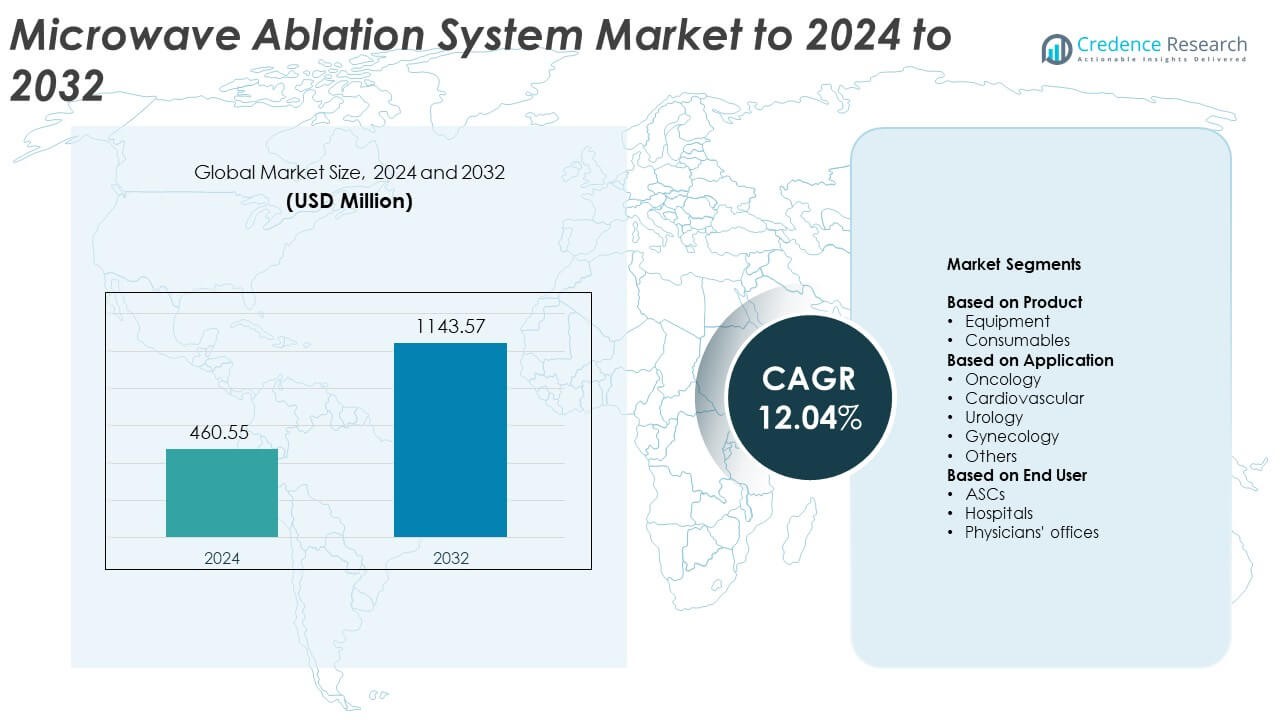
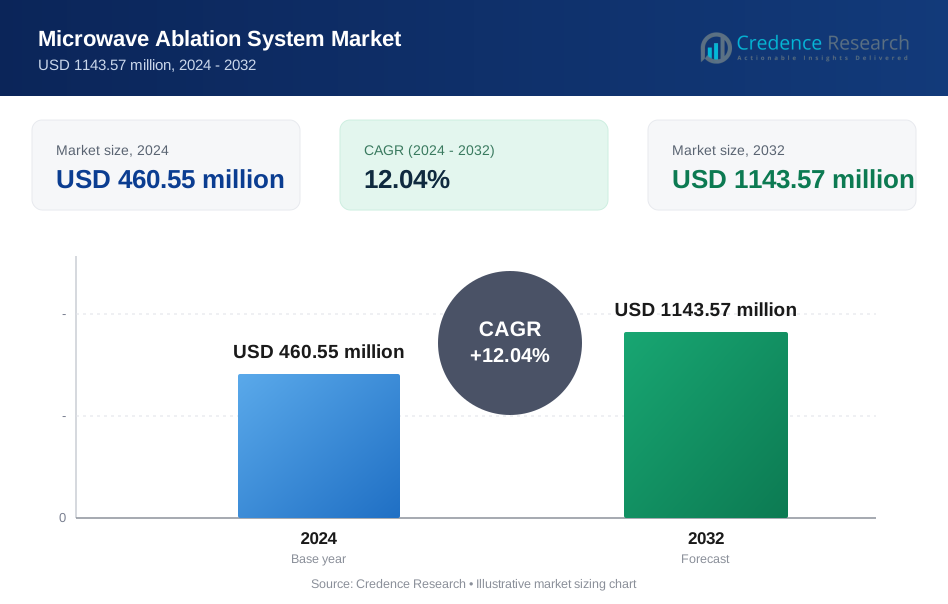
Microwave Ablation System Market size was valued USD 460.55 million in 2024 and is anticipated to reach USD 1143.57 million by 2032, at a CAGR of 12.04% during the forecast period.
| REPORT ATTRIBUTE | DETAILS |
|---|---|
| Historical Period | 2020-2023 |
| Base Year | 2024 |
| Forecast Period | 2025-2032 |
| Microwave Ablation System Market Size 2024 | USD 460.55 Million |
| Microwave Ablation System Market, CAGR | 12.04% |
| Microwave Ablation System Market Size 2032 | USD 1143.57 Million |
The microwave ablation system market is shaped by major players such as Varian Medical Systems, Inc., HUBER+SUHNER, Emblation Ltd., Terumo Corporation, SympleSurgical Inc., Johnson & Johnson Services, Inc., MedWaves, Inc., AngioDynamics, Mermaid Medical, and Medtronic. These companies compete through advanced generators, improved antenna designs, and stronger integration with image-guided platforms. North America led the global market in 2024 with about 38% share, supported by high cancer treatment volume, strong reimbursement, and rapid adoption of minimally invasive procedures. Europe held the second-largest share, while Asia Pacific expanded quickly with rising healthcare investment and broader access to ablation technologies.
Market Insights
- The microwave ablation system market reached USD 460.55 million in 2024 and is projected to hit USD 1143.57 million by 2032, advancing at a CAGR of 12.04%. • Strong demand rises from the oncology segment, which held nearly 71% share in 2024 due to wider adoption of minimally invasive tumor treatment supported by improved imaging accuracy. • Key trends include rapid use of AI-enabled planning tools, growing adoption of portable generators, and expansion into non-oncology applications such as thyroid and urology care. • Competition strengthens as leading companies invest in advanced antennas, efficient generators, and software-guided ablation systems that enhance precision and reduce procedure time across hospital networks. • North America dominated the market with about 38% share in 2024, followed by Europe at 29%, while Asia Pacific grew quickly with 23% driven by rising cancer burden and upgraded oncology infrastructure.
Market Segmentation Analysis:
By Product
Equipment dominated the microwave ablation system market in 2024 with about 64% share. Strong demand came from expanded use of advanced generators and antennas in cancer treatment. Hospitals preferred these systems because they provide stable energy delivery and short procedure time. Consumables grew at a steady rate as repeat use increased for antenna kits, but equipment remained the leading category due to higher replacement cycles and broad adoption in image-guided ablation.
- For instance, Medtronic’s Emprint microwave ablation system was used to treat 56 liver tumors with a median lesion size of 1.4 cm (ranging from 0.4 to 3.7 cm) in a clinical series assessing ablation performance in hepatic malignancies.
By Application
Oncology held the leading position in 2024 with nearly 71% share. Cancer care centers used microwave ablation for liver, lung, kidney, and bone tumors. Doctors selected this method because it offers fast heating, fewer sessions, and minimal blood loss. Other applications such as cardiovascular and urology showed gradual expansion, but oncology stayed dominant as global cancer cases rose and treatment guidelines supported minimally invasive tumor ablation.
- For instance, AngioDynamics’ Solero microwave tissue ablation system is specified to create an ablation zone up to 5 cm in diameter in about 6 minutes at maximum power using a single applicator, supporting treatment of larger liver tumors in oncology practice.
By End User
Hospitals led the end-user segment in 2024 with around 59% share. Large hospital networks adopted microwave ablation systems to manage complex oncology and cardiovascular cases. These facilities favored the technology because it improves accuracy under CT or ultrasound guidance. ASCs and physicians' offices expanded usage for small lesions and outpatient care, yet hospitals remained ahead due to higher patient volume and stronger investment in image-guided ablation infrastructure.
Key Growth Drivers
Rising Cancer Burden
The surge in global cancer cases drives strong demand for microwave ablation systems. Hospitals and specialty centers prefer this technique because it delivers rapid heating, wider ablation zones, and shorter procedure times than several alternative methods. The technology supports treatment of liver, lung, kidney, and bone tumors, which increases its clinical relevance. Growing patient preference for minimally invasive procedures further accelerates adoption. As cancer screening programs expand, more early-stage lesions qualify for ablation, strengthening long-term demand across developed and emerging regions.
- For instance, in a randomized phase 2 trial of liver malignancies, HS Hospital Service’s AMICA microwave generator operated at 2.45 GHz with a maximum output of 140 W, using standard applications of 3 to 6 minutes at 60 to 80 W in a total of 82 patients (41 in the MWA group), reflecting its use in routine cancer workloads, as documented in published clinical trial results.
Advancements in Image-Guided Technologies
Continuous improvements in CT, MRI, and ultrasound imaging support precise antenna placement and enhance ablation accuracy. These imaging upgrades help doctors monitor tissue temperature, ablation margins, and real-time treatment response. Better visual guidance reduces complication rates and supports adoption in complex tumors located near vital structures. As hospitals upgrade imaging suites, microwave ablation becomes more efficient and safer. The integration of software-based planning tools and automated energy control systems also increases reliability and physician confidence.
- For instance, ultrasound-guided thermal ablation techniques are a recommended alternative option to surgery for symptomatic, solid benign thyroid nodules according to guidelines from the European Thyroid Association, using high-frequency linear probes (typically 7.5 to 12 MHz) for real-time visualization and guidance.
Shift Toward Minimally Invasive Therapies
Healthcare systems favor minimally invasive treatments that reduce hospital stay, recovery time, and procedure-related risk. Microwave ablation aligns with these goals because it provides targeted tumor destruction with small incisions and limited anesthesia needs. Patients benefit from rapid discharge and faster return to routine activities. This shift is also driven by cost optimization, as shorter inpatient time reduces overall treatment expenses. The trend strengthens in markets facing high surgical backlog and limited operating-room capacity.
Key Trends and Opportunities
Integration of AI and Navigation Software
Developers increasingly integrate AI-assisted planning tools and navigation software to enhance system accuracy. These solutions support automated ablation zone prediction, optimal antenna positioning, and energy modulation. Hospitals adopting digital platforms gain higher consistency across procedures, which improves patient outcomes. The opportunity grows as vendors combine imaging, robotics, and computational modeling into unified ablation workstations. Such integration increases equipment value and expands usage across both oncology and non-oncology cases.
- For instance, ActiViews’ CT-Guide navigation system combines a miniature video camera, registration sticker, and 3D navigation software, and was prospectively tested in 20 patients undergoing CT-guided liver biopsy or ablation, where all procedures achieved satisfactory instrument positioning on CT review with an average target lesion size of 3.1 cm and mean target depth of 8.0 cm.
Rising Use in Outpatient and Ambulatory Settings
Microwave ablation systems continue gaining traction in ASCs and office-based practices as devices become more compact and user-friendly. Growing acceptance of same-day tumor ablation creates strong opportunities for manufacturers offering portable generators and disposable antenna kits. Outpatient expansion reduces procedure cost, improves patient convenience, and allows providers to handle higher case volumes. The trend accelerates in regions with strong reimbursement support for minimally invasive procedures.
- For instance, Urologix’s Targis cooled transurethral microwave therapy system for benign prostatic hyperplasia was evaluated in a randomized study of 94 men (46 of whom received the 60-minute treatment protocol), where the active microwave treatment was delivered during a single session of about 60 minutes, designed for performance with local anesthesia and sedation in an outpatient setting
Expansion into Non-Oncology Applications
Broader clinical research supports the use of microwave ablation in thyroid nodules, varicose veins, benign prostatic hyperplasia, and gynecological conditions. These emerging uses create a sizable opportunity for market expansion beyond traditional oncology. Physicians adopt the technology due to its ability to achieve localized thermal destruction with minimal structural damage. As clinical evidence strengthens, regulatory approvals and expanded guidelines may further boost non-oncology penetration.
Key Challenges
High Capital and Procedure Costs
Microwave ablation generators, antennas, and imaging requirements create a high upfront investment for healthcare facilities. Many centers in developing regions struggle to adopt the technology due to limited budgets and constrained reimbursement. The cost of disposable antenna kits also increases the per-procedure expense, reducing affordability for patients. These financial barriers limit widespread adoption despite strong clinical benefits.
Limited Skilled Professionals
Successful microwave ablation requires experienced radiologists, oncologists, and surgeons trained in image-guided procedures. Several regions face shortages of trained specialists, which restricts safe and effective system use. Limited hands-on training programs and uneven access to advanced imaging further widen the skill gap. This challenge slows adoption in emerging markets and delays expansion into new clinical applications.
Regional Analysis
North America
North America held the leading position in the microwave ablation system market in 2024 with around 38% share. The region benefited from strong adoption in oncology centers, advanced imaging infrastructure, and high use of minimally invasive procedures. Hospitals invested in next-generation generators and software-guided ablation systems to improve accuracy and reduce procedure time. Supportive reimbursement and growing cancer screening programs further strengthened demand. The United States dominated regional usage due to high procedural volume, while Canada showed steady adoption through expanded cancer care networks.
Europe
Europe accounted for roughly 29% share of the microwave ablation system market in 2024. The region showed strong clinical uptake across liver, lung, and renal tumor ablation due to well-established interventional radiology units. Countries such as Germany, France, Italy, and the U.K. invested in image-guided systems to support early-stage cancer treatment. Growing demand for minimally invasive solutions and rising preference for day-care procedures supported wider use. Regulatory approval of advanced antennas and improved hospital budgets further strengthened market performance across Western and Northern Europe.
Asia Pacific
Asia Pacific represented nearly 23% share of the market in 2024 and grew rapidly due to rising cancer incidence and expanding healthcare infrastructure. China, Japan, South Korea, and India increased investment in oncology centers and image-guided therapies. Hospitals adopted microwave ablation systems because they offer faster procedures and shorter recovery time, which helps manage large patient volumes. Local manufacturing growth and favorable government programs improved accessibility. The region also benefited from rising awareness of minimally invasive tumor treatment among patients and physicians.
Latin America
Latin America held close to 6% share in the microwave ablation system market in 2024. Adoption increased as Brazil, Mexico, and Argentina improved cancer detection rates and expanded interventional radiology capabilities. Hospitals favored microwave ablation for liver and lung tumors due to shorter procedure duration and reduced hospitalization needs. Limited budgets slowed penetration in smaller facilities, yet public-private investments supported gradual expansion. Growing training programs for radiologists also improved procedural capability across leading medical centers.
Middle East and Africa
The Middle East and Africa accounted for about 4% share in 2024, driven by rising healthcare modernization across the Gulf countries. Saudi Arabia, the UAE, and Qatar invested in advanced oncology centers that adopted microwave ablation to manage rising cancer cases. Access remained uneven in Africa due to limited imaging technology and high equipment cost. However, gradual improvements in cancer care programs and partnerships with global device suppliers supported wider availability. The region showed steady growth potential as hospitals shifted toward minimally invasive therapies.
Market Segmentations:
By Product
- Equipment
- Consumables
By Application
- Oncology
- Cardiovascular
- Urology
- Gynecology
- Others
By End User
- ASCs
- Hospitals
- Physicians' offices
By Geography
- North America
- U.S.
- Canada
- Mexico
- Europe
- Germany
- France
- U.K.
- Italy
- Spain
- Rest of Europe
- Asia Pacific
- China
- Japan
- India
- South Korea
- South-east Asia
- Rest of Asia Pacific
- Latin America
- Brazil
- Argentina
- Rest of Latin America
- Middle East & Africa
- GCC Countries
- South Africa
- Rest of the Middle East and Africa
Competitive Landscape
The microwave ablation system market is shaped by leading companies such as Varian Medical Systems, Inc., HUBER+SUHNER, Emblation Ltd., Terumo Corporation, SympleSurgical Inc., Johnson & Johnson Services, Inc., MedWaves, Inc., AngioDynamics, Mermaid Medical, and Medtronic. The competitive environment reflects strong investment in next-generation generators, precision antennas, and software-guided ablation solutions designed to support faster and more controlled energy delivery. Manufacturers focus on improving system integration with CT, MRI, and ultrasound platforms to enhance accuracy in tumor targeting. Many firms expand their portfolios through regulatory approvals, product upgrades, and geographic expansion into high-growth regions. Strategic partnerships with hospitals and oncology centers strengthen clinical adoption, while emphasis on disposable antenna kits increases recurring revenue. Companies also compete on ease of use, portability, ablation zone consistency, and compatibility with minimally invasive workflows, reinforcing steady market advancement.
Key Player Analysis
- Varian Medical Systems, Inc.
- HUBER+SUHNER
- Emblation Ltd.
- Terumo Corporation
- SympleSurgical Inc.
- Johnson & Johnson Services, Inc.
- MedWaves, Inc.
- AngioDynamics
- Mermaid Medical
- Medtronic
Recent Developments
- In 2024, Medtronic received FDA approval for its Affera Mapping and Ablation System with Sphere-9 Catheter.
- In 2024, HUBER+SUHNER continued to supply its extensive range of high-performance connectivity solutions globally, which are utilized across many industries, including medical technology.
- In 2024, Varian received FDA clearance for its IntelliBlate microwave ablation system, which is designed to provide clinicians with enhanced precision, predictability, and control during soft tissue ablation procedures.
Report Coverage
The research report offers an in-depth analysis based on Product, Application, End-User and Geography. It details leading market players, providing an overview of their business, product offerings, investments, revenue streams, and key applications. Additionally, the report includes insights into the competitive environment, SWOT analysis, current market trends, as well as the primary drivers and constraints. Furthermore, it discusses various factors that have driven market expansion in recent years. The report also explores market dynamics, regulatory scenarios, and technological advancements that are shaping the industry. It assesses the impact of external factors and global economic changes on market growth. Lastly, it provides strategic recommendations for new entrants and established companies to navigate the complexities of the market.
Future Outlook
- The market will expand as cancer incidence rises and early detection improves.
- Adoption will grow as hospitals upgrade imaging systems for more accurate guidance.
- Outpatient and ambulatory centers will perform more ablation procedures.
- AI-based planning and navigation tools will enhance treatment precision.
- Compact and portable generators will increase use in smaller clinical settings.
- Non-oncology applications will gain wider acceptance across global markets.
- Training programs for interventional radiologists will improve procedural adoption.
- Manufacturers will focus on advanced antenna designs for larger ablation zones.
- Reimbursement improvements in emerging markets will support system penetration.
- Strategic partnerships between hospitals and device makers will accelerate technology integration.
Request a Free Sample
Fill in your details and we'll send you a free sample report.
- Sample data tables & charts
- Research methodology
Need a Custom Version of This Report?
Tailor the scope, geography, or segments to your exact requirements.
- Custom geography or segment scope
- Direct access to our analyst team
Frequently Asked Questions
What is the current market size for Microwave Ablation System Market, and what is its projected size in 2032?
At what Compound Annual Growth Rate is the Microwave Ablation System Market projected to grow between 2025 and 2032?
Which Microwave Ablation System Market segment held the largest share in 2024?
What are the primary factors fueling the growth of the Microwave Ablation System Market?
Who are the leading companies in the Microwave Ablation System Market?
Which region commanded the largest share of the Microwave Ablation System Market in 2024?
Table of Content
Chapter 1. Report Introduction
- 1.1 Report Description & Purpose
- 1.1.1 Report Title & Market Definition
- 1.1.2 Unique Selling Propositions (USP) & Key Differentiators
- 1.1.3 Value Proposition for Stakeholders
- 1.2 Research Objectives
- 1.2.1 Market Sizing Objectives (Volume & Revenue) (Volume Where Applicable)
- 1.2.2 Segmentation Objectives
- 1.2.3 Competitive Intelligence Objectives
- 1.2.4 Forecast & Scenario Objectives
- 1.3 Report Scope
- 1.3.1 Microwave Ablation System Scope – Segments & Subsegments Covered
- 1.3.2 Geographic Scope – Regions & Countries Covered
- 1.3.3 Historical Period, Base Year & Forecast Period (2024; forecast to 2032)
- 1.3.4 Inclusions & Exclusions
- 1.4 Industry Classification & Applicable Codes
- 1.5 Currency, Measurement Units & Valuation Basis
- 1.6 Target Stakeholders
- 1.7 Limitations & Assumptions
Chapter 2. Executive Summary
- 2.1 Global Microwave Ablation System Market Snapshot
- 2.1.1 Market Size – Historical (2024) & Forecast (2024-2032) (2024: USD 460.55 million → 2032: USD 1143.57 million)
- 2.1.2 Volume & Revenue – Global Totals (Volume Where Applicable)
- 2.1.3 Key Market Highlights – Top Five Facts
- 2.2 Microwave Ablation System Market Segmentation Snapshot
- 2.2.1 Market Split by Region – 2024 vs. 2032
- 2.3 Competitive Snapshot
- 2.3.1 Top 10 Players by Revenue Share – 2024
- 2.3.2 Top 10 Players by Volume Share – 2024 (Volume Where Applicable)
- 2.3.3 Recent Strategic Developments (18-Month Summary)
- 2.4 Key Investment Highlights & Strategic Conclusions
Chapter 3. Microwave Ablation System Market Dynamics & Industry Analysis
- 3.1 Market Overview & Context
- 3.1.1 Microwave Ablation System Market Position in the Broader Industry Value Chain
- 3.1.2 Demand Structure & Purchasing Dynamics
- 3.1.3 Market Maturity & Development Stage by Region
- 3.2 Microwave Ablation System Market Drivers
- 3.3 Microwave Ablation System Market Restraints & Challenges
- 3.4 Microwave Ablation System Market Opportunities
- 3.5 Porter's Five Forces Analysis
- 3.5.1 Threat of New Entrants
- 3.5.2 Bargaining Power of Suppliers
- 3.5.3 Bargaining Power of Buyers
- 3.5.4 Threat of Substitutes
- 3.5.5 Competitive Rivalry – Intensity Assessment
- 3.6 Microwave Ablation System Value Chain Analysis
- 3.6.1 Upstream – Key Inputs, Resources & Suppliers
- 3.6.1.1 Key Input/Resource 1
- 3.6.1.2 Key Input/Resource 2
- 3.6.1.3 Key Input/Resource 3
- 3.6.2 Midstream – Core Operations & Value Creation
- 3.6.2.1 Operating Model & Process Overview
- 3.6.2.2 Key Operating Locations & Capabilities by Company
- 3.6.3 Downstream – Market Channels & End Users
- 3.6.3.1 Direct Sales & Customer Engagement Channels
- 3.6.3.2 Indirect Sales, Intermediaries & Partner Channels
- 3.6.4 Value Chain Profitability Analysis
- 3.6.1 Upstream – Key Inputs, Resources & Suppliers
- 3.7 PESTEL Analysis
- 3.7.1 Political Factors
- 3.7.2 Economic Factors
- 3.7.3 Social Factors
- 3.7.4 Technological Factors
- 3.7.5 Environmental Factors
- 3.7.6 Legal Factors
- 3.8 Microwave Ablation System Supply Chain Analysis
- 3.8.1 Critical Input & Resource Availability Risk Assessment
- 3.8.2 Supplier & Operational Concentration Risk (Geographic Exposure)
- 3.8.3 Supply & Service Disruption Impact Analysis
- 3.9 Regulatory & Policy Landscape
Note: The regulatory and policy landscape section covers regulations based on their applicability to the market, Microwave Ablation System category, geography, and scope of the study. Only regulatory frameworks with a material impact on operations, compliance, trade, sustainability, or market access are analyzed in detail.
Chapter 4. Key Investment Pockets & Opportunity Analysis
- 4.1 Microwave Ablation System Market Attractiveness Analysis
- 4.1.1 By Region – Investment Attractiveness Matrix (Market Size × CAGR)
- 4.2 Absolute Revenue Growth Opportunity
- 4.2.1 By Region – Absolute Revenue Growth Through 2032
- 4.3 Incremental Demand Opportunity
- 4.3.1 By Region – Incremental Demand Through 2032
- 4.3.2 Segment – Incremental Demand
- 4.4 Emerging Submarket Opportunity Deep Dive (Subject to Applicability)
- 4.5 Priority Market Opportunity Scorecards
- 4.5.1 United States
- 4.5.2 Europe
- 4.5.3 Asia
- 4.5.4 Middle East & Africa
Note: Priority market opportunity scorecards reflect the geographic scope and strategic relevance of the study. Listed markets are indicative and may be adapted to the industry.
Chapter 5. Microwave Ablation System Cross-Border Trade & Market Access Analysis
- 5.1 International Trade & Cross-Border Activity Overview
- 5.1.1 Global Export Value by Country (2024)
- 5.1.2 Global Export Volume by Country (2024) (Volume Where Applicable)
- 5.1.3 Global Import Value by Country (2024)
- 5.1.4 Global Import Volume by Country (2024) (Volume Where Applicable)
- 5.1.5 Net Trade Balance by Country (2024)
- 5.2 Export Analysis – Segment
- 5.2.1 Category 1 (Applicable Classification Code)
- 5.2.2 Category 2 (Applicable Classification Code)
- 5.2.3 Category 3 (Applicable Classification Code)
- 5.2.4 Category 4 (Applicable Classification Code)
- 5.2.5 Category 5 (Applicable Classification Code)
- 5.3 Import Analysis – Segment
- 5.3.1 Category 1 (Applicable Classification Code)
- 5.3.2 Category 2 (Applicable Classification Code)
- 5.3.3 Category 3 (Applicable Classification Code)
- 5.3.4 Category 4 (Applicable Classification Code)
- 5.3.5 Category 5 (Applicable Classification Code)
- 5.4 Cross-Border Pricing & Transaction Benchmarks
- 5.4.1 Export Pricing – Segment & Country
- 5.4.2 Import Pricing – Segment & Source Country
- 5.4.3 Price Trends (2024)
- 5.5 Key Cross-Border Trade & Delivery Routes
- 5.5.1 Cross-Border Trade/Delivery Route 1
- 5.5.2 Cross-Border Trade/Delivery Route 2
- 5.5.3 Cross-Border Trade/Delivery Route 3
- 5.5.4 Cross-Border Trade/Delivery Route 4
- 5.5.5 Cross-Border Trade/Delivery Route 5
- 5.6 Trade Policy & Market Access Impact Assessment
- 5.6.1 Tariff & Non-Tariff Barriers
- 5.6.2 Regional Trade & Economic Integration Frameworks
- 5.6.3 Bilateral & Multilateral Trade Agreements
- 5.6.4 Cross-Border Operating, Licensing & Localization Requirements
Note: This chapter applies where cross-border trade or delivery is relevant to Microwave Ablation System. Goods, services, and digital offerings are assessed using applicable classifications and transaction measures. Import-export volumes, trade balances, and route analyses are included only where meaningful to the market.
Chapter 6. Competitive Landscape & Company Benchmarking
- 6.1 Microwave Ablation System Market Concentration & Structure
- 6.1.1 Herfindahl-Hirschman Index (HHI) – vs. 2024
- 6.1.2 Leading, Mid-Sized & Emerging Player Structure
- 6.1.3 Global, Regional & Local Player Dynamics
- 6.2 Microwave Ablation System Market Share Analysis – 2024
- 6.2.1 Global Revenue Share by Company
- 6.2.2 Global Volume Share by Company (Volume Where Applicable)
- 6.2.3 Regional Revenue Share
- 6.2.4 Market Share Evolution ( vs. 2024)
- 6.2.5 Company Market Share by Key Segment
- 6.2.6 Company Market Share by Customer Group
- 6.3 Operating Scale, Capacity & Infrastructure Analysis
- 6.3.1 Global Operating Scale & Supply Capacity
- 6.3.2 Resource Utilization & Operating Efficiency
- 6.3.3 Output, Service Delivery & Activity Metrics
- 6.3.4 Operating Footprint & Infrastructure Map
- 6.3.5 Planned Operational & Capacity Expansion
- 6.4 Microwave Ablation System Competitive Benchmarking Matrix
- 6.4.1 Revenue, Growth, Profitability & Operating Metric Comparison
- 6.4.2 Channel Revenue Mix
- 6.4.3 Geographic Revenue Exposure
- 6.4.4 R&D Intensity
- 6.4.5 Sustainability Maturity
- 6.5 Strategic Developments in Microwave Ablation System (Last 24 Months)
- 6.5.1 Mergers, Acquisitions & Divestments
- 6.5.2 New Products, Services & Solutions in Microwave Ablation System
- 6.5.3 Operational & Infrastructure Expansions
- 6.5.4 Strategic Alliances, Joint Ventures & Partnerships
- 6.5.5 Distribution Expansion & Market Entry
- 6.5.6 Sustainability & ESG Initiatives
- 6.6 Competitive Strategy Mapping
- 6.6.1 Leader, Challenger, Follower & Niche Classification
- 6.6.2 Pricing Strategy Comparison
- 6.6.3 Channel Strategy Matrix
Note: Strategic developments are included based on their materiality and the availability of reliable information.
Chapter 7. Global Microwave Ablation System Market – By Sales & Delivery Channel
- 7.1 Segment Overview
- 7.1.1 Volume & Revenue Split by Channel (2024 & 2032) (Volume Where Applicable)
- 7.1.2 Channel Mix Evolution (2024-2032)
Chapter 8. Regional Market Analysis – Global Overview
- 8.1 Global Regional Overview
- 8.1.1 Regional Volume Share (Volume Where Applicable)
- 8.1.2 Regional Revenue Share
- 8.1.3 Regional Volume by Region (Volume Where Applicable)
- 8.1.4 Regional Revenue by Region
- 8.1.5 Regional Forecast Through 2032
- 8.2 Cross-Regional Segment Analysis
- 8.2.1 By Sales & Delivery Channel
- 8.2.2 By Competitive Positioning & Price Tier
Chapter 9. North America Microwave Ablation System Market
- 9.1 United States
- 9.2 Canada
- 9.3 Mexico
Chapter 10. Europe Microwave Ablation System Market
- 10.1 Germany
- 10.2 France
- 10.3 Italy
- 10.4 United Kingdom
- 10.5 Spain
- 10.6 Poland
- 10.7 Russia
- 10.8 Netherlands
- 10.9 Belgium
- 10.10 Sweden
- 10.11 Denmark
- 10.12 Norway
- 10.13 Rest of Europe
Chapter 11. Asia Pacific Microwave Ablation System Market
- 11.1 China
- 11.2 India
- 11.3 Japan
- 11.4 South Korea
- 11.5 Thailand
- 11.6 Indonesia
- 11.7 Vietnam
- 11.8 Malaysia
- 11.9 Australia
- 11.10 Rest of Asia Pacific
Chapter 12. Latin America Microwave Ablation System Market
- 12.1 Brazil
- 12.2 Argentina
- 12.3 Colombia
- 12.4 Chile
- 12.5 Rest of Latin America
Chapter 13. Middle East Microwave Ablation System Market
- 13.1 Saudi Arabia
- 13.2 United Arab Emirates
- 13.3 Turkey
- 13.4 Israel
- 13.5 Iran
- 13.6 Rest of the Middle East
Chapter 14. Africa Microwave Ablation System Market
- 14.1 South Africa
- 14.2 Egypt
- 14.3 Nigeria
- 14.4 Morocco
- 14.5 Rest of Africa
Chapter 15. Microwave Ablation System Company Profiles
- 15.1 [Company 01]
- 15.1.1 Company Overview
- 15.1.2 Key Management Personnel
- 15.1.3 Products & Services Portfolio
- 15.1.4 Financial Performance
- 15.1.5 Key Market Focus & Geographic Presence
- 15.1.6 Recent Developments & Strategic Initiatives
Note: The company profile list is preliminary and may change based on research findings, market developments, data availability, and client requirements.
Chapter 16. Appendices
- Appendix A – List of Abbreviations & Acronyms
- Appendix B – Industry Classification Code Reference – Full Series
- Appendix C – Supply, Output & Operating Capacity Data Tables
- Appendix D – End-Use & Demand Base Tables
- Appendix E – Demand, Adoption & Usage Assumptions
- Appendix F – Pricing & Revenue Metric Reference Tables
- Appendix G – Company Operations & Infrastructure Database
- Appendix H – Cross-Border Trade & Activity Data Tables (Where Applicable)
- Appendix I – Regulatory Summary Tables
- Appendix J – Primary Research Participant List (Anonymized)
- Appendix K – Primary Research Questionnaire Framework
- Appendix L – Data Sources & Bibliography
- Appendix M – Market Size Divergence & Source Comparison
Chapter 17. Research Methodology
- 17.1 Research Framework & Philosophy
- 17.2 Secondary Research – Sources, Hierarchy & Data Extraction
- 17.3 Data Modeling – Bottom-Up & Top-Down Market Sizing
- 17.4 Primary Research – Stakeholder Framework, LOI & Sample Sizes
- 17.5 Forecast Methodology – Regression, Scenario & Sensitivity Analysis
- 17.6 Quality Control – Four-Layer Validation Framework
- 17.7 Limitations & Standard Assumptions
- 17.8 Disclaimer
