
| REPORT ATTRIBUTE | DETAILS |
|---|---|
| Historical Period | 2019-2022 |
| Base Year | 2023 |
| Forecast Period | 2024-2032 |
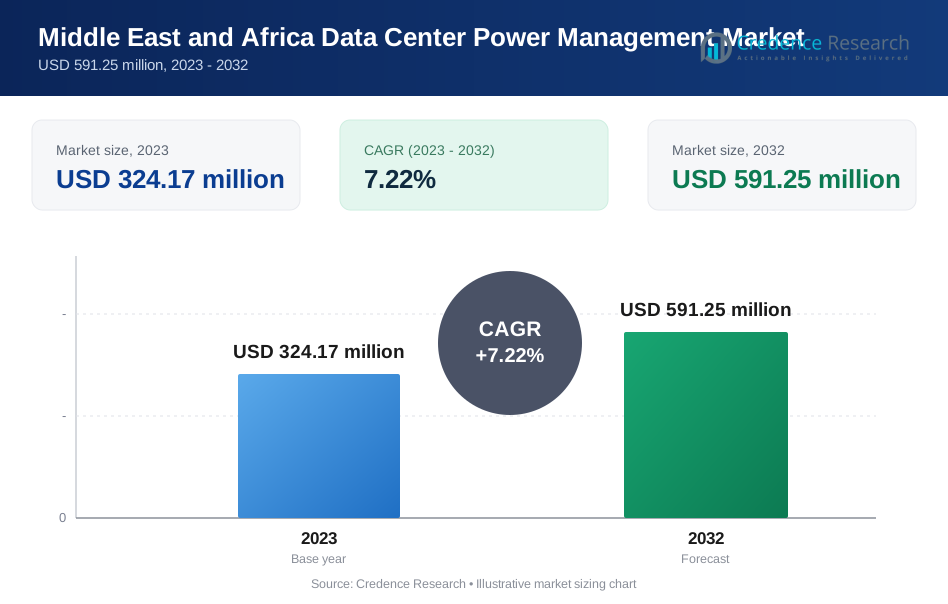
| Middle East and Africa Data Center Power Management Market Size 2023 | USD 324.17 Million |
| Middle East and Africa Data Center Power Management Market, CAGR | 7.22% |
| Middle East and Africa Data Center Power Management Market Size 2032 | USD 591.25 Million |
Market Overview
The Middle East and Africa Data Center Power Management Market is projected to grow from USD 324.17 million in 2023 to USD 591.25 million by 2032, at a compound annual growth rate (CAGR) of 7.22%.
The Middle East and Africa Data Center Power Management Market is driven by the rapid expansion of data centers due to increasing digitalization and the rising demand for data storage and processing. Companies are investing in power management solutions to enhance energy efficiency and meet regulatory requirements, which further fuels market growth. Concurrently, advancements in technologies such as IoT and AI are optimizing power usage, while growing awareness of sustainability and green practices is pushing for innovative power management solutions. These factors collectively contribute to the robust development and evolution of the market in the region.
The Middle East and Africa Data Center Power Management Market is dominated by key regions like the UAE and Saudi Arabia, driven by strong investments in digital infrastructure and smart city initiatives. Nigeria is also emerging as a significant player due to its growing digital economy. Key players in the market include industry leaders such as Emerson Electric, Siemens AG, ABB, Schneider Electric SE, and Delta Electronics Inc., all of which are focusing on enhancing power management solutions to meet the region’s increasing demand for energy-efficient data centers and sustainable operations. These companies play a pivotal role in shaping the market's growth trajectory.
Market Drivers
Rapid Digital Transformation
The Middle East and Africa are witnessing significant digital transformation driven by increased internet penetration and robust government initiatives. Growing internet connectivity fuels the demand for data centers to support expanding online services, e-commerce, and digital content. For instance, the UAE government re-established the Telecommunications Regulatory Authority to the Telecommunications and Digital Government Regulatory Authority, which published its Digital Transformation Enablers Report highlighting key achievements such as the comprehensive Federal Network (FEDnet) cloud infrastructure and the UAE Pass digital ID. Concurrently, regional governments are heavily investing in digital infrastructure to bolster economic growth and enhance public services, thereby amplifying the need for advanced data center solutions. These efforts collectively drive the expansion of data centers as essential components in the digital ecosystem.
Cloud Computing Adoption
The widespread adoption of cloud computing is another key driver for the data center power management market. Cloud-based services necessitate scalable and flexible data center infrastructure capable of managing fluctuating workloads efficiently. Additionally, data localization regulations in many countries are prompting the construction of local data centers to comply with legal requirements. This regulatory shift not only supports data sovereignty but also stimulates further investment in data center infrastructure across the region.
Rising Population and Urbanization
The rising population and rapid urbanization in the Middle East and Africa are significantly impacting the demand for data center power management solutions. Increasing urban populations drive the need for digital services, including online banking, healthcare, and education, all of which require substantial data processing capabilities. Additionally, government-backed smart city initiatives are generating demand for extensive data storage and processing capabilities, further propelling the need for efficient data center power management solutions.
Energy Efficiency and Sustainability
Energy efficiency and sustainability are critical drivers for the data center power management market. Rising energy costs in the region emphasize the importance of energy-efficient data centers to manage operational expenses effectively. For instance, the U.S. Department of Energy’s Federal Energy Management Program (FEMP) encourages agencies to improve data center energy efficiency through resources such as the Better Buildings Challenge and Data Center Accelerator. At the same time, there is a growing focus on environmental sustainability, with governments and businesses prioritizing efforts to reduce carbon footprints. This dual emphasis on cost savings and environmental responsibility is steering investments towards advanced power management solutions that support sustainable data center operations.
Market Trends
Increased Focus on Energy Efficiency
The Middle East and Africa are increasingly prioritizing energy efficiency in data centers due to escalating energy costs and stringent government regulations. The region’s rising energy costs make it essential for data centers to adopt energy-efficient practices to manage operational expenses effectively. In response, governments are implementing regulations designed to promote energy conservation and reduce carbon emissions, which is pushing data centers to integrate advanced technologies. For instance, Johnson Controls offers advanced energy efficiency solutions tailored specifically for data centers. Their intelligent building management systems monitor and optimize energy consumption, enabling data centers to reduce their carbon footprint and operational costs. Solutions such as modular data centers, which offer flexibility and scalability, liquid cooling systems for enhanced thermal management, and renewable energy sources like solar and wind power are becoming more prevalent. These technologies not only help in reducing energy consumption but also align with regulatory requirements and sustainability goals. The adoption of these efficient technologies is transforming the data center landscape, driving significant investments in power management solutions that cater to both cost-efficiency and environmental responsibility.
Cloud Computing and Data Center Expansion
The expansion of cloud computing services is a significant trend driving the growth of data centers in the Middle East and Africa. As the demand for cloud services surges, there is an increasing need for robust data center infrastructure to support extensive cloud-based operations. This heightened demand is further compounded by data localization requirements in various countries, which are necessitating the development of new data centers within local jurisdictions to comply with national regulations. Additionally, the region is witnessing the emergence of large-scale data centers designed to accommodate the growing need for computing resources. These expansive facilities are equipped to handle vast amounts of data and provide the necessary infrastructure for cloud services, ensuring high availability and performance. The combination of rising cloud service demand, regulatory pressures for data localization, and the establishment of large-scale data centers underscores a dynamic shift in the region’s data center industry, reflecting a broader trend towards enhancing infrastructure capabilities to meet evolving technological and regulatory demands.
Market Challenges Analysis
Infrastructure Limitations
The Middle East and Africa face significant infrastructure limitations that challenge the growth of data centers. Many countries in the region are dealing with aging power grids that are ill-equipped to handle the rising demand for electricity from expanding data centers. These outdated grids often suffer from insufficient capacity, particularly in remote areas, which can impede the development and expansion of new facilities. For instance, a report highlights that the region’s power grids often suffer from insufficient capacity, particularly in remote areas, which can impede the development and expansion of new facilities. Additionally, power quality issues such as voltage fluctuations and unstable supply can adversely affect data center operations and the performance of sensitive equipment. These infrastructure constraints necessitate substantial upgrades and investments to ensure that power delivery meets the demands of modern data centers and supports their reliable operation.
Extreme Weather Conditions
Extreme weather conditions pose considerable challenges to data center operations in the region. High temperatures prevalent in the area can significantly increase cooling loads, leading to higher energy consumption and operational costs. Furthermore, dust and sandstorms common in the region can impact the physical infrastructure, requiring frequent maintenance and potentially causing equipment malfunctions. Natural disasters such as earthquakes, floods, and cyclones also present risks by disrupting power supplies and damaging data center facilities. These extreme weather conditions necessitate robust design considerations and contingency plans to mitigate their impact, ensuring data centers remain operational and secure despite the harsh environmental challenges.
Market Segmentation Analysis:
By Component:
The Middle East and Africa Data Center Power Management Market is segmented by component into hardware, DCIM (Data Center Infrastructure Management) software, and services. Hardware includes power distribution units (PDUs), uninterruptible power supplies (UPS), and cooling systems, essential for maintaining optimal operational conditions. DCIM software plays a crucial role in monitoring and managing data center infrastructure, offering real-time insights into power usage and operational efficiency. Services encompass a range of support activities such as installation, maintenance, and consulting, which are vital for ensuring the reliability and performance of data center power management systems. The combined use of these components facilitates effective power management, contributing to the growth and advancement of data center infrastructure in the region.
By Type:
The market is also analyzed based on data center types, including modular, colocation, cloud, edge, hyperscale, and micro mobile data centers. Modular data centers offer flexibility and scalability, making them ideal for expanding operations rapidly. Colocation data centers provide shared facilities for multiple organizations, optimizing resource use and cost efficiency. Cloud data centers support cloud-based services, which are increasingly in demand. Edge data centers address the need for low-latency processing by being located closer to end-users. Hyperscale data centers are designed for massive scale and high-performance computing, while micro mobile data centers offer portable solutions for remote or temporary deployments. Each type addresses specific needs and contributes to the overall growth of the data center power management market in the region.
Segments:
Based on Component:
- Hardware
- DCIM (Data Center Infrastructure Management) Software
- Services
Based on Type:
- Modular Data Centers
- Colocation Data Centers
- Cloud Data Centers
- Edge Data Centers
- Hyperscale Data Centers
- Micro Mobile Data Centers
Based on End-user:
- Cloud Providers
- Colocation Providers
- Enterprise Data Centers
- Hyperscale Data Centers
- Others
Based on Tier:
- Tier-1 Data Centers
- Tier-2 Data Centers
- Tier-3 Data Centers
- Tier-4 Data Centers
Based on Industry:
- BFSI
- Healthcare
- Manufacturing
- IT & Telecom
- Others
Based on Installation Type:
- New Installation
- Retrofit/Upgrade
Based on the Geography:
- UAE
- KSA (Kingdom of Saudi Arabia)
- Israel
- Turkey
- Iran
- Egypt
- Nigeria
- Algeria
- Morocco
- Rest of Middle East and Africa
Regional Analysis
UAE
The UAE stands out prominently in the Middle East and Africa Data Center Power Management Market, holding a significant market share of approximately 30%. This dominance is driven by the country’s substantial investments in technological infrastructure and a strategic focus on sustainability. The UAE’s advanced digital ecosystem is characterized by the presence of numerous high-tech hubs and data centers, particularly in major cities like Dubai and Abu Dhabi. The government's commitment to creating smart cities and promoting green technologies further fuels the demand for sophisticated power management solutions. Regulatory frameworks in the UAE also support energy efficiency and environmental sustainability, encouraging the adoption of innovative power management technologies. Additionally, the country’s strong economic stability and strategic location as a business hub enhance its attractiveness for data center investments, solidifying its leading position in the regional market.
KSA
The Kingdom of Saudi Arabia (KSA) also plays a crucial role in the regional market, with a notable market share of around 25%. The growth in KSA’s data center power management market is largely attributed to the country’s Vision 2030 initiative, which aims to diversify the economy and enhance technological infrastructure. Significant investments in data center facilities and a push towards digital transformation are driving this growth. KSA’s large-scale infrastructure projects and increasing demand for cloud services and data storage solutions contribute to its substantial market presence. Despite facing challenges such as infrastructure development and energy management, KSA’s strategic investments and regulatory support are fostering a robust environment for data center expansion. The country’s commitment to developing smart infrastructure and integrating advanced technologies further supports its competitive position in the data center power management market.
Key Player Analysis
- Emerson Electric
- Siemens AG
- ABB
- Eaton
- Schneider Electric SE
- Delta Electronics Inc.
- Bxterra Power Technology
- General Electric
- Sunbird Software Inc.
- Elco Solutions
Competitive Analysis
The competitive landscape of the Middle East and Africa Data Center Power Management Market is marked by the presence of several leading players, including Emerson Electric, Siemens AG, ABB, Schneider Electric SE, Delta Electronics Inc., and Eaton. These companies are focused on innovation, offering advanced power management solutions to cater to the growing demand for energy efficiency in data centers. Key strategies include offering comprehensive infrastructure management, energy-efficient technologies, and cutting-edge power distribution systems. The market is highly competitive, with players investing in research and development to introduce cost-effective and sustainable solutions. Innovation, particularly in areas like modular data centers and renewable energy integration, is a driving force. Companies are also focusing on expanding their regional footprint and strengthening partnerships to maintain a competitive edge in this dynamic market.
Recent Developments
- In May 2024, ABB supported the introduction of AI with the rapid deployment of advanced power distribution and power protection solutions to data centers in North America, Europe, and Asia-Pacific. ABB’s HiPerGuard medium voltage UPS system was integrated to improve power supply reliability and energy efficiency.
- In March 2024, Delta presented new developments in power solutions at NVIDIA GTC, focusing on optimizing energy efficiency in gigawatt-grade data centers for AI training. They showcased ORV3 racks, 33 kW power shelves, and innovative board-level DC/DC Converters VR Series.
- In March 2024, Schneider Electric collaborated with NVIDIA to optimize data center infrastructure and pave the way for advancements in edge artificial intelligence (AI) and digital twin technologies. They introduced the first publicly available AI data center reference designs.
- In September 2023, Eaton launched an industry-first software platform to help data center operators accelerate their digital transformation journey. The platform unites asset management, IT and operational technology device monitoring, power quality metrics, and other unique capabilities in a single, native application.
- In May 2022, Siemens deployed artificial intelligence at the Baltics’ newest, most energy-efficient data center in Tallinn, Estonia. The data center targets a Power Usage Effectiveness (PUE) value of 1.2, against the industry average of around 1.6.
Market Concentration & Characteristics
The Middle East and Africa Data Center Power Management Market is moderately concentrated, with a few key players dominating a significant share of the market. These companies offer a wide range of power management solutions, including hardware, software, and services, tailored to meet the growing demand for energy-efficient and sustainable data centers. The market is characterized by a high focus on technological innovation, as well as increasing investments in green and energy-saving technologies. Additionally, the market exhibits regional diversification, with key hubs in countries like the UAE and Saudi Arabia, where infrastructure investments are higher. Despite competition from smaller players, the established market leaders continue to expand their portfolios and regional presence, reinforcing their dominant position. The market’s concentration is also influenced by high entry barriers, including capital-intensive infrastructure and the need for technical expertise, which limits new entrants and contributes to the current competitive landscape.
Report Coverage
The research report offers an in-depth analysis based on Component, Type, End-user, Tier, Industry, Installation Type and Geography. It details leading market players, providing an overview of their business, product offerings, investments, revenue streams, and key applications. Additionally, the report includes insights into the competitive environment, SWOT analysis, current market trends, as well as the primary drivers and constraints. Furthermore, it discusses various factors that have driven market expansion in recent years. The report also explores market dynamics, regulatory scenarios, and technological advancements that are shaping the industry. It assesses the impact of external factors and global economic changes on market growth. Lastly, it provides strategic recommendations for new entrants and established companies to navigate the complexities of the market.
Future Outlook
- The Middle East and Africa data center power management market will see increased adoption of energy-efficient technologies driven by rising energy costs and sustainability goals.
- Cloud computing demand will continue to fuel data center expansion, requiring robust power management solutions.
- Governments will implement stricter regulations on energy efficiency, pushing data centers to adopt greener technologies.
- The growing trend of data localization will lead to the construction of more local data centers, further boosting power management demand.
- Renewable energy integration in data centers will become a priority to reduce carbon footprints and operational costs.
- Technological advancements in power distribution and monitoring systems will enhance data center efficiency and reliability.
- Increasing urbanization and digitalization will drive the demand for new data centers, particularly in emerging markets like Nigeria and Egypt.
- Modular data centers will gain traction due to their scalability and flexibility in meeting regional data demands.
- Investments in smart city projects will create new opportunities for advanced data center infrastructure and power management solutions.
- Security concerns and the need for real-time monitoring will encourage the adoption of advanced data center infrastructure management (DCIM) solutions.
Request a Free Sample
Fill in your details and we'll send you a free sample report.
- Sample data tables & charts
- Research methodology
Need a Custom Version of This Report?
Tailor the scope, geography, or segments to your exact requirements.
- Custom geography or segment scope
- Direct access to our analyst team
Frequently Asked Questions
What is the current size of the Middle East and Africa Data Center Power Management Market?
What factors are driving the growth of the Middle East and Africa Data Center Power Management Market?
What are the key segments within the Middle East and Africa Data Center Power Management Market?
What are some challenges faced by the Middle East and Africa Data Center Power Management Market?
Who are the major players in the Middle East and Africa Data Center Power Management Market?
Table of Content
Chapter 1. Report Introduction
- 1.1 Report Description & Purpose
- 1.1.1 Report Title & Market Definition
- 1.1.2 Unique Selling Propositions (USP) & Key Differentiators
- 1.1.3 Value Proposition for Stakeholders
- 1.2 Research Objectives
- 1.2.1 Market Sizing Objectives (Volume & Revenue)
- 1.2.2 Segmentation Objectives
- 1.2.3 Competitive Intelligence Objectives
- 1.2.4 Forecast & Scenario Objectives
- 1.3 Report Scope
- 1.3.1 Middle East and Africa Data Center Power Management Scope – Types & Subtypes Covered
- 1.3.2 Geographic Scope – Regions & Countries Covered
- 1.3.3 Historical Period, Base Year & Forecast Period (2023; forecast to 2032)
- 1.3.4 Inclusions & Exclusions
- 1.4 HS Code & Classification Framework
- 1.5 Currency, Units & Pricing Basis
- 1.6 Target Stakeholders
- 1.7 Limitations & Assumptions
Chapter 2. Executive Summary
- 2.1 Global Middle East and Africa Data Center Power Management Market Snapshot
- 2.1.1 Market Size – Historical (2023) & Forecast (2023-2032) (2023: USD 324.17 million → 2032: USD 591.25 million)
- 2.1.2 Volume & Revenue – Global Totals
- 2.1.3 Key Market Highlights – Top Five Facts
- 2.2 Middle East and Africa Data Center Power Management Market Segmentation Snapshot
- 2.2.1 Market Split by Region – 2023 vs. 2032
- 2.3 Competitive Snapshot
- 2.3.1 Top 10 Players by Revenue Share – 2023
- 2.3.2 Top 10 Players by Volume Share – 2023
- 2.3.3 Recent Strategic Developments (18-Month Summary)
- 2.4 Key Investment Highlights & Strategic Conclusions
Chapter 3. Middle East and Africa Data Center Power Management Market Dynamics & Industry Analysis
- 3.1 Market Overview & Context
- 3.1.1 Middle East and Africa Data Center Power Management Market Position in the Broader Automotive Value Chain
- 3.1.2 OEM vs. Replacement Market Dynamics
- 3.1.3 Market Maturity & Development Stage by Region
- 3.2 Middle East and Africa Data Center Power Management Market Drivers
- 3.3 Middle East and Africa Data Center Power Management Market Restraints & Challenges
- 3.4 Middle East and Africa Data Center Power Management Market Opportunities
- 3.5 Porter's Five Forces Analysis
- 3.5.1 Threat of New Entrants
- 3.5.2 Bargaining Power of Suppliers
- 3.5.3 Bargaining Power of Buyers
- 3.5.4 Threat of Substitutes
- 3.5.5 Competitive Rivalry – Intensity Assessment
- 3.6 Middle East and Africa Data Center Power Management Value Chain Analysis
- 3.6.1 Upstream – Raw Material/Input Suppliers
- 3.6.1.1 Raw Material/Input 1
- 3.6.1.2 Raw Material/Input 2
- 3.6.1.3 Raw Material/Input 3
- 3.6.2 Midstream – Production/Manufacturing/Service Delivery
- 3.6.2.1 Production/Process Overview
- 3.6.2.2 Key Facility Locations & Capacity by Manufacturer
- 3.6.3 Downstream – Distribution & End Consumer
- 3.6.3.1 Primary Channel – B2B/OEM
- 3.6.3.2 Secondary Channels – Dealer, Retail, Online, Direct
- 3.6.4 Value Chain Profitability Analysis
- 3.6.1 Upstream – Raw Material/Input Suppliers
- 3.7 PESTEL Analysis
- 3.7.1 Political Factors
- 3.7.2 Economic Factors
- 3.7.3 Social Factors
- 3.7.4 Technological Factors
- 3.7.5 Environmental Factors
- 3.7.6 Legal Factors
- 3.8 Middle East and Africa Data Center Power Management Supply Chain Analysis
- 3.8.1 Raw Material/Input Supply Risk Assessment
- 3.8.2 Manufacturing Concentration Risk (Geographic Exposure)
- 3.8.3 Trade Disruption Impact Analysis
- 3.9 Regulatory & Policy Landscape
Note: The regulatory and policy landscape section covers regulations based on their applicability to the market, Middle East and Africa Data Center Power Management category, geography, and scope of the study. Only regulatory frameworks with a material impact on operations, compliance, trade, sustainability, or market access are analyzed in detail.
Chapter 4. Key Investment Pockets & Opportunity Analysis
- 4.1 Middle East and Africa Data Center Power Management Market Attractiveness Analysis
- 4.1.1 By Region – Investment Attractiveness Matrix (Volume × CAGR)
- 4.2 Absolute Revenue Growth Opportunity
- 4.2.1 By Region – Absolute USD Growth Through 2032
- 4.3 Incremental Volume Opportunity
- 4.3.1 By Region – Incremental Volume Through 2032
- 4.3.2 Segment – Incremental Volume
- 4.4 Emerging Submarket Opportunity Deep Dive (Subject to Applicability)
- 4.5 Emerging Market Opportunity Scorecards
- 4.5.1 United States
- 4.5.2 Europe
- 4.5.3 Asia
- 4.5.4 Middle East & Africa
Note: Emerging Market Opportunity Scorecards will be included based on relevance and strategic importance. Regions listed are indicative and may vary depending on data availability and market dynamics.
Chapter 5. Middle East and Africa Data Center Power Management Import-Export Analysis & Trade Flows
- 5.1 Global Trade Overview
- 5.1.1 Global Export Value by Country (2023)
- 5.1.2 Global Export Volume by Country (2023)
- 5.1.3 Global Import Value by Country (2023)
- 5.1.4 Global Import Volume by Country (2023)
- 5.1.5 Net Trade Balance by Country (2023)
- 5.2 Export Analysis – Segment
- 5.2.1 Type 1 (HS Code)
- 5.2.2 Type 2 (HS Code)
- 5.2.3 Type 3 (HS Code)
- 5.2.4 Type 4 (HS Code)
- 5.2.5 Type 5 (HS Code)
- 5.3 Import Analysis – Segment
- 5.3.1 Type 1 (HS Code)
- 5.3.2 Type 2 (HS Code)
- 5.3.3 Type 3 (HS Code)
- 5.3.4 Type 4 (HS Code)
- 5.3.5 Type 5 (HS Code)
- 5.4 Average Unit Trade Prices
- 5.4.1 Average Export Price – Segment & Country
- 5.4.2 Average Import Price – Segment & Source Country
- 5.4.3 Price Trends (2023)
- 5.5 Key Trade Route Analysis
- 5.5.1 Trade Route 1
- 5.5.2 Trade Route 2
- 5.5.3 Trade Route 3
- 5.5.4 Trade Route 4
- 5.5.5 Trade Route 5
- 5.6 Trade Policy Impact Assessment
- 5.6.1 US Anti-Dumping & Section 301 Tariffs
- 5.6.2 EU Customs Union Impact
- 5.6.3 Major Free Trade Agreements
- 5.6.4 USMCA Rules of Origin
Note: Trade policy analysis will be included only where relevant to the Middle East and Africa Data Center Power Management market.
Chapter 6. Competitive Landscape & Company Benchmarking
- 6.1 Middle East and Africa Data Center Power Management Market Concentration & Structure
- 6.1.1 Herfindahl-Hirschman Index (HHI) – vs. 2023
- 6.1.2 Tier 1, Tier 2 & Tier 3 Market Structure
- 6.1.3 Global, Regional & Local Player Dynamics
- 6.2 Middle East and Africa Data Center Power Management Market Share Analysis – 2023
- 6.2.1 Global Revenue Share by Company
- 6.2.2 Global Volume Share by Company
- 6.2.3 Regional Revenue Share
- 6.2.4 Market Share Evolution ( vs. 2023)
- 6.2.5 OEM Segment Share by Company
- 6.2.6 Replacement Segment Share by Company
- 6.3 Production/Delivery Capacity & Facility Analysis
- 6.3.1 Global Installed Capacity
- 6.3.2 Capacity Utilization Rates
- 6.3.3 Production/Output Volume
- 6.3.4 Facility Locations & Capacity Map
- 6.3.5 Planned Capacity Additions
- 6.4 Middle East and Africa Data Center Power Management Competitive Benchmarking Matrix
- 6.4.1 Revenue, Volume, CAGR & Profitability Comparison
- 6.4.2 Channel Revenue Mix
- 6.4.3 Geographic Revenue Exposure
- 6.4.4 R&D Intensity
- 6.4.5 Sustainability Maturity
- 6.5 Strategic Developments in Middle East and Africa Data Center Power Management (Last 24 Months)
- 6.5.1 Mergers, Acquisitions & Divestments
- 6.5.2 New Middle East and Africa Data Center Power Management Launches
- 6.5.3 Facility Expansions
- 6.5.4 Strategic Alliances, Joint Ventures & Partnerships
- 6.5.5 Distribution Expansion & Market Entry
- 6.5.6 Sustainability & ESG Initiatives
- 6.6 Competitive Strategy Mapping
- 6.6.1 Leader, Challenger, Follower & Niche Classification
- 6.6.2 Pricing Strategy Comparison
- 6.6.3 Channel Strategy Matrix
Note: Strategic developments are included based on their materiality and the availability of reliable information.
Chapter 7. Global Middle East and Africa Data Center Power Management Market – By Distribution Channel
- 7.1 Segment Overview
- 7.1.1 Volume & Revenue Split by Channel (2023 & 2032)
- 7.1.2 Channel Mix Evolution (2023-2032)
Chapter 8. Regional Market Analysis – Global Overview
- 8.1 Global Regional Overview
- 8.1.1 Regional Volume Share
- 8.1.2 Regional Revenue Share
- 8.1.3 Regional Volume by Region
- 8.1.4 Regional Revenue by Region
- 8.1.5 Regional Forecast Through 2032
- 8.2 Cross-Regional Segment Analysis
- 8.2.1 By Distribution Channel
- 8.2.2 By Brand/Price Tier
Chapter 9. North America Middle East and Africa Data Center Power Management Market
- 9.1 United States
- 9.2 Canada
- 9.3 Mexico
Chapter 10. Europe Middle East and Africa Data Center Power Management Market
- 10.1 Germany
- 10.2 France
- 10.3 Italy
- 10.4 United Kingdom
- 10.5 Spain
- 10.6 Poland
- 10.7 Russia
- 10.8 Netherlands
- 10.9 Belgium
- 10.10 Sweden
- 10.11 Denmark
- 10.12 Norway
- 10.13 Rest of Europe
Chapter 11. Asia Pacific Middle East and Africa Data Center Power Management Market
- 11.1 China
- 11.2 India
- 11.3 Japan
- 11.4 South Korea
- 11.5 Thailand
- 11.6 Indonesia
- 11.7 Vietnam
- 11.8 Malaysia
- 11.9 Australia
- 11.10 Rest of Asia Pacific
Chapter 12. Latin America Middle East and Africa Data Center Power Management Market
- 12.1 Brazil
- 12.2 Argentina
- 12.3 Colombia
- 12.4 Chile
- 12.5 Rest of Latin America
Chapter 13. Middle East Middle East and Africa Data Center Power Management Market
- 13.1 Saudi Arabia
- 13.2 United Arab Emirates
- 13.3 Turkey
- 13.4 Israel
- 13.5 Iran
- 13.6 Rest of the Middle East
Chapter 14. Africa Middle East and Africa Data Center Power Management Market
- 14.1 South Africa
- 14.2 Egypt
- 14.3 Nigeria
- 14.4 Morocco
- 14.5 Rest of Africa
Chapter 15. Middle East and Africa Data Center Power Management Company Profiles
- 15.1 [Company 01]
- 15.1.1 Company Overview
- 15.1.2 Key Management Personnel
- 15.1.3 Products & Services Portfolio
- 15.1.4 Financial Performance
- 15.1.5 Key Market Focus & Geographic Presence
- 15.1.6 Recent Developments & Strategic Initiatives
Note: The company profile list is preliminary and may change based on research findings, market developments, data availability, and client requirements.
Chapter 16. Appendices
- Appendix A – List of Abbreviations & Acronyms
- Appendix B – Industry Classification Code Reference – Full Series
- Appendix C – Production & Capacity Data Tables
- Appendix D – End-Use & Demand Base Tables
- Appendix E – Consumption & Replacement Rate Assumptions
- Appendix F – ASP Reference Tables
- Appendix G – Manufacturing & Facility Database
- Appendix H – Import-Export Data Tables
- Appendix I – Regulatory Summary Tables
- Appendix J – Primary Research Participant List (Anonymized)
- Appendix K – Primary Research Questionnaire Framework
- Appendix L – Data Sources & Bibliography
- Appendix M – Market Size Divergence & Source Comparison
Chapter 17. Research Methodology
- 17.1 Research Framework & Philosophy
- 17.2 Secondary Research – Sources, Hierarchy & Data Extraction
- 17.3 Data Modeling – Bottom-Up & Top-Down Market Sizing
- 17.4 Primary Research – Stakeholder Framework, LOI & Sample Sizes
- 17.5 Forecast Methodology – Regression, Scenario & Sensitivity Analysis
- 17.6 Quality Control – Four-Layer Validation Framework
- 17.7 Limitations & Standard Assumptions
- 17.8 Disclaimer
