
Market Overview:
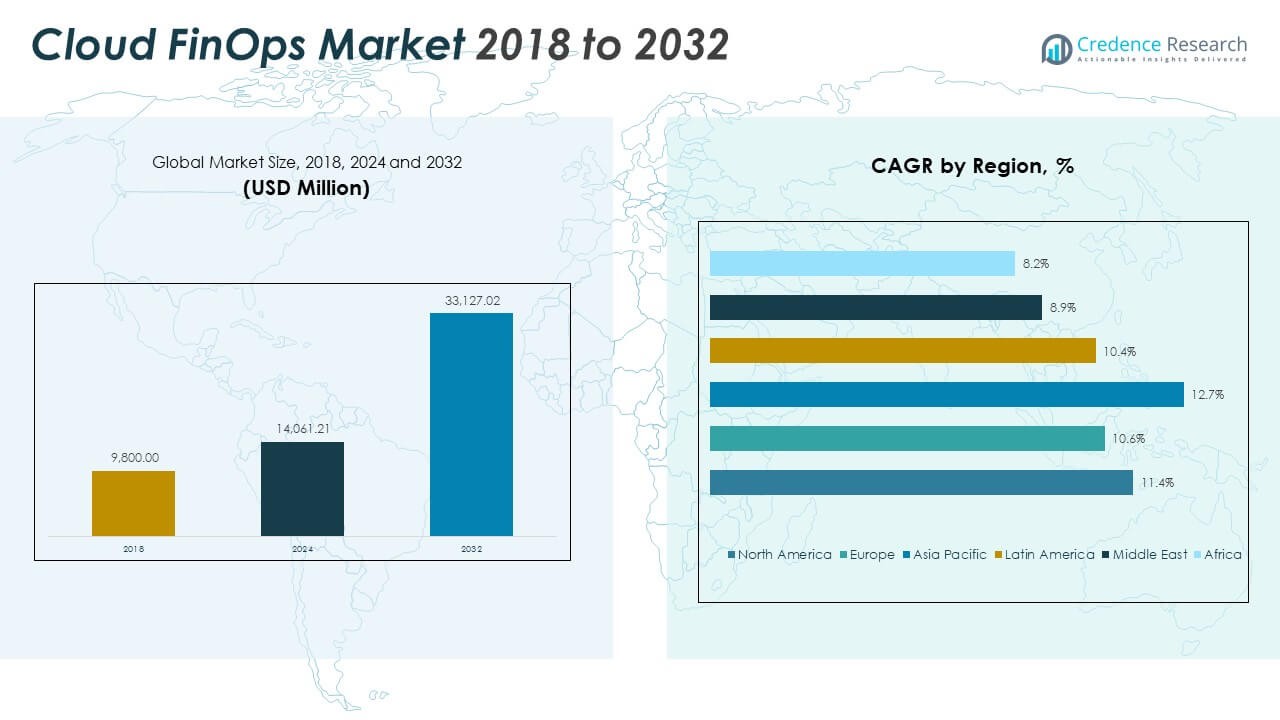
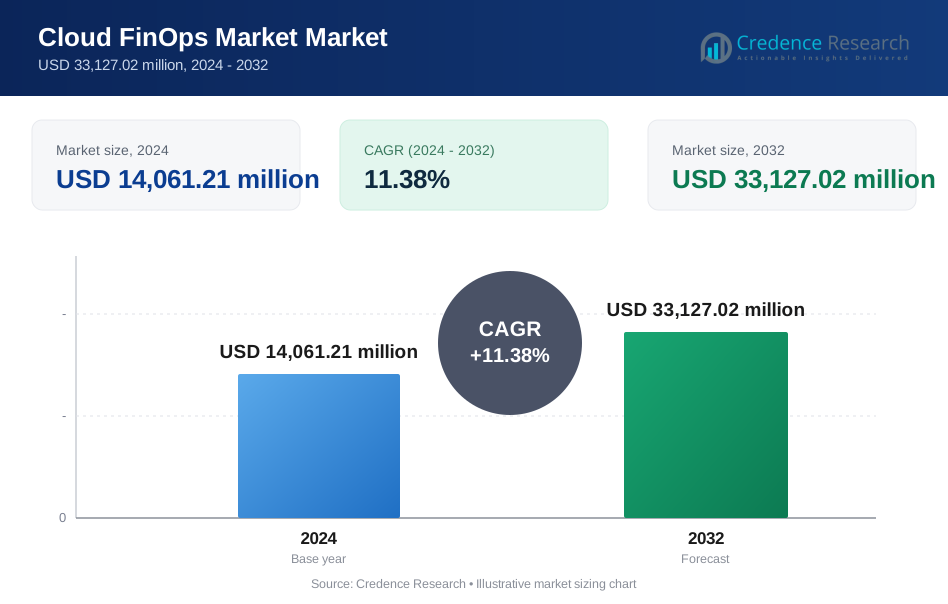
The Cloud FinOps Market size was valued at USD 9,800.00 million in 2018 to USD 14,061.21 million in 2024 and is anticipated to reach USD 33,127.02 million by 2032, at a CAGR of 11.38% during the forecast period.
| REPORT ATTRIBUTE | DETAILS |
|---|---|
| Historical Period | 2020-2023 |
| Base Year | 2024 |
| Forecast Period | 2025-2032 |
| Cloud FinOps Market Size 2024 | USD 14,061.21 Million |
| Cloud FinOps Market, CAGR | 11.38% |
| Cloud FinOps Market Size 2032 | USD 33,127.02 Million |
The market expands rapidly due to rising enterprise focus on financial governance within cloud ecosystems. Organizations prioritize visibility, accountability, and optimization across multi-cloud infrastructures. Growing complexity in billing models and dynamic workloads drives the adoption of automation-led FinOps tools. Businesses seek real-time insights to manage budgets, reduce waste, and improve cross-department collaboration. The increasing integration of AI-driven analytics and automation enhances cost predictability and resource utilization. This shift strengthens strategic decision-making and operational transparency across digital platforms.
North America leads the Cloud FinOps Market, supported by mature cloud infrastructure and early FinOps adoption among large enterprises. Europe follows with steady growth, driven by regulatory compliance and strong enterprise governance frameworks. Asia Pacific emerges as the fastest-growing region due to rapid digital transformation across China, India, and Japan. The Middle East and Latin America show growing adoption through modernization initiatives, while Africa remains in its early adoption phase, benefiting from expanding cloud infrastructure and government-led digital programs.
Market Insights:
- The Cloud FinOps Market was valued at USD 9,800.00 million in 2018, reached USD 14,061.21 million in 2024, and is projected to hit USD 33,127.02 million by 2032, expanding at a CAGR of 11.38%.
- North America leads with a 38% share, supported by mature cloud infrastructure and early adoption of FinOps frameworks among large enterprises.
- Europe follows with a 25% share, driven by strong regulatory compliance and growing multi-cloud adoption across key economies.
- Asia Pacific holds a 24% share and remains the fastest-growing region due to rapid digitalization, expanding IT infrastructure, and increased demand for cloud cost transparency.
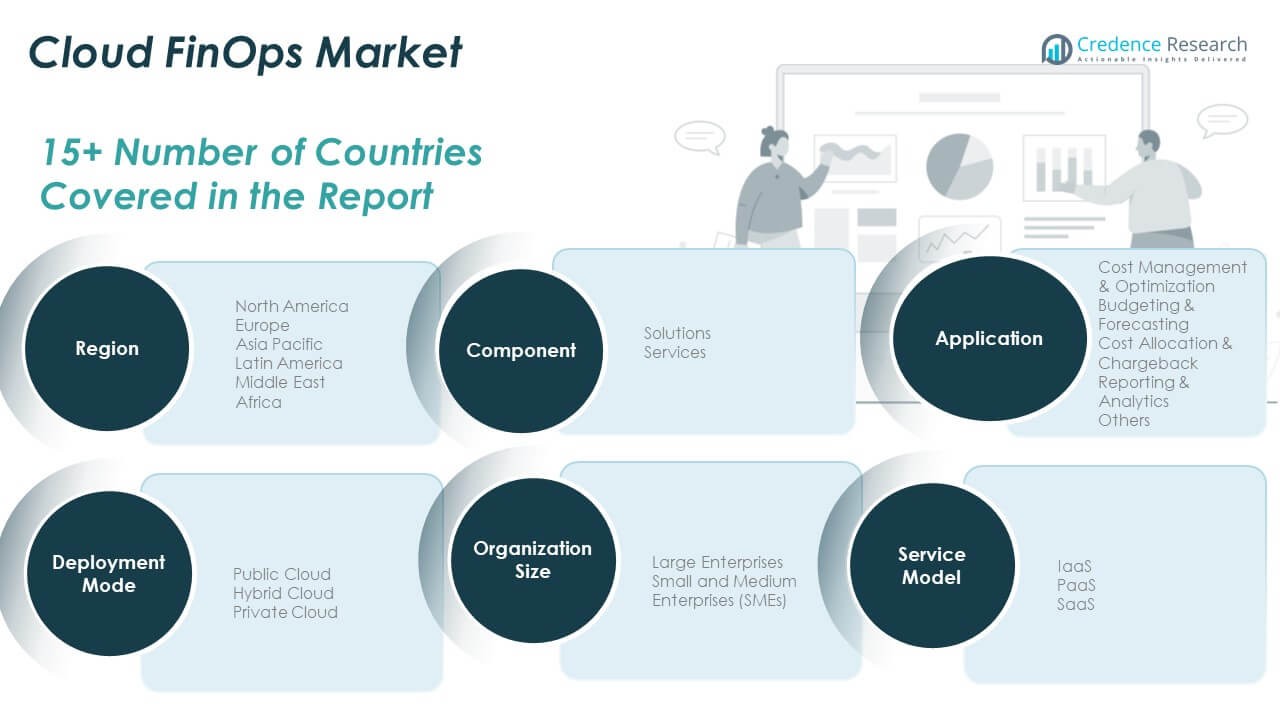
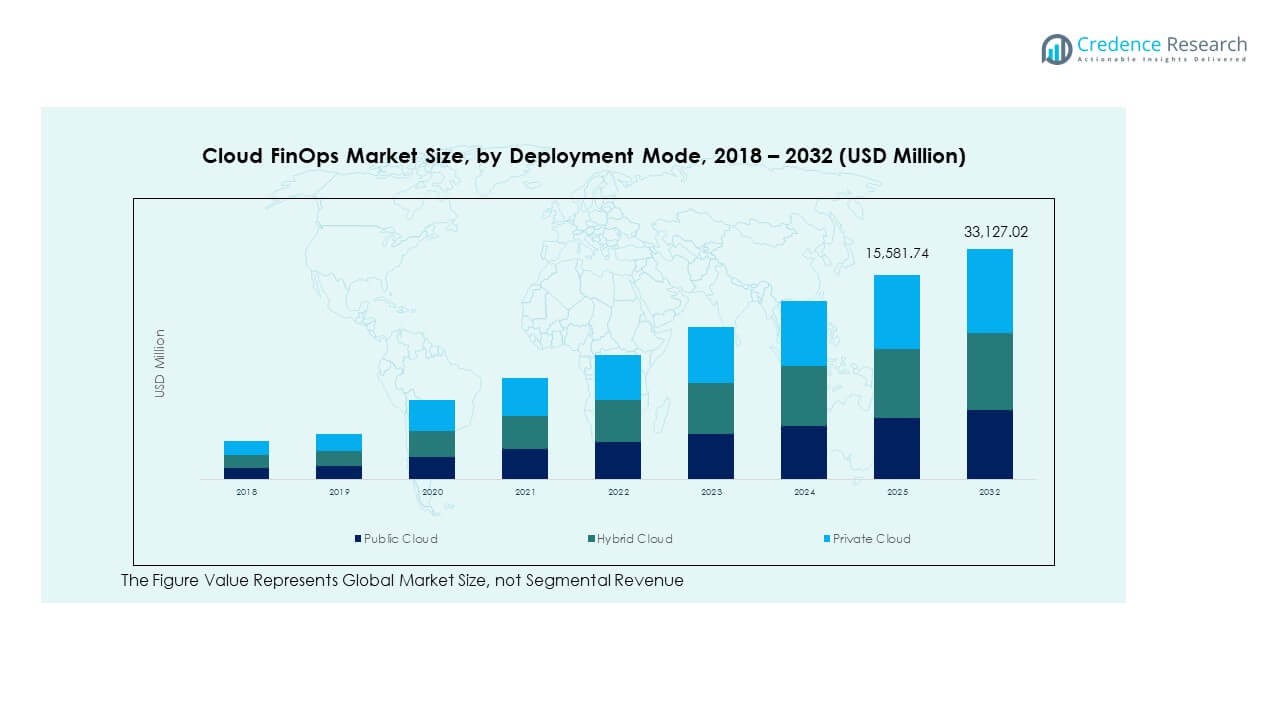
- By deployment, Public Cloud accounts for about 45% of the market, followed by Hybrid Cloud at 35% and Private Cloud at 20%, showing a clear preference for scalable and cost-efficient architectures.
Market Drivers
Growing Need for Cost Optimization Across Multi-Cloud Environments
Enterprises face mounting pressure to optimize cloud expenditures across multiple service providers. The Cloud FinOps Market gains traction as organizations aim to align financial accountability with operational efficiency. Finance and IT teams seek visibility into spending patterns to reduce waste. Enterprises deploy FinOps platforms that consolidate billing and usage data from hybrid setups. It supports detailed chargebacks and budget forecasting aligned with business goals. Continuous tracking tools enable performance-based spending control. Real-time analytics guide decision-makers to adjust workloads dynamically. This driver strengthens financial governance and long-term adoption among enterprises.
- For instance, e‑Core worked with Ouribank to apply FinOps practices on AWS, which included tagging of ≈ 92 % of resources, implementation of Spot/Reserved Instances strategy, and achieved a 60 % cost reduction while improving availability and processing capacity
Rising Integration of Automation in Cloud Financial Management
Automation accelerates financial accuracy and improves workflow efficiency in complex cloud setups. Companies integrate AI-driven tools to analyze billing anomalies and forecast usage trends. Automated budget alerts and predictive algorithms improve cost predictability. It enhances collaboration between engineering, finance, and procurement divisions. Automated optimization reduces manual oversight, ensuring faster corrective actions. Machine learning improves accuracy of consumption-based projections. Enterprises use automation to set resource scaling thresholds that balance cost and performance. The adoption trend increases the operational maturity of FinOps frameworks across industries.
Increasing Collaboration Between Finance and Engineering Teams
Cross-functional teamwork drives higher efficiency in financial operations across digital environments. Organizations promote shared ownership between finance and engineering to control costs. FinOps tools support shared dashboards and unified reporting. It allows engineers to understand financial implications of technical decisions. Collaborative governance models help departments plan budgets aligned with application performance. Real-time communication enhances agility and accountability in cost management. Companies rely on FinOps structures to standardize expense evaluation. Growing cultural alignment between departments reinforces enterprise-wide cost responsibility.
- For instance, the Azure FinOps Framework emphasizes transparency and cross-team collaboration by making financial data accessible through centralized dashboards using Power BI and Azure Data Explorer.
Expanding Cloud Infrastructure and Service Diversity
The surge in cloud infrastructure investments fuels stronger FinOps adoption. Enterprises use multiple platforms to achieve flexibility and avoid vendor lock-in. The Cloud FinOps Market benefits from rising demand for transparent pricing and optimized workloads. Diverse pricing models increase the need for centralized financial management. It helps organizations navigate different billing frameworks efficiently. FinOps platforms simplify contract comparisons and resource allocation. Advanced solutions integrate benchmarking tools that ensure competitive pricing. Expanding infrastructure diversity amplifies the requirement for structured financial monitoring across regions.
Market Trends
Adoption of AI and Predictive Analytics in Cloud Financial Governance
AI and analytics tools transform financial decision-making within cloud ecosystems. Predictive systems detect anomalies before they inflate operational costs. Companies employ AI to forecast future resource requirements with greater precision. It allows teams to implement preventive optimization strategies. FinOps platforms now embed machine learning to identify inefficiencies in real time. Predictive reporting enhances cost forecasting accuracy across large workloads. Enterprises gain stronger command over cloud budgets through automated insights. These tools position FinOps as a strategic pillar in digital transformation.
- For instance, JPMorgan Chase confirmed that its Coach AI tool enabled financial advisers to retrieve information up to 95% faster during market volatility, contributing to a 20% growth in gross sales within its asset and wealth management division between 2023 and 2024. The bank also reported saving nearly USD 1.5 billion through AI-driven fraud prevention, personalization, and operational efficiencies.
Shift Toward Unified Multi-Cloud Financial Dashboards
Enterprises demand unified visibility across diverse cloud service providers. Centralized dashboards consolidate multi-vendor usage data into actionable insights. Teams gain faster access to budget allocations and cost summaries. It improves accountability by mapping costs to business units. Integrated dashboards minimize duplication of analytics efforts. Vendors innovate to provide customizable, interactive data visualization modules. These tools foster clarity in resource distribution and financial decision-making. Unified platforms redefine governance standards across large-scale digital operations.
Growth in Managed FinOps Service Providers
Managed service vendors emerge as key enablers of FinOps adoption. Small and mid-sized firms rely on external expertise to handle complex cost structures. Providers offer consulting, implementation, and continuous monitoring solutions. It ensures consistent cost efficiency for organizations without in-house financial governance teams. Managed services lower barriers to entry for FinOps adoption. Vendors deliver scalable solutions tailored to industry-specific needs. Demand increases for subscription-based FinOps offerings that evolve with client growth. The service-oriented trend boosts the global reach of FinOps capabilities.
- For instance, AWS Managed Services provides cost optimization and governance automation tools that help enterprises manage and monitor cloud spending efficiently. The service enables continuous cost tracking, resource optimization, and operational governance aligned with AWS Well-Architected and FinOps best practices.
Integration of FinOps with Cloud Security and Compliance Frameworks
Financial management aligns closely with governance, risk, and compliance strategies. Enterprises integrate FinOps tools with security and regulatory frameworks. It helps ensure financial accountability while maintaining data compliance. Automated systems flag non-compliant resource spending in real time. Companies reduce audit risks through synchronized financial and security oversight. Vendors build unified solutions connecting billing systems with compliance databases. This integration simplifies reporting and enhances transparency. The convergence of FinOps and compliance reshapes enterprise governance practices.
Market Challenges Analysis
Complexity of Multi-Cloud Cost Structures and Billing Transparency
Enterprises face increasing difficulty managing complex cost patterns across different cloud environments. Billing models vary among providers, creating confusion in charge allocation. The Cloud FinOps Market must address inconsistencies in pricing metrics and usage data. It becomes harder for organizations to maintain cost predictability under variable workloads. Financial teams struggle with hidden costs like data transfer and idle resources. Lack of standardized reporting frameworks limits benchmarking accuracy. Companies seek advanced analytics to interpret intricate billing details. Complexity across diverse vendors challenges efficient and transparent financial management.
Shortage of Skilled Professionals and Organizational Resistance Skill shortages limit the effective deployment of FinOps strategies. Many enterprises lack experts who combine financial literacy with technical knowledge. It slows adoption and weakens governance structures. Resistance from traditional finance departments hinders cross-functional collaboration. Employees often hesitate to adjust established budgeting routines. Companies invest in training programs to bridge knowledge gaps. Vendor support becomes crucial to accelerate learning curves. Cultural adaptation remains a major hurdle to successful FinOps integration.
Market Opportunities
Rising Demand for Cloud Cost Intelligence Platforms Across Industries
Growing digitalization opens strong opportunities for FinOps solution providers. Enterprises prioritize data-driven financial decisions to sustain competitiveness. The Cloud FinOps Market benefits from expanding interest in cloud cost intelligence tools. It supports accurate forecasting and optimization across multiple verticals. Industries such as BFSI, healthcare, and retail adopt FinOps to stabilize cloud spending. Vendors deliver sector-specific platforms with tailored dashboards and benchmarking tools. Expanding digital operations amplify the need for smarter cost analytics. This opportunity accelerates product innovation and market penetration.
Increasing Government and Enterprise Cloud Transformation Programs
Public sector and large enterprises embrace cloud transformation initiatives. Governments promote digital infrastructure programs demanding financial accountability. It increases interest in standardized cost optimization models. Enterprises use FinOps to achieve fiscal transparency in cloud adoption projects. Vendors engage in public-private collaborations to provide scalable governance frameworks. Expanding global investment in digital services boosts FinOps implementation scope. Long-term modernization strategies create recurring demand for FinOps capabilities. This opportunity strengthens partnerships and ecosystem expansion worldwide.
Market Segmentation Analysis:
The Cloud FinOps Market is structured across multiple dimensions that shape adoption patterns and revenue streams.
By component, solutions lead demand due to their ability to deliver automated cost tracking, budgeting, and forecasting functions across complex cloud infrastructures. Services complement these offerings through implementation support, training, and continuous optimization, ensuring enterprises achieve sustained value. It reflects strong enterprise preference for integrated platforms that combine analytics and operational guidance to maximize cloud efficiency.
- For instance, CloudKeeper provides FinOps solutions that combine automation, analytics, and expert services to optimize cloud costs. Its AI-enabled scheduler automates the shutdown of non-production resources during off-hours and has demonstrated measurable savings through verified customer case studies focused on cost control and financial governance in AWS environments.
By application, cost management and optimization holds a dominant share as organizations seek visibility into variable spending. Budgeting and forecasting tools strengthen financial control and aid strategic decision-making. Cost allocation and chargeback functions enable accountability across departments, while reporting and analytics enhance real-time governance.
By deployment mode, Public cloud leads due to its scalability, agility, and wide provider ecosystem supporting real-time financial visibility. Hybrid cloud gains momentum as enterprises combine private and public resources to balance compliance and cost optimization. Private cloud remains vital for organizations with strict data control and security mandates. It supports consistent FinOps operations while enabling tailored governance frameworks.
- For instance, CloudKeeper delivers FinOps solutions across major cloud providers, including AWS and Google Cloud, enabling unified financial visibility and automated cost control. The platform’s Enterprise Discount Program (EDP+) and managed FinOps services have documented measurable cost savings for clients through continuous monitoring, optimization, and governance in hybrid cloud environments.
By service model, IaaS remains central for infrastructure-heavy workloads, while PaaS and SaaS expand through application-level financial governance needs. Under deployment mode, public cloud platforms dominate usage, though hybrid and private cloud models gain traction among regulated industries.
By organization size, large enterprises drive significant demand due to high multi-cloud complexity, while SMEs adopt agile FinOps solutions to manage operational costs efficiently. This segmentation underlines the market’s balanced growth driven by scalability, accountability, and cost intelligence across cloud environments.
Segmentation:
By Component
- Solutions
- Services
By Application
- Cost Management & Optimization
- Budgeting & Forecasting
- Cost Allocation & Chargeback
- Reporting & Analytics
- Others
By Service Model
- Infrastructure as a Service (IaaS)
- Platform as a Service (PaaS)
- Software as a Service (SaaS)
By Deployment Mode
- Public Cloud
- Hybrid Cloud
- Private Cloud
By Organization Size
- Large Enterprises
- Small and Medium Enterprises (SMEs)
By Region
- North America
- U.S.
- Canada
- Mexico
- Europe
- Germany
- France
- U.K.
- Italy
- Spain
- Rest of Europe
- Asia Pacific
- China
- Japan
- India
- South Korea
- South-east Asia
- Rest of Asia Pacific
- Latin America
- Brazil
- Argentina
- Rest of Latin America
- Middle East & Africa
- GCC Countries
- South Africa
- Rest of the Middle East and Africa
Regional Analysis:
North America
The North America Cloud FinOps Market size was valued at USD 3,792.60 million in 2018 to USD 5,379.74 million in 2024 and is anticipated to reach USD 12,657.89 million by 2032, at a CAGR of 11.4% during the forecast period. North America holds around 38% of the global market share, supported by its advanced cloud infrastructure and high FinOps maturity levels. The region benefits from strong adoption of multi-cloud platforms by major enterprises in the U.S. and Canada. It drives innovation through established vendors integrating AI-based automation for cost optimization. Regulatory focus on financial accountability strengthens adoption across healthcare, finance, and technology sectors. Enterprises emphasize cross-functional collaboration for better financial visibility. Strong partnerships between FinOps consultancies and cloud providers accelerate implementation efficiency. The regional ecosystem’s maturity makes it the benchmark for global FinOps practices.
Europe
The Europe Cloud FinOps Market size was valued at USD 2,604.84 million in 2018 to USD 3,593.66 million in 2024 and is anticipated to reach USD 8,001.92 million by 2032, at a CAGR of 10.6%. Europe accounts for about 25% of the global share, driven by its regulatory emphasis on transparency and cost governance. The region’s enterprises invest in FinOps to comply with data protection norms and budget accuracy. Strong cloud migration initiatives in the UK, Germany, and France stimulate tool integration. It benefits from the rise of managed service providers offering regionalized FinOps consulting. Financial institutions and telecom firms expand usage for multi-cloud optimization. Continuous digitalization in government and industrial sectors promotes adoption. Europe’s focus on compliance and cost predictability strengthens steady growth across its FinOps landscape.
Asia Pacific
The Asia Pacific Cloud FinOps Market size was valued at USD 2,387.28 million in 2018 to USD 3,577.82 million in 2024 and is anticipated to reach USD 9,305.41 million by 2032, at a CAGR of 12.7%. Asia Pacific commands about 24% of the market share and represents the fastest-growing region. Rapid digital transformation in China, India, Japan, and South Korea fuels demand for cloud financial governance. It benefits from rising multi-cloud deployments across manufacturing, retail, and BFSI industries. Local enterprises invest in FinOps to address budget overruns and optimize subscription-based services. Regional cloud service providers expand alliances with FinOps vendors to offer integrated solutions. Strong government support for digital infrastructure boosts awareness and training. Asia Pacific’s competitive ecosystem positions it as a key growth driver for the global market.
Latin America
The Latin America Cloud FinOps Market size was valued at USD 627.20 million in 2018 to USD 891.34 million in 2024 and is anticipated to reach USD 1,950.19 million by 2032, at a CAGR of 10.4%. Latin America holds around 7% of the global market share, supported by growing cloud adoption in Brazil and Mexico. Organizations modernize their infrastructure to gain better cost visibility and budget control. It benefits from FinOps integration into managed services and outsourced IT operations. Rising investment in cloud analytics and financial governance drives uptake in mid-sized enterprises. Regional consultancies partner with global vendors to provide localized FinOps training. Economic diversification and SME growth further enhance demand for cost-optimization tools. The region’s steady digital progress creates a foundation for broader FinOps adoption.
Middle East
The Middle East Cloud FinOps Market size was valued at USD 231.28 million in 2018 to USD 298.01 million in 2024 and is anticipated to reach USD 586.53 million by 2032, at a CAGR of 8.9%. The region accounts for about 3% of the global market share. It is driven by rising investments in digital transformation across the UAE, Saudi Arabia, and Israel. Public sector modernization initiatives encourage FinOps adoption to ensure budget efficiency. Enterprises use cloud governance tools to balance cost and performance in multi-tenant infrastructures. Strong cloud partnerships with global vendors aid skill development and implementation. Financial institutions and energy firms deploy FinOps for compliance and operational visibility. The region’s steady shift toward data-driven governance supports its long-term market potential.
Africa
The Africa Cloud FinOps Market size was valued at USD 156.80 million in 2018 to USD 320.65 million in 2024 and is anticipated to reach USD 625.08 million by 2032, at a CAGR of 8.2%. Africa represents around 3% of the global market share and is at an early stage of FinOps adoption. South Africa leads regional growth with rising cloud migration across finance and telecom sectors. It benefits from digital start-up expansion and public sector investment in cloud governance. Limited technical expertise and infrastructure pose short-term challenges. Partnerships with global vendors help address capability gaps through training and consulting. Government-led digital initiatives enhance awareness and encourage adoption. The region’s gradual progress shows potential for steady growth in cloud financial management.
Key Player Analysis:
- Amazon Web Services (AWS)
- Microsoft
- IBM
- Oracle
- SAP
- ServiceNow
- VMware
- Flexera
- HCL Technologies
Competitive Analysis:
The Cloud FinOps Market features intense competition driven by major technology firms and specialist providers. Leading players include Microsoft Corporation, Amazon Web Services, Inc. (AWS), Google LLC and IBM Corporation, each offering integrated cost-governance platforms and leveraging extensive cloud footprints. Specialist vendors such as Flexera Software LLC and VMware, Inc. (via CloudHealth) carve out value through advanced analytics and chargeback functionality. It competes on factors such as real-time insights, predictive forecasting, multi-cloud support, and managed services delivery. Players focus on strategic partnerships, acquisitions and feature enhancements to differentiate. Market fragmentation persists because newer regional players target mid-market firms with tailored offerings. Pricing pressures and feature convergence increase buyer choice, compelling vendors to innovate continually and maintain ecosystem relevance.
Recent Developments:
- In November 2025, Amazon Web Services (AWS) announced a strategic alliance with Ingram Micro, providing over 5,000 Ingram Micro AWS partners and their customers access to DoiT Cloud Intelligence™, a FinOps 3.0 platform that enhances governance and delivers actionable cloud insights.
- In November 2025, CloudKeeper launched an industry-first all-in-one FinOps suite that unifies their proven FinOps platforms, AI capabilities, and expert-led services to enable organizations to achieve continuous cloud cost optimization and financial control.
- In March 2025, Flexera completed the acquisition of NetApp, Inc.'s Spot FinOps portfolio, expanding its cloud financial management offerings with AI-powered FinOps technologies. This acquisition enhances Flexera's capabilities to help organizations and managed service providers optimize cloud financial commitments, including cost management for hybrid cloud, SaaS, and container environments.
- In March 2025, CloudBolt announced the acquisition of StormForge, a leader in machine learning-powered Kubernetes resource optimization. This integration enhanced CloudBolt's FinOps platform by incorporating advanced AI/ML-driven capabilities, further reducing the insight-to-action time in Kubernetes cost management and reinforcing CloudBolt's leadership in intelligent cloud financial operations.
Report Coverage:
The research report offers an in-depth analysis based on Component, Application, Service Model, Deployment Mode and Organization Size. It details leading market players, providing an overview of their business, product offerings, investments, revenue streams, and key applications. Additionally, the report includes insights into the competitive environment, SWOT analysis, current market trends, as well as the primary drivers and constraints. Furthermore, it discusses various factors that have driven market expansion in recent years. The report also explores market dynamics, regulatory scenarios, and technological advancements that are shaping the industry. It assesses the impact of external factors and global economic changes on market growth. Lastly, it provides strategic recommendations for new entrants and established companies to navigate the complexities of the market.
Future Outlook:
- Growing enterprise cloud adoption will strengthen financial accountability through structured FinOps frameworks.
- Integration of AI and automation will enhance predictive cost analytics and operational efficiency.
- Multi-cloud and hybrid strategies will increase demand for unified visibility and cross-platform governance.
- Vendors will expand managed FinOps services to support SMEs lacking in-house expertise.
- Cloud-native cost intelligence tools will become standard in enterprise digital transformation roadmaps.
- Partnerships between hyperscale providers and FinOps specialists will accelerate solution innovation.
- Regulatory focus on financial transparency will influence enterprise adoption patterns.
- Increased collaboration between finance and engineering teams will drive better resource utilization.
- Industry-specific FinOps solutions will evolve to meet compliance and workload diversity needs.
- Continuous product upgrades and regional expansion will shape long-term competitive differentiation.
Request a Free Sample
Fill in your details and we'll send you a free sample report.
- Sample data tables & charts
- Research methodology
Need a Custom Version of This Report?
Tailor the scope, geography, or segments to your exact requirements.
- Custom geography or segment scope
- Direct access to our analyst team
Frequently Asked Questions
What is the current market size for Cloud FinOps Market, and what is its projected size in 2032?
At what Compound Annual Growth Rate is the Cloud FinOps Market projected to grow between 2024 and 2032?
Which Cloud FinOps Market segment held the largest share in 2024?
What are the primary factors fueling the growth of the Cloud FinOps Market?
Who are the leading companies in the Cloud FinOps Market?
Which region commanded the largest share of the Cloud FinOps Market in 2024?
Table of Content
Chapter 1. Report Introduction
- 1.1 Report Description & Purpose
- 1.1.1 Report Title & Market Definition
- 1.1.2 Unique Selling Propositions (USP) & Key Differentiators
- 1.1.3 Value Proposition for Stakeholders
- 1.2 Research Objectives
- 1.2.1 Market Sizing Objectives (Volume & Revenue)
- 1.2.2 Segmentation Objectives
- 1.2.3 Competitive Intelligence Objectives
- 1.2.4 Forecast & Scenario Objectives
- 1.3 Report Scope
- 1.3.1 Cloud FinOps Market Scope – Types & Subtypes Covered
- 1.3.2 Geographic Scope – Regions & Countries Covered
- 1.3.3 Historical Period, Base Year & Forecast Period (2024; forecast to 2032)
- 1.3.4 Inclusions & Exclusions
- 1.4 HS Code & Classification Framework
- 1.5 Currency, Units & Pricing Basis
- 1.6 Target Stakeholders
- 1.7 Limitations & Assumptions
Chapter 2. Executive Summary
- 2.1 Global Cloud FinOps Market Market Snapshot
- 2.1.1 Market Size – Historical (2024) & Forecast (2024-2032) (2024: USD 14,061.21 million → 2032: USD 33,127.02 million)
- 2.1.2 Volume & Revenue – Global Totals
- 2.1.3 Key Market Highlights – Top Five Facts
- 2.2 Cloud FinOps Market Market Segmentation Snapshot
- 2.2.1 Market Split by Region – 2024 vs. 2032
- 2.3 Competitive Snapshot
- 2.3.1 Top 10 Players by Revenue Share – 2024
- 2.3.2 Top 10 Players by Volume Share – 2024
- 2.3.3 Recent Strategic Developments (18-Month Summary)
- 2.4 Key Investment Highlights & Strategic Conclusions
Chapter 3. Cloud FinOps Market Market Dynamics & Industry Analysis
- 3.1 Market Overview & Context
- 3.1.1 Cloud FinOps Market Market Position in the Broader Automotive Value Chain
- 3.1.2 OEM vs. Replacement Market Dynamics
- 3.1.3 Market Maturity & Development Stage by Region
- 3.2 Cloud FinOps Market Market Drivers
- 3.3 Cloud FinOps Market Market Restraints & Challenges
- 3.4 Cloud FinOps Market Market Opportunities
- 3.5 Porter's Five Forces Analysis
- 3.5.1 Threat of New Entrants
- 3.5.2 Bargaining Power of Suppliers
- 3.5.3 Bargaining Power of Buyers
- 3.5.4 Threat of Substitutes
- 3.5.5 Competitive Rivalry – Intensity Assessment
- 3.6 Cloud FinOps Market Value Chain Analysis
- 3.6.1 Upstream – Raw Material/Input Suppliers
- 3.6.1.1 Raw Material/Input 1
- 3.6.1.2 Raw Material/Input 2
- 3.6.1.3 Raw Material/Input 3
- 3.6.2 Midstream – Production/Manufacturing/Service Delivery
- 3.6.2.1 Production/Process Overview
- 3.6.2.2 Key Facility Locations & Capacity by Manufacturer
- 3.6.3 Downstream – Distribution & End Consumer
- 3.6.3.1 Primary Channel – B2B/OEM
- 3.6.3.2 Secondary Channels – Dealer, Retail, Online, Direct
- 3.6.4 Value Chain Profitability Analysis
- 3.6.1 Upstream – Raw Material/Input Suppliers
- 3.7 PESTEL Analysis
- 3.7.1 Political Factors
- 3.7.2 Economic Factors
- 3.7.3 Social Factors
- 3.7.4 Technological Factors
- 3.7.5 Environmental Factors
- 3.7.6 Legal Factors
- 3.8 Cloud FinOps Market Supply Chain Analysis
- 3.8.1 Raw Material/Input Supply Risk Assessment
- 3.8.2 Manufacturing Concentration Risk (Geographic Exposure)
- 3.8.3 Trade Disruption Impact Analysis
- 3.9 Regulatory & Policy Landscape
Note: The regulatory and policy landscape section covers regulations based on their applicability to the market, Cloud FinOps Market category, geography, and scope of the study. Only regulatory frameworks with a material impact on operations, compliance, trade, sustainability, or market access are analyzed in detail.
Chapter 4. Key Investment Pockets & Opportunity Analysis
- 4.1 Cloud FinOps Market Market Attractiveness Analysis
- 4.1.1 By Region – Investment Attractiveness Matrix (Volume × CAGR)
- 4.2 Absolute Revenue Growth Opportunity
- 4.2.1 By Region – Absolute USD Growth Through 2032
- 4.3 Incremental Volume Opportunity
- 4.3.1 By Region – Incremental Volume Through 2032
- 4.3.2 Segment – Incremental Volume
- 4.4 Emerging Submarket Opportunity Deep Dive (Subject to Applicability)
- 4.5 Emerging Market Opportunity Scorecards
- 4.5.1 United States
- 4.5.2 Europe
- 4.5.3 Asia
- 4.5.4 Middle East & Africa
Note: Emerging Market Opportunity Scorecards will be included based on relevance and strategic importance. Regions listed are indicative and may vary depending on data availability and market dynamics.
Chapter 5. Cloud FinOps Market Import-Export Analysis & Trade Flows
- 5.1 Global Trade Overview
- 5.1.1 Global Export Value by Country (2024)
- 5.1.2 Global Export Volume by Country (2024)
- 5.1.3 Global Import Value by Country (2024)
- 5.1.4 Global Import Volume by Country (2024)
- 5.1.5 Net Trade Balance by Country (2024)
- 5.2 Export Analysis – Segment
- 5.2.1 Type 1 (HS Code)
- 5.2.2 Type 2 (HS Code)
- 5.2.3 Type 3 (HS Code)
- 5.2.4 Type 4 (HS Code)
- 5.2.5 Type 5 (HS Code)
- 5.3 Import Analysis – Segment
- 5.3.1 Type 1 (HS Code)
- 5.3.2 Type 2 (HS Code)
- 5.3.3 Type 3 (HS Code)
- 5.3.4 Type 4 (HS Code)
- 5.3.5 Type 5 (HS Code)
- 5.4 Average Unit Trade Prices
- 5.4.1 Average Export Price – Segment & Country
- 5.4.2 Average Import Price – Segment & Source Country
- 5.4.3 Price Trends (2024)
- 5.5 Key Trade Route Analysis
- 5.5.1 Trade Route 1
- 5.5.2 Trade Route 2
- 5.5.3 Trade Route 3
- 5.5.4 Trade Route 4
- 5.5.5 Trade Route 5
- 5.6 Trade Policy Impact Assessment
- 5.6.1 US Anti-Dumping & Section 301 Tariffs
- 5.6.2 EU Customs Union Impact
- 5.6.3 Major Free Trade Agreements
- 5.6.4 USMCA Rules of Origin
Note: Trade policy analysis will be included only where relevant to the Cloud FinOps Market market.
Chapter 6. Competitive Landscape & Company Benchmarking
- 6.1 Cloud FinOps Market Market Concentration & Structure
- 6.1.1 Herfindahl-Hirschman Index (HHI) – vs. 2024
- 6.1.2 Tier 1, Tier 2 & Tier 3 Market Structure
- 6.1.3 Global, Regional & Local Player Dynamics
- 6.2 Cloud FinOps Market Market Share Analysis – 2024
- 6.2.1 Global Revenue Share by Company
- 6.2.2 Global Volume Share by Company
- 6.2.3 Regional Revenue Share
- 6.2.4 Market Share Evolution ( vs. 2024)
- 6.2.5 OEM Segment Share by Company
- 6.2.6 Replacement Segment Share by Company
- 6.3 Production/Delivery Capacity & Facility Analysis
- 6.3.1 Global Installed Capacity
- 6.3.2 Capacity Utilization Rates
- 6.3.3 Production/Output Volume
- 6.3.4 Facility Locations & Capacity Map
- 6.3.5 Planned Capacity Additions
- 6.4 Cloud FinOps Market Competitive Benchmarking Matrix
- 6.4.1 Revenue, Volume, CAGR & Profitability Comparison
- 6.4.2 Channel Revenue Mix
- 6.4.3 Geographic Revenue Exposure
- 6.4.4 R&D Intensity
- 6.4.5 Sustainability Maturity
- 6.5 Strategic Developments in Cloud FinOps Market (Last 24 Months)
- 6.5.1 Mergers, Acquisitions & Divestments
- 6.5.2 New Cloud FinOps Market Launches
- 6.5.3 Facility Expansions
- 6.5.4 Strategic Alliances, Joint Ventures & Partnerships
- 6.5.5 Distribution Expansion & Market Entry
- 6.5.6 Sustainability & ESG Initiatives
- 6.6 Competitive Strategy Mapping
- 6.6.1 Leader, Challenger, Follower & Niche Classification
- 6.6.2 Pricing Strategy Comparison
- 6.6.3 Channel Strategy Matrix
Note: Strategic developments are included based on their materiality and the availability of reliable information.
Chapter 7. Global Cloud FinOps Market Market – By Distribution Channel
- 7.1 Segment Overview
- 7.1.1 Volume & Revenue Split by Channel (2024 & 2032)
- 7.1.2 Channel Mix Evolution (2024-2032)
Chapter 8. Regional Market Analysis – Global Overview
- 8.1 Global Regional Overview
- 8.1.1 Regional Volume Share
- 8.1.2 Regional Revenue Share
- 8.1.3 Regional Volume by Region
- 8.1.4 Regional Revenue by Region
- 8.1.5 Regional Forecast Through 2032
- 8.2 Cross-Regional Segment Analysis
- 8.2.1 By Distribution Channel
- 8.2.2 By Brand/Price Tier
Chapter 9. North America Cloud FinOps Market Market
- 9.1 United States
- 9.2 Canada
- 9.3 Mexico
Chapter 10. Europe Cloud FinOps Market Market
- 10.1 Germany
- 10.2 France
- 10.3 Italy
- 10.4 United Kingdom
- 10.5 Spain
- 10.6 Poland
- 10.7 Russia
- 10.8 Netherlands
- 10.9 Belgium
- 10.10 Sweden
- 10.11 Denmark
- 10.12 Norway
- 10.13 Rest of Europe
Chapter 11. Asia Pacific Cloud FinOps Market Market
- 11.1 China
- 11.2 India
- 11.3 Japan
- 11.4 South Korea
- 11.5 Thailand
- 11.6 Indonesia
- 11.7 Vietnam
- 11.8 Malaysia
- 11.9 Australia
- 11.10 Rest of Asia Pacific
Chapter 12. Latin America Cloud FinOps Market Market
- 12.1 Brazil
- 12.2 Argentina
- 12.3 Colombia
- 12.4 Chile
- 12.5 Rest of Latin America
Chapter 13. Middle East Cloud FinOps Market Market
- 13.1 Saudi Arabia
- 13.2 United Arab Emirates
- 13.3 Turkey
- 13.4 Israel
- 13.5 Iran
- 13.6 Rest of the Middle East
Chapter 14. Africa Cloud FinOps Market Market
- 14.1 South Africa
- 14.2 Egypt
- 14.3 Nigeria
- 14.4 Morocco
- 14.5 Rest of Africa
Chapter 15. Cloud FinOps Market Company Profiles
- 15.1 [Company 01]
- 15.1.1 Company Overview
- 15.1.2 Key Management Personnel
- 15.1.3 Products & Services Portfolio
- 15.1.4 Financial Performance
- 15.1.5 Key Market Focus & Geographic Presence
- 15.1.6 Recent Developments & Strategic Initiatives
Note: The company profile list is preliminary and may change based on research findings, market developments, data availability, and client requirements.
Chapter 16. Appendices
- Appendix A – List of Abbreviations & Acronyms
- Appendix B – Industry Classification Code Reference – Full Series
- Appendix C – Production & Capacity Data Tables
- Appendix D – End-Use & Demand Base Tables
- Appendix E – Consumption & Replacement Rate Assumptions
- Appendix F – ASP Reference Tables
- Appendix G – Manufacturing & Facility Database
- Appendix H – Import-Export Data Tables
- Appendix I – Regulatory Summary Tables
- Appendix J – Primary Research Participant List (Anonymized)
- Appendix K – Primary Research Questionnaire Framework
- Appendix L – Data Sources & Bibliography
- Appendix M – Market Size Divergence & Source Comparison
Chapter 17. Research Methodology
- 17.1 Research Framework & Philosophy
- 17.2 Secondary Research – Sources, Hierarchy & Data Extraction
- 17.3 Data Modeling – Bottom-Up & Top-Down Market Sizing
- 17.4 Primary Research – Stakeholder Framework, LOI & Sample Sizes
- 17.5 Forecast Methodology – Regression, Scenario & Sensitivity Analysis
- 17.6 Quality Control – Four-Layer Validation Framework
- 17.7 Limitations & Standard Assumptions
- 17.8 Disclaimer
