
| REPORT ATTRIBUTE | DETAILS |
|---|---|
| Historical Period | 2019-2022 |
| Base Year | 2023 |
| Forecast Period | 2024-2032 |
| Mobile Data Protection Solution and Services MarketSize 2024 | USD 9825 million |
| Mobile Data Protection Solution and Services Market, CAGR | 20.68% |
| Mobile Data Protection Solution and Services Market Size 2032 | USD 44199.2 million |
Market Overview:
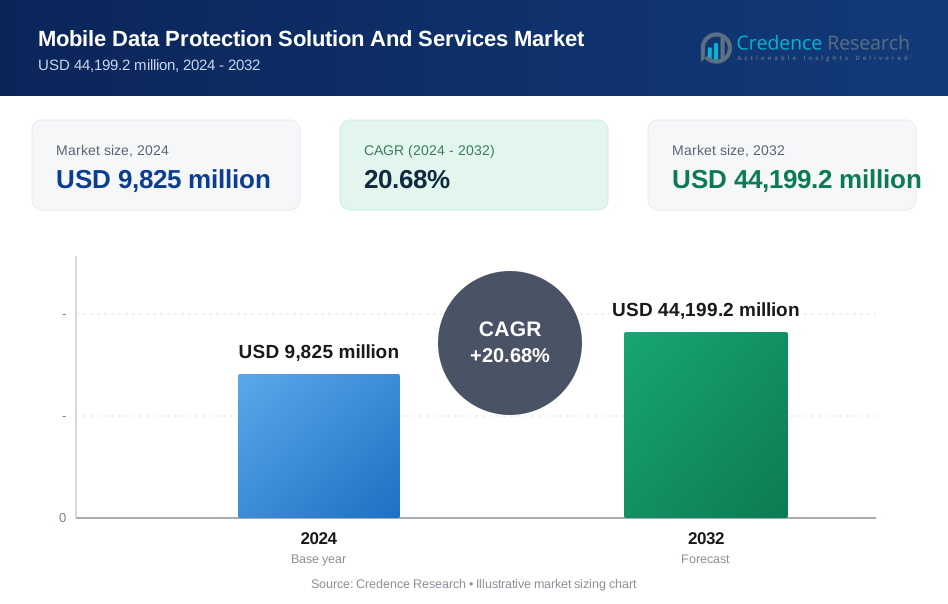
The Mobile Data Protection Solution and Services Market is projected to grow from USD 9825 million in 2024 to an estimated USD 44199.2 million by 2032, with a compound annual growth rate (CAGR) of 20.68% from 2024 to 2032.
The MDP solutions and services market is driven by the rapid increase in cyber threats and data breaches, necessitating comprehensive protection measures for sensitive mobile data. With the rise in remote working, mobile devices have become critical points of business operation, exposing companies to heightened security risks. This has resulted in a growing need for advanced data encryption, device management, and threat prevention solutions. Furthermore, regulatory frameworks such as GDPR (General Data Protection Regulation) and CCPA (California Consumer Privacy Act) have compelled businesses to implement robust MDP solutions to ensure compliance, thereby fueling market growth. The integration of artificial intelligence (AI) and machine learning (ML) capabilities into MDP systems also enhances threat detection and response, driving further adoption across diverse industry sectors, including banking, healthcare, IT, and telecommunications.
North America currently dominates the MDP solutions and services market due to its advanced IT infrastructure, strong regulatory landscape, and high awareness of data security risks. The presence of major market players and significant investments in cybersecurity further bolster the region’s market leadership. Meanwhile, Europe represents a mature market, driven by stringent data protection laws and rising demand for secure mobile solutions in various sectors. The Asia-Pacific region is anticipated to exhibit the highest growth rate due to rapid digital transformation across emerging economies like India and China, increasing smartphone penetration, and government initiatives to enhance data security. Latin America and the Middle East & Africa are also witnessing growing demand, supported by heightened regulatory compliance efforts and the rising adoption of digital technologies in business operations.
Market Drivers:
Rising Cybersecurity Threats and Data Breaches:
The growing frequency and sophistication of cyberattacks and data breaches have been key market drivers for Mobile Data Protection (MDP) solutions and services. Organizations across industries are recognizing that sensitive data stored and transmitted via mobile devices is particularly vulnerable to unauthorized access, data theft, and ransomware attacks. For instance, IBM reported that the average cost of a data breach in 2023 was $4.45 million, highlighting the financial impact of such incidents. As mobile devices become increasingly central to business operations, securing these endpoints has become a critical priority. The risks associated with data breaches can lead to significant financial losses, reputational damage, and regulatory penalties. Consequently, enterprises are investing heavily in MDP solutions that offer robust security features such as encryption, device management, access control, and threat detection capabilities to safeguard sensitive mobile data.
Increasing Adoption of BYOD Policies and Remote Work:
The widespread adoption of Bring Your Own Device (BYOD) policies and the shift towards remote work have accelerated demand for comprehensive MDP solutions. As employees use personal and company-issued devices for work, sensitive business data is often accessed outside traditional office environments, which poses security challenges. For instance, according to a survey by Cisco, 85% of organizations allow BYOD in some form, underscoring the need for effective MDP solutions. MDP solutions help mitigate these risks by ensuring data protection regardless of device ownership or location, enabling secure remote access, and preventing data leakage. The shift to hybrid and remote work arrangements during and post-pandemic has further underscored the need for effective MDP measures. Businesses are now prioritizing mobile device security to maintain seamless, secure workflows while reducing potential threats from unprotected endpoints.
Stringent Regulatory and Compliance Mandates:
The global regulatory environment has become increasingly stringent concerning data privacy and protection, driving the adoption of MDP solutions. Regulations such as the General Data Protection Regulation (GDPR) in Europe, the California Consumer Privacy Act (CCPA) in the United States, and other data protection frameworks worldwide impose strict requirements on organizations to safeguard customer data and prevent data breaches. Non-compliance can lead to heavy fines and legal consequences, creating a strong incentive for companies to adopt comprehensive MDP measures. By implementing solutions that offer features like encryption, compliance reporting, and data access control, businesses can ensure adherence to these regulations and mitigate legal risks. This growing regulatory scrutiny is expected to continue driving demand for MDP services across diverse sectors.
Technological Advancements and Integration of AI:
Technological advancements and the integration of artificial intelligence (AI) and machine learning (ML) into MDP solutions are also driving market growth. These innovations enhance the capabilities of MDP systems, providing real-time threat detection, intelligent risk analysis, and automated responses to security incidents. AI-powered MDP solutions can analyze vast amounts of data to identify anomalies, detect potential threats, and respond more effectively than traditional security measures. Moreover, the continuous evolution of cyber threats has necessitated the development of dynamic security solutions capable of adapting to new challenges. By leveraging AI and ML, organizations can maintain proactive defense strategies that safeguard mobile data, fostering greater trust and confidence in digital business environments.
Market Trends:
Cloud-Based Solutions and SaaS Adoption:
A notable trend in the Mobile Data Protection (MDP) solutions and services market is the increasing adoption of cloud-based security solutions and Software-as-a-Service (SaaS) models. As organizations migrate their data and applications to the cloud, the need for comprehensive mobile data protection becomes more critical. For instance, Thales Group reported that enterprises now use, on average, 2.3 cloud platforms and 97 SaaS applications, highlighting the complexity and need for robust security measures. Cloud-based MDP solutions offer scalability, flexibility, and real-time security updates, which are particularly advantageous for businesses with geographically dispersed workforces and hybrid work arrangements. These solutions enable secure access to data across mobile devices while minimizing infrastructure costs and management complexity. As businesses continue to embrace cloud environments, the demand for MDP services that seamlessly integrate with cloud-based applications and services is projected to grow steadily.
Focus on Data-Centric Security Approaches:
The shift towards data-centric security is gaining traction in the MDP market. Unlike traditional perimeter-based security approaches, data-centric protection focuses on safeguarding the data itself, regardless of its location or access point. This trend has been driven by the increasing mobility of data, which often flows through various devices, networks, and cloud environments. MDP solutions that provide features such as data encryption, data loss prevention (DLP), and granular access control are in high demand. Organizations are prioritizing these capabilities to ensure that sensitive information remains protected, even if devices are compromised or accessed by unauthorized users. This shift towards data-centric security aligns with the evolving nature of mobile data risks and reflects the growing emphasis on zero-trust security models.
Growth in AI-Driven Threat Detection and Response:
Another significant trend in the MDP market is the incorporation of artificial intelligence (AI) and machine learning (ML) technologies to enhance threat detection and response capabilities. AI-driven MDP solutions can analyze user behavior, detect anomalies, and respond to potential threats in real-time, providing a higher level of protection against sophisticated cyberattacks. For instance, SentinelOne's AI-powered threat detection systems can identify and mitigate threats more effectively than traditional methods. As cyber threats continue to evolve and become more targeted, businesses are increasingly relying on intelligent MDP solutions that offer predictive threat analytics and automated incident response. The ability to proactively identify and mitigate risks through AI-driven insights is expected to play a pivotal role in shaping the future of mobile data protection strategies.
Rising Demand in Emerging Markets:
Emerging markets, particularly in Asia-Pacific, Latin America, and parts of the Middle East and Africa, are witnessing a surge in demand for MDP solutions. Rapid digital transformation, increasing smartphone penetration, and growing awareness of data security risks have contributed to this trend. Governments and enterprises in these regions are investing in advanced mobile security measures to protect sensitive data and comply with evolving regulatory requirements. Small and medium-sized enterprises (SMEs) in emerging markets are also recognizing the importance of mobile data protection to ensure business continuity and customer trust. This growing demand in emerging regions represents a significant opportunity for MDP solution providers to expand their market reach and tailor their offerings to diverse customer needs.
Market Restraints and Challenges:
High Implementation Costs and Complexities:
One of the key market restraints for Mobile Data Protection (MDP) solutions and services is the high cost associated with implementation and ongoing maintenance. Deploying comprehensive MDP solutions often involves significant investment in software, hardware, and technical expertise, which can be challenging for small and medium-sized enterprises (SMEs) with limited budgets. Additionally, the complexity of integrating MDP solutions with existing IT infrastructure, legacy systems, and diverse mobile devices can pose challenges, leading to potential delays in deployment and increased operational costs. These cost and complexity factors may deter some organizations from fully embracing advanced MDP measures.
Evolving Nature of Cyber Threats:
The rapidly evolving nature of cyber threats presents a significant challenge for MDP solution providers and users alike. Cybercriminals continuously develop new methods and techniques to breach security systems, necessitating constant updates and enhancements to MDP solutions. This dynamic threat landscape requires organizations to remain vigilant and invest in evolving protection measures, which can be both costly and resource-intensive. The challenge for MDP vendors is to stay ahead of emerging threats while ensuring their solutions remain effective, user-friendly, and adaptable to changing attack vectors.
User Awareness and Adoption Challenges:
Despite the growing importance of mobile data protection, there remains a lack of awareness and understanding among some end-users regarding the risks associated with mobile data breaches and the benefits of MDP solutions. Resistance to change, inadequate training, and the perceived complexity of using advanced security tools can lead to underutilization or ineffective implementation of MDP systems. Ensuring user adoption and compliance is a challenge for organizations, particularly those with a dispersed workforce or varied levels of digital literacy among employees. Bridging this gap requires ongoing education, training, and simplified user interfaces to drive effective adoption of MDP practices.
Market Segmentation Analysis:
The Mobile Data Protection (MDP) Solutions and Services market can be analyzed across several key segments based on platform, deployment, and enterprise size.
By Platform, MDP solutions cater to diverse operating systems, with Windows and Android platforms dominating due to their widespread adoption in corporate environments and high mobile usage rates. iOS also holds a significant market share, particularly in organizations emphasizing premium security features and robust device management. Mac OS has seen increased uptake in specific sectors like creative and tech industries, while Blackberry, though reduced in market presence, remains relevant in niche security-focused segments. Linux, known for its strong security foundations, is adopted primarily in tech-centric and open-source communities.
By Deployment, MDP solutions are delivered through cloud, on-premise, and hybrid models. Cloud deployments, including private, public, and hybrid cloud solutions, are rapidly gaining traction due to their scalability, cost-effectiveness, and real-time security updates. Hybrid cloud solutions, combining on-premise and cloud functionalities, offer flexibility and cater to organizations with complex data security requirements. On-premise deployments continue to be relevant for organizations requiring strict control over their data and security infrastructure.
By Enterprise Size, large enterprises dominate the market due to their greater resources and more complex security needs. However, Small and Medium Enterprises (SMEs) represent a growing segment as they increasingly recognize the importance of protecting sensitive data amid evolving cyber threats. SMEs often seek cost-effective, scalable MDP solutions, with cloud-based services particularly appealing to this segment due to their affordability and flexibility.
Segmentation:
By Platform
- Windows
- Android
- iOS
- Mac OS
- Blackberry
- Linux
By Deployment
- Cloud
- Private Cloud
- Public Cloud
- Hybrid Cloud
- On-premise
- Hybrid
By Enterprise Size
- Small & Medium Enterprises (SMEs)
- Large Enterprises
By Region
- North America
- U.S.
- Canada
- Mexico
- Europe
- Germany
- France
- U.K.
- Italy
- Spain
- Rest of Europe
- Asia Pacific
- China
- Japan
- India
- South Korea
- South-east Asia
- Rest of Asia Pacific
- Latin America
- Brazil
- Argentina
- Rest of Latin America
- Middle East & Africa
- GCC Countries
- South Africa
- Rest of the Middle East and Africa
Regional Analysis:
The Mobile Data Protection (MDP) Solutions and Services market exhibits regional variations in terms of adoption, regulatory compliance, and market growth potential.
North America holds the largest market share, accounting for approximately 35-40% of the global market. The region’s dominance is driven by strong cybersecurity infrastructure, widespread adoption of advanced IT systems, and strict regulatory frameworks such as the California Consumer Privacy Act (CCPA) and other state-level data protection laws. The high penetration of mobile devices in the corporate sector, combined with the presence of major market players, has further propelled MDP adoption in industries such as healthcare, finance, and IT services. The emphasis on data protection and privacy amid rising cyber threats has kept demand for robust MDP solutions at the forefront in North America.
Europe represents a significant portion of the MDP market, contributing around 25-30% of the global market share. The General Data Protection Regulation (GDPR) has been a major driver for MDP solution adoption, compelling businesses to enhance their data protection practices. Countries such as Germany, the United Kingdom, and France lead in the uptake of MDP solutions across diverse industries, including finance, manufacturing, and government. Organizations in Europe are prioritizing security solutions that offer compliance assurance, strong encryption, and data access control to meet stringent regulatory demands and mitigate potential fines and legal implications.
Asia-Pacific is experiencing the fastest growth rate in the MDP market and accounts for approximately 20-25% of the global share. Rapid digital transformation across key economies like China, India, and Japan, coupled with increasing mobile device penetration, has driven the demand for mobile data protection. The rise of remote work and heightened awareness of cybersecurity threats have further accelerated the adoption of MDP solutions. Government initiatives to strengthen data privacy regulations and the proliferation of SMEs adopting digital strategies are also key growth factors. The region offers significant opportunities for MDP solution providers as organizations continue to modernize their security infrastructure.
Latin America and the Middle East & Africa together make up the remaining market share, contributing roughly 10-15% combined. While these regions are relatively smaller in market size, they are witnessing growing adoption of MDP solutions due to increased digitalization, the rise of mobile workforce trends, and enhanced regulatory frameworks aimed at improving data security. Countries such as Brazil, South Africa, and the UAE are leading the charge within their respective regions. Challenges such as limited budgets for cybersecurity and varying levels of technological maturity exist but are being gradually addressed through greater public-private partnerships and targeted investments in cybersecurity infrastructure.
Key Player Analysis:
- Acronis
- CA Technologies
- CheckPoint Software Technologies Pvt. Ltd.
- Dell Inc.
- EMC Corporation (AirWatch)
- Hewlett-Packard
- HPE Symantec
- IBM
- Intel Corporation
- Mcafee
- Netapp
- Oracle
- Quest Software
- Sophos
- Trend Micro Inc.
- Veeam
Competitive Analysis:
The Mobile Data Protection (MDP) Solutions and Services market is highly competitive, driven by the growing need for secure mobile communications and data protection across industries. Major players such as Microsoft, Symantec, IBM, McAfee, and Trend Micro lead the market by offering comprehensive solutions with advanced features like encryption, data loss prevention, and threat detection. These industry leaders focus on continuous innovation, leveraging artificial intelligence and machine learning capabilities to enhance their offerings. Smaller and emerging players bring niche solutions and customized services to meet specific enterprise needs, often emphasizing flexibility, cost-efficiency, and specialized support. The market's competitive intensity is further fueled by rapid advancements in mobile security technologies and the demand for integrated, scalable, cloud-based solutions. As cybersecurity threats evolve, competition is expected to heighten, with players vying to deliver the most robust and adaptive MDP systems to meet global regulatory and security standards.
Recent Developments:
- In February 2023, Hewlett Packard Enterprise (HPE) and Nokia announced an expansion of their partnership to deliver an open and competitive Cloud RAN solution to Communication Service Providers (CSPs) and enterprises globally. This enhanced collaboration will also enable the availability of HPE telco servers to Nokia Mobile Networks customers worldwide as they deploy Cloud RAN within CSP networks.
- In February 2023, Trend Micro Incorporated, a leading provider of security operations center (SOC) technology, announced its acquisition of Anlyz. This acquisition is aimed at enhancing Trend Micro’s capabilities in orchestration, automation, and integration, enabling businesses and Managed Security Service Providers (MSSPs) to achieve improved operational efficiency, cost-effectiveness, and superior security outcomes.
Market Concentration & Characteristics:
The Mobile Data Protection (MDP) Solutions and Services market exhibits a moderately concentrated structure, with a mix of large established players and smaller, specialized providers. Major companies such as Microsoft, IBM, Symantec, and McAfee dominate the market due to their extensive product portfolios, global reach, and substantial investments in research and development. These leaders often provide comprehensive, end-to-end solutions tailored to a broad range of enterprise needs. In contrast, smaller and emerging players focus on niche markets, offering specialized solutions that address unique security challenges, including flexible deployment options and industry-specific customizations. The market is characterized by rapid technological advancements, frequent product updates, and intense competition driven by evolving cyber threats and regulatory requirements. Cloud-based deployments and AI-driven threat detection capabilities are among the key differentiators shaping market dynamics. The need for continuous innovation and compliance with global data protection laws further defines the competitive landscape in this space.
Report Coverage:
The research report offers an in-depth analysis based on By Platform, By Deployment and By Enterprise Size. It details leading market players, providing an overview of their business, product offerings, investments, revenue streams, and key applications. Additionally, the report includes insights into the competitive environment, SWOT analysis, current market trends, as well as the primary drivers and constraints. Furthermore, it discusses various factors that have driven market expansion in recent years. The report also explores market dynamics, regulatory scenarios, and technological advancements that are shaping the industry. It assesses the impact of external factors and global economic changes on market growth. Lastly, it provides strategic recommendations for new entrants and established companies to navigate the complexities of the market.
Future Outlook:
- Increasing adoption of cloud-based MDP solutions will drive market growth, fueled by demand for scalability and real-time security updates.
- AI and machine learning integration will enhance threat detection, enabling proactive defense against evolving cyber threats.
- Expanding regulatory frameworks worldwide will push organizations to adopt comprehensive MDP measures for compliance and data protection.
- Rising cybercrime rates and sophisticated attack vectors will lead to continuous innovation in mobile data security technologies.
- Growing emphasis on data-centric security will encourage widespread deployment of encryption, access control, and data loss prevention tools.
- SMEs will become a key market driver as they increasingly adopt cost-effective, scalable MDP solutions to mitigate cyber risks.
- Hybrid work models will continue to propel demand for mobile security solutions that support remote and flexible work environments.
- Emerging markets in Asia-Pacific, Latin America, and Africa will contribute to robust market expansion as digitalization accelerates.
- Partnerships and mergers among major players will lead to innovative, integrated solutions tailored to evolving enterprise needs.
- The proliferation of IoT and connected devices will create new challenges and opportunities for MDP solution providers to secure diverse endpoints.
Request a Free Sample
Fill in your details and we'll send you a free sample report.
- Sample data tables & charts
- Research methodology
Need a Custom Version of This Report?
Tailor the scope, geography, or segments to your exact requirements.
- Custom geography or segment scope
- Direct access to our analyst team
Frequently Asked Questions
What is the size of Mobile Data Protection Solution And Services Market?
What factors are driving market growth?
What is a major challenge faced by MDP solution providers?
Which regions lead the market?
Table of Content
Chapter 1. Report Introduction
- 1.1 Report Description & Purpose
- 1.1.1 Report Title & Market Definition
- 1.1.2 Unique Selling Propositions (USP) & Key Differentiators
- 1.1.3 Value Proposition for Stakeholders
- 1.2 Research Objectives
- 1.2.1 Market Sizing Objectives (Volume & Revenue)
- 1.2.2 Segmentation Objectives
- 1.2.3 Competitive Intelligence Objectives
- 1.2.4 Forecast & Scenario Objectives
- 1.3 Report Scope
- 1.3.1 Mobile Data Protection Solution And Services Scope – Types & Subtypes Covered
- 1.3.2 Geographic Scope – Regions & Countries Covered
- 1.3.3 Historical Period, Base Year & Forecast Period (2024; forecast to 2032)
- 1.3.4 Inclusions & Exclusions
- 1.4 HS Code & Classification Framework
- 1.5 Currency, Units & Pricing Basis
- 1.6 Target Stakeholders
- 1.7 Limitations & Assumptions
Chapter 2. Executive Summary
- 2.1 Global Mobile Data Protection Solution And Services Market Snapshot
- 2.1.1 Market Size – Historical (2024) & Forecast (2024-2032) (2024: USD 9,825 million → 2032: USD 44,199.2 million)
- 2.1.2 Volume & Revenue – Global Totals
- 2.1.3 Key Market Highlights – Top Five Facts
- 2.2 Mobile Data Protection Solution And Services Market Segmentation Snapshot
- 2.2.1 Market Split by Region – 2024 vs. 2032
- 2.3 Competitive Snapshot
- 2.3.1 Top 10 Players by Revenue Share – 2024
- 2.3.2 Top 10 Players by Volume Share – 2024
- 2.3.3 Recent Strategic Developments (18-Month Summary)
- 2.4 Key Investment Highlights & Strategic Conclusions
Chapter 3. Mobile Data Protection Solution And Services Market Dynamics & Industry Analysis
- 3.1 Market Overview & Context
- 3.1.1 Mobile Data Protection Solution And Services Market Position in the Broader Automotive Value Chain
- 3.1.2 OEM vs. Replacement Market Dynamics
- 3.1.3 Market Maturity & Development Stage by Region
- 3.2 Mobile Data Protection Solution And Services Market Drivers
- 3.3 Mobile Data Protection Solution And Services Market Restraints & Challenges
- 3.4 Mobile Data Protection Solution And Services Market Opportunities
- 3.5 Porter's Five Forces Analysis
- 3.5.1 Threat of New Entrants
- 3.5.2 Bargaining Power of Suppliers
- 3.5.3 Bargaining Power of Buyers
- 3.5.4 Threat of Substitutes
- 3.5.5 Competitive Rivalry – Intensity Assessment
- 3.6 Mobile Data Protection Solution And Services Value Chain Analysis
- 3.6.1 Upstream – Raw Material/Input Suppliers
- 3.6.1.1 Raw Material/Input 1
- 3.6.1.2 Raw Material/Input 2
- 3.6.1.3 Raw Material/Input 3
- 3.6.2 Midstream – Production/Manufacturing/Service Delivery
- 3.6.2.1 Production/Process Overview
- 3.6.2.2 Key Facility Locations & Capacity by Manufacturer
- 3.6.3 Downstream – Distribution & End Consumer
- 3.6.3.1 Primary Channel – B2B/OEM
- 3.6.3.2 Secondary Channels – Dealer, Retail, Online, Direct
- 3.6.4 Value Chain Profitability Analysis
- 3.6.1 Upstream – Raw Material/Input Suppliers
- 3.7 PESTEL Analysis
- 3.7.1 Political Factors
- 3.7.2 Economic Factors
- 3.7.3 Social Factors
- 3.7.4 Technological Factors
- 3.7.5 Environmental Factors
- 3.7.6 Legal Factors
- 3.8 Mobile Data Protection Solution And Services Supply Chain Analysis
- 3.8.1 Raw Material/Input Supply Risk Assessment
- 3.8.2 Manufacturing Concentration Risk (Geographic Exposure)
- 3.8.3 Trade Disruption Impact Analysis
- 3.9 Regulatory & Policy Landscape
Note: The regulatory and policy landscape section covers regulations based on their applicability to the market, Mobile Data Protection Solution And Services category, geography, and scope of the study. Only regulatory frameworks with a material impact on operations, compliance, trade, sustainability, or market access are analyzed in detail.
Chapter 4. Key Investment Pockets & Opportunity Analysis
- 4.1 Mobile Data Protection Solution And Services Market Attractiveness Analysis
- 4.1.1 By Region – Investment Attractiveness Matrix (Volume × CAGR)
- 4.2 Absolute Revenue Growth Opportunity
- 4.2.1 By Region – Absolute USD Growth Through 2032
- 4.3 Incremental Volume Opportunity
- 4.3.1 By Region – Incremental Volume Through 2032
- 4.3.2 Segment – Incremental Volume
- 4.4 Emerging Submarket Opportunity Deep Dive (Subject to Applicability)
- 4.5 Emerging Market Opportunity Scorecards
- 4.5.1 United States
- 4.5.2 Europe
- 4.5.3 Asia
- 4.5.4 Middle East & Africa
Note: Emerging Market Opportunity Scorecards will be included based on relevance and strategic importance. Regions listed are indicative and may vary depending on data availability and market dynamics.
Chapter 5. Mobile Data Protection Solution And Services Import-Export Analysis & Trade Flows
- 5.1 Global Trade Overview
- 5.1.1 Global Export Value by Country (2024)
- 5.1.2 Global Export Volume by Country (2024)
- 5.1.3 Global Import Value by Country (2024)
- 5.1.4 Global Import Volume by Country (2024)
- 5.1.5 Net Trade Balance by Country (2024)
- 5.2 Export Analysis – Segment
- 5.2.1 Type 1 (HS Code)
- 5.2.2 Type 2 (HS Code)
- 5.2.3 Type 3 (HS Code)
- 5.2.4 Type 4 (HS Code)
- 5.2.5 Type 5 (HS Code)
- 5.3 Import Analysis – Segment
- 5.3.1 Type 1 (HS Code)
- 5.3.2 Type 2 (HS Code)
- 5.3.3 Type 3 (HS Code)
- 5.3.4 Type 4 (HS Code)
- 5.3.5 Type 5 (HS Code)
- 5.4 Average Unit Trade Prices
- 5.4.1 Average Export Price – Segment & Country
- 5.4.2 Average Import Price – Segment & Source Country
- 5.4.3 Price Trends (2024)
- 5.5 Key Trade Route Analysis
- 5.5.1 Trade Route 1
- 5.5.2 Trade Route 2
- 5.5.3 Trade Route 3
- 5.5.4 Trade Route 4
- 5.5.5 Trade Route 5
- 5.6 Trade Policy Impact Assessment
- 5.6.1 US Anti-Dumping & Section 301 Tariffs
- 5.6.2 EU Customs Union Impact
- 5.6.3 Major Free Trade Agreements
- 5.6.4 USMCA Rules of Origin
Note: Trade policy analysis will be included only where relevant to the Mobile Data Protection Solution And Services market.
Chapter 6. Competitive Landscape & Company Benchmarking
- 6.1 Mobile Data Protection Solution And Services Market Concentration & Structure
- 6.1.1 Herfindahl-Hirschman Index (HHI) – vs. 2024
- 6.1.2 Tier 1, Tier 2 & Tier 3 Market Structure
- 6.1.3 Global, Regional & Local Player Dynamics
- 6.2 Mobile Data Protection Solution And Services Market Share Analysis – 2024
- 6.2.1 Global Revenue Share by Company
- 6.2.2 Global Volume Share by Company
- 6.2.3 Regional Revenue Share
- 6.2.4 Market Share Evolution ( vs. 2024)
- 6.2.5 OEM Segment Share by Company
- 6.2.6 Replacement Segment Share by Company
- 6.3 Production/Delivery Capacity & Facility Analysis
- 6.3.1 Global Installed Capacity
- 6.3.2 Capacity Utilization Rates
- 6.3.3 Production/Output Volume
- 6.3.4 Facility Locations & Capacity Map
- 6.3.5 Planned Capacity Additions
- 6.4 Mobile Data Protection Solution And Services Competitive Benchmarking Matrix
- 6.4.1 Revenue, Volume, CAGR & Profitability Comparison
- 6.4.2 Channel Revenue Mix
- 6.4.3 Geographic Revenue Exposure
- 6.4.4 R&D Intensity
- 6.4.5 Sustainability Maturity
- 6.5 Strategic Developments in Mobile Data Protection Solution And Services (Last 24 Months)
- 6.5.1 Mergers, Acquisitions & Divestments
- 6.5.2 New Mobile Data Protection Solution And Services Launches
- 6.5.3 Facility Expansions
- 6.5.4 Strategic Alliances, Joint Ventures & Partnerships
- 6.5.5 Distribution Expansion & Market Entry
- 6.5.6 Sustainability & ESG Initiatives
- 6.6 Competitive Strategy Mapping
- 6.6.1 Leader, Challenger, Follower & Niche Classification
- 6.6.2 Pricing Strategy Comparison
- 6.6.3 Channel Strategy Matrix
Note: Strategic developments are included based on their materiality and the availability of reliable information.
Chapter 7. Global Mobile Data Protection Solution And Services Market – By Distribution Channel
- 7.1 Segment Overview
- 7.1.1 Volume & Revenue Split by Channel (2024 & 2032)
- 7.1.2 Channel Mix Evolution (2024-2032)
Chapter 8. Regional Market Analysis – Global Overview
- 8.1 Global Regional Overview
- 8.1.1 Regional Volume Share
- 8.1.2 Regional Revenue Share
- 8.1.3 Regional Volume by Region
- 8.1.4 Regional Revenue by Region
- 8.1.5 Regional Forecast Through 2032
- 8.2 Cross-Regional Segment Analysis
- 8.2.1 By Distribution Channel
- 8.2.2 By Brand/Price Tier
Chapter 9. North America Mobile Data Protection Solution And Services Market
- 9.1 United States
- 9.2 Canada
- 9.3 Mexico
Chapter 10. Europe Mobile Data Protection Solution And Services Market
- 10.1 Germany
- 10.2 France
- 10.3 Italy
- 10.4 United Kingdom
- 10.5 Spain
- 10.6 Poland
- 10.7 Russia
- 10.8 Netherlands
- 10.9 Belgium
- 10.10 Sweden
- 10.11 Denmark
- 10.12 Norway
- 10.13 Rest of Europe
Chapter 11. Asia Pacific Mobile Data Protection Solution And Services Market
- 11.1 China
- 11.2 India
- 11.3 Japan
- 11.4 South Korea
- 11.5 Thailand
- 11.6 Indonesia
- 11.7 Vietnam
- 11.8 Malaysia
- 11.9 Australia
- 11.10 Rest of Asia Pacific
Chapter 12. Latin America Mobile Data Protection Solution And Services Market
- 12.1 Brazil
- 12.2 Argentina
- 12.3 Colombia
- 12.4 Chile
- 12.5 Rest of Latin America
Chapter 13. Middle East Mobile Data Protection Solution And Services Market
- 13.1 Saudi Arabia
- 13.2 United Arab Emirates
- 13.3 Turkey
- 13.4 Israel
- 13.5 Iran
- 13.6 Rest of the Middle East
Chapter 14. Africa Mobile Data Protection Solution And Services Market
- 14.1 South Africa
- 14.2 Egypt
- 14.3 Nigeria
- 14.4 Morocco
- 14.5 Rest of Africa
Chapter 15. Mobile Data Protection Solution And Services Company Profiles
- 15.1 [Company 01]
- 15.1.1 Company Overview
- 15.1.2 Key Management Personnel
- 15.1.3 Products & Services Portfolio
- 15.1.4 Financial Performance
- 15.1.5 Key Market Focus & Geographic Presence
- 15.1.6 Recent Developments & Strategic Initiatives
Note: The company profile list is preliminary and may change based on research findings, market developments, data availability, and client requirements.
Chapter 16. Appendices
- Appendix A – List of Abbreviations & Acronyms
- Appendix B – Industry Classification Code Reference – Full Series
- Appendix C – Production & Capacity Data Tables
- Appendix D – End-Use & Demand Base Tables
- Appendix E – Consumption & Replacement Rate Assumptions
- Appendix F – ASP Reference Tables
- Appendix G – Manufacturing & Facility Database
- Appendix H – Import-Export Data Tables
- Appendix I – Regulatory Summary Tables
- Appendix J – Primary Research Participant List (Anonymized)
- Appendix K – Primary Research Questionnaire Framework
- Appendix L – Data Sources & Bibliography
- Appendix M – Market Size Divergence & Source Comparison
Chapter 17. Research Methodology
- 17.1 Research Framework & Philosophy
- 17.2 Secondary Research – Sources, Hierarchy & Data Extraction
- 17.3 Data Modeling – Bottom-Up & Top-Down Market Sizing
- 17.4 Primary Research – Stakeholder Framework, LOI & Sample Sizes
- 17.5 Forecast Methodology – Regression, Scenario & Sensitivity Analysis
- 17.6 Quality Control – Four-Layer Validation Framework
- 17.7 Limitations & Standard Assumptions
- 17.8 Disclaimer
