
Market Overview:
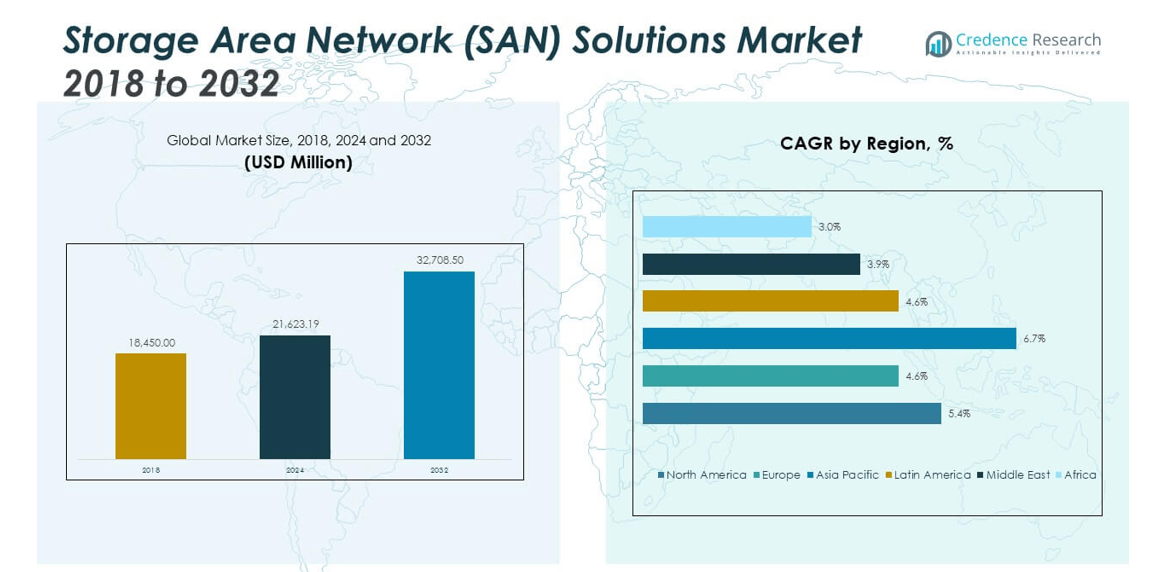
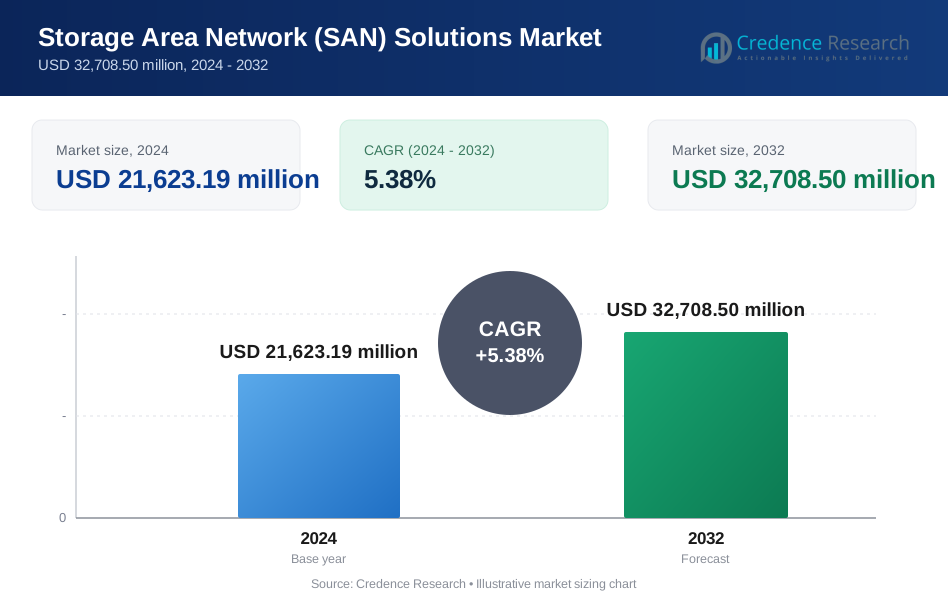
The Global Storage Area Network (SAN) Solutions Market size was valued at USD 18,450.00 million in 2018 to USD 21,623.19 million in 2024 and is anticipated to reach USD 32,708.50 million by 2032, at a CAGR of 5.38% during the forecast period.
| REPORT ATTRIBUTE | DETAILS |
|---|---|
| Historical Period | 2020-2023 |
| Base Year | 2024 |
| Forecast Period | 2025-2032 |
| Storage Area Network (SAN) Solutions Market Size 2024 | USD 21,623.19 million |
| Storage Area Network (SAN) Solutions Market, CAGR | 5.38% |
| Storage Area Network (SAN) Solutions Market Size 2032 | USD 32,708.50 million |
Enterprises generate growing data from virtualization, analytics, and cloud workloads. SAN solutions deliver low latency and high throughput storage. Businesses need centralized storage with strong availability controls. Mission critical applications demand consistent performance under heavy loads. SAN architectures support scalable block storage across data centers. Cyber resilience needs drive adoption of secure storage fabrics. Backup and recovery cycles benefit from fast data access. Hybrid environments require reliable on premises performance. Vendors improve automation and management simplicity. Operational efficiency gains reinforce term platform selection decisions.
North America leads adoption due to mature enterprise IT estates. Large data centers rely on high performance storage networks. The United States drives demand across finance and cloud services. Europe follows with strong uptake in Germany and the United Kingdom. Compliance focused industries favor resilient storage architectures. Asia Pacific emerges rapidly led by China and India. Expanding data centers and digital services fuel demand. Japan and South Korea adopt advanced storage for reliability. Latin America and the Middle East show gradual growth. Infrastructure modernization supports future expansion across enterprise sectors.
Market Insights:
- The Global Storage Area Network (SAN) Solutions Market size was valued at USD 18,450.00 million in 2018, reached USD 21,623.19 million in 2024, and is projected to reach USD 32,708.50 million by 2032, growing at a CAGR of 5.38% during the forecast period.
- North America leads with about 37.4% share due to mature data centers, followed by Europe with 24.4% supported by compliance-driven enterprise IT, while Asia Pacific holds nearly 24.3% backed by rapid data center expansion.
- Asia Pacific is the fastest-growing region with a CAGR of 6.7%, driven by rising cloud adoption, large-scale digital transformation, and strong investments in China, India, and Southeast Asia.
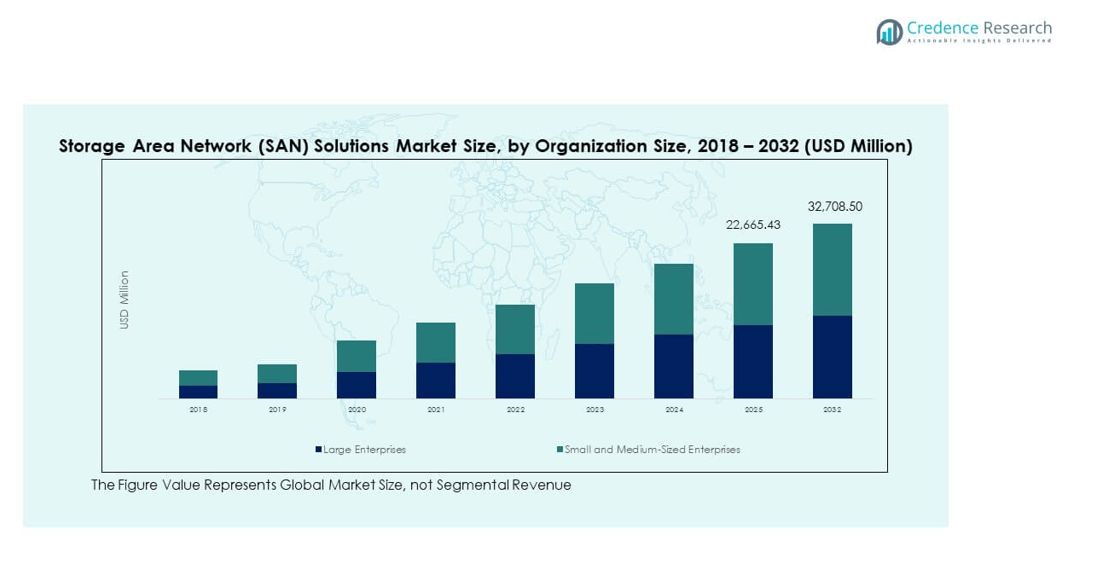
- By organization size, large enterprises account for roughly 62% of the market, reflecting higher reliance on high-performance and mission-critical SAN infrastructure.
- Small and medium-sized enterprises contribute about 38% share, supported by gradual adoption for core applications and selective data center modernization.
Market Drivers:
Rising Enterprise Dependence On High-Performance Transaction Processing Infrastructure
Enterprises operate databases that demand strict latency control and consistent throughput. The Global Storage Area Network (SAN) Solutions Market supports predictable performance for transaction-heavy environments. Financial institutions rely on stable data flow during peak processing cycles. Core banking platforms depend on block-level storage precision for accuracy. Enterprise resource systems require uninterrupted access across operations. Manufacturing execution systems need fast commit speeds for process continuity. SAN architectures reduce network congestion through dedicated fabrics. These capabilities reinforce sustained procurement across large enterprises.
- For instance, IBM’s DS8900F enterprise storage delivers end-to-end NVMe performance with response times as low as 18 microseconds in IBM Z environments (via zHyperLink) and 90 microseconds for distributed systems. While high-end models like the DS8950F support up to 2.3 million IOPS rather than 10 million the system’s 99.99999% availability and mission-critical reliability enable the world's largest banks to process massive transaction volumes securely.
Expansion Of Virtualized And Private Cloud Data Center Environments
Organizations deploy private cloud environments to retain workload control and security. The Global Storage Area Network (SAN) Solutions Market aligns well with virtualization requirements. Hypervisors depend on shared storage for live migration and workload mobility. Centralized storage pools improve resource utilization and governance. IT teams value deterministic performance for virtual machines. SAN fabrics support high server density without performance loss. Clustered designs reduce downtime exposure. These factors sustain adoption across enterprise data centers.
- For instance, VMware vSphere environments commonly use Fibre Channel SANs that support live migration of hundreds of virtual machines with near-zero downtime, validated by deployments using 32 Gb Fibre Channel links across enterprise data centers.
Growth In Mission Critical Applications Across Regulated Industries
Regulated industries manage workloads with strict availability mandates. The Global Storage Area Network (SAN) Solutions Market addresses compliance driven storage needs. Healthcare providers require reliable access for imaging and clinical systems. Government agencies store sensitive citizen data under tight controls. Telecom operators process billing and subscriber records continuously. SAN environments maintain availability during audits and system checks. Controlled access policies strengthen data security. Regulatory pressure preserves long-term investment momentum.
Rising Focus On Data Protection And Business Continuity Planning
Organizations prioritize resilience to limit operational disruption. The Global Storage Area Network (SAN) Solutions Market enables structured recovery frameworks. Replication supports site-level failover strategies. Snapshot capabilities protect against data corruption events. Enterprises aim to reduce recovery time objectives. Storage fabrics isolate faults efficiently. Faster data transfer shortens backup cycles. Continuity planning drives sustained SAN adoption.
Market Trends:
Adoption Of NVMe Over Fabrics For Low Latency Storage Access
Enterprises adopt advanced interconnect standards to improve performance. The Global Storage Area Network (SAN) Solutions Market evolves through NVMe over Fabrics integration. Lower latency enhances application response across workloads. Analytics platforms benefit from parallel data access. Modern switches support higher port density and speed. IT teams upgrade storage networks in phases. Performance gains justify infrastructure refresh decisions. This trend reshapes enterprise storage expectations.
- For instance, Broadcom’s Brocade Gen 7 Fibre Channel technology supports 64 Gb speeds and NVMe over Fabrics, reducing latency by nearly 50% compared to prior generations in enterprise database and analytics workloads.
Shift Toward Software Defined SAN Management Platforms
Organizations prefer centralized and flexible control layers. The Global Storage Area Network (SAN) Solutions Market reflects a shift toward software defined management. Policy-based provisioning simplifies storage operations. Automation reduces configuration errors and manual effort. Unified dashboards improve visibility across fabrics. IT teams achieve faster deployment timelines. Operational consistency improves across locations. Software focus strengthens vendor differentiation.
- For instance, NetApp’s ONTAP software enables policy-driven SAN provisioning and supports automated workload balancing across thousands of LUNs, with customers reporting deployment time reductions of over 60% in multi-site environments.
Growing Integration With Hybrid Cloud Storage Architectures
Enterprises connect on-premises systems with cloud resources. The Global Storage Area Network (SAN) Solutions Market supports hybrid deployment models. SAN platforms integrate with cloud gateways and connectors. Workloads shift based on performance and governance needs. Data placement policies enhance flexibility. Hybrid designs support disaster recovery planning. Enterprises maintain control over sensitive datasets. This trend supports balanced infrastructure strategies.
Increased Use Of AI Driven Storage Monitoring Tools
Storage teams adopt intelligent monitoring capabilities. The Global Storage Area Network (SAN) Solutions Market benefits from AI-enabled insights. Systems detect anomalies before failures escalate. Capacity forecasting improves infrastructure planning. Performance tuning becomes proactive. Smart alerts reduce operational noise. Decision quality improves through deeper visibility. AI adoption shapes future SAN management models.
Market Challenges Analysis:
High Capital Investment And Complex Deployment Requirements
Organizations face significant upfront infrastructure costs. The Global Storage Area Network (SAN) Solutions Market encounters budget scrutiny across enterprises. Hardware fabrics require skilled deployment resources. Legacy environments increase integration complexity. Small enterprises face higher entry barriers. Maintenance contracts add recurring expenses. Skill shortages raise operational risk. Cost pressure slows adoption among mid-sized firms.
Competition From Alternative Storage Architectures And Cloud Services
Enterprises assess multiple storage alternatives. The Global Storage Area Network (SAN) Solutions Market faces substitution pressure. Hyperconverged platforms offer simplified deployment models. Public cloud storage reduces direct hardware ownership. Decision makers compare total cost structures closely. SAN vendors must defend performance value. Procurement cycles extend due to evaluation depth. Competitive intensity challenges traditional adoption paths.
Market Opportunities:
Expansion Of Hyperscale And Colocation Data Center Facilities
Data center operators expand capacity across regions. The Global Storage Area Network (SAN) Solutions Market benefits from large-scale deployments. Hyperscale facilities demand high throughput storage fabrics. Colocation providers support diverse tenant requirements. Shared infrastructure needs strong storage isolation. SAN solutions meet multi-tenant performance demands. Operators prefer scalable and proven architectures. Expansion creates sustained vendor opportunities.
Rising Digital Transformation Across Emerging Economies
Enterprises modernize IT systems in developing regions. The Global Storage Area Network (SAN) Solutions Market gains from digital transformation programs. Banks digitize customer engagement platforms. Manufacturers deploy automation and analytics tools. Public sector agencies replace legacy systems. Reliable storage supports digital service delivery. Local data centers expand capacity. Emerging markets offer long-term growth potential.
Market Segmentation Analysis:
By Component
Hardware forms the physical backbone of SAN deployments and supports high throughput workloads. Software enables centralized control, policy enforcement, and performance optimization across storage fabrics. Services cover design, deployment, and lifecycle support, which help enterprises maintain reliability. The Global Storage Area Network (SAN) Solutions Market reflects balanced demand across all three components. It relies on hardware strength, software intelligence, and service expertise for stable operations.
- For instance, Dell Technologies’ PowerStore platform integrates NVMe hardware with intelligent software automation and ProSupport services, supporting multi-petabyte scalability while maintaining consistent performance across enterprise data centers.
By SAN Type
Hyperscale Server SAN serves large data centers that require massive scalability and consistent performance. Enterprise Server SAN supports traditional enterprises with mission critical workloads and structured storage needs. The Global Storage Area Network (SAN) Solutions Market shows stronger volume adoption from enterprise deployments. It also gains strategic growth from hyperscale expansion.
- For instance, hyperscale operators deploy server SAN architectures capable of supporting tens of thousands of nodes per cluster, while enterprise SAN deployments from vendors like HPE support mission-critical workloads with six-nines availability through redundant controller and fabric designs.
By Technology
Fibre Channel SAN remains preferred for low latency and high reliability environments. Fibre Channel over Ethernet SAN reduces infrastructure complexity through network convergence. InfiniBand SAN supports extreme performance workloads in analytics and high-performance computing. iSCSI SAN offers cost effective deployment over IP networks. The Global Storage Area Network (SAN) Solutions Market benefits from varied technology choices. It allows enterprises to align performance, cost, and complexity needs.
By End Use
BFSI drives demand through transaction intensive applications. IT and telecom rely on SAN for data center reliability. Government and public sector prioritize secure data control. Healthcare depends on availability for clinical systems. Retail, manufacturing, and others support steady adoption through operational workloads. The Global Storage Area Network (SAN) Solutions Market addresses diverse industry requirements. It supports both regulated and commercial use cases.
By Organization Size
Large enterprises dominate adoption due to scale and workload complexity. SMEs adopt SAN selectively for critical applications. The Global Storage Area Network (SAN) Solutions Market adapts to both segments. It balances performance depth with flexible deployment options.
Segmentation:
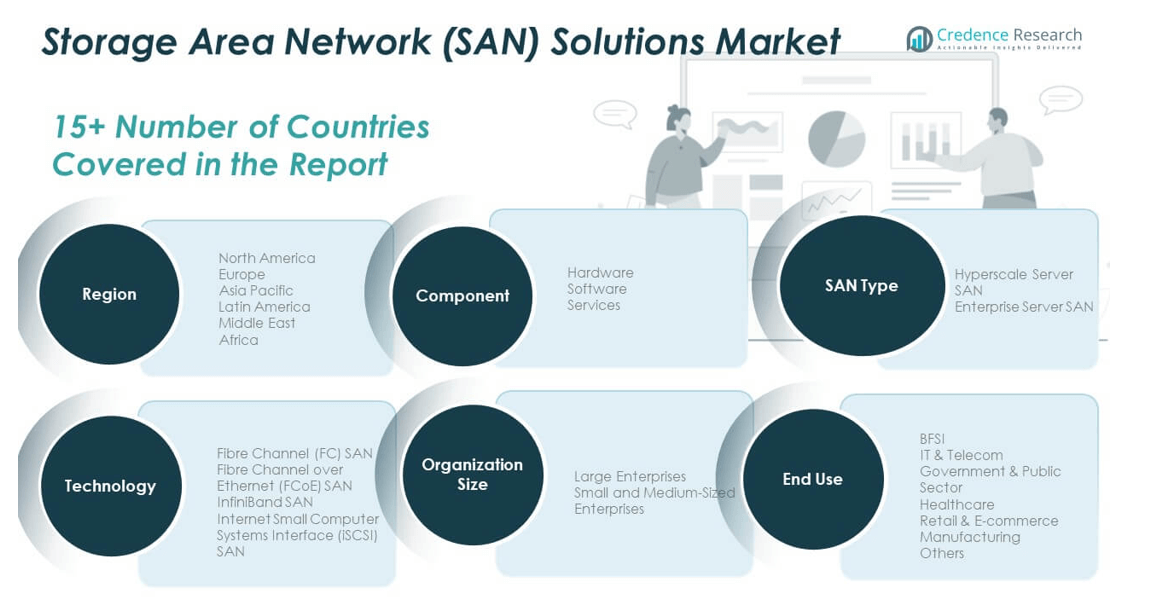
By Component- Hardware
- Software
- Services
- Hyperscale Server SAN
- Enterprise Server SAN
- Fibre Channel (FC) SAN
- Fibre Channel over Ethernet (FCoE) SAN
- InfiniBand SAN
- Internet Small Computer Systems Interface (iSCSI) SAN
- BFSI
- IT & Telecom
- Government & Public Sector
- Healthcare
- Retail & E-commerce
- Manufacturing
- Others
- Large Enterprises
- Small and Medium Enterprises (SMEs)
- North America
- U.S.
- Canada
- Mexico
- Europe
- Germany
- France
- U.K.
- Italy
- Spain
- Rest of Europe
- Asia Pacific
- China
- Japan
- India
- South Korea
- South-east Asia
- Rest of Asia Pacific
- Latin America
- Brazil
- Argentina
- Rest of Latin America
- Middle East & Africa
- GCC Countries
- South Africa
- Rest of the Middle East and Africa
Regional Analysis:
North America
The North America Storage Area Network (SAN) Solutions Market size was valued at USD 6,992.55 million in 2018 to USD 8,099.92 million in 2024 and is anticipated to reach USD 12,236.31 million by 2032, at a CAGR of 5.4% during the forecast period. North America accounted for nearly 37.4% share in 2024. The Global Storage Area Network (SAN) Solutions Market shows strong maturity in this region. Enterprises invest heavily in high performance data centers. BFSI and cloud service providers drive steady demand. Advanced IT infrastructure supports early adoption. Data protection requirements remain strict. Vendors benefit from long-term contracts. The United States leads regional deployment.
Europe
The Europe Storage Area Network (SAN) Solutions Market size was valued at USD 4,686.30 million in 2018 to USD 5,271.14 million in 2024 and is anticipated to reach USD 7,514.86 million by 2032, at a CAGR of 4.6% during the forecast period. Europe held around 24.4% share in 2024. The Global Storage Area Network (SAN) Solutions Market benefits from compliance-driven investments. Financial institutions prioritize secure storage frameworks. Manufacturing and healthcare support consistent adoption. Germany, the UK, and France lead deployments. Enterprises favor reliable and standardized architectures. Public sector digitization supports demand. Market growth remains stable.
Asia Pacific
The Asia Pacific Storage Area Network (SAN) Solutions Market size was valued at USD 4,280.40 million in 2018 to USD 5,251.10 million in 2024 and is anticipated to reach USD 8,808.43 million by 2032, at a CAGR of 6.7% during the forecast period. Asia Pacific captured nearly 24.3% share in 2024. The Global Storage Area Network (SAN) Solutions Market gains momentum from rapid digital expansion. China, India, and Japan lead adoption. Data center construction rises sharply. Telecom and cloud providers invest aggressively. Enterprises modernize legacy infrastructure. Growth pace exceeds other regions.
Latin America
The Latin America Storage Area Network (SAN) Solutions Market size was valued at USD 1,439.10 million in 2018 to USD 1,673.42 million in 2024 and is anticipated to reach USD 2,383.47 million by 2032, at a CAGR of 4.6% during the forecast period. Latin America held about 7.7% share in 2024. The Global Storage Area Network (SAN) Solutions Market expands gradually in this region. Brazil and Mexico remain key contributors. Enterprises adopt SAN for core systems. Cloud adoption supports infrastructure upgrades. Budget sensitivity shapes procurement. Market penetration remains selective.
Middle East
The Middle East Storage Area Network (SAN) Solutions Market size was valued at USD 645.75 million in 2018 to USD 704.78 million in 2024 and is anticipated to reach USD 952.00 million by 2032, at a CAGR of 3.9% during the forecast period. The region accounted for nearly 3.3% share in 2024. The Global Storage Area Network (SAN) Solutions Market benefits from government digitization. GCC countries lead regional demand. Banking and public services invest steadily. Data sovereignty drives local storage deployment. Adoption remains project-based. Infrastructure upgrades support long-term growth.
Africa
The Africa Storage Area Network (SAN) Solutions Market size was valued at USD 405.90 million in 2018 to USD 622.84 million in 2024 and is anticipated to reach USD 813.44 million by 2032, at a CAGR of 3.0% during the forecast period. Africa represented around 2.9% share in 2024. The Global Storage Area Network (SAN) Solutions Market remains nascent across most countries. South Africa leads regional adoption. Enterprises focus on essential storage needs. Limited infrastructure slows large deployments. Public sector digitization offers opportunity. Market growth stays gradual.
Key Player Analysis:
- Dell Technologies
- Hewlett Packard Enterprise (HPE)
- IBM Corporation
- Cisco Systems, Inc.
- Broadcom Inc. (Brocade)
- NetApp, Inc.
- Hitachi Vantara (Hitachi Ltd.)
- Fujitsu Limited
- Huawei Technologies Co., Ltd.
- Lenovo Group Limited
- DataCore Software Corporation
- StarWind Software Inc.
- Nutanix, Inc.
- NEC Corporation
Competitive Analysis:
The Global Storage Area Network (SAN) Solutions Market features strong competition among established infrastructure vendors and specialized software providers. Leading companies focus on performance reliability, scalability, and enterprise-grade security. Hardware leaders strengthen portfolios through integrated systems and fabric innovation. Software-focused players differentiate through automation, policy control, and virtualization alignment. Strategic partnerships with cloud and data center operators enhance market reach. It remains competitive due to high switching costs and long sales cycles. Vendors emphasize lifecycle services to retain clients. Product compatibility and ecosystem strength shape buyer decisions. Continuous technology upgrades sustain competitive positioning.
Recent Developments:
- In October 2025, at its INSIGHT 2025 event, NetApp announced the disaggregation of its ONTAP storage architecture with the launch of NetApp AFX (All-Flash X) arrays, which allow compute and storage to scale independently. Alongside this hardware, the company introduced the "AI Data Engine," a solution designed to pre-process data for AI large language models (LLMs) and agent use. NetApp also deepened its partnership with Google Cloud, integrating its block storage capabilities directly into NetApp Volumes to support enterprise workloads and AI applications.
- In November 2025, Hitachi Vantara launched the Virtual Storage Platform One (VSP One) Block High End, a next-generation all-flash NVMe storage solution built to handle mission-critical and growing AI workloads. This launch completed its VSP One data platform strategy, offering enhanced cyber resilience and a 100% data availability guarantee. Earlier in July 2025, the company announced that its VSP One Software-Defined Storage (SDS) became available on the Google Cloud Marketplace, enabling seamless hybrid cloud data management with features like two-way asynchronous replication.
- In October 2025, Fsas Technologies, a Fujitsu company, announced a reseller partnership with Proxmox to provide a data sovereignty-focused virtualization alternative for European data centers. In April 2025, Fujitsu announced a collaboration with Supermicro and Nidec to develop liquid-cooling solutions for data centers to address the surging power consumption of AI workloads, with a subscription-based offering rolling out in Japan. Regarding storage specifically, Fujitsu began shipping its ETERNUS NU200 unified storage system in April 2024, designed to handle block, file, and object workloads in a single, cost-effective platform.
Report Coverage:
The research report offers an in-depth analysis based on component, SAN type, technology, end use, organization size, and regional segments. It details leading market players, providing an overview of their business, product offerings, investments, revenue streams, and key applications. Additionally, the report includes insights into the competitive environment, SWOT analysis, current market trends, as well as the primary drivers and constraints. Furthermore, it discusses various factors that have driven market expansion in recent years. The report also explores market dynamics, regulatory scenarios, and technological advancements that are shaping the industry. It assesses the impact of external factors and global economic changes on market growth. Lastly, it provides strategic recommendations for new entrants and established companies to navigate the complexities of the market.
Future Outlook:
- Enterprises will continue to prioritize low-latency storage solutions for mission-critical workloads.
- Hybrid IT strategies will increasingly influence SAN deployment and upgrade decisions.
- Software-defined SAN management will gain broader acceptance across large organizations.
- NVMe-based storage fabrics will drive performance-focused infrastructure modernization.
- Data security and regulatory compliance will remain central to SAN investment decisions.
- Expansion of hyperscale and colocation data centers will sustain long-term demand.
- Automation capabilities will improve operational efficiency and reduce management effort.
- Service-led offerings will strengthen vendor differentiation and customer retention.
- Emerging economies will gradually increase SAN adoption with digital infrastructure growth.
- Long-term enterprise contracts will support stable and predictable market development.
Request a Free Sample
Fill in your details and we'll send you a free sample report.
- Sample data tables & charts
- Research methodology
Need a Custom Version of This Report?
Tailor the scope, geography, or segments to your exact requirements.
- Custom geography or segment scope
- Direct access to our analyst team
Frequently Asked Questions
What is the current market size for Storage Area Network (SAN) Solutions Market, and what is its projected size in 2032?
At what Compound Annual Growth Rate is the Storage Area Network (SAN) Solutions Market projected to grow between 2025 and 2032?
Who are the major players in this market?
What are the primary factors fueling the growth of the Storage Area Network (SAN) Solutions Market?
Who are the leading companies in the Storage Area Network (SAN) Solutions Market?
Table of Content
Chapter 1. Report Introduction
- 1.1 Report Description & Purpose
- 1.1.1 Report Title & Market Definition
- 1.1.2 Unique Selling Propositions (USP) & Key Differentiators
- 1.1.3 Value Proposition for Stakeholders
- 1.2 Research Objectives
- 1.2.1 Market Sizing Objectives (Volume & Revenue)
- 1.2.2 Segmentation Objectives
- 1.2.3 Competitive Intelligence Objectives
- 1.2.4 Forecast & Scenario Objectives
- 1.3 Report Scope
- 1.3.1 Storage Area Network (SAN) Solutions Scope – Types & Subtypes Covered
- 1.3.2 Geographic Scope – Regions & Countries Covered
- 1.3.3 Historical Period, Base Year & Forecast Period (2024; forecast to 2032)
- 1.3.4 Inclusions & Exclusions
- 1.4 HS Code & Classification Framework
- 1.5 Currency, Units & Pricing Basis
- 1.6 Target Stakeholders
- 1.7 Limitations & Assumptions
Chapter 2. Executive Summary
- 2.1 Global Storage Area Network (SAN) Solutions Market Snapshot
- 2.1.1 Market Size – Historical (2024) & Forecast (2024-2032) (2024: USD 21,623.19 million → 2032: USD 32,708.50 million)
- 2.1.2 Volume & Revenue – Global Totals
- 2.1.3 Key Market Highlights – Top Five Facts
- 2.2 Storage Area Network (SAN) Solutions Market Segmentation Snapshot
- 2.2.1 Market Split by Region – 2024 vs. 2032
- 2.3 Competitive Snapshot
- 2.3.1 Top 10 Players by Revenue Share – 2024
- 2.3.2 Top 10 Players by Volume Share – 2024
- 2.3.3 Recent Strategic Developments (18-Month Summary)
- 2.4 Key Investment Highlights & Strategic Conclusions
Chapter 3. Storage Area Network (SAN) Solutions Market Dynamics & Industry Analysis
- 3.1 Market Overview & Context
- 3.1.1 Storage Area Network (SAN) Solutions Market Position in the Broader Automotive Value Chain
- 3.1.2 OEM vs. Replacement Market Dynamics
- 3.1.3 Market Maturity & Development Stage by Region
- 3.2 Storage Area Network (SAN) Solutions Market Drivers
- 3.3 Storage Area Network (SAN) Solutions Market Restraints & Challenges
- 3.4 Storage Area Network (SAN) Solutions Market Opportunities
- 3.5 Porter's Five Forces Analysis
- 3.5.1 Threat of New Entrants
- 3.5.2 Bargaining Power of Suppliers
- 3.5.3 Bargaining Power of Buyers
- 3.5.4 Threat of Substitutes
- 3.5.5 Competitive Rivalry – Intensity Assessment
- 3.6 Storage Area Network (SAN) Solutions Value Chain Analysis
- 3.6.1 Upstream – Raw Material/Input Suppliers
- 3.6.1.1 Raw Material/Input 1
- 3.6.1.2 Raw Material/Input 2
- 3.6.1.3 Raw Material/Input 3
- 3.6.2 Midstream – Production/Manufacturing/Service Delivery
- 3.6.2.1 Production/Process Overview
- 3.6.2.2 Key Facility Locations & Capacity by Manufacturer
- 3.6.3 Downstream – Distribution & End Consumer
- 3.6.3.1 Primary Channel – B2B/OEM
- 3.6.3.2 Secondary Channels – Dealer, Retail, Online, Direct
- 3.6.4 Value Chain Profitability Analysis
- 3.6.1 Upstream – Raw Material/Input Suppliers
- 3.7 PESTEL Analysis
- 3.7.1 Political Factors
- 3.7.2 Economic Factors
- 3.7.3 Social Factors
- 3.7.4 Technological Factors
- 3.7.5 Environmental Factors
- 3.7.6 Legal Factors
- 3.8 Storage Area Network (SAN) Solutions Supply Chain Analysis
- 3.8.1 Raw Material/Input Supply Risk Assessment
- 3.8.2 Manufacturing Concentration Risk (Geographic Exposure)
- 3.8.3 Trade Disruption Impact Analysis
- 3.9 Regulatory & Policy Landscape
Note: The regulatory and policy landscape section covers regulations based on their applicability to the market, Storage Area Network (SAN) Solutions category, geography, and scope of the study. Only regulatory frameworks with a material impact on operations, compliance, trade, sustainability, or market access are analyzed in detail.
Chapter 4. Key Investment Pockets & Opportunity Analysis
- 4.1 Storage Area Network (SAN) Solutions Market Attractiveness Analysis
- 4.1.1 By Region – Investment Attractiveness Matrix (Volume × CAGR)
- 4.2 Absolute Revenue Growth Opportunity
- 4.2.1 By Region – Absolute USD Growth Through 2032
- 4.3 Incremental Volume Opportunity
- 4.3.1 By Region – Incremental Volume Through 2032
- 4.3.2 Segment – Incremental Volume
- 4.4 Emerging Submarket Opportunity Deep Dive (Subject to Applicability)
- 4.5 Emerging Market Opportunity Scorecards
- 4.5.1 United States
- 4.5.2 Europe
- 4.5.3 Asia
- 4.5.4 Middle East & Africa
Note: Emerging Market Opportunity Scorecards will be included based on relevance and strategic importance. Regions listed are indicative and may vary depending on data availability and market dynamics.
Chapter 5. Storage Area Network (SAN) Solutions Import-Export Analysis & Trade Flows
- 5.1 Global Trade Overview
- 5.1.1 Global Export Value by Country (2024)
- 5.1.2 Global Export Volume by Country (2024)
- 5.1.3 Global Import Value by Country (2024)
- 5.1.4 Global Import Volume by Country (2024)
- 5.1.5 Net Trade Balance by Country (2024)
- 5.2 Export Analysis – Segment
- 5.2.1 Type 1 (HS Code)
- 5.2.2 Type 2 (HS Code)
- 5.2.3 Type 3 (HS Code)
- 5.2.4 Type 4 (HS Code)
- 5.2.5 Type 5 (HS Code)
- 5.3 Import Analysis – Segment
- 5.3.1 Type 1 (HS Code)
- 5.3.2 Type 2 (HS Code)
- 5.3.3 Type 3 (HS Code)
- 5.3.4 Type 4 (HS Code)
- 5.3.5 Type 5 (HS Code)
- 5.4 Average Unit Trade Prices
- 5.4.1 Average Export Price – Segment & Country
- 5.4.2 Average Import Price – Segment & Source Country
- 5.4.3 Price Trends (2024)
- 5.5 Key Trade Route Analysis
- 5.5.1 Trade Route 1
- 5.5.2 Trade Route 2
- 5.5.3 Trade Route 3
- 5.5.4 Trade Route 4
- 5.5.5 Trade Route 5
- 5.6 Trade Policy Impact Assessment
- 5.6.1 US Anti-Dumping & Section 301 Tariffs
- 5.6.2 EU Customs Union Impact
- 5.6.3 Major Free Trade Agreements
- 5.6.4 USMCA Rules of Origin
Note: Trade policy analysis will be included only where relevant to the Storage Area Network (SAN) Solutions market.
Chapter 6. Competitive Landscape & Company Benchmarking
- 6.1 Storage Area Network (SAN) Solutions Market Concentration & Structure
- 6.1.1 Herfindahl-Hirschman Index (HHI) – vs. 2024
- 6.1.2 Tier 1, Tier 2 & Tier 3 Market Structure
- 6.1.3 Global, Regional & Local Player Dynamics
- 6.2 Storage Area Network (SAN) Solutions Market Share Analysis – 2024
- 6.2.1 Global Revenue Share by Company
- 6.2.2 Global Volume Share by Company
- 6.2.3 Regional Revenue Share
- 6.2.4 Market Share Evolution ( vs. 2024)
- 6.2.5 OEM Segment Share by Company
- 6.2.6 Replacement Segment Share by Company
- 6.3 Production/Delivery Capacity & Facility Analysis
- 6.3.1 Global Installed Capacity
- 6.3.2 Capacity Utilization Rates
- 6.3.3 Production/Output Volume
- 6.3.4 Facility Locations & Capacity Map
- 6.3.5 Planned Capacity Additions
- 6.4 Storage Area Network (SAN) Solutions Competitive Benchmarking Matrix
- 6.4.1 Revenue, Volume, CAGR & Profitability Comparison
- 6.4.2 Channel Revenue Mix
- 6.4.3 Geographic Revenue Exposure
- 6.4.4 R&D Intensity
- 6.4.5 Sustainability Maturity
- 6.5 Strategic Developments in Storage Area Network (SAN) Solutions (Last 24 Months)
- 6.5.1 Mergers, Acquisitions & Divestments
- 6.5.2 New Storage Area Network (SAN) Solutions Launches
- 6.5.3 Facility Expansions
- 6.5.4 Strategic Alliances, Joint Ventures & Partnerships
- 6.5.5 Distribution Expansion & Market Entry
- 6.5.6 Sustainability & ESG Initiatives
- 6.6 Competitive Strategy Mapping
- 6.6.1 Leader, Challenger, Follower & Niche Classification
- 6.6.2 Pricing Strategy Comparison
- 6.6.3 Channel Strategy Matrix
Note: Strategic developments are included based on their materiality and the availability of reliable information.
Chapter 7. Global Storage Area Network (SAN) Solutions Market – By Distribution Channel
- 7.1 Segment Overview
- 7.1.1 Volume & Revenue Split by Channel (2024 & 2032)
- 7.1.2 Channel Mix Evolution (2024-2032)
Chapter 8. Regional Market Analysis – Global Overview
- 8.1 Global Regional Overview
- 8.1.1 Regional Volume Share
- 8.1.2 Regional Revenue Share
- 8.1.3 Regional Volume by Region
- 8.1.4 Regional Revenue by Region
- 8.1.5 Regional Forecast Through 2032
- 8.2 Cross-Regional Segment Analysis
- 8.2.1 By Distribution Channel
- 8.2.2 By Brand/Price Tier
Chapter 9. North America Storage Area Network (SAN) Solutions Market
- 9.1 United States
- 9.2 Canada
- 9.3 Mexico
Chapter 10. Europe Storage Area Network (SAN) Solutions Market
- 10.1 Germany
- 10.2 France
- 10.3 Italy
- 10.4 United Kingdom
- 10.5 Spain
- 10.6 Poland
- 10.7 Russia
- 10.8 Netherlands
- 10.9 Belgium
- 10.10 Sweden
- 10.11 Denmark
- 10.12 Norway
- 10.13 Rest of Europe
Chapter 11. Asia Pacific Storage Area Network (SAN) Solutions Market
- 11.1 China
- 11.2 India
- 11.3 Japan
- 11.4 South Korea
- 11.5 Thailand
- 11.6 Indonesia
- 11.7 Vietnam
- 11.8 Malaysia
- 11.9 Australia
- 11.10 Rest of Asia Pacific
Chapter 12. Latin America Storage Area Network (SAN) Solutions Market
- 12.1 Brazil
- 12.2 Argentina
- 12.3 Colombia
- 12.4 Chile
- 12.5 Rest of Latin America
Chapter 13. Middle East Storage Area Network (SAN) Solutions Market
- 13.1 Saudi Arabia
- 13.2 United Arab Emirates
- 13.3 Turkey
- 13.4 Israel
- 13.5 Iran
- 13.6 Rest of the Middle East
Chapter 14. Africa Storage Area Network (SAN) Solutions Market
- 14.1 South Africa
- 14.2 Egypt
- 14.3 Nigeria
- 14.4 Morocco
- 14.5 Rest of Africa
Chapter 15. Storage Area Network (SAN) Solutions Company Profiles
- 15.1 [Company 01]
- 15.1.1 Company Overview
- 15.1.2 Key Management Personnel
- 15.1.3 Products & Services Portfolio
- 15.1.4 Financial Performance
- 15.1.5 Key Market Focus & Geographic Presence
- 15.1.6 Recent Developments & Strategic Initiatives
Note: The company profile list is preliminary and may change based on research findings, market developments, data availability, and client requirements.
Chapter 16. Appendices
- Appendix A – List of Abbreviations & Acronyms
- Appendix B – Industry Classification Code Reference – Full Series
- Appendix C – Production & Capacity Data Tables
- Appendix D – End-Use & Demand Base Tables
- Appendix E – Consumption & Replacement Rate Assumptions
- Appendix F – ASP Reference Tables
- Appendix G – Manufacturing & Facility Database
- Appendix H – Import-Export Data Tables
- Appendix I – Regulatory Summary Tables
- Appendix J – Primary Research Participant List (Anonymized)
- Appendix K – Primary Research Questionnaire Framework
- Appendix L – Data Sources & Bibliography
- Appendix M – Market Size Divergence & Source Comparison
Chapter 17. Research Methodology
- 17.1 Research Framework & Philosophy
- 17.2 Secondary Research – Sources, Hierarchy & Data Extraction
- 17.3 Data Modeling – Bottom-Up & Top-Down Market Sizing
- 17.4 Primary Research – Stakeholder Framework, LOI & Sample Sizes
- 17.5 Forecast Methodology – Regression, Scenario & Sensitivity Analysis
- 17.6 Quality Control – Four-Layer Validation Framework
- 17.7 Limitations & Standard Assumptions
- 17.8 Disclaimer
