
Market Overview
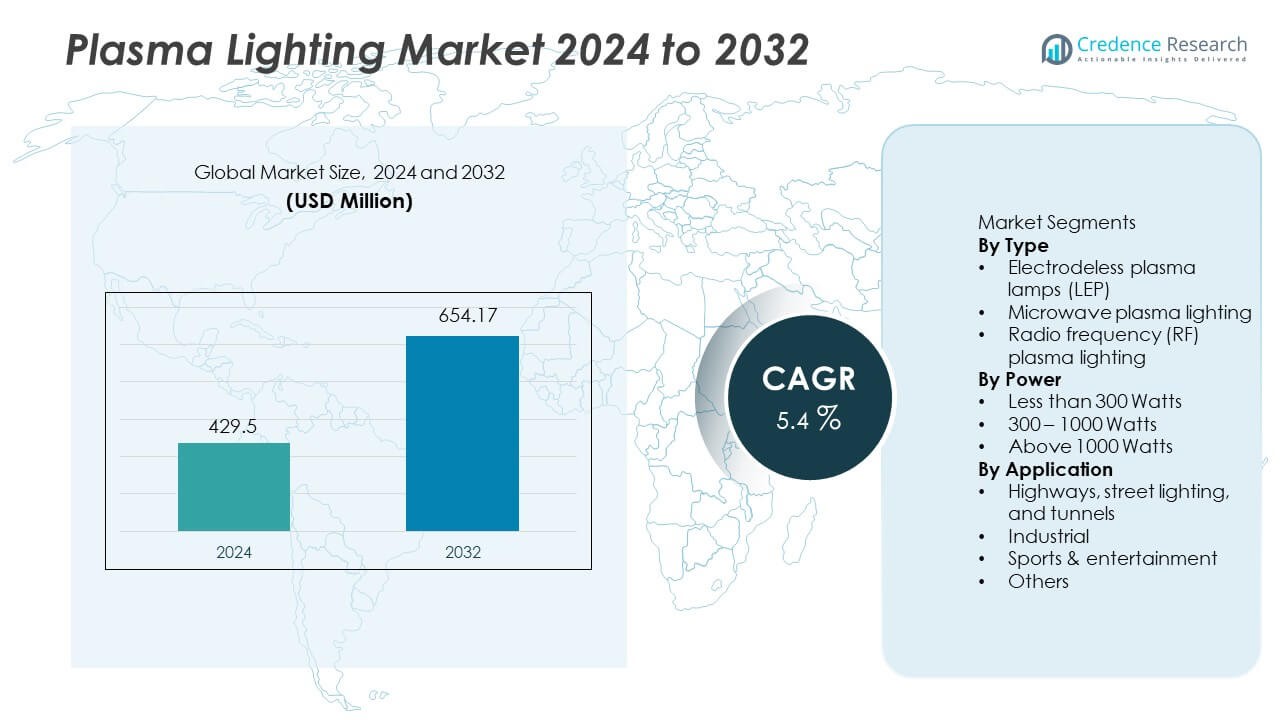
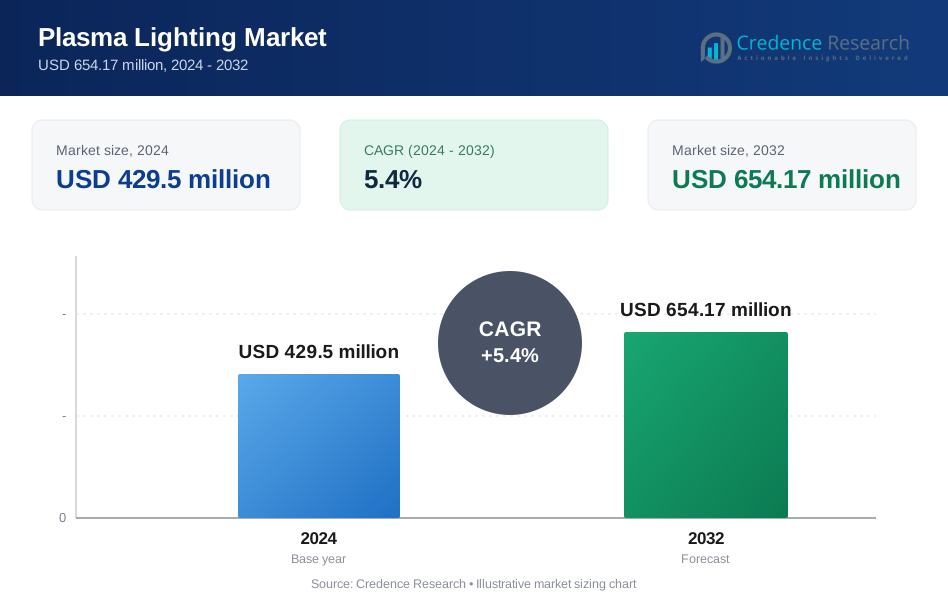
The Plasma Lighting Market was valued at USD 429.5 million in 2024 and is projected to reach USD 654.17 million by 2032, registering a CAGR of 5.4% during the forecast period.
| REPORT ATTRIBUTE | DETAILS |
|---|---|
| Historical Period | 2020-2023 |
| Base Year | 2024 |
| Forecast Period | 2025-2032 |
| Plasma Lighting Market Size 2024 | USD 429.5 Million |
| Plasma Lighting Market, CAGR | 5.4% |
| Plasma Lighting Market Size 2032 | USD 654.17 Million |
Top players in the Plasma Lighting market include Hive Lighting, Solaronix, Topanga USA, Ceravision, Plasma International, Ushio Lighting, Luxim Corporation, Gavita Holland, Ka Shui International, and M B Tech. These manufacturers focus on high-intensity illumination systems that support smart city lighting, industrial operations, and large-area outdoor applications. Asia Pacific leads the market with a 33% share, driven by rapid urban development and growing investments in transportation infrastructure across China and India. North America follows with a 30% share, supported by tunnel and roadway upgrades, while Europe holds a 27% share due to strong sustainability programs and infrastructure modernization across major economies.
Market Insights
- The Plasma Lighting market reached USD 429.5 million in 2024 and will reach USD 654.17 million by 2032 at a CAGR of 5.4% during the forecast period.
- Infrastructure growth and rising need for energy-efficient outdoor lighting drive steady adoption, with Electrodeless plasma lamps holding a 46% share supported by strong illumination and long operating life in public lighting and industrial settings.
- Market trends show increased use of smart controls, remote monitoring, and long-life plasma discharge technologies that support industrial modernization and advanced urban lighting systems across developing regions.
- Competitive activity focuses on high-intensity platforms, microwave and RF systems, and heat-resistant components, while high initial investment and competition from LED technologies remain primary restraints in cost-sensitive applications.
- Asia Pacific leads regional demand with a 33% share, followed by North America at 30% and Europe at 27%, supported by smart transportation projects and large-scale outdoor lighting programs across highways, tunnels, and industrial corridors.
Market Segmentation Analysis:
By Type
Electrodeless plasma lamps lead this segment with a 46% share, supported by energy efficiency and long operating life across industrial and outdoor lighting applications. These lamps deliver high lumen output and stable performance for continuous lighting needs in large outdoor spaces. Microwave plasma lighting follows due to strong adoption in high-power settings that require reliable brightness and reduced maintenance cycles. Radio frequency plasma lighting serves niche applications where specific frequency control and illumination quality matter. Growing demand for advanced lighting in infrastructure and urban projects strengthens preference for electrodeless systems with lower operating cost.
- For instance, Luxim’s STA 41-02 LEP (light-emitting plasma) lamp produces a large quantity of lumens and runs for tens of thousands of hours - making it suited for high-intensity applications such as street lights and large parking-lot luminaires.
By Power
The 300–1000 Watts category holds a 49% share, driven by strong demand in medium to large-scale industrial lighting, public infrastructure, and commercial facilities. These systems offer balanced illumination intensity while controlling power consumption in long-duration operating environments. Lower wattage products support smaller installations such as street corridors or compact industrial sites. Above 1000 Watt plasma lighting serves specialized heavy-duty environments, stadiums, and industrial yards with large area coverage. Demand increases as public authorities adopt efficient mid-power lighting to reduce maintenance cycles and improve energy performance in urban infrastructure programs.
- For instance, Ceravision’s ionCORE plasma luminaires scale from 100 Watts up to 5,000 Watts, enabling coverage of large stadiums and industrial yards with a single lamp.
By Application
Highways, street lighting, and tunnels represent the largest application with a 48% share, supported by government investments in smart urban lighting and roadway safety enhancements. Plasma lighting delivers high intensity and long-distance visibility that supports safe night-time driving conditions. Industrial installations follow due to large area coverage needs and heat-resistant lighting in production zones. Sports and entertainment applications require high lumen density and uniform illumination during events and broadcasts. Adoption grows as municipalities upgrade public lighting networks and integrate energy-efficient plasma systems for outdoor and transit infrastructure across many developing regions.
 Key Growth Drivers
Rising Demand for Energy-Efficient High-Intensity Lighting
Demand for energy-efficient illumination grows as governments promote low-carbon lighting solutions. Plasma lighting provides strong lumen output and long service life for highways, tunnels, and industrial environments. These systems help reduce electricity use and maintenance cost in long-running applications. Infrastructure upgrades across developing regions drive new installations in public lighting. Industries adopt plasma due to high brightness and reduced heat load in heavy-duty settings. Rising energy prices support adoption of cost-saving illumination across outdoor and commercial spaces.
- For instance, Gavita Holland reports plasma fixtures delivering a particular photon efficacy in controlled horticulture applications, supporting reduced thermal load in sealed grow rooms.
Infrastructure Development and Urban Expansion Projects
Growing infrastructure programs expand street lighting and tunnel illumination needs. Smart city initiatives promote advanced outdoor lighting with remote control and performance monitoring. Road safety regulations drive replacement of older lamps with high-intensity plasma units. New expressways, metro networks, and transportation corridors support installation growth. Government investments in public lighting projects open wider demand for durable high-output systems. Urban expansion across Asia and the Middle East strengthens long-term opportunities for plasma lighting providers.
- For instance, Ushio Lighting highlights high intensity discharge lamps with a high color temperature, providing high-visibility lighting suitable for large outdoor areas and industrial settings.
Expanding Adoption in Industrial and Sports Arenas
Industrial facilities adopt plasma lighting for long duty cycles, heat resistance, and large area coverage. Sports and stadiums require uniform illumination and high lumen density for professional events and broadcasting needs. Plasma lighting enables clear visibility with reduced glare, supporting player and audience safety. Industrial users shift from conventional high-pressure lamps to plasma solutions that reduce replacement intervals and maintenance shutdowns. Growth in entertainment venues and outdoor event infrastructure encourages adoption of high-output lighting platforms.
Key Trends and Opportunities
Integration of Smart Controls and Remote Monitoring
Plasma lighting integrates intelligent control systems that support remote operation, dimming, and performance tracking. Smart monitoring improves energy usage and manages maintenance through predictive analytics. Municipalities adopt connected lighting to support smart city standards and traffic safety. Vendors develop digital platforms that optimize illumination and extend component life. This trend creates new opportunities for service-based lighting models across urban areas.
- For instance, Topanga USA developed plasma fixtures using RF drivers that had control capabilities, allowing for light level adjustments while having potential for good lumen maintenance over a significant number of operating hours.
Replacement of Aging HID and High-Pressure Lamps
Many regions still rely on aging HID lamps in public lighting networks. Plasma lighting offers a long-life alternative that reduces operational cost and downtime. Government initiatives for sustainable lighting accelerate replacement of high-pressure sodium and metal halide systems. Sports facilities and industrial units adopt plasma solutions to enhance brightness and visibility. Replacement-driven demand supports steady adoption across developing markets.
- For instance, Solaronix plasma light sources provide a sun-like continuous light spectrum that can achieve Class A ratings under relevant testing standards, with an outstanding service life of many thousands of hours.
Key Challenges
High Initial Investment and Cost Competitiveness
Plasma lighting requires higher upfront investment compared to traditional lamps. Small municipalities and cost-sensitive industries face barriers to adoption. LED systems also compete on cost, energy saving, and standard availability. These factors limit plasma penetration in price-competitive segments. Vendors need to demonstrate lifetime savings and maintenance benefits to justify adoption.
Growing Competition from LED Technologies
LED lighting continues to advance in brightness, efficiency, and durability. Many applications shift from plasma to LED due to lower cost and wider product availability. Continuous LED innovation challenges plasma vendors to differentiate based on performance. Competitive pressure pushes plasma manufacturers to enhance system efficiency and reduce power consumption across large-area installations.
Regional Analysis
North America
North America holds a 30% share, driven by early adoption of energy-efficient lighting in highways, tunnels, and industrial facilities. The United States invests in smart transportation systems that require high-intensity and low-maintenance illumination. Public agencies replace older HID lamps with plasma solutions to reduce operational cost and improve visibility. Industrial plants adopt plasma lighting for large-area coverage and heat resistance in long duty cycles. Municipal sustainability programs encourage wider adoption in public lighting networks. Demand also grows in sports venues that require high lumen density and uniform visibility for professional events.
Europe
Europe accounts for a 27% share, supported by strict energy regulations and sustainability policies that favor long-life lighting systems. Countries including Germany, France, and the United Kingdom invest in advanced outdoor and road illumination. Plasma lighting adoption rises in major expressways and tunnel projects that require strong brightness and heat stability. The region’s strong industrial base supports installation in warehouses, processing plants, and logistics facilities. Replacement of high-pressure sodium lamps continues under energy-saving initiatives. Infrastructure modernization in Eastern Europe also contributes to market expansion for durable plasma lighting systems.
Asia Pacific
Asia Pacific leads the market with a 33% share, driven by rapid urbanization, expanding road networks, and large-scale construction projects. China and India continue to deploy plasma lighting in highways, flyovers, and public infrastructure. Industrial growth across Southeast Asia supports adoption in factories and logistics hubs. Increased focus on operational efficiency encourages replacement of conventional lamps in commercial spaces. Sports and entertainment venues also invest in high-intensity plasma systems for stadiums and outdoor events. Government initiatives promoting efficient public lighting strengthen long-term demand across developing markets.
Latin America
Latin America represents an 8% share, supported by expanding urban infrastructure and improved road safety programs in Brazil and Mexico. Public authorities adopt high-intensity lighting for tunnels and highways where durability and low maintenance matter. Industrial users adopt plasma solutions for large warehouses, mining sites, and heavy-duty outdoor zones. Stadium upgrades and commercial construction support selective adoption in metropolitan areas. However, budget constraints slow replacement of older HID systems across smaller municipalities. Gradual infrastructure modernization and rising energy costs encourage long-term investment in efficient lighting.
Middle East and Africa
Middle East and Africa hold a 2% share, driven by focused installation in high-temperature industrial zones, oil and gas projects, and outdoor facilities. Gulf infrastructure development supports demand for long-life lighting in tunnels, highways, and ports. Large international sports events in the Middle East also favor high-intensity illumination for stadiums. Africa sees limited penetration due to cost sensitivity and slower infrastructure development. However, improving urban networks and industry activity in countries such as South Africa support gradual growth for advanced lighting systems across selected regions.
Market Segmentations:
By Type
- Electrodeless plasma lamps (LEP)
- Microwave plasma lighting
- Radio frequency (RF) plasma lighting
By Power
- Less than 300 Watts
- 300 – 1000 Watts
- Above 1000 Watts
By Application
- Highways, street lighting, and tunnels
- Industrial
- Sports & entertainment
- Others
By Geography
- North America
- U.S.
- Canada
- Mexico
- Europe
- Germany
- France
- U.K.
- Italy
- Spain
- Rest of Europe
- Asia Pacific
- China
- Japan
- India
- South Korea
- South-east Asia
- Rest of Asia Pacific
- Latin America
- Brazil
- Argentina
- Rest of Latin America
- Middle East & Africa
- GCC Countries
- South Africa
- Rest of the Middle East and Africa
Competitive Landscape
Competitive landscape in the Plasma Lighting market features key companies such as Hive Lighting, Solaronix, Topanga USA, Ceravision, Plasma International, Ushio Lighting, Luxim Corporation, Gavita Holland, Ka Shui International, and M B Tech. Leading players focus on high-intensity plasma solutions that deliver strong lumen output, durability, and long service life in outdoor and industrial settings. Many companies invest in advanced plasma discharge technologies, microwave and RF platforms, and heat-resistant components that support long operating cycles in tunnels, stadiums, and heavy-duty industrial areas. Vendors also expand smart control capabilities and remote monitoring systems to improve energy performance and lower maintenance requirements. Strategic partnerships with infrastructure and industrial developers drive adoption across smart cities and transportation projects. Continuous pressure from LED technologies motivates manufacturers to improve efficiency, reduce cost, and expand application suitability across global markets.
Key Player Analysis
- Hive Lighting
- Solaronix
- Topanga USA
- Ceravision
- Plasma International
- Ushio Lighting
- Luxim Corporation
- Gavita Holland
- Ka Shui International
- M B Tech
Recent Developments
- In January 2024, Excelitas Technologies Corp. announced that it had acquired the Noblelight business from Heraeus Group, a Germany-based technology company. Noblelight provides infrared and ultraviolet (IR/UV) light solutions for industrial, scientific, and medical applications.
- In December 2023 Lumartix developed a solar simulator that allows performing aging, characterization as well as stabilization tests. The simulator was dubbed as Solixon, which has features for solar simulation and light soaking. The Solixon devices use Lumartix plasma light engine as alternative Xenon arc lamp technology which is said to be low maintenance.
- In December 2023, Ushio Inc. and TNO, a Dutch research and technology organization, further consolidated their relationship with a new agreement aimed at maintenance and partnership over a five-year period. Ushio provided TNO with a high-intensity EUV light source for use in TNO’s EBL2 facility.
Report Coverage
The research report offers an in-depth analysis based on Type, Power, Application and Geography. It details leading market players, providing an overview of their business, product offerings, investments, revenue streams, and key applications. Additionally, the report includes insights into the competitive environment, SWOT analysis, current market trends, as well as the primary drivers and constraints. Furthermore, it discusses various factors that have driven market expansion in recent years. The report also explores market dynamics, regulatory scenarios, and technological advancements that are shaping the industry. It assesses the impact of external factors and global economic changes on market growth. Lastly, it provides strategic recommendations for new entrants and established companies to navigate the complexities of the market.
Future Outlook
- Future demand will rise due to growing infrastructure lighting projects.
- Outdoor and highway lighting will expand as urban networks increase.
- Mid-power systems will grow in industrial and commercial applications.
- High-intensity platforms will gain use in stadiums and event venues.
- Smart monitoring and control systems will support energy management.
- Replacement of HID lamps will continue in public lighting networks.
- Plasma technology will focus on longer operating life and heat resistance.
- Cost reduction initiatives will improve market penetration in new regions.
- Integration with smart city platforms will open additional opportunities.
- Competition from LED technologies will drive performance upgrades.
Request a Free Sample
Fill in your details and we'll send you a free sample report.
- Sample data tables & charts
- Research methodology
Need a Custom Version of This Report?
Tailor the scope, geography, or segments to your exact requirements.
- Custom geography or segment scope
- Direct access to our analyst team
Frequently Asked Questions
What is the current market size for the Plasma Lighting market, and what is its projected size in 2032?
At what Compound Annual Growth Rate is the Plasma Lighting market projected to grow between 2024 and 2032?
Which Plasma Lighting market segment held the largest share in 2024?
What are the primary factors fueling the growth of the Plasma Lighting market?
Who are the leading companies in the Plasma Lighting market?
Which region commanded the largest share of the Plasma Lighting market in 2024?
Table of Content
Chapter 1. Report Introduction
- 1.1 Report Description & Purpose
- 1.1.1 Report Title & Market Definition
- 1.1.2 Unique Selling Propositions (USP) & Key Differentiators
- 1.1.3 Value Proposition for Stakeholders
- 1.2 Research Objectives
- 1.2.1 Market Sizing Objectives (Volume & Revenue)
- 1.2.2 Segmentation Objectives
- 1.2.3 Competitive Intelligence Objectives
- 1.2.4 Forecast & Scenario Objectives
- 1.3 Report Scope
- 1.3.1 Plasma Lighting Scope – Types & Subtypes Covered
- 1.3.2 Geographic Scope – Regions & Countries Covered
- 1.3.3 Historical Period, Base Year & Forecast Period (2024; forecast to 2032)
- 1.3.4 Inclusions & Exclusions
- 1.4 HS Code & Classification Framework
- 1.5 Currency, Units & Pricing Basis
- 1.6 Target Stakeholders
- 1.7 Limitations & Assumptions
Chapter 2. Executive Summary
- 2.1 Global Plasma Lighting Market Snapshot
- 2.1.1 Market Size – Historical (2024) & Forecast (2024-2032) (2024: USD 429.5 million → 2032: USD 654.17 million)
- 2.1.2 Volume & Revenue – Global Totals
- 2.1.3 Key Market Highlights – Top Five Facts
- 2.2 Plasma Lighting Market Segmentation Snapshot
- 2.2.1 Market Split by Region – 2024 vs. 2032
- 2.3 Competitive Snapshot
- 2.3.1 Top 10 Players by Revenue Share – 2024
- 2.3.2 Top 10 Players by Volume Share – 2024
- 2.3.3 Recent Strategic Developments (18-Month Summary)
- 2.4 Key Investment Highlights & Strategic Conclusions
Chapter 3. Plasma Lighting Market Dynamics & Industry Analysis
- 3.1 Market Overview & Context
- 3.1.1 Plasma Lighting Market Position in the Broader Automotive Value Chain
- 3.1.2 OEM vs. Replacement Market Dynamics
- 3.1.3 Market Maturity & Development Stage by Region
- 3.2 Plasma Lighting Market Drivers
- 3.3 Plasma Lighting Market Restraints & Challenges
- 3.4 Plasma Lighting Market Opportunities
- 3.5 Porter's Five Forces Analysis
- 3.5.1 Threat of New Entrants
- 3.5.2 Bargaining Power of Suppliers
- 3.5.3 Bargaining Power of Buyers
- 3.5.4 Threat of Substitutes
- 3.5.5 Competitive Rivalry – Intensity Assessment
- 3.6 Plasma Lighting Value Chain Analysis
- 3.6.1 Upstream – Raw Material/Input Suppliers
- 3.6.1.1 Raw Material/Input 1
- 3.6.1.2 Raw Material/Input 2
- 3.6.1.3 Raw Material/Input 3
- 3.6.2 Midstream – Production/Manufacturing/Service Delivery
- 3.6.2.1 Production/Process Overview
- 3.6.2.2 Key Facility Locations & Capacity by Manufacturer
- 3.6.3 Downstream – Distribution & End Consumer
- 3.6.3.1 Primary Channel – B2B/OEM
- 3.6.3.2 Secondary Channels – Dealer, Retail, Online, Direct
- 3.6.4 Value Chain Profitability Analysis
- 3.6.1 Upstream – Raw Material/Input Suppliers
- 3.7 PESTEL Analysis
- 3.7.1 Political Factors
- 3.7.2 Economic Factors
- 3.7.3 Social Factors
- 3.7.4 Technological Factors
- 3.7.5 Environmental Factors
- 3.7.6 Legal Factors
- 3.8 Plasma Lighting Supply Chain Analysis
- 3.8.1 Raw Material/Input Supply Risk Assessment
- 3.8.2 Manufacturing Concentration Risk (Geographic Exposure)
- 3.8.3 Trade Disruption Impact Analysis
- 3.9 Regulatory & Policy Landscape
Note: The regulatory and policy landscape section covers regulations based on their applicability to the market, Plasma Lighting category, geography, and scope of the study. Only regulatory frameworks with a material impact on operations, compliance, trade, sustainability, or market access are analyzed in detail.
Chapter 4. Key Investment Pockets & Opportunity Analysis
- 4.1 Plasma Lighting Market Attractiveness Analysis
- 4.1.1 By Region – Investment Attractiveness Matrix (Volume × CAGR)
- 4.2 Absolute Revenue Growth Opportunity
- 4.2.1 By Region – Absolute USD Growth Through 2032
- 4.3 Incremental Volume Opportunity
- 4.3.1 By Region – Incremental Volume Through 2032
- 4.3.2 Segment – Incremental Volume
- 4.4 Emerging Submarket Opportunity Deep Dive (Subject to Applicability)
- 4.5 Emerging Market Opportunity Scorecards
- 4.5.1 United States
- 4.5.2 Europe
- 4.5.3 Asia
- 4.5.4 Middle East & Africa
Note: Emerging Market Opportunity Scorecards will be included based on relevance and strategic importance. Regions listed are indicative and may vary depending on data availability and market dynamics.
Chapter 5. Plasma Lighting Import-Export Analysis & Trade Flows
- 5.1 Global Trade Overview
- 5.1.1 Global Export Value by Country (2024)
- 5.1.2 Global Export Volume by Country (2024)
- 5.1.3 Global Import Value by Country (2024)
- 5.1.4 Global Import Volume by Country (2024)
- 5.1.5 Net Trade Balance by Country (2024)
- 5.2 Export Analysis – Segment
- 5.2.1 Type 1 (HS Code)
- 5.2.2 Type 2 (HS Code)
- 5.2.3 Type 3 (HS Code)
- 5.2.4 Type 4 (HS Code)
- 5.2.5 Type 5 (HS Code)
- 5.3 Import Analysis – Segment
- 5.3.1 Type 1 (HS Code)
- 5.3.2 Type 2 (HS Code)
- 5.3.3 Type 3 (HS Code)
- 5.3.4 Type 4 (HS Code)
- 5.3.5 Type 5 (HS Code)
- 5.4 Average Unit Trade Prices
- 5.4.1 Average Export Price – Segment & Country
- 5.4.2 Average Import Price – Segment & Source Country
- 5.4.3 Price Trends (2024)
- 5.5 Key Trade Route Analysis
- 5.5.1 Trade Route 1
- 5.5.2 Trade Route 2
- 5.5.3 Trade Route 3
- 5.5.4 Trade Route 4
- 5.5.5 Trade Route 5
- 5.6 Trade Policy Impact Assessment
- 5.6.1 US Anti-Dumping & Section 301 Tariffs
- 5.6.2 EU Customs Union Impact
- 5.6.3 Major Free Trade Agreements
- 5.6.4 USMCA Rules of Origin
Note: Trade policy analysis will be included only where relevant to the Plasma Lighting market.
Chapter 6. Competitive Landscape & Company Benchmarking
- 6.1 Plasma Lighting Market Concentration & Structure
- 6.1.1 Herfindahl-Hirschman Index (HHI) – vs. 2024
- 6.1.2 Tier 1, Tier 2 & Tier 3 Market Structure
- 6.1.3 Global, Regional & Local Player Dynamics
- 6.2 Plasma Lighting Market Share Analysis – 2024
- 6.2.1 Global Revenue Share by Company
- 6.2.2 Global Volume Share by Company
- 6.2.3 Regional Revenue Share
- 6.2.4 Market Share Evolution ( vs. 2024)
- 6.2.5 OEM Segment Share by Company
- 6.2.6 Replacement Segment Share by Company
- 6.3 Production/Delivery Capacity & Facility Analysis
- 6.3.1 Global Installed Capacity
- 6.3.2 Capacity Utilization Rates
- 6.3.3 Production/Output Volume
- 6.3.4 Facility Locations & Capacity Map
- 6.3.5 Planned Capacity Additions
- 6.4 Plasma Lighting Competitive Benchmarking Matrix
- 6.4.1 Revenue, Volume, CAGR & Profitability Comparison
- 6.4.2 Channel Revenue Mix
- 6.4.3 Geographic Revenue Exposure
- 6.4.4 R&D Intensity
- 6.4.5 Sustainability Maturity
- 6.5 Strategic Developments in Plasma Lighting (Last 24 Months)
- 6.5.1 Mergers, Acquisitions & Divestments
- 6.5.2 New Plasma Lighting Launches
- 6.5.3 Facility Expansions
- 6.5.4 Strategic Alliances, Joint Ventures & Partnerships
- 6.5.5 Distribution Expansion & Market Entry
- 6.5.6 Sustainability & ESG Initiatives
- 6.6 Competitive Strategy Mapping
- 6.6.1 Leader, Challenger, Follower & Niche Classification
- 6.6.2 Pricing Strategy Comparison
- 6.6.3 Channel Strategy Matrix
Note: Strategic developments are included based on their materiality and the availability of reliable information.
Chapter 7. Global Plasma Lighting Market – By Distribution Channel
- 7.1 Segment Overview
- 7.1.1 Volume & Revenue Split by Channel (2024 & 2032)
- 7.1.2 Channel Mix Evolution (2024-2032)
Chapter 8. Regional Market Analysis – Global Overview
- 8.1 Global Regional Overview
- 8.1.1 Regional Volume Share
- 8.1.2 Regional Revenue Share
- 8.1.3 Regional Volume by Region
- 8.1.4 Regional Revenue by Region
- 8.1.5 Regional Forecast Through 2032
- 8.2 Cross-Regional Segment Analysis
- 8.2.1 By Distribution Channel
- 8.2.2 By Brand/Price Tier
Chapter 9. North America Plasma Lighting Market
- 9.1 United States
- 9.2 Canada
- 9.3 Mexico
Chapter 10. Europe Plasma Lighting Market
- 10.1 Germany
- 10.2 France
- 10.3 Italy
- 10.4 United Kingdom
- 10.5 Spain
- 10.6 Poland
- 10.7 Russia
- 10.8 Netherlands
- 10.9 Belgium
- 10.10 Sweden
- 10.11 Denmark
- 10.12 Norway
- 10.13 Rest of Europe
Chapter 11. Asia Pacific Plasma Lighting Market
- 11.1 China
- 11.2 India
- 11.3 Japan
- 11.4 South Korea
- 11.5 Thailand
- 11.6 Indonesia
- 11.7 Vietnam
- 11.8 Malaysia
- 11.9 Australia
- 11.10 Rest of Asia Pacific
Chapter 12. Latin America Plasma Lighting Market
- 12.1 Brazil
- 12.2 Argentina
- 12.3 Colombia
- 12.4 Chile
- 12.5 Rest of Latin America
Chapter 13. Middle East Plasma Lighting Market
- 13.1 Saudi Arabia
- 13.2 United Arab Emirates
- 13.3 Turkey
- 13.4 Israel
- 13.5 Iran
- 13.6 Rest of the Middle East
Chapter 14. Africa Plasma Lighting Market
- 14.1 South Africa
- 14.2 Egypt
- 14.3 Nigeria
- 14.4 Morocco
- 14.5 Rest of Africa
Chapter 15. Plasma Lighting Company Profiles
- 15.1 [Company 01]
- 15.1.1 Company Overview
- 15.1.2 Key Management Personnel
- 15.1.3 Products & Services Portfolio
- 15.1.4 Financial Performance
- 15.1.5 Key Market Focus & Geographic Presence
- 15.1.6 Recent Developments & Strategic Initiatives
Note: The company profile list is preliminary and may change based on research findings, market developments, data availability, and client requirements.
Chapter 16. Appendices
- Appendix A – List of Abbreviations & Acronyms
- Appendix B – Industry Classification Code Reference – Full Series
- Appendix C – Production & Capacity Data Tables
- Appendix D – End-Use & Demand Base Tables
- Appendix E – Consumption & Replacement Rate Assumptions
- Appendix F – ASP Reference Tables
- Appendix G – Manufacturing & Facility Database
- Appendix H – Import-Export Data Tables
- Appendix I – Regulatory Summary Tables
- Appendix J – Primary Research Participant List (Anonymized)
- Appendix K – Primary Research Questionnaire Framework
- Appendix L – Data Sources & Bibliography
- Appendix M – Market Size Divergence & Source Comparison
Chapter 17. Research Methodology
- 17.1 Research Framework & Philosophy
- 17.2 Secondary Research – Sources, Hierarchy & Data Extraction
- 17.3 Data Modeling – Bottom-Up & Top-Down Market Sizing
- 17.4 Primary Research – Stakeholder Framework, LOI & Sample Sizes
- 17.5 Forecast Methodology – Regression, Scenario & Sensitivity Analysis
- 17.6 Quality Control – Four-Layer Validation Framework
- 17.7 Limitations & Standard Assumptions
- 17.8 Disclaimer
