
Mobile Data Terminals (MDT) Sales Market Overview:
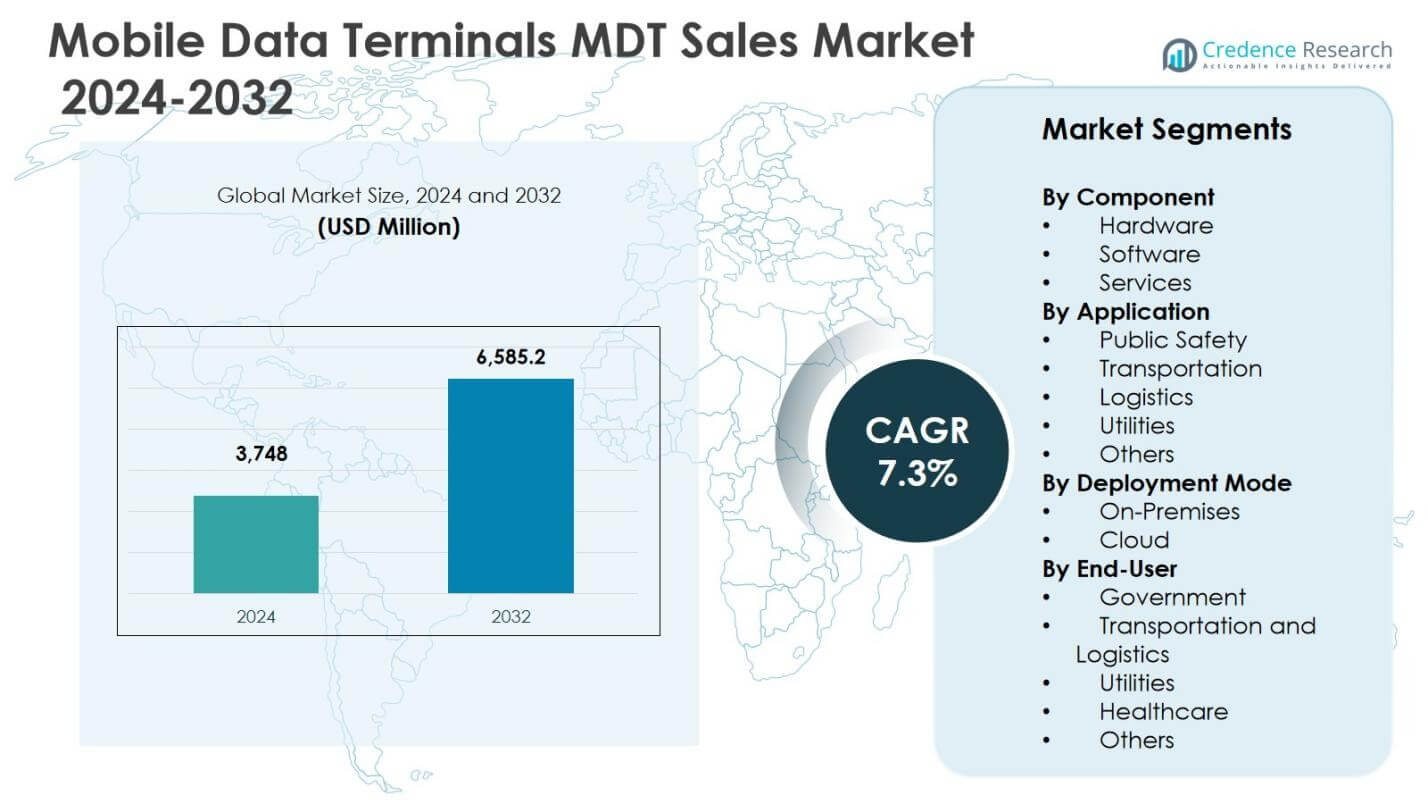
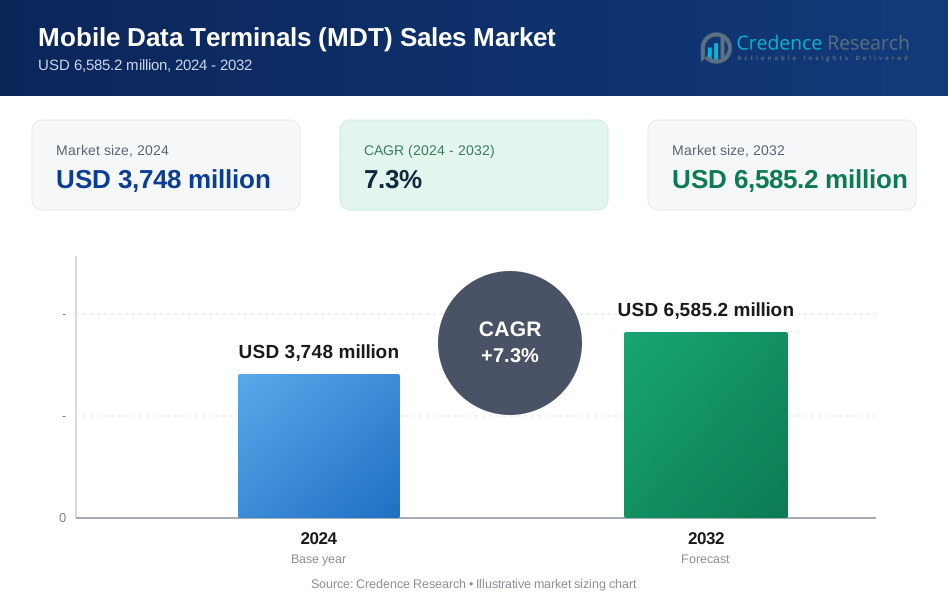
The Mobile Data Terminals (MDT) Sales Market size was valued at USD 3,748 million in 2024 and is anticipated to reach USD 6,585.2 million by 2032, growing at a CAGR of 7.3% during the forecast period.
| REPORT ATTRIBUTE | DETAILS |
|---|---|
| Historical Period | 2020-2023 |
| Base Year | 2024 |
| Forecast Period | 2025-2032 |
| Mobile Data Terminals (MDT) Sales Market Size 2024 | USD 3,748 million |
| Mobile Data Terminals (MDT) Sales Market, CAGR | 7.3% |
| Mobile Data Terminals (MDT) Sales Market Size 2032 | USD 6,585.2 million |
Mobile Data Terminals (MDT) Sales Market Insights
- Market growth is driven by increasing adoption of digital public safety systems, expansion of fleet management solutions, and rising demand for ruggedized, mission-critical computing devices used in real-time operations.
- Key market trends include growing integration of cloud-based MDT platforms, advanced analytics, and telematics, while hardware remains the leading segment with 6% share in 2024, followed by software at 29.4% and services at 18.0%.
- Market structure is shaped by strong focus on durable hardware innovation, system interoperability, cybersecurity features, and long-term deployments across government and commercial fleets.
- Regionally, North America led with 38.4% share, followed by Europe at 27.2%, Asia Pacific at 22.1%, Latin America at 7.1%, and Middle East & Africa at 5.2%, reflecting varied levels of digital infrastructure maturity.
Mobile Data Terminals (MDT) Sales Market Segmentation Analysis:
By Component:
The Mobile Data Terminals (MDT) Sales Market by component is led by the hardware segment, which accounted for 52.6% of the total market share in 2024, driven by sustained demand for ruggedized terminals, in-vehicle displays, and handheld MDT devices across mission-critical operations. Hardware dominance reflects continuous fleet expansion by public safety agencies, logistics operators, and transportation authorities requiring durable, high-performance devices. The software segment held 29.4% share, supported by growing adoption of fleet management, dispatch, and real-time communication platforms, while services represented 18.0%, driven by installation, maintenance, and system integration requirements.
- For instance, Greater Manchester Fire and Rescue Service deployed 143 Panasonic TOUGHBOOK 33 rugged tablets across 93 vehicles as fixed in-cab MDTs and demountable units, integrating with MODAS software for real-time incident data access and crew safety.
By Application:
By application, public safety emerged as the dominant segment with a 34.8% market share in 2024, supported by widespread MDT deployment across police, fire, and emergency medical services for real-time data access, incident reporting, and situational awareness. Governments’ continued investment in smart policing and emergency response infrastructure remains the primary driver. Transportation accounted for 27.1% share, fueled by transit modernization and connected fleet initiatives, while logistics held 22.6%, driven by route optimization and tracking needs. Utilities and other applications collectively captured 15.5%, supported by field service digitalization.
- For instance, Frisco Police Department deployed Getac F110 rugged tablets as MDTs in patrol cars, enabling reliable in-car access to data amid high vibration and tough conditions.
By Deployment Mode:
The on-premises deployment mode dominated the market with a 58.9% share in 2024, reflecting strong preference among public safety, utilities, and government users for enhanced data security, system control, and regulatory compliance. On-premises MDT solutions remain critical for latency-sensitive and mission-critical operations. However, cloud-based deployment captured 41.1% share, supported by scalability, lower infrastructure costs, and improved integration with advanced analytics and fleet management platforms. Increasing adoption of cloud MDTs among logistics and transportation operators continues to strengthen growth prospects across this segment.
Key Growth Drivers
Rising Adoption of Digital Public Safety Infrastructure
The Mobile Data Terminals (MDT) Sales Market is strongly driven by increasing investments in digital public safety infrastructure across developed and emerging economies. Law enforcement agencies, fire departments, and emergency medical services continue to deploy MDTs to enable real-time access to dispatch data, incident reports, criminal databases, and navigation systems. Governments are prioritizing connected emergency response frameworks to improve response time, situational awareness, and operational transparency. This driver is further reinforced by national smart city programs and modernization initiatives that mandate the use of secure, in-vehicle computing platforms for frontline responders.
- For instance, Leicestershire Fire and Rescue Service uses MDTs over a 4G network for two-way crew-control room communication, delivering incident updates, status messages, and live vehicle tracking en route to emergencies
Expansion of Fleet Management and Logistics Digitization
Rapid growth in commercial fleet operations is a key driver supporting MDT adoption across transportation and logistics sectors. Logistics operators increasingly rely on MDTs for route optimization, electronic logging, asset tracking, and driver communication. The expansion of e-commerce, last-mile delivery networks, and cold-chain logistics has accelerated demand for reliable in-vehicle data terminals that integrate with fleet management systems. MDTs help reduce operational inefficiencies, improve fuel utilization, and ensure regulatory compliance, making them a core component of modern fleet digitalization strategies.
- For instance, Ryder equips fleets with MDTs featuring electronic logging devices (ELDs) and telematics for power units and trailers. These enable real-time engine data recording, hours-of-service compliance, and fuel performance monitoring to enhance driver safety and operational efficiency.
Increasing Demand for Ruggedized and Mission-Critical Computing
Demand for ruggedized computing solutions is a significant growth driver in the MDT Sales Market. Industries such as utilities, transportation, mining, and public services require devices capable of operating under harsh environmental conditions, including extreme temperatures, vibration, and dust exposure. MDTs are specifically designed to meet these operational requirements while ensuring uninterrupted connectivity and system reliability. Ongoing technological advancements in processing power, display clarity, and wireless connectivity further strengthen adoption across mission-critical environments where device failure is not acceptable.
Key Trends & Opportunities
Integration of Cloud Platforms and Advanced Analytics
A major trend shaping the MDT Sales Market is the growing integration of cloud platforms and advanced analytics capabilities. Organizations are increasingly deploying cloud-connected MDTs to enable real-time data synchronization, predictive maintenance, and centralized fleet monitoring. This trend creates opportunities for vendors to offer value-added software layers, analytics dashboards, and AI-enabled insights that enhance decision-making. Cloud integration also supports scalability and remote system updates, making MDT solutions more attractive to logistics operators and transportation agencies with large, geographically dispersed fleets.
- For instance, Walmart transitioned to cloud-based logistics in 2024, deploying MDTs for real-time inventory synchronization across stores and warehouses. Dispatchers use analytics dashboards for demand-responsive fleet adjustments.
Growing Adoption in Smart Transportation and Utilities
The expansion of smart transportation systems and digital utility operations presents strong growth opportunities for the MDT market. Public transit authorities are deploying MDTs for real-time vehicle tracking, passenger information systems, and driver communication. Similarly, utilities are adopting MDTs for field workforce management, outage response coordination, and asset inspection activities. These applications benefit from improved data accuracy, faster response times, and enhanced workforce productivity, creating sustained demand for MDT solutions across non-traditional public safety sectors.
- For instance, DIMTS in Delhi implemented a Passenger Information System using GPS-enabled MDTs on four bus routes, displaying real-time locations and ETAs on 58 boards to reduce commuter wait anxiety.
Key Challenges
High Initial Deployment and Integration Costs
High upfront costs remain a key challenge for broader MDT adoption, particularly among small and mid-sized fleet operators. Expenses related to rugged hardware procurement, system integration, software licensing, and ongoing maintenance can create budget constraints. Additionally, integrating MDTs with legacy dispatch systems, fleet management platforms, and enterprise IT infrastructure increases implementation complexity. These cost and integration barriers may delay purchasing decisions, especially in cost-sensitive regions or industries with limited digital maturity.
Data Security and Connectivity Reliability Concerns
Ensuring data security and uninterrupted connectivity poses a significant challenge in the MDT Sales Market. MDTs handle sensitive operational and personal data, particularly in public safety and government applications, making them vulnerable to cyber threats if not properly secured. At the same time, reliable network connectivity remains a concern in remote or infrastructure-limited areas, potentially impacting real-time data transmission. Addressing cybersecurity risks and ensuring consistent network performance are critical requirements for sustained MDT adoption across mission-critical environments.
Regional Analysis
North America
North America accounted for 38.4% of the Mobile Data Terminals (MDT) Sales Market share in 2024, supported by widespread deployment across public safety agencies, transportation authorities, and large commercial fleets. Strong government funding for law enforcement modernization, advanced emergency response systems, and smart transportation infrastructure continues to drive adoption. The region benefits from high penetration of ruggedized computing, early adoption of cloud-integrated MDT platforms, and strong presence of leading technology providers. Growing demand from logistics and utilities for real-time fleet visibility and regulatory compliance further reinforces North America’s dominant position in the global market.
Europe
Europe held a 27.2% market share in 2024, driven by increasing investments in smart mobility, public transit digitalization, and cross-border logistics operations. Regulatory emphasis on road safety, emissions monitoring, and electronic logging has accelerated MDT adoption among transportation and logistics operators. Public safety agencies across Western and Northern Europe continue to upgrade in-vehicle communication systems to enhance response efficiency. Additionally, growing deployment of MDTs in utility field services and municipal operations supports regional growth. Technological maturity and strong integration of MDTs with fleet management platforms sustain Europe’s steady contribution to global revenues.
Asia Pacific
Asia Pacific captured a 22.1% share of the MDT Sales Market in 2024, reflecting rapid expansion of transportation networks, urbanization, and government-led smart city initiatives. Countries such as China, Japan, India, and South Korea are increasing investments in public safety modernization and logistics infrastructure. Rising e-commerce volumes and expanding commercial vehicle fleets are accelerating MDT deployment for route optimization and operational efficiency. Growing adoption by utilities and municipal service providers further supports demand. The region’s strong manufacturing base and increasing digitization of fleet operations position Asia Pacific as the fastest-growing regional market.
Latin America
Latin America accounted for 7.1% of the global market share in 2024, supported by gradual modernization of public transportation systems and increasing adoption of fleet management technologies. Governments are investing in public safety communication systems to improve emergency response and urban security. Logistics and distribution companies are deploying MDTs to enhance route planning and asset tracking amid expanding regional trade. While budget constraints limit large-scale deployments, growing awareness of operational efficiency benefits continues to drive adoption across transportation, utilities, and municipal services, supporting steady market growth across key Latin American economies.
Middle East & Africa
The Middle East & Africa region represented 5.2% of the MDT Sales Market share in 2024, driven by investments in smart city projects, transportation infrastructure, and public safety modernization. Gulf countries are adopting MDTs across law enforcement, emergency services, and public transit fleets to support real-time communication and operational efficiency. In Africa, growing deployment is observed in logistics, utilities, and government services as digital infrastructure improves. Although adoption remains uneven across countries, increasing focus on connected mobility and security solutions continues to strengthen regional demand for MDT systems.
Mobile Data Terminals (MDT) Sales Market Segmentations:
By Component
- Hardware
- Software
- Services
By Application
- Public Safety
- Transportation
- Logistics
- Utilities
- Others
By Deployment Mode
- On-Premises
- Cloud
By End-User
- Government
- Transportation and Logistics
- Utilities
- Healthcare
- Others
By Geography
- North America
- U.S.
- Canada
- Mexico
- Europe
- Germany
- France
- U.K.
- Italy
- Spain
- Rest of Europe
- Asia Pacific
- China
- Japan
- India
- South Korea
- South-east Asia
- Rest of Asia Pacific
- Latin America
- Brazil
- Argentina
- Rest of Latin America
- Middle East & Africa
- GCC Countries
- South Africa
- Rest of the Middle East and Africa
Competitive Landscape
Competitive landscape analysis of the Mobile Data Terminals (MDT) Sales Market includes key players such as Panasonic Corporation, Zebra Technologies Corporation, Honeywell International Inc., Datalogic S.p.A., Trimble Inc., Advantech Co., Ltd., Kontron AG, Motorola Solutions, Inc., L3Harris Technologies, Inc., and Micronet Ltd. The market is moderately consolidated, with leading players focusing on rugged hardware innovation, integrated software platforms, and long-term contracts with public safety and transportation agencies. Competition is driven by product durability, connectivity performance, system interoperability, and lifecycle support services. Major vendors leverage strong global distribution networks and partnerships with fleet management and public safety solution providers to strengthen market presence. Continuous investments in cloud-enabled MDTs, cybersecurity features, and AI-driven analytics are shaping competitive differentiation. Meanwhile, regional players compete through cost-effective offerings and customization for local regulatory requirements, intensifying competition across emerging markets.
Key Player Analysis
- Kontron AG
- Honeywell International Inc.
- Micronet Ltd.
- Motorola Solutions, Inc.
- Datalogic S.p.A.
- Trimble Inc.
- Panasonic Corporation
- Advantech Co., Ltd.
- L3Harris Technologies, Inc.
- Zebra Technologies Corporation
Recent Developments
- In March 2024, Panasonic Connect launched upgrades to its TOUGHBOOK G2 and TOUGHBOOK 33 detachable rugged tablets devices widely deployed as in-vehicle mobile data terminals (MDTs) for field, fleet, and public-safety workflows.
- In February 2024, Getac announced the AI-ready ZX80 fully rugged Android tablet, positioned for transportation and mobile workforce use cases that commonly rely on MDT-style deployments.
- In April 2025, Versaterm launched its next-generation user interface for the Versaterm Mobile Data Terminal (MDT) application, enhancing usability, real-time integration with its CAD system, and field data access for first responders to improve efficiency and safety.
Report Coverage
The research report offers an in-depth analysis based on Component, Application, Deployment mode, End User and Geography. It details leading market players, providing an overview of their business, product offerings, investments, revenue streams, and key applications. Additionally, the report includes insights into the competitive environment, SWOT analysis, current market trends, as well as the primary drivers and constraints. Furthermore, it discusses various factors that have driven market expansion in recent years. The report also explores market dynamics, regulatory scenarios, and technological advancements that are shaping the industry. It assesses the impact of external factors and global economic changes on market growth. Lastly, it provides strategic recommendations for new entrants and established companies to navigate the complexities of the market.
Future Outlook
- MDT adoption will increase across public safety agencies as governments prioritize real-time data access and faster emergency response.
- Transportation and logistics operators will expand MDT deployments to improve route optimization, compliance, and fleet efficiency.
- Cloud-based MDT solutions will gain stronger traction due to scalability, centralized management, and lower infrastructure complexity.
- Demand for ruggedized and high-performance MDT hardware will remain strong in mission-critical and harsh operating environments.
- Integration of MDTs with advanced analytics, AI, and telematics platforms will enhance operational decision-making.
- Smart city and intelligent transportation initiatives will create sustained long-term demand for MDT systems.
- Utilities and field service organizations will increasingly rely on MDTs for workforce coordination and asset management.
- Cybersecurity and data protection capabilities will become key purchase criteria for MDT buyers.
- Vendors will focus on modular and interoperable MDT solutions to support diverse fleet and application requirements.
- Emerging markets will contribute higher growth as digital fleet management adoption accelerates across commercial and government sectors.
Request a Free Sample
Fill in your details and we'll send you a free sample report.
- Sample data tables & charts
- Research methodology
Need a Custom Version of This Report?
Tailor the scope, geography, or segments to your exact requirements.
- Custom geography or segment scope
- Direct access to our analyst team
Frequently Asked Questions
What is the current market size for Mobile Data Terminals MDT Sales Market, and what is its projected size in 2032?
At what Compound Annual Growth Rate is the Mobile Data Terminals MDT Sales Market projected to grow between 2024 and 2032?
Which Mobile Data Terminals MDT Sales Market segment held the largest share in 2024?
What are the primary factors fueling the growth of the Mobile Data Terminals MDT Sales Market?
Who are the leading companies in the Mobile Data Terminals MDT Sales Market?
Which region commanded the largest share of the Mobile Data Terminals MDT Sales Market in 2024?
Table of Content
Chapter 1. Report Introduction
- 1.1 Report Description & Purpose
- 1.1.1 Report Title & Market Definition
- 1.1.2 Unique Selling Propositions (USP) & Key Differentiators
- 1.1.3 Value Proposition for Stakeholders
- 1.2 Research Objectives
- 1.2.1 Market Sizing Objectives (Volume & Revenue)
- 1.2.2 Segmentation Objectives
- 1.2.3 Competitive Intelligence Objectives
- 1.2.4 Forecast & Scenario Objectives
- 1.3 Report Scope
- 1.3.1 Mobile Data Terminals (MDT) Sales Scope – Types & Subtypes Covered
- 1.3.2 Geographic Scope – Regions & Countries Covered
- 1.3.3 Historical Period, Base Year & Forecast Period (2024; forecast to 2032)
- 1.3.4 Inclusions & Exclusions
- 1.4 HS Code & Classification Framework
- 1.5 Currency, Units & Pricing Basis
- 1.6 Target Stakeholders
- 1.7 Limitations & Assumptions
Chapter 2. Executive Summary
- 2.1 Global Mobile Data Terminals (MDT) Sales Market Snapshot
- 2.1.1 Market Size – Historical (2024) & Forecast (2024-2032) (2024: USD 3,748 million → 2032: USD 6,585.2 million)
- 2.1.2 Volume & Revenue – Global Totals
- 2.1.3 Key Market Highlights – Top Five Facts
- 2.2 Mobile Data Terminals (MDT) Sales Market Segmentation Snapshot
- 2.2.1 Market Split by Region – 2024 vs. 2032
- 2.3 Competitive Snapshot
- 2.3.1 Top 10 Players by Revenue Share – 2024
- 2.3.2 Top 10 Players by Volume Share – 2024
- 2.3.3 Recent Strategic Developments (18-Month Summary)
- 2.4 Key Investment Highlights & Strategic Conclusions
Chapter 3. Mobile Data Terminals (MDT) Sales Market Dynamics & Industry Analysis
- 3.1 Market Overview & Context
- 3.1.1 Mobile Data Terminals (MDT) Sales Market Position in the Broader Automotive Value Chain
- 3.1.2 OEM vs. Replacement Market Dynamics
- 3.1.3 Market Maturity & Development Stage by Region
- 3.2 Mobile Data Terminals (MDT) Sales Market Drivers
- 3.3 Mobile Data Terminals (MDT) Sales Market Restraints & Challenges
- 3.4 Mobile Data Terminals (MDT) Sales Market Opportunities
- 3.5 Porter's Five Forces Analysis
- 3.5.1 Threat of New Entrants
- 3.5.2 Bargaining Power of Suppliers
- 3.5.3 Bargaining Power of Buyers
- 3.5.4 Threat of Substitutes
- 3.5.5 Competitive Rivalry – Intensity Assessment
- 3.6 Mobile Data Terminals (MDT) Sales Value Chain Analysis
- 3.6.1 Upstream – Raw Material/Input Suppliers
- 3.6.1.1 Raw Material/Input 1
- 3.6.1.2 Raw Material/Input 2
- 3.6.1.3 Raw Material/Input 3
- 3.6.2 Midstream – Production/Manufacturing/Service Delivery
- 3.6.2.1 Production/Process Overview
- 3.6.2.2 Key Facility Locations & Capacity by Manufacturer
- 3.6.3 Downstream – Distribution & End Consumer
- 3.6.3.1 Primary Channel – B2B/OEM
- 3.6.3.2 Secondary Channels – Dealer, Retail, Online, Direct
- 3.6.4 Value Chain Profitability Analysis
- 3.6.1 Upstream – Raw Material/Input Suppliers
- 3.7 PESTEL Analysis
- 3.7.1 Political Factors
- 3.7.2 Economic Factors
- 3.7.3 Social Factors
- 3.7.4 Technological Factors
- 3.7.5 Environmental Factors
- 3.7.6 Legal Factors
- 3.8 Mobile Data Terminals (MDT) Sales Supply Chain Analysis
- 3.8.1 Raw Material/Input Supply Risk Assessment
- 3.8.2 Manufacturing Concentration Risk (Geographic Exposure)
- 3.8.3 Trade Disruption Impact Analysis
- 3.9 Regulatory & Policy Landscape
Note: The regulatory and policy landscape section covers regulations based on their applicability to the market, Mobile Data Terminals (MDT) Sales category, geography, and scope of the study. Only regulatory frameworks with a material impact on operations, compliance, trade, sustainability, or market access are analyzed in detail.
Chapter 4. Key Investment Pockets & Opportunity Analysis
- 4.1 Mobile Data Terminals (MDT) Sales Market Attractiveness Analysis
- 4.1.1 By Region – Investment Attractiveness Matrix (Volume × CAGR)
- 4.2 Absolute Revenue Growth Opportunity
- 4.2.1 By Region – Absolute USD Growth Through 2032
- 4.3 Incremental Volume Opportunity
- 4.3.1 By Region – Incremental Volume Through 2032
- 4.3.2 Segment – Incremental Volume
- 4.4 Emerging Submarket Opportunity Deep Dive (Subject to Applicability)
- 4.5 Emerging Market Opportunity Scorecards
- 4.5.1 United States
- 4.5.2 Europe
- 4.5.3 Asia
- 4.5.4 Middle East & Africa
Note: Emerging Market Opportunity Scorecards will be included based on relevance and strategic importance. Regions listed are indicative and may vary depending on data availability and market dynamics.
Chapter 5. Mobile Data Terminals (MDT) Sales Import-Export Analysis & Trade Flows
- 5.1 Global Trade Overview
- 5.1.1 Global Export Value by Country (2024)
- 5.1.2 Global Export Volume by Country (2024)
- 5.1.3 Global Import Value by Country (2024)
- 5.1.4 Global Import Volume by Country (2024)
- 5.1.5 Net Trade Balance by Country (2024)
- 5.2 Export Analysis – Segment
- 5.2.1 Type 1 (HS Code)
- 5.2.2 Type 2 (HS Code)
- 5.2.3 Type 3 (HS Code)
- 5.2.4 Type 4 (HS Code)
- 5.2.5 Type 5 (HS Code)
- 5.3 Import Analysis – Segment
- 5.3.1 Type 1 (HS Code)
- 5.3.2 Type 2 (HS Code)
- 5.3.3 Type 3 (HS Code)
- 5.3.4 Type 4 (HS Code)
- 5.3.5 Type 5 (HS Code)
- 5.4 Average Unit Trade Prices
- 5.4.1 Average Export Price – Segment & Country
- 5.4.2 Average Import Price – Segment & Source Country
- 5.4.3 Price Trends (2024)
- 5.5 Key Trade Route Analysis
- 5.5.1 Trade Route 1
- 5.5.2 Trade Route 2
- 5.5.3 Trade Route 3
- 5.5.4 Trade Route 4
- 5.5.5 Trade Route 5
- 5.6 Trade Policy Impact Assessment
- 5.6.1 US Anti-Dumping & Section 301 Tariffs
- 5.6.2 EU Customs Union Impact
- 5.6.3 Major Free Trade Agreements
- 5.6.4 USMCA Rules of Origin
Note: Trade policy analysis will be included only where relevant to the Mobile Data Terminals (MDT) Sales market.
Chapter 6. Competitive Landscape & Company Benchmarking
- 6.1 Mobile Data Terminals (MDT) Sales Market Concentration & Structure
- 6.1.1 Herfindahl-Hirschman Index (HHI) – vs. 2024
- 6.1.2 Tier 1, Tier 2 & Tier 3 Market Structure
- 6.1.3 Global, Regional & Local Player Dynamics
- 6.2 Mobile Data Terminals (MDT) Sales Market Share Analysis – 2024
- 6.2.1 Global Revenue Share by Company
- 6.2.2 Global Volume Share by Company
- 6.2.3 Regional Revenue Share
- 6.2.4 Market Share Evolution ( vs. 2024)
- 6.2.5 OEM Segment Share by Company
- 6.2.6 Replacement Segment Share by Company
- 6.3 Production/Delivery Capacity & Facility Analysis
- 6.3.1 Global Installed Capacity
- 6.3.2 Capacity Utilization Rates
- 6.3.3 Production/Output Volume
- 6.3.4 Facility Locations & Capacity Map
- 6.3.5 Planned Capacity Additions
- 6.4 Mobile Data Terminals (MDT) Sales Competitive Benchmarking Matrix
- 6.4.1 Revenue, Volume, CAGR & Profitability Comparison
- 6.4.2 Channel Revenue Mix
- 6.4.3 Geographic Revenue Exposure
- 6.4.4 R&D Intensity
- 6.4.5 Sustainability Maturity
- 6.5 Strategic Developments in Mobile Data Terminals (MDT) Sales (Last 24 Months)
- 6.5.1 Mergers, Acquisitions & Divestments
- 6.5.2 New Mobile Data Terminals (MDT) Sales Launches
- 6.5.3 Facility Expansions
- 6.5.4 Strategic Alliances, Joint Ventures & Partnerships
- 6.5.5 Distribution Expansion & Market Entry
- 6.5.6 Sustainability & ESG Initiatives
- 6.6 Competitive Strategy Mapping
- 6.6.1 Leader, Challenger, Follower & Niche Classification
- 6.6.2 Pricing Strategy Comparison
- 6.6.3 Channel Strategy Matrix
Note: Strategic developments are included based on their materiality and the availability of reliable information.
Chapter 7. Global Mobile Data Terminals (MDT) Sales Market – By Distribution Channel
- 7.1 Segment Overview
- 7.1.1 Volume & Revenue Split by Channel (2024 & 2032)
- 7.1.2 Channel Mix Evolution (2024-2032)
Chapter 8. Regional Market Analysis – Global Overview
- 8.1 Global Regional Overview
- 8.1.1 Regional Volume Share
- 8.1.2 Regional Revenue Share
- 8.1.3 Regional Volume by Region
- 8.1.4 Regional Revenue by Region
- 8.1.5 Regional Forecast Through 2032
- 8.2 Cross-Regional Segment Analysis
- 8.2.1 By Distribution Channel
- 8.2.2 By Brand/Price Tier
Chapter 9. North America Mobile Data Terminals (MDT) Sales Market
- 9.1 United States
- 9.2 Canada
- 9.3 Mexico
Chapter 10. Europe Mobile Data Terminals (MDT) Sales Market
- 10.1 Germany
- 10.2 France
- 10.3 Italy
- 10.4 United Kingdom
- 10.5 Spain
- 10.6 Poland
- 10.7 Russia
- 10.8 Netherlands
- 10.9 Belgium
- 10.10 Sweden
- 10.11 Denmark
- 10.12 Norway
- 10.13 Rest of Europe
Chapter 11. Asia Pacific Mobile Data Terminals (MDT) Sales Market
- 11.1 China
- 11.2 India
- 11.3 Japan
- 11.4 South Korea
- 11.5 Thailand
- 11.6 Indonesia
- 11.7 Vietnam
- 11.8 Malaysia
- 11.9 Australia
- 11.10 Rest of Asia Pacific
Chapter 12. Latin America Mobile Data Terminals (MDT) Sales Market
- 12.1 Brazil
- 12.2 Argentina
- 12.3 Colombia
- 12.4 Chile
- 12.5 Rest of Latin America
Chapter 13. Middle East Mobile Data Terminals (MDT) Sales Market
- 13.1 Saudi Arabia
- 13.2 United Arab Emirates
- 13.3 Turkey
- 13.4 Israel
- 13.5 Iran
- 13.6 Rest of the Middle East
Chapter 14. Africa Mobile Data Terminals (MDT) Sales Market
- 14.1 South Africa
- 14.2 Egypt
- 14.3 Nigeria
- 14.4 Morocco
- 14.5 Rest of Africa
Chapter 15. Mobile Data Terminals (MDT) Sales Company Profiles
- 15.1 [Company 01]
- 15.1.1 Company Overview
- 15.1.2 Key Management Personnel
- 15.1.3 Products & Services Portfolio
- 15.1.4 Financial Performance
- 15.1.5 Key Market Focus & Geographic Presence
- 15.1.6 Recent Developments & Strategic Initiatives
Note: The company profile list is preliminary and may change based on research findings, market developments, data availability, and client requirements.
Chapter 16. Appendices
- Appendix A – List of Abbreviations & Acronyms
- Appendix B – Industry Classification Code Reference – Full Series
- Appendix C – Production & Capacity Data Tables
- Appendix D – End-Use & Demand Base Tables
- Appendix E – Consumption & Replacement Rate Assumptions
- Appendix F – ASP Reference Tables
- Appendix G – Manufacturing & Facility Database
- Appendix H – Import-Export Data Tables
- Appendix I – Regulatory Summary Tables
- Appendix J – Primary Research Participant List (Anonymized)
- Appendix K – Primary Research Questionnaire Framework
- Appendix L – Data Sources & Bibliography
- Appendix M – Market Size Divergence & Source Comparison
Chapter 17. Research Methodology
- 17.1 Research Framework & Philosophy
- 17.2 Secondary Research – Sources, Hierarchy & Data Extraction
- 17.3 Data Modeling – Bottom-Up & Top-Down Market Sizing
- 17.4 Primary Research – Stakeholder Framework, LOI & Sample Sizes
- 17.5 Forecast Methodology – Regression, Scenario & Sensitivity Analysis
- 17.6 Quality Control – Four-Layer Validation Framework
- 17.7 Limitations & Standard Assumptions
- 17.8 Disclaimer
