
Market Overview:
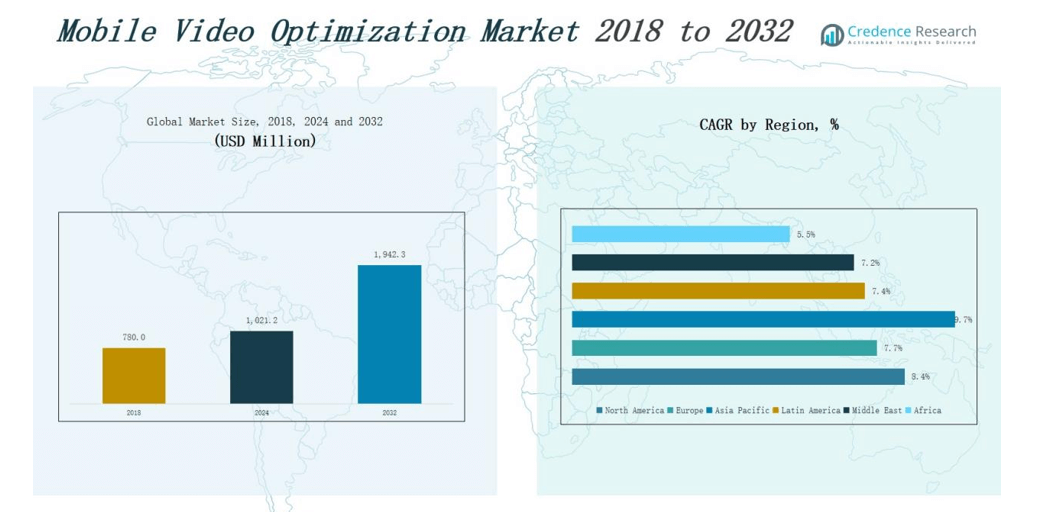
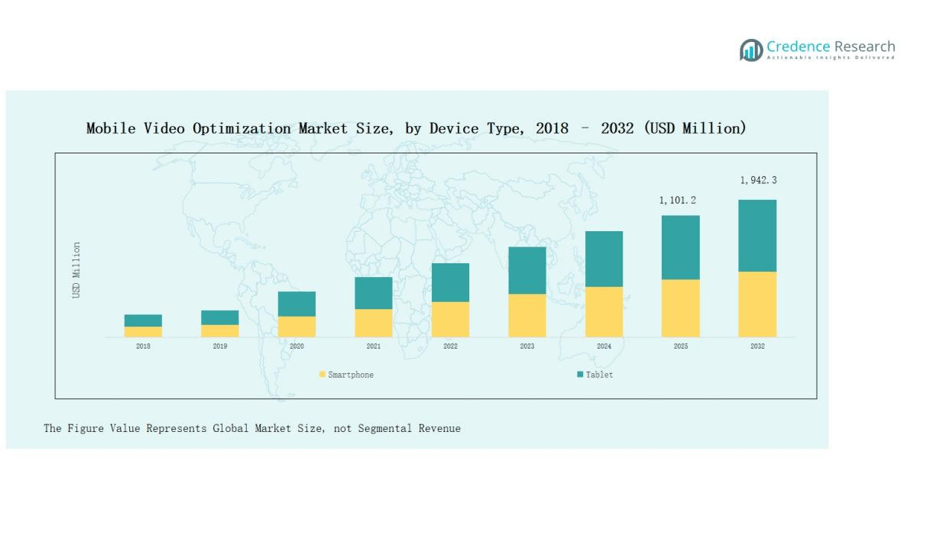
Mobile Video Optimization Market size was valued at USD 780.0 million in 2018 to USD 1,021.2 million in 2024 and is anticipated to reach USD 1,942.3 million by 2032, at a CAGR of 8.4% during the forecast period.
| REPORT ATTRIBUTE | DETAILS |
|---|---|
| Historical Period | 2020-2023 |
| Base Year | 2024 |
| Forecast Period | 2025-2032 |
| Mobile Video Optimization Market Size 2024 | USD 1,021.2 million |
| Mobile Video Optimization Market, CAGR | 8.4% |
| Mobile Video Optimization Market Size 2032 | USD 1,942.3 million |
The Mobile Video Optimization Market is shaped by leading players such as Akamai Technologies, Fastly, Google, Microsoft, Lumen Technologies, Limelight Networks, Ericsson, ZTE Corporation, ChinaCache International Holdings, and Viavi Solutions. These companies compete through advanced cloud-based delivery networks, AI-driven optimization tools, and partnerships with telecom operators to enhance video quality and reduce bandwidth strain. North America emerges as the leading region, accounting for 32% of the global market share in 2024, driven by strong 5G adoption, high smartphone penetration, and the dominance of OTT platforms demanding superior video experiences.
Market Insights
- The market is projected to grow from USD 780.0 million in 2018 to USD 1,942.3 million by 2032, driven by rising demand for seamless video experiences.
- Video streaming leads with a 52% share, followed by gaming and social media, supported by high-definition and interactive content demand.
- Smartphones dominate device adoption with a 68% share, while cloud deployment leads with 61% due to scalability and cost efficiency.
- North America holds the largest regional share at 32% in 2024, followed by Europe at 25% and Asia Pacific at 23%.
- Key players including Akamai, Fastly, Google, Microsoft, Lumen, Ericsson, ZTE, and Limelight compete through AI-driven solutions, telecom partnerships, and global expansions.
Market Segment Insights
By Application
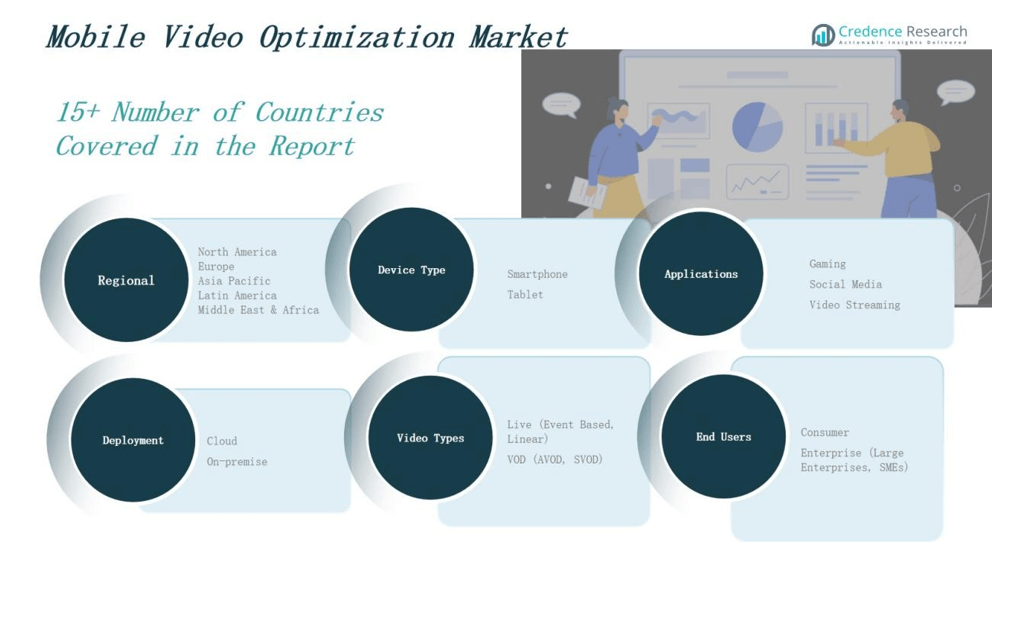
Video streaming dominates the mobile video optimization market with a 52% share. The segment leads due to rising consumption of high-definition and 4K content across platforms like Netflix, YouTube, and Amazon Prime Video. Network operators prioritize video optimization to reduce buffering, enhance user experience, and manage rising mobile data traffic. Gaming holds a significant portion, supported by mobile eSports and cloud gaming platforms. Social media contributes steadily, driven by short-form video growth on platforms such as TikTok, Instagram, and Facebook.
- For instance, Microsoft’s Xbox Cloud Gaming service expanded to over 30 countries by 2024, enabling mobile users to stream console-quality games without downloads.
By Device Type
Smartphones account for a dominant 68% share of the market. Their leadership stems from global smartphone penetration, affordable data plans, and the shift toward video-first communication. Optimized video delivery on mobile devices is critical, as users expect smooth playback even on lower bandwidths. Tablets maintain a smaller share, supported by enterprise adoption and usage for education and entertainment. Growth in larger-screen video consumption, particularly among students and professionals, keeps the tablet segment relevant.
- For instance, Samsung’s Galaxy Tab S9 series introduced in 2023 emphasizes productivity and immersive video experiences, aligning with growing demand among professionals and students alike.
By Deployment
Cloud deployment leads with a 61% share in the mobile video optimization market. Enterprises and service providers prefer cloud-based solutions for scalability, faster updates, and lower infrastructure costs. Rising adoption of video-on-demand and live streaming services further strengthens cloud’s position. On-premise deployment retains demand from organizations prioritizing data control, security, and compliance. Industries such as government and large enterprises still opt for on-premise models, though the shift toward hybrid solutions is increasing.
Market Overview
Rising Mobile Data Traffic
The rapid surge in mobile data consumption is a primary driver for the mobile video optimization market. Increasing video streaming, gaming, and social media usage on smartphones generates unprecedented data loads on networks. Telecom operators face pressure to maintain service quality while managing bandwidth constraints. Video optimization technologies help reduce buffering, latency, and network congestion. With global mobile internet adoption accelerating, operators and content providers are investing heavily in optimization tools to deliver seamless experiences, directly fueling market expansion.
- For instance, Ericsson reported in its 2024 Mobility Report that video accounts for over 70% of global mobile data traffic, with short-form videos from platforms like TikTok driving the sharpest increases.
Expansion of OTT and Video-on-Demand Platforms
The expansion of OTT platforms such as Netflix, Disney+, and Amazon Prime is boosting demand for video optimization solutions. Consumers increasingly prefer high-quality, on-demand content on mobile devices, requiring advanced optimization to support smooth playback across varying network conditions. Video quality, adaptive streaming, and minimal lag are critical to subscriber retention. As competition intensifies among OTT platforms, providers seek optimization technologies to differentiate services and deliver superior user experience. This demand significantly drives market growth across both developed and emerging regions.
- For instance, Disney+ leverages Google Cloud’s adaptive bitrate streaming to dynamically adjust video resolution based on network conditions, maintaining consistency across devices.
Growth in Mobile Gaming Ecosystem
The growth of mobile gaming, including cloud-based and eSports platforms, is fueling the need for video optimization. Gaming requires ultra-low latency, high-resolution graphics, and uninterrupted connections. Mobile video optimization ensures real-time responsiveness and smooth gameplay, even on fluctuating networks. The rising popularity of multiplayer and live-streamed games amplifies demand for advanced optimization solutions. Telecom operators and gaming companies are collaborating to optimize network resources for immersive experiences. This strong alignment of gaming and optimization technologies drives revenue growth in the market.
Key Trends & Opportunities
Shift Toward Cloud-Based Optimization
A key trend in the mobile video optimization market is the shift toward cloud-based solutions. Cloud platforms provide scalability, cost-efficiency, and faster deployment compared to on-premise systems. Service providers can dynamically manage network traffic and deliver enhanced video experiences using AI-driven analytics. This transition supports real-time monitoring and adaptive optimization across devices and regions. As enterprises and telecom operators increasingly adopt cloud ecosystems, the demand for cloud-native optimization tools grows, opening strong opportunities for vendors and solution providers.
- For instance, in 2023, Ericsson introduced its Cloud RAN solutions that allow operators to virtualize network functions in the cloud, enabling more flexible video delivery.
Integration of AI and Machine Learning
The integration of AI and machine learning in video optimization is creating new growth opportunities. These technologies enable predictive analytics, automated traffic management, and personalized video delivery. AI-powered solutions can identify patterns in user behavior, optimize bandwidth allocation, and enhance video quality dynamically. Machine learning algorithms improve compression efficiency and reduce data usage without affecting performance. The push for intelligent networks and 5G deployments makes AI-driven optimization central to future advancements, positioning it as a transformative opportunity in the market.
- For instance, Netflix's recommendation engine uses sophisticated AI and machine learning algorithms to suggest content that users are likely to enjoy.
Key Challenges
Rising Network Complexity
The increasing complexity of mobile networks poses a major challenge for video optimization providers. The introduction of 5G, combined with legacy 3G and 4G infrastructure, creates fragmented environments that require tailored optimization strategies. Managing diverse device ecosystems and varying traffic loads adds further complications. Providers must continuously innovate to ensure seamless integration of optimization tools across multi-layered networks. This complexity increases implementation costs and technical barriers, limiting adoption among smaller operators and slowing overall market penetration.
Data Privacy and Security Concerns
Data privacy and security challenges hinder the adoption of mobile video optimization solutions. Optimization often requires processing and analyzing user data, raising concerns about compliance with regulations such as GDPR and CCPA. Any breach or misuse of sensitive data can lead to reputational damage and financial penalties. Enterprises and telecom providers face added scrutiny while deploying these technologies. Addressing privacy through secure architectures, encryption, and transparent practices is critical to building trust and expanding adoption in this market.
High Infrastructure and Deployment Costs
The high cost of infrastructure upgrades and solution deployment remains a barrier to market growth. Advanced optimization solutions often require significant investment in hardware, software, and skilled expertise. For small and mid-sized telecom operators, these costs can outweigh the benefits, limiting adoption. The challenge intensifies in developing regions where budget constraints and limited technical capabilities prevail. Vendors must develop cost-effective, scalable solutions to encourage wider acceptance. Without addressing affordability, growth in several potential markets may remain restricted.
Regional Analysis
North America
North America holds the largest share of the mobile video optimization market at 32% in 2024, valued at USD 360.9 million. Strong adoption of video-on-demand, gaming, and social media platforms drives demand for advanced optimization solutions. The U.S. dominates due to its mature telecom infrastructure, rapid 5G deployment, and high smartphone penetration. Enterprises in media and entertainment continue to invest heavily in cloud-based video optimization for scalability and performance. With a projected CAGR of 8.4%, the region is expected to reach USD 685.3 million by 2032, maintaining leadership in the global market.
Europe
Europe represents a significant 25% share in 2024, valued at USD 280.1 million. Demand is driven by high mobile video consumption in markets such as the UK, Germany, and France, supported by advanced broadband and LTE infrastructure. Strong regulatory support for data efficiency and network optimization fosters adoption across enterprises and telecom providers. The region benefits from the growing popularity of OTT services and social video content. With a CAGR of 7.7%, Europe’s market is expected to reach USD 505.5 million by 2032, solidifying its position as the second-largest market globally.
Asia Pacific
Asia Pacific accounts for 23% of the market in 2024, valued at USD 259.2 million, and is the fastest-growing region. The strong CAGR of 9.7% reflects rapid smartphone adoption, affordable data plans, and a booming base of OTT subscribers in China, India, and Southeast Asia. Telecom operators face significant bandwidth pressures due to surging mobile video consumption, driving investments in optimization technologies. Japan and South Korea lead in early 5G deployment, further enhancing demand for cloud-based solutions. The market is projected to reach USD 542.7 million by 2032, strengthening Asia Pacific’s global share.
Latin America
Latin America represents a 6% share in 2024, valued at USD 63.0 million. Growing internet penetration, rising smartphone adoption, and expansion of local streaming services contribute to steady growth. Brazil and Mexico drive most of the regional demand, with enterprises and telecom providers investing in optimization tools to manage rising mobile traffic. Limited infrastructure in smaller economies slows adoption but presents future opportunities. The region is expected to grow at a CAGR of 7.4%, reaching USD 111.1 million by 2032, supported by improved broadband connectivity and digitalization initiatives.
Middle East
The Middle East holds a 5% share in 2024, valued at USD 38.9 million. Demand is concentrated in GCC countries, where rapid 5G rollouts and smart city projects fuel adoption of advanced video optimization solutions. Rising demand for streaming services and gaming further supports market expansion. Israel and Turkey also contribute to growth, driven by strong telecom investments. The region is forecasted to grow at a CAGR of 7.2%, reaching USD 67.2 million by 2032. Continued infrastructure development and digital transformation initiatives will underpin future market momentum.
Africa
Africa accounts for the smallest share at 3% in 2024, valued at USD 19.1 million. Limited network infrastructure and affordability challenges restrict large-scale adoption of optimization solutions. However, increasing smartphone penetration and expanding 4G coverage are improving conditions for market growth. South Africa leads the region, followed by Egypt, with growing demand for mobile video and social media content. The market is projected to expand at a CAGR of 5.5%, reaching USD 30.5 million by 2032, with gradual improvements in connectivity driving long-term opportunities.
Market Segmentations:
By Application
- Gaming
- Social Media
- Video Streaming
By Device Type
- Smartphones
- Tablets
By Deployment
- Cloud
- On-premise
By Video Types
- Live (Event Based, Linear)
- VOD (AVOD, SVOD)
By End Users
- Consumer
- Enterprise
- Large Enterprises
- SMEs
By Region
- North America
- U.S.
- Canada
- Mexico
- Europe
- Germany
- France
- U.K.
- Italy
- Spain
- Rest of Europe
- Asia Pacific
- China
- Japan
- India
- South Korea
- South-east Asia
- Rest of Asia Pacific
- Latin America
- Brazil
- Argentina
- Rest of Latin America
- Middle East & Africa
- GCC Countries
- South Africa
- Rest of the Middle East and Africa
Competitive Landscape
The mobile video optimization market is highly competitive, with global technology providers and telecom-focused solution vendors striving to expand their presence. Leading companies such as Akamai Technologies, Fastly, Google, Microsoft, and Lumen Technologies dominate through advanced content delivery networks and cloud-based optimization solutions. Vendors like Limelight Networks, Ericsson, ZTE Corporation, and ChinaCache International strengthen their positions by leveraging telecom partnerships and expanding infrastructure support. Competitive strategies include mergers, acquisitions, and investments in AI-driven optimization to enhance video quality and reduce bandwidth consumption. Market players also focus on regional expansions to capture high-growth markets in Asia Pacific and Latin America. Pricing flexibility, scalability, and integration with 5G ecosystems remain critical differentiators. The market is characterized by high innovation intensity, where companies prioritize real-time traffic management, adaptive streaming, and secure video delivery to maintain an edge in addressing increasing mobile data demands worldwide.
Key Players
- Akamai Technologies, Inc
- Fastly, Inc.
- Google LLC
- Microsoft Corporation
- Lumen Technologies, Inc.
- Limelight Networks, Inc.
- ChinaCache International Holdings Ltd.
- Ericsson AB
- ZTE Corporation
- Viavi Solutions Inc.
Recent Developments
- In January 2025, Verve completed the acquisition of Jun Group, a mobile video and gaming platform. The deal enhances Verve’s mobile ad tech portfolio, strengthening its capabilities in mobile video optimization and advertising solutions.
- In May 2025, Aarki introduced Encore, a full-funnel mobile growth platform designed with deep neural optimization and SKAN 4-ready targeting features.
- In February 2025, Mediaocean finalized the acquisition of Innovid, expanding its reach and strengthening its position as an independent omnichannel ad tech platform.
- In June 2024, Verve acquired Jun Group, a mobile video and gaming platform, to boost its mobile ad tech and video optimization capabilities.
Market Concentration & Characteristics
The Mobile Video Optimization Market reflects a moderately concentrated structure, with a few global leaders controlling significant revenue share and several regional players focusing on niche opportunities. It is shaped by the dominance of companies with strong cloud infrastructure, advanced content delivery capabilities, and telecom partnerships. Competition is driven by innovation intensity, where vendors differentiate through AI-powered analytics, adaptive streaming, and low-latency delivery. The market demonstrates high entry barriers due to capital-intensive infrastructure, technical expertise requirements, and regulatory compliance challenges. It also shows strong regional variation, with mature markets such as North America and Europe leading adoption, while Asia Pacific emerges as the fastest-growing hub due to rapid mobile penetration and OTT expansion. Pricing strategies, scalability, and interoperability across devices influence vendor competitiveness. The Mobile Video Optimization Market continues to evolve with 5G rollouts, rising video consumption, and the growing need for efficient bandwidth management across global networks.
Report Coverage
The research report offers an in-depth analysis based on Application, Device Type, Deployment, Video Types and Region. It details leading market players, providing an overview of their business, product offerings, investments, revenue streams, and key applications. Additionally, the report includes insights into the competitive environment, SWOT analysis, current market trends, as well as the primary drivers and constraints. Furthermore, it discusses various factors that have driven market expansion in recent years. The report also explores market dynamics, regulatory scenarios, and technological advancements that are shaping the industry. It assesses the impact of external factors and global economic changes on market growth. Lastly, it provides strategic recommendations for new entrants and established companies to navigate the complexities of the market.
Future Outlook
- Growing global smartphone penetration will drive continuous demand for seamless, high-quality mobile video experiences.
- Cloud-based optimization platforms will dominate adoption, offering scalability, flexibility, and cost-effective video traffic management.
- Accelerated 5G deployments will enhance demand for advanced video optimization tools supporting ultra-low latency streaming.
- AI-driven analytics and machine learning will improve predictive bandwidth allocation and real-time optimization efficiency.
- Enterprises will adopt advanced optimization to ensure smooth remote collaboration, conferencing, and video-based communication tools.
- Expanding OTT platforms will rely heavily on optimization to deliver consistent, superior user streaming experiences.
- Mobile gaming and eSports expansion will significantly increase demand for ultra-responsive, low-latency optimization technologies.
- Telecom operators will collaborate with vendors to deploy scalable video optimization solutions across diverse networks.
- Rising concerns around user data privacy will shape secure and compliant video optimization solutions.
- Emerging economies will boost growth as rising smartphone adoption fuels video consumption and digital transformation.

Request a Free Sample
Fill in your details and we'll send you a free sample report.
- Sample data tables & charts
- Research methodology
Market Dynamics
Surge in Mobile Data Traffic
The exponential increase in mobile video consumption, driven by streaming, gaming, and social media on smartphones, is straining network capacity. Mobile video optimization technologies are essential for reducing buffering, latency, and congestion, enabling operators to deliver seamless video experiences and manage bandwidth efficiently.
Expansion of OTT and Video-on-Demand Platforms
The rapid growth of OTT services like Netflix, Disney+, and Amazon Prime Video has heightened the need for advanced video optimization to ensure high-quality, uninterrupted playback across diverse network conditions. Providers are investing in optimization tools to differentiate their offerings and retain subscribers.
Growth in Mobile Gaming Ecosystem
The rise of mobile gaming, including cloud gaming and eSports, demands ultra-low latency and high-resolution video delivery. Video optimization solutions are critical for ensuring real-time responsiveness and smooth gameplay, driving adoption among telecom operators and gaming companies.
Shift Toward Cloud-Based Optimization
Enterprises and service providers are increasingly adopting cloud-based video optimization platforms for their scalability, cost efficiency, and rapid deployment capabilities. Cloud solutions enable dynamic traffic management and real-time analytics, supporting the growing demand for flexible and adaptive video delivery.
Integration of AI and Machine Learning
AI and machine learning are transforming video optimization by enabling predictive analytics, automated bandwidth allocation, and personalized video delivery. These technologies enhance compression efficiency and video quality, supporting the industry's shift toward intelligent, adaptive optimization in the era of 5G.
Need a Custom Version of This Report?
Tailor the scope, geography, or segments to your exact requirements.
- Custom geography or segment scope
- Direct access to our analyst team
Frequently Asked Questions
What is the projected growth of the Mobile Video Optimization Market?
What are the primary factors driving the growth of the Mobile Video Optimization Market?
How does 5G technology influence the Mobile Video Optimization Market?
Which regions are leading the Mobile Video Optimization Market?
How is the Mobile Video Optimization Market evolving in emerging regions?
Table of Content
Chapter 1 Market Segmentation
- 1.1 Segmentation Framework
- 1.1.1 Product and Service Classification
- 1.1.2 Application and End-Use Classification
- 1.1.3 Technology and Solution Classification
- 1.1.4 Customer and Distribution Channel Classification
- 1.1.5 Geographic Segmentation
- 1.1.6 Market Segment Definitions and Boundaries
- 1.2 By Deployment
- 1.2.1 Cloud
- 1.2.2 On-premise
- 1.3 By Application
- 1.3.1 Video Streaming
- 1.3.2 Gaming
- 1.3.3 Social Media
- 1.4 By Device Type
- 1.4.1 Smartphones
- 1.4.2 Tablets
- 1.5 By Video Types
- 1.5.1 Live (Event Based, Linear)
- 1.5.2 VOD (AVOD, SVOD)
Chapter 2 Introduction
- 2.1 Report Objectives and Scope
- 2.2 Product Definition and Industry Terminology
- 2.3 Market Inclusions and Exclusions
- 2.4 Research Process
- 2.4.1 Primary Research and Expert Interviews
- 2.4.2 Secondary Research and Source Review
- 2.4.3 Top-Down and Bottom-Up Estimation
- 2.4.4 Data Triangulation and Verification
- 2.5 Market Size Measurement Basis
- 2.5.1 2024: USD 1,021.2 million → 2032: USD 1,942.3 million
- 2.6 Historical and Forecast Reference Periods
- 2.6.1 Base Year: 2024
- 2.6.2 Forecast Period: 2024-2032
- 2.7 Research Assumptions and Limitations
Chapter 3 Executive Summary
- 3.1 Market Snapshot and Key Findings
- 3.2 Base-Year Market Size, 2024
- 3.3 Forecast Market Size, 2032
- 3.4 Revenue and Volume Growth Outlook
- 3.5 Key Demand and Supply Indicators
- 3.6 Leading Market Segments
- 3.7 Fastest-Growing Market Opportunities
- 3.8 Regional Performance Highlights
- 3.9 Technology and Industry Transformation
- 3.10 Competitive Landscape Summary
- 3.11 Analyst View and Strategic Implications
Chapter 4 Global Mobile Video Optimization Market Trends and Developments
- 4.1 Historical Industry Development
- 4.2 Recent Market Trends and Developments
- 4.3 Demand and Customer Behavior Trends
- 4.4 Technology and Product Innovation
- 4.5 Artificial Intelligence, Automation and Digitalization
- 4.6 Local Manufacturing and Supply Chain Realignment
- 4.7 Industry Partnerships, Mergers and Acquisitions
- 4.8 Sustainability and Circular Economy Developments
- 4.9 Government and Private Sector Investment Trends
- 4.10 Emerging Business Models and Commercialization
- 4.11 Industry Developments and Announcements
Chapter 5 Global Mobile Video Optimization Market Production, Supply and Demand Analysis
- 5.1 Demand Trend and Consumption Analysis
- 5.2 Demand Forecast, 2024-2032
- 5.3 Production and Output Trend
- 5.4 Production and Output Forecast, 2024-2032
- 5.5 Installed Capacity and Capacity Utilization
- 5.6 Company-Wise Production Plants and Statistics
- 5.6.1 Installed Production Capacity
- 5.6.2 Actual Production
- 5.6.3 Planned Capacity and Expansion Targets
- 5.7 Supply Chain Structure and Procurement Trends
- 5.8 Supply-Demand Gap and Bottlenecks
- 5.9 Import Dependence and Sourcing Structure
- 5.10 Contract Manufacturing and Outsourcing
- 5.11 Regional Supply and Demand Concentration
Chapter 6 Global Mobile Video Optimization Market Pricing Analysis
- 6.1 Pricing Structure and Measurement
- 6.2 Historical Pricing Trends
- 6.3 Pricing Outlook, 2024-2032
- 6.4 Average Selling Price and Unit Economics
- 6.5 Pricing by Product and Market Segment
- 6.6 Geographic Pricing Differences
- 6.7 Key Input, Energy, Labor and Logistics Costs
- 6.8 Contract Pricing and Purchasing Models
- 6.9 Pricing Sensitivity and Competitive Positioning
- 6.10 Price, Margin and Profitability Implications
Chapter 7 Global Mobile Video Optimization Market Dynamics
- 7.1 Market Growth Drivers
- 7.1.1 Demand-Side Drivers
- 7.1.2 Technology and Innovation Drivers
- 7.1.3 Infrastructure and Investment Drivers
- 7.1.4 Regulatory and Policy Drivers
- 7.2 Market Restraints
- 7.2.1 Cost and Affordability Constraints
- 7.2.2 Technology and Adoption Barriers
- 7.2.3 Supply Chain and Operational Constraints
- 7.3 Market Challenges
- 7.3.1 Competitive Pressure and Margin Erosion
- 7.3.2 Skills, Infrastructure and Implementation Gaps
- 7.4 Emerging Market Opportunities
- 7.5 Market Dynamics Impact and Time-Horizon Assessment
Chapter 8 Global Mobile Video Optimization Value Chain Analysis
- 8.1 Industry Value Chain Overview
- 8.2 Upstream Suppliers and Critical Inputs
- 8.3 Technology and Component Providers
- 8.4 Manufacturing or Service Delivery
- 8.5 Distribution, Channel Partners and Integrators
- 8.6 Downstream Applications and End Users
- 8.7 Value Addition and Profit Pools
- 8.8 Vertical Integration and Outsourcing
- 8.9 Supplier Concentration and Risk
- 8.10 Supply Chain Localization and Resilience
Chapter 9 Global Mobile Video Optimization Market Regulations and Policies
- 9.1 Relevant Laws, Standards and Compliance Frameworks
- 9.2 Product, Service, Safety and Quality Requirements
- 9.3 Government Policies, Incentives and Subsidies
- 9.4 Imports, Exports and Trade Barriers
- 9.5 Public Procurement and Local Content Requirements
- 9.6 Environmental and Sustainability Compliance
- 9.7 Data Protection, AI and Cybersecurity Compliance
- 9.8 Upcoming Policy Changes and Market Implications
Chapter 10 Global Mobile Video Optimization Market Hotspots and Opportunities
- 10.1 Market Opportunity Mapping and Growth Hotspots
- 10.2 High-Growth Applications and Customer Groups
- 10.3 Underserved Markets and White-Space Opportunities
- 10.4 Emerging Technology and Product Opportunities
- 10.5 New Capacity and Investment Hotspots
- 10.6 Market Entry and Expansion Opportunities
- 10.7 Distribution and Partnership Opportunities
- 10.8 Near-Term and Long-Term Commercial Potential
- 10.9 Opportunity Attractiveness and Execution Risks
Chapter 11 Global Mobile Video Optimization Market Outlook, 2024-2032
- 11.1 Market Size and Analysis
- 11.1.1 Revenue (Market Measurement: 2024: USD 1,021.2 million → 2032: USD 1,942.3 million)
- 11.1.2 Market Volume and Quantity Sold
- 11.1.3 Historical Market Size
- 11.1.4 Base-Year Market Size, 2024
- 11.2 Market Forecast, 2024-2032
- 11.2.1 Revenue Forecast to 2032
- 11.2.2 Volume Forecast to 2032
- 11.2.3 CAGR and Year-on-Year Growth
- 11.2.4 Incremental Revenue Opportunity
- 11.3 Forecast Assumptions and Scenario Analysis
- 11.3.1 Base-Case Forecast
- 11.3.2 Optimistic and Conservative Scenarios
- 11.3.3 Technology, Pricing and Policy Sensitivities
- 11.4 Market Attractiveness and Growth Outlook
Chapter 12 Global Mobile Video Optimization Market Segmentation and Outlook
- 12.1 Segmentation Summary and Market Shares, 2024
- 12.2 Largest and Fastest-Growing Segments
- 12.3 By Deployment - Market Size and Forecast, 2024-2032
- 12.3.1 Segment Definition and Scope
- 12.3.2 Historical Market Size
- 12.3.3 Revenue Forecast, 2024-2032
- 12.3.4 Volume Forecast, 2024-2032
- 12.3.5 Base-Year Market Share, 2024
- 12.3.6 Segment CAGR and Growth Drivers
- 12.3.7 Subsegment Market Size and Forecast
- 12.3.7.1 Cloud
- 12.3.7.2 On-premise
- 12.3.8 Subsegment Pricing and Adoption Trends
- 12.3.9 Leading Suppliers and Competition
- 12.3.10 Regional Demand and Opportunities
- 12.4 By Application - Market Size and Forecast, 2024-2032
- 12.4.1 Segment Definition and Scope
- 12.4.2 Historical Market Size
- 12.4.3 Revenue Forecast, 2024-2032
- 12.4.4 Volume Forecast, 2024-2032
- 12.4.5 Base-Year Market Share, 2024
- 12.4.6 Segment CAGR and Growth Drivers
- 12.4.7 Subsegment Market Size and Forecast
- 12.4.7.1 Video Streaming
- 12.4.7.2 Gaming
- 12.4.7.3 Social Media
- 12.4.8 Subsegment Pricing and Adoption Trends
- 12.4.9 Leading Suppliers and Competition
- 12.4.10 Regional Demand and Opportunities
- 12.5 By Device Type - Market Size and Forecast, 2024-2032
- 12.5.1 Segment Definition and Scope
- 12.5.2 Historical Market Size
- 12.5.3 Revenue Forecast, 2024-2032
- 12.5.4 Volume Forecast, 2024-2032
- 12.5.5 Base-Year Market Share, 2024
- 12.5.6 Segment CAGR and Growth Drivers
- 12.5.7 Subsegment Market Size and Forecast
- 12.5.7.1 Smartphones
- 12.5.7.2 Tablets
- 12.5.8 Subsegment Pricing and Adoption Trends
- 12.5.9 Leading Suppliers and Competition
- 12.5.10 Regional Demand and Opportunities
- 12.6 By Video Types - Market Size and Forecast, 2024-2032
- 12.6.1 Segment Definition and Scope
- 12.6.2 Historical Market Size
- 12.6.3 Revenue Forecast, 2024-2032
- 12.6.4 Volume Forecast, 2024-2032
- 12.6.5 Base-Year Market Share, 2024
- 12.6.6 Segment CAGR and Growth Drivers
- 12.6.7 Subsegment Market Size and Forecast
- 12.6.7.1 Live (Event Based, Linear)
- 12.6.7.2 VOD (AVOD, SVOD)
- 12.6.8 Subsegment Pricing and Adoption Trends
- 12.6.9 Leading Suppliers and Competition
- 12.6.10 Regional Demand and Opportunities
- 12.7 Segment Growth Comparison
- 12.8 Segment Attractiveness and Priority Matrix
Chapter 13 Global Mobile Video Optimization End-Use and Application Market Outlook
- 13.1 End-Use Industry and Customer Demand Structure
- 13.2 Leading Applications and Customer Groups
- 13.3 End-Use Market Size, Share and Forecast
- 13.4 Major End-Use Industry Deep Dives
- 13.4.1 Customer Requirements and Use Cases
- 13.4.2 Demand and Replacement Cycles
- 13.4.3 Technical and Regulatory Considerations
- 13.4.4 Purchasing and Procurement Models
- 13.4.5 Leading Vendors and Distribution Channels
- 13.4.6 Forecast and Commercial Opportunities
- 13.5 Emerging Applications and Cross-Segment Demand
- 13.6 End-Use Industry Investment Priorities
Chapter 14 Global Mobile Video Optimization Geographic Market Outlook, 2024-2032
- 14.1 Regional Market Size and Share, 2024
- 14.2 Regional Market Forecast, 2024-2032
- 14.3 Regional Pricing, Production and Demand Differences
- 14.4 North America
- 14.4.1 United States
- 14.4.2 Canada
- 14.4.3 Mexico
- 14.5 Europe
- 14.5.1 Germany
- 14.5.2 France
- 14.5.3 Italy
- 14.5.4 United Kingdom
- 14.5.5 Spain
- 14.5.6 Poland
- 14.5.7 Russia
- 14.5.8 Netherlands
- 14.5.9 Belgium
- 14.5.10 Sweden
- 14.5.11 Denmark
- 14.5.12 Norway
- 14.5.13 Rest of Europe
- 14.6 Asia Pacific
- 14.6.1 China
- 14.6.2 India
- 14.6.3 Japan
- 14.6.4 South Korea
- 14.6.5 Thailand
- 14.6.6 Indonesia
- 14.6.7 Vietnam
- 14.6.8 Malaysia
- 14.6.9 Australia
- 14.6.10 Rest of Asia Pacific
- 14.7 Latin America
- 14.7.1 Brazil
- 14.7.2 Argentina
- 14.7.3 Colombia
- 14.7.4 Chile
- 14.7.5 Rest of Latin America
- 14.8 Middle East
- 14.8.1 Saudi Arabia
- 14.8.2 United Arab Emirates
- 14.8.3 Turkey
- 14.8.4 Israel
- 14.8.5 Iran
- 14.8.6 Rest of the Middle East
- 14.9 Africa
- 14.9.1 South Africa
- 14.9.2 Egypt
- 14.9.3 Nigeria
- 14.9.4 Morocco
- 14.9.5 Rest of Africa
- 14.10 Regional Investment, Policy and Supply Chain Differences
- 14.11 Regional Competitive Landscape
- 14.12 Geographic Growth Hotspots
Chapter 15 Global Mobile Video Optimization Technology, Innovation and Sustainability Outlook
- 15.1 Technology Landscape and Maturity
- 15.2 Product, Process and Service Innovation
- 15.3 AI, Automation and Digital Tools in the Industry
- 15.4 Technology Adoption and Performance Benchmarking
- 15.5 Innovation Pipeline and R&D Investment
- 15.6 Patent and Intellectual Property Trends
- 15.7 Energy Efficiency and Resource Management
- 15.8 Sustainability, Recycling and Circularity
- 15.9 Technology Roadmap, 2024-2032
- 15.10 Risks of Obsolescence and Technology Substitution
Chapter 16 Global Mobile Video Optimization Market Key Strategic Imperatives
- 16.1 Growth and Market Entry Priorities
- 16.2 High-Return Products and Segments
- 16.3 Pricing, Profitability and Cost Optimization
- 16.4 Technology Investment and Product Differentiation
- 16.5 Supply Chain Localization and Resilience
- 16.6 Distribution and Customer Acquisition
- 16.7 Partnership, Acquisition and Capacity Strategy
- 16.8 Regional Expansion Priorities
- 16.9 Short-, Medium- and Long-Term Actions
Chapter 17 Competition Outlook
- 17.1 Industry Competition Characteristics
- 17.2 Market Structure and Concentration
- 17.3 Market Share and Competitive Positioning, 2024
- 17.4 Company-Wise Revenue and Product Benchmarking
- 17.5 Production and Service Capacity Benchmarking
- 17.6 Technology, Pricing and Differentiation
- 17.7 Regional Footprint and Distribution Strength
- 17.8 Mergers, Acquisitions and Strategic Alliances
- 17.9 New Entrants and Competitive Threats
- 17.10 Porter's Five Forces and Industry Attractiveness
- 17.11 Competitive Outlook, 2024-2032
Chapter 18 Company Profiles
- 18.1 Company Coverage and Selection Criteria
- 18.2 Akamai Technologies, Inc
- 18.2.1 Business Description
- 18.2.2 Company Ownership and Geographic Presence
- 18.2.3 Product and Service Portfolio
- 18.2.4 Manufacturing and Operating Footprint
- 18.2.5 Production Capacity and Expansion Plans
- 18.2.6 Financial Performance and Investment
- 18.2.7 Market Share and Competitive Position
- 18.2.8 Technology and Innovation Capabilities
- 18.2.9 Strategic Alliances or Partnerships
- 18.2.10 Recent Developments
- 18.2.11 Growth Strategy and Outlook
- 18.3 Fastly, Inc.
- 18.4 Google LLC
- 18.5 Microsoft Corporation
- 18.6 Lumen Technologies, Inc.
- 18.7 Limelight Networks, Inc.
- 18.8 ChinaCache International Holdings Ltd.
- 18.9 Ericsson AB
- 18.10 ZTE Corporation
- 18.11 Viavi Solutions Inc.
- 18.12 Other Relevant Market Participants
Note: Every listed company is profiled on the structure shown under the first company. The company list is preliminary and may change based on research findings, market developments, data availability and client requirements.
Chapter 19 Disclaimer
- 19.1 Research and Forecast Disclaimer
- 19.2 Data Source and Estimation Limitations
Note: The depth of individual sections depends on data availability for this market. Volume, capacity, trade and other unit-based metrics are included where applicable.

