
Market Overview:
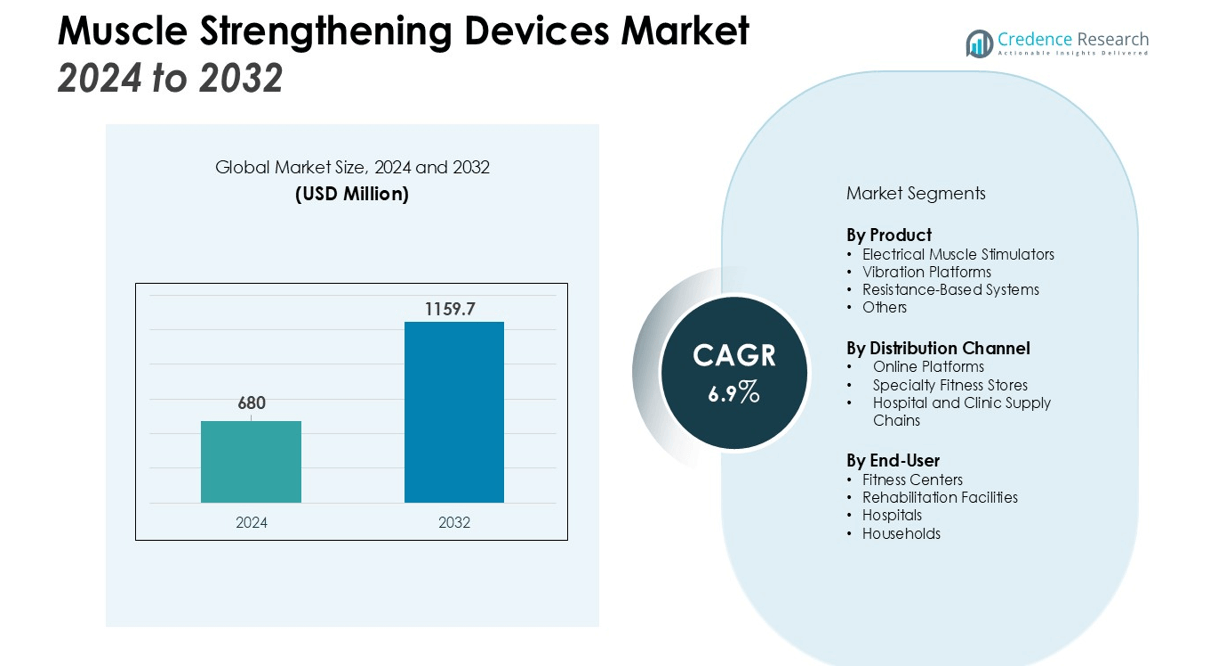
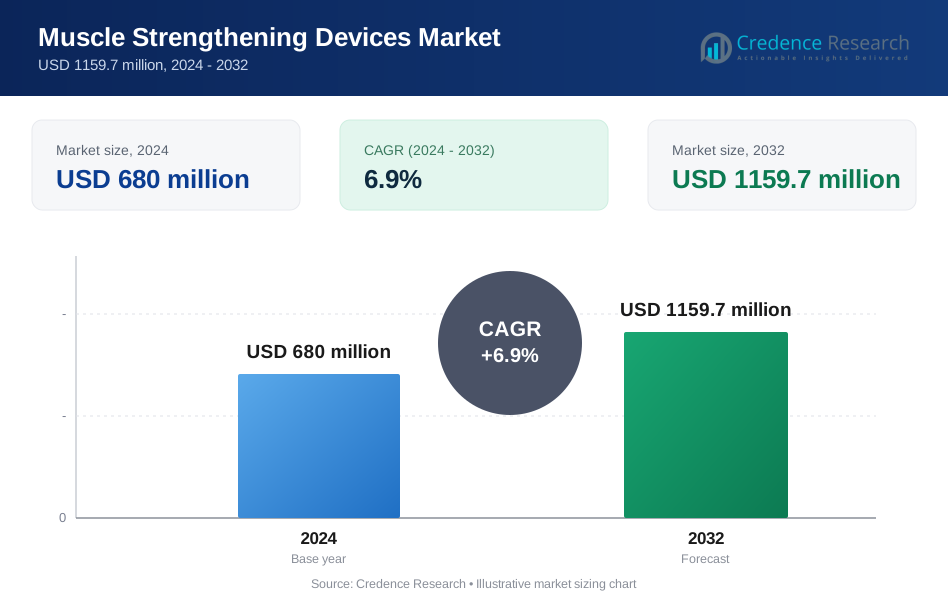
The Muscle Strengthening Devices Market size was valued at USD 680 million in 2024 and is anticipated to reach USD 1159.7 million by 2032, at a CAGR of 6.9% during the forecast period (2024-2032).
| REPORT ATTRIBUTE | DETAILS |
|---|---|
| Historical Period | 2020-2023 |
| Base Year | 2024 |
| Forecast Period | 2025-2032 |
| Muscle Strengthening Devices Market Size 2024 | USD 680 million |
| Muscle Strengthening Devices Market, CAGR | 6.9% |
| Muscle Strengthening Devices Market Size 2032 | USD 1159.7 million |
Fitness awareness and demand for home-based workouts drive consistent growth. Consumers are increasingly adopting devices such as electrical muscle stimulators, vibration platforms, and resistance-based systems to improve strength and support recovery. Advances in technology, particularly portable and connected solutions, make these products more accessible and convenient, broadening their appeal across different demographics. The integration of digital monitoring features also aligns with the rising trend of personalized fitness.
North America dominates the market, supported by widespread fitness culture, high spending power, and strong wellness initiatives. The United States accounts for a significant portion of the regional revenue, reflecting robust consumer adoption and ongoing product innovation. Europe also shows strong uptake, driven by healthcare applications and government support for preventive health programs, while Asia Pacific is emerging as a high-growth region fueled by urbanization and rising health consciousness. Growing adoption in rehabilitation centers and physiotherapy practices further strengthens global demand for muscle strengthening devices.
Market Insights:
- The Muscle Strengthening Devices Market was valued at USD 680 million and is projected to reach USD 1159.7 million by 2032, advancing at a CAGR of 6.9%.
- Rising fitness awareness and consumer focus on preventive health strongly support device adoption across fitness centers and home settings.
- Technological innovation, including smart connectivity and app-based tracking, enhances usability and fosters trust in advanced products.
- Healthcare and rehabilitation segments present expanding opportunities, with hospitals and clinics integrating devices for recovery and therapy.
- North America held 42% of the global share, supported by strong fitness culture, advanced technology access, and high spending power.
- Europe accounted for 28% share, driven by structured healthcare systems and government support for preventive health programs.
- Asia Pacific captured 21% share, with China, Japan, and India showing high growth supported by urbanization, rising incomes, and lifestyle shifts.
Market Drivers:
Rising Fitness Awareness and Growing Health Consciousness
The Muscle Strengthening Devices Market benefits from increasing global awareness of health and fitness. Consumers seek to maintain active lifestyles and prevent chronic diseases by incorporating strength-focused routines. This shift encourages demand for devices that support consistent training at home and in fitness centers. The trend also aligns with rising healthcare emphasis on preventive care and wellness solutions.
- For instance, Technogym’s Biostrength line uses patented Biodrive technology, inspired by aerospace engineering, to offer 6 different types of resistance for tailored workout programs.
Adoption of Home-Based and Portable Solutions
Busy lifestyles and limited time for gyms encourage consumers to invest in home-friendly equipment. The Muscle Strengthening Devices Market is supported by compact, portable, and connected products that offer convenience and flexibility. Devices such as EMS units and resistance-based platforms allow users to integrate workouts into daily schedules. It helps bridge the gap between traditional gym training and personal wellness needs.
Technological Advancements and Smart Features
The Muscle Strengthening Devices Market continues to expand with the integration of advanced technology. Smart connectivity, digital monitoring, and app-based tracking enhance the user experience and improve training outcomes. It creates opportunities for manufacturers to develop innovative systems with customizable programs. These features strengthen consumer trust in devices designed to support personalized fitness journeys.
- For instance, Technogym's Mywellness digital platform has successfully integrated smart tracking into fitness, registering over 15 million users who manage their workouts across the company's connected equipment.
Expansion Across Healthcare and Rehabilitation Segments
Healthcare providers adopt muscle strengthening devices for physiotherapy, post-surgery recovery, and rehabilitation programs. The Muscle Strengthening Devices Market benefits from clinical applications that complement sports and lifestyle use. It expands reach by addressing patients recovering from injuries or chronic conditions. Hospitals and clinics recognize the value of these devices in accelerating recovery and improving patient outcomes.
Market Trends:
Integration of Smart Technology and Digital Platforms
The Muscle Strengthening Devices Market is witnessing strong demand for smart and connected solutions. Consumers prefer devices that integrate with mobile apps, wearable trackers, and digital platforms for real-time performance insights. It supports personalized workout programs, progress tracking, and remote guidance, which enhance user engagement. Manufacturers focus on Bluetooth-enabled products, AI-driven training modules, and compact designs to match consumer expectations. Growing interest in virtual fitness ecosystems is encouraging partnerships between device makers and digital health platforms. These developments highlight a trend where technology and fitness converge to create more adaptive and data-driven solutions.
- For instance, the Compex Mini Wireless Muscle Stimulator is an FDA 510(k) cleared device that connects to a smartphone app via Bluetooth, offering 6 pre-designed programs for muscle warm-up, endurance, and recovery.
Expanding Role in Rehabilitation and Preventive Healthcare
The Muscle Strengthening Devices Market is expanding its role beyond fitness into clinical and rehabilitation settings. Healthcare professionals recommend devices for physiotherapy, muscle recovery, and long-term wellness management. It addresses the needs of aging populations and patients with chronic conditions seeking safe strength support. Rising adoption in hospitals, rehabilitation centers, and home-care programs demonstrates its growing healthcare relevance. Manufacturers are aligning product features with medical-grade standards to gain trust from healthcare providers. This trend reflects a shift where muscle strengthening devices are positioned as vital tools not only for fitness enthusiasts but also for preventive care and recovery solutions.
- For instance, the Tempo Studio uses a 3D Time-of-Flight sensor to enable AI-powered form correction, providing real-time feedback to ensure movements are performed correctly and safely.
Market Challenges Analysis:
High Costs and Limited Accessibility
The Muscle Strengthening Devices Market faces challenges due to the high cost of advanced equipment. Premium products with smart features and medical-grade technology remain unaffordable for a large segment of consumers. It limits widespread adoption, especially in developing economies where disposable income is lower. Distribution gaps and lack of availability in rural areas also restrict access to these devices. Consumers in price-sensitive markets often prefer low-cost alternatives that may not deliver the same benefits. These factors create hurdles for manufacturers aiming to expand market reach.
Regulatory Barriers and Safety Concerns
The Muscle Strengthening Devices Market must address strict regulatory requirements and varying safety standards across regions. Compliance with medical device approvals and certifications increases costs and slows product launches. It raises concerns when devices do not meet quality expectations, leading to reputational risks for brands. Misuse of electrical stimulation or poorly designed equipment can cause injuries, limiting consumer trust. The lack of proper training and awareness further adds to safety-related challenges. These issues underline the importance of regulatory alignment and education to support sustainable market growth.
Market Opportunities:
Rising Demand from Aging Population and Rehabilitation Needs
The Muscle Strengthening Devices Market presents opportunities driven by an aging global population. Older adults seek safe and effective ways to maintain muscle mass, mobility, and independence. It supports healthcare initiatives focused on preventing age-related conditions and promoting active lifestyles. Rehabilitation centers increasingly adopt these devices to aid recovery from surgeries, injuries, and chronic disorders. Expanding applications in physiotherapy and post-operative care create consistent demand. This trend strengthens the role of muscle strengthening devices in both consumer and clinical settings.
Expansion Through Technological Innovation and Emerging Markets
The Muscle Strengthening Devices Market is positioned to benefit from advances in portable and connected technologies. Smart features such as app-based tracking, AI-driven training, and compact designs appeal to tech-savvy consumers. It allows manufacturers to target new demographics, including home fitness enthusiasts and younger users. Growth in emerging economies with rising disposable incomes provides further potential. Partnerships with digital health platforms and fitness programs can extend market reach. These opportunities highlight the scope for product differentiation and expansion into untapped regions.
Market Segmentation Analysis:
By Product
The Muscle Strengthening Devices Market is segmented into electrical muscle stimulators, vibration platforms, resistance-based systems, and others. Electrical muscle stimulators hold a significant share due to their wide use in both fitness and rehabilitation programs. Vibration platforms are gaining traction for improving circulation, balance, and muscle activation. Resistance-based systems remain popular among home users seeking affordable and compact solutions. It reflects diverse consumer preferences shaped by convenience, performance, and application needs.
- For instance, the Compex Motion, a transcutaneous functional electrical stimulator, has been successfully used as a neuroprosthesis for walking, reaching, and grasping in more than 100 stroke and spinal cord injured patients.
By Distribution Channel
The market is distributed through online platforms, specialty fitness stores, and hospital or clinic supply chains. Online platforms dominate due to rising e-commerce penetration and consumer preference for direct access to product information and reviews. Specialty fitness stores maintain a strong presence with personalized sales support and product demonstrations. Hospital and clinic channels focus on medical-grade devices used in recovery and physiotherapy. It highlights the role of distribution variety in expanding global market reach.
By End-User
End-users include fitness centers, rehabilitation facilities, hospitals, and households. Fitness centers and gyms remain key contributors with consistent demand for advanced strengthening solutions. Rehabilitation facilities and hospitals emphasize clinical benefits, adopting devices for post-surgery care and chronic condition management. Households represent a growing segment, fueled by interest in home-based workouts and portable technologies. It underlines how the Muscle Strengthening Devices Market addresses both consumer fitness goals and medical recovery needs.
- For instance, to validate the effectiveness of home-based devices for post-operative care, one clinical study on an intelligent monitoring system for knee rehabilitation enrolled 120 patients following surgery.
Segmentations:
By Product
- Electrical Muscle Stimulators
- Vibration Platforms
- Resistance-Based Systems
- Others
By Distribution Channel
- Online Platforms
- Specialty Fitness Stores
- Hospital and Clinic Supply Chains
By End-User
- Fitness Centers
- Rehabilitation Facilities
- Hospitals
- Households
By Geography
- North America
- U.S.
- Canada
- Mexico
- Europe
- UK
- France
- Germany
- Italy
- Spain
- Russia
- Belgium
- Netherlands
- Austria
- Sweden
- Poland
- Denmark
- Switzerland
- Rest of Europe
- Asia Pacific
- China
- Japan
- South Korea
- India
- Australia
- Thailand
- Indonesia
- Vietnam
- Malaysia
- Philippines
- Taiwan
- Rest of Asia Pacific
- Latin America
- Brazil
- Argentina
- Peru
- Chile
- Colombia
- Rest of Latin America
- Middle East
- UAE
- KSA
- Israel
- Turkey
- Iran
- Rest of Middle East
- Africa
- Egypt
- Nigeria
- Algeria
- Morocco
- Rest of Africa
Regional Analysis:
North America Leading with Strong Consumer Adoption
North America accounted for 42% of the global Muscle Strengthening Devices Market. The United States represented the largest portion of this share, supported by strong adoption of home-based and portable solutions. It benefits from the presence of key manufacturers and widespread access to digital fitness platforms. Wellness-focused initiatives and preventive healthcare policies also support steady growth. Canada contributes with rising investments in rehabilitation and physiotherapy facilities, expanding the role of these devices in healthcare.
Europe Strengthening Through Healthcare Integration
Europe held 28% of the global Muscle Strengthening Devices Market. Germany, the UK, and France contributed significantly to this share through demand for advanced rehabilitation and fitness solutions. It aligns with government-backed healthcare programs that encourage preventive health practices. High awareness of wellness and sports performance also supports uptake across gyms and personal training facilities. Expanding use in post-surgery recovery highlights Europe’s focus on clinical applications and structured health systems.
Asia Pacific Emerging as High-Growth Region
Asia Pacific captured 21% of the global Muscle Strengthening Devices Market. China, Japan, and India led this regional share, driven by rising consumer focus on health and growing disposable incomes. It gains momentum from the growth of digital health platforms and a surge in younger demographics adopting home-based devices. Government initiatives promoting healthy lifestyles and fitness participation add further support. Strong potential exists in rehabilitation applications, where hospitals and clinics increasingly recognize the value of these devices.
Key Player Analysis:
- Hibbett Sports (U.S.)
- Torque Fitness (U.S.)
- NordicTrack (U.S.)
- Spirit Fitness (U.S.)
- Technogym (Italy)
- Peloton (U.S.)
- Marcy (India)
- Bowflex (U.S.)
- Life Fitness (U.S.)
- ProForm (U.S.)
Competitive Analysis:
The Muscle Strengthening Devices Market features a competitive landscape shaped by innovation, product quality, and distribution reach. Leading companies focus on integrating smart features such as app connectivity, digital monitoring, and customizable training programs to attract diverse consumers. It is driven by demand from both fitness and healthcare sectors, prompting firms to align products with medical-grade standards. Strategic partnerships with digital health platforms and fitness service providers expand visibility and consumer trust. Manufacturers also emphasize affordability and compact designs to capture the growing household segment. Regional players strengthen their presence through targeted distribution and localized marketing efforts. Global brands invest in research and development to introduce advanced technologies that enhance performance and safety. Competition remains intense, with firms balancing innovation and cost efficiency to secure long-term growth. This competitive dynamic ensures continuous improvement and supports broader adoption of muscle strengthening devices worldwide.
Recent Developments:
- In July 2025, Peloton initiated a partnership with the global fitness racing brand Hyrox, becoming its official digital training partner and launching a new series of on-demand classes to help users prepare for Hyrox events.
- In March 2025, Torque Fitness introduced several new commercial fitness products at the Health & Fitness Association (HFA) 2025 show, including the TANK® M3 all-surface sled, the STEALTH AIR™ Rower, new Glute & Sissy Squat Modules, and new Lifting Platforms.
Report Coverage:
The research report offers an in-depth analysis based on Product, Distribution Channel, End-Use and Geography. It details leading market players, providing an overview of their business, product offerings, investments, revenue streams, and key applications. Additionally, the report includes insights into the competitive environment, SWOT analysis, current market trends, as well as the primary drivers and constraints. Furthermore, it discusses various factors that have driven market expansion in recent years. The report also explores market dynamics, regulatory scenarios, and technological advancements that are shaping the industry. It assesses the impact of external factors and global economic changes on market growth. Lastly, it provides strategic recommendations for new entrants and established companies to navigate the complexities of the market.
Future Outlook:
- The Muscle Strengthening Devices Market will expand with rising global focus on preventive healthcare.
- Home-based fitness solutions will gain traction as consumers seek convenience and flexibility.
- Smart technologies such as AI-driven training and app-based monitoring will reshape product design.
- Rehabilitation and physiotherapy applications will create steady demand across hospitals and clinics.
- Aging populations will adopt devices to maintain muscle strength and mobility.
- Manufacturers will target younger demographics with portable and affordable strengthening systems.
- Partnerships with digital health platforms will enhance integration into broader fitness ecosystems.
- Emerging economies will provide strong growth opportunities supported by rising incomes and urbanization.
- Product differentiation through safety features and medical-grade certifications will strengthen consumer trust.
- Continuous investment in innovation and global distribution will sustain competitiveness and broaden adoption.
Request a Free Sample
Fill in your details and we'll send you a free sample report.
- Sample data tables & charts
- Research methodology
Need a Custom Version of This Report?
Tailor the scope, geography, or segments to your exact requirements.
- Custom geography or segment scope
- Direct access to our analyst team
Frequently Asked Questions
What is the current market size for Muscle Strengthening Devices, and what is its projected size in 2032?
At what Compound Annual Growth Rate is the Muscle Strengthening Devices market projected to grow between 2024 and 2032?
What are the primary factors fueling the growth of the Muscle Strengthening Devices market?
Which region commanded the largest share of the Muscle Strengthening Devices market in 2024?
Table of Content
Chapter 1. Report Introduction
- 1.1 Report Description & Purpose
- 1.1.1 Report Title & Market Definition
- 1.1.2 Unique Selling Propositions (USP) & Key Differentiators
- 1.1.3 Value Proposition for Stakeholders
- 1.2 Research Objectives
- 1.2.1 Market Sizing Objectives (Volume & Revenue)
- 1.2.2 Segmentation Objectives
- 1.2.3 Competitive Intelligence Objectives
- 1.2.4 Forecast & Scenario Objectives
- 1.3 Report Scope
- 1.3.1 Muscle Strengthening Devices Scope – Types & Subtypes Covered
- 1.3.2 Geographic Scope – Regions & Countries Covered
- 1.3.3 Historical Period, Base Year & Forecast Period (2024; forecast to 2032)
- 1.3.4 Inclusions & Exclusions
- 1.4 HS Code & Classification Framework
- 1.5 Currency, Units & Pricing Basis
- 1.6 Target Stakeholders
- 1.7 Limitations & Assumptions
Chapter 2. Executive Summary
- 2.1 Global Muscle Strengthening Devices Market Snapshot
- 2.1.1 Market Size – Historical (2024) & Forecast (2024-2032) (2024: USD 680 million → 2032: USD 1159.7 million)
- 2.1.2 Volume & Revenue – Global Totals
- 2.1.3 Key Market Highlights – Top Five Facts
- 2.2 Muscle Strengthening Devices Market Segmentation Snapshot
- 2.2.1 Market Split by Region – 2024 vs. 2032
- 2.3 Competitive Snapshot
- 2.3.1 Top 10 Players by Revenue Share – 2024
- 2.3.2 Top 10 Players by Volume Share – 2024
- 2.3.3 Recent Strategic Developments (18-Month Summary)
- 2.4 Key Investment Highlights & Strategic Conclusions
Chapter 3. Muscle Strengthening Devices Market Dynamics & Industry Analysis
- 3.1 Market Overview & Context
- 3.1.1 Muscle Strengthening Devices Market Position in the Broader Automotive Value Chain
- 3.1.2 OEM vs. Replacement Market Dynamics
- 3.1.3 Market Maturity & Development Stage by Region
- 3.2 Muscle Strengthening Devices Market Drivers
- 3.3 Muscle Strengthening Devices Market Restraints & Challenges
- 3.4 Muscle Strengthening Devices Market Opportunities
- 3.5 Porter's Five Forces Analysis
- 3.5.1 Threat of New Entrants
- 3.5.2 Bargaining Power of Suppliers
- 3.5.3 Bargaining Power of Buyers
- 3.5.4 Threat of Substitutes
- 3.5.5 Competitive Rivalry – Intensity Assessment
- 3.6 Muscle Strengthening Devices Value Chain Analysis
- 3.6.1 Upstream – Raw Material/Input Suppliers
- 3.6.1.1 Raw Material/Input 1
- 3.6.1.2 Raw Material/Input 2
- 3.6.1.3 Raw Material/Input 3
- 3.6.2 Midstream – Production/Manufacturing/Service Delivery
- 3.6.2.1 Production/Process Overview
- 3.6.2.2 Key Facility Locations & Capacity by Manufacturer
- 3.6.3 Downstream – Distribution & End Consumer
- 3.6.3.1 Primary Channel – B2B/OEM
- 3.6.3.2 Secondary Channels – Dealer, Retail, Online, Direct
- 3.6.4 Value Chain Profitability Analysis
- 3.6.1 Upstream – Raw Material/Input Suppliers
- 3.7 PESTEL Analysis
- 3.7.1 Political Factors
- 3.7.2 Economic Factors
- 3.7.3 Social Factors
- 3.7.4 Technological Factors
- 3.7.5 Environmental Factors
- 3.7.6 Legal Factors
- 3.8 Muscle Strengthening Devices Supply Chain Analysis
- 3.8.1 Raw Material/Input Supply Risk Assessment
- 3.8.2 Manufacturing Concentration Risk (Geographic Exposure)
- 3.8.3 Trade Disruption Impact Analysis
- 3.9 Regulatory & Policy Landscape
Note: The regulatory and policy landscape section covers regulations based on their applicability to the market, Muscle Strengthening Devices category, geography, and scope of the study. Only regulatory frameworks with a material impact on operations, compliance, trade, sustainability, or market access are analyzed in detail.
Chapter 4. Key Investment Pockets & Opportunity Analysis
- 4.1 Muscle Strengthening Devices Market Attractiveness Analysis
- 4.1.1 By Region – Investment Attractiveness Matrix (Volume × CAGR)
- 4.2 Absolute Revenue Growth Opportunity
- 4.2.1 By Region – Absolute USD Growth Through 2032
- 4.3 Incremental Volume Opportunity
- 4.3.1 By Region – Incremental Volume Through 2032
- 4.3.2 Segment – Incremental Volume
- 4.4 Emerging Submarket Opportunity Deep Dive (Subject to Applicability)
- 4.5 Emerging Market Opportunity Scorecards
- 4.5.1 United States
- 4.5.2 Europe
- 4.5.3 Asia
- 4.5.4 Middle East & Africa
Note: Emerging Market Opportunity Scorecards will be included based on relevance and strategic importance. Regions listed are indicative and may vary depending on data availability and market dynamics.
Chapter 5. Muscle Strengthening Devices Import-Export Analysis & Trade Flows
- 5.1 Global Trade Overview
- 5.1.1 Global Export Value by Country (2024)
- 5.1.2 Global Export Volume by Country (2024)
- 5.1.3 Global Import Value by Country (2024)
- 5.1.4 Global Import Volume by Country (2024)
- 5.1.5 Net Trade Balance by Country (2024)
- 5.2 Export Analysis – Segment
- 5.2.1 Type 1 (HS Code)
- 5.2.2 Type 2 (HS Code)
- 5.2.3 Type 3 (HS Code)
- 5.2.4 Type 4 (HS Code)
- 5.2.5 Type 5 (HS Code)
- 5.3 Import Analysis – Segment
- 5.3.1 Type 1 (HS Code)
- 5.3.2 Type 2 (HS Code)
- 5.3.3 Type 3 (HS Code)
- 5.3.4 Type 4 (HS Code)
- 5.3.5 Type 5 (HS Code)
- 5.4 Average Unit Trade Prices
- 5.4.1 Average Export Price – Segment & Country
- 5.4.2 Average Import Price – Segment & Source Country
- 5.4.3 Price Trends (2024)
- 5.5 Key Trade Route Analysis
- 5.5.1 Trade Route 1
- 5.5.2 Trade Route 2
- 5.5.3 Trade Route 3
- 5.5.4 Trade Route 4
- 5.5.5 Trade Route 5
- 5.6 Trade Policy Impact Assessment
- 5.6.1 US Anti-Dumping & Section 301 Tariffs
- 5.6.2 EU Customs Union Impact
- 5.6.3 Major Free Trade Agreements
- 5.6.4 USMCA Rules of Origin
Note: Trade policy analysis will be included only where relevant to the Muscle Strengthening Devices market.
Chapter 6. Competitive Landscape & Company Benchmarking
- 6.1 Muscle Strengthening Devices Market Concentration & Structure
- 6.1.1 Herfindahl-Hirschman Index (HHI) – vs. 2024
- 6.1.2 Tier 1, Tier 2 & Tier 3 Market Structure
- 6.1.3 Global, Regional & Local Player Dynamics
- 6.2 Muscle Strengthening Devices Market Share Analysis – 2024
- 6.2.1 Global Revenue Share by Company
- 6.2.2 Global Volume Share by Company
- 6.2.3 Regional Revenue Share
- 6.2.4 Market Share Evolution ( vs. 2024)
- 6.2.5 OEM Segment Share by Company
- 6.2.6 Replacement Segment Share by Company
- 6.3 Production/Delivery Capacity & Facility Analysis
- 6.3.1 Global Installed Capacity
- 6.3.2 Capacity Utilization Rates
- 6.3.3 Production/Output Volume
- 6.3.4 Facility Locations & Capacity Map
- 6.3.5 Planned Capacity Additions
- 6.4 Muscle Strengthening Devices Competitive Benchmarking Matrix
- 6.4.1 Revenue, Volume, CAGR & Profitability Comparison
- 6.4.2 Channel Revenue Mix
- 6.4.3 Geographic Revenue Exposure
- 6.4.4 R&D Intensity
- 6.4.5 Sustainability Maturity
- 6.5 Strategic Developments in Muscle Strengthening Devices (Last 24 Months)
- 6.5.1 Mergers, Acquisitions & Divestments
- 6.5.2 New Muscle Strengthening Devices Launches
- 6.5.3 Facility Expansions
- 6.5.4 Strategic Alliances, Joint Ventures & Partnerships
- 6.5.5 Distribution Expansion & Market Entry
- 6.5.6 Sustainability & ESG Initiatives
- 6.6 Competitive Strategy Mapping
- 6.6.1 Leader, Challenger, Follower & Niche Classification
- 6.6.2 Pricing Strategy Comparison
- 6.6.3 Channel Strategy Matrix
Note: Strategic developments are included based on their materiality and the availability of reliable information.
Chapter 7. Global Muscle Strengthening Devices Market – By Distribution Channel
- 7.1 Segment Overview
- 7.1.1 Volume & Revenue Split by Channel (2024 & 2032)
- 7.1.2 Channel Mix Evolution (2024-2032)
Chapter 8. Regional Market Analysis – Global Overview
- 8.1 Global Regional Overview
- 8.1.1 Regional Volume Share
- 8.1.2 Regional Revenue Share
- 8.1.3 Regional Volume by Region
- 8.1.4 Regional Revenue by Region
- 8.1.5 Regional Forecast Through 2032
- 8.2 Cross-Regional Segment Analysis
- 8.2.1 By Distribution Channel
- 8.2.2 By Brand/Price Tier
Chapter 9. North America Muscle Strengthening Devices Market
- 9.1 United States
- 9.2 Canada
- 9.3 Mexico
Chapter 10. Europe Muscle Strengthening Devices Market
- 10.1 Germany
- 10.2 France
- 10.3 Italy
- 10.4 United Kingdom
- 10.5 Spain
- 10.6 Poland
- 10.7 Russia
- 10.8 Netherlands
- 10.9 Belgium
- 10.10 Sweden
- 10.11 Denmark
- 10.12 Norway
- 10.13 Rest of Europe
Chapter 11. Asia Pacific Muscle Strengthening Devices Market
- 11.1 China
- 11.2 India
- 11.3 Japan
- 11.4 South Korea
- 11.5 Thailand
- 11.6 Indonesia
- 11.7 Vietnam
- 11.8 Malaysia
- 11.9 Australia
- 11.10 Rest of Asia Pacific
Chapter 12. Latin America Muscle Strengthening Devices Market
- 12.1 Brazil
- 12.2 Argentina
- 12.3 Colombia
- 12.4 Chile
- 12.5 Rest of Latin America
Chapter 13. Middle East Muscle Strengthening Devices Market
- 13.1 Saudi Arabia
- 13.2 United Arab Emirates
- 13.3 Turkey
- 13.4 Israel
- 13.5 Iran
- 13.6 Rest of the Middle East
Chapter 14. Africa Muscle Strengthening Devices Market
- 14.1 South Africa
- 14.2 Egypt
- 14.3 Nigeria
- 14.4 Morocco
- 14.5 Rest of Africa
Chapter 15. Muscle Strengthening Devices Company Profiles
- 15.1 [Company 01]
- 15.1.1 Company Overview
- 15.1.2 Key Management Personnel
- 15.1.3 Products & Services Portfolio
- 15.1.4 Financial Performance
- 15.1.5 Key Market Focus & Geographic Presence
- 15.1.6 Recent Developments & Strategic Initiatives
Note: The company profile list is preliminary and may change based on research findings, market developments, data availability, and client requirements.
Chapter 16. Appendices
- Appendix A – List of Abbreviations & Acronyms
- Appendix B – Industry Classification Code Reference – Full Series
- Appendix C – Production & Capacity Data Tables
- Appendix D – End-Use & Demand Base Tables
- Appendix E – Consumption & Replacement Rate Assumptions
- Appendix F – ASP Reference Tables
- Appendix G – Manufacturing & Facility Database
- Appendix H – Import-Export Data Tables
- Appendix I – Regulatory Summary Tables
- Appendix J – Primary Research Participant List (Anonymized)
- Appendix K – Primary Research Questionnaire Framework
- Appendix L – Data Sources & Bibliography
- Appendix M – Market Size Divergence & Source Comparison
Chapter 17. Research Methodology
- 17.1 Research Framework & Philosophy
- 17.2 Secondary Research – Sources, Hierarchy & Data Extraction
- 17.3 Data Modeling – Bottom-Up & Top-Down Market Sizing
- 17.4 Primary Research – Stakeholder Framework, LOI & Sample Sizes
- 17.5 Forecast Methodology – Regression, Scenario & Sensitivity Analysis
- 17.6 Quality Control – Four-Layer Validation Framework
- 17.7 Limitations & Standard Assumptions
- 17.8 Disclaimer
