
Market Overview:
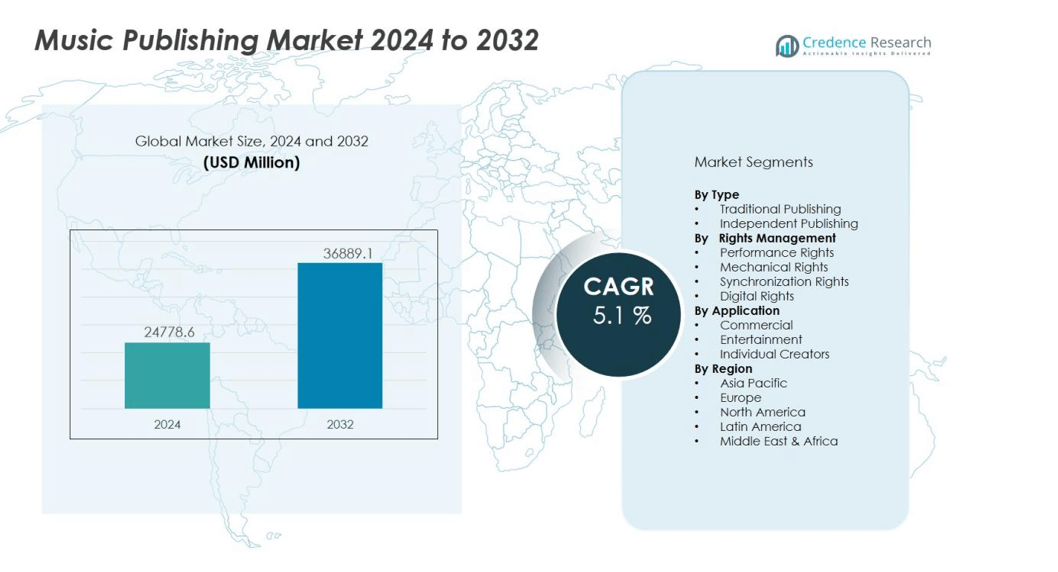
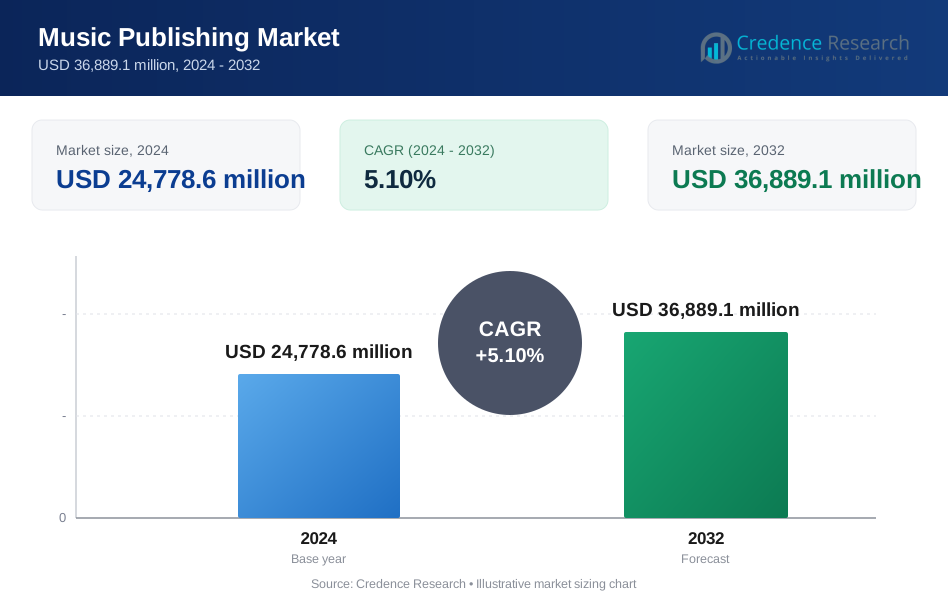
The music publishing market size was valued at USD 24778.6 million in 2024 and is anticipated to reach USD 36889.1 million by 2032, at a CAGR of 5.1 % during the forecast period (2024-2032).
| REPORT ATTRIBUTE | DETAILS |
|---|---|
| Historical Period | 2020-2023 |
| Base Year | 2024 |
| Forecast Period | 2025-2032 |
| Music Publishing Market Size 2024 | USD 24778.6 million |
| Music Publishing Market, CAGR | 5.1% |
| Music Publishing Market Size 2032 | USD 36889.1 million |
The market is driven by the rapid rise of digital streaming services, which have transformed music consumption patterns worldwide. Growth in subscription-based platforms, expanding global internet penetration, and the integration of advanced technologies such as artificial intelligence for rights management are fueling revenue streams for publishers. Increased collaboration between artists and brands, coupled with the surge in user-generated content on platforms like TikTok and YouTube, is further accelerating licensing demand.
Regionally, North America leads the music publishing market, supported by a strong presence of global publishing houses, high streaming adoption, and robust licensing structures. Europe follows with well-established copyright frameworks and strong demand from live entertainment and advertising sectors. The Asia-Pacific region is expected to record the fastest growth, driven by booming music consumption in emerging economies such as India and China, rising smartphone penetration, and the rapid expansion of regional streaming platforms.
Market Insights:
- The music publishing market was valued at USD 24,778.6 million in 2024 and is projected to reach USD 36,889.1 million by 2032, reflecting a CAGR of 1%.
- Rapid expansion of digital streaming platforms is the primary growth driver, supported by subscription-based and ad-supported revenue models.
- Rising demand for synchronization rights in films, advertising, gaming, and OTT productions provides high-margin revenue streams for publishers.
- Adoption of AI, blockchain, and digital tracking technologies is enhancing royalty management, copyright protection, and transparency.
- The market faces challenges in royalty disputes, piracy, and revenue-sharing models that often favor digital distributors.
- Regionally, North America leads with over 35% share, followed by Europe at nearly 30%, while Asia-Pacific grows fastest at close to 25%.
- Expanding music consumption in emerging markets, supported by smartphone adoption, affordable internet, and local content investment, offers strong future opportunities.
Market Drivers:
Expansion of Digital Streaming Platforms:
The music publishing market is propelled by the explosive growth of digital streaming platforms. Subscription-based and ad-supported services create consistent revenue streams for publishers through performance and mechanical royalties. It benefits from wider consumer access to global music catalogs and personalized content delivery. The surge in music discovery via short-form video and social media platforms strengthens demand for synchronization rights. Publishers are increasingly securing favorable licensing agreements with digital service providers to maximize revenue.
- For instance, Spotify, with over 100 million tracks and nearly 7 million podcasts, combines algorithm-driven recommendations with licensing agreements that have supported payment of $40 billion to music rights holders as of early 2025, showcasing a wide-reaching revenue generation ecosystem.
Rising Demand for Synchronization Rights:
The integration of music into films, advertisements, video games, and digital content is a critical driver of the music publishing market. Synchronization rights provide publishers with high-margin revenue opportunities and long-term brand exposure. It benefits from increasing collaborations between artists and global brands seeking to connect with audiences through music. The demand for background scores in digital streaming shows and original productions adds further momentum. Growth in online gaming also strengthens the need for curated soundtracks and licensed compositions.
- For instance, Netflix has scaled its original programming significantly, reaching 301.6 million paid memberships globally as of 2025, requiring thousands of hours of synchronized music content across its original series and films.
Technological Advancements in Rights Management:
The adoption of artificial intelligence, blockchain, and digital tracking systems is enhancing royalty collection and transparency in the music publishing market. It allows publishers to streamline copyright enforcement and protect intellectual property in complex digital ecosystems. Automation improves accuracy in monitoring performance royalties across diverse platforms. Blockchain adoption ensures efficient contract execution and transparent revenue sharing for artists. These innovations strengthen publisher confidence in managing growing volumes of global content.
Global Music Consumption and Emerging Markets:
Rising smartphone penetration, affordable data, and expanding regional streaming services are fueling growth of the music publishing market in emerging economies. It gains traction from young populations with strong appetite for international and local music. Governments supporting copyright reforms and improved enforcement frameworks create a favorable environment. Expanding middle-class income levels and digital adoption increase willingness to pay for premium music services. These dynamics expand the global reach and monetization potential for publishers.
Market Trends:
Growth of Independent Publishing and Artist-Centric Models;
The music publishing market is witnessing a significant shift toward independent publishing and direct-to-artist models. Artists are increasingly seeking control over their rights and revenue streams, driving growth in boutique publishing firms and self-publishing platforms. It benefits from digital tools that simplify rights management, royalty collection, and global distribution. Independent publishers are leveraging technology to provide flexible contracts and transparent revenue sharing, which attract emerging and established artists. Social media platforms and digital distribution channels amplify artist visibility, enabling them to bypass traditional publishing structures. This trend is reshaping competitive dynamics by reducing reliance on large, legacy publishing houses.
- For Instance, BeatStars provides a marketplace for independent producers and artists, generating over $100 million in payouts to creators by 2024, demonstrating the scale of direct artist monetization through technology-driven platforms.
Integration of Technology and Data-Driven Insights:
Technological innovation is transforming operational efficiency and strategic decision-making within the music publishing market. Artificial intelligence supports predictive analytics for royalty forecasting, licensing optimization, and music recommendation systems. It enhances rights tracking across multiple digital platforms, ensuring greater accuracy in royalty distribution. Blockchain solutions are gaining traction for secure contract management and transparent revenue sharing between artists and publishers. Data-driven insights allow publishers to align content with audience preferences, increasing the value of synchronization deals across entertainment and advertising. The adoption of advanced technologies strengthens market confidence and broadens monetization opportunities for global music catalogs.
- For example, the Mycelia Creative Passport by Imogen Heap, built on blockchain, securely manages music rights and payment terms, supporting transparent royalty distribution for over 10,000 artists globally.
Market Challenges Analysis:
Complexities in Copyright and Royalty Management:
The music publishing market faces persistent challenges in managing copyright ownership and royalty distribution across diverse platforms. Fragmented licensing structures create disputes between publishers, artists, and digital service providers. It struggles with inconsistent copyright enforcement across regions, which limits transparency and revenue collection. Emerging markets often lack robust legal frameworks, making piracy a serious issue for publishers. Delayed royalty payments and disputes over performance rights undermine artist confidence. These challenges highlight the need for standardized, technology-driven solutions to streamline processes.
Pressure from Market Consolidation and Revenue Models:
Industry consolidation among major publishers creates barriers for independent players seeking fair representation. The dominance of streaming platforms also shifts bargaining power, forcing publishers to negotiate under revenue-sharing models that often favor distributors. It struggles with declining margins from physical sales and traditional broadcasting while relying heavily on streaming growth. Rising competition from self-publishing tools further intensifies pressure on established publishers. Uncertainty in advertising-based monetization adds volatility to revenue streams. These structural issues demand adaptive strategies to protect long-term sustainability.
Market Opportunities:
Expansion of Global Streaming and Emerging Market Potential:
The music publishing market has strong opportunities through the rapid expansion of global streaming platforms and growing penetration in emerging economies. Rising internet access and affordable smartphones are driving demand for licensed music in countries such as India, Brazil, and Indonesia. It benefits from young demographics and increasing willingness to pay for premium subscriptions. Regional streaming services are forging partnerships with publishers to secure exclusive content, creating new revenue channels. Cross-border collaborations between international and local artists enhance the appeal of licensed catalogs. These trends expand the reach of publishers and strengthen global monetization prospects.
Growth of Synchronization and Innovative Licensing Models
Rising demand for synchronization rights in advertising, gaming, and digital media offers a lucrative opportunity for the music publishing market. Brands and entertainment platforms are investing in unique soundtracks to improve audience engagement and brand recall. It gains from the surge in original content production on OTT platforms, where music plays a vital role in storytelling. New licensing models such as micro-licensing enable easier access for independent creators, small businesses, and influencers. The rise of immersive technologies like VR and AR also creates fresh avenues for music integration. These opportunities support publishers in diversifying income streams and strengthening market relevance.
Market Segmentation Analysis:
By Type:
By type, the market includes traditional publishing and independent publishing. Traditional publishing dominates with large catalogs, global reach, and established licensing networks. Independent publishing is expanding as artists pursue flexible contracts, transparent royalty structures, and greater creative control. Growth of digital platforms supports independent models, allowing emerging artists to access global audiences without relying heavily on major publishers.
- For instance, Kobo Writing Life facilitated distribution of over 350,000 indie-published ebook titles to readers in more than 190 countries in 2024, highlighting its global digital reach.
By Rights Management;
By rights management, the market covers performance rights, mechanical rights, synchronization rights, and digital rights. Performance rights lead with steady revenue from live performances, broadcasting, and streaming royalties. Synchronization rights are growing fastest, driven by high demand in advertising, gaming, and OTT productions. Mechanical and digital rights also hold strong positions as streaming adoption expands worldwide.
- For instance, ASCAP reported distributing over 1.3 billion US dollars in performance royalties to its members in 2024, reflecting strong ongoing demand for live and broadcast music usage.
By Application:
By application, the market serves commercial, entertainment, and individual creators. Commercial applications dominate through advertising, films, and corporate branding initiatives that integrate licensed music. Entertainment applications thrive in television, gaming, and live shows where music enhances consumer engagement. Individual creators are emerging as a growing segment, supported by micro-licensing and accessible self-publishing tools. These applications broaden the market scope and reinforce its long-term growth potential.
Segmentations:
By Type:
- Traditional Publishing
- Independent Publishing
By Rights Management:
- Performance Rights
- Mechanical Rights
- Synchronization Rights
- Digital Rights
By Application:
- Commercial
- Entertainment
- Individual Creators
By Region:
- North America
- U.S.
- Canada
- Mexico
- Europe
- Germany
- France
- U.K.
- Italy
- Spain
- Rest of Europe
- Asia Pacific
- China
- Japan
- India
- South Korea
- South-east Asia
- Rest of Asia Pacific
- Latin America
- Brazil
- Argentina
- Rest of Latin America
- Middle East & Africa
- GCC Countries
- South Africa
- Rest of the Middle East and Africa
Regional Analysis:
North America :
North America holds the largest market share of the music publishing market at over 35%, driven by established industry players and advanced copyright enforcement systems. The region accounts for a dominant portion of global revenues supported by streaming, synchronization, and performance rights. It benefits from the presence of leading publishing houses that actively partner with digital service providers. High consumer spending on premium streaming subscriptions and live music events reinforces growth. Strong legal frameworks ensure transparent royalty collection and protection of intellectual property. Expanding collaborations between publishers and entertainment companies further strengthen regional leadership.
Europe :
Europe commands a significant market share of the music publishing market at nearly 30%, supported by well-defined copyright laws and cross-border licensing initiatives. The region maintains steady revenues through collective rights management organizations and diverse cultural content. It benefits from a mature live performance ecosystem and strong adoption of digital streaming services. Government-backed initiatives promoting fair remuneration for artists reinforce publisher confidence. Rising demand for synchronization rights in advertising, films, and television boosts growth. Expanding partnerships between European publishers and global platforms enhance content accessibility across international markets.
Asia-Pacific :
Asia-Pacific captures a growing market share of the music publishing market at close to 25%, fueled by rapid digitization and expanding streaming penetration. The region records the fastest revenue growth, supported by young demographics and increasing investment in local content. It thrives on the popularity of regional music industries such as K-pop, Bollywood, and J-pop, which attract global licensing opportunities. Affordable internet access and smartphone adoption drive higher consumption of licensed music across emerging economies. Government reforms to strengthen copyright protection create favorable conditions for publishers. Strategic alliances between global and regional platforms continue to accelerate market expansion.
Key Player Analysis:
- Sony/ATV Music Publishing LLC
- Warner/Chappell Music Inc.
- Universal Music Publishing Group
- BMG Rights Management
- Avatar Publishing Group
- Broadcast Music, Inc.
- Super Cassettes Industries Private Ltd.
- Criterion Music Corporation
- Mass Appeal India
- Downtown Music Publishing
- Kobalt Music Publishing
- Concord Music Publishing
Competitive Analysis:
The music publishing market is highly competitive, dominated by global leaders with extensive catalogs and strong licensing networks. Key players include Sony/ATV Music Publishing LLC, Warner/Chappell Music Inc., Universal Music Publishing Group, BMG Rights Management, Avatar Publishing Group, Broadcast Music, Inc., Super Cassettes Industries Private Ltd., Criterion Music Corporation, and Mass Appeal India. It reflects a mix of multinational corporations and regional firms leveraging local content strengths. Large publishers hold significant bargaining power through global distribution channels and strategic partnerships with streaming platforms, brands, and entertainment companies. Regional players focus on niche markets, cultural diversity, and artist-centric models to strengthen competitiveness. Expanding demand for synchronization rights in advertising, films, and gaming creates opportunities for both global and local publishers. The market emphasizes innovation in rights management, transparent royalty systems, and cross-border collaborations to sustain growth and enhance long-term industry influence.
Recent Developments:
- In June 2025, Sony Music Publishing acquired Hipgnosis Songs Group, adding approximately 4,400 copyright assets from artists including Sabrina Carpenter, St. Vincent, and Kali Uchis to its global portfolio.
- In January 2025, Universal Music Publishing Group and Universal Music Group finalized a multi-year partnership agreement with Spotify, introducing new paid subscription tiers and innovative licensing arrangements to improve experiences for artists, songwriters, and consumers.
- In January 2025, BMG brought the artist and label rights of the German band Seeed under one roof, consolidating the group’s first five albums into its catalog.
Market Concentration & Characteristics:
The music publishing market is moderately concentrated, with a few global players such as Universal Music Publishing, Sony Music Publishing, and Warner Chappell dominating industry revenues. It is characterized by long-term licensing agreements, extensive copyright portfolios, and strong bargaining power with digital service providers. Independent publishers hold a growing presence by offering flexible contracts and transparent royalty structures, appealing to emerging artists. The market demonstrates high entry barriers due to complex copyright regulations and the need for scale in rights management. Strategic collaborations with streaming platforms, gaming companies, and advertising agencies define competitive positioning. Strong reliance on digital revenues highlights the market’s shift toward technology-driven operations and globalized content distribution.
Report Coverage:
The research report offers an in-depth analysis based on Type, Rights Management, Application and Region. It details leading Market players, providing an overview of their business, product offerings, investments, revenue streams, and key applications. Additionally, the report includes insights into the competitive environment, SWOT analysis, current Market trends, as well as the primary drivers and constraints. Furthermore, it discusses various factors that have driven Market expansion in recent years. The report also explores Market dynamics, regulatory scenarios, and technological advancements that are shaping the industry. It assesses the impact of external factors and global economic changes on Market growth. Lastly, it provides strategic recommendations for new entrants and established companies to navigate the complexities of the Market.
Future Outlook:
- The music publishing market will experience sustained growth through stronger integration with global streaming platforms.
- Publishers will expand revenue streams by focusing on synchronization rights across films, gaming, advertising, and OTT platforms.
- Independent publishers and self-publishing platforms will capture greater relevance by empowering artists with transparent contracts and data-driven tools.
- Advances in blockchain and artificial intelligence will improve rights tracking, royalty distribution, and copyright protection.
- Cross-border collaborations between global and regional artists will increase the value of licensed catalogs.
- Emerging markets in Asia-Pacific, Latin America, and Africa will play a pivotal role due to rising digital adoption and young consumer demographics.
- Publishers will strengthen partnerships with brands and entertainment companies to monetize music in immersive technologies such as VR and AR.
- The rise of micro-licensing models will create new opportunities for small businesses, content creators, and influencers.
- Regulatory reforms in key regions will enhance transparency, ensuring fair compensation for artists and publishers.
- The market will evolve toward a balanced ecosystem where large publishers, independent players, and digital platforms collaborate to maximize global music consumption and monetization.
Request a Free Sample
Fill in your details and we'll send you a free sample report.
- Sample data tables & charts
- Research methodology
Need a Custom Version of This Report?
Tailor the scope, geography, or segments to your exact requirements.
- Custom geography or segment scope
- Direct access to our analyst team
Frequently Asked Questions
What is the current market size for the music publishing market, and what is its projected size in 2032?
Which music publishing market segment held the largest share in 2024?
What are the primary factors fueling the growth of the music publishing market?
Who are the leading companies in the music publishing market?
Table of Content
Chapter 1. Report Introduction
- 1.1 Report Description & Purpose
- 1.1.1 Report Title & Market Definition
- 1.1.2 Unique Selling Propositions (USP) & Key Differentiators
- 1.1.3 Value Proposition for Stakeholders
- 1.2 Research Objectives
- 1.2.1 Market Sizing Objectives (Volume & Revenue)
- 1.2.2 Segmentation Objectives
- 1.2.3 Competitive Intelligence Objectives
- 1.2.4 Forecast & Scenario Objectives
- 1.3 Report Scope
- 1.3.1 Music Publishing Scope – Types & Subtypes Covered
- 1.3.2 Geographic Scope – Regions & Countries Covered
- 1.3.3 Historical Period, Base Year & Forecast Period (2024; forecast to 2032)
- 1.3.4 Inclusions & Exclusions
- 1.4 HS Code & Classification Framework
- 1.5 Currency, Units & Pricing Basis
- 1.6 Target Stakeholders
- 1.7 Limitations & Assumptions
Chapter 2. Executive Summary
- 2.1 Global Music Publishing Market Snapshot
- 2.1.1 Market Size – Historical (2024) & Forecast (2024-2032) (2024: USD 24,778.6 million → 2032: USD 36,889.1 million)
- 2.1.2 Volume & Revenue – Global Totals
- 2.1.3 Key Market Highlights – Top Five Facts
- 2.2 Music Publishing Market Segmentation Snapshot
- 2.2.1 Market Split by Region – 2024 vs. 2032
- 2.3 Competitive Snapshot
- 2.3.1 Top 10 Players by Revenue Share – 2024
- 2.3.2 Top 10 Players by Volume Share – 2024
- 2.3.3 Recent Strategic Developments (18-Month Summary)
- 2.4 Key Investment Highlights & Strategic Conclusions
Chapter 3. Music Publishing Market Dynamics & Industry Analysis
- 3.1 Market Overview & Context
- 3.1.1 Music Publishing Market Position in the Broader Automotive Value Chain
- 3.1.2 OEM vs. Replacement Market Dynamics
- 3.1.3 Market Maturity & Development Stage by Region
- 3.2 Music Publishing Market Drivers
- 3.3 Music Publishing Market Restraints & Challenges
- 3.4 Music Publishing Market Opportunities
- 3.5 Porter's Five Forces Analysis
- 3.5.1 Threat of New Entrants
- 3.5.2 Bargaining Power of Suppliers
- 3.5.3 Bargaining Power of Buyers
- 3.5.4 Threat of Substitutes
- 3.5.5 Competitive Rivalry – Intensity Assessment
- 3.6 Music Publishing Value Chain Analysis
- 3.6.1 Upstream – Raw Material/Input Suppliers
- 3.6.1.1 Raw Material/Input 1
- 3.6.1.2 Raw Material/Input 2
- 3.6.1.3 Raw Material/Input 3
- 3.6.2 Midstream – Production/Manufacturing/Service Delivery
- 3.6.2.1 Production/Process Overview
- 3.6.2.2 Key Facility Locations & Capacity by Manufacturer
- 3.6.3 Downstream – Distribution & End Consumer
- 3.6.3.1 Primary Channel – B2B/OEM
- 3.6.3.2 Secondary Channels – Dealer, Retail, Online, Direct
- 3.6.4 Value Chain Profitability Analysis
- 3.6.1 Upstream – Raw Material/Input Suppliers
- 3.7 PESTEL Analysis
- 3.7.1 Political Factors
- 3.7.2 Economic Factors
- 3.7.3 Social Factors
- 3.7.4 Technological Factors
- 3.7.5 Environmental Factors
- 3.7.6 Legal Factors
- 3.8 Music Publishing Supply Chain Analysis
- 3.8.1 Raw Material/Input Supply Risk Assessment
- 3.8.2 Manufacturing Concentration Risk (Geographic Exposure)
- 3.8.3 Trade Disruption Impact Analysis
- 3.9 Regulatory & Policy Landscape
Note: The regulatory and policy landscape section covers regulations based on their applicability to the market, Music Publishing category, geography, and scope of the study. Only regulatory frameworks with a material impact on operations, compliance, trade, sustainability, or market access are analyzed in detail.
Chapter 4. Key Investment Pockets & Opportunity Analysis
- 4.1 Music Publishing Market Attractiveness Analysis
- 4.1.1 By Region – Investment Attractiveness Matrix (Volume × CAGR)
- 4.2 Absolute Revenue Growth Opportunity
- 4.2.1 By Region – Absolute USD Growth Through 2032
- 4.3 Incremental Volume Opportunity
- 4.3.1 By Region – Incremental Volume Through 2032
- 4.3.2 Segment – Incremental Volume
- 4.4 Emerging Submarket Opportunity Deep Dive (Subject to Applicability)
- 4.5 Emerging Market Opportunity Scorecards
- 4.5.1 United States
- 4.5.2 Europe
- 4.5.3 Asia
- 4.5.4 Middle East & Africa
Note: Emerging Market Opportunity Scorecards will be included based on relevance and strategic importance. Regions listed are indicative and may vary depending on data availability and market dynamics.
Chapter 5. Music Publishing Import-Export Analysis & Trade Flows
- 5.1 Global Trade Overview
- 5.1.1 Global Export Value by Country (2024)
- 5.1.2 Global Export Volume by Country (2024)
- 5.1.3 Global Import Value by Country (2024)
- 5.1.4 Global Import Volume by Country (2024)
- 5.1.5 Net Trade Balance by Country (2024)
- 5.2 Export Analysis – Segment
- 5.2.1 Type 1 (HS Code)
- 5.2.2 Type 2 (HS Code)
- 5.2.3 Type 3 (HS Code)
- 5.2.4 Type 4 (HS Code)
- 5.2.5 Type 5 (HS Code)
- 5.3 Import Analysis – Segment
- 5.3.1 Type 1 (HS Code)
- 5.3.2 Type 2 (HS Code)
- 5.3.3 Type 3 (HS Code)
- 5.3.4 Type 4 (HS Code)
- 5.3.5 Type 5 (HS Code)
- 5.4 Average Unit Trade Prices
- 5.4.1 Average Export Price – Segment & Country
- 5.4.2 Average Import Price – Segment & Source Country
- 5.4.3 Price Trends (2024)
- 5.5 Key Trade Route Analysis
- 5.5.1 Trade Route 1
- 5.5.2 Trade Route 2
- 5.5.3 Trade Route 3
- 5.5.4 Trade Route 4
- 5.5.5 Trade Route 5
- 5.6 Trade Policy Impact Assessment
- 5.6.1 US Anti-Dumping & Section 301 Tariffs
- 5.6.2 EU Customs Union Impact
- 5.6.3 Major Free Trade Agreements
- 5.6.4 USMCA Rules of Origin
Note: Trade policy analysis will be included only where relevant to the Music Publishing market.
Chapter 6. Competitive Landscape & Company Benchmarking
- 6.1 Music Publishing Market Concentration & Structure
- 6.1.1 Herfindahl-Hirschman Index (HHI) – vs. 2024
- 6.1.2 Tier 1, Tier 2 & Tier 3 Market Structure
- 6.1.3 Global, Regional & Local Player Dynamics
- 6.2 Music Publishing Market Share Analysis – 2024
- 6.2.1 Global Revenue Share by Company
- 6.2.2 Global Volume Share by Company
- 6.2.3 Regional Revenue Share
- 6.2.4 Market Share Evolution ( vs. 2024)
- 6.2.5 OEM Segment Share by Company
- 6.2.6 Replacement Segment Share by Company
- 6.3 Production/Delivery Capacity & Facility Analysis
- 6.3.1 Global Installed Capacity
- 6.3.2 Capacity Utilization Rates
- 6.3.3 Production/Output Volume
- 6.3.4 Facility Locations & Capacity Map
- 6.3.5 Planned Capacity Additions
- 6.4 Music Publishing Competitive Benchmarking Matrix
- 6.4.1 Revenue, Volume, CAGR & Profitability Comparison
- 6.4.2 Channel Revenue Mix
- 6.4.3 Geographic Revenue Exposure
- 6.4.4 R&D Intensity
- 6.4.5 Sustainability Maturity
- 6.5 Strategic Developments in Music Publishing (Last 24 Months)
- 6.5.1 Mergers, Acquisitions & Divestments
- 6.5.2 New Music Publishing Launches
- 6.5.3 Facility Expansions
- 6.5.4 Strategic Alliances, Joint Ventures & Partnerships
- 6.5.5 Distribution Expansion & Market Entry
- 6.5.6 Sustainability & ESG Initiatives
- 6.6 Competitive Strategy Mapping
- 6.6.1 Leader, Challenger, Follower & Niche Classification
- 6.6.2 Pricing Strategy Comparison
- 6.6.3 Channel Strategy Matrix
Note: Strategic developments are included based on their materiality and the availability of reliable information.
Chapter 7. Global Music Publishing Market – By Distribution Channel
- 7.1 Segment Overview
- 7.1.1 Volume & Revenue Split by Channel (2024 & 2032)
- 7.1.2 Channel Mix Evolution (2024-2032)
Chapter 8. Regional Market Analysis – Global Overview
- 8.1 Global Regional Overview
- 8.1.1 Regional Volume Share
- 8.1.2 Regional Revenue Share
- 8.1.3 Regional Volume by Region
- 8.1.4 Regional Revenue by Region
- 8.1.5 Regional Forecast Through 2032
- 8.2 Cross-Regional Segment Analysis
- 8.2.1 By Distribution Channel
- 8.2.2 By Brand/Price Tier
Chapter 9. North America Music Publishing Market
- 9.1 United States
- 9.2 Canada
- 9.3 Mexico
Chapter 10. Europe Music Publishing Market
- 10.1 Germany
- 10.2 France
- 10.3 Italy
- 10.4 United Kingdom
- 10.5 Spain
- 10.6 Poland
- 10.7 Russia
- 10.8 Netherlands
- 10.9 Belgium
- 10.10 Sweden
- 10.11 Denmark
- 10.12 Norway
- 10.13 Rest of Europe
Chapter 11. Asia Pacific Music Publishing Market
- 11.1 China
- 11.2 India
- 11.3 Japan
- 11.4 South Korea
- 11.5 Thailand
- 11.6 Indonesia
- 11.7 Vietnam
- 11.8 Malaysia
- 11.9 Australia
- 11.10 Rest of Asia Pacific
Chapter 12. Latin America Music Publishing Market
- 12.1 Brazil
- 12.2 Argentina
- 12.3 Colombia
- 12.4 Chile
- 12.5 Rest of Latin America
Chapter 13. Middle East Music Publishing Market
- 13.1 Saudi Arabia
- 13.2 United Arab Emirates
- 13.3 Turkey
- 13.4 Israel
- 13.5 Iran
- 13.6 Rest of the Middle East
Chapter 14. Africa Music Publishing Market
- 14.1 South Africa
- 14.2 Egypt
- 14.3 Nigeria
- 14.4 Morocco
- 14.5 Rest of Africa
Chapter 15. Music Publishing Company Profiles
- 15.1 [Company 01]
- 15.1.1 Company Overview
- 15.1.2 Key Management Personnel
- 15.1.3 Products & Services Portfolio
- 15.1.4 Financial Performance
- 15.1.5 Key Market Focus & Geographic Presence
- 15.1.6 Recent Developments & Strategic Initiatives
Note: The company profile list is preliminary and may change based on research findings, market developments, data availability, and client requirements.
Chapter 16. Appendices
- Appendix A – List of Abbreviations & Acronyms
- Appendix B – Industry Classification Code Reference – Full Series
- Appendix C – Production & Capacity Data Tables
- Appendix D – End-Use & Demand Base Tables
- Appendix E – Consumption & Replacement Rate Assumptions
- Appendix F – ASP Reference Tables
- Appendix G – Manufacturing & Facility Database
- Appendix H – Import-Export Data Tables
- Appendix I – Regulatory Summary Tables
- Appendix J – Primary Research Participant List (Anonymized)
- Appendix K – Primary Research Questionnaire Framework
- Appendix L – Data Sources & Bibliography
- Appendix M – Market Size Divergence & Source Comparison
Chapter 17. Research Methodology
- 17.1 Research Framework & Philosophy
- 17.2 Secondary Research – Sources, Hierarchy & Data Extraction
- 17.3 Data Modeling – Bottom-Up & Top-Down Market Sizing
- 17.4 Primary Research – Stakeholder Framework, LOI & Sample Sizes
- 17.5 Forecast Methodology – Regression, Scenario & Sensitivity Analysis
- 17.6 Quality Control – Four-Layer Validation Framework
- 17.7 Limitations & Standard Assumptions
- 17.8 Disclaimer
