
| REPORT ATTRIBUTE | DETAILS |
|---|---|
| Historical Period | 2020-2023 |
| Base Year | 2024 |
| Forecast Period | 2025-2032 |
| North America Medical Device Contract Manufacturing Market Size 2024 | USD 24,090.98 million |
| North America Medical Device Contract Manufacturing Market, CGR | 11.50%% |
| North America Medical Device Contract Manufacturing Market Size 2032 | USD 57,552.59 million |
Market Overview
North America Medical Device Contract Manufacturing market size was valued at USD 24,090.98 million in 2024 and is anticipated to reach USD 57,552.59 million by 2032, at a CAGR of 11.50% during the forecast period (2024-2032).
The North America Medical Device Contract Manufacturing market is driven by the rising demand for advanced medical technologies, increasing prevalence of chronic diseases, and the growing aging population, which collectively heighten the need for cost-effective, high-quality medical devices. OEMs are increasingly outsourcing manufacturing processes to specialized contract manufacturers to streamline operations, reduce time-to-market, and focus on core competencies such as R&D and innovation. Technological advancements, including automation, precision engineering, and additive manufacturing, are enhancing production capabilities and product customization. Additionally, stringent regulatory requirements are prompting companies to partner with experienced manufacturers who possess the necessary certifications and compliance expertise. The market is also witnessing a trend toward miniaturization and the integration of smart technologies in medical devices, further fueling demand for specialized manufacturing services. Strategic partnerships, mergers, and acquisitions continue to shape the competitive landscape, enabling companies to expand their service offerings and geographical presence in the rapidly evolving healthcare environment.
The North American medical device contract manufacturing market is characterized by a diverse geographical landscape, with significant activity concentrated in the United States, Canada, and Mexico. The U.S. remains the leading market, driven by its advanced healthcare infrastructure, regulatory environment, and high demand for innovative medical technologies. Canada, with its supportive regulatory framework and proximity to the U.S., is becoming an increasingly important player, particularly for specialized manufacturing in niche segments. Mexico offers a cost-effective solution for contract manufacturing, benefiting from lower labor costs and proximity to the U.S. market. Key players in this space include Jabil Healthcare, a major provider of end-to-end services across the medical device lifecycle, Integer Holdings, known for its expertise in electrochemical medical devices, and Flex Health Solutions, which offers integrated solutions for complex medical device manufacturing. Other notable companies include TE Connectivity and Viant Medical, which play pivotal roles in supplying high-quality components and services to OEMs across North America.
Market Insights
- The North America medical device contract manufacturing market was valued at USD 24,090.98 million in 2024 and is expected to reach USD 57,552.59 million by 2032, growing at a CAGR of 11.50% from 2024 to 2032.
- The global medical device contract manufacturing market was valued at USD 79,181.52 million in 2024 and is expected to reach USD 1,90,413.88 million by 2032, growing at a CAGR of 11.59% during the forecast period (2024-2032).
- Key drivers include the increasing demand for advanced medical technologies, cost-effective manufacturing, and the rising prevalence of chronic diseases.
- Technological advancements, such as automation, precision engineering, and smart manufacturing, are shaping production capabilities.
- Regulatory complexity and the need for compliance expertise continue to drive the market, as manufacturers seek partners to navigate strict guidelines.
- Trends include the growing demand for customized, patient-centric solutions and the rise of wearable medical devices.
- The market is highly competitive, with major players like Jabil Healthcare, Integer Holdings, and Flex Health Solutions dominating the space.
- Regional growth is led by the U.S., with emerging contributions from Canada and Mexico, offering cost-effective manufacturing solutions.
Report Scope
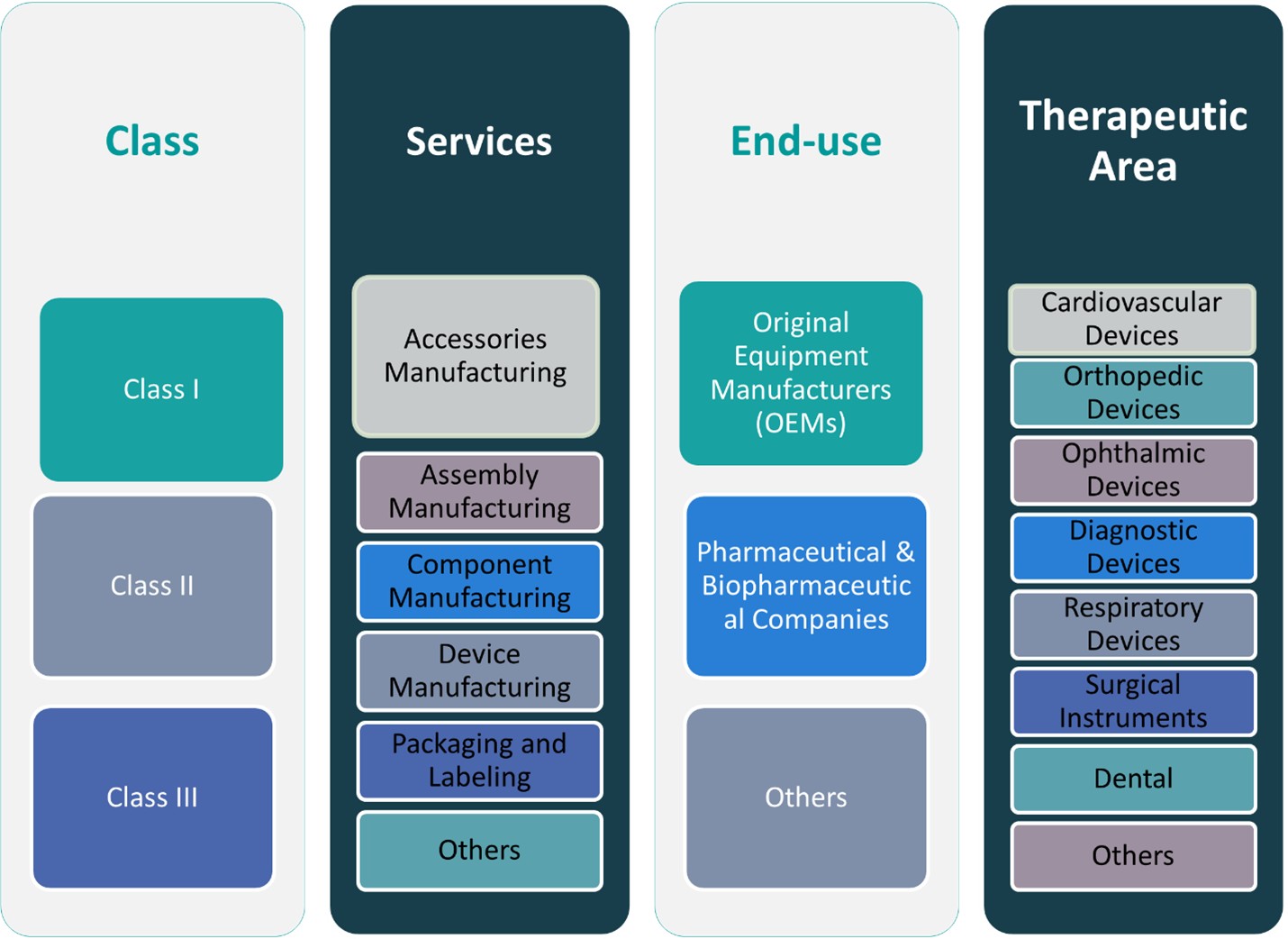
This report segments the North America Medical Device Contract Manufacturing market as follows:
Market Drivers
Growing Demand for Advanced and Cost-Effective Healthcare Solutions
The increasing prevalence of chronic and lifestyle-related diseases, such as diabetes, cardiovascular conditions, and orthopedic disorders, has significantly boosted the demand for innovative and reliable medical devices across North America. As healthcare providers seek cost-effective solutions to manage these growing patient populations, original equipment manufacturers (OEMs) are turning to contract manufacturers to deliver high-quality products at competitive prices. For instance, North America's medical device contract manufacturing sector is expanding as healthcare providers seek cost-effective solutions for managing chronic diseases. By outsourcing production, OEMs can lower operational costs, optimize resource allocation, and accelerate time-to-market, all of which are critical in today’s competitive healthcare landscape. This shift toward outsourcing is further supported by the need for flexibility in scaling production volumes based on fluctuating market demands.
Technological Advancements in Manufacturing Processes
Technological innovation is a key driver transforming the medical device contract manufacturing industry. For instance, the integration of automation, robotics, and 3D printing is revolutionizing medical device production in North America. These technologies also support small batch production and rapid prototyping, which are increasingly important in the development of next-generation medical devices. In addition, the adoption of smart manufacturing practices such as the Internet of Things (IoT), artificial intelligence (AI), and real-time data analytics is enhancing quality control and reducing time and material waste, thus driving productivity and compliance.
Regulatory Complexity and the Need for Compliance Expertise
The North American medical device market is subject to stringent regulatory frameworks, including those established by the U.S. Food and Drug Administration (FDA) and Health Canada. OEMs are increasingly reliant on contract manufacturers with deep regulatory knowledge and robust quality assurance systems to ensure compliance across all stages of the product lifecycle. Partnering with experienced contract manufacturers not only minimizes the risk of regulatory delays and recalls but also streamlines the approval process for new devices. This regulatory expertise has become a key differentiator in the market, as it allows OEMs to maintain focus on innovation while ensuring their products meet strict safety and efficacy standards.
Rising Demand for Device Miniaturization and Smart Technologies
There is a growing trend toward the miniaturization of medical devices, especially in fields such as diagnostics, wearable health monitoring, and implantable technologies. These compact devices require advanced manufacturing techniques and specialized materials, which many OEMs find challenging to manage in-house. Contract manufacturers with capabilities in micro-molding, laser processing, and nano-technology are well-positioned to meet these demands. Additionally, the integration of digital and smart technologies, such as sensors, wireless communication, and data analytics, is increasing the complexity of devices and necessitating multidisciplinary manufacturing expertise. As healthcare moves toward personalized and remote patient care, the role of contract manufacturers in delivering sophisticated, high-tech devices is becoming increasingly vital.
Market Trends
Surge in Outsourcing Across the Product Lifecycle
A key trend shaping the North American medical device contract manufacturing market is the expanding scope of outsourcing beyond just production. For instance, North America's medical device contract manufacturing market is seeing increased collaboration between OEMs and contract manufacturers for services beyond production, including regulatory support and packaging. This end-to-end collaboration helps streamline operations, reduce internal complexities, and accelerate product launches. By leveraging the specialized expertise of contract manufacturers, OEMs can remain agile and competitive in an industry that demands speed, innovation, and precision.
Integration of Digital and Smart Manufacturing Technologies
The adoption of smart manufacturing and digital technologies is transforming the contract manufacturing landscape. Contract manufacturers are integrating advanced capabilities such as the Internet of Things (IoT), machine learning, predictive maintenance, and real-time data analytics into their operations. For instance, contract manufacturers in North America are integrating IoT, machine learning, and predictive maintenance to enhance efficiency and product traceability. Additionally, the use of digital twins and virtual simulation tools enables manufacturers to optimize device designs and production processes before physical manufacturing begins, reducing costs and accelerating time-to-market.
Focus on Sustainable and Compliant Manufacturing Practices
Sustainability is becoming a significant priority in the medical device industry. Contract manufacturers are investing in eco-friendly materials, energy-efficient technologies, and waste-reduction initiatives to align with the environmental goals of OEM partners and regulatory bodies. Moreover, there is a growing emphasis on ethical sourcing, lean manufacturing practices, and compliance with global standards such as ISO 13485 and FDA’s Quality System Regulation (QSR). These efforts not only help meet environmental and regulatory requirements but also enhance brand reputation and stakeholder trust across the value chain.
Increased Demand for Customization and Patient-Centric Solutions
The market is witnessing a rising demand for customized medical devices tailored to specific patient needs and therapeutic applications. This trend is particularly prominent in areas such as orthopedic implants, dental devices, and wearable health monitors. Contract manufacturers are responding by offering greater flexibility in production, investing in modular manufacturing systems, and enhancing their design and engineering capabilities. As personalized medicine gains traction, contract manufacturers who can deliver low-volume, high-mix production with precision and reliability are becoming indispensable partners in the healthcare ecosystem.
Market Challenges Analysis
Navigating Complex Regulatory and Quality Requirements
One of the most significant challenges facing the North American medical device contract manufacturing market is the complexity of regulatory compliance. For instance, North American medical device manufacturers must comply with stringent regulations set by the FDA, Health Canada, and ISO standards. Maintaining compliance with regulations such as FDA’s 21 CFR Part 820 and ISO 13485 requires substantial investment in quality management systems, documentation, audits, and continuous process validation. Any lapses in compliance can result in costly recalls, reputational damage, and loss of client trust. Moreover, the frequent updates to regulatory frameworks and the increasing scrutiny on supply chain traceability add further pressure on contract manufacturers to remain vigilant and adaptable, while also supporting their OEM partners through the regulatory approval processes.
Rising Cost Pressures and Talent Shortages
As demand for advanced and customized medical devices grows, contract manufacturers are under constant pressure to deliver high-quality products at competitive prices. The need to invest in cutting-edge technologies, sustainable manufacturing practices, and skilled labor contributes to rising operational costs. At the same time, pricing pressures from OEMs seeking cost efficiencies can strain profit margins. Additionally, the industry is facing a talent shortage, particularly in specialized areas such as microfabrication, biomedical engineering, and regulatory affairs. Attracting and retaining qualified professionals is becoming increasingly difficult amid growing competition and an aging workforce. These challenges are compounded by global supply chain disruptions, which have led to fluctuating raw material prices and extended lead times, further affecting production planning and cost control. To remain competitive, contract manufacturers must strategically balance cost-efficiency, innovation, and workforce development while maintaining stringent quality standards.
Market Opportunities
The North America Medical Device Contract Manufacturing market presents significant growth opportunities driven by the increasing demand for specialized and value-added services. As medical technologies evolve, OEMs are seeking strategic partnerships with contract manufacturers that can provide comprehensive solutions, including product development, regulatory support, and lifecycle management. This shift toward full-service outsourcing allows contract manufacturers to become integrated partners in the innovation process, creating long-term value through collaboration. Moreover, the rise in complex and high-tech devices-such as diagnostic imaging systems, wearable sensors, and implantable devices-opens doors for manufacturers with advanced engineering capabilities and expertise in high-precision manufacturing techniques. Companies that invest in these competencies are well-positioned to capture a greater share of this rapidly expanding market.
In addition, the increasing focus on personalized medicine and patient-specific solutions presents opportunities for contract manufacturers to offer low-volume, high-mix production capabilities. Demand for customized products in orthopedics, cardiology, and neurology is driving the need for flexible, adaptive manufacturing models supported by technologies like 3D printing and computer-aided design. The market is also poised to benefit from the growing adoption of connected healthcare devices and smart technologies, which require integration of electronics, software, and wireless capabilities. Contract manufacturers that can deliver turnkey solutions for such hybrid devices are likely to see rising demand. Furthermore, as OEMs look to expand into emerging markets or navigate complex regulatory environments, they will increasingly rely on partners with global supply chain networks and localized compliance expertise. These trends collectively underscore a wealth of opportunities for contract manufacturers that are agile, technologically advanced, and capable of delivering comprehensive, end-to-end solutions tailored to the evolving needs of the healthcare sector.
Market Segmentation Analysis:
By Class:
The North America medical device contract manufacturing market is segmented by device classification into Class I, Class II, and Class III devices, each reflecting varying degrees of risk and regulatory oversight. Among these, Class II devices-such as infusion pumps, surgical drapes, and diagnostic equipment-account for the largest market share, driven by high demand and moderate regulatory requirements that allow for quicker manufacturing cycles. Class I devices, which include low-risk items like bandages and handheld surgical instruments, represent a significant volume of manufacturing due to their simplicity and routine usage in clinical settings. However, the Class III segment, which includes life-sustaining or life-supporting devices such as pacemakers and implantable defibrillators, is witnessing notable growth. This growth is fueled by rising incidences of chronic diseases and advancements in implantable technology. Though Class III devices require the most stringent compliance and validation protocols, their high margins and growing clinical importance present substantial opportunities for contract manufacturers with the necessary regulatory expertise and technical capabilities.
By Services:
Based on services, the market is segmented into accessories manufacturing, assembly manufacturing, component manufacturing, device manufacturing, packaging and labelling, and others. Device manufacturing holds the largest share, as OEMs increasingly outsource full device production to reduce costs and enhance operational focus. Component manufacturing also constitutes a significant segment, supporting the production of high-precision parts required in complex devices. Assembly manufacturing is gaining traction as manufacturers seek streamlined, turnkey production solutions. Packaging and labelling services are expected to experience steady growth, driven by rising regulatory emphasis on traceability, safety, and brand integrity. Accessories manufacturing and other support services-including sterilization and logistics-add value by complementing core manufacturing processes and ensuring compliance with end-to-end regulatory standards. As the demand for integrated, end-to-end solutions continues to grow, contract manufacturers offering a wide portfolio of services under one roof will be better positioned to attract OEM partnerships and expand their market presence across the North American healthcare landscape.
Segments:
Based on Class:
- Class I
- Class II
- Class III
Based on Services:
- Accessories Manufacturing
- Assembly Manufacturing
- Component Manufacturing
- Device Manufacturing
- Packaging and Labelling
- Others
Based on End- Use:
- Original Equipment Manufacturers (OEMs)
- Pharmaceutical & Biopharmaceutical Companies
- Others
Based on Therapeutic Area:
- Cardiovascular Devices
- Orthopedic Devices
- Ophthalmic Devices
- Diagnostic Devices
- Respiratory Devices
- Surgical Instruments
- Dental
- Others
Based on the Geography:
- S.
- Canada
- Mexico
Regional Analysis
United States
The United States holds the dominant share of the North America medical device contract manufacturing market, accounting for approximately 76% of the regional market in 2024. This leadership is driven by a robust healthcare infrastructure, advanced manufacturing capabilities, and a high concentration of major original equipment manufacturers (OEMs) and contract manufacturing organizations (CMOs). The U.S. benefits from a strong regulatory framework led by the FDA, which, while stringent, fosters innovation and ensures high standards. In addition, the country's ongoing demand for technologically advanced and high-performance medical devices ranging from minimally invasive surgical tools to implantable electronics-continues to fuel outsourcing needs. The presence of numerous industry leaders, access to skilled labor, and continuous investment in R&D make the U.S. a hub for both domestic and international contract manufacturing activity.
Canada
Canada contributes around 12% of the North American market and is steadily expanding its footprint due to a supportive regulatory environment and growing investments in healthcare innovation. Health Canada's streamlined approval processes and commitment to quality standards make it an attractive location for both domestic and cross-border contract manufacturing partnerships. Canadian contract manufacturers are increasingly focusing on niche technologies such as wearable health tech, diagnostics, and home care devices. The government’s support for medical technology startups and collaborative research programs has further bolstered Canada's role as a competitive player in the regional market. Additionally, the country’s proximity to the U.S. facilitates efficient cross-border logistics and collaboration, enhancing its appeal for OEMs looking for nearshore manufacturing solutions.
Mexico
Mexico accounts for approximately 9% of the North American medical device contract manufacturing market and is emerging as a strategic outsourcing destination, particularly for cost-sensitive production needs. Mexico offers competitive labor costs, free trade agreements such as the USMCA, and a growing network of medical device manufacturing clusters in regions like Baja California. Its proximity to the U.S. enables reduced transportation times and costs, making it an attractive option for OEMs seeking to optimize their supply chains. Furthermore, the Mexican government’s efforts to enhance quality and regulatory standards are improving the country’s credibility and appeal to global manufacturers, especially for the production of Class I and Class II devices.
Key Player Analysis
- Jabil Healthcare
- Integer Holdings
- Flex Health Solutions
- TE Connectivity
- Viant Medical
Competitive Analysis
The North American medical device contract manufacturing market is highly competitive, with several key players offering specialized services across various stages of product development and manufacturing. Leading companies in this space include Jabil, TE Connectivity, Flex Ltd., Integer Holdings Corporation, and Viant Medical. Companies in this market increasingly prioritize advanced manufacturing technologies, such as automation, robotics, and smart manufacturing, to improve production efficiency, reduce costs, and meet the growing demand for customized, high-quality devices. Furthermore, regulatory compliance remains a critical factor, as manufacturers must adhere to stringent standards set by authorities like the FDA and Health Canada. Many companies invest in building strong regulatory expertise to navigate these complex frameworks effectively, ensuring quicker time-to-market and reduced risk of product recalls. Additionally, trends like the growing demand for personalized healthcare solutions, wearable devices, and connected technologies continue to shape the competitive landscape. To maintain a competitive edge, contract manufacturers also focus on offering flexible, end-to-end services, from product design to post-market support, catering to the evolving needs of OEMs and healthcare providers. The ability to adapt to these trends, leverage technological advancements, and maintain regulatory compliance is key to success in this rapidly evolving market.
Recent Developments
- In February 2025, Jabil completed the acquisition of Pii, a contract development and manufacturing organization (CDMO) specializing in aseptic filling, lyophilization, and oral solid dose manufacturing.
- In November 2024, Integer completed the sale of its non-medical Electrochem business for $50 million, making it a pure-play medical technology company and allowing it to redeploy capital into high-growth medtech markets.
- In October 2024, At CPHI Milan 2024, Thermo Fisher launched its Accelerator Drug Development platform, a 360° CDMO and CRO offering. This service provides customizable manufacturing, clinical research, and supply chain solutions for small molecules, biologics, and cell and gene therapies, covering the full drug development lifecycle.
Market Concentration & Characteristics
The North America medical device contract manufacturing market exhibits a moderate to high level of concentration, with a few large players dominating the landscape while several smaller, specialized firms cater to niche segments. The market is characterized by intense competition among established contract manufacturers that offer end-to-end solutions, including design, prototyping, production, and regulatory compliance services. These firms often differentiate themselves through technological innovation, such as the integration of automation, smart manufacturing, and advanced materials to meet the rising demand for complex medical devices. The market also reflects a growing trend toward customization and personalized healthcare solutions, with manufacturers offering flexible, low-volume, high-mix production capabilities. Regulatory compliance remains a critical feature, as companies must navigate stringent standards imposed by agencies such as the FDA and Health Canada. Overall, the market is driven by a combination of large-scale players with global reach and smaller, specialized firms that focus on specific device types or regions.
Report Coverage
The research report offers an in-depth analysis based on Class, Services, End-Use, Therapeutic Area and Geography. It details leading market players, providing an overview of their business, product offerings, investments, revenue streams, and key applications. Additionally, the report includes insights into the competitive environment, SWOT analysis, current market trends, as well as the primary drivers and constraints. Furthermore, it discusses various factors that have driven market expansion in recent years. The report also explores market dynamics, regulatory scenarios, and technological advancements that are shaping the industry. It assesses the impact of external factors and global economic changes on market growth. Lastly, it provides strategic recommendations for new entrants and established companies to navigate the complexities of the market.
Future Outlook
- The North America medical device contract manufacturing market will continue to experience robust growth, driven by technological advancements and increasing demand for complex devices.
- Increased outsourcing of non-core manufacturing activities by OEMs will further fuel market expansion as companies seek cost-effective solutions.
- The demand for personalized and patient-centric devices will rise, prompting manufacturers to focus on low-volume, high-mix production capabilities.
- The adoption of smart manufacturing technologies, such as automation, AI, and IoT, will improve efficiency, reduce costs, and enhance product quality.
- Regulatory compliance will remain a key challenge, driving manufacturers to invest in quality systems and specialized expertise to navigate stringent standards.
- The growth of wearable medical devices and homecare solutions will offer significant opportunities for contract manufacturers to innovate and cater to emerging trends.
- Increasing collaboration between contract manufacturers and OEMs will lead to more integrated, end-to-end solutions for medical device production.
- The rise of advanced materials and 3D printing technologies will enable the production of more complex and customized medical devices.
- Market consolidation is likely as larger companies acquire smaller, specialized firms to expand their capabilities and access new technologies.
- North American manufacturers will continue to capitalize on nearshoring opportunities, with Mexico offering cost-effective solutions and proximity to the U.S. market.

Request a Free Sample
Fill in your details and we'll send you a free sample report.
- Sample data tables & charts
- Research methodology
Need a Custom Version of This Report?
Tailor the scope, geography, or segments to your exact requirements.
- Custom geography or segment scope
- Direct access to our analyst team
Frequently Asked Questions
What is the current size of the North America Medical Device Contract Manufacturing?
What factors are driving the growth of the North America Medical Device Contract Manufacturing?
What are the key segments within the North America Medical Device Contract Manufacturing?
Who are the major players in the North America Medical Device Contract Manufacturing?
Table of Content
Chapter 1. Report Introduction
- 1.1 Report Description & Purpose
- 1.1.1 Report Title & Market Definition
- 1.1.2 Unique Selling Propositions (USP) & Key Differentiators
- 1.1.3 Value Proposition for Stakeholders
- 1.2 Research Objectives
- 1.2.1 Market Sizing Objectives (Volume & Revenue) (Volume Where Applicable)
- 1.2.2 Segmentation Objectives
- 1.2.3 Competitive Intelligence Objectives
- 1.2.4 Forecast & Scenario Objectives
- 1.3 Report Scope
- 1.3.1 North America Medical Device Contract Manufacturing Scope – Segments & Subsegments Covered
- 1.3.2 Geographic Scope – Selected Region & Countries Covered
- 1.3.3 Historical Period, Base Year & Forecast Period (2024; forecast to 2032)
- 1.3.4 Inclusions & Exclusions
- 1.4 Industry Classification & Applicable Codes
- 1.5 Currency, Measurement Units & Valuation Basis
- 1.6 Target Stakeholders
- 1.7 Limitations & Assumptions
Chapter 2. Executive Summary
- 2.1 North America Medical Device Contract Manufacturing Snapshot
- 2.1.1 Market Size – Historical (2024) & Forecast (2024-2032) (2024: USD 24,090.98 million → 2032: USD 57,552.59 million)
- 2.1.2 Volume & Revenue – Regional Totals (Volume Where Applicable)
- 2.1.3 Key Market Highlights – Top Five Facts
- 2.2 North America Medical Device Contract Manufacturing Segmentation Snapshot
- 2.2.1 Market Split by Country – 2024 vs. 2032
- 2.3 Competitive Snapshot
- 2.3.1 Top 10 Players by Revenue Share – 2024
- 2.3.2 Top 10 Players by Volume Share – 2024 (Volume Where Applicable)
- 2.3.3 Recent Strategic Developments (18-Month Summary)
- 2.4 Key Investment Highlights & Strategic Conclusions
Chapter 3. North America Medical Device Contract Manufacturing Dynamics & Industry Analysis
- 3.1 Market Overview & Context
- 3.1.1 North America Medical Device Contract Manufacturing Position in the Broader Industry Value Chain
- 3.1.2 Demand Structure & Purchasing Dynamics
- 3.1.3 Market Maturity & Development Stage by Country
- 3.2 North America Medical Device Contract Manufacturing Drivers
- 3.3 North America Medical Device Contract Manufacturing Restraints & Challenges
- 3.4 North America Medical Device Contract Manufacturing Opportunities
- 3.5 Porter's Five Forces Analysis
- 3.5.1 Threat of New Entrants
- 3.5.2 Bargaining Power of Suppliers
- 3.5.3 Bargaining Power of Buyers
- 3.5.4 Threat of Substitutes
- 3.5.5 Competitive Rivalry – Intensity Assessment
- 3.6 North America Medical Device Contract Manufacturing Value Chain Analysis
- 3.6.1 Upstream – Key Inputs, Resources & Suppliers
- 3.6.1.1 Key Input/Resource 1
- 3.6.1.2 Key Input/Resource 2
- 3.6.1.3 Key Input/Resource 3
- 3.6.2 Midstream – Core Operations & Value Creation
- 3.6.2.1 Operating Model & Process Overview
- 3.6.2.2 Key Operating Locations & Capabilities by Company
- 3.6.3 Downstream – Market Channels & End Users
- 3.6.3.1 Direct Sales & Customer Engagement Channels
- 3.6.3.2 Indirect Sales, Intermediaries & Partner Channels
- 3.6.4 Value Chain Profitability Analysis
- 3.6.1 Upstream – Key Inputs, Resources & Suppliers
- 3.7 PESTEL Analysis
- 3.7.1 Political Factors
- 3.7.2 Economic Factors
- 3.7.3 Social Factors
- 3.7.4 Technological Factors
- 3.7.5 Environmental Factors
- 3.7.6 Legal Factors
- 3.8 North America Medical Device Contract Manufacturing Supply Chain Analysis
- 3.8.1 Critical Input & Resource Availability Risk Assessment
- 3.8.2 Supplier & Operational Concentration Risk (Geographic Exposure)
- 3.8.3 Supply & Service Disruption Impact Analysis
- 3.9 Regional & Country Regulatory Landscape
Note: The regulatory and policy landscape section covers regulations based on their applicability to the market, North America Medical Device Contract Manufacturing category, geography, and scope of the study. Only regulatory frameworks with a material impact on operations, compliance, trade, sustainability, or market access are analyzed in detail.
Chapter 4. Key Investment Pockets & Opportunity Analysis
- 4.1 North America Medical Device Contract Manufacturing Attractiveness Analysis
- 4.1.1 By Country – Investment Attractiveness Matrix (Market Size × CAGR)
- 4.2 Absolute Revenue Growth Opportunity
- 4.2.1 By Country – Absolute Revenue Growth Through 2032
- 4.3 Incremental Demand Opportunity
- 4.3.1 By Country – Incremental Demand Through 2032
- 4.3.2 Segment – Incremental Demand
- 4.4 Emerging Submarket Opportunity Deep Dive (Subject to Applicability)
- 4.5 Priority Country Opportunity Scorecards
- 4.5.1 Priority Country 1
- 4.5.2 Priority Country 2
- 4.5.3 Priority Country 3
- 4.5.4 Priority Country 4
Note: Priority countries are selected from within the region covered by the study. Numbered entries are indicative and are populated with relevant country names based on market size, growth potential, and strategic relevance.
Chapter 5. North America Medical Device Contract Manufacturing Cross-Border Trade & Market Access Analysis
- 5.1 Intra-Regional & Extra-Regional Trade Overview
- 5.1.1 Regional Export Value by Country (2024)
- 5.1.2 Regional Export Volume by Country (2024) (Volume Where Applicable)
- 5.1.3 Regional Import Value by Country (2024)
- 5.1.4 Regional Import Volume by Country (2024) (Volume Where Applicable)
- 5.1.5 Net Trade Balance by Country (2024)
- 5.2 Export Analysis – Segment
- 5.2.1 Category 1 (Applicable Classification Code)
- 5.2.2 Category 2 (Applicable Classification Code)
- 5.2.3 Category 3 (Applicable Classification Code)
- 5.2.4 Category 4 (Applicable Classification Code)
- 5.2.5 Category 5 (Applicable Classification Code)
- 5.3 Import Analysis – Segment
- 5.3.1 Category 1 (Applicable Classification Code)
- 5.3.2 Category 2 (Applicable Classification Code)
- 5.3.3 Category 3 (Applicable Classification Code)
- 5.3.4 Category 4 (Applicable Classification Code)
- 5.3.5 Category 5 (Applicable Classification Code)
- 5.4 Cross-Border Pricing & Transaction Benchmarks
- 5.4.1 Export Pricing – Segment & Country
- 5.4.2 Import Pricing – Segment & Source Country
- 5.4.3 Price Trends (2024)
- 5.5 Key Cross-Border Trade & Delivery Routes
- 5.5.1 Cross-Border Trade/Delivery Route 1
- 5.5.2 Cross-Border Trade/Delivery Route 2
- 5.5.3 Cross-Border Trade/Delivery Route 3
- 5.5.4 Cross-Border Trade/Delivery Route 4
- 5.5.5 Cross-Border Trade/Delivery Route 5
- 5.6 Trade Policy & Market Access Impact Assessment
- 5.6.1 Tariff & Non-Tariff Barriers
- 5.6.2 Regional Trade & Economic Integration Frameworks
- 5.6.3 Bilateral & Multilateral Trade Agreements
- 5.6.4 Cross-Border Operating, Licensing & Localization Requirements
Note: Cross-border analysis applies where relevant to North America Medical Device Contract Manufacturing. Country trade flows distinguish intra-regional activity from trade with markets outside the region. Regional external trade totals exclude intra-regional flows to avoid double counting. Classifications and transaction measures follow the market scope; volume and route analyses apply only where meaningful.
Chapter 6. Competitive Landscape & Company Benchmarking
- 6.1 North America Medical Device Contract Manufacturing Concentration & Structure
- 6.1.1 Herfindahl-Hirschman Index (HHI) – vs. 2024
- 6.1.2 Leading, Mid-Sized & Emerging Player Structure
- 6.1.3 Global, Regional & Local Player Dynamics
- 6.2 North America Medical Device Contract Manufacturing Share Analysis – 2024
- 6.2.1 Regional Revenue Share by Company
- 6.2.2 Regional Volume Share by Company (Volume Where Applicable)
- 6.2.3 Company Revenue Share by Country
- 6.2.4 Market Share Evolution ( vs. 2024)
- 6.2.5 Company Market Share by Key Segment
- 6.2.6 Company Market Share by Customer Group
- 6.3 Operating Scale, Capacity & Infrastructure Analysis
- 6.3.1 Regional Operating Scale & Supply Capacity
- 6.3.2 Resource Utilization & Operating Efficiency
- 6.3.3 Output, Service Delivery & Activity Metrics
- 6.3.4 Operating Footprint & Infrastructure Map
- 6.3.5 Planned Operational & Capacity Expansion
- 6.4 North America Medical Device Contract Manufacturing Competitive Benchmarking Matrix
- 6.4.1 Revenue, Growth, Profitability & Operating Metric Comparison
- 6.4.2 Channel Revenue Mix
- 6.4.3 Revenue Exposure by Country Within the Region
- 6.4.4 R&D Intensity
- 6.4.5 Sustainability Maturity
- 6.5 Strategic Developments in North America Medical Device Contract Manufacturing (Last 24 Months)
- 6.5.1 Mergers, Acquisitions & Divestments
- 6.5.2 New Products, Services & Solutions in North America Medical Device Contract Manufacturing
- 6.5.3 Operational & Infrastructure Expansions
- 6.5.4 Strategic Alliances, Joint Ventures & Partnerships
- 6.5.5 Distribution Expansion & Market Entry
- 6.5.6 Sustainability & ESG Initiatives
- 6.6 Competitive Strategy Mapping
- 6.6.1 Leader, Challenger, Follower & Niche Classification
- 6.6.2 Pricing Strategy Comparison
- 6.6.3 Channel Strategy Matrix
Note: Strategic developments are included based on their materiality and the availability of reliable information.
Chapter 7. North America Medical Device Contract Manufacturing – By Sales & Delivery Channel
- 7.1 Segment Overview
- 7.1.1 Volume & Revenue Split by Channel (2024 & 2032) (Volume Where Applicable)
- 7.1.2 Channel Mix Evolution (2024-2032)
Chapter 8. Country Market Analysis – Regional Overview
- 8.1 Country Market Overview Within the Region
- 8.1.1 Country Volume Share Within the Region (Where Applicable)
- 8.1.2 Country Revenue Share Within the Region
- 8.1.3 Market Volume by Country (Where Applicable)
- 8.1.4 Market Revenue by Country
- 8.1.5 Country Forecasts Through 2032
- 8.2 Cross-Country Segment Analysis
- 8.2.1 By Sales & Delivery Channel
- 8.2.2 By Competitive Positioning & Price Tier
Chapter 9. North America Medical Device Contract Manufacturing – Priority Country 1
Chapter 10. North America Medical Device Contract Manufacturing – Priority Country 2
Chapter 11. North America Medical Device Contract Manufacturing – Priority Country 3
Chapter 12. North America Medical Device Contract Manufacturing – Priority Country 4
Chapter 13. North America Medical Device Contract Manufacturing Company Profiles
- 13.1 [Company 01]
- 13.1.1 Company Overview
- 13.1.2 Key Management Personnel
- 13.1.3 Products & Services Portfolio
- 13.1.4 Financial Performance
- 13.1.5 Regional Market Focus & Country Presence
- 13.1.6 Recent Developments & Strategic Initiatives
Note: The company profile list is preliminary and may change based on research findings, market developments, data availability, and client requirements.
Chapter 14. Appendices
- Appendix A – List of Abbreviations & Acronyms
- Appendix B – Industry Classification Code Reference – Full Series
- Appendix C – Supply, Output & Operating Capacity Data Tables
- Appendix D – End-Use & Demand Base Tables
- Appendix E – Demand, Adoption & Usage Assumptions
- Appendix F – Pricing & Revenue Metric Reference Tables
- Appendix G – Company Operations & Infrastructure Database
- Appendix H – Cross-Border Trade & Activity Data Tables (Where Applicable)
- Appendix I – Regulatory Summary Tables
- Appendix J – Primary Research Participant List (Anonymized)
- Appendix K – Primary Research Questionnaire Framework
- Appendix L – Data Sources & Bibliography
- Appendix M – Market Size Divergence & Source Comparison
Chapter 15. Research Methodology
- 15.1 Research Framework & Philosophy
- 15.2 Secondary Research – Sources, Hierarchy & Data Extraction
- 15.3 Data Modeling – Country-Level Estimates & Regional Aggregation
- 15.4 Primary Research – Stakeholder Framework, LOI & Sample Sizes
- 15.5 Forecast Methodology – Regression, Scenario & Sensitivity Analysis
- 15.6 Quality Control – Four-Layer Validation Framework
- 15.7 Limitations & Standard Assumptions
- 15.8 Disclaimer
