
Market Overview
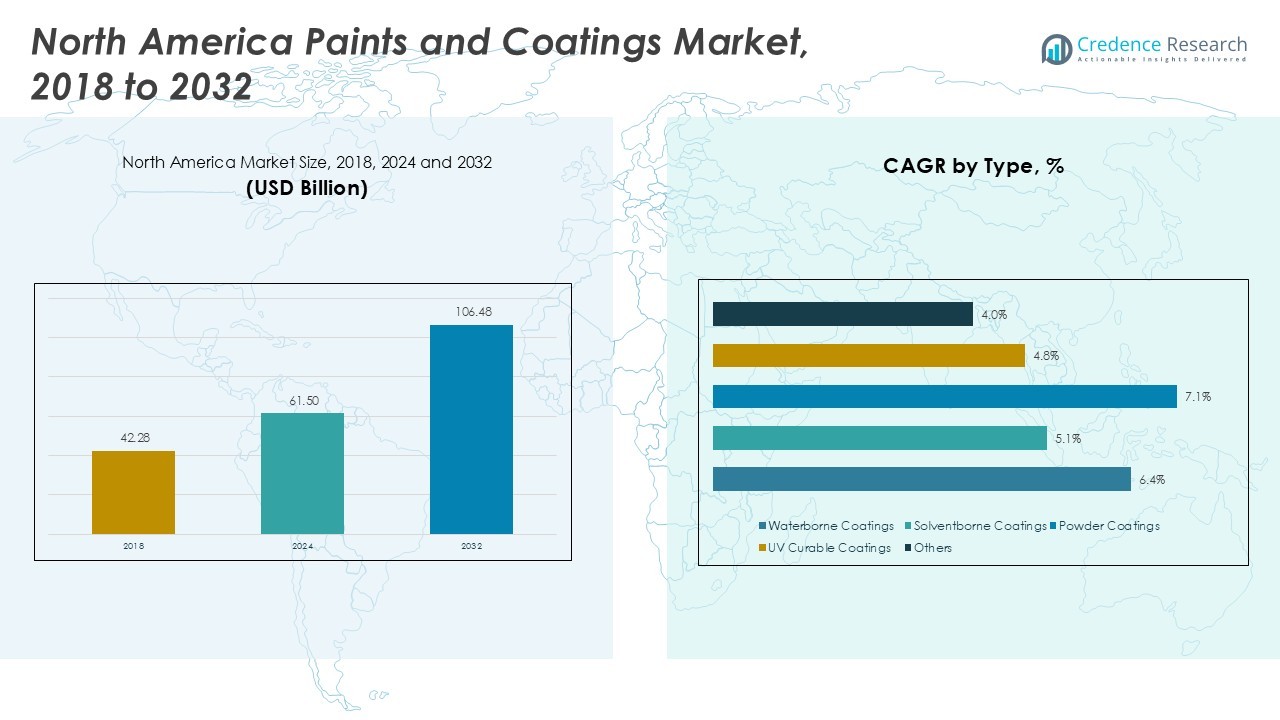
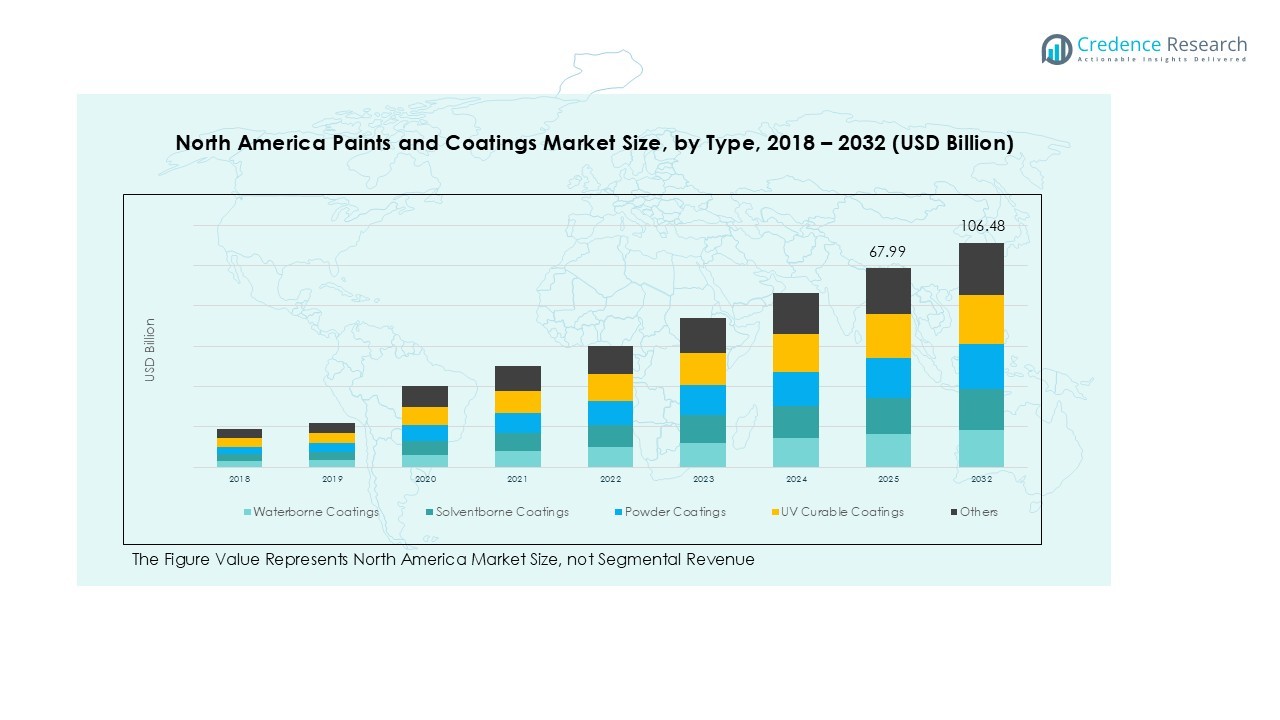
North America Paints and Coatings market size was valued at USD 42.28 Bn in 2018 and grew to USD 61.50 Billion in 2024. The market is anticipated to reach USD 106.48 Billion by 2032, registering a CAGR of 6.6% during the forecast period.
| REPORT ATTRIBUTE | DETAILS |
|---|---|
| Historical Period | 2020-2023 |
| Base Year | 2024 |
| Forecast Period | 2025-2032 |
| North America Paints and Coatings market Size 2024 | USD 61.50 Billion |
| North America Paints and Coatings market , CAGR | 6.6% |
| North America Paints and Coatings market Size 2032 | USD 106.48 Billion |
The North America paints and coatings market is dominated by key players including Sherwin-Williams Company, Akzo Nobel N.V., PPG Industries, Inc., BASF SE, RPM International Inc., Asian Paints Limited, Nippon Paint Holdings Co., Ltd., Kansai Paint Co., Ltd., Axalta Coating Systems, and Jotun A/S. These companies lead through innovation, sustainable product offerings, and strategic expansions, catering to residential, commercial, automotive, and industrial sectors. The United States is the largest regional contributor, holding a 68% market share, driven by robust construction activity, automotive production, and regulatory support for eco-friendly coatings. Canada follows with a 20% share, benefiting from infrastructure projects and industrial demand, while Mexico accounts for 12%, supported by growing industrialization and construction initiatives. Together, these regions shape the North American market, providing significant opportunities for growth in high-performance and environmentally compliant coatings.
Market Insights
- North America paints and coatings market was valued at USD 61.50 Bn in 2024 and is projected to reach USD 106.48 Bn by 2032, growing at a CAGR of 6.6%. Waterborne coatings dominate the type segment with a 38% share, while acrylic coatings lead the technology segment with 32% share. Residential construction holds the largest end-user segment with 35% share.
- Market growth is driven by increasing demand for eco-friendly, low-VOC coatings and rising construction and renovation activities across the United States, Canada, and Mexico.
- Key trends include adoption of advanced coating technologies such as UV-curable and powder coatings, along with digital and automated application systems, enhancing efficiency and product performance.
- Competitive landscape is dominated by Sherwin-Williams, PPG Industries, Akzo Nobel, BASF, and RPM International, focusing on product innovation, sustainability, and strategic expansions.
- Market restraints include fluctuating raw material costs and strict environmental regulations, impacting pricing and operational efficiency, while regional growth is highest in the United States (68% share), followed by Canada (20%) and Mexico (12%).
Market Segmentation Analysis:
By Type:
The North America paints and coatings market is led by waterborne coatings, accounting for approximately 38% of the type segment. Their increasing adoption is driven by stringent environmental regulations and growing demand for low-VOC solutions across residential and commercial construction. Solventborne coatings follow with a 28% share, valued for their superior durability in industrial applications. Powder coatings (16% share) and UV curable coatings (10% share) are gaining traction due to energy efficiency and faster curing times, while other types contribute the remaining 8%, supporting niche industrial and decorative applications.
- For instance, Axalta Coating Systems LLC and PPG Industries Inc. have intensified competition in North America’s waterborne coatings segment, largely due to their high demand in automotive and architectural applications where low-VOC solutions are prioritized.
By Technology:
In terms of technology, acrylic coatings dominate the North American market, representing nearly 32% of the technology segment, attributed to their versatility, weather resistance, and strong aesthetic appeal. Epoxy coatings hold a 25% share, benefiting from robust performance in industrial and automotive applications. Polyurethane (PU) coatings account for 18%, favored for high-performance protective layers, while alkyd (12%) and polyester coatings (8%) continue to serve decorative and industrial segments. Other technologies, with a 5% share, are gradually emerging, focusing on eco-friendly and UV-curable solutions.
- For instance, PPG Industries offers advanced acrylic coatings in architectural applications known for strong aesthetic appeal and durability.
By End User Industry:
The residential construction sector leads the market with a 35% share, driven by rising housing demand and increased renovation activities. Commercial construction follows at 25%, supported by infrastructure development and sustainable building initiatives. The automotive segment accounts for 20%, benefiting from rising production and the need for corrosion-resistant coatings. Industrial manufacturing (12% share) and other end users (8%) continue to adopt specialized coatings for machinery, equipment, and protective applications, reflecting steady growth driven by performance and regulatory compliance requirements.
Key Growth Drivers
Rising Demand for Eco-Friendly Coatings
The North America paints and coatings market is propelled by increasing demand for environmentally friendly and low-VOC coatings. Regulatory frameworks and stricter emission standards encourage manufacturers and end users to adopt waterborne and powder coatings. Consumers and commercial builders increasingly prefer sustainable products that reduce indoor pollution and environmental impact. This shift not only boosts sales of compliant products but also incentivizes innovation in green technologies, creating long-term growth potential across residential, commercial, and industrial sectors.
- For instance, AkzoNobel has introduced sustainable coating solutions that contribute to healthier living spaces by significantly reducing emissions during application.
Expansion of Construction and Infrastructure Activities
The rapid growth of residential and commercial construction projects in North America drives significant demand for paints and coatings. Renovation and urban infrastructure initiatives stimulate demand for decorative, protective, and durable coatings. Rising urbanization, coupled with government investments in smart buildings and sustainable infrastructure, enhances the market’s scale. This demand spans both private and public projects, increasing the adoption of high-performance coatings, particularly waterborne and acrylic-based products, which offer longevity, aesthetic appeal, and compliance with evolving building standards.
- For instance, Sherwin-Williams provided premium architectural coatings for projects like The Stavros Niarchos Foundation Library and The Epic, emphasizing long-lasting durability and vibrant aesthetics to meet high indoor-air quality standards.
Growth in Automotive and Industrial Manufacturing
The automotive and industrial manufacturing sectors remain critical drivers for paints and coatings growth. Rising vehicle production, coupled with stringent safety and corrosion-resistance requirements, supports epoxy, polyurethane, and powder coatings. Similarly, industrial manufacturers increasingly rely on protective coatings to enhance equipment lifespan and reduce maintenance costs. Technological advancements in coating formulations, including UV-curable and high-durability products, further accelerate adoption, positioning these end-user industries as consistent revenue contributors while supporting innovation-led market expansion.
Key Trends & Opportunities
Technological Advancements in Coating Solutions
Advancements in coating technologies, including UV-curable, powder, and hybrid formulations, are creating new market opportunities. These technologies offer faster curing, higher durability, and lower environmental impact, appealing to both industrial and commercial users. Additionally, smart coatings with anti-corrosion, self-cleaning, and antimicrobial properties are gaining traction. Companies investing in R&D to develop innovative products can capture high-value segments, differentiate their portfolios, and strengthen market positioning, particularly in sectors requiring performance-driven solutions like automotive, aerospace, and industrial manufacturing.
- For instance, AkzoNobel has developed UV-curable powder coatings that cure within seconds under UV light, reducing production cycles and energy use while enabling coating of heat-sensitive substrates in electronics and luxury furniture sectors.
Increasing Adoption of Digital and Automated Coating Systems
The integration of digital and automated coating systems in industrial and commercial applications presents a significant growth opportunity. Automation improves efficiency, consistency, and waste reduction, while reducing labor costs. Advanced spray, robotic, and powder coating systems enhance productivity in high-volume manufacturing and construction projects. Additionally, digital color matching and smart coating technologies allow for precise customization, meeting evolving customer demands. Early adoption of such solutions provides a competitive edge for manufacturers, creating sustainable market expansion and operational efficiency gains.
- For instance, Sprimag's Robot Shuttle System precisely coats complex automotive and electronic parts with flexible programming, minimizing setup time and maximizing productivity.
Key Challenges
Fluctuating Raw Material Prices
Volatility in raw material prices, particularly for solvents, resins, and pigments, poses a major challenge to the North America paints and coatings market. Price fluctuations can impact profit margins, especially for small and mid-sized manufacturers. Supply chain disruptions, global trade uncertainties, and dependence on petrochemical derivatives further exacerbate cost pressures. Manufacturers must adopt strategic sourcing, alternative materials, and efficient production processes to maintain competitiveness, while balancing quality and compliance with environmental regulations.
Strict Environmental and Regulatory Compliance
Compliance with stringent environmental regulations, including VOC limits and hazardous chemical restrictions, presents a persistent challenge for manufacturers. Regulatory requirements demand significant investment in research, reformulation, and production process modifications. Non-compliance can result in fines, restricted market access, and reputational damage. Companies must proactively implement sustainable practices, adopt eco-friendly coatings, and continuously monitor evolving regulations to mitigate risks, ensuring both legal adherence and long-term market sustainability.
Regional Analysis
United States
The United States dominates the North America paints and coatings market, holding a market share of 68%. Strong growth is driven by extensive residential and commercial construction activities, rising automotive production, and increasing adoption of eco-friendly coatings. High demand for decorative and protective coatings supports the waterborne, acrylic, and epoxy segments. Government regulations promoting low-VOC and sustainable products further stimulate market expansion. Major players in the U.S., including Sherwin-Williams and PPG Industries, focus on innovative product launches and strategic acquisitions to strengthen their position, making the country the largest contributor to the regional market’s revenue.
Canada
Canada accounts for a market share of 20% in the North America paints and coatings market. Growth is primarily fueled by urban infrastructure projects, residential renovation activities, and industrial manufacturing requirements. Waterborne and acrylic coatings lead the market due to environmental regulations and performance advantages in cold climates. Automotive and industrial sectors also contribute to demand for high-performance coatings, including epoxy and polyurethane formulations. Leading companies actively invest in sustainable product development and localized manufacturing to meet regulatory standards and customer preferences, positioning Canada as a stable and growing market within the North American region.
Mexico
Mexico holds a market share of 12% in the North America paints and coatings market, driven by industrial growth, automotive production, and expanding residential and commercial construction. Demand for cost-effective, high-performance coatings, including solventborne and waterborne solutions, is increasing. Rapid industrialization and government support for infrastructure development encourage adoption of protective and decorative coatings. Companies operating in Mexico focus on partnerships, distribution network expansion, and localized manufacturing to capitalize on market growth. The rising preference for environmentally compliant coatings also drives innovation and product diversification, strengthening Mexico’s position as a key contributor to the North American paints and coatings landscape.
Market Segmentations:
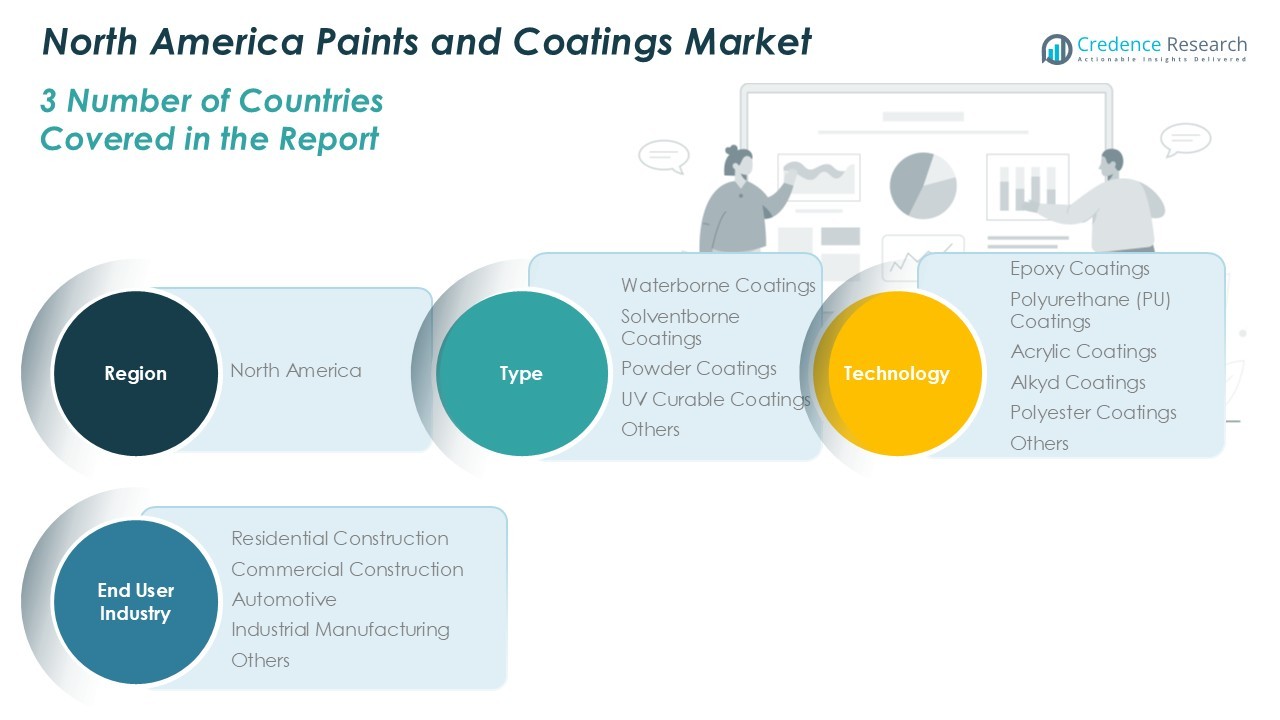
By Type:
- Waterborne Coatings
- Solventborne Coatings
- Powder Coatings
- UV Curable Coatings
- Others
By Technology:
- Epoxy Coatings
- Polyurethane (PU) Coatings
- Acrylic Coatings
- Alkyd Coatings
- Polyester Coatings
- Others
By End User Industry:
- Residential Construction
- Commercial Construction
- Automotive
- Industrial Manufacturing
- Others
By Region
- North America overall
- U.S.
- Canada
- Mexico
Competitive Landscape
The competitive landscape of the North America paints and coatings market is led by Sherwin-Williams Company, Akzo Nobel N.V., PPG Industries, Inc., BASF SE, RPM International Inc., Asian Paints Limited, Nippon Paint Holdings Co., Ltd., Kansai Paint Co., Ltd., Axalta Coating Systems, and Jotun A/S. The market is highly fragmented, with companies focusing on product innovation, sustainable solutions, and expansion of distribution networks to strengthen their market presence. Key players are investing in low-VOC, waterborne, and high-performance coatings to comply with environmental regulations while meeting growing construction, automotive, and industrial demand. Strategic partnerships, mergers, and acquisitions further enhance competitiveness, allowing companies to capture high-value segments. Innovation in digital coating technologies, customized solutions, and eco-friendly formulations continues to drive differentiation, supporting long-term growth and establishing strong brand loyalty in the North American paints and coatings market.
Key Player Analysis
- Sherwin-Williams Company
- Akzo Nobel N.V.
- PPG Industries, Inc.
- BASF SE
- RPM International Inc.
- Asian Paints Limited
- Nippon Paint Holdings Co., Ltd.
- Kansai Paint Co., Ltd.
- Axalta Coating Systems
- Jotun A/S
Recent Developments
- In October 2025, BASF launched biomass-balanced refinish coatings in North America, focusing on sustainability and reducing the carbon footprint in the automotive sector.
- In October 2025, Axalta introduced Alesta® e-PRO FG Black and Alesta® e-PRO Dielectric Gray coatings to enhance heat protection and electrical insulation for electric vehicle batteries.
- In March 2025, BASF formed a strategic partnership with NIO to develop advanced coating technologies with a focus on sustainability and carbon neutrality.
Report Coverage
The research report offers an in-depth analysis based on Type, Technology, End User Industry, and Region. It details leading market players, providing an overview of their business, product offerings, investments, revenue streams, and key applications. Additionally, the report includes insights into the competitive environment, SWOT analysis, current market trends, as well as the primary drivers and constraints. Furthermore, it discusses various factors that have driven market expansion in recent years. The report also explores market dynamics, regulatory scenarios, and technological advancements that are shaping the industry. It assesses the impact of external factors and global economic changes on market growth. Lastly, it provides strategic recommendations for new entrants and established companies to navigate the complexities of the market.
Future Outlook
- The market is expected to grow steadily, driven by increasing construction and infrastructure activities.
- Adoption of eco-friendly and low-VOC coatings will accelerate across residential and commercial sectors.
- Waterborne and acrylic coatings are likely to maintain dominance in their respective segments.
- Automotive and industrial manufacturing will continue to demand high-performance and protective coatings.
- Technological innovations such as UV-curable, powder, and hybrid coatings will create new growth opportunities.
- Digital and automated coating systems will improve application efficiency and reduce waste.
- Companies will focus on R&D and sustainable product development to comply with environmental regulations.
- Strategic partnerships, mergers, and acquisitions will strengthen market positions and expand distribution networks.
- Rising awareness of energy-efficient and long-lasting coatings will drive adoption in industrial and commercial projects.
- North America will remain the leading region, with the United States retaining the largest market share.
Request a Free Sample
Fill in your details and we'll send you a free sample report.
- Sample data tables & charts
- Research methodology
Need a Custom Version of This Report?
Tailor the scope, geography, or segments to your exact requirements.
- Custom geography or segment scope
- Direct access to our analyst team
Frequently Asked Questions
What is the current market size for North America Paints and Coatings market, and what is its projected size in 2032?
At what Compound Annual Growth Rate is the North America Paints and Coatings market projected to grow between 2025 and 2032?
What are the primary factors fueling the growth of the North America Paints and Coatings market?
Which North America Paints and Coatings market segment held the largest share in 2024?
Who are the leading companies in the North America Paints and Coatings market?
Which region commanded the largest share of the North America Paints and Coatings market in 2024?
Table of Content
Chapter 1. Report Introduction
- 1.1 Report Description & Purpose
- 1.1.1 Report Title & Market Definition
- 1.1.2 Unique Selling Propositions (USP) & Key Differentiators
- 1.1.3 Value Proposition for Stakeholders
- 1.2 Research Objectives
- 1.2.1 Market Sizing Objectives (Volume & Revenue)
- 1.2.2 Segmentation Objectives
- 1.2.3 Competitive Intelligence Objectives
- 1.2.4 Forecast & Scenario Objectives
- 1.3 Report Scope
- 1.3.1 North America Paints and Coatings Scope – Types & Subtypes Covered
- 1.3.2 Geographic Scope – Regions & Countries Covered
- 1.3.3 Historical Period, Base Year & Forecast Period (the historical period; forecast to the forecast period)
- 1.3.4 Inclusions & Exclusions
- 1.4 HS Code & Classification Framework
- 1.5 Currency, Units & Pricing Basis
- 1.6 Target Stakeholders
- 1.7 Limitations & Assumptions
Chapter 2. Executive Summary
- 2.1 Global North America Paints and Coatings Market Snapshot
- 2.1.1 Market Size – Historical (the historical period) & Forecast (the forecast period) (base year: NULL → forecast year: NULL)
- 2.1.2 Volume & Revenue – Global Totals
- 2.1.3 Key Market Highlights – Top Five Facts
- 2.2 North America Paints and Coatings Market Segmentation Snapshot
- 2.2.1 Market Split by Region – vs.
- 2.3 Competitive Snapshot
- 2.3.1 Top 10 Players by Revenue Share –
- 2.3.2 Top 10 Players by Volume Share –
- 2.3.3 Recent Strategic Developments (18-Month Summary)
- 2.4 Key Investment Highlights & Strategic Conclusions
Chapter 3. North America Paints and Coatings Market Dynamics & Industry Analysis
- 3.1 Market Overview & Context
- 3.1.1 North America Paints and Coatings Market Position in the Broader Automotive Value Chain
- 3.1.2 OEM vs. Replacement Market Dynamics
- 3.1.3 Market Maturity & Development Stage by Region
- 3.2 North America Paints and Coatings Market Drivers
- 3.3 North America Paints and Coatings Market Restraints & Challenges
- 3.4 North America Paints and Coatings Market Opportunities
- 3.5 Porter's Five Forces Analysis
- 3.5.1 Threat of New Entrants
- 3.5.2 Bargaining Power of Suppliers
- 3.5.3 Bargaining Power of Buyers
- 3.5.4 Threat of Substitutes
- 3.5.5 Competitive Rivalry – Intensity Assessment
- 3.6 North America Paints and Coatings Value Chain Analysis
- 3.6.1 Upstream – Raw Material/Input Suppliers
- 3.6.1.1 Raw Material/Input 1
- 3.6.1.2 Raw Material/Input 2
- 3.6.1.3 Raw Material/Input 3
- 3.6.2 Midstream – Production/Manufacturing/Service Delivery
- 3.6.2.1 Production/Process Overview
- 3.6.2.2 Key Facility Locations & Capacity by Manufacturer
- 3.6.3 Downstream – Distribution & End Consumer
- 3.6.3.1 Primary Channel – B2B/OEM
- 3.6.3.2 Secondary Channels – Dealer, Retail, Online, Direct
- 3.6.4 Value Chain Profitability Analysis
- 3.6.1 Upstream – Raw Material/Input Suppliers
- 3.7 PESTEL Analysis
- 3.7.1 Political Factors
- 3.7.2 Economic Factors
- 3.7.3 Social Factors
- 3.7.4 Technological Factors
- 3.7.5 Environmental Factors
- 3.7.6 Legal Factors
- 3.8 North America Paints and Coatings Supply Chain Analysis
- 3.8.1 Raw Material/Input Supply Risk Assessment
- 3.8.2 Manufacturing Concentration Risk (Geographic Exposure)
- 3.8.3 Trade Disruption Impact Analysis
- 3.9 Regulatory & Policy Landscape
Note: The regulatory and policy landscape section covers regulations based on their applicability to the market, North America Paints and Coatings category, geography, and scope of the study. Only regulatory frameworks with a material impact on operations, compliance, trade, sustainability, or market access are analyzed in detail.
Chapter 4. Key Investment Pockets & Opportunity Analysis
- 4.1 North America Paints and Coatings Market Attractiveness Analysis
- 4.1.1 By Region – Investment Attractiveness Matrix (Volume × CAGR)
- 4.2 Absolute Revenue Growth Opportunity
- 4.2.1 By Region – Absolute USD Growth Through the forecast period
- 4.3 Incremental Volume Opportunity
- 4.3.1 By Region – Incremental Volume Through the forecast period
- 4.3.2 Segment – Incremental Volume
- 4.4 Emerging Submarket Opportunity Deep Dive (Subject to Applicability)
- 4.5 Emerging Market Opportunity Scorecards
- 4.5.1 United States
- 4.5.2 Europe
- 4.5.3 Asia
- 4.5.4 Middle East & Africa
Note: Emerging Market Opportunity Scorecards will be included based on relevance and strategic importance. Regions listed are indicative and may vary depending on data availability and market dynamics.
Chapter 5. North America Paints and Coatings Import-Export Analysis & Trade Flows
- 5.1 Global Trade Overview
- 5.1.1 Global Export Value by Country (the historical period)
- 5.1.2 Global Export Volume by Country (the historical period)
- 5.1.3 Global Import Value by Country (the historical period)
- 5.1.4 Global Import Volume by Country (the historical period)
- 5.1.5 Net Trade Balance by Country (the historical period)
- 5.2 Export Analysis – Segment
- 5.2.1 Type 1 (HS Code)
- 5.2.2 Type 2 (HS Code)
- 5.2.3 Type 3 (HS Code)
- 5.2.4 Type 4 (HS Code)
- 5.2.5 Type 5 (HS Code)
- 5.3 Import Analysis – Segment
- 5.3.1 Type 1 (HS Code)
- 5.3.2 Type 2 (HS Code)
- 5.3.3 Type 3 (HS Code)
- 5.3.4 Type 4 (HS Code)
- 5.3.5 Type 5 (HS Code)
- 5.4 Average Unit Trade Prices
- 5.4.1 Average Export Price – Segment & Country
- 5.4.2 Average Import Price – Segment & Source Country
- 5.4.3 Price Trends (the historical period)
- 5.5 Key Trade Route Analysis
- 5.5.1 Trade Route 1
- 5.5.2 Trade Route 2
- 5.5.3 Trade Route 3
- 5.5.4 Trade Route 4
- 5.5.5 Trade Route 5
- 5.6 Trade Policy Impact Assessment
- 5.6.1 US Anti-Dumping & Section 301 Tariffs
- 5.6.2 EU Customs Union Impact
- 5.6.3 Major Free Trade Agreements
- 5.6.4 USMCA Rules of Origin
Note: Trade policy analysis will be included only where relevant to the North America Paints and Coatings market.
Chapter 6. Competitive Landscape & Company Benchmarking
- 6.1 North America Paints and Coatings Market Concentration & Structure
- 6.1.1 Herfindahl-Hirschman Index (HHI) – vs.
- 6.1.2 Tier 1, Tier 2 & Tier 3 Market Structure
- 6.1.3 Global, Regional & Local Player Dynamics
- 6.2 North America Paints and Coatings Market Share Analysis –
- 6.2.1 Global Revenue Share by Company
- 6.2.2 Global Volume Share by Company
- 6.2.3 Regional Revenue Share
- 6.2.4 Market Share Evolution ( vs. )
- 6.2.5 OEM Segment Share by Company
- 6.2.6 Replacement Segment Share by Company
- 6.3 Production/Delivery Capacity & Facility Analysis
- 6.3.1 Global Installed Capacity
- 6.3.2 Capacity Utilization Rates
- 6.3.3 Production/Output Volume
- 6.3.4 Facility Locations & Capacity Map
- 6.3.5 Planned Capacity Additions
- 6.4 North America Paints and Coatings Competitive Benchmarking Matrix
- 6.4.1 Revenue, Volume, CAGR & Profitability Comparison
- 6.4.2 Channel Revenue Mix
- 6.4.3 Geographic Revenue Exposure
- 6.4.4 R&D Intensity
- 6.4.5 Sustainability Maturity
- 6.5 Strategic Developments in North America Paints and Coatings (Last 24 Months)
- 6.5.1 Mergers, Acquisitions & Divestments
- 6.5.2 New North America Paints and Coatings Launches
- 6.5.3 Facility Expansions
- 6.5.4 Strategic Alliances, Joint Ventures & Partnerships
- 6.5.5 Distribution Expansion & Market Entry
- 6.5.6 Sustainability & ESG Initiatives
- 6.6 Competitive Strategy Mapping
- 6.6.1 Leader, Challenger, Follower & Niche Classification
- 6.6.2 Pricing Strategy Comparison
- 6.6.3 Channel Strategy Matrix
Note: Strategic developments are included based on their materiality and the availability of reliable information.
Chapter 7. Global North America Paints and Coatings Market – By Distribution Channel
- 7.1 Segment Overview
- 7.1.1 Volume & Revenue Split by Channel ( & )
- 7.1.2 Channel Mix Evolution (the forecast period)
Chapter 8. Regional Market Analysis – Global Overview
- 8.1 Global Regional Overview
- 8.1.1 Regional Volume Share
- 8.1.2 Regional Revenue Share
- 8.1.3 Regional Volume by Region
- 8.1.4 Regional Revenue by Region
- 8.1.5 Regional Forecast Through the forecast period
- 8.2 Cross-Regional Segment Analysis
- 8.2.1 By Distribution Channel
- 8.2.2 By Brand/Price Tier
Chapter 9. North America North America Paints and Coatings Market
- 9.1 United States
- 9.2 Canada
- 9.3 Mexico
Chapter 10. Europe North America Paints and Coatings Market
- 10.1 Germany
- 10.2 France
- 10.3 Italy
- 10.4 United Kingdom
- 10.5 Spain
- 10.6 Poland
- 10.7 Russia
- 10.8 Netherlands
- 10.9 Belgium
- 10.10 Sweden
- 10.11 Denmark
- 10.12 Norway
- 10.13 Rest of Europe
Chapter 11. Asia Pacific North America Paints and Coatings Market
- 11.1 China
- 11.2 India
- 11.3 Japan
- 11.4 South Korea
- 11.5 Thailand
- 11.6 Indonesia
- 11.7 Vietnam
- 11.8 Malaysia
- 11.9 Australia
- 11.10 Rest of Asia Pacific
Chapter 12. Latin America North America Paints and Coatings Market
- 12.1 Brazil
- 12.2 Argentina
- 12.3 Colombia
- 12.4 Chile
- 12.5 Rest of Latin America
Chapter 13. Middle East North America Paints and Coatings Market
- 13.1 Saudi Arabia
- 13.2 United Arab Emirates
- 13.3 Turkey
- 13.4 Israel
- 13.5 Iran
- 13.6 Rest of the Middle East
Chapter 14. Africa North America Paints and Coatings Market
- 14.1 South Africa
- 14.2 Egypt
- 14.3 Nigeria
- 14.4 Morocco
- 14.5 Rest of Africa
Chapter 15. North America Paints and Coatings Company Profiles
- 15.1 [Company 01]
- 15.1.1 Company Overview
- 15.1.2 Key Management Personnel
- 15.1.3 Products & Services Portfolio
- 15.1.4 Financial Performance
- 15.1.5 Key Market Focus & Geographic Presence
- 15.1.6 Recent Developments & Strategic Initiatives
Note: The company profile list is preliminary and may change based on research findings, market developments, data availability, and client requirements.
Chapter 16. Appendices
- Appendix A – List of Abbreviations & Acronyms
- Appendix B – Industry Classification Code Reference – Full Series
- Appendix C – Production & Capacity Data Tables
- Appendix D – End-Use & Demand Base Tables
- Appendix E – Consumption & Replacement Rate Assumptions
- Appendix F – ASP Reference Tables
- Appendix G – Manufacturing & Facility Database
- Appendix H – Import-Export Data Tables
- Appendix I – Regulatory Summary Tables
- Appendix J – Primary Research Participant List (Anonymized)
- Appendix K – Primary Research Questionnaire Framework
- Appendix L – Data Sources & Bibliography
- Appendix M – Market Size Divergence & Source Comparison
Chapter 17. Research Methodology
- 17.1 Research Framework & Philosophy
- 17.2 Secondary Research – Sources, Hierarchy & Data Extraction
- 17.3 Data Modeling – Bottom-Up & Top-Down Market Sizing
- 17.4 Primary Research – Stakeholder Framework, LOI & Sample Sizes
- 17.5 Forecast Methodology – Regression, Scenario & Sensitivity Analysis
- 17.6 Quality Control – Four-Layer Validation Framework
- 17.7 Limitations & Standard Assumptions
- 17.8 Disclaimer
