Market Overview:
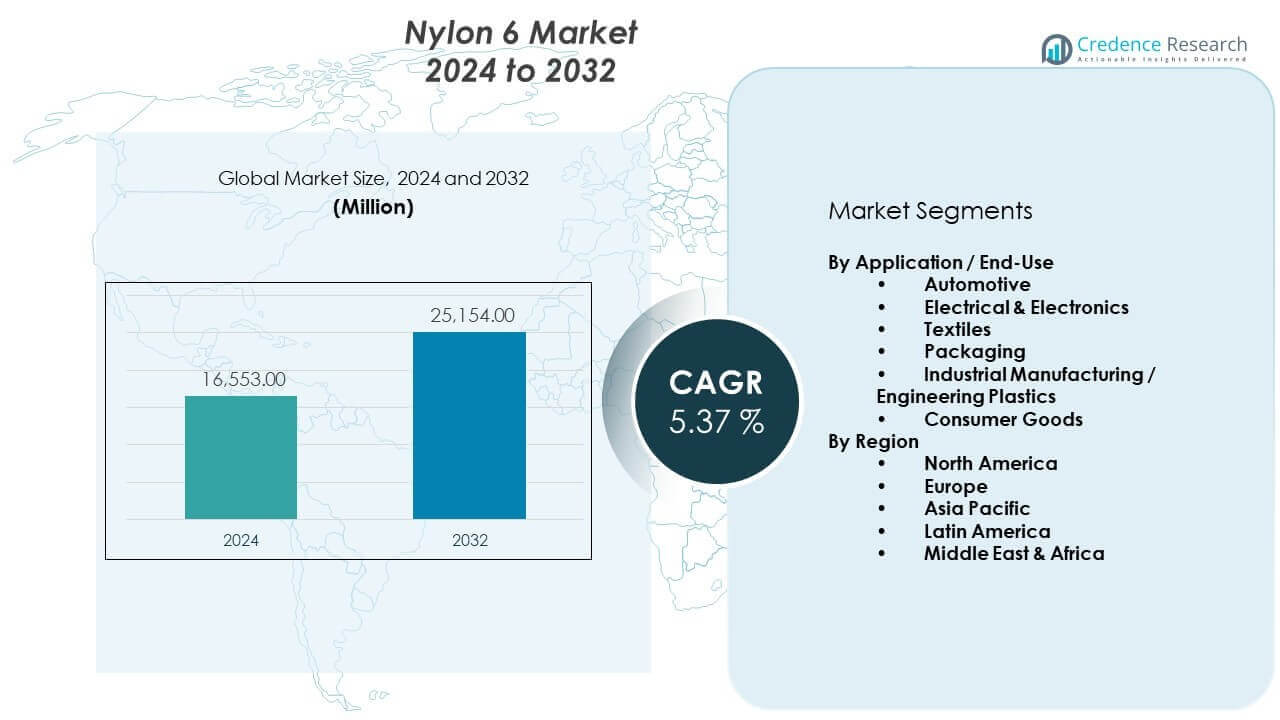
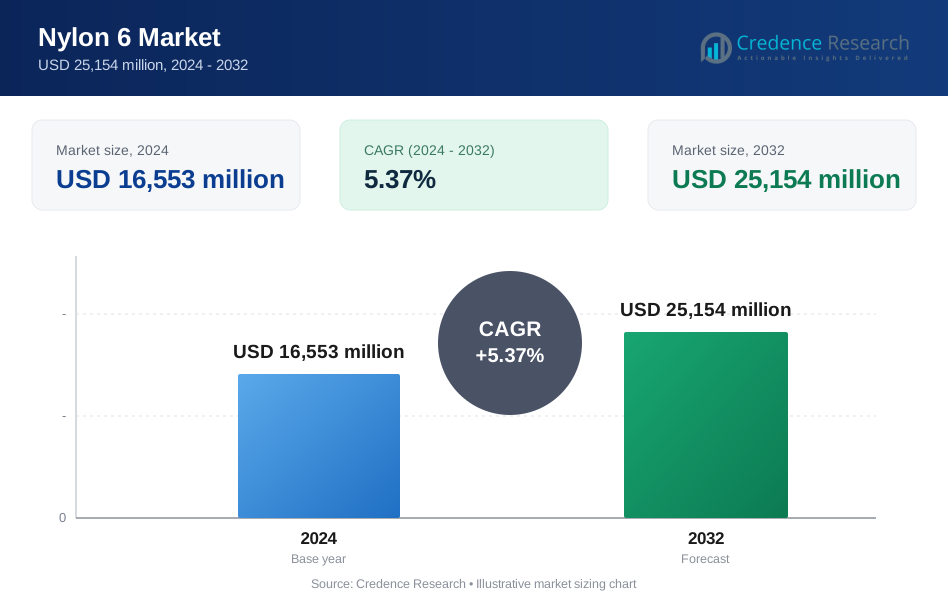
The Nylon 6 market is projected to grow from USD 16,553 million in 2024 to USD 25,154 million by 2032. The market is expected to record a compound annual growth rate of 5.37% from 2024 to 2032.
| REPORT ATTRIBUTE | DETAILS |
|---|---|
| Historical Period | 2020-2023 |
| Base Year | 2024 |
| Forecast Period | 2025-2032 |
| Nylon 6 Market Size 2024 | USD 16,553 million |
| Nylon 6 Market, CAGR | 5.37% |
| Nylon 6 Market Size 2032 | USD 25,154 million |
Demand rises due to wide use in automotive, electrical, and consumer goods sectors. Automakers adopt Nylon 6 to reduce vehicle weight and improve fuel efficiency. Electrical producers rely on the material for insulation and durability. Packaging demand grows due to high barrier and toughness features. Textile producers prefer Nylon 6 for abrasion resistance and dye uptake. Industrial applications benefit from cost efficiency versus alternative polymers. Recycling initiatives also support adoption in sustainable material programs.
Asia Pacific leads due to strong manufacturing bases in China, Japan, and South Korea. The region benefits from high polymer production capacity and end-use demand. Europe shows steady growth driven by automotive engineering and sustainability rules. North America remains a key market due to advanced plastics processing and product innovation. Emerging growth appears in India and Southeast Asia due to expanding textiles and electronics output. These regions gain from rising industrialization and domestic consumption.
Market Insights:
- The market stood at USD 16,553 million in 2024 and is projected to reach USD 25,154 million by 2032, expanding at a CAGR of 5.37%.
- Asia Pacific leads with about 45% share due to strong polymer capacity, followed by Europe at 25% driven by automotive engineering, and North America at 20% supported by advanced plastics processing.
- Asia Pacific is also the fastest-growing region with nearly 45% share, supported by rapid industrialization, expanding textiles, and electronics manufacturing in China, India, and Southeast Asia.
- By application, automotive holds the largest share at around 35% due to lightweight and performance needs in vehicles.
- Textiles account for nearly 25% share, followed by electrical & electronics and packaging, supported by durability, insulation needs, and barrier performance.
Market Drivers:
Rising Automotive Lightweighting And Performance Material Adoption
The Nylon 6 market gains traction from strong automotive light weighting demand. Carmakers replace metal parts with high-strength polymers. Nylon 6 supports weight reduction without strength loss. Heat resistance suits under-the-hood applications. Fuel efficiency targets push polymer use. Component designers value mold flexibility. Cost control supports large-scale adoption. Safety compliance remains achievable with this material.
- For instance, BASF reported weight reductions of 50% to 60% in air-intake systems by replacing traditional aluminum designs with modules made of Ultramid® (Nylon 6).
Expanding Electrical And Electronics Manufacturing Base Worldwide
Electrical manufacturers increase use of Nylon 6 for insulation parts. The material offers stable dielectric performance. Heat tolerance supports compact device design. Consumer electronics rely on durable housings. Industrial connectors need long service life. Production lines favor consistent resin behavior. The Nylon 6 market benefits from electronics output growth. Reliability standards sustain repeat demand.
- For instance, Asahi Kasei validated its LEONA™ PN series (polyamide 66/semi-aromatic alloys) for connectors rated for continuous use at 150°C and above in industrial electronics.
Growth In Industrial Machinery And Engineering Plastics Demand
Industrial equipment producers favor Nylon 6 components. Gears and bearings require wear resistance. Low friction improves equipment efficiency. Chemical resistance suits harsh environments. Fabrication ease supports custom designs. Maintenance cycles extend with polymer parts. The Nylon 6 market sees steady industrial uptake. Cost benefits reinforce material preference.
Rising Textile And Fiber Applications Across Global Markets
Textile producers rely on Nylon 6 fibers for durability. Apparel brands value abrasion resistance. Dye uptake improves color consistency. Sportswear demand supports fiber volumes. Industrial yarns need tensile strength. Production scalability supports mass output. The Nylon 6 market gains from fabric innovation. Fashion cycles sustain material relevance.
Market Trends:
Shift Toward Recyclable And Circular Polymer Solutions
Producers focus on circular material strategies. Mechanical recycling of Nylon 6 gains scale. Brands seek recycled content compliance. Waste reduction targets shape procurement choices. Polymer blends improve reuse quality. Certification supports market acceptance. The Nylon 6 market aligns with circular goals. Sustainability reporting drives material selection.
- For instance, DOMO Chemicals confirmed recycled Nylon 6 grades retaining over 90% mechanical strength versus virgin material.
Advancement In High-Performance Nylon 6 Compounding Techniques
Compounders develop enhanced Nylon 6 grades. Fillers improve stiffness and heat limits. Flame retardant variants expand applications. Process stability improves part quality. Custom compounds meet niche needs. Shorter development cycles support innovation. The Nylon 6 market adopts tailored formulations. End users value performance tuning.
- For instance, Lanxess introduced reinforced Nylon 6 compounds achieving up to 60% glass-fiber content for structural parts.
Increased Use In 3D Printing And Advanced Manufacturing
Additive manufacturing adopts Nylon 6 filaments. Strength supports functional prototypes. Thermal stability aids precision output. Low warpage improves print success. Engineers test parts before mass production. Design freedom supports rapid iteration. The Nylon 6 market enters advanced manufacturing. Innovation pipelines expand material use.
Growing Preference For Bio-Based And Low-Impact Feedstocks
Chemical firms invest in bio-based caprolactam. Carbon footprint reduction guides sourcing. Customers request eco-labeled polymers. Pilot plants test alternative feedstocks. Scale expansion remains gradual. Performance parity remains essential. The Nylon 6 market explores greener pathways. Regulation pressure accelerates adoption.
Market Challenges Analysis:
Volatility In Raw Material Pricing And Supply Stability
Raw material price swings affect production planning. Caprolactam supply depends on petrochemical cycles. Cost unpredictability pressures margins. Contract pricing becomes complex. Smaller producers face sourcing risks. Inventory management requires precision. The Nylon 6 market faces cost uncertainty. Long-term planning remains difficult.
Competition From Alternative Polymers And Material Substitutes
Competing polymers offer similar performance levels. Polyesters attract cost-sensitive buyers. High-temperature plastics challenge premium segments. End users compare lifecycle costs. Material switching lowers loyalty. Innovation pace determines retention. The Nylon 6 market faces substitution pressure. Differentiation becomes critical.
Market Opportunities:
Expansion Of Electric Vehicle And Battery Component Usage
Electric vehicle growth creates new polymer needs. Battery housings need thermal stability. Lightweight materials extend driving range. Structural parts demand durability. Nylon 6 meets safety criteria. Design freedom supports compact layouts. The Nylon 6 market aligns with EV growth. OEM partnerships open new volumes.
Rising Demand From Emerging Manufacturing Economies
Emerging economies expand industrial output. Local plastics processing capacity grows. Infrastructure projects boost polymer demand. Textile and electronics sectors scale fast. Cost-effective materials gain preference. Domestic production reduces import reliance. The Nylon 6 market benefits from expansion. Long-term demand outlook improves.
Market Segmentation Analysis:
By Application / End-Use Overview
The Nylon 6 market shows balanced demand across multiple end-use industries. Automotive, electronics, and textiles account for core consumption. Packaging and consumer goods add volume stability. Industrial manufacturing supports value-driven demand. Material versatility enables cross-sector use. Performance consistency supports repeat adoption. Segment diversity reduces demand risk.
Automotive
Automotive applications use Nylon 6 for lightweight components. Carmakers reduce metal use through polymer substitution. Heat resistance supports engine-area parts. Mechanical strength ensures safety compliance. Mold flexibility enables complex designs. Cost efficiency suits mass production. Demand remains steady across vehicle categories.
- For instance, DuPont reported Nylon 6 use in engine covers delivering up to 25% weight savings versus metal alternatives.
Electrical & Electronics
Electrical producers adopt Nylon 6 for insulation parts. Dielectric stability supports circuit safety. Heat tolerance suits compact devices. Connectors require dimensional precision. Durability extends product life. Processing stability improves output quality. Volume demand tracks electronics growth.
- For instance, UBE Corporation supplies Nylon 6 grades tested for high dielectric strength above 20 kV/mm in electrical components.
Textiles
Textile manufacturers rely on Nylon 6 fibers. Abrasion resistance suits apparel use. Dye affinity supports consistent colors. Industrial yarns need tensile strength. Sportswear drives premium fiber demand. Spinning efficiency supports scale. Replacement cycles sustain volumes.
Packaging
Packaging applications value strength and toughness. Films resist puncture and tearing. Barrier performance protects contents. Thin structures reduce material use. Automation compatibility improves throughput. Food and industrial packaging adopt widely. Demand aligns with logistics growth.
Industrial Manufacturing / Engineering Plastics
Industrial users apply Nylon 6 in gears and bearings. Wear resistance improves equipment life. Low friction supports efficiency. Chemical stability suits harsh settings. Custom grades meet design needs. Maintenance costs remain controlled. Industrial demand stays resilient.
Consumer Goods
Consumer goods producers favor Nylon 6 for durability. Impact resistance protects products. Lightweight design improves usability. Surface finish supports aesthetics. Cost control aids pricing strategy. Design freedom supports variety. Demand remains consistent.
Segmentation:
By Application / End-Use
- Automotive
- Electrical & Electronics
- Textiles
- Packaging
- Industrial Manufacturing / Engineering Plastics
- Consumer Goods
By Region
- North America
- U.S.
- Canada
- Mexico
- Europe
- Germany
- France
- U.K.
- Italy
- Spain
- Rest of Europe
- Asia Pacific
- China
- Japan
- India
- South Korea
- South-east Asia
- Rest of Asia Pacific
- Latin America
- Brazil
- Argentina
- Rest of Latin America
- Middle East & Africa
- GCC Countries
- South Africa
- Rest of the Middle East and Africa
Regional Analysis:
Asia Pacific Dominates Global Consumption
Asia Pacific holds the largest share of the Nylon 6 market, accounting for about 45% of global demand. China leads regional consumption due to strong polymer production capacity. Japan and South Korea support demand through automotive and electronics manufacturing. India shows fast growth from textiles and consumer goods output. Regional supply chains remain well integrated. Cost-efficient manufacturing strengthens competitiveness. It benefits from steady domestic and export demand.
Europe And North America Maintain Strong Positions
Europe represents nearly 25% of the Nylon 6 market share. Germany, France, and Italy drive demand through automotive engineering and industrial plastics. Sustainability focus supports material innovation. North America holds around 20% share. The United States leads regional consumption through advanced plastics processing. Demand comes from automotive, packaging, and consumer goods sectors. It benefits from stable industrial output and technology adoption.
Emerging Growth Across Other Regions
Latin America accounts for close to 5% of the global share. Brazil and Mexico support demand through automotive and packaging uses. Manufacturing expansion improves regional consumption. The Middle East & Africa region also holds about 5% share. Construction activity and consumer goods production drive usage. Import dependence remains high in several countries. Long-term industrial investment supports gradual growth.
Key Player Analysis:
- BASF SE
- DuPont de Nemours, Inc.
- DSM Engineering Materials
- UBE Corporation
- Toray Industries, Inc.
- Ascend Performance Materials
- Lanxess AG
- DOMO Chemicals
- Asahi Kasei Corporation
- Shenma Industrial Co., Ltd.
Competitive Analysis:
The Nylon 6 market shows moderate consolidation with global chemical leaders holding strong positions. Major players compete through capacity expansion and grade differentiation. Product quality, supply reliability, and cost control shape competition. Companies invest in advanced compounding and specialty grades. Automotive and electronics demand drives strategic focus. Regional production footprints support supply chain efficiency. It remains competitive due to material substitution pressure. Innovation and customer partnerships influence long-term positioning.
Recent Developments:
- In October 2025, Lanxess participated in K 2025 showcasing its portfolio of polymer additives, colorants, and heat-stable inorganic pigments for advanced plastic coloring systems. The company introduced Levagard 2100, a next-generation reactive flame retardant that chemically bonds into the polymer matrix, offering superior durability, lower volatility, minimal migration, and reduced VOC emissions compared to conventional approaches. Lanxess maintains a strategic focus on sustainable polyamide solutions through its Durethan polyamide portfolio, leveraging certified carbon footprint assessments and offering bio-based and recycled variants. The company has established partnerships, such as its collaboration with bp on renewable raw materials for polyamide 6 production, reflecting ongoing investment in sustainable manufacturing processes and climate-neutral supply chain objectives targeted for 2050.
- In September 2025, Asahi Kasei unveiled cutting-edge innovations at K 2025, the world's leading plastics and rubber trade fair in Düsseldorf, Germany. The company introduced a new PFAS-free low-friction LEONA™ polyamide grade for European markets, addressing growing regulatory demands and offering friction properties comparable to fluororesins while maintaining excellent processability for industrial applications. Additionally, Asahi Kasei showcased polyamide and SEBS compounds reinforced with bio-based, biodegradable cellulose nanofiber derived from cotton linter, which offers advantages such as reduced viscosity under agitation, making the materials ideal for 3D printing applications. The company continues to advance chemical recycling technologies through partnerships, including an ongoing demonstration project with Microwave Chemical launched in April 2023 aimed at commercializing microwave-based chemical recycling of polyamide 66 by fiscal 2025, with detailed commercialization analysis planned by fiscal 2025.
- In July 2025, BASF announced a transformative acquisition that strengthens its position in polyamide intermediates. The German specialty chemicals giant completed the full acquisition of Alsachimie, taking over the remaining 49% stake from joint venture partner DOMO Chemicals. This acquisition consolidates BASF's control over a critical polyamide precursor facility located on the Franco-German border, which manufactures essential components for PA66 production including KA oil, adipic acid, and AH salt. The move is mission-critical for BASF's European supply chain, particularly for PA66 precursors that serve the automotive and textiles sectors. Prior to this, BASF inaugurated a groundbreaking sustainability initiative in March 2025 when it launched loopamid®, the world's first commercial recycled polyamide 6 production plant in Shanghai, China, with an annual capacity of 500 metric tons. This facility transforms textile waste both post-industrial and post-consumer into virgin-quality recycled PA6, representing a significant step toward circular economy adoption in the textile industry.
- In June 2025, UBE Corporation announced the certification of two new products under its U-BE-INFINITY® eco-product brand, reinforcing the company's commitment to sustainable polyamide solutions. The certified products include bio-circular caprolactam produced by UBE Corporation Europe S.A.U., manufactured using the mass balance method with sustainable raw materials and achieving ISCC PLUS certification, and recycled polyamide composites (DINALON® A2X25-MI H-4109 for PA66 and B2E25 G20DI-4115 for PA6) developed by UBE Composites Europe S.L.U., certified under the AENOR UNE-EN15343 standard. These offerings support the circular economy and decarbonization efforts by reducing reliance on fossil fuels while maintaining performance equivalence to virgin materials. Earlier, in July 2023, UBE introduced an FDA-approved nylon copolyamide grade, UBE NYLON 5036B, featuring low crystallinity and approval for food contact applications, offering improved recyclability compared to other CoPA 6/6.6 grades.
Report Coverage:
The research report offers an in-depth analysis based on By Application / End-Use and By Region segments. It details leading market players, providing an overview of their business, product offerings, investments, revenue streams, and key applications. Additionally, the report includes insights into the competitive environment, SWOT analysis, current market trends, as well as the primary drivers and constraints. Furthermore, it discusses various factors that have driven market expansion in recent years. The report also explores market dynamics, regulatory scenarios, and technological advancements that are shaping the industry. It assesses the impact of external factors and global economic changes on market growth. Lastly, it provides strategic recommendations for new entrants and established companies to navigate the complexities of the market.
Future Outlook:
- The Nylon 6 market will continue to see steady demand from automotive and electronics sectors.
- Lightweight material preference will support long-term adoption across vehicle platforms.
- Recycling and circular material use will gain stronger acceptance among manufacturers.
- Specialty and reinforced Nylon 6 grades will attract higher industrial demand.
- Asia Pacific will remain a key destination for new capacity investments.
- Engineering plastics applications will drive value-oriented growth.
- Research on bio-based feedstocks will progress gradually across producers.
- Cost control will remain critical for sustaining competitive positioning.
- Strategic partnerships will support product development and innovation pipelines.
- End-use diversification will help stabilize demand across economic cycles.
Request a Free Sample
Fill in your details and we'll send you a free sample report.
- Sample data tables & charts
- Research methodology
Need a Custom Version of This Report?
Tailor the scope, geography, or segments to your exact requirements.
- Custom geography or segment scope
- Direct access to our analyst team
Frequently Asked Questions
What is the current market size for Nylon 6 market, and what is its projected size in 2032?
At what Compound Annual Growth Rate is the Nylon 6 market projected to grow between 2025 and 2032?
Which Nylon 6 market segment held the largest share in 2024?
What are the primary factors fueling the growth of the Nylon 6 market?
Who are the leading companies in the Nylon 6 market?
Which region commanded the largest share of the Nylon 6 market in 2024?
Table of Content
Chapter 1 Market Segmentation
- 1.1 Segmentation Framework
- 1.1.1 Product and Service Classification
- 1.1.2 Application and End-Use Classification
- 1.1.3 Technology and Solution Classification
- 1.1.4 Customer and Distribution Channel Classification
- 1.1.5 Geographic Segmentation
- 1.1.6 Market Segment Definitions and Boundaries
Chapter 2 Introduction
- 2.1 Report Objectives and Scope
- 2.2 Product Definition and Industry Terminology
- 2.3 Market Inclusions and Exclusions
- 2.4 Research Process
- 2.4.1 Primary Research and Expert Interviews
- 2.4.2 Secondary Research and Source Review
- 2.4.3 Top-Down and Bottom-Up Estimation
- 2.4.4 Data Triangulation and Verification
- 2.5 Market Size Measurement Basis
- 2.5.1 2024: USD 16,553 million → 2032: USD 25,154 million
- 2.6 Historical and Forecast Reference Periods
- 2.6.1 Base Year: 2024
- 2.6.2 Forecast Period: 2024-2032
- 2.7 Research Assumptions and Limitations
Chapter 3 Executive Summary
- 3.1 Market Snapshot and Key Findings
- 3.2 Base-Year Market Size, 2024
- 3.3 Forecast Market Size, 2032
- 3.4 Revenue and Volume Growth Outlook
- 3.5 Key Demand and Supply Indicators
- 3.6 Leading Market Segments
- 3.7 Fastest-Growing Market Opportunities
- 3.8 Regional Performance Highlights
- 3.9 Technology and Industry Transformation
- 3.10 Competitive Landscape Summary
- 3.11 Analyst View and Strategic Implications
Chapter 4 Global Nylon 6 Market Trends and Developments
- 4.1 Historical Industry Development
- 4.2 Recent Market Trends and Developments
- 4.3 Demand and Customer Behavior Trends
- 4.4 Technology and Product Innovation
- 4.5 Artificial Intelligence, Automation and Digitalization
- 4.6 Local Manufacturing and Supply Chain Realignment
- 4.7 Industry Partnerships, Mergers and Acquisitions
- 4.8 Sustainability and Circular Economy Developments
- 4.9 Government and Private Sector Investment Trends
- 4.10 Emerging Business Models and Commercialization
- 4.11 Industry Developments and Announcements
Chapter 5 Global Nylon 6 Market Production, Supply and Demand Analysis
- 5.1 Demand Trend and Consumption Analysis
- 5.2 Demand Forecast, 2024-2032
- 5.3 Production and Output Trend
- 5.4 Production and Output Forecast, 2024-2032
- 5.5 Installed Capacity and Capacity Utilization
- 5.6 Company-Wise Production Plants and Statistics
- 5.6.1 Installed Production Capacity
- 5.6.2 Actual Production
- 5.6.3 Planned Capacity and Expansion Targets
- 5.7 Supply Chain Structure and Procurement Trends
- 5.8 Supply-Demand Gap and Bottlenecks
- 5.9 Import Dependence and Sourcing Structure
- 5.10 Contract Manufacturing and Outsourcing
- 5.11 Regional Supply and Demand Concentration
Chapter 6 Global Nylon 6 Market Pricing Analysis
- 6.1 Pricing Structure and Measurement
- 6.2 Historical Pricing Trends
- 6.3 Pricing Outlook, 2024-2032
- 6.4 Average Selling Price and Unit Economics
- 6.5 Pricing by Product and Market Segment
- 6.6 Geographic Pricing Differences
- 6.7 Key Input, Energy, Labor and Logistics Costs
- 6.8 Contract Pricing and Purchasing Models
- 6.9 Pricing Sensitivity and Competitive Positioning
- 6.10 Price, Margin and Profitability Implications
Chapter 7 Global Nylon 6 Market Dynamics
- 7.1 Market Growth Drivers
- 7.1.1 Demand-Side Drivers
- 7.1.2 Technology and Innovation Drivers
- 7.1.3 Infrastructure and Investment Drivers
- 7.1.4 Regulatory and Policy Drivers
- 7.2 Market Restraints
- 7.2.1 Cost and Affordability Constraints
- 7.2.2 Technology and Adoption Barriers
- 7.2.3 Supply Chain and Operational Constraints
- 7.3 Market Challenges
- 7.3.1 Competitive Pressure and Margin Erosion
- 7.3.2 Skills, Infrastructure and Implementation Gaps
- 7.4 Emerging Market Opportunities
- 7.5 Market Dynamics Impact and Time-Horizon Assessment
Chapter 8 Global Nylon 6 Value Chain Analysis
- 8.1 Industry Value Chain Overview
- 8.2 Upstream Suppliers and Critical Inputs
- 8.3 Technology and Component Providers
- 8.4 Manufacturing or Service Delivery
- 8.5 Distribution, Channel Partners and Integrators
- 8.6 Downstream Applications and End Users
- 8.7 Value Addition and Profit Pools
- 8.8 Vertical Integration and Outsourcing
- 8.9 Supplier Concentration and Risk
- 8.10 Supply Chain Localization and Resilience
Chapter 9 Global Nylon 6 Market Regulations and Policies
- 9.1 Relevant Laws, Standards and Compliance Frameworks
- 9.2 Product, Service, Safety and Quality Requirements
- 9.3 Government Policies, Incentives and Subsidies
- 9.4 Imports, Exports and Trade Barriers
- 9.5 Public Procurement and Local Content Requirements
- 9.6 Environmental and Sustainability Compliance
- 9.7 Upcoming Policy Changes and Market Implications
Chapter 10 Global Nylon 6 Market Hotspots and Opportunities
- 10.1 Market Opportunity Mapping and Growth Hotspots
- 10.2 High-Growth Applications and Customer Groups
- 10.3 Underserved Markets and White-Space Opportunities
- 10.4 Emerging Technology and Product Opportunities
- 10.5 New Capacity and Investment Hotspots
- 10.6 Market Entry and Expansion Opportunities
- 10.7 Distribution and Partnership Opportunities
- 10.8 Near-Term and Long-Term Commercial Potential
- 10.9 Opportunity Attractiveness and Execution Risks
Chapter 11 Global Nylon 6 Market Outlook, 2024-2032
- 11.1 Market Size and Analysis
- 11.1.1 Revenue (Market Measurement: 2024: USD 16,553 million → 2032: USD 25,154 million)
- 11.1.2 Market Volume and Quantity Sold
- 11.1.3 Historical Market Size
- 11.1.4 Base-Year Market Size, 2024
- 11.2 Market Forecast, 2024-2032
- 11.2.1 Revenue Forecast to 2032
- 11.2.2 Volume Forecast to 2032
- 11.2.3 CAGR and Year-on-Year Growth
- 11.2.4 Incremental Revenue Opportunity
- 11.3 Forecast Assumptions and Scenario Analysis
- 11.3.1 Base-Case Forecast
- 11.3.2 Optimistic and Conservative Scenarios
- 11.3.3 Technology, Pricing and Policy Sensitivities
- 11.4 Market Attractiveness and Growth Outlook
Chapter 12 Global Nylon 6 Market Segmentation and Outlook
- 12.1 Segmentation Summary and Market Shares, 2024
- 12.2 Largest and Fastest-Growing Segments
- 12.3 Segment Growth Comparison
- 12.4 Segment Attractiveness and Priority Matrix
Chapter 13 Global Nylon 6 Geographic Market Outlook, 2024-2032
- 13.1 Regional Market Size and Share, 2024
- 13.2 Regional Market Forecast, 2024-2032
- 13.3 Regional Pricing, Production and Demand Differences
- 13.4 North America
- 13.4.1 United States
- 13.4.2 Canada
- 13.4.3 Mexico
- 13.5 Europe
- 13.5.1 Germany
- 13.5.2 France
- 13.5.3 Italy
- 13.5.4 United Kingdom
- 13.5.5 Spain
- 13.5.6 Poland
- 13.5.7 Russia
- 13.5.8 Netherlands
- 13.5.9 Belgium
- 13.5.10 Sweden
- 13.5.11 Denmark
- 13.5.12 Norway
- 13.5.13 Rest of Europe
- 13.6 Asia Pacific
- 13.6.1 China
- 13.6.2 India
- 13.6.3 Japan
- 13.6.4 South Korea
- 13.6.5 Thailand
- 13.6.6 Indonesia
- 13.6.7 Vietnam
- 13.6.8 Malaysia
- 13.6.9 Australia
- 13.6.10 Rest of Asia Pacific
- 13.7 Latin America
- 13.7.1 Brazil
- 13.7.2 Argentina
- 13.7.3 Colombia
- 13.7.4 Chile
- 13.7.5 Rest of Latin America
- 13.8 Middle East
- 13.8.1 Saudi Arabia
- 13.8.2 United Arab Emirates
- 13.8.3 Turkey
- 13.8.4 Israel
- 13.8.5 Iran
- 13.8.6 Rest of the Middle East
- 13.9 Africa
- 13.9.1 South Africa
- 13.9.2 Egypt
- 13.9.3 Nigeria
- 13.9.4 Morocco
- 13.9.5 Rest of Africa
- 13.10 Regional Investment, Policy and Supply Chain Differences
- 13.11 Regional Competitive Landscape
- 13.12 Geographic Growth Hotspots
Chapter 14 Global Nylon 6 Technology, Innovation and Sustainability Outlook
- 14.1 Technology Landscape and Maturity
- 14.2 Product, Process and Service Innovation
- 14.3 AI, Automation and Digital Tools in the Industry
- 14.4 Technology Adoption and Performance Benchmarking
- 14.5 Innovation Pipeline and R&D Investment
- 14.6 Patent and Intellectual Property Trends
- 14.7 Energy Efficiency and Resource Management
- 14.8 Sustainability, Recycling and Circularity
- 14.9 Technology Roadmap, 2024-2032
- 14.10 Risks of Obsolescence and Technology Substitution
Chapter 15 Global Nylon 6 Market Key Strategic Imperatives
- 15.1 Growth and Market Entry Priorities
- 15.2 High-Return Products and Segments
- 15.3 Pricing, Profitability and Cost Optimization
- 15.4 Technology Investment and Product Differentiation
- 15.5 Supply Chain Localization and Resilience
- 15.6 Distribution and Customer Acquisition
- 15.7 Partnership, Acquisition and Capacity Strategy
- 15.8 Regional Expansion Priorities
- 15.9 Short-, Medium- and Long-Term Actions
Chapter 16 Competition Outlook
- 16.1 Industry Competition Characteristics
- 16.2 Market Structure and Concentration
- 16.3 Market Share and Competitive Positioning, 2024
- 16.4 Company-Wise Revenue and Product Benchmarking
- 16.5 Production and Service Capacity Benchmarking
- 16.6 Technology, Pricing and Differentiation
- 16.7 Regional Footprint and Distribution Strength
- 16.8 Mergers, Acquisitions and Strategic Alliances
- 16.9 New Entrants and Competitive Threats
- 16.10 Porter's Five Forces and Industry Attractiveness
- 16.11 Competitive Outlook, 2024-2032
Chapter 17 Company Profiles
- 17.1 Company Coverage and Selection Criteria
- 17.2 Leading Market Participants – Standard Profile Structure
- 17.2.1 Business Description
- 17.2.2 Company Ownership and Geographic Presence
- 17.2.3 Product and Service Portfolio
- 17.2.4 Manufacturing and Operating Footprint
- 17.2.5 Production Capacity and Expansion Plans
- 17.2.6 Financial Performance and Investment
- 17.2.7 Market Share and Competitive Position
- 17.2.8 Technology and Innovation Capabilities
- 17.2.9 Strategic Alliances or Partnerships
- 17.2.10 Recent Developments
- 17.2.11 Growth Strategy and Outlook
- 17.3 Other Relevant Market Participants
Note: Every listed company is profiled on the structure shown under the first company. The company list is preliminary and may change based on research findings, market developments, data availability and client requirements.
Chapter 18 Disclaimer
- 18.1 Research and Forecast Disclaimer
- 18.2 Data Source and Estimation Limitations
Note: The depth of individual sections depends on data availability for this market. Volume, capacity, trade and other unit-based metrics are included where applicable.