
Market Overview:
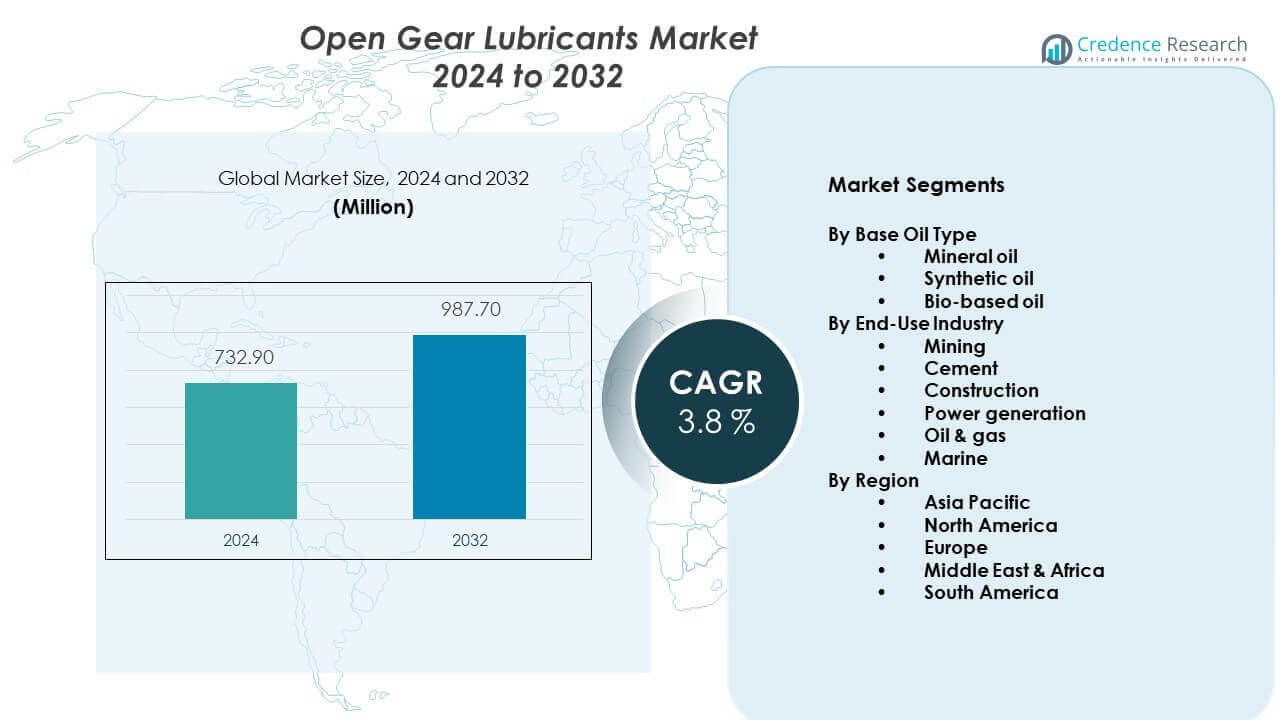
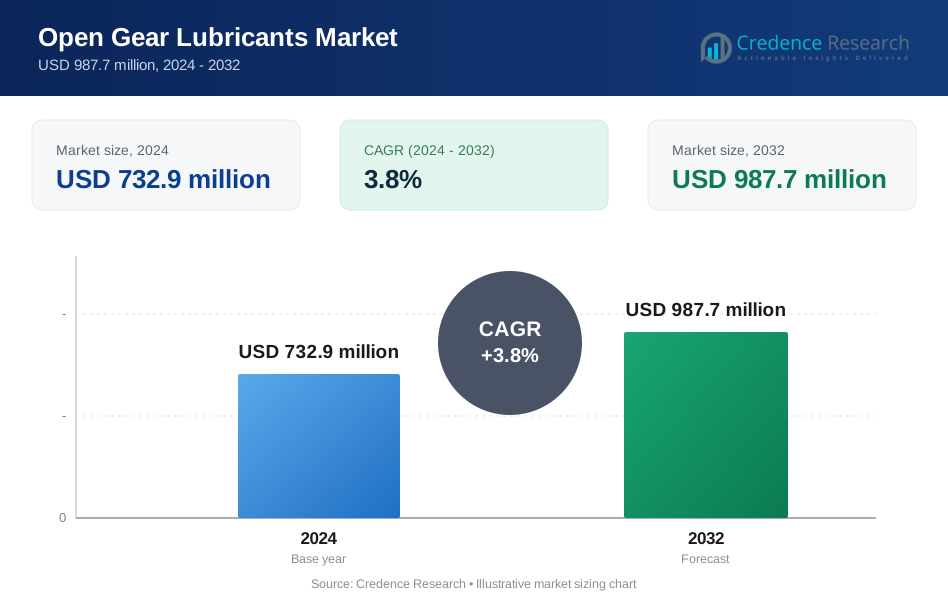
The Open gear lubricants market is projected to grow from USD 732.9 million in 2024 to USD 987.7 million by 2032. The market is expected to expand at a CAGR of 3.8% from 2024 to 2032.
| REPORT ATTRIBUTE | DETAILS |
|---|---|
| Historical Period | 2020-2023 |
| Base Year | 2024 |
| Forecast Period | 2025-2032 |
| Open Gear Lubricants Market Size 2024 | USD 732.9 million |
| Open Gear Lubricants Market, CAGR | 3.8% |
| Open Gear Lubricants Market Size 2032 | USD 987.7 million |
Rising mining output increases the use of large mills and kilns. These systems require reliable open gear lubrication. Cement production growth supports steady lubricant demand. Power plants use open gears in coal handling and ash systems. Equipment owners focus on wear reduction and shock load protection. High-load operations need lubricants with strong adhesion. Longer maintenance cycles reduce downtime costs. Synthetic and semi-synthetic products gain preference. Reliability goals continue to shape purchasing decisions.
Asia Pacific leads the market due to strong mining and cement capacity. China and India drive volume through infrastructure expansion. Southeast Asia shows rising demand from new industrial projects. North America remains mature with stable replacement demand. The United States focuses on high-performance formulations. Europe maintains steady use in cement and power sectors. Environmental compliance shapes product selection there. Latin America emerges with mining investments. The Middle East sees gradual growth from industrial diversification.
Market Insights:
- The Open gear lubricants market was valued at USD 732.9 million in 2024 and is projected to reach USD 987.7 million by 2032, growing at a CAGR of 3.8%.
- Asia Pacific leads with about 38% share due to strong mining and cement capacity, followed by North America at 27% driven by replacement demand, and Europe at 22% supported by strict maintenance standards.
- South America is the fastest-growing region with nearly 6% share, supported by mining investments and expanding cement production in Brazil and Chile.
- By end-use industry, mining holds the largest share at around 35% due to heavy mill and crusher usage, while cement accounts for nearly 28% from kiln and grinding operations.
- By base oil type, mineral oil dominates with about 52% share for cost efficiency, while synthetic oil holds close to 38% due to demand for higher performance and longer service life.
Market Drivers:
Rising Dependence On Heavy-Duty Industrial Equipment Across Core Sectors
Mining operations rely on large mills and crushers with exposed gear systems. Cement plants use kilns and raw mills that face high loads. Steel facilities operate open gears under extreme pressure cycles. These conditions demand stable lubrication performance. The Open gear lubricants market benefits from steady industrial output. Operators focus on reducing gear tooth wear. Shock load absorption remains a priority. Lubricant selection supports long equipment life. Industrial reliability targets continue to drive demand.
- For instance, FUCHS SE reported that its CEPLATTYN open gear lubricants operate reliably on gears exceeding 5 meters in diameter under heavy shock loads.
Focus On Equipment Protection And Reduced Unplanned Downtime
Plant operators aim to avoid costly shutdowns. Open gears face dust, moisture, and vibration stress. Proper lubrication reduces metal contact. Maintenance teams seek products with strong film strength. The Open gear lubricants market supports uptime goals across plants. Consistent lubrication lowers repair frequency. Gear replacement costs remain high. Reliability plans favor proven lubricant grades. Asset protection drives repeat purchases.
- For instance, Shell plc documented reduced gear wear rates in cement kiln gears after switching to Shell Omala Open Gear products under high-load operations.
Growth In Cement And Mining Capacity In Developing Economies
Emerging economies expand cement output for infrastructure. Mining activity supports energy and metal supply chains. These industries use heavy rotating equipment. Open gear systems require constant lubrication. The Open gear lubricants market aligns with capacity expansion. New plants adopt standardized lubrication practices. OEM guidelines influence product choice. Large-scale projects ensure volume stability. Industrial expansion sustains long-term demand.
Demand For Longer Maintenance Cycles And Operational Efficiency
Industrial operators reduce maintenance labor exposure. Longer relubrication intervals support safety goals. High-performance lubricants enable extended service life. Gear protection remains stable under variable loads. The Open gear lubricants market responds to efficiency needs. Maintenance planning favors predictable lubricant behavior. Equipment access constraints raise product expectations. Reliable performance reduces inspection frequency. Operational efficiency remains a key purchase driver.
Market Trends:
Shift Toward High-Performance And Specialty Lubricant Formulations
Manufacturers improve base oil quality. Advanced additives enhance load tolerance. Products show better adhesion to gear surfaces. Thermal stability improves under harsh conditions. The Open gear lubricants market reflects this shift. Buyers compare performance data more closely. Field testing influences adoption rates. Premium products gain acceptance in critical assets. Performance consistency defines supplier selection.
- For instance, Klüber Lubrication validated its Klüberfluid C-F series in mining mills handling torque levels above 1,000 kNm, confirming stable film strength.
Increased Adoption Of Synthetic And Semi-Synthetic Lubricants
Synthetic oils offer better temperature control. Semi-synthetic blends balance cost and durability. These options reduce residue buildup. Gear cleanliness supports smoother operation. The Open gear lubricants market sees wider synthetic use. Operators seek stable viscosity profiles. Lubricant life extension supports cost planning. Equipment manuals increasingly approve these grades. Formulation upgrades shape market preference.
- For instance, Exxon Mobil Corporation reports that Mobilgear OGL products maintain lubrication stability across wide temperature ranges in large rotating equipment.
Growing Emphasis On Condition Monitoring And Predictive Maintenance
Plants adopt oil analysis programs. Lubricant condition data guides service timing. Gear wear trends support proactive decisions. Maintenance teams rely on data insights. The Open gear lubricants market aligns with predictive models. Suppliers offer technical support services. Sampling programs improve lubricant management. Data-driven maintenance gains acceptance. Monitoring trends influence lubricant choice.
Customization Of Lubricants For Specific Equipment And Environments
Industries operate under varied climate conditions. Dust, humidity, and load profiles differ widely. Standard products may not suit all needs. Customized formulations address site challenges. The Open gear lubricants market adapts through tailored solutions. OEM collaboration supports formulation alignment. Site audits guide product selection. Customized lubrication improves gear performance. Flexibility becomes a competitive factor.
Market Challenges Analysis:
High Sensitivity To Product Performance And Application Practices
Open gear lubrication requires precise application. Incorrect dosing leads to gear damage. Spray system calibration affects coverage quality. Operators need trained maintenance staff. The Open gear lubricants market faces usage variability. Performance depends on field conditions. Inconsistent practices reduce expected benefits. Training gaps affect lubricant outcomes. Service quality becomes critical.
Environmental And Regulatory Pressure On Lubricant Composition
Regulators tighten environmental compliance norms. Lubricant disposal rules increase oversight. Certain additives face usage restrictions. Manufacturers adjust formulations carefully. The Open gear lubricants market must balance compliance and performance. Eco-friendly options raise cost concerns. Certification processes extend product cycles. End users seek compliant solutions. Regulatory alignment adds complexity.
Market Opportunities:
Expansion Of Industrial Infrastructure In Emerging Regions
New cement and mining projects drive lubricant demand. Industrial zones expand in developing economies. Heavy machinery installation supports open gear use. Maintenance planning starts early in project phases. The Open gear lubricants market gains from new capacity. Long-term supply contracts become possible. Early supplier engagement builds loyalty. Infrastructure growth creates sustained opportunity.
Innovation In Application Systems And Value-Added Services
Automated spray systems improve lubricant efficiency. Controlled application reduces product waste. Service-based lubrication models gain interest. Suppliers offer audits and monitoring support. The Open gear lubricants market benefits from service integration. Value-added offerings differentiate suppliers. Technical partnerships strengthen customer ties. Innovation supports higher-margin opportunities.
Market Segmentation Analysis:
By Base Oil Type
Mineral oil holds a strong position due to cost efficiency and wide availability. Many heavy industries rely on mineral-based products for standard load conditions. Synthetic oil gains traction where extreme pressure and temperature stability matter. These products support longer service intervals and consistent film strength. Bio-based oil remains a niche option with limited adoption. Environmental focus supports gradual interest in this segment. Performance validation still guides buyer confidence. The Open gear lubricants market reflects varied base oil demand across applications.
- For instance, TotalEnergies SE confirms mineral-based open gear lubricants remain widely used in cement kilns due to predictable performance under continuous operation.
By End-Use Industry
Mining represents a major consumption segment due to large mills and crushers. Cement plants rely on open gear systems in kilns and grinding units. Construction equipment uses open gears under high shock loads. Power generation applies these lubricants in coal handling and auxiliary systems. Oil & gas operations use them in offshore and onshore machinery. Marine applications depend on corrosion resistance and load stability. Each industry applies distinct operating conditions. End-use diversity supports steady market demand.
- For instance, Chevron Corporation supplies open gear lubricants used in large mining shovels and mills operating continuously in abrasive environments.
Segmentation:
By Base Oil Type
- Mineral oil
- Synthetic oil
- Bio-based oil
By End-Use Industry
- Mining
- Cement
- Construction
- Power generation
- Oil & gas
- Marine
By Region
- North America
- U.S.
- Canada
- Mexico
- Europe
- Germany
- France
- U.K.
- Italy
- Spain
- Rest of Europe
- Asia Pacific
- China
- Japan
- India
- South Korea
- South-east Asia
- Rest of Asia Pacific
- Latin America
- Brazil
- Argentina
- Rest of Latin America
- Middle East & Africa
- GCC Countries
- South Africa
- Rest of the Middle East and Africa
Regional Analysis:
Asia Pacific
Asia Pacific holds the largest share of the Open gear lubricants market, accounting for about 38%. China leads due to large mining and cement capacity. India follows with strong infrastructure and power projects. Southeast Asia shows steady growth from new industrial plants. High equipment installation supports lubricant demand. Maintenance practices mature across the region. Industrial expansion sustains long-term consumption.
North America And Europe
North America represents nearly 27% of the market share. The United States drives demand through mining, cement, and power sectors. Operators focus on high-performance and specialty lubricants. Europe accounts for around 22% of global share. Germany, France, and Italy lead regional demand. Strict maintenance standards support consistent lubricant use. Equipment upgrades maintain stable replacement demand.
Middle East & Africa And South America
The Middle East & Africa region holds close to 7% share. Mining activity in Africa supports gradual growth. Industrial diversification supports new demand in Gulf countries. South America contributes nearly 6% of the market. Brazil and Chile drive demand through mining operations. Cement capacity expansion supports lubricant consumption. Both regions show moderate but steady growth trends.
Key Player Analysis:
- FUCHS SE
- Klüber Lubrication
- Carl Bechem GmbH
- CWS Industrials, Inc.
- Shell plc
- Exxon Mobil Corporation
- Chevron Corporation
- TotalEnergies SE
Competitive Analysis:
The Open gear lubricants market shows moderate concentration with global and regional suppliers competing on performance and service depth. Large players focus on strong distribution networks and long-term industrial contracts. Product portfolios cover mineral, synthetic, and specialty grades for harsh conditions. It favors suppliers with application expertise and technical support. Brand trust plays a key role in repeat purchases. Pricing competition remains visible in mature regions. Innovation supports differentiation in critical assets. Partnerships with OEMs strengthen market access. Service-led models enhance customer retention.
Recent Developments:
- In October 2025, TotalEnergies highlighted its pioneering role in mining lubrication solutions by introducing next-generation bio-lubricants designed to reduce engine oil usage by up to 30% and withstand harsh open-pit mining environments. The company also rolled out advanced digital monitoring solutions throughout 2024 and 2025, enabling mining operators to track lubricant performance and machinery health in real-time to prevent open gear failures and optimize decarbonization efforts in heavy industry.
- In January 2025, FUCHS SE expanded its specialty portfolio by acquiring Boss Lubricants GmbH & Co. KG, a German manufacturer known for its specialized lubricant applications in medical and mechanical engineering sectors. This followed a significant strategic move in April 2024, when the company acquired the LUBCON Group, a family-run manufacturer of high-performance specialty lubricants, to explicitly strengthen its capabilities in advanced industrial applications, including open gear solutions. Additionally, in November 2024, FUCHS completed the acquisition of STRUB & Co. AG, a Swiss lubricant specialist, to establish a direct research and production footprint in Switzerland.
- In March 2025, Klüber Lubrication joined the "GearOil-Loop" joint research initiative alongside partners like Schaeffler and BASF, aiming to develop the industry's first circular economy model for gear oils using at least 50% recycled base oils. Prior to this sustainability push, in May 2024, the company announced a major USD 16.88 million investment to expand its manufacturing facility in Mysore, India, positioning the plant as a key global hub for producing its specialty lubricants and open gear solutions for the heavy industry sector.
- In 2024 and 2025, Carl Bechem GmbH continued to consolidate its market position through the promotion of its Berulit GA series (specifically Berulit GA 400, 800, and 2500), a high-performance open gear lubricant range free from bituminous ingredients and toxic heavy metals. Throughout the period, the company focused on deploying its Berugear HV series, an advanced high-viscous service lubricant designed for extreme load applications in the cement and mining industries, emphasizing its ability to be applied via automatic spray systems to reduce consumption and extend maintenance intervals.
Report Coverage:
The research report offers an in-depth analysis based on base oil type and end-use industry. It details leading market players, providing an overview of their business, product offerings, investments, revenue streams, and key applications. Additionally, the report includes insights into the competitive environment, SWOT analysis, current market trends, as well as the primary drivers and constraints. Furthermore, it discusses various factors that have driven market expansion in recent years. The report also explores market dynamics, regulatory scenarios, and technological advancements that are shaping the industry. It assesses the impact of external factors and global economic changes on market growth. Lastly, it provides strategic recommendations for new entrants and established companies to navigate the complexities of the market.
Future Outlook:
- Industrial expansion will continue to sustain steady demand for open gear lubricants across heavy-duty sectors.
- Mining and cement industries will remain the primary consumption bases due to constant operation needs.
- Synthetic lubricant adoption will increase as operators seek longer service life and stable performance.
- Equipment reliability goals will push demand for lubricants with strong load-carrying capability.
- Service-oriented lubrication models will gain importance in large industrial plants.
- OEM approvals will increasingly influence lubricant selection decisions.
- Predictive maintenance practices will shape future lubrication strategies.
- Emerging economies will contribute incremental demand through new industrial capacity.
- Environmental compliance requirements will guide future formulation development.
- Technical support and application expertise will define supplier competitiveness.
Request a Free Sample
Fill in your details and we'll send you a free sample report.
- Sample data tables & charts
- Research methodology
Need a Custom Version of This Report?
Tailor the scope, geography, or segments to your exact requirements.
- Custom geography or segment scope
- Direct access to our analyst team
Frequently Asked Questions
What is the current market size for Open gear lubricants market, and what is its projected size in 2032?
At what Compound Annual Growth Rate is the Open gear lubricants market projected to grow between 2025 and 2032?
Which Open gear lubricants market segment held the largest share in 2024?
What are the primary factors fueling the growth of the Open gear lubricants market?
Who are the leading companies in the Open gear lubricants market?
Which region commanded the largest share of the Open gear lubricants market in 2024?
Table of Content
Chapter 1. Report Introduction
- 1.1 Report Description & Purpose
- 1.1.1 Report Title & Market Definition
- 1.1.2 Unique Selling Propositions (USP) & Key Differentiators
- 1.1.3 Value Proposition for Stakeholders
- 1.2 Research Objectives
- 1.2.1 Market Sizing Objectives (Volume & Revenue)
- 1.2.2 Segmentation Objectives
- 1.2.3 Competitive Intelligence Objectives
- 1.2.4 Forecast & Scenario Objectives
- 1.3 Report Scope
- 1.3.1 Open Gear Lubricants Scope – Types & Subtypes Covered
- 1.3.2 Geographic Scope – Regions & Countries Covered
- 1.3.3 Historical Period, Base Year & Forecast Period (2024; forecast to 2032)
- 1.3.4 Inclusions & Exclusions
- 1.4 HS Code & Classification Framework
- 1.5 Currency, Units & Pricing Basis
- 1.6 Target Stakeholders
- 1.7 Limitations & Assumptions
Chapter 2. Executive Summary
- 2.1 Global Open Gear Lubricants Market Snapshot
- 2.1.1 Market Size – Historical (2024) & Forecast (2024-2032) (2024: USD 732.9 million → 2032: USD 987.7 million)
- 2.1.2 Volume & Revenue – Global Totals
- 2.1.3 Key Market Highlights – Top Five Facts
- 2.2 Open Gear Lubricants Market Segmentation Snapshot
- 2.2.1 Market Split by Region – 2024 vs. 2032
- 2.3 Competitive Snapshot
- 2.3.1 Top 10 Players by Revenue Share – 2024
- 2.3.2 Top 10 Players by Volume Share – 2024
- 2.3.3 Recent Strategic Developments (18-Month Summary)
- 2.4 Key Investment Highlights & Strategic Conclusions
Chapter 3. Open Gear Lubricants Market Dynamics & Industry Analysis
- 3.1 Market Overview & Context
- 3.1.1 Open Gear Lubricants Market Position in the Broader Automotive Value Chain
- 3.1.2 OEM vs. Replacement Market Dynamics
- 3.1.3 Market Maturity & Development Stage by Region
- 3.2 Open Gear Lubricants Market Drivers
- 3.3 Open Gear Lubricants Market Restraints & Challenges
- 3.4 Open Gear Lubricants Market Opportunities
- 3.5 Porter's Five Forces Analysis
- 3.5.1 Threat of New Entrants
- 3.5.2 Bargaining Power of Suppliers
- 3.5.3 Bargaining Power of Buyers
- 3.5.4 Threat of Substitutes
- 3.5.5 Competitive Rivalry – Intensity Assessment
- 3.6 Open Gear Lubricants Value Chain Analysis
- 3.6.1 Upstream – Raw Material/Input Suppliers
- 3.6.1.1 Raw Material/Input 1
- 3.6.1.2 Raw Material/Input 2
- 3.6.1.3 Raw Material/Input 3
- 3.6.2 Midstream – Production/Manufacturing/Service Delivery
- 3.6.2.1 Production/Process Overview
- 3.6.2.2 Key Facility Locations & Capacity by Manufacturer
- 3.6.3 Downstream – Distribution & End Consumer
- 3.6.3.1 Primary Channel – B2B/OEM
- 3.6.3.2 Secondary Channels – Dealer, Retail, Online, Direct
- 3.6.4 Value Chain Profitability Analysis
- 3.6.1 Upstream – Raw Material/Input Suppliers
- 3.7 PESTEL Analysis
- 3.7.1 Political Factors
- 3.7.2 Economic Factors
- 3.7.3 Social Factors
- 3.7.4 Technological Factors
- 3.7.5 Environmental Factors
- 3.7.6 Legal Factors
- 3.8 Open Gear Lubricants Supply Chain Analysis
- 3.8.1 Raw Material/Input Supply Risk Assessment
- 3.8.2 Manufacturing Concentration Risk (Geographic Exposure)
- 3.8.3 Trade Disruption Impact Analysis
- 3.9 Regulatory & Policy Landscape
Note: The regulatory and policy landscape section covers regulations based on their applicability to the market, Open Gear Lubricants category, geography, and scope of the study. Only regulatory frameworks with a material impact on operations, compliance, trade, sustainability, or market access are analyzed in detail.
Chapter 4. Key Investment Pockets & Opportunity Analysis
- 4.1 Open Gear Lubricants Market Attractiveness Analysis
- 4.1.1 By Region – Investment Attractiveness Matrix (Volume × CAGR)
- 4.2 Absolute Revenue Growth Opportunity
- 4.2.1 By Region – Absolute USD Growth Through 2032
- 4.3 Incremental Volume Opportunity
- 4.3.1 By Region – Incremental Volume Through 2032
- 4.3.2 Segment – Incremental Volume
- 4.4 Emerging Submarket Opportunity Deep Dive (Subject to Applicability)
- 4.5 Emerging Market Opportunity Scorecards
- 4.5.1 United States
- 4.5.2 Europe
- 4.5.3 Asia
- 4.5.4 Middle East & Africa
Note: Emerging Market Opportunity Scorecards will be included based on relevance and strategic importance. Regions listed are indicative and may vary depending on data availability and market dynamics.
Chapter 5. Open Gear Lubricants Import-Export Analysis & Trade Flows
- 5.1 Global Trade Overview
- 5.1.1 Global Export Value by Country (2024)
- 5.1.2 Global Export Volume by Country (2024)
- 5.1.3 Global Import Value by Country (2024)
- 5.1.4 Global Import Volume by Country (2024)
- 5.1.5 Net Trade Balance by Country (2024)
- 5.2 Export Analysis – Segment
- 5.2.1 Type 1 (HS Code)
- 5.2.2 Type 2 (HS Code)
- 5.2.3 Type 3 (HS Code)
- 5.2.4 Type 4 (HS Code)
- 5.2.5 Type 5 (HS Code)
- 5.3 Import Analysis – Segment
- 5.3.1 Type 1 (HS Code)
- 5.3.2 Type 2 (HS Code)
- 5.3.3 Type 3 (HS Code)
- 5.3.4 Type 4 (HS Code)
- 5.3.5 Type 5 (HS Code)
- 5.4 Average Unit Trade Prices
- 5.4.1 Average Export Price – Segment & Country
- 5.4.2 Average Import Price – Segment & Source Country
- 5.4.3 Price Trends (2024)
- 5.5 Key Trade Route Analysis
- 5.5.1 Trade Route 1
- 5.5.2 Trade Route 2
- 5.5.3 Trade Route 3
- 5.5.4 Trade Route 4
- 5.5.5 Trade Route 5
- 5.6 Trade Policy Impact Assessment
- 5.6.1 US Anti-Dumping & Section 301 Tariffs
- 5.6.2 EU Customs Union Impact
- 5.6.3 Major Free Trade Agreements
- 5.6.4 USMCA Rules of Origin
Note: Trade policy analysis will be included only where relevant to the Open Gear Lubricants market.
Chapter 6. Competitive Landscape & Company Benchmarking
- 6.1 Open Gear Lubricants Market Concentration & Structure
- 6.1.1 Herfindahl-Hirschman Index (HHI) – vs. 2024
- 6.1.2 Tier 1, Tier 2 & Tier 3 Market Structure
- 6.1.3 Global, Regional & Local Player Dynamics
- 6.2 Open Gear Lubricants Market Share Analysis – 2024
- 6.2.1 Global Revenue Share by Company
- 6.2.2 Global Volume Share by Company
- 6.2.3 Regional Revenue Share
- 6.2.4 Market Share Evolution ( vs. 2024)
- 6.2.5 OEM Segment Share by Company
- 6.2.6 Replacement Segment Share by Company
- 6.3 Production/Delivery Capacity & Facility Analysis
- 6.3.1 Global Installed Capacity
- 6.3.2 Capacity Utilization Rates
- 6.3.3 Production/Output Volume
- 6.3.4 Facility Locations & Capacity Map
- 6.3.5 Planned Capacity Additions
- 6.4 Open Gear Lubricants Competitive Benchmarking Matrix
- 6.4.1 Revenue, Volume, CAGR & Profitability Comparison
- 6.4.2 Channel Revenue Mix
- 6.4.3 Geographic Revenue Exposure
- 6.4.4 R&D Intensity
- 6.4.5 Sustainability Maturity
- 6.5 Strategic Developments in Open Gear Lubricants (Last 24 Months)
- 6.5.1 Mergers, Acquisitions & Divestments
- 6.5.2 New Open Gear Lubricants Launches
- 6.5.3 Facility Expansions
- 6.5.4 Strategic Alliances, Joint Ventures & Partnerships
- 6.5.5 Distribution Expansion & Market Entry
- 6.5.6 Sustainability & ESG Initiatives
- 6.6 Competitive Strategy Mapping
- 6.6.1 Leader, Challenger, Follower & Niche Classification
- 6.6.2 Pricing Strategy Comparison
- 6.6.3 Channel Strategy Matrix
Note: Strategic developments are included based on their materiality and the availability of reliable information.
Chapter 7. Global Open Gear Lubricants Market – By Distribution Channel
- 7.1 Segment Overview
- 7.1.1 Volume & Revenue Split by Channel (2024 & 2032)
- 7.1.2 Channel Mix Evolution (2024-2032)
Chapter 8. Regional Market Analysis – Global Overview
- 8.1 Global Regional Overview
- 8.1.1 Regional Volume Share
- 8.1.2 Regional Revenue Share
- 8.1.3 Regional Volume by Region
- 8.1.4 Regional Revenue by Region
- 8.1.5 Regional Forecast Through 2032
- 8.2 Cross-Regional Segment Analysis
- 8.2.1 By Distribution Channel
- 8.2.2 By Brand/Price Tier
Chapter 9. North America Open Gear Lubricants Market
- 9.1 United States
- 9.2 Canada
- 9.3 Mexico
Chapter 10. Europe Open Gear Lubricants Market
- 10.1 Germany
- 10.2 France
- 10.3 Italy
- 10.4 United Kingdom
- 10.5 Spain
- 10.6 Poland
- 10.7 Russia
- 10.8 Netherlands
- 10.9 Belgium
- 10.10 Sweden
- 10.11 Denmark
- 10.12 Norway
- 10.13 Rest of Europe
Chapter 11. Asia Pacific Open Gear Lubricants Market
- 11.1 China
- 11.2 India
- 11.3 Japan
- 11.4 South Korea
- 11.5 Thailand
- 11.6 Indonesia
- 11.7 Vietnam
- 11.8 Malaysia
- 11.9 Australia
- 11.10 Rest of Asia Pacific
Chapter 12. Latin America Open Gear Lubricants Market
- 12.1 Brazil
- 12.2 Argentina
- 12.3 Colombia
- 12.4 Chile
- 12.5 Rest of Latin America
Chapter 13. Middle East Open Gear Lubricants Market
- 13.1 Saudi Arabia
- 13.2 United Arab Emirates
- 13.3 Turkey
- 13.4 Israel
- 13.5 Iran
- 13.6 Rest of the Middle East
Chapter 14. Africa Open Gear Lubricants Market
- 14.1 South Africa
- 14.2 Egypt
- 14.3 Nigeria
- 14.4 Morocco
- 14.5 Rest of Africa
Chapter 15. Open Gear Lubricants Company Profiles
- 15.1 [Company 01]
- 15.1.1 Company Overview
- 15.1.2 Key Management Personnel
- 15.1.3 Products & Services Portfolio
- 15.1.4 Financial Performance
- 15.1.5 Key Market Focus & Geographic Presence
- 15.1.6 Recent Developments & Strategic Initiatives
Note: The company profile list is preliminary and may change based on research findings, market developments, data availability, and client requirements.
Chapter 16. Appendices
- Appendix A – List of Abbreviations & Acronyms
- Appendix B – Industry Classification Code Reference – Full Series
- Appendix C – Production & Capacity Data Tables
- Appendix D – End-Use & Demand Base Tables
- Appendix E – Consumption & Replacement Rate Assumptions
- Appendix F – ASP Reference Tables
- Appendix G – Manufacturing & Facility Database
- Appendix H – Import-Export Data Tables
- Appendix I – Regulatory Summary Tables
- Appendix J – Primary Research Participant List (Anonymized)
- Appendix K – Primary Research Questionnaire Framework
- Appendix L – Data Sources & Bibliography
- Appendix M – Market Size Divergence & Source Comparison
Chapter 17. Research Methodology
- 17.1 Research Framework & Philosophy
- 17.2 Secondary Research – Sources, Hierarchy & Data Extraction
- 17.3 Data Modeling – Bottom-Up & Top-Down Market Sizing
- 17.4 Primary Research – Stakeholder Framework, LOI & Sample Sizes
- 17.5 Forecast Methodology – Regression, Scenario & Sensitivity Analysis
- 17.6 Quality Control – Four-Layer Validation Framework
- 17.7 Limitations & Standard Assumptions
- 17.8 Disclaimer
