
Market Overview:
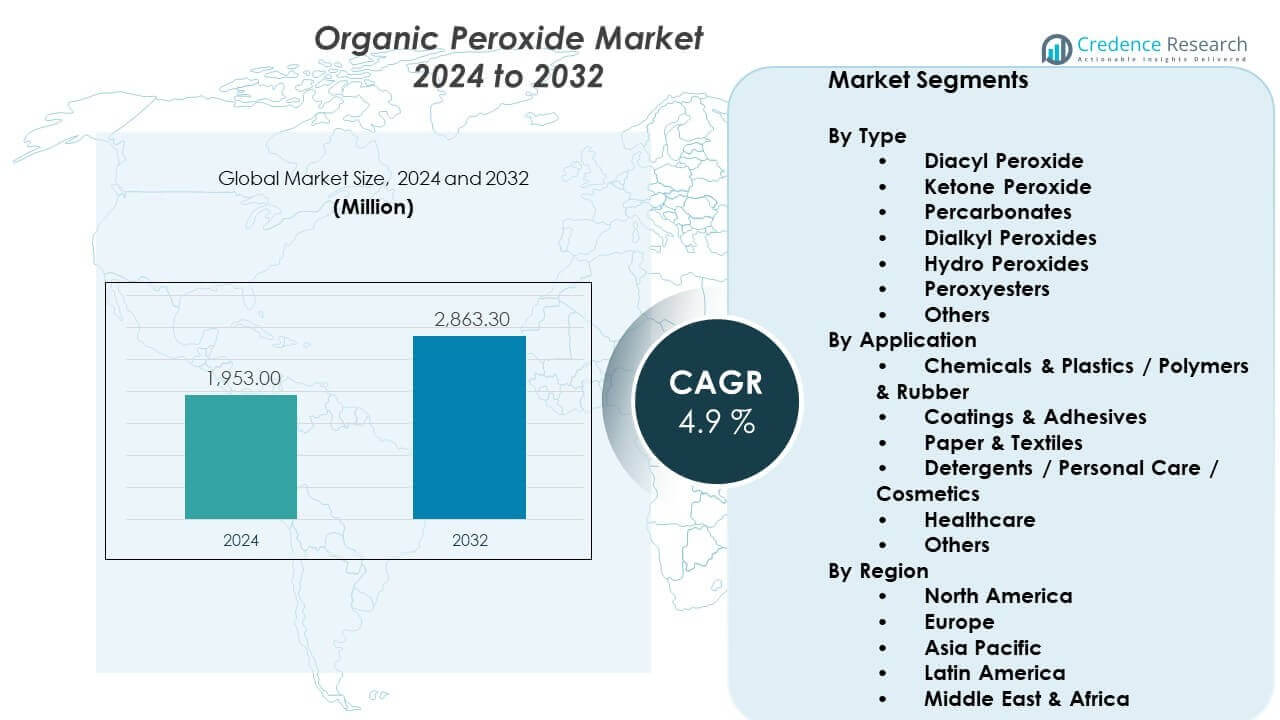
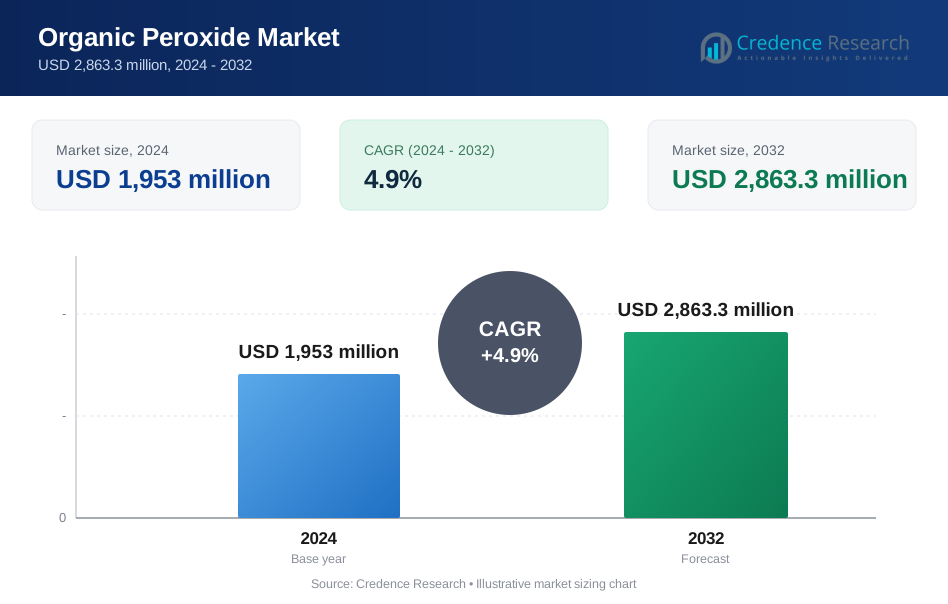
The Organic peroxide market is projected to grow from USD 1,953 million in 2024 to an estimated USD 2,863.3 million by 2032. The market is expected to register a CAGR of 4.9% from 2024 to 2032.
| REPORT ATTRIBUTE | DETAILS |
|---|---|
| Historical Period | 2020-2023 |
| Base Year | 2024 |
| Forecast Period | 2025-2032 |
| Organic Peroxide Market Size 2024 | USD 1,953 million |
| Organic Peroxide Market, CAGR | 4.9% |
| Organic Peroxide Market Size 2032 | USD 2,863.3 million |
Market growth is driven by rising use of polymers in packaging, construction, and automotive manufacturing. Organic peroxides enable efficient polymerization in polyethylene, polypropylene, and elastomers. Manufacturers adopt these compounds to improve material strength and processing speed. Growth in composite materials increases demand for curing agents. Infrastructure projects raise consumption of crosslinked plastics and rubber products. Chemical producers focus on safer formulations with improved thermal stability. Regulatory emphasis on product consistency supports standardized peroxide grades. Demand also benefits from expanding chemical capacity in downstream industries.
Asia Pacific leads the market due to strong plastics production and industrial expansion. China and India drive demand through large-scale polymer and rubber manufacturing bases. Japan and South Korea contribute through advanced chemical processing capabilities. Europe maintains a strong position with established specialty chemical producers and strict quality standards. North America shows stable demand supported by automotive, packaging, and construction sectors. Emerging markets in Southeast Asia gain traction due to manufacturing relocation. Regional growth aligns closely with polymer capacity expansion and industrial investment trends.
Market Insights:
- The Organic peroxide market was valued at USD 1,953 million in 2024 and is projected to reach USD 2,863.3 million by 2032, registering a CAGR of 4.9% during the forecast period.
- Asia Pacific leads with about 45% share, followed by Europe at nearly 25% and North America at around 20%, driven by strong polymer production, mature chemical industries, and stable industrial demand.
- Asia Pacific remains the fastest-growing region with roughly 45% share, supported by expanding plastics manufacturing, infrastructure growth, and rising chemical capacity in China and India.
- By application, chemicals and plastics including polymers and rubber account for nearly 60% share due to extensive use in polymerization and crosslinking processes.
- By type, diacyl peroxide and ketone peroxide together hold over 50% share, supported by wide adoption in polymer initiation, composites, and rubber curing applications.
Market Drivers:
Rising Polymer And Plastics Production Across Industrial Value Chains
The Organic peroxide market gains momentum from strong polymer production growth worldwide. Manufacturers use organic peroxides to start polymer chains with precision. Packaging demand pushes polyethylene and polypropylene output upward. Construction activity raises need for crosslinked plastics and pipes. Automotive producers rely on durable polymer components for weight reduction. Consumer goods demand supports steady plastic resin output. Chemical processors prefer organic peroxides for process reliability. Industrial expansion sustains long-term consumption trends.
- For instance, Arkema reports that its Luperox® organic peroxide range supports polyethylene and polypropylene polymerization across multiple global polymer plants, enabling consistent initiation performance at industrial-scale reactor volumes exceeding several hundred kilotons per year.
Growing Demand For Rubber Processing And Elastomer Applications
Rubber processing remains a core driver for organic peroxide consumption. Tire manufacturing uses peroxides for controlled rubber curing. Industrial rubber goods require consistent crosslink density. Automotive hoses and seals depend on high-performance elastomers. It supports faster curing cycles in rubber compounds. Manufacturers value predictable reaction behavior during processing. Industrial safety standards favor controlled curing systems. Rubber demand growth sustains peroxide volumes.
- For instance, LANXESS states that its Perkadox® organic peroxides are used for peroxide curing of EPDM and silicone rubber, operating reliably at curing temperatures above 160 °C in tire and technical rubber applications.
Expansion Of Composite Materials In Infrastructure And Transport
Composite materials gain adoption across transport and infrastructure sectors. Organic peroxides act as curing agents for reinforced composites. Wind energy blades rely on durable composite structures. Construction panels use peroxide-cured resins for strength. Aerospace suppliers adopt lightweight composite solutions. Marine applications depend on corrosion-resistant materials. It enables stable curing in thick composite sections. Composite demand supports specialty peroxide grades.
Rising Chemical Manufacturing Capacity In Emerging Economies
Emerging economies expand chemical and polymer manufacturing capacity. Organic peroxide demand follows new plant installations. Producers invest in localized chemical supply chains. Cost advantages support capacity additions in Asia. Domestic plastic consumption drives internal demand growth. Export-oriented manufacturing raises peroxide usage levels. Industrial policy supports chemical sector expansion. Capacity growth sustains steady market demand.
Market Trends:
Shift Toward Safer And Thermally Stable Peroxide Formulations
Producers focus on safer organic peroxide formulations. Improved thermal stability reduces handling risks. Storage life improvement supports logistics efficiency. Manufacturers invest in low-temperature decomposition products. End users demand safer processing materials. Regulatory scrutiny encourages advanced formulation design. It supports adoption of stabilized peroxide grades. Product innovation shapes market direction.
- For instance, Nouryon reports that its Trigonox® organic peroxide portfolio includes thermally stable grades designed to lower transport risk and improve storage safety under regulated temperature conditions.
Rising Use Of Customized Peroxides For Specific Polymer Systems
Customization becomes a key trend across polymer processing. Organic peroxides now match specific resin requirements. Tailored decomposition rates improve polymer quality. Specialty plastics require precise reaction control. Producers collaborate with polymer manufacturers for solutions. Customized grades improve process efficiency. It reduces waste during polymer production. Customization strengthens supplier relationships.
- For instance, United Initiators documents offering customized peroxide solutions for EVA, LDPE, and XLPE processing, enabling precise curing control in extrusion and molding operations.
Increasing Adoption In Specialty And High-Performance Plastics
High-performance plastics gain attention across industries. Organic peroxides support specialty polymer synthesis. Electronics demand materials with thermal resistance. Medical devices require clean polymer reactions. Specialty plastics need controlled curing systems. Producers develop peroxides for niche applications. It expands value-added product portfolios. Specialty demand improves margin potential.
Process Automation And Controlled Chemical Processing Practices
Automation influences chemical processing trends. Organic peroxide dosing systems integrate with digital controls. Precise feed rates improve product consistency. Automated systems reduce operator exposure risks. Manufacturers adopt smart monitoring solutions. Process control improves reaction predictability. It enhances operational efficiency. Automation reshapes production practices.
Market Challenges Analysis:
Handling Risks And Strict Safety Compliance Requirements
The Organic peroxide market faces safety-related challenges. Organic peroxides exhibit high reactivity under heat. Storage requires controlled temperature environments. Transportation involves strict hazard regulations. Safety training raises operational costs. Smaller manufacturers face compliance burdens. Insurance costs increase due to risk profiles. Safety concerns limit widespread adoption.
Regulatory Pressure And Complex Approval Processes
Chemical regulations create compliance complexity for producers. Organic peroxides fall under hazardous material rules. Approval processes vary across regions. Documentation demands increase administrative workload. Compliance delays slow product launches. Regulatory updates require frequent formulation reviews. It raises costs for global suppliers. Market entry barriers remain high.
Market Opportunities:
Growth In Renewable Energy And Advanced Composite Manufacturing
Renewable energy projects create new demand avenues. Wind turbine manufacturing uses peroxide-cured composites. Lightweight materials improve energy efficiency. Infrastructure investment supports composite adoption. Organic peroxide demand rises with turbine installations. Composite durability remains a priority factor. It supports long-term material consumption. Renewable expansion unlocks growth potential.
Innovation In Low-Emission And Sustainable Chemical Solutions
Sustainability trends open new market opportunities. Producers develop low-emission organic peroxide products. Customers seek environmentally responsible chemicals. Cleaner processing improves workplace safety. Sustainable formulations gain regulatory acceptance. Research investment drives eco-friendly alternatives. It aligns with global sustainability goals. Innovation creates competitive advantage.
Market Segmentation Analysis:
By Type
Diacyl peroxide holds strong demand due to reliable performance in polymer initiation. Ketone peroxide sees wide use in composite curing and reinforced plastics. Percarbonates support low-temperature polymer processing applications. Dialkyl peroxides gain traction in high-temperature polymer reactions. Hydro peroxides serve niche roles in chemical synthesis and specialty polymers. Peroxyesters offer controlled decomposition for advanced resin systems. Other peroxide types address customized industrial needs. Product selection depends on stability, reaction control, and safety needs.
- For instance, AkzoNobel technical data confirms that ketone peroxides are standard initiators for fiberglass-reinforced polyester composites, supporting controlled curing in marine and industrial laminate production.
By Application
Chemicals and plastics remain the dominant application area. Polymers and rubber processing rely on organic peroxides for curing and crosslinking. Coatings and adhesives use these compounds to enhance bonding strength. Paper and textile processing applies peroxides for specialty treatments. Detergents, personal care, and cosmetics adopt selected grades for formulation support. Healthcare applications use controlled peroxide systems for specific chemical processes. Other uses include specialty chemicals and industrial formulations. The Organic peroxide market benefits from diverse end-use demand across industries.
Segmentation:
By Type
- Diacyl Peroxide
- Ketone Peroxide
- Percarbonates
- Dialkyl Peroxides
- Hydro Peroxides
- Peroxyesters
- Others
By Application
- Chemicals & Plastics / Polymers & Rubber
- Coatings & Adhesives
- Paper & Textiles
- Detergents / Personal Care / Cosmetics
- Healthcare
- Others
By Region
- North America
- U.S.
- Canada
- Mexico
- Europe
- Germany
- France
- U.K.
- Italy
- Spain
- Rest of Europe
- Asia Pacific
- China
- Japan
- India
- South Korea
- South-east Asia
- Rest of Asia Pacific
- Latin America
- Brazil
- Argentina
- Rest of Latin America
- Middle East & Africa
- GCC Countries
- South Africa
- Rest of the Middle East and Africa
Regional Analysis:
Asia Pacific Dominance And Manufacturing-Led Demand
Asia Pacific holds the largest share at around 45% of global demand. China leads due to large-scale polymer and rubber manufacturing capacity. India supports growth through expanding plastics, automotive, and infrastructure sectors. Japan contributes with specialty chemicals and high-quality peroxide grades. South Korea adds demand from advanced polymer processing industries. Regional cost advantages attract chemical capacity expansion. The Organic peroxide market benefits from strong downstream industrial consumption in this region.
Europe And North America With Mature Industrial Consumption
Europe accounts for nearly 25% of the market share. Germany, France, and Italy drive demand through specialty chemicals and composites. Strict quality standards support consistent peroxide usage across industries. North America holds close to 20% share, led by the United States. Automotive, packaging, and construction sectors sustain stable demand. Advanced safety practices support controlled peroxide handling. Both regions show steady replacement and specialty-grade demand patterns.
Latin America And Middle East & Africa As Emerging Regions
Latin America represents about 5% of the global market. Brazil and Mexico lead due to plastics and rubber processing activity. Industrial diversification supports gradual demand growth. The Middle East & Africa also holds nearly 5% share. GCC countries invest in petrochemicals and downstream polymer production. Africa shows early-stage growth tied to industrial development. These regions offer long-term expansion potential through new capacity additions.
Key Player Analysis:
- Akzo Nobel N.V. / Nouryon
- Arkema Group / Arkema S.A.
- United Initiators
- NOF Corporation
- PERGAN GmbH
Competitive Analysis:
The Organic peroxide market shows moderate consolidation with a mix of global and regional players. Leading companies compete on product reliability, safety performance, and formulation depth. Large manufacturers benefit from integrated chemical portfolios and strong downstream links. Mid-sized suppliers focus on niche peroxide grades and customer-specific solutions. Competition centers on process efficiency and consistent quality delivery. Firms invest in capacity optimization and safety upgrades to protect margins. Product differentiation supports long-term customer contracts. It reflects stable rivalry with limited price disruption.
Recent Developments:
- More recently, in December 2025, United Initiators strengthened its regional presence in the Asia-Pacific market by appointing Redox as the authorized distributor for its comprehensive range of organic peroxides across Australia and New Zealand. This appointment included a full product portfolio featuring respected brands such as CUROX®, BENOX®, and NOROX® products including dibenzoyl peroxide, dichloro benzoyl peroxide, butyl hydroperoxide, butyl peroxybenzoate, and various ketone peroxide blends. The partnership ensures customers benefit from local inventory management, technical support, and reliable logistics backed by Redox's extensive distribution network and specialty chemicals expertise.
- In March 2025, NOF showcased its latest innovations at the 4th Annual LNP Formulation & Process Development Summit, presenting research on biodegradable lipid nanoparticles with tunable immunogenicity. The company highlighted its COATSOME® SS Series—a library of biodegradable lipids specifically engineered for vaccine and gene therapy applications with increased in vivo potency and tolerability. These developments underscore NOF's strategic focus on addressing evolving pharmaceutical industry requirements for sustainable, effective lipid-based therapeutic delivery systems.
- In April 2023, Nouryon announced a significant capacity expansion initiative at its organic peroxides manufacturing facility in Ningbo, China. The company invested substantially to double the annual production capacity for two critical products: Perkadox 14 and Trigonox 101 organic peroxides, with the expansion reaching 6,000 tons of annual capacity for each product by mid-2024. This strategic investment was driven by the company's commitment to supporting the growing polymer industry across Asia, positioning Nouryon to meet increasing demand from customers in this fast-expanding region.
- Further strengthening its market position, Nouryon announced in October 2025 (with activities planned through 2027) an aggressive expansion strategy in China that extends beyond organic peroxides. The company completed a capacity expansion for metal alkyls production at its Jiaxing site, which ultimately doubled the company's ability to produce triethylaluminum, a co-catalyst essential in polyethylene and polypropylene manufacturing for packaging and automotive applications. Additionally, Nouryon committed to establishing a dedicated organic peroxides innovation center in Tianjin by 2026, designed to provide specialized polymer application capabilities and accelerate product development. The company also plans to begin producing modified methylaluminoxane (MMAO) in China by 2027, supporting the growing demand for catalysts used in polyolefin elastomers for solar panel manufacturing.
Report Coverage:
The research report offers an in-depth analysis based on type and application segments. It details leading market players, providing an overview of their business, product offerings, investments, revenue streams, and key applications. Additionally, the report includes insights into the competitive environment, SWOT analysis, current market trends, as well as the primary drivers and constraints. Furthermore, it discusses various factors that have driven market expansion in recent years. The report also explores market dynamics, regulatory scenarios, and technological advancements that are shaping the industry. It assesses the impact of external factors and global economic changes on market growth. Lastly, it provides strategic recommendations for new entrants and established companies to navigate the complexities of the market.
Future Outlook:
- Polymer production across packaging, construction, and automotive sectors will sustain long-term demand growth.
- Specialty organic peroxide grades will see higher adoption due to controlled reaction performance.
- Safety-focused formulation development will remain a core priority for manufacturers.
- Composite materials used in wind energy and transportation will create new consumption avenues.
- Emerging economies will attract fresh investments in organic peroxide manufacturing capacity.
- Customized peroxide solutions will strengthen long-term relationships with polymer producers.
- Automation and digital process control will improve efficiency in production and handling.
- Regulatory compliance requirements will continue to shape product design strategies.
- Sustainability goals will guide the development of low-emission and safer peroxide products.
- Strategic partnerships will support regional expansion and supply chain resilience.
Request a Free Sample
Fill in your details and we'll send you a free sample report.
- Sample data tables & charts
- Research methodology
Need a Custom Version of This Report?
Tailor the scope, geography, or segments to your exact requirements.
- Custom geography or segment scope
- Direct access to our analyst team
Frequently Asked Questions
What is the current market size for Organic peroxide market, and what is its projected size in 2032?
At what Compound Annual Growth Rate is the Organic peroxide market projected to grow between 2025 and 2032?
Which Organic peroxide market segment held the largest share in 2024?
What are the primary factors fueling the growth of the Organic peroxide market?
Who are the leading companies in the Organic peroxide market?
Which region commanded the largest share of the Organic peroxide market in 2024?
Table of Content
Chapter 1. Report Introduction
- 1.1 Report Description & Purpose
- 1.1.1 Report Title & Market Definition
- 1.1.2 Unique Selling Propositions (USP) & Key Differentiators
- 1.1.3 Value Proposition for Stakeholders
- 1.2 Research Objectives
- 1.2.1 Market Sizing Objectives (Volume & Revenue)
- 1.2.2 Segmentation Objectives
- 1.2.3 Competitive Intelligence Objectives
- 1.2.4 Forecast & Scenario Objectives
- 1.3 Report Scope
- 1.3.1 Organic Peroxide Scope – Types & Subtypes Covered
- 1.3.2 Geographic Scope – Regions & Countries Covered
- 1.3.3 Historical Period, Base Year & Forecast Period (2024; forecast to 2032)
- 1.3.4 Inclusions & Exclusions
- 1.4 HS Code & Classification Framework
- 1.5 Currency, Units & Pricing Basis
- 1.6 Target Stakeholders
- 1.7 Limitations & Assumptions
Chapter 2. Executive Summary
- 2.1 Global Organic Peroxide Market Snapshot
- 2.1.1 Market Size – Historical (2024) & Forecast (2024-2032) (2024: USD 1,953 million → 2032: USD 2,863.3 million)
- 2.1.2 Volume & Revenue – Global Totals
- 2.1.3 Key Market Highlights – Top Five Facts
- 2.2 Organic Peroxide Market Segmentation Snapshot
- 2.2.1 Market Split by Region – 2024 vs. 2032
- 2.3 Competitive Snapshot
- 2.3.1 Top 10 Players by Revenue Share – 2024
- 2.3.2 Top 10 Players by Volume Share – 2024
- 2.3.3 Recent Strategic Developments (18-Month Summary)
- 2.4 Key Investment Highlights & Strategic Conclusions
Chapter 3. Organic Peroxide Market Dynamics & Industry Analysis
- 3.1 Market Overview & Context
- 3.1.1 Organic Peroxide Market Position in the Broader Automotive Value Chain
- 3.1.2 OEM vs. Replacement Market Dynamics
- 3.1.3 Market Maturity & Development Stage by Region
- 3.2 Organic Peroxide Market Drivers
- 3.3 Organic Peroxide Market Restraints & Challenges
- 3.4 Organic Peroxide Market Opportunities
- 3.5 Porter's Five Forces Analysis
- 3.5.1 Threat of New Entrants
- 3.5.2 Bargaining Power of Suppliers
- 3.5.3 Bargaining Power of Buyers
- 3.5.4 Threat of Substitutes
- 3.5.5 Competitive Rivalry – Intensity Assessment
- 3.6 Organic Peroxide Value Chain Analysis
- 3.6.1 Upstream – Raw Material/Input Suppliers
- 3.6.1.1 Raw Material/Input 1
- 3.6.1.2 Raw Material/Input 2
- 3.6.1.3 Raw Material/Input 3
- 3.6.2 Midstream – Production/Manufacturing/Service Delivery
- 3.6.2.1 Production/Process Overview
- 3.6.2.2 Key Facility Locations & Capacity by Manufacturer
- 3.6.3 Downstream – Distribution & End Consumer
- 3.6.3.1 Primary Channel – B2B/OEM
- 3.6.3.2 Secondary Channels – Dealer, Retail, Online, Direct
- 3.6.4 Value Chain Profitability Analysis
- 3.6.1 Upstream – Raw Material/Input Suppliers
- 3.7 PESTEL Analysis
- 3.7.1 Political Factors
- 3.7.2 Economic Factors
- 3.7.3 Social Factors
- 3.7.4 Technological Factors
- 3.7.5 Environmental Factors
- 3.7.6 Legal Factors
- 3.8 Organic Peroxide Supply Chain Analysis
- 3.8.1 Raw Material/Input Supply Risk Assessment
- 3.8.2 Manufacturing Concentration Risk (Geographic Exposure)
- 3.8.3 Trade Disruption Impact Analysis
- 3.9 Regulatory & Policy Landscape
Note: The regulatory and policy landscape section covers regulations based on their applicability to the market, Organic Peroxide category, geography, and scope of the study. Only regulatory frameworks with a material impact on operations, compliance, trade, sustainability, or market access are analyzed in detail.
Chapter 4. Key Investment Pockets & Opportunity Analysis
- 4.1 Organic Peroxide Market Attractiveness Analysis
- 4.1.1 By Region – Investment Attractiveness Matrix (Volume × CAGR)
- 4.2 Absolute Revenue Growth Opportunity
- 4.2.1 By Region – Absolute USD Growth Through 2032
- 4.3 Incremental Volume Opportunity
- 4.3.1 By Region – Incremental Volume Through 2032
- 4.3.2 Segment – Incremental Volume
- 4.4 Emerging Submarket Opportunity Deep Dive (Subject to Applicability)
- 4.5 Emerging Market Opportunity Scorecards
- 4.5.1 United States
- 4.5.2 Europe
- 4.5.3 Asia
- 4.5.4 Middle East & Africa
Note: Emerging Market Opportunity Scorecards will be included based on relevance and strategic importance. Regions listed are indicative and may vary depending on data availability and market dynamics.
Chapter 5. Organic Peroxide Import-Export Analysis & Trade Flows
- 5.1 Global Trade Overview
- 5.1.1 Global Export Value by Country (2024)
- 5.1.2 Global Export Volume by Country (2024)
- 5.1.3 Global Import Value by Country (2024)
- 5.1.4 Global Import Volume by Country (2024)
- 5.1.5 Net Trade Balance by Country (2024)
- 5.2 Export Analysis – Segment
- 5.2.1 Type 1 (HS Code)
- 5.2.2 Type 2 (HS Code)
- 5.2.3 Type 3 (HS Code)
- 5.2.4 Type 4 (HS Code)
- 5.2.5 Type 5 (HS Code)
- 5.3 Import Analysis – Segment
- 5.3.1 Type 1 (HS Code)
- 5.3.2 Type 2 (HS Code)
- 5.3.3 Type 3 (HS Code)
- 5.3.4 Type 4 (HS Code)
- 5.3.5 Type 5 (HS Code)
- 5.4 Average Unit Trade Prices
- 5.4.1 Average Export Price – Segment & Country
- 5.4.2 Average Import Price – Segment & Source Country
- 5.4.3 Price Trends (2024)
- 5.5 Key Trade Route Analysis
- 5.5.1 Trade Route 1
- 5.5.2 Trade Route 2
- 5.5.3 Trade Route 3
- 5.5.4 Trade Route 4
- 5.5.5 Trade Route 5
- 5.6 Trade Policy Impact Assessment
- 5.6.1 US Anti-Dumping & Section 301 Tariffs
- 5.6.2 EU Customs Union Impact
- 5.6.3 Major Free Trade Agreements
- 5.6.4 USMCA Rules of Origin
Note: Trade policy analysis will be included only where relevant to the Organic Peroxide market.
Chapter 6. Competitive Landscape & Company Benchmarking
- 6.1 Organic Peroxide Market Concentration & Structure
- 6.1.1 Herfindahl-Hirschman Index (HHI) – vs. 2024
- 6.1.2 Tier 1, Tier 2 & Tier 3 Market Structure
- 6.1.3 Global, Regional & Local Player Dynamics
- 6.2 Organic Peroxide Market Share Analysis – 2024
- 6.2.1 Global Revenue Share by Company
- 6.2.2 Global Volume Share by Company
- 6.2.3 Regional Revenue Share
- 6.2.4 Market Share Evolution ( vs. 2024)
- 6.2.5 OEM Segment Share by Company
- 6.2.6 Replacement Segment Share by Company
- 6.3 Production/Delivery Capacity & Facility Analysis
- 6.3.1 Global Installed Capacity
- 6.3.2 Capacity Utilization Rates
- 6.3.3 Production/Output Volume
- 6.3.4 Facility Locations & Capacity Map
- 6.3.5 Planned Capacity Additions
- 6.4 Organic Peroxide Competitive Benchmarking Matrix
- 6.4.1 Revenue, Volume, CAGR & Profitability Comparison
- 6.4.2 Channel Revenue Mix
- 6.4.3 Geographic Revenue Exposure
- 6.4.4 R&D Intensity
- 6.4.5 Sustainability Maturity
- 6.5 Strategic Developments in Organic Peroxide (Last 24 Months)
- 6.5.1 Mergers, Acquisitions & Divestments
- 6.5.2 New Organic Peroxide Launches
- 6.5.3 Facility Expansions
- 6.5.4 Strategic Alliances, Joint Ventures & Partnerships
- 6.5.5 Distribution Expansion & Market Entry
- 6.5.6 Sustainability & ESG Initiatives
- 6.6 Competitive Strategy Mapping
- 6.6.1 Leader, Challenger, Follower & Niche Classification
- 6.6.2 Pricing Strategy Comparison
- 6.6.3 Channel Strategy Matrix
Note: Strategic developments are included based on their materiality and the availability of reliable information.
Chapter 7. Global Organic Peroxide Market – By Distribution Channel
- 7.1 Segment Overview
- 7.1.1 Volume & Revenue Split by Channel (2024 & 2032)
- 7.1.2 Channel Mix Evolution (2024-2032)
Chapter 8. Regional Market Analysis – Global Overview
- 8.1 Global Regional Overview
- 8.1.1 Regional Volume Share
- 8.1.2 Regional Revenue Share
- 8.1.3 Regional Volume by Region
- 8.1.4 Regional Revenue by Region
- 8.1.5 Regional Forecast Through 2032
- 8.2 Cross-Regional Segment Analysis
- 8.2.1 By Distribution Channel
- 8.2.2 By Brand/Price Tier
Chapter 9. North America Organic Peroxide Market
- 9.1 United States
- 9.2 Canada
- 9.3 Mexico
Chapter 10. Europe Organic Peroxide Market
- 10.1 Germany
- 10.2 France
- 10.3 Italy
- 10.4 United Kingdom
- 10.5 Spain
- 10.6 Poland
- 10.7 Russia
- 10.8 Netherlands
- 10.9 Belgium
- 10.10 Sweden
- 10.11 Denmark
- 10.12 Norway
- 10.13 Rest of Europe
Chapter 11. Asia Pacific Organic Peroxide Market
- 11.1 China
- 11.2 India
- 11.3 Japan
- 11.4 South Korea
- 11.5 Thailand
- 11.6 Indonesia
- 11.7 Vietnam
- 11.8 Malaysia
- 11.9 Australia
- 11.10 Rest of Asia Pacific
Chapter 12. Latin America Organic Peroxide Market
- 12.1 Brazil
- 12.2 Argentina
- 12.3 Colombia
- 12.4 Chile
- 12.5 Rest of Latin America
Chapter 13. Middle East Organic Peroxide Market
- 13.1 Saudi Arabia
- 13.2 United Arab Emirates
- 13.3 Turkey
- 13.4 Israel
- 13.5 Iran
- 13.6 Rest of the Middle East
Chapter 14. Africa Organic Peroxide Market
- 14.1 South Africa
- 14.2 Egypt
- 14.3 Nigeria
- 14.4 Morocco
- 14.5 Rest of Africa
Chapter 15. Organic Peroxide Company Profiles
- 15.1 [Company 01]
- 15.1.1 Company Overview
- 15.1.2 Key Management Personnel
- 15.1.3 Products & Services Portfolio
- 15.1.4 Financial Performance
- 15.1.5 Key Market Focus & Geographic Presence
- 15.1.6 Recent Developments & Strategic Initiatives
Note: The company profile list is preliminary and may change based on research findings, market developments, data availability, and client requirements.
Chapter 16. Appendices
- Appendix A – List of Abbreviations & Acronyms
- Appendix B – Industry Classification Code Reference – Full Series
- Appendix C – Production & Capacity Data Tables
- Appendix D – End-Use & Demand Base Tables
- Appendix E – Consumption & Replacement Rate Assumptions
- Appendix F – ASP Reference Tables
- Appendix G – Manufacturing & Facility Database
- Appendix H – Import-Export Data Tables
- Appendix I – Regulatory Summary Tables
- Appendix J – Primary Research Participant List (Anonymized)
- Appendix K – Primary Research Questionnaire Framework
- Appendix L – Data Sources & Bibliography
- Appendix M – Market Size Divergence & Source Comparison
Chapter 17. Research Methodology
- 17.1 Research Framework & Philosophy
- 17.2 Secondary Research – Sources, Hierarchy & Data Extraction
- 17.3 Data Modeling – Bottom-Up & Top-Down Market Sizing
- 17.4 Primary Research – Stakeholder Framework, LOI & Sample Sizes
- 17.5 Forecast Methodology – Regression, Scenario & Sensitivity Analysis
- 17.6 Quality Control – Four-Layer Validation Framework
- 17.7 Limitations & Standard Assumptions
- 17.8 Disclaimer
