
Market Overview
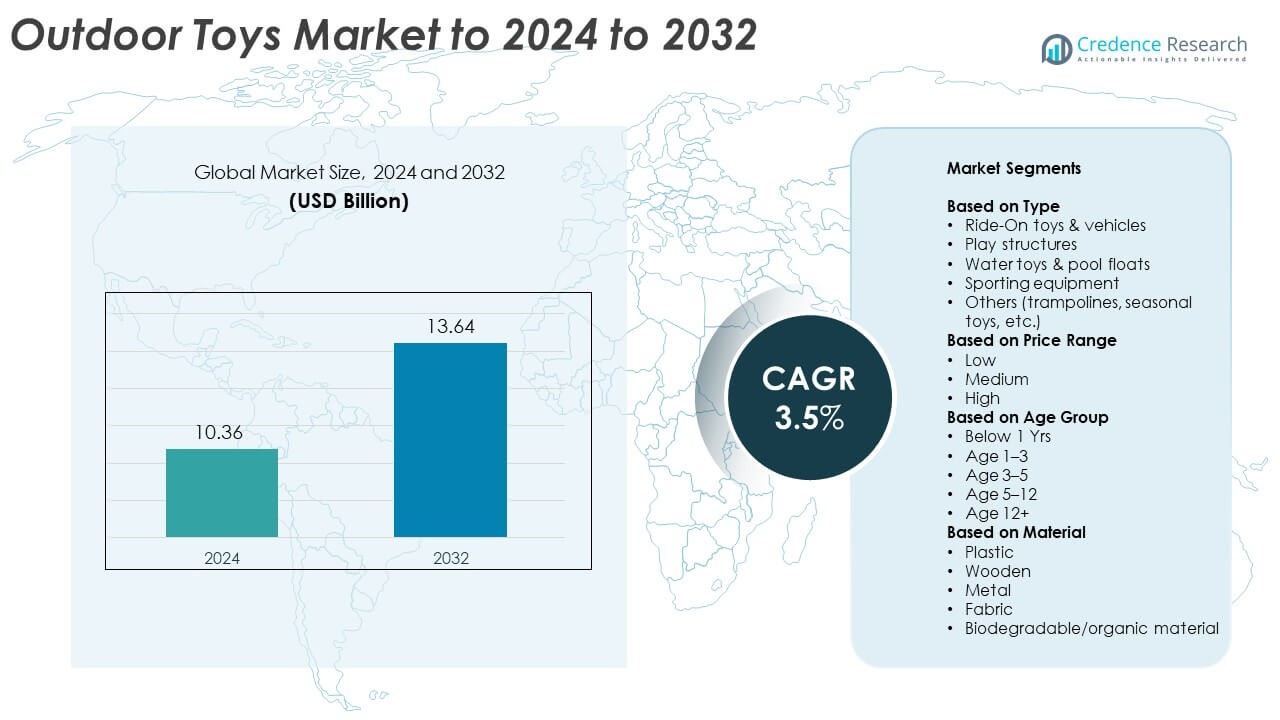
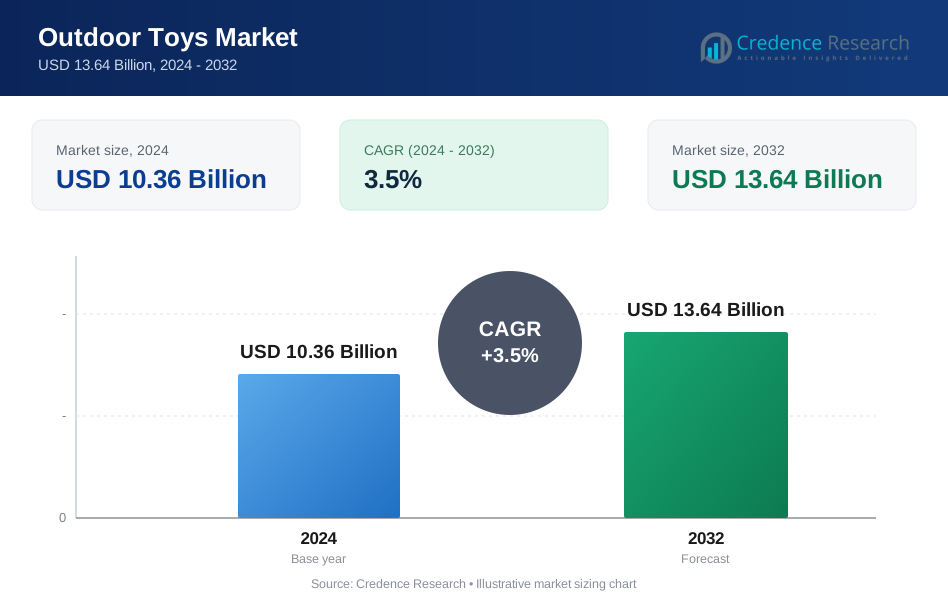
Outdoor Toys Market size was valued USD 10.36 Billion in 2024 and is anticipated to reach USD 13.64 Billion by 2032, at a CAGR of 3.5% during the forecast period.
| REPORT ATTRIBUTE | DETAILS |
|---|---|
| Historical Period | 2020-2023 |
| Base Year | 2024 |
| Forecast Period | 2025-2032 |
| Outdoor Toys Market Size 2024 | USD 10.36 Billion |
| Outdoor Toys Market, CAGR | 3.5% |
| Outdoor Toys Market Size 2032 | USD 13.64 Billion |
The outdoor toys market is driven by major players including Simba Dickie Group GmbH, Mattel, Inc., Decathlon, Jakks Pacific, Inc., Outdoor Toys, Ravensburger AG, Hasbro, Inc., Playmobil, Mookie Toys, and Little Tikes. These companies compete through wider product portfolios, strong distribution networks, and steady innovation in ride-on vehicles, sports equipment, and backyard play systems. North America leads the market with about 37% share due to higher household spending and strong adoption of premium outdoor toys. Europe follows with nearly 28% share, supported by strong demand for sustainable and safety-certified products. Asia Pacific holds about 24% share and remains the fastest-growing region due to rising urbanization and expanding online retail access.
Market Insights
- The outdoor toys market reached USD 10.36 Billion in 2024 and is projected to hit USD 13.64 Billion by 2032, growing at a CAGR of 3.5%.
- Demand rises due to parents encouraging outdoor activity, with the 5–12 age group holding the largest share at 42% and ride-on toys leading type demand with 34% share.
- Sustainable designs, modular backyard playsets, and tech-enabled outdoor toys shape key trends as brands focus on durability and safer materials.
- Competition remains strong as major companies expand product lines, improve safety testing, and enhance online distribution to strengthen their market presence.
- North America leads with 37% share, followed by Europe at 28% and Asia Pacific at 24%, while the medium price range remains the dominant segment with 48% share due to balanced affordability and quality.
Market Segmentation Analysis:
By Type
Ride-on toys and vehicles held the dominant position in 2024 with about 34% share of the outdoor toys market. Parents prefer these products because they support motor-skill growth and give children active playtime outdoors. Strong demand comes from battery-powered ride-ons, balance bikes, and push cars used across parks and home spaces. Play structures and water toys grew at a steady pace as families invested in backyard play zones, but ride-on toys stayed ahead due to wide product variety, strong brand presence, and higher replacement cycles during early childhood years.
- For instance, the Power Wheels brand, a subsidiary of Mattel's Fisher-Price division since 1994, achieved record sales in 1999, a year which saw the introduction of the Harley-Davidson Motorcycle ride-on toy,
By Price Range
The medium price range led the market in 2024 with nearly 48% share. This range balances affordability with better durability and features, making it the most preferred choice among urban families. Parents choose mid-range outdoor toys because these products offer safer materials, longer life, and wider designs compared with low-priced options. High-priced toys expanded in premium homes, but the medium segment remained dominant as brands introduced stronger plastics, improved safety standards, and bundled accessories without steep price increases.
- For instance, Step2 established a manufacturing facility in Fort Valley, Georgia, with a total space of 109,250 square feet in 2000 to serve its growing southeast business, according to reports in Plastics News.
By Age Group
Children aged 5–12 years accounted for the largest share in 2024 with about 42% share. This group drives strong demand for bicycles, sports gear, outdoor play structures, and skill-based toys that support active outdoor routines. Rising participation in school sports and growing awareness of reducing screen time boost purchases in this segment. Younger groups such as ages 1–3 also showed healthy growth, but the 5–12 years category stayed dominant because of broader product usage, higher outdoor activity levels, and frequent upgrades as children grow.
Key Growth Drivers
Rising focus on active outdoor play
Parents are encouraging children to spend more time outdoors due to growing concerns over screen exposure and reduced physical activity. This trend boosts demand for bicycles, sports sets, ride-on toys, and backyard play structures that promote movement and skill development. Schools and community groups also add outdoor activities to support physical health, which increases product adoption. Brands expand product lines designed for skill building, balance training, and coordination support. This growing shift toward healthy outdoor routines acts as a major growth driver for the outdoor toys market.
- For instance, Decathlon supports organized sport and outdoor activity through 1,817 stores across 79 territories (countries and regions) and a workforce of about 101,100 employees, giving global reach to its sports and outdoor equipment range.
Increasing household spending on recreation
Higher disposable income and rising interest in home-based entertainment have increased demand for mid-range and premium outdoor toys. Families invest in durable playsets, upgraded ride-ons, and customized outdoor gear that enhances backyard use. Seasonal gifting and festive purchases further support strong sales across developed and emerging markets. Retailers expand product lists across online and offline channels, making it easier for families to access a wide range of designs. This steady rise in household recreational spending remains a major growth driver for the outdoor toys market.
- For instance, Spin Master has grown into a global toy and entertainment company with more than 2,500 employees working from 29 offices in nearly 20 countries, reflecting large-scale supply of branded play and recreation products.
Expansion of online retail and global brands
E-commerce platforms have made outdoor toys more accessible by offering wide product catalogs, discounts, and home delivery options. Global brands enter new markets through online channels, which increases consumer choice and improves product quality standards. Digital reviews and social media influence buyer decisions, pushing families toward safer and more innovative toys. Retail giants partner with toy makers to introduce exclusive collections, supporting sustained demand. This rapid expansion of online retail acts as another key growth driver for the outdoor toys market.
Key Trends & Opportunities
Growth of eco-friendly and sustainable toys
Many parents prefer toys made from recycled plastics, wood, or biodegradable materials due to rising environmental concerns. This shift creates strong opportunities for brands offering eco-certified outdoor toys with reduced chemical use. Companies focus on greener supply chains and packaging to meet sustainability expectations. Growing global awareness about environmental impact pushes retailers to add dedicated “green toy” categories. This rising adoption of sustainable products stands out as a key trend and opportunity in the outdoor toys market.
- For instance, Green Toys reported by May 2024 that it had recycled over 155 million post-consumer milk jugs into toy-grade plastic, directly tying toy production to large-scale waste diversion.
Integration of technology in outdoor play
Manufacturers introduce smart ride-ons, app-linked sports gear, and interactive outdoor games that blend physical activity with digital engagement. This shift attracts older children who want tech-driven play while still spending time outdoors. Brands explore sensor-based scoring, GPS navigation, and Bluetooth features that enhance safety and learning. Technology-supported outdoor toys also appeal to parents seeking controlled and measurable activity. This increased integration of digital tools presents a strong trend and opportunity within the outdoor toys market.
- For instance, Segway’s Ninebot eKickScooter ZING E8 for children offers a maximum speed of 14 kilometers per hour and a range of about 10 kilometers, and is designed for users aged 6 to 12 years, combining electronics with outdoor riding.
Rising demand for modular backyard play zones
Families invest in customizable backyard setups that include swings, climbers, mini sports turfs, and splash zones. Modular designs help parents expand or reconfigure play spaces as children grow, which increases repeat purchases. Home improvement trends and larger suburban homes further support adoption. Manufacturers introduce weather-resistant materials and easy installation systems, boosting the appeal of these products. This rise in modular outdoor play environments represents a key trend and opportunity for market expansion.
Key Challenges
Safety concerns and compliance requirements
Manufacturers must meet strict safety norms related to material quality, impact resistance, and chemical limits. Non-compliance leads to recalls and damages brand trust, which restricts product adoption. Parents closely monitor product reviews and certification labels before buying, raising the need for consistent quality checks. Complex regulations across regions increase operational costs and slow product launches. These rising safety and compliance pressures stand as a major challenge in the outdoor toys market.
Seasonal demand fluctuations and cost pressures
Outdoor toys experience peak demand during holidays and summer months, which leads to uneven sales cycles. Manufacturers face high storage and inventory management costs during off-season periods. Price fluctuations in plastics, metals, and packaging materials add further strain on production budgets. Retailers also reduce stock in cooler months, limiting full-year revenue potential. These seasonal shifts and material cost pressures remain a key challenge limiting stable growth in the outdoor toys market.
Regional Analysis
North America
North America held about 37% share of the outdoor toys market in 2024, driven by strong spending on premium ride-ons, play structures, and sports gear across the U.S. and Canada. Parents focus on outdoor recreation to reduce screen time, which boosts demand for durable and skill-based products. Retailers expand online and in-store selections, helping families access a wide range of designs. Backyard upgrades in suburban homes also support steady growth. Rising preference for safety-certified and eco-friendly toys continues to shape buying patterns across the region.
Europe
Europe captured nearly 28% share in 2024, supported by strong demand for eco-friendly outdoor toys and higher adoption of wooden and sustainable materials. Consumer preference for quality-certified products drives growth across Germany, the U.K., France, and Nordic countries. Outdoor sports participation among children increases sales of bicycles, scooters, and backyard sports sets. Seasonal festivals and holidays further push toy purchases. Widespread regulatory standards guide manufacturers toward safer and greener designs, keeping the region a key market for consistent product innovation.
Asia Pacific
Asia Pacific accounted for about 24% share in 2024 and showed the fastest growth due to rising urbanization and increasing household spending. Larger families in China, India, and Southeast Asia invest in affordable ride-ons, sports toys, and outdoor playsets. Expanding e-commerce platforms boost accessibility, offering a wide range of low- to mid-range products. Parents seek toys that support physical development and outdoor routines, pushing manufacturers to expand their portfolios. Growing interest in backyard play spaces strengthens regional demand.
Latin America
Latin America represented nearly 7% share in 2024, driven by growing interest in outdoor recreation across Brazil, Mexico, and Argentina. Urban families buy more ride-on vehicles, sports gear, and summer water toys as outdoor activities become more common. Local manufacturers introduce cost-effective products suited for warm climates, helping improve affordability. Economic improvements in several countries support greater spending on children’s leisure products. Seasonal events and holiday sales also encourage higher purchases across major cities.
Middle East & Africa
Middle East & Africa held around 4% share in 2024, with steady growth supported by rising urban development and increasing adoption of modern outdoor toys. Families in the UAE, Saudi Arabia, and South Africa invest in premium ride-ons, sports gear, and weather-resistant play structures suited for hot climates. Expanding retail chains and online marketplaces improve access to global brands. Water toys and pool accessories gain popularity due to warmer temperatures in many areas. Gradual income growth and rising focus on children’s recreation continue to support market expansion.
Market Segmentations:
By Type
- Ride-On toys & vehicles
- Play structures
- Water toys & pool floats
- Sporting equipment
- Others (trampolines, seasonal toys, etc.)
By Price Range
- Low
- Medium
- High
By Age Group
- Below 1 Yrs
- Age 1–3
- Age 3–5
- Age 5–12
- Age 12+
By Material
- Plastic
- Wooden
- Metal
- Fabric
- Biodegradable/organic material
By Geography
- North America
- U.S.
- Canada
- Mexico
- Europe
- Germany
- France
- U.K.
- Italy
- Spain
- Rest of Europe
- Asia Pacific
- China
- Japan
- India
- South Korea
- South-east Asia
- Rest of Asia Pacific
- Latin America
- Brazil
- Argentina
- Rest of Latin America
- Middle East & Africa
- GCC Countries
- South Africa
- Rest of the Middle East and Africa
Competitive Landscape
The outdoor toys market is shaped by leading companies such as Simba Dickie Group GmbH, Mattel, Inc., Decathlon, Jakks Pacific, Inc., Outdoor Toys, Ravensburger AG, Hasbro, Inc., Playmobil, Mookie Toys, and Little Tikes. The competitive landscape reflects strong innovation efforts focused on safety, durability, and child development, with manufacturers expanding product lines across ride-ons, sports gear, outdoor playsets, and water toys. Many companies invest in eco-friendly materials and weather-resistant designs to align with sustainability trends and longer outdoor usage. Online retail partnerships continue to strengthen brand visibility, while exclusive deals with large retailers help secure additional market share. Rising demand for multifunctional and modular play equipment pushes companies to upgrade designs and introduce customizable features. Firms also enhance quality certifications and safety testing to meet regional regulations, ensuring stronger consumer trust. Competition intensifies as both global and regional brands expand into new markets through e-commerce platforms.
Key Player Analysis
- Simba Dickie Group GmbH
- Mattel, Inc.
- Decathlon
- Jakks Pacific, Inc.
- Outdoor Toys
- Ravensburger AG
- Hasbro, Inc.
- Playmobil
- Mookie Toys
- Little Tikes
Recent Developments
- In 2025, Decathlon launched its 2025 Spring Outdoor Sports and Camping Collection in March 2025, featuring a variety of outdoor sports equipment and toys for children, including items like children's mountain bikes.
- In 2025, Hasbro unveiled new products at the North American International Toy Fair, including the new intellectual property Nano-mals, a new line of PLAY-DOH BARBIE toys, and expanded offerings for established brands like FURBY and Peppa Pig
- In 2024, Jakks Pacific launched a new lifestyle products line beginning in Fall 2024 with skateboards, helmets, and roller skates under brands such as Roxy, Quiksilver, and Juicy Couture. The collection was expanded in early 2025 to include spring/summer focused items such as branded volleyballs, floaties, and other beach accessories.
Report Coverage
The research report offers an in-depth analysis based on Type, Price Range, Age Group, Material and Geography. It details leading market players, providing an overview of their business, product offerings, investments, revenue streams, and key applications. Additionally, the report includes insights into the competitive environment, SWOT analysis, current market trends, as well as the primary drivers and constraints. Furthermore, it discusses various factors that have driven market expansion in recent years. The report also explores market dynamics, regulatory scenarios, and technological advancements that are shaping the industry. It assesses the impact of external factors and global economic changes on market growth. Lastly, it provides strategic recommendations for new entrants and established companies to navigate the complexities of the market.
Future Outlook
- The outdoor toys market will see steady growth as parents promote more outdoor play.
- Manufacturers will expand eco-friendly product lines using recycled and safer materials.
- Demand for modular backyard play zones will rise in suburban households.
- Smart features in ride-ons and sports gear will attract older children seeking interactive play.
- E-commerce platforms will increase product visibility and drive stronger cross-border sales.
- Brands will invest in durable, weather-resistant materials to improve product life.
- Sports-linked outdoor toys will grow as schools and clubs promote physical fitness.
- Premium outdoor toys will gain traction among higher-income families.
- Safety-certified products will remain a top priority for buyers and regulators.
- Seasonal demand patterns will continue, but promotions and online sales will reduce fluctuations.
Request a Free Sample
Fill in your details and we'll send you a free sample report.
- Sample data tables & charts
- Research methodology
Need a Custom Version of This Report?
Tailor the scope, geography, or segments to your exact requirements.
- Custom geography or segment scope
- Direct access to our analyst team
Frequently Asked Questions
What is the current market size for outdoor toys market, and what is its projected size in 2032?
At what Compound Annual Growth Rate is the outdoor toys market projected to grow between 2025 and 2032?
Which outdoor toys market segment held the largest share in 2024?
What are the primary factors fueling the growth of the outdoor toys market?
Who are the leading companies in the outdoor toys market?
Which region commanded the largest share of the outdoor toys market in 2024?
Table of Content
Chapter 1. Report Introduction
- 1.1 Report Description & Purpose
- 1.1.1 Report Title & Market Definition
- 1.1.2 Unique Selling Propositions (USP) & Key Differentiators
- 1.1.3 Value Proposition for Stakeholders
- 1.2 Research Objectives
- 1.2.1 Market Sizing Objectives (Volume & Revenue)
- 1.2.2 Segmentation Objectives
- 1.2.3 Competitive Intelligence Objectives
- 1.2.4 Forecast & Scenario Objectives
- 1.3 Report Scope
- 1.3.1 Outdoor Toys Scope – Types & Subtypes Covered
- 1.3.2 Geographic Scope – Regions & Countries Covered
- 1.3.3 Historical Period, Base Year & Forecast Period (2024; forecast to 2032)
- 1.3.4 Inclusions & Exclusions
- 1.4 HS Code & Classification Framework
- 1.5 Currency, Units & Pricing Basis
- 1.6 Target Stakeholders
- 1.7 Limitations & Assumptions
Chapter 2. Executive Summary
- 2.1 Global Outdoor Toys Market Snapshot
- 2.1.1 Market Size – Historical (2024) & Forecast (2024-2032) (2024: USD 10.36 Billion → 2032: USD 13.64 Billion)
- 2.1.2 Volume & Revenue – Global Totals
- 2.1.3 Key Market Highlights – Top Five Facts
- 2.2 Outdoor Toys Market Segmentation Snapshot
- 2.2.1 Market Split by Region – 2024 vs. 2032
- 2.3 Competitive Snapshot
- 2.3.1 Top 10 Players by Revenue Share – 2024
- 2.3.2 Top 10 Players by Volume Share – 2024
- 2.3.3 Recent Strategic Developments (18-Month Summary)
- 2.4 Key Investment Highlights & Strategic Conclusions
Chapter 3. Outdoor Toys Market Dynamics & Industry Analysis
- 3.1 Market Overview & Context
- 3.1.1 Outdoor Toys Market Position in the Broader Automotive Value Chain
- 3.1.2 OEM vs. Replacement Market Dynamics
- 3.1.3 Market Maturity & Development Stage by Region
- 3.2 Outdoor Toys Market Drivers
- 3.3 Outdoor Toys Market Restraints & Challenges
- 3.4 Outdoor Toys Market Opportunities
- 3.5 Porter's Five Forces Analysis
- 3.5.1 Threat of New Entrants
- 3.5.2 Bargaining Power of Suppliers
- 3.5.3 Bargaining Power of Buyers
- 3.5.4 Threat of Substitutes
- 3.5.5 Competitive Rivalry – Intensity Assessment
- 3.6 Outdoor Toys Value Chain Analysis
- 3.6.1 Upstream – Raw Material/Input Suppliers
- 3.6.1.1 Raw Material/Input 1
- 3.6.1.2 Raw Material/Input 2
- 3.6.1.3 Raw Material/Input 3
- 3.6.2 Midstream – Production/Manufacturing/Service Delivery
- 3.6.2.1 Production/Process Overview
- 3.6.2.2 Key Facility Locations & Capacity by Manufacturer
- 3.6.3 Downstream – Distribution & End Consumer
- 3.6.3.1 Primary Channel – B2B/OEM
- 3.6.3.2 Secondary Channels – Dealer, Retail, Online, Direct
- 3.6.4 Value Chain Profitability Analysis
- 3.6.1 Upstream – Raw Material/Input Suppliers
- 3.7 PESTEL Analysis
- 3.7.1 Political Factors
- 3.7.2 Economic Factors
- 3.7.3 Social Factors
- 3.7.4 Technological Factors
- 3.7.5 Environmental Factors
- 3.7.6 Legal Factors
- 3.8 Outdoor Toys Supply Chain Analysis
- 3.8.1 Raw Material/Input Supply Risk Assessment
- 3.8.2 Manufacturing Concentration Risk (Geographic Exposure)
- 3.8.3 Trade Disruption Impact Analysis
- 3.9 Regulatory & Policy Landscape
Note: The regulatory and policy landscape section covers regulations based on their applicability to the market, Outdoor Toys category, geography, and scope of the study. Only regulatory frameworks with a material impact on operations, compliance, trade, sustainability, or market access are analyzed in detail.
Chapter 4. Key Investment Pockets & Opportunity Analysis
- 4.1 Outdoor Toys Market Attractiveness Analysis
- 4.1.1 By Region – Investment Attractiveness Matrix (Volume × CAGR)
- 4.2 Absolute Revenue Growth Opportunity
- 4.2.1 By Region – Absolute USD Growth Through 2032
- 4.3 Incremental Volume Opportunity
- 4.3.1 By Region – Incremental Volume Through 2032
- 4.3.2 Segment – Incremental Volume
- 4.4 Emerging Submarket Opportunity Deep Dive (Subject to Applicability)
- 4.5 Emerging Market Opportunity Scorecards
- 4.5.1 United States
- 4.5.2 Europe
- 4.5.3 Asia
- 4.5.4 Middle East & Africa
Note: Emerging Market Opportunity Scorecards will be included based on relevance and strategic importance. Regions listed are indicative and may vary depending on data availability and market dynamics.
Chapter 5. Outdoor Toys Import-Export Analysis & Trade Flows
- 5.1 Global Trade Overview
- 5.1.1 Global Export Value by Country (2024)
- 5.1.2 Global Export Volume by Country (2024)
- 5.1.3 Global Import Value by Country (2024)
- 5.1.4 Global Import Volume by Country (2024)
- 5.1.5 Net Trade Balance by Country (2024)
- 5.2 Export Analysis – Segment
- 5.2.1 Type 1 (HS Code)
- 5.2.2 Type 2 (HS Code)
- 5.2.3 Type 3 (HS Code)
- 5.2.4 Type 4 (HS Code)
- 5.2.5 Type 5 (HS Code)
- 5.3 Import Analysis – Segment
- 5.3.1 Type 1 (HS Code)
- 5.3.2 Type 2 (HS Code)
- 5.3.3 Type 3 (HS Code)
- 5.3.4 Type 4 (HS Code)
- 5.3.5 Type 5 (HS Code)
- 5.4 Average Unit Trade Prices
- 5.4.1 Average Export Price – Segment & Country
- 5.4.2 Average Import Price – Segment & Source Country
- 5.4.3 Price Trends (2024)
- 5.5 Key Trade Route Analysis
- 5.5.1 Trade Route 1
- 5.5.2 Trade Route 2
- 5.5.3 Trade Route 3
- 5.5.4 Trade Route 4
- 5.5.5 Trade Route 5
- 5.6 Trade Policy Impact Assessment
- 5.6.1 US Anti-Dumping & Section 301 Tariffs
- 5.6.2 EU Customs Union Impact
- 5.6.3 Major Free Trade Agreements
- 5.6.4 USMCA Rules of Origin
Note: Trade policy analysis will be included only where relevant to the Outdoor Toys market.
Chapter 6. Competitive Landscape & Company Benchmarking
- 6.1 Outdoor Toys Market Concentration & Structure
- 6.1.1 Herfindahl-Hirschman Index (HHI) – vs. 2024
- 6.1.2 Tier 1, Tier 2 & Tier 3 Market Structure
- 6.1.3 Global, Regional & Local Player Dynamics
- 6.2 Outdoor Toys Market Share Analysis – 2024
- 6.2.1 Global Revenue Share by Company
- 6.2.2 Global Volume Share by Company
- 6.2.3 Regional Revenue Share
- 6.2.4 Market Share Evolution ( vs. 2024)
- 6.2.5 OEM Segment Share by Company
- 6.2.6 Replacement Segment Share by Company
- 6.3 Production/Delivery Capacity & Facility Analysis
- 6.3.1 Global Installed Capacity
- 6.3.2 Capacity Utilization Rates
- 6.3.3 Production/Output Volume
- 6.3.4 Facility Locations & Capacity Map
- 6.3.5 Planned Capacity Additions
- 6.4 Outdoor Toys Competitive Benchmarking Matrix
- 6.4.1 Revenue, Volume, CAGR & Profitability Comparison
- 6.4.2 Channel Revenue Mix
- 6.4.3 Geographic Revenue Exposure
- 6.4.4 R&D Intensity
- 6.4.5 Sustainability Maturity
- 6.5 Strategic Developments in Outdoor Toys (Last 24 Months)
- 6.5.1 Mergers, Acquisitions & Divestments
- 6.5.2 New Outdoor Toys Launches
- 6.5.3 Facility Expansions
- 6.5.4 Strategic Alliances, Joint Ventures & Partnerships
- 6.5.5 Distribution Expansion & Market Entry
- 6.5.6 Sustainability & ESG Initiatives
- 6.6 Competitive Strategy Mapping
- 6.6.1 Leader, Challenger, Follower & Niche Classification
- 6.6.2 Pricing Strategy Comparison
- 6.6.3 Channel Strategy Matrix
Note: Strategic developments are included based on their materiality and the availability of reliable information.
Chapter 7. Global Outdoor Toys Market – By Distribution Channel
- 7.1 Segment Overview
- 7.1.1 Volume & Revenue Split by Channel (2024 & 2032)
- 7.1.2 Channel Mix Evolution (2024-2032)
Chapter 8. Regional Market Analysis – Global Overview
- 8.1 Global Regional Overview
- 8.1.1 Regional Volume Share
- 8.1.2 Regional Revenue Share
- 8.1.3 Regional Volume by Region
- 8.1.4 Regional Revenue by Region
- 8.1.5 Regional Forecast Through 2032
- 8.2 Cross-Regional Segment Analysis
- 8.2.1 By Distribution Channel
- 8.2.2 By Brand/Price Tier
Chapter 9. North America Outdoor Toys Market
- 9.1 United States
- 9.2 Canada
- 9.3 Mexico
Chapter 10. Europe Outdoor Toys Market
- 10.1 Germany
- 10.2 France
- 10.3 Italy
- 10.4 United Kingdom
- 10.5 Spain
- 10.6 Poland
- 10.7 Russia
- 10.8 Netherlands
- 10.9 Belgium
- 10.10 Sweden
- 10.11 Denmark
- 10.12 Norway
- 10.13 Rest of Europe
Chapter 11. Asia Pacific Outdoor Toys Market
- 11.1 China
- 11.2 India
- 11.3 Japan
- 11.4 South Korea
- 11.5 Thailand
- 11.6 Indonesia
- 11.7 Vietnam
- 11.8 Malaysia
- 11.9 Australia
- 11.10 Rest of Asia Pacific
Chapter 12. Latin America Outdoor Toys Market
- 12.1 Brazil
- 12.2 Argentina
- 12.3 Colombia
- 12.4 Chile
- 12.5 Rest of Latin America
Chapter 13. Middle East Outdoor Toys Market
- 13.1 Saudi Arabia
- 13.2 United Arab Emirates
- 13.3 Turkey
- 13.4 Israel
- 13.5 Iran
- 13.6 Rest of the Middle East
Chapter 14. Africa Outdoor Toys Market
- 14.1 South Africa
- 14.2 Egypt
- 14.3 Nigeria
- 14.4 Morocco
- 14.5 Rest of Africa
Chapter 15. Outdoor Toys Company Profiles
- 15.1 [Company 01]
- 15.1.1 Company Overview
- 15.1.2 Key Management Personnel
- 15.1.3 Products & Services Portfolio
- 15.1.4 Financial Performance
- 15.1.5 Key Market Focus & Geographic Presence
- 15.1.6 Recent Developments & Strategic Initiatives
Note: The company profile list is preliminary and may change based on research findings, market developments, data availability, and client requirements.
Chapter 16. Appendices
- Appendix A – List of Abbreviations & Acronyms
- Appendix B – Industry Classification Code Reference – Full Series
- Appendix C – Production & Capacity Data Tables
- Appendix D – End-Use & Demand Base Tables
- Appendix E – Consumption & Replacement Rate Assumptions
- Appendix F – ASP Reference Tables
- Appendix G – Manufacturing & Facility Database
- Appendix H – Import-Export Data Tables
- Appendix I – Regulatory Summary Tables
- Appendix J – Primary Research Participant List (Anonymized)
- Appendix K – Primary Research Questionnaire Framework
- Appendix L – Data Sources & Bibliography
- Appendix M – Market Size Divergence & Source Comparison
Chapter 17. Research Methodology
- 17.1 Research Framework & Philosophy
- 17.2 Secondary Research – Sources, Hierarchy & Data Extraction
- 17.3 Data Modeling – Bottom-Up & Top-Down Market Sizing
- 17.4 Primary Research – Stakeholder Framework, LOI & Sample Sizes
- 17.5 Forecast Methodology – Regression, Scenario & Sensitivity Analysis
- 17.6 Quality Control – Four-Layer Validation Framework
- 17.7 Limitations & Standard Assumptions
- 17.8 Disclaimer
