
Market Overview:
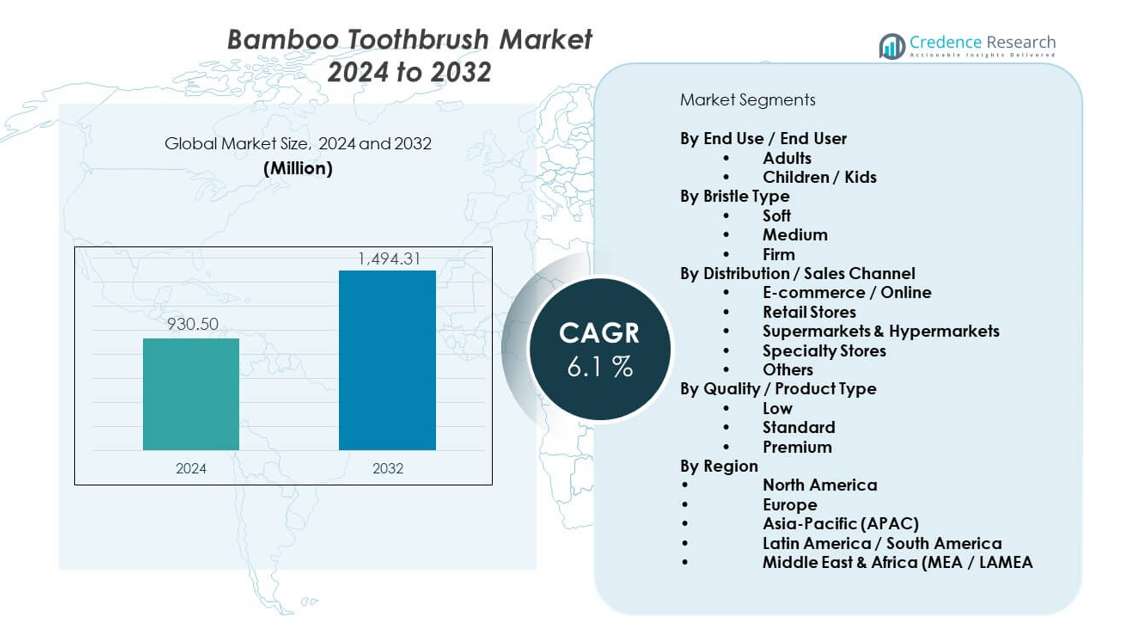
The Bamboo toothbrush market is projected to grow from USD 930.5 million in 2024 to an estimated USD 1494.31 million by 2032, with a CAGR of 6.1% from 2024 to 2032. Demand rises due to strong interest in eco-friendly oral care.
| REPORT ATTRIBUTE | DETAILS |
|---|---|
| Historical Period | 2020-2023 |
| Base Year | 2024 |
| Forecast Period | 2025-2032 |
| Bamboo Toothbrush Market Size 2024 | USD 930.5 million |
| Bamboo Toothbrush Market, CAGR | 6.1% |
| Bamboo Toothbrush Market Size 2032 | USD 1494.31 million |
Growing awareness of plastic waste drives steady adoption across global users. Brands promote biodegradable handles that support greener daily routines. Retailers expand shelf space for sustainable items across urban outlets. Health-focused buyers seek natural designs with safe materials. Online channels push wide choices that match varied brushing needs. Schools and NGOs run awareness drives that boost early adoption. Manufacturers launch improved bristle blends for better cleaning. Strong product visibility supports long-term category growth.
North America leads due to high sustainability awareness and broad retail access. Europe follows due to strict environmental policies that push greener consumption. Asia Pacific emerges fast due to rising eco-friendly habits and large young populations. Latin America gains traction through growing interest in natural lifestyle goods. The Middle East expands slowly but benefits from rising premium oral care demand. Africa shows early adoption through urban-focused awareness programs. Global brands widen reach by adjusting designs to local needs.
Market Insights:
- The Bamboo toothbrush market reached USD 930.5 million in 2024 and is projected to hit USD 1494.31 million by 2032, with a steady 6.1% CAGR driven by rising adoption of sustainable oral care.
- Asia-Pacific leads with 35% share, followed by North America at 30% and Europe at 25%, supported by strong sustainability awareness and broad retail access across major countries.
- Asia-Pacific is also the fastest-growing region with 35% share, driven by expanding eco-friendly habits, large population bases, and strong online penetration.
- Soft bristle variants account for about 55% share, supported by dentist recommendations and high comfort levels.
- Adults represent roughly 65% share due to stronger sustainability adoption and higher purchasing capacity across global markets.
Market Drivers:
Rising Preference for Sustainable Oral Care Products
The Bamboo toothbrush market grows due to rising demand for greener daily use items. Buyers shift toward eco-friendly tools that reduce plastic dependence and support cleaner habits. Brands highlight biodegradable handles that meet strict sustainability goals. Retail shelves feature natural products that appeal to eco-aware adults. Young consumers embrace greener brushing due to strong social influence. Awareness campaigns push families to adopt natural oral care options. Producers create smooth designs that support comfort during regular use. Strong interest in natural materials drives consistent category strength.
- For instance, Sustainable Tomorrow's Zen Bamboo Electric Toothbrush features sonic cleaning technology delivering 38,000 vibrations per minute with 5 cleaning modes, enabling users to remove up to 10x more plaque compared to manual toothbrushes while maintaining 95% biodegradable heads composed of raw bamboo and plant-based materials.
Expansion of Promotional Campaigns Encouraging Eco-Conscious Choices
Promotional activity across digital platforms fuels stronger acceptance of bamboo brushes. NGOs push clean-living messages that reach schools and homes. Retailers run seasonal themes built around greener living. The Bamboo toothbrush market gains traction through public drives that present safe brushing habits. Influencers share product benefits that reach large online groups. Educators include sustainability topics that guide early adoption. Manufacturers expand visibility through eco fairs and green exhibitions. Public engagement strengthens understanding of natural oral tools.
- For instance, The Bam and Boo, a Portuguese skincare brand based in the Azores, promotes its products through targeted promotional campaigns and community engagement initiatives, including partnerships with influencers. Since shifting its focus from being a bamboo toothbrush company, the brand now offers a range of subscription and one-time purchase products and actively engages its community on platforms like Facebook and Instagram.
Growing Investments in Product Innovation and Quality Improvement
Investments in advanced shaping and bristle options lift customer trust. Producers design lighter handles that improve grip in daily routines. Quality checks ensure smoother surfaces that reduce splinter concerns. The Bamboo toothbrush market benefits from strong R&D aimed at better user comfort. Makers introduce plant-based bristles that align with broad sustainability goals. Packaging designs shift toward compostable forms that enhance brand appeal. Firms revise production steps to meet global safety rules. Steady innovation keeps buyers engaged.
Expanding Online Retail Access Across Global Regions
Online platforms increase the reach of bamboo brushes across many countries. Digital channels offer wide choices that suit varied brushing needs. Strong delivery networks support timely access for rural and urban buyers. Marketing teams highlight natural benefits through video formats. The Bamboo toothbrush market gains reach due to cross-border sales growth. Subscription models help users maintain regular replacement cycles. Reviews guide new buyers toward safer natural options. Broader retail access supports long-term adoption.
Market Trends:
Integration of Natural Lifestyle Positioning Across Oral Care Brands
Brands reshape messaging to reflect clean-living themes. Firms align oral hygiene tools with broader natural lifestyle choices. Marketing teams link bamboo brushes with wellness-driven routines. Buyers view such tools as part of a wider eco-focused identity. The Bamboo toothbrush market gains visibility through strong lifestyle branding. Retail stores align natural product shelves with wellness sections. Cross-category promotions increase interest in clean-living kits. Messaging centered on nature strengthens overall brand loyalty.
Rise of Subscription-Based Oral Care Kits for Regular Replacement Cycles
Subscription kits grow due to rising interest in structured routines. Users appreciate predictable delivery that prevents gaps in oral care. Retailers build mixed kits that include brushes and eco-friendly accessories. The Bamboo toothbrush market expands reach through flexible subscription offers. Platforms promote simple sign-up options that support steady user retention. New brands position kits as convenient green solutions. Automatic renewals help families maintain hygiene consistency. Digital tools track user preferences for tailored deliveries.
- For instance, Industry benchmarks suggest that subscription-based models for everyday consumer goods, like bamboo toothbrushes, can achieve a customer retention rate of 45–55%. This is significantly higher than the average for traditional retail, and targeted offerings can further boost long-term sign-ups.
Shift Toward Premium and Design-Focused Natural Toothbrush Models
Premium models gain traction among style-focused buyers seeking distinct looks. Makers use polished finishes that improve daily experience. Designs feature engraved patterns that appeal to niche groups. The Bamboo toothbrush market moves toward stronger personalization themes. Retailers display premium variants in curated sections to lift appeal. Consumers choose designs that reflect personal identity. Custom engraving options enhance gifting interest. Premium placement increases perceived value.
Higher Retail Presence in Pharmacies and Specialized Eco Stores
Pharmacies increase stock levels due to rising demand for safe materials. Specialty eco stores highlight bamboo brushes near other green items. Health-focused shoppers view these stores as trusted channels. The Bamboo toothbrush market benefits from wider category exposure. Retail planners design clear shelf zones that guide faster selection. Eco aisles attract conscious buyers seeking natural alternatives. Staff training supports awareness of product benefits. Strong in-store presence lifts conversion rates.
Market Challenges Analysis:
Limited Awareness in Price-Sensitive Regions and Slow Adoption Pace
Low awareness in developing markets restricts category expansion. Some buyers view natural tools as less essential in daily life. Limited marketing reach slows early-stage acceptance. The Bamboo toothbrush market faces hurdles where price guides most decisions. Competing plastic brushes maintain strong share due to low cost. Retailers hesitate to stock broad varieties in small outlets. Rural consumers often lack access to natural oral tools. Awareness gaps limit steady growth.
Supply Chain Variability and Quality Consistency Concerns
Bamboo sourcing shifts due to climatic and regional factors. Producers face quality gaps that affect finishing standards. Uneven bristle integration affects user comfort in lower-cost variants. The Bamboo toothbrush market encounters pressure to meet global safety rules. Smaller firms struggle with stable material supply. Inconsistent packaging strength affects shelf durability. Trade hurdles disrupt timely distribution across borders. Quality variations reduce user trust.
Market Opportunities:
Rising Global Push Toward Zero-Waste Personal Care Choices
Growing zero-waste adoption unlocks strong demand for greener oral tools. Urban buyers move toward natural products that support waste-free routines. The Bamboo toothbrush market benefits from new eco-aware communities. Firms introduce refill-based kits that reduce long-term waste. Better messaging strengthens recognition of durable natural materials. Retailers curate zero-waste bundles that include bamboo brushes. Awareness campaigns broaden entry into new user groups. Clean-living growth creates long-term opportunity.
Expansion Potential Across Emerging Markets with Eco-Friendly Policies
Emerging regions increase focus on greener consumption patterns. Governments support plant-based materials through policy changes. The Bamboo toothbrush market gains access to new consumer pools. Local brands rise through low-cost natural models. Producers explore region-specific tools suited to climate and culture. Trade partnerships improve retail entry for eco-friendly goods. Rapid urban growth lifts interest in clean living. Expanding eco policies create strong future scope.
Market Segmentation Analysis:
By End Use / End User
The Bamboo toothbrush market records strong demand from adults who prefer eco-friendly oral care tools. Adults choose natural handles that support sustainable living. Children show rising adoption through school programs and parental guidance. Kid-focused designs use smaller grips that improve brushing comfort. Brands introduce fun colors to keep young users engaged. Retailers position kid variants near family wellness zones. Schools promote clean-living habits through awareness drives. Broader acceptance across age groups strengthens segment depth.
- For instance, PUREXA's Bamboo Kids Toothbrush employs an ergonomic, CE-certified bamboo handle specifically engineered for children aged 3-12 years, featuring super soft BPA-free bristles designed to provide gentle cleaning for milk teeth while the handle shape delivers enhanced grip security for small hands.
By Bristle Type
Soft bristles hold the largest share of the Bamboo toothbrush market due to higher comfort and dentist preference. Consumers choose soft variants for daily use across sensitive gums. Medium bristles attract buyers seeking firmer cleaning action. Firm bristles serve niche users with specific cleaning habits. Producers refine bristle designs to improve smoothness. Quality checks maintain consistency across batches. Retailers highlight soft variants for general use. Clear differentiation helps buyers select suitable options.
- For instance, clinical efficacy studies demonstrate that tapered-tip soft-bristle toothbrushes achieve mean plaque reductions of 21.39% in whole-mouth plaque scores after a single brushing session, with gumline plaque reductions of 6.32%, significantly outperforming end-rounded variants.
By Distribution / Sales Channel & Quality / Product Type
E-commerce drives strong reach for the Bamboo toothbrush market due to wide choice and steady promotions. Retail stores support impulse buying through clear displays. Supermarkets and hypermarkets offer bulk packs for family use. Specialty stores attract eco-focused buyers seeking natural kits. Other channels include wellness fairs and local green outlets. Low-tier models target price-sensitive users. Standard tiers balance cost and quality. Premium variants gain traction through design appeal and gifting demand.
Segmentation:
By End Use / End User
- Adults
- Children / Kids
By Bristle Type
- Soft
- Medium
- Firm
By Distribution / Sales Channel
- E-commerce / Online
- Retail Stores
- Supermarkets & Hypermarkets
- Specialty Stores
- Others
By Quality / Product Type
- Low
- Standard
- Premium
By Region
- North America
- U.S.
- Canada
- Mexico
- Europe
- Germany
- France
- U.K.
- Italy
- Spain
- Rest of Europe
- Asia Pacific
- China
- Japan
- India
- South Korea
- South-east Asia
- Rest of Asia Pacific
- Latin America
- Brazil
- Argentina
- Rest of Latin America
- Middle East & Africa
- GCC Countries
- South Africa
- Rest of the Middle East and Africa
Regional Analysis:
North America
North America holds an estimated 30% share of the Bamboo toothbrush market due to strong awareness of sustainable personal care. Consumers adopt natural oral tools through wellness-driven lifestyles. Retailers promote eco-friendly packs across major pharmacy chains. Brands leverage digital campaigns that drive steady conversions. Schools and NGOs support early adoption of greener habits. Buyers trust certified natural materials across daily routines. The region maintains stable leadership through high environmental focus.
Europe
Europe accounts for roughly 25% share, driven by strict regulations that support plastic-free alternatives. Buyers across Germany, France, and the U.K. prefer sustainable oral care tools with certified materials. Retailers expand natural product zones that highlight bamboo variants. Government-backed sustainability goals support wider category acceptance. The region aligns personal care choices with zero-waste principles. The Bamboo toothbrush market gains strength through eco-focused consumer groups. It benefits from strong advocacy for greener household items.
Asia-Pacific, Latin America, and Middle East & Africa
Asia-Pacific leads with nearly 35% share due to large population bases and rapid sustainability engagement. Buyers in China, India, and Southeast Asia shift toward natural oral care through expanding awareness programs. Latin America contributes about 5% share, supported by rising interest in natural lifestyle goods. MEA holds close to 5% share, driven by premium wellness demand in urban zones. The Bamboo toothbrush market expands through improving retail access and digital reach. It gains traction across emerging economies with growing eco-friendly habits. Regional growth strengthens long-term category stability.
Key Player Analysis:
- Colgate-Palmolive Company
- The Humble Co. / Humble Group AB
- Brush with Bamboo
- Bamboo India
- The Bamboo Brush Society
- Bamboo Brush Co.
- Environmental Toothbrush
- Ecolife Innovations LLC (Ecolife)
- Bam&Boo
- Church & Dwight Co., Inc.
- Simply Bamboo
- Boobam
- Organic B / ORGANIC LABS (P) LTD
- Anything But Plastic
- The Green Root
- Nature & My Limited
Competitive Analysis:
The Bamboo toothbrush market features a mix of global oral care companies and niche sustainability-focused brands competing for visibility. Leading players focus on eco-friendly designs, plant-based materials, and strong digital marketing. Established firms use broad retail networks, while emerging brands rely on lifestyle positioning. It gains support from buyers who value natural oral care. Companies improve bristle quality and surface finishing to strengthen customer trust. Producers also invest in compostable packaging to build greener product lines. Strong branding, diversified portfolios, and steady online engagement shape competitive strength.
Recent Developments:
- In August 2024, Colgate-Palmolive relaunched its bamboo toothbrush featuring a 100% natural, biodegradable handle made from sustainably grown bamboo. The toothbrush is packaged in a recyclable paper-based tub and lid, maintaining product protection standards comparable to plastic blister packaging. This launch aligns with Colgate-Palmolive's commitment to environmental sustainability and offers an eco-friendly alternative to traditional plastic toothbrushes.
- In November 2023, Hydrophil formed a partnership with a major European retailer to expand the availability of its bamboo toothbrushes in physical stores across Europe. This collaboration aimed at increasing consumer access to sustainable oral care products and bolstering Hydrophil's market presence in Europe.
Report Coverage:
The research report offers an in-depth analysis based on End Use, Bristle Type, Distribution Channel, and Quality Tier. It details leading market players, providing an overview of their business, product offerings, investments, revenue streams, and key applications. Additionally, the report includes insights into the competitive environment, SWOT analysis, current market trends, as well as the primary drivers and constraints. Furthermore, it discusses various factors that have driven market expansion in recent years. The report also explores market dynamics, regulatory scenarios, and technological advancements that are shaping the industry. It assesses the impact of external factors and global economic changes on market growth. Lastly, it provides strategic recommendations for new entrants and established companies to navigate the complexities of the market.
Future Outlook:
- Rising focus on plastic-free living will expand natural oral care acceptance.
- Premium bamboo variants will gain visibility through design upgrades.
- Retail chains will increase shelf space for eco-focused oral care tools.
- Online subscriptions will support steady replacement cycles.
- Product innovations will improve bristle comfort and durability.
- Government sustainability agendas will push greener alternatives.
- Emerging markets will show higher adoption through awareness programs.
- Partnerships will expand bamboo sourcing and production capacity.
- Brands will integrate compostable packaging across product tiers.
- Global buyers will adopt natural oral tools for lifestyle alignment.

Request a Free Sample
Fill in your details and we'll send you a free sample report.
- Sample data tables & charts
- Research methodology
Market Dynamics
Rising Preference for Sustainable Oral Care Products
Consumers are increasingly seeking eco-friendly alternatives to plastic toothbrushes, driving demand for bamboo toothbrushes with biodegradable handles and natural materials. This shift is supported by heightened environmental awareness and a desire to reduce plastic waste in daily routines.
Expansion of Promotional Campaigns Encouraging Eco-Conscious Choices
Brands, NGOs, and retailers are running targeted campaigns and awareness drives that educate consumers about the benefits of bamboo toothbrushes, boosting adoption rates, especially among younger demographics and families.
Growing Investments in Product Innovation and Quality Improvement
Manufacturers are investing in advanced bristle technologies, ergonomic handle designs, and compostable packaging, which enhance user comfort and trust, making bamboo toothbrushes more appealing and competitive with traditional options.
Expanding Online Retail Access Across Global Regions
The growth of e-commerce platforms and subscription models has made bamboo toothbrushes more accessible to a wider audience, supporting regular replacement cycles and increasing market penetration in both urban and rural areas.
Government Sustainability Agendas and Regulatory Support
Stricter environmental policies and government-backed sustainability initiatives in regions like Europe and Asia Pacific are encouraging consumers and retailers to adopt and promote bamboo toothbrushes, accelerating market growth.
Need a Custom Version of This Report?
Tailor the scope, geography, or segments to your exact requirements.
- Custom geography or segment scope
- Direct access to our analyst team
Frequently Asked Questions
What is the current market size for the Bamboo toothbrush market, and what is its projected size in 2032?
At what Compound Annual Growth Rate is the Bamboo toothbrush market projected to grow between 2025 and 2032?
Which is the leading region of the market for bamboo toothbrushes?
What are the key drivers for the growth of the bamboo toothbrush market?
Which is the major segment in the bamboo toothbrush market by distribution channel outlook?
Who are the leading companies in the Bamboo toothbrush market?
Table of Content
Chapter 1 Market Segmentation
- 1.1 Segmentation Framework
- 1.1.1 Product and Service Classification
- 1.1.2 Application and End-Use Classification
- 1.1.3 Technology and Solution Classification
- 1.1.4 Customer and Distribution Channel Classification
- 1.1.5 Geographic Segmentation
- 1.1.6 Market Segment Definitions and Boundaries
- 1.2 By Bristle Type
- 1.2.1 Soft
- 1.2.2 Medium
- 1.2.3 Firm
- 1.3 By End Use / End User
- 1.3.1 Adults
- 1.3.2 Children / Kids
- 1.4 By Quality / Product Type
- 1.4.1 Low
- 1.4.2 Standard
- 1.4.3 Premium
- 1.5 By Distribution / Sales Channel
- 1.5.1 E-commerce / Online
- 1.5.2 Retail Stores
- 1.5.3 Supermarkets & Hypermarkets
- 1.5.4 Specialty Stores
- 1.5.5 Others
Chapter 2 Introduction
- 2.1 Report Objectives and Scope
- 2.2 Product Definition and Industry Terminology
- 2.3 Market Inclusions and Exclusions
- 2.4 Research Process
- 2.4.1 Primary Research and Expert Interviews
- 2.4.2 Secondary Research and Source Review
- 2.4.3 Top-Down and Bottom-Up Estimation
- 2.4.4 Data Triangulation and Verification
- 2.5 Market Size Measurement Basis
- 2.5.1 2024: USD 930.5 million → 2032: USD 1494.31 million
- 2.6 Historical and Forecast Reference Periods
- 2.6.1 Base Year: 2024
- 2.6.2 Forecast Period: 2024-2032
- 2.7 Research Assumptions and Limitations
Chapter 3 Executive Summary
- 3.1 Market Snapshot and Key Findings
- 3.2 Base-Year Market Size, 2024
- 3.3 Forecast Market Size, 2032
- 3.4 Revenue and Volume Growth Outlook
- 3.5 Key Demand and Supply Indicators
- 3.6 Leading Market Segments
- 3.7 Fastest-Growing Market Opportunities
- 3.8 Regional Performance Highlights
- 3.9 Technology and Industry Transformation
- 3.10 Competitive Landscape Summary
- 3.11 Analyst View and Strategic Implications
Chapter 4 Global Bamboo Toothbrush Market Trends and Developments
- 4.1 Historical Industry Development
- 4.2 Recent Market Trends and Developments
- 4.3 Demand and Customer Behavior Trends
- 4.4 Technology and Product Innovation
- 4.5 Artificial Intelligence, Automation and Digitalization
- 4.6 Local Manufacturing and Supply Chain Realignment
- 4.7 Industry Partnerships, Mergers and Acquisitions
- 4.8 Sustainability and Circular Economy Developments
- 4.9 Government and Private Sector Investment Trends
- 4.10 Emerging Business Models and Commercialization
- 4.11 Industry Developments and Announcements
Chapter 5 Global Bamboo Toothbrush Market Production, Supply and Demand Analysis
- 5.1 Demand Trend and Consumption Analysis
- 5.2 Demand Forecast, 2024-2032
- 5.3 Production and Output Trend
- 5.4 Production and Output Forecast, 2024-2032
- 5.5 Installed Capacity and Capacity Utilization
- 5.6 Company-Wise Production Plants and Statistics
- 5.6.1 Installed Production Capacity
- 5.6.2 Actual Production
- 5.6.3 Planned Capacity and Expansion Targets
- 5.7 Supply Chain Structure and Procurement Trends
- 5.8 Supply-Demand Gap and Bottlenecks
- 5.9 Import Dependence and Sourcing Structure
- 5.10 Contract Manufacturing and Outsourcing
- 5.11 Regional Supply and Demand Concentration
Chapter 6 Global Bamboo Toothbrush Market Pricing Analysis
- 6.1 Pricing Structure and Measurement
- 6.2 Historical Pricing Trends
- 6.3 Pricing Outlook, 2024-2032
- 6.4 Average Selling Price and Unit Economics
- 6.5 Pricing by Product and Market Segment
- 6.6 Geographic Pricing Differences
- 6.7 Key Input, Energy, Labor and Logistics Costs
- 6.8 Contract Pricing and Purchasing Models
- 6.9 Pricing Sensitivity and Competitive Positioning
- 6.10 Price, Margin and Profitability Implications
Chapter 7 Global Bamboo Toothbrush Market Dynamics
- 7.1 Market Growth Drivers
- 7.1.1 Demand-Side Drivers
- 7.1.2 Technology and Innovation Drivers
- 7.1.3 Infrastructure and Investment Drivers
- 7.1.4 Regulatory and Policy Drivers
- 7.2 Market Restraints
- 7.2.1 Cost and Affordability Constraints
- 7.2.2 Technology and Adoption Barriers
- 7.2.3 Supply Chain and Operational Constraints
- 7.3 Market Challenges
- 7.3.1 Competitive Pressure and Margin Erosion
- 7.3.2 Skills, Infrastructure and Implementation Gaps
- 7.4 Emerging Market Opportunities
- 7.5 Market Dynamics Impact and Time-Horizon Assessment
Chapter 8 Global Bamboo Toothbrush Value Chain Analysis
- 8.1 Industry Value Chain Overview
- 8.2 Upstream Suppliers and Critical Inputs
- 8.3 Technology and Component Providers
- 8.4 Manufacturing or Service Delivery
- 8.5 Distribution, Channel Partners and Integrators
- 8.6 Downstream Applications and End Users
- 8.7 Value Addition and Profit Pools
- 8.8 Vertical Integration and Outsourcing
- 8.9 Supplier Concentration and Risk
- 8.10 Supply Chain Localization and Resilience
Chapter 9 Global Bamboo Toothbrush Market Regulations and Policies
- 9.1 Relevant Laws, Standards and Compliance Frameworks
- 9.2 Product, Service, Safety and Quality Requirements
- 9.3 Government Policies, Incentives and Subsidies
- 9.4 Imports, Exports and Trade Barriers
- 9.5 Public Procurement and Local Content Requirements
- 9.6 Environmental and Sustainability Compliance
- 9.7 Upcoming Policy Changes and Market Implications
Chapter 10 Global Bamboo Toothbrush Market Hotspots and Opportunities
- 10.1 Market Opportunity Mapping and Growth Hotspots
- 10.2 High-Growth Applications and Customer Groups
- 10.3 Underserved Markets and White-Space Opportunities
- 10.4 Emerging Technology and Product Opportunities
- 10.5 New Capacity and Investment Hotspots
- 10.6 Market Entry and Expansion Opportunities
- 10.7 Distribution and Partnership Opportunities
- 10.8 Near-Term and Long-Term Commercial Potential
- 10.9 Opportunity Attractiveness and Execution Risks
Chapter 11 Global Bamboo Toothbrush Market Outlook, 2024-2032
- 11.1 Market Size and Analysis
- 11.1.1 Revenue (Market Measurement: 2024: USD 930.5 million → 2032: USD 1494.31 million)
- 11.1.2 Market Volume and Quantity Sold
- 11.1.3 Historical Market Size
- 11.1.4 Base-Year Market Size, 2024
- 11.2 Market Forecast, 2024-2032
- 11.2.1 Revenue Forecast to 2032
- 11.2.2 Volume Forecast to 2032
- 11.2.3 CAGR and Year-on-Year Growth
- 11.2.4 Incremental Revenue Opportunity
- 11.3 Forecast Assumptions and Scenario Analysis
- 11.3.1 Base-Case Forecast
- 11.3.2 Optimistic and Conservative Scenarios
- 11.3.3 Technology, Pricing and Policy Sensitivities
- 11.4 Market Attractiveness and Growth Outlook
Chapter 12 Global Bamboo Toothbrush Market Segmentation and Outlook
- 12.1 Segmentation Summary and Market Shares, 2024
- 12.2 Largest and Fastest-Growing Segments
- 12.3 By Bristle Type - Market Size and Forecast, 2024-2032
- 12.3.1 Segment Definition and Scope
- 12.3.2 Historical Market Size
- 12.3.3 Revenue Forecast, 2024-2032
- 12.3.4 Volume Forecast, 2024-2032
- 12.3.5 Base-Year Market Share, 2024
- 12.3.6 Segment CAGR and Growth Drivers
- 12.3.7 Subsegment Market Size and Forecast
- 12.3.7.1 Soft
- 12.3.7.2 Medium
- 12.3.7.3 Firm
- 12.3.8 Subsegment Pricing and Adoption Trends
- 12.3.9 Leading Suppliers and Competition
- 12.3.10 Regional Demand and Opportunities
- 12.4 By End Use / End User - Market Size and Forecast, 2024-2032
- 12.4.1 Segment Definition and Scope
- 12.4.2 Historical Market Size
- 12.4.3 Revenue Forecast, 2024-2032
- 12.4.4 Volume Forecast, 2024-2032
- 12.4.5 Base-Year Market Share, 2024
- 12.4.6 Segment CAGR and Growth Drivers
- 12.4.7 Subsegment Market Size and Forecast
- 12.4.7.1 Adults
- 12.4.7.2 Children / Kids
- 12.4.8 Subsegment Pricing and Adoption Trends
- 12.4.9 Leading Suppliers and Competition
- 12.4.10 Regional Demand and Opportunities
- 12.5 By Quality / Product Type - Market Size and Forecast, 2024-2032
- 12.5.1 Segment Definition and Scope
- 12.5.2 Historical Market Size
- 12.5.3 Revenue Forecast, 2024-2032
- 12.5.4 Volume Forecast, 2024-2032
- 12.5.5 Base-Year Market Share, 2024
- 12.5.6 Segment CAGR and Growth Drivers
- 12.5.7 Subsegment Market Size and Forecast
- 12.5.7.1 Low
- 12.5.7.2 Standard
- 12.5.7.3 Premium
- 12.5.8 Subsegment Pricing and Adoption Trends
- 12.5.9 Leading Suppliers and Competition
- 12.5.10 Regional Demand and Opportunities
- 12.6 By Distribution / Sales Channel - Market Size and Forecast, 2024-2032
- 12.6.1 Segment Definition and Scope
- 12.6.2 Historical Market Size
- 12.6.3 Revenue Forecast, 2024-2032
- 12.6.4 Volume Forecast, 2024-2032
- 12.6.5 Base-Year Market Share, 2024
- 12.6.6 Segment CAGR and Growth Drivers
- 12.6.7 Subsegment Market Size and Forecast
- 12.6.7.1 E-commerce / Online
- 12.6.7.2 Retail Stores
- 12.6.7.3 Supermarkets & Hypermarkets
- 12.6.7.4 Specialty Stores
- 12.6.7.5 Others
- 12.6.8 Subsegment Pricing and Adoption Trends
- 12.6.9 Leading Suppliers and Competition
- 12.6.10 Regional Demand and Opportunities
- 12.7 Segment Growth Comparison
- 12.8 Segment Attractiveness and Priority Matrix
Chapter 13 Global Bamboo Toothbrush End-Use and Application Market Outlook
- 13.1 End-Use Industry and Customer Demand Structure
- 13.2 Leading Applications and Customer Groups
- 13.3 End-Use Market Size, Share and Forecast
- 13.4 Major End-Use Industry Deep Dives
- 13.4.1 Customer Requirements and Use Cases
- 13.4.2 Demand and Replacement Cycles
- 13.4.3 Technical and Regulatory Considerations
- 13.4.4 Purchasing and Procurement Models
- 13.4.5 Leading Vendors and Distribution Channels
- 13.4.6 Forecast and Commercial Opportunities
- 13.5 Emerging Applications and Cross-Segment Demand
- 13.6 End-Use Industry Investment Priorities
Chapter 14 Global Bamboo Toothbrush Geographic Market Outlook, 2024-2032
- 14.1 Regional Market Size and Share, 2024
- 14.2 Regional Market Forecast, 2024-2032
- 14.3 Regional Pricing, Production and Demand Differences
- 14.4 North America
- 14.4.1 United States
- 14.4.2 Canada
- 14.4.3 Mexico
- 14.5 Europe
- 14.5.1 Germany
- 14.5.2 France
- 14.5.3 Italy
- 14.5.4 United Kingdom
- 14.5.5 Spain
- 14.5.6 Poland
- 14.5.7 Russia
- 14.5.8 Netherlands
- 14.5.9 Belgium
- 14.5.10 Sweden
- 14.5.11 Denmark
- 14.5.12 Norway
- 14.5.13 Rest of Europe
- 14.6 Asia Pacific
- 14.6.1 China
- 14.6.2 India
- 14.6.3 Japan
- 14.6.4 South Korea
- 14.6.5 Thailand
- 14.6.6 Indonesia
- 14.6.7 Vietnam
- 14.6.8 Malaysia
- 14.6.9 Australia
- 14.6.10 Rest of Asia Pacific
- 14.7 Latin America
- 14.7.1 Brazil
- 14.7.2 Argentina
- 14.7.3 Colombia
- 14.7.4 Chile
- 14.7.5 Rest of Latin America
- 14.8 Middle East
- 14.8.1 Saudi Arabia
- 14.8.2 United Arab Emirates
- 14.8.3 Turkey
- 14.8.4 Israel
- 14.8.5 Iran
- 14.8.6 Rest of the Middle East
- 14.9 Africa
- 14.9.1 South Africa
- 14.9.2 Egypt
- 14.9.3 Nigeria
- 14.9.4 Morocco
- 14.9.5 Rest of Africa
- 14.10 Regional Investment, Policy and Supply Chain Differences
- 14.11 Regional Competitive Landscape
- 14.12 Geographic Growth Hotspots
Chapter 15 Global Bamboo Toothbrush Technology, Innovation and Sustainability Outlook
- 15.1 Technology Landscape and Maturity
- 15.2 Product, Process and Service Innovation
- 15.3 AI, Automation and Digital Tools in the Industry
- 15.4 Technology Adoption and Performance Benchmarking
- 15.5 Innovation Pipeline and R&D Investment
- 15.6 Patent and Intellectual Property Trends
- 15.7 Energy Efficiency and Resource Management
- 15.8 Sustainability, Recycling and Circularity
- 15.9 Technology Roadmap, 2024-2032
- 15.10 Risks of Obsolescence and Technology Substitution
Chapter 16 Global Bamboo Toothbrush Market Key Strategic Imperatives
- 16.1 Growth and Market Entry Priorities
- 16.2 High-Return Products and Segments
- 16.3 Pricing, Profitability and Cost Optimization
- 16.4 Technology Investment and Product Differentiation
- 16.5 Supply Chain Localization and Resilience
- 16.6 Distribution and Customer Acquisition
- 16.7 Partnership, Acquisition and Capacity Strategy
- 16.8 Regional Expansion Priorities
- 16.9 Short-, Medium- and Long-Term Actions
Chapter 17 Competition Outlook
- 17.1 Industry Competition Characteristics
- 17.2 Market Structure and Concentration
- 17.3 Market Share and Competitive Positioning, 2024
- 17.4 Company-Wise Revenue and Product Benchmarking
- 17.5 Production and Service Capacity Benchmarking
- 17.6 Technology, Pricing and Differentiation
- 17.7 Regional Footprint and Distribution Strength
- 17.8 Mergers, Acquisitions and Strategic Alliances
- 17.9 New Entrants and Competitive Threats
- 17.10 Porter's Five Forces and Industry Attractiveness
- 17.11 Competitive Outlook, 2024-2032
Chapter 18 Company Profiles
- 18.1 Company Coverage and Selection Criteria
- 18.2 Colgate-Palmolive Company
- 18.2.1 Business Description
- 18.2.2 Company Ownership and Geographic Presence
- 18.2.3 Product and Service Portfolio
- 18.2.4 Manufacturing and Operating Footprint
- 18.2.5 Production Capacity and Expansion Plans
- 18.2.6 Financial Performance and Investment
- 18.2.7 Market Share and Competitive Position
- 18.2.8 Technology and Innovation Capabilities
- 18.2.9 Strategic Alliances or Partnerships
- 18.2.10 Recent Developments
- 18.2.11 Growth Strategy and Outlook
- 18.3 The Humble Co. / Humble Group AB
- 18.4 Brush with Bamboo
- 18.5 Bamboo India
- 18.6 The Bamboo Brush Society
- 18.7 Environmental Toothbrush
- 18.8 Ecolife Innovations LLC (Ecolife)
- 18.9 Bam&Boo
- 18.10 Church & Dwight Co., Inc.
- 18.11 Boobam
- 18.12 Other Relevant Market Participants
Note: Every listed company is profiled on the structure shown under the first company. The company list is preliminary and may change based on research findings, market developments, data availability and client requirements.
Chapter 19 Disclaimer
- 19.1 Research and Forecast Disclaimer
- 19.2 Data Source and Estimation Limitations
Note: The depth of individual sections depends on data availability for this market. Volume, capacity, trade and other unit-based metrics are included where applicable.

