
Market Overview:
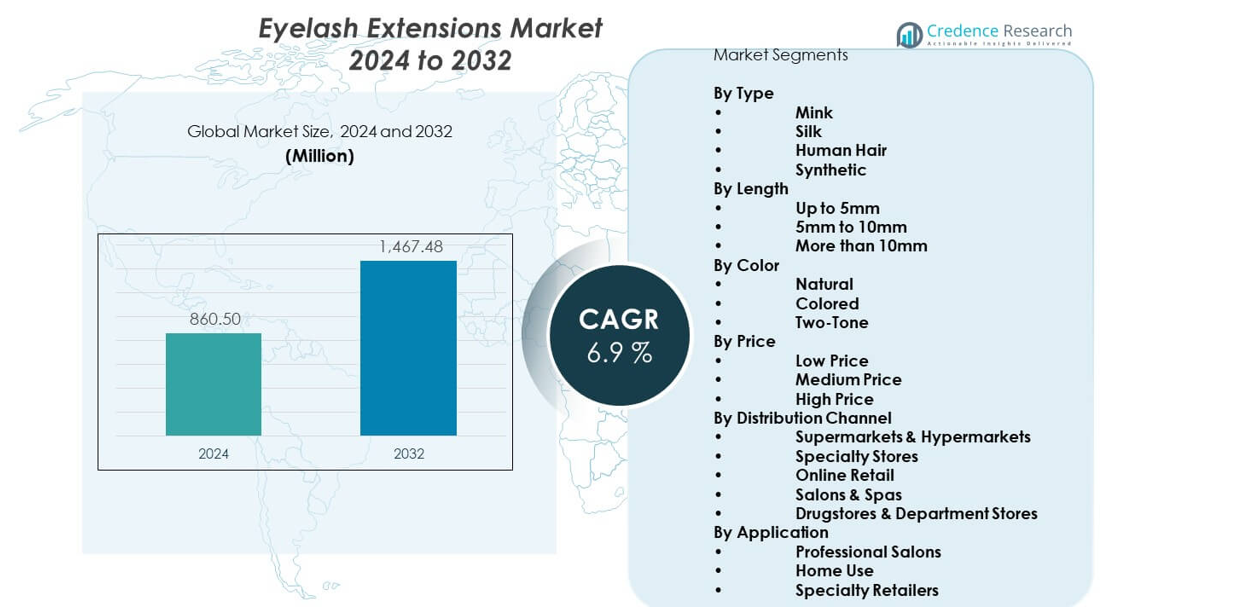
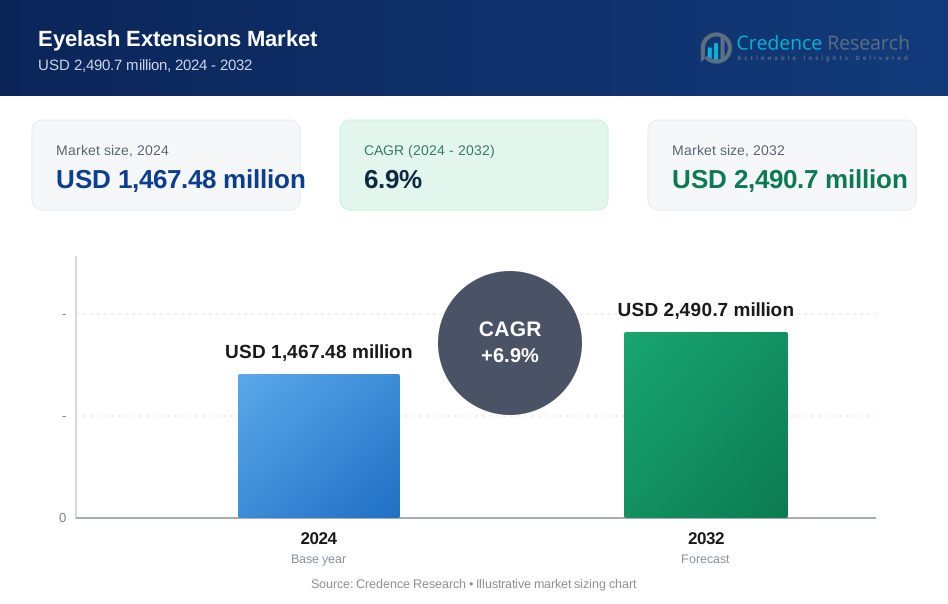
The Eyelash Extensions Market is projected to grow from USD 1,467.48 million in 2024 to an estimated USD 2,490.7 million by 2032, registering a CAGR of 6.9% from 2024 to 2032.
| REPORT ATTRIBUTE | DETAILS |
|---|---|
| Historical Period | 2020-2023 |
| Base Year | 2024 |
| Forecast Period | 2025-2032 |
| Eyelash Extensions Market Size 2024 | USD 1,467.48 million |
| Eyelash Extensions Market , CAGR | 6.9% |
| Eyelash Extensions Market Size 2032 | USD 2,490.7 million |
Rising beauty consciousness and increasing adoption of professional grooming services drive steady expansion. Salons promote customizable lash sets that match diverse eye shapes and lifestyle needs. Younger consumers prefer long-lasting lash styles that cut daily makeup time. Product innovation strengthens industry growth, with manufacturers offering hypoallergenic adhesives and heat-resistant fibers. Awareness campaigns in beauty clinics expand the user base, while digital booking platforms improve access to certified technicians and enhance customer convenience.
The market shows strong traction in North America, supported by high salon density, rising cosmetic spending, and early adoption of premium beauty services. Europe maintains solid growth due to professional training standards and the popularity of customizable lash styles. Asia Pacific emerges as the fastest-expanding region, driven by a large youth population, beauty culture influence from Korea and Japan, and rapid salon expansion in China and Southeast Asia. Regional progress also accelerates through social media trends and rising demand for semi-permanent cosmetic solutions.
Market Insights:
- The Eyelash extensions market reached USD 1,467.48 million in 2024 and is projected to hit USD 2,490.7 million by 2032, advancing at a 6.9% CAGR, supported by rising demand for long-lasting beauty enhancements and wider salon availability.
- North America (27–35%), Europe (~30%), and Asia-Pacific (~25%) lead the global share due to strong salon networks, high cosmetic spending, and deep beauty culture adoption, which sustain consistent consumer uptake.
- Asia-Pacific, holding nearly 25%, is the fastest-growing region driven by a large youth population, rapid urban expansion, and strong influence from Korea, Japan, and China in shaping modern lash trends.
- The 5mm to 10mm length segment dominates with 58% share, driven by balanced styling preferences that suit daily wear across broad consumer groups.
- The Natural color segment leads with about USD 700 million in 2023, reflecting wide acceptance of subtle, everyday looks across major markets.
Market Drivers:
Growing Demand for Premium Beauty Enhancement and Long-Lasting Aesthetic Results
The Eyelash extensions market benefits from steady interest in premium beauty services. Consumers seek longer retention and fuller lash finishes for daily grooming needs. Urban buyers prefer solutions that reduce makeup routines. Brands promote lightweight fibers to improve comfort. Product lines expand to support sensitive-skin users. Salons offer diverse volume styles to match face profiles. Online tutorials strengthen user awareness. Influencers present new looks that lift beauty aspirations. Professional treatment packages encourage repeat appointments.
- For instance, Lashify reports that its Gossamer lash system remains intact for up to ten days per application, giving users a reliable retention benchmark.
Rising Adoption of Skilled Technicians and Expanding Training Ecosystems Across Beauty Hubs
Strong training programs support higher service quality in the Eyelash extensions market. Beauty academies introduce structured certification programs. Technicians learn safe application methods through live sessions. Better training reduces application errors. Salons highlight certified staff to build customer trust. Digital classes support flexible learning needs. More students enter the sector and increase service capacity. Brands partner with institutes to promote new adhesives. Skilled professionals improve end-user retention.
- For instance, NovaLash delivers an 8-hour Classic Training course (4 hours hands-on) and offers a free refresher within six months, helping technicians gain full certification and apply advanced techniques.
Innovative Material Development and Safety-Focused Adhesive Formulations Across Product Lines
Product innovation strengthens momentum for the Eyelash extensions market. Manufacturers design lighter synthetic fibers for natural looks. New adhesives reduce irritation risks. Safer formulations support sensitive eyes. Brands test materials under strict protocols. Research teams improve retention strength. Technology teams create heat-resistant lash fibers. Advanced coating methods support durability. Clean-label formulas appeal to wellness-focused buyers.
Growing Influence of Social Platforms and Rising Consumer Exposure to Beauty Inspiration Content
Digital platforms shape demand within the Eyelash extensions market. Short-form videos promote new lash styles. Artists share application techniques that attract younger viewers. Viral trends raise interest in unique curl patterns. Tutorials help buyers understand care routines. Strong brand presence boosts product recall. Reviews guide new users toward tried solutions. Social communities support product discussions. Visual campaigns lift awareness among entry-level buyers.
Market Trends:
Higher Preference for Natural-Looking Lash Designs and Subtle Volume Effects Across Style Choices
A growing shift toward natural aesthetics influences the Eyelash extensions market. Consumers search for soft textures that match daily use. Stylists promote lighter fans for subtle enhancement. Brands develop fibers with refined tapering. Nuanced curl patterns support diverse preferences. Salons highlight minimalist looks for office wear. Natural finishes appeal to mature buyers. Balanced styles gain visibility across social platforms. Demand rises for blended lash sets.
- For instance, Lashify highlights the use of “Korean PBT Silk” fibers labelled “ultra-lightweight” and designed to mimic natural lashes while maintaining comfort and durability.
Rapid Growth of At-Home Maintenance Accessories and Aftercare Products Expanding User Convenience
A wider range of aftercare solutions supports the Eyelash extensions market. Buyers pick cleansers that protect lash bonds. Retailers promote gentle brushes for routine cleaning. Brands launch sealants that extend wear time. New formulas improve moisture balance. Online stores increase access to care kits. Rising awareness improves maintenance discipline. Consumers show interest in low-effort routines. Aftercare products strengthen the long-term user base.
- For instance, Lashify’s Pre-Cleanse Cleansing Water is available in 80ml or 200ml sizes and supports daily lash hygiene by removing oils and debris, helping maintain stronger adhesive bonds.
Integration of Digital Booking Platforms and Smart Scheduling Tools Across Salon Networks
Digital tools reshape appointment behavior for the Eyelash extensions market. Booking apps reduce wait times. Automated reminders cut missed sessions. Salons streamline client flow and improve service planning. Data insights guide staffing needs. Platforms support promotional campaigns. Customers enjoy transparent scheduling choices. Digital wallets simplify in-store transactions. Technology adoption strengthens user experience.
Growing Popularity of Hybrid Lash Techniques and Multi-Texture Styling Across Beauty Studios
Technique innovation brings new designs to the Eyelash extensions market. Hybrid sets combine classic and volume effects. Mixed textures support unique styling requests. Artists use fine lashes to shape expressive looks. Custom mapping enhances eye definition. Buyers explore layered patterns for special events. Salons build signature styles to stand out. Experimentation drives brand loyalty. Blended approaches attract trend-focused audiences.
Market Challenges Analysis:
High Sensitivity Risks, Application Errors, and Strict Quality Standards Within Professional Service Settings
The Eyelash extensions market faces various risks linked to sensitive eyes. Poor application may cause discomfort. Adhesive fumes require strict ventilation. Salons must follow hygiene rules. Brands must pass safety testing. Inconsistent training leads to service gaps. Regulatory checks influence operational decisions. Technicians need strong precision skills. Limited oversight in small studios creates quality variation.
Rising Competition, Price Pressures, and Limited Customer Awareness in Emerging Service Regions
Competitive pressure shapes long-term performance in the Eyelash extensions market. Smaller salons compete on price. High-quality materials push costs upward. Buyers hesitate when awareness is low. Regions with fewer trained staff lack advanced options. Marketing budgets limit exposure. Consumer education requires time. New entrants face slow early traction. Low differentiation reduces repeat visits.
Market Opportunities:
Expansion of Premium Service Packages and Growth of High-End Lash Innovations Across Modern Studios
New premium offerings open space for the Eyelash extensions market. Salons upgrade menus with advanced designs. Brands develop ultra-soft fibers for comfort. Longer-lasting adhesives appeal to busy users. Training institutes support premium treatments. Tech-driven mapping tools improve precision. High-spend clients search for exclusive styles. Upselling potential increases revenue growth. Service upgrades encourage customer loyalty.
Strong Scope for Regional Penetration and Wider Adoption in Fast-Growing Beauty-Driven Economies
Emerging regions present significant opportunities for the Eyelash extensions market. Beauty culture expands quickly across urban hubs. Young buyers adopt grooming trends early. Salons multiply in mid-tier cities. Social media exposure raises aspirations. Brands enter new countries through distributors. Training centers support skill growth. Local influencers guide market adoption. Rising interest fuels long-term expansion.
Market Segmentation Analysis:
By Type
The Eyelash extensions market shows strong variation across material categories. Mink holds wide preference for premium finishes, while silk supports mid-range styling needs. Human hair appeals to buyers seeking natural texture. Synthetic types gain demand due to low cost and consistent quality.
By Length
Up to 5mm targets subtle enhancement needs. The 5mm to 10mm range dominates due to balanced volume and daily suitability. More than 10mm grows fast driven by bold styling choices in younger groups.
By Color
Natural shades lead due to broad acceptance across all age groups. Colored lashes appeal to creative users seeking fashion alignment. Two-tone styles find space in event-driven purchases and niche beauty trends.
By Price
Low-price options attract entry-level buyers. Medium-price products suit regular salon goers demanding higher durability. High-price items remain linked to premium treatments and exclusive lash designs.
By Distribution Channel
Supermarkets and hypermarkets support quick purchases of basic kits. Specialty stores provide expert-curated collections. Online retail gains traction due to wider assortments and flexible access. Salons and spas dominate professional service delivery. Drugstores and department stores support steady walk-in sales.
By Application
Professional salons retain leadership through certified technicians and structured treatments. Home use expands due to DIY kits and digital tutorials. Specialty retailers supply advanced tools, adhesives, and curated lash sets for trained users.
Segmentation:
By Type
- Mink
- Silk
- Human Hair
- Synthetic
By Length
- Up to 5mm
- 5mm to 10mm
- More than 10mm
By Color
- Natural
- Colored
- Two-Tone
By Price
- Low Price
- Medium Price
- High Price
By Distribution Channel
- Supermarkets & Hypermarkets
- Specialty Stores
- Online Retail
- Salons & Spas
- Drugstores & Department Stores
By Application
- Professional Salons
- Home Use
- Specialty Retailers
By Region
- North America
- U.S.
- Canada
- Mexico
- Europe
- Germany
- France
- U.K.
- Italy
- Spain
- Rest of Europe
- Asia Pacific
- China
- Japan
- India
- South Korea
- South-east Asia
- Rest of Asia Pacific
- Latin America
- Brazil
- Argentina
- Rest of Latin America
- Middle East & Africa
- GCC Countries
- South Africa
- Rest of the Middle East and Africa
Regional Analysis:
North America and Europe
The Eyelash extensions market secures strong presence in North America with a share between 27% and 35%. The region benefits from high salon penetration and strong cosmetic spending patterns. Consumers prefer premium lash materials supported by trained technicians. Influencer-led trends drive fast adoption of new styles. Europe holds close to 30% share and maintains demand through regulated beauty standards. Buyers in major cities focus on natural designs and curated salon services. Strong retail networks support consistent product visibility.
Asia-Pacific
Asia-Pacific holds around 25% share and grows at the fastest pace in the sector. The region benefits from strong beauty culture rooted in Korea, Japan, and China. Young consumers follow evolving makeup trends and support rapid product turnover. Expansion of mid-tier salons broadens service access across urban corridors. Online platforms raise awareness of premium lash options. The Eyelash extensions market gains momentum due to growing disposable income. Cross-border brand influence strengthens product acceptance.
Latin America and Middle East & Africa
Latin America holds close to 5% share and builds traction through rising interest in modern grooming habits. Countries expand salon networks in major metropolitan zones. Local influencers help shape buyer preferences. Product access improves through online retail channels. Middle East & Africa also account for nearly 5% share. Demand rises across premium beauty clusters in Gulf markets. Regional growth stays steady due to expanding youth-driven cosmetic adoption.
Key Player Analysis:
- NovaLash
- Lashify
- Ardell (Ardell International Inc.)
- KISS Products Inc.
- Xtreme Lashes
- Velour Lashes
- House of Lashes
- Sugarlash Pro
- Huda Beauty
- Sephora Collection
- Lilly Lashes
- Qingdao LashBeauty Cosmetic Co., Ltd.
- Babil Lashes (China)
- Acelashes (China)
- Emeda Eyelash Company
- CharmLash
- NAGARAKU
- Pingdu Sparkling Eyelash Co., Ltd.
Competitive Analysis:
The Eyelash extensions market reflects strong competition among global beauty brands, regional manufacturers, and premium salon-focused suppliers. Leading companies invest in fiber innovation, safer adhesives, and improved mapping tools to lift treatment quality. Product portfolios expand to serve diverse curl patterns, lengths, and texture needs. Brands compete through training support, influencer programs, and retail visibility. Online-first players gain reach through subscription kits and curated bundles. Salons strengthen their position by promoting certified technicians. It benefits from rapid product cycles and dynamic marketing strategies.
Recent Developments:
- In June 2025, Lash Therapy Australia officially launched its Lash & Brow Serum and full lash set kits at Costco Canada, bolstering its international growth strategy into North America. This partnership emphasizes the brand's cruelty-free, science-backed products and expands Canadian market accessibility, marking a pivotal moment in the brand's global outreach. Co-founder Emma Spiliopoulos expressed enthusiasm about the partnership, highlighting shared values of accessibility and quality between both organizations.
- In February 2025, Velour Beauty launched its first-ever co-branded product with celebrity makeup artist Carolina Gonzalez: a limited-edition set of self-stick lash clusters.
Report Coverage:
The research report offers an in-depth analysis based on By Type, By Length, By Color, By Price, By Distribution Channel, By Application, and By Region. It details leading market players, providing an overview of their business, product offerings, investments, revenue streams, and key applications. Additionally, the report includes insights into the competitive environment, SWOT analysis, current market trends, as well as the primary drivers and constraints. Furthermore, it discusses various factors that have driven market expansion in recent years. The report also explores market dynamics, regulatory scenarios, and technological advancements that are shaping the industry. It assesses the impact of external factors and global economic changes on market growth. Lastly, it provides strategic recommendations for new entrants and established companies to navigate the complexities of the market.
Future Outlook:
- Growing demand for lighter fibers will support premium service upgrades across salons.
- Rising adoption of safe adhesives will influence product innovation cycles.
- Digital booking platforms will enhance treatment access for urban consumers.
- Training programs will expand technician capabilities in major beauty hubs.
- Online retail growth will raise visibility for specialized lash products.
- Natural-look trends will guide design choices within key buyer groups.
- Expansion of mid-tier salons will widen service reach in emerging regions.
- Strong influencer partnerships will shape style preferences among young audiences.
- Premium segments will benefit from rising cosmetic spending in developed markets.
- Clean beauty shifts will encourage development of low-irritation formulas.
Request a Free Sample
Fill in your details and we'll send you a free sample report.
- Sample data tables & charts
- Research methodology
Market Dynamics
Premium Beauty Enhancement Demand
Consumers are increasingly seeking long-lasting, premium beauty solutions that reduce daily makeup routines and deliver fuller, natural-looking lashes, driving steady demand for professional eyelash extension services.
Expansion of Skilled Technician Training
The proliferation of structured certification programs and advanced training for lash technicians is raising service quality, reducing application errors, and building consumer trust, which in turn expands the market's user base.
Product Innovation in Materials and Adhesives
Manufacturers are developing hypoallergenic adhesives and lightweight, heat-resistant fibers to cater to sensitive-skin users and improve comfort, safety, and retention, fueling market growth through differentiated offerings.
Influence of Social Media and Digital Platforms
Social media trends, influencer-driven tutorials, and digital booking platforms are increasing consumer awareness, shaping style preferences, and making professional lash services more accessible, especially among younger demographics.
Growth of Aftercare and At-Home Maintenance Products
The introduction of specialized aftercare kits and at-home maintenance accessories is enhancing user convenience and retention, encouraging repeat purchases and supporting the long-term expansion of the eyelash extensions market.
Need a Custom Version of This Report?
Tailor the scope, geography, or segments to your exact requirements.
- Custom geography or segment scope
- Direct access to our analyst team
Frequently Asked Questions
What is the current market size for the Eyelash extensions market, and what is its projected size in 2032?
At what Compound Annual Growth Rate is the Eyelash extensions market projected to grow between 2025 and 2032?
Which is the leading region of the market for eyelash extensions?
What are the key drivers for the growth of the eyelash extensions market?
Which is the major segment in the eyelash extensions market by product?
Which is the major segment in the eyelash extensions market by constituent?
Who are the leading companies in the Eyelash extensions market?
Table of Content
Chapter 1 Market Segmentation
- 1.1 Segmentation Framework
- 1.1.1 Product and Service Classification
- 1.1.2 Application and End-Use Classification
- 1.1.3 Technology and Solution Classification
- 1.1.4 Customer and Distribution Channel Classification
- 1.1.5 Geographic Segmentation
- 1.1.6 Market Segment Definitions and Boundaries
- 1.2 By Type
- 1.2.1 Mink
- 1.2.2 Silk
- 1.2.3 Human Hair
- 1.2.4 Synthetic
- 1.3 By Color
- 1.3.1 Natural
- 1.3.2 Colored
- 1.3.3 Two-Tone
- 1.4 By Length
- 1.4.1 Up to 5mm
- 1.4.2 5mm to 10mm
- 1.4.3 More than 10mm
Chapter 2 Introduction
- 2.1 Report Objectives and Scope
- 2.2 Product Definition and Industry Terminology
- 2.3 Market Inclusions and Exclusions
- 2.4 Research Process
- 2.4.1 Primary Research and Expert Interviews
- 2.4.2 Secondary Research and Source Review
- 2.4.3 Top-Down and Bottom-Up Estimation
- 2.4.4 Data Triangulation and Verification
- 2.5 Market Size Measurement Basis
- 2.5.1 2024: USD 1,467.48 million → 2032: USD 2,490.7 million
- 2.6 Historical and Forecast Reference Periods
- 2.6.1 Base Year: 2024
- 2.6.2 Forecast Period: 2024-2032
- 2.7 Research Assumptions and Limitations
Chapter 3 Executive Summary
- 3.1 Market Snapshot and Key Findings
- 3.2 Base-Year Market Size, 2024
- 3.3 Forecast Market Size, 2032
- 3.4 Revenue and Volume Growth Outlook
- 3.5 Key Demand and Supply Indicators
- 3.6 Leading Market Segments
- 3.7 Fastest-Growing Market Opportunities
- 3.8 Regional Performance Highlights
- 3.9 Technology and Industry Transformation
- 3.10 Competitive Landscape Summary
- 3.11 Analyst View and Strategic Implications
Chapter 4 Global Eyelash Extensions Market Trends and Developments
- 4.1 Historical Industry Development
- 4.2 Recent Market Trends and Developments
- 4.3 Demand and Customer Behavior Trends
- 4.4 Technology and Product Innovation
- 4.5 Artificial Intelligence, Automation and Digitalization
- 4.6 Local Manufacturing and Supply Chain Realignment
- 4.7 Industry Partnerships, Mergers and Acquisitions
- 4.8 Sustainability and Circular Economy Developments
- 4.9 Government and Private Sector Investment Trends
- 4.10 Emerging Business Models and Commercialization
- 4.11 Industry Developments and Announcements
Chapter 5 Global Eyelash Extensions Market Production, Supply and Demand Analysis
- 5.1 Demand Trend and Consumption Analysis
- 5.2 Demand Forecast, 2024-2032
- 5.3 Production and Output Trend
- 5.4 Production and Output Forecast, 2024-2032
- 5.5 Installed Capacity and Capacity Utilization
- 5.6 Company-Wise Production Plants and Statistics
- 5.6.1 Installed Production Capacity
- 5.6.2 Actual Production
- 5.6.3 Planned Capacity and Expansion Targets
- 5.7 Supply Chain Structure and Procurement Trends
- 5.8 Supply-Demand Gap and Bottlenecks
- 5.9 Import Dependence and Sourcing Structure
- 5.10 Contract Manufacturing and Outsourcing
- 5.11 Regional Supply and Demand Concentration
Chapter 6 Global Eyelash Extensions Market Pricing Analysis
- 6.1 Pricing Structure and Measurement
- 6.2 Historical Pricing Trends
- 6.3 Pricing Outlook, 2024-2032
- 6.4 Average Selling Price and Unit Economics
- 6.5 Pricing by Product and Market Segment
- 6.6 Geographic Pricing Differences
- 6.7 Key Input, Energy, Labor and Logistics Costs
- 6.8 Contract Pricing and Purchasing Models
- 6.9 Pricing Sensitivity and Competitive Positioning
- 6.10 Price, Margin and Profitability Implications
Chapter 7 Global Eyelash Extensions Market Dynamics
- 7.1 Market Growth Drivers
- 7.1.1 Demand-Side Drivers
- 7.1.2 Technology and Innovation Drivers
- 7.1.3 Infrastructure and Investment Drivers
- 7.1.4 Regulatory and Policy Drivers
- 7.2 Market Restraints
- 7.2.1 Cost and Affordability Constraints
- 7.2.2 Technology and Adoption Barriers
- 7.2.3 Supply Chain and Operational Constraints
- 7.3 Market Challenges
- 7.3.1 Competitive Pressure and Margin Erosion
- 7.3.2 Skills, Infrastructure and Implementation Gaps
- 7.4 Emerging Market Opportunities
- 7.5 Market Dynamics Impact and Time-Horizon Assessment
Chapter 8 Global Eyelash Extensions Value Chain Analysis
- 8.1 Industry Value Chain Overview
- 8.2 Upstream Suppliers and Critical Inputs
- 8.3 Technology and Component Providers
- 8.4 Manufacturing or Service Delivery
- 8.5 Distribution, Channel Partners and Integrators
- 8.6 Downstream Applications and End Users
- 8.7 Value Addition and Profit Pools
- 8.8 Vertical Integration and Outsourcing
- 8.9 Supplier Concentration and Risk
- 8.10 Supply Chain Localization and Resilience
Chapter 9 Global Eyelash Extensions Market Regulations and Policies
- 9.1 Relevant Laws, Standards and Compliance Frameworks
- 9.2 Product, Service, Safety and Quality Requirements
- 9.3 Government Policies, Incentives and Subsidies
- 9.4 Imports, Exports and Trade Barriers
- 9.5 Public Procurement and Local Content Requirements
- 9.6 Environmental and Sustainability Compliance
- 9.7 Upcoming Policy Changes and Market Implications
Chapter 10 Global Eyelash Extensions Market Hotspots and Opportunities
- 10.1 Market Opportunity Mapping and Growth Hotspots
- 10.2 High-Growth Applications and Customer Groups
- 10.3 Underserved Markets and White-Space Opportunities
- 10.4 Emerging Technology and Product Opportunities
- 10.5 New Capacity and Investment Hotspots
- 10.6 Market Entry and Expansion Opportunities
- 10.7 Distribution and Partnership Opportunities
- 10.8 Near-Term and Long-Term Commercial Potential
- 10.9 Opportunity Attractiveness and Execution Risks
Chapter 11 Global Eyelash Extensions Market Outlook, 2024-2032
- 11.1 Market Size and Analysis
- 11.1.1 Revenue (Market Measurement: 2024: USD 1,467.48 million → 2032: USD 2,490.7 million)
- 11.1.2 Market Volume and Quantity Sold
- 11.1.3 Historical Market Size
- 11.1.4 Base-Year Market Size, 2024
- 11.2 Market Forecast, 2024-2032
- 11.2.1 Revenue Forecast to 2032
- 11.2.2 Volume Forecast to 2032
- 11.2.3 CAGR and Year-on-Year Growth
- 11.2.4 Incremental Revenue Opportunity
- 11.3 Forecast Assumptions and Scenario Analysis
- 11.3.1 Base-Case Forecast
- 11.3.2 Optimistic and Conservative Scenarios
- 11.3.3 Technology, Pricing and Policy Sensitivities
- 11.4 Market Attractiveness and Growth Outlook
Chapter 12 Global Eyelash Extensions Market Segmentation and Outlook
- 12.1 Segmentation Summary and Market Shares, 2024
- 12.2 Largest and Fastest-Growing Segments
- 12.3 By Type - Market Size and Forecast, 2024-2032
- 12.3.1 Segment Definition and Scope
- 12.3.2 Historical Market Size
- 12.3.3 Revenue Forecast, 2024-2032
- 12.3.4 Volume Forecast, 2024-2032
- 12.3.5 Base-Year Market Share, 2024
- 12.3.6 Segment CAGR and Growth Drivers
- 12.3.7 Subsegment Market Size and Forecast
- 12.3.7.1 Mink
- 12.3.7.2 Silk
- 12.3.7.3 Human Hair
- 12.3.7.4 Synthetic
- 12.3.8 Subsegment Pricing and Adoption Trends
- 12.3.9 Leading Suppliers and Competition
- 12.3.10 Regional Demand and Opportunities
- 12.4 By Color - Market Size and Forecast, 2024-2032
- 12.4.1 Segment Definition and Scope
- 12.4.2 Historical Market Size
- 12.4.3 Revenue Forecast, 2024-2032
- 12.4.4 Volume Forecast, 2024-2032
- 12.4.5 Base-Year Market Share, 2024
- 12.4.6 Segment CAGR and Growth Drivers
- 12.4.7 Subsegment Market Size and Forecast
- 12.4.7.1 Natural
- 12.4.7.2 Colored
- 12.4.7.3 Two-Tone
- 12.4.8 Subsegment Pricing and Adoption Trends
- 12.4.9 Leading Suppliers and Competition
- 12.4.10 Regional Demand and Opportunities
- 12.5 By Length - Market Size and Forecast, 2024-2032
- 12.5.1 Segment Definition and Scope
- 12.5.2 Historical Market Size
- 12.5.3 Revenue Forecast, 2024-2032
- 12.5.4 Volume Forecast, 2024-2032
- 12.5.5 Base-Year Market Share, 2024
- 12.5.6 Segment CAGR and Growth Drivers
- 12.5.7 Subsegment Market Size and Forecast
- 12.5.7.1 Up to 5mm
- 12.5.7.2 5mm to 10mm
- 12.5.7.3 More than 10mm
- 12.5.8 Subsegment Pricing and Adoption Trends
- 12.5.9 Leading Suppliers and Competition
- 12.5.10 Regional Demand and Opportunities
- 12.6 Segment Growth Comparison
- 12.7 Segment Attractiveness and Priority Matrix
Chapter 13 Global Eyelash Extensions Geographic Market Outlook, 2024-2032
- 13.1 Regional Market Size and Share, 2024
- 13.2 Regional Market Forecast, 2024-2032
- 13.3 Regional Pricing, Production and Demand Differences
- 13.4 North America
- 13.4.1 United States
- 13.4.2 Canada
- 13.4.3 Mexico
- 13.5 Europe
- 13.5.1 Germany
- 13.5.2 France
- 13.5.3 Italy
- 13.5.4 United Kingdom
- 13.5.5 Spain
- 13.5.6 Poland
- 13.5.7 Russia
- 13.5.8 Netherlands
- 13.5.9 Belgium
- 13.5.10 Sweden
- 13.5.11 Denmark
- 13.5.12 Norway
- 13.5.13 Rest of Europe
- 13.6 Asia Pacific
- 13.6.1 China
- 13.6.2 India
- 13.6.3 Japan
- 13.6.4 South Korea
- 13.6.5 Thailand
- 13.6.6 Indonesia
- 13.6.7 Vietnam
- 13.6.8 Malaysia
- 13.6.9 Australia
- 13.6.10 Rest of Asia Pacific
- 13.7 Latin America
- 13.7.1 Brazil
- 13.7.2 Argentina
- 13.7.3 Colombia
- 13.7.4 Chile
- 13.7.5 Rest of Latin America
- 13.8 Middle East
- 13.8.1 Saudi Arabia
- 13.8.2 United Arab Emirates
- 13.8.3 Turkey
- 13.8.4 Israel
- 13.8.5 Iran
- 13.8.6 Rest of the Middle East
- 13.9 Africa
- 13.9.1 South Africa
- 13.9.2 Egypt
- 13.9.3 Nigeria
- 13.9.4 Morocco
- 13.9.5 Rest of Africa
- 13.10 Regional Investment, Policy and Supply Chain Differences
- 13.11 Regional Competitive Landscape
- 13.12 Geographic Growth Hotspots
Chapter 14 Global Eyelash Extensions Technology, Innovation and Sustainability Outlook
- 14.1 Technology Landscape and Maturity
- 14.2 Product, Process and Service Innovation
- 14.3 AI, Automation and Digital Tools in the Industry
- 14.4 Technology Adoption and Performance Benchmarking
- 14.5 Innovation Pipeline and R&D Investment
- 14.6 Patent and Intellectual Property Trends
- 14.7 Energy Efficiency and Resource Management
- 14.8 Sustainability, Recycling and Circularity
- 14.9 Technology Roadmap, 2024-2032
- 14.10 Risks of Obsolescence and Technology Substitution
Chapter 15 Global Eyelash Extensions Market Key Strategic Imperatives
- 15.1 Growth and Market Entry Priorities
- 15.2 High-Return Products and Segments
- 15.3 Pricing, Profitability and Cost Optimization
- 15.4 Technology Investment and Product Differentiation
- 15.5 Supply Chain Localization and Resilience
- 15.6 Distribution and Customer Acquisition
- 15.7 Partnership, Acquisition and Capacity Strategy
- 15.8 Regional Expansion Priorities
- 15.9 Short-, Medium- and Long-Term Actions
Chapter 16 Competition Outlook
- 16.1 Industry Competition Characteristics
- 16.2 Market Structure and Concentration
- 16.3 Market Share and Competitive Positioning, 2024
- 16.4 Company-Wise Revenue and Product Benchmarking
- 16.5 Production and Service Capacity Benchmarking
- 16.6 Technology, Pricing and Differentiation
- 16.7 Regional Footprint and Distribution Strength
- 16.8 Mergers, Acquisitions and Strategic Alliances
- 16.9 New Entrants and Competitive Threats
- 16.10 Porter's Five Forces and Industry Attractiveness
- 16.11 Competitive Outlook, 2024-2032
Chapter 17 Company Profiles
- 17.1 Company Coverage and Selection Criteria
- 17.2 NovaLash
- 17.2.1 Business Description
- 17.2.2 Company Ownership and Geographic Presence
- 17.2.3 Product and Service Portfolio
- 17.2.4 Manufacturing and Operating Footprint
- 17.2.5 Production Capacity and Expansion Plans
- 17.2.6 Financial Performance and Investment
- 17.2.7 Market Share and Competitive Position
- 17.2.8 Technology and Innovation Capabilities
- 17.2.9 Strategic Alliances or Partnerships
- 17.2.10 Recent Developments
- 17.2.11 Growth Strategy and Outlook
- 17.3 Lashify
- 17.4 Ardell (Ardell International Inc.)
- 17.5 KISS Products Inc.
- 17.6 Xtreme Lashes
- 17.7 Velour Lashes
- 17.8 House of Lashes
- 17.9 Sugarlash Pro
- 17.10 Huda Beauty
- 17.11 Sephora Collection
- 17.12 Other Relevant Market Participants
Note: Every listed company is profiled on the structure shown under the first company. The company list is preliminary and may change based on research findings, market developments, data availability and client requirements.
Chapter 18 Disclaimer
- 18.1 Research and Forecast Disclaimer
- 18.2 Data Source and Estimation Limitations
Note: The depth of individual sections depends on data availability for this market. Volume, capacity, trade and other unit-based metrics are included where applicable.
