
Peripheral Component Interconnect Express Market Overview:
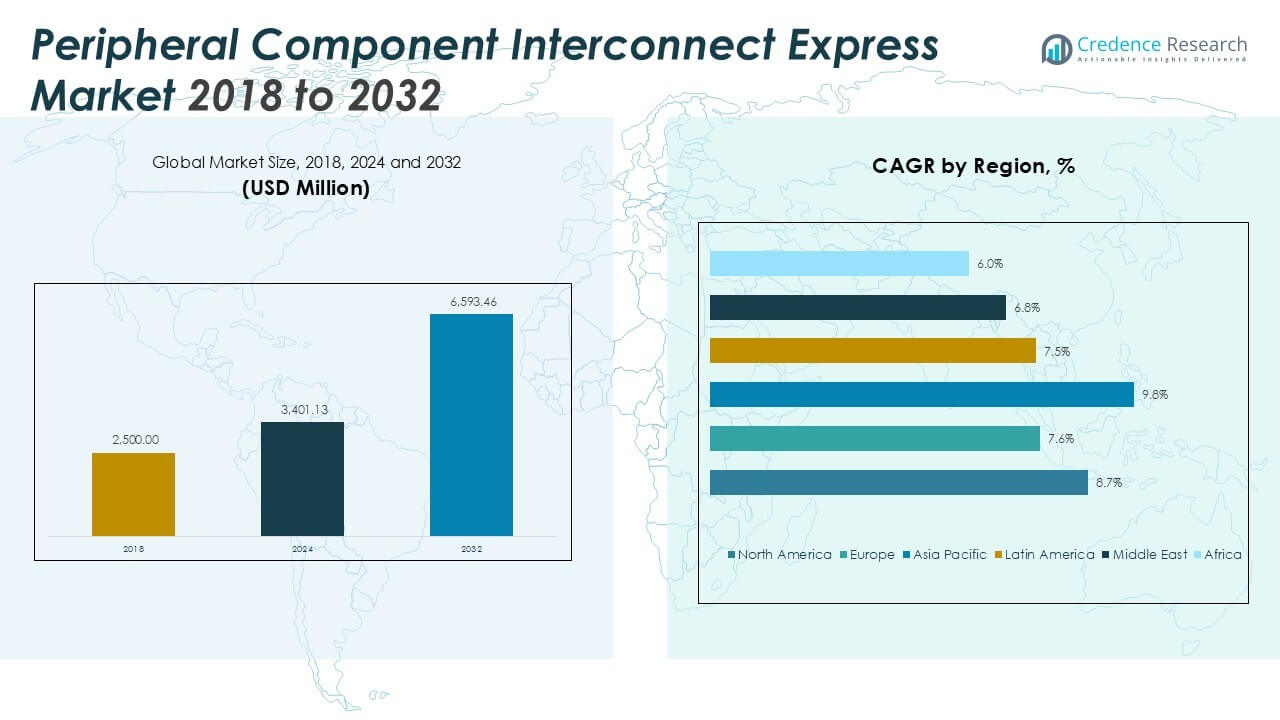
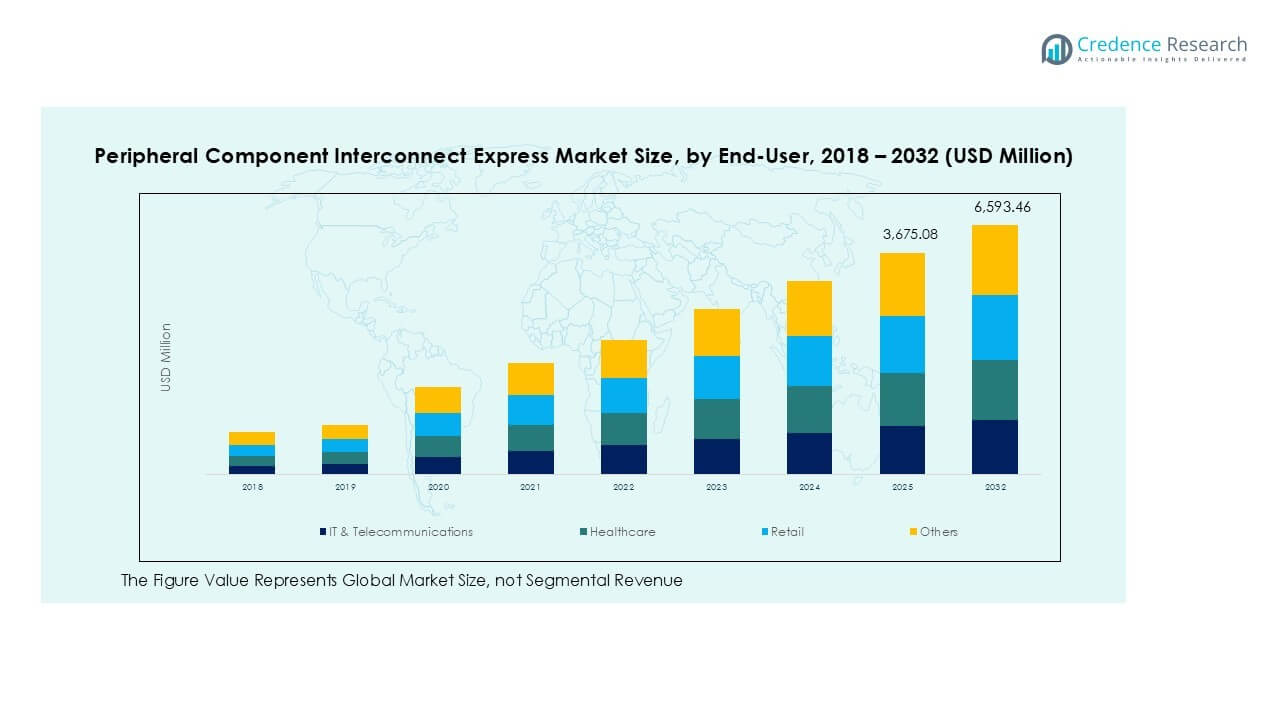
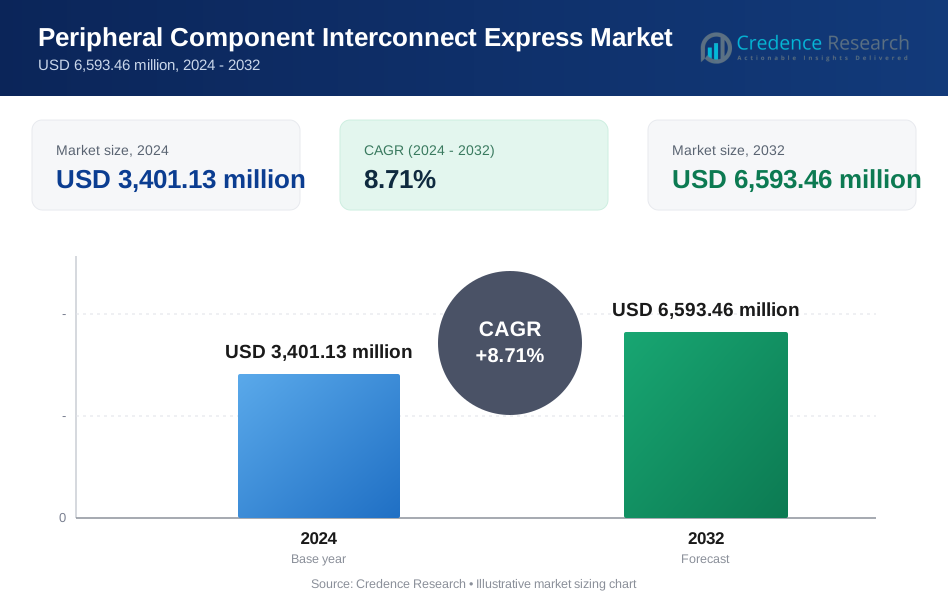
Peripheral Component Interconnect Express market size was valued at USD 2,500.00 million in 2018, increased to USD 3,401.13 million in 2024, and is anticipated to reach USD 6,593.46 million by 2032, at a CAGR of 8.71% during the forecast period.
| REPORT ATTRIBUTE | DETAILS |
|---|---|
| Historical Period | 2020-2023 |
| Base Year | 2024 |
| Forecast Period | 2025-2032 |
| Peripheral Component Interconnect Express Market Size 2024 | USD 3,401.13 million |
| Peripheral Component Interconnect Express Market, CAGR | 8.71% |
| Peripheral Component Interconnect Express Market Size 2032 | USD 6,593.46 million |
The Peripheral Component Interconnect Express market is led by major players such as Intel Corporation, Advanced Micro Devices, Inc. (AMD), NVIDIA Corporation, Broadcom Inc., and Marvell Technology Group Ltd. These companies drive innovation through PCIe-enabled CPUs, GPUs, switches, and storage controllers tailored for high-performance computing, data centers, and automotive systems. Intel and AMD hold strong positions through widespread platform integration, while NVIDIA leads in accelerator deployment. Broadcom and Marvell dominate PCIe-based networking and storage connectivity. Regionally, North America leads the market with a 39.3% share in 2024, supported by hyperscale data center investments and early PCIe Gen 5 adoption. Asia Pacific follows closely due to rapid industrialization, OEM presence, and strong demand for high-speed interfaces in automotive and electronics sectors. These competitive dynamics and regional strengths shape the growth trajectory of the global PCIe ecosystem.
Peripheral Component Interconnect Express Market Insights
- The Peripheral Component Interconnect Express market was valued at USD 2,500.00 million in 2018, reached USD 3,401.13 million in 2024, and is projected to hit USD 6,593.46 million by 2032, growing at a CAGR of 8.71%.
- Growing demand for high-speed data transmission in data centers and AI workloads drives PCIe adoption across servers, storage, and accelerator platforms.
- The shift toward PCIe Gen 4 and Gen 5, supported by leading players like Intel, AMD, and NVIDIA, boosts performance in cloud, edge, and automotive applications.
- High upgrade costs and thermal management challenges restrain adoption across cost-sensitive and space-constrained environments.
- North America leads with 39.3% market share in 2024, followed by Asia Pacific at 32.6%; hardware is the dominant component segment, while data centers account for the largest application share.
Peripheral Component Interconnect Express Market Segmentation Analysis:
By Component
The hardware segment dominates the Peripheral Component Interconnect Express market with the highest revenue share. High-speed connectivity requirements across servers, storage systems, and embedded platforms drive strong demand for PCIe-based hardware components. Advanced GPUs, SSDs, and network interface cards rely on PCIe lanes for faster data throughput and reduced latency. Growing deployment of AI workloads in data centers and edge devices further boosts hardware integration. Continuous upgrades to PCIe generations like Gen 4 and Gen 5 support higher bandwidth and efficiency. Software and services segments grow steadily, driven by system-level optimization and support requirements.
- For instance, Intel’s 5th Gen Xeon Scalable processors support up to 80 PCIe 5.0 lanes running at 32 GT/s per lane for networking and accelerators.
By Application
Data centers represent the leading application segment, accounting for the largest market share in the PCI Express ecosystem. Rising hyperscale infrastructure and cloud computing expansion increase the need for scalable, low-latency interconnects. PCIe supports high-performance computing environments through efficient link speeds and multi-device connectivity. Automotive follows as a fast-growing segment due to increased ECU communication and ADAS integration. Consumer electronics and industrial applications adopt PCIe for compact, high-speed device communication. Aerospace and defense demand ruggedized PCIe solutions for mission-critical systems, while the others segment includes embedded and IoT system applications.
- For instance, NVIDIA’s A100 Tensor Core GPU delivers internal HBM2e memory bandwidth of up to 2 TB/s for AI and HPC systems.
By End-user
IT & telecommunications hold the dominant position among end-users, driven by widespread server and storage adoption. PCIe enables faster data flow across cloud networks, telecom switching systems, and high-performance servers. The BFSI sector also sees growing adoption to support real-time data processing and secure transaction handling. Healthcare organizations deploy PCIe-based systems for advanced diagnostics and medical imaging. The retail sector benefits from PCIe-enabled analytics platforms and POS systems that process high data loads quickly. The others category includes education, manufacturing, and government sectors, where data reliability and speed are essential.
Peripheral Component Interconnect Express Market Key Growth Drivers
Surging Demand for High-Speed Data Transmission in Data Centers
The rapid expansion of cloud computing, AI workloads, and big data analytics is fueling demand for high-speed data transmission, positioning PCI Express (PCIe) as a critical interconnect technology. Modern data centers require efficient, low-latency communication between servers, storage arrays, and GPUs. PCIe Gen 4 and Gen 5 architectures support bandwidths up to 32 GT/s, meeting the growing throughput needs of hyperscale environments. Enterprises increasingly deploy PCIe-enabled SSDs, accelerators, and network interface cards to reduce bottlenecks and improve server performance. The migration toward NVMe storage further strengthens reliance on PCIe lanes. As hyperscalers and colocation providers expand facilities globally, the integration of PCIe components becomes essential to maintaining performance and scalability. This continued adoption of advanced PCIe interfaces is expected to drive long-term revenue growth across data-centric infrastructure applications.
- For instance, enterprise NVMe SSDs use PCIe lanes to fully exploit low‑latency, high‑parallelism storage access defined by NVMe specifications over PCIe.
Integration of PCIe in Automotive and Embedded Systems
The automotive industry is rapidly adopting PCIe to support evolving electronic architectures in electric and connected vehicles. Advanced driver assistance systems (ADAS), infotainment units, and centralized domain controllers demand high-speed communication with multiple components. PCIe supports modular design, enabling flexible upgrades across sensor fusion, AI-based decision systems, and telematics platforms. With automotive Ethernet and high-performance processors becoming standard, PCIe ensures seamless data movement between ECUs and peripherals. The embedded systems segment, which includes medical, industrial, and military-grade computing devices, also increasingly utilizes PCIe for compact, rugged, and high-speed interconnectivity. As software-defined vehicles and smart mobility ecosystems mature, PCIe-based solutions become essential for supporting real-time decision-making and fail-safe operations. These developments firmly position PCIe as a growth enabler in next-generation automotive and embedded platforms.
- For instance, PCIe technology enables high‑speed connections for automated driving sensor and ADAS compute distribution in centralized vehicle platforms
Ongoing Evolution of PCIe Standards and Product Innovations
The continuous evolution of PCIe standards, from Gen 3 to Gen 6, drives demand by enhancing performance and future-proofing infrastructure. Each successive generation doubles data rate capabilities, with Gen 6 expected to offer 64 GT/s while maintaining backward compatibility. This standard progression supports intensive workloads in AI, ML, and HPC systems. Major semiconductor players launch chipsets and processors embedded with the latest PCIe versions, fueling ecosystem upgrades. For instance, Intel and AMD have rolled out CPUs supporting Gen 5, while GPU manufacturers like NVIDIA integrate PCIe to accelerate compute performance. PCIe switch fabrics and retimers also gain traction for extending connectivity across larger systems. The rise of chiplet architecture in advanced processors further leverages PCIe’s modular scalability. This ongoing innovation cycle ensures PCIe remains relevant across evolving computing paradigms, strengthening its market position.
Peripheral Component Interconnect Express Market Key Trends & Opportunities
Proliferation of AI and HPC Workloads Across Industries
AI, deep learning, and high-performance computing (HPC) workloads are growing across healthcare, financial services, research, and defense sectors. These applications demand massive data processing, low latency, and parallel compute architectures capabilities PCIe is well-suited to support. PCIe-connected GPUs, FPGAs, and ASIC accelerators help scale AI inferencing and training efficiently. In supercomputing clusters, PCIe fabrics offer optimized bandwidth distribution between compute and memory nodes. PCIe’s adoption in AI servers with high core-density and memory bandwidth configurations is increasing sharply. As enterprises pursue real-time analytics and edge inferencing, PCIe-enabled solutions become a key enabler for meeting performance thresholds. This trend creates strong demand for PCIe switches, lanes, and Gen 4/Gen 5-compliant motherboards across enterprise and scientific compute environments.
- For instance, AMD EPYC processors provide up to 160 PCIe Gen5 lanes, enabling rapid transfers among GPUs, storage, and networking in enterprise AI clusters.
Adoption of PCIe in Edge Computing and IoT Systems
Edge computing is gaining momentum as industries aim to process data closer to the source, reducing latency and bandwidth usage. PCIe plays a pivotal role in enabling high-speed connectivity between sensors, edge processors, and storage units in these compact deployments. From smart factories and autonomous logistics to remote medical devices and surveillance systems, PCIe supports scalable data exchange across decentralized infrastructures. Industrial PCs and embedded systems leverage PCIe to integrate multiple functional modules within tight space constraints. The trend toward modular edge gateways, powered by PCIe-enabled SoCs and accelerators, opens new opportunities for suppliers. As 5G connectivity expands and edge use cases diversify, PCIe’s role in facilitating local compute and real-time decision-making continues to grow, making it a key technology in the edge-IoT convergence.
Peripheral Component Interconnect Express Market Key Challenges
Thermal Management and Power Consumption Concerns
One of the major challenges in adopting high-speed PCIe components is effective thermal and power management. Higher PCIe generations, such as Gen 4 and Gen 5, generate significant heat due to increased data rates and signal integrity requirements. In dense server environments or compact embedded systems, this leads to thermal throttling, reliability issues, and reduced performance over time. Power-hungry GPUs, accelerators, and SSDs connected via PCIe further burden system power budgets. Designing adequate cooling solutions and power delivery systems increases overall hardware complexity and cost. These constraints limit PCIe adoption in space-constrained environments and demand innovation in energy-efficient design, signal conditioning, and heat dissipation mechanisms to ensure sustained high-speed performance.
Cost Barriers in Upgrading Legacy Infrastructure
Transitioning to newer PCIe standards requires major infrastructure upgrades across boards, processors, chipsets, and interconnects. Enterprises operating on Gen 3 or earlier face high costs in adopting Gen 4 or Gen 5 due to backward compatibility limitations and system reconfiguration. The need for compatible motherboards, retimers, and signal integrity tools adds to procurement and integration expenses. Smaller organizations and cost-sensitive sectors may delay adoption due to these investment hurdles. Vendors also face the challenge of educating end-users and providing seamless migration paths. Until economies of scale improve and PCIe component costs decline, these budgetary constraints could slow down adoption in segments outside hyperscale data centers and high-end computing.
Peripheral Component Interconnect Express Market Regional Analysis
North America
North America accounted for the largest market share in the Peripheral Component Interconnect Express market, valued at USD 993.75 million in 2018 and reaching USD 1,336.96 million in 2024. It is projected to grow to USD 2,588.61 million by 2032, registering a CAGR of 8.7%. The region holds approximately 39.3% of the global market in 2024. Strong presence of hyperscale data centers, leading semiconductor manufacturers, and robust IT infrastructure drive demand. Investments in AI servers and high-performance computing platforms further support PCIe adoption. The U.S. leads regional growth due to early PCIe Gen 4 and Gen 5 deployments.
Asia Pacific
Asia Pacific is the fastest-growing region, expanding at a CAGR of 9.8%. The market size increased from USD 787.50 million in 2018 to USD 1,108.24 million in 2024 and is expected to reach USD 2,322.88 million by 2032. It holds a 32.6% market share in 2024. Rapid industrialization, increasing deployment of edge computing, and large-scale data center construction across China, Japan, and India fuel growth. The presence of OEMs and strong semiconductor production base accelerate PCIe integration. Growing consumer electronics and automotive sectors further enhance regional demand for high-speed interconnects.
Europe
Europe held a market size of USD 468.00 million in 2018, reaching USD 601.91 million in 2024 and projected to grow to USD 1,074.42 million by 2032, at a CAGR of 7.6%. The region contributes about 17.7% to the global market share in 2024. Germany, France, and the UK lead adoption with advancements in automotive electronics, industrial automation, and defense computing. PCIe integration supports evolving architectures in connected vehicles and AI-driven applications. The growing focus on green data centers and energy-efficient technologies also favors PCIe-enabled infrastructure deployment across European enterprises.
Latin America
Latin America’s market stood at USD 131.50 million in 2018 and is expected to rise from USD 176.82 million in 2024 to USD 312.99 million by 2032, with a CAGR of 7.5%. The region holds a 5.2% share of the global market in 2024. Brazil and Mexico drive regional adoption with expanding IT services and increasing cloud infrastructure. PCIe-based components gain traction in smart city projects and public sector digitization. Although still developing, the demand for high-speed communication tools and improved storage performance supports steady growth in the PCIe ecosystem.
Middle East
The Middle East Peripheral Component Interconnect Express market was valued at USD 72.25 million in 2018, reached USD 90.11 million in 2024, and is projected to grow to USD 151.69 million by 2032, at a CAGR of 6.8%. The region accounts for 3.2% of the market share in 2024. Countries like the UAE and Saudi Arabia invest in data-driven national strategies, promoting smart infrastructure and digital governance. The adoption of PCIe components is rising in telecom, fintech, and government computing environments. However, slower pace of manufacturing and limited tech localization slightly restrain growth.
Africa
Africa recorded the lowest market share of 2.6% in 2024, with a size of USD 47.00 million in 2018 and USD 87.08 million in 2024, expected to reach USD 142.88 million by 2032, growing at a CAGR of 6.0%. South Africa, Nigeria, and Egypt lead adoption driven by ICT expansion, educational digitization, and enterprise cloud migration. Infrastructure limitations and cost barriers slow down PCIe rollout across wider regions. However, government-led digital initiatives and foreign investments in data centers offer growth opportunities for PCIe component suppliers targeting emerging digital markets.
Peripheral Component Interconnect Express Market Segmentations:
By Component:
- Hardware
- Software
- Services
By Application:
- Data Centers
- Automotive
- Consumer Electronics
- Industrial
- Aerospace & Defense
- Others
By End-user:
- IT & Telecommunications
- Healthcare
- Retail
- BFSI
- Others
By Geography:
- North America
- U.S.
- Canada
- Mexico
- Europe
- Germany
- France
- U.K.
- Italy
- Spain
- Rest of Europe
- Asia Pacific
- China
- Japan
- India
- South Korea
- South-east Asia
- Rest of Asia Pacific
- Latin America
- Brazil
- Argentina
- Rest of Latin America
- Middle East & Africa
- GCC Countries
- South Africa
- Rest of the Middle East and Africa
Peripheral Component Interconnect Express Market Competitive Landscape
The competitive landscape of the Peripheral Component Interconnect Express market is characterized by strong presence of leading semiconductor and chipset manufacturers. Intel Corporation dominates the space with consistent PCIe integration across its processors and server platforms. Advanced Micro Devices (AMD) and NVIDIA continue expanding their PCIe-enabled GPU and accelerator portfolios to support high-performance computing and AI workloads. Broadcom, Marvell, and Microchip Technology focus on PCIe switches, controllers, and storage connectivity solutions, strengthening enterprise infrastructure offerings. Companies like Texas Instruments, Renesas, and Analog Devices contribute specialized PCIe interface components for embedded and industrial systems. Increasing adoption of PCIe Gen 4 and Gen 5 standards pushes vendors to invest in advanced signal integrity and power management designs. Competitive differentiation is driven by product performance, interoperability, latency, and energy efficiency. Strategic collaborations with hyperscale cloud providers and OEMs also shape market positions. Continuous innovation, standard upgrades, and ecosystem compatibility remain central to sustaining leadership in this evolving market.
Key Player Analysis
- Intel Corporation
- Advanced Micro Devices, Inc. (AMD)
- NVIDIA Corporation
- Broadcom Inc.
- Texas Instruments Incorporated
- Microchip Technology Inc.
- Marvell Technology Group Ltd.
- Xilinx, Inc.
- Qualcomm Incorporated
- Samsung Electronics Co., Ltd.
- Renesas Electronics Corporation
- Analog Devices, Inc.
- NXP Semiconductors N.V.
- STMicroelectronics N.V.
- Infineon Technologies AG
- Silicon Motion Technology Corporation
- Altera Corporation
Recent Developments
- In May 2025, Astera Labs has started volume production of its PCIe 6 connectivity portfolio, which includes gearbox, retimer, fabric switch, and optical solutions designed to enhance AI and cloud infrastructure performance. The company is collaborating with industry partners such as AMD, Micron, Samsung, and Keysight to accelerate PCIe 6 adoption and ensure seamless interoperability across hyperscale data centers.
- In November 2024, AMD launched the Versal Premium Series Gen 2, the first FPGA platform supporting CXL 3.1 and PCIe Gen6, designed to optimize data flow in AI, data center, and aerospace applications. The device enhances memory scalability, bandwidth, and security with integrated encryption engines and high-speed interconnects.
Report Coverage
The research report offers an in-depth analysis based on Component, Application, End-User and Geography. It details leading market players, providing an overview of their business, product offerings, investments, revenue streams, and key applications. Additionally, the report includes insights into the competitive environment, SWOT analysis, current market trends, as well as the primary drivers and constraints. Furthermore, it discusses various factors that have driven market expansion in recent years. The report also explores market dynamics, regulatory scenarios, and technological advancements that are shaping the industry. It assesses the impact of external factors and global economic changes on market growth. Lastly, it provides strategic recommendations for new entrants and established companies to navigate the complexities of the market.
Future Outlook
- PCIe Gen 5 and Gen 6 adoption will accelerate across data center and enterprise platforms.
- AI, HPC, and machine learning workloads will increase demand for low-latency PCIe interconnects.
- Modular and chiplet-based processors will rely more on scalable PCIe architectures.
- Automotive systems will integrate PCIe for ADAS, infotainment, and centralized computing modules.
- Edge computing growth will boost use of compact PCIe components in industrial and IoT applications.
- Semiconductor companies will focus on energy-efficient PCIe designs to address thermal and power limits.
- Expansion of NVMe storage and PCIe-based SSDs will enhance performance in cloud systems.
- PCIe switches and retimers will see higher demand in multi-GPU and server configurations.
- Emerging economies will gradually adopt PCIe with increasing investment in digital infrastructure.
- Strategic collaborations between OEMs and hyperscale players will shape product development and deployment.
Request a Free Sample
Fill in your details and we'll send you a free sample report.
- Sample data tables & charts
- Research methodology
Need a Custom Version of This Report?
Tailor the scope, geography, or segments to your exact requirements.
- Custom geography or segment scope
- Direct access to our analyst team
Frequently Asked Questions
What is the current market size for Peripheral Component Interconnect Express market, and what is its projected size in 2032?
At what Compound Annual Growth Rate is the Peripheral Component Interconnect Express market projected to grow between 2024 and 2032?
Which Peripheral Component Interconnect Express market segment held the largest share in 2024?
What are the primary factors fueling the growth of the Peripheral Component Interconnect Express market?
Who are the leading companies in the Peripheral Component Interconnect Express market?
Which region commanded the largest share of the Peripheral Component Interconnect Express market in 2024?
Table of Content
Chapter 1. Report Introduction
- 1.1 Report Description & Purpose
- 1.1.1 Report Title & Market Definition
- 1.1.2 Unique Selling Propositions (USP) & Key Differentiators
- 1.1.3 Value Proposition for Stakeholders
- 1.2 Research Objectives
- 1.2.1 Market Sizing Objectives (Volume & Revenue)
- 1.2.2 Segmentation Objectives
- 1.2.3 Competitive Intelligence Objectives
- 1.2.4 Forecast & Scenario Objectives
- 1.3 Report Scope
- 1.3.1 Peripheral Component Interconnect Express Scope – Types & Subtypes Covered
- 1.3.2 Geographic Scope – Regions & Countries Covered
- 1.3.3 Historical Period, Base Year & Forecast Period (2024; forecast to 2032)
- 1.3.4 Inclusions & Exclusions
- 1.4 HS Code & Classification Framework
- 1.5 Currency, Units & Pricing Basis
- 1.6 Target Stakeholders
- 1.7 Limitations & Assumptions
Chapter 2. Executive Summary
- 2.1 Global Peripheral Component Interconnect Express Market Snapshot
- 2.1.1 Market Size – Historical (2024) & Forecast (2024-2032) (2024: USD 3,401.13 million → 2032: USD 6,593.46 million)
- 2.1.2 Volume & Revenue – Global Totals
- 2.1.3 Key Market Highlights – Top Five Facts
- 2.2 Peripheral Component Interconnect Express Market Segmentation Snapshot
- 2.2.1 Market Split by Region – 2024 vs. 2032
- 2.3 Competitive Snapshot
- 2.3.1 Top 10 Players by Revenue Share – 2024
- 2.3.2 Top 10 Players by Volume Share – 2024
- 2.3.3 Recent Strategic Developments (18-Month Summary)
- 2.4 Key Investment Highlights & Strategic Conclusions
Chapter 3. Peripheral Component Interconnect Express Market Dynamics & Industry Analysis
- 3.1 Market Overview & Context
- 3.1.1 Peripheral Component Interconnect Express Market Position in the Broader Automotive Value Chain
- 3.1.2 OEM vs. Replacement Market Dynamics
- 3.1.3 Market Maturity & Development Stage by Region
- 3.2 Peripheral Component Interconnect Express Market Drivers
- 3.3 Peripheral Component Interconnect Express Market Restraints & Challenges
- 3.4 Peripheral Component Interconnect Express Market Opportunities
- 3.5 Porter's Five Forces Analysis
- 3.5.1 Threat of New Entrants
- 3.5.2 Bargaining Power of Suppliers
- 3.5.3 Bargaining Power of Buyers
- 3.5.4 Threat of Substitutes
- 3.5.5 Competitive Rivalry – Intensity Assessment
- 3.6 Peripheral Component Interconnect Express Value Chain Analysis
- 3.6.1 Upstream – Raw Material/Input Suppliers
- 3.6.1.1 Raw Material/Input 1
- 3.6.1.2 Raw Material/Input 2
- 3.6.1.3 Raw Material/Input 3
- 3.6.2 Midstream – Production/Manufacturing/Service Delivery
- 3.6.2.1 Production/Process Overview
- 3.6.2.2 Key Facility Locations & Capacity by Manufacturer
- 3.6.3 Downstream – Distribution & End Consumer
- 3.6.3.1 Primary Channel – B2B/OEM
- 3.6.3.2 Secondary Channels – Dealer, Retail, Online, Direct
- 3.6.4 Value Chain Profitability Analysis
- 3.6.1 Upstream – Raw Material/Input Suppliers
- 3.7 PESTEL Analysis
- 3.7.1 Political Factors
- 3.7.2 Economic Factors
- 3.7.3 Social Factors
- 3.7.4 Technological Factors
- 3.7.5 Environmental Factors
- 3.7.6 Legal Factors
- 3.8 Peripheral Component Interconnect Express Supply Chain Analysis
- 3.8.1 Raw Material/Input Supply Risk Assessment
- 3.8.2 Manufacturing Concentration Risk (Geographic Exposure)
- 3.8.3 Trade Disruption Impact Analysis
- 3.9 Regulatory & Policy Landscape
Note: The regulatory and policy landscape section covers regulations based on their applicability to the market, Peripheral Component Interconnect Express category, geography, and scope of the study. Only regulatory frameworks with a material impact on operations, compliance, trade, sustainability, or market access are analyzed in detail.
Chapter 4. Key Investment Pockets & Opportunity Analysis
- 4.1 Peripheral Component Interconnect Express Market Attractiveness Analysis
- 4.1.1 By Region – Investment Attractiveness Matrix (Volume × CAGR)
- 4.2 Absolute Revenue Growth Opportunity
- 4.2.1 By Region – Absolute USD Growth Through 2032
- 4.3 Incremental Volume Opportunity
- 4.3.1 By Region – Incremental Volume Through 2032
- 4.3.2 Segment – Incremental Volume
- 4.4 Emerging Submarket Opportunity Deep Dive (Subject to Applicability)
- 4.5 Emerging Market Opportunity Scorecards
- 4.5.1 United States
- 4.5.2 Europe
- 4.5.3 Asia
- 4.5.4 Middle East & Africa
Note: Emerging Market Opportunity Scorecards will be included based on relevance and strategic importance. Regions listed are indicative and may vary depending on data availability and market dynamics.
Chapter 5. Peripheral Component Interconnect Express Import-Export Analysis & Trade Flows
- 5.1 Global Trade Overview
- 5.1.1 Global Export Value by Country (2024)
- 5.1.2 Global Export Volume by Country (2024)
- 5.1.3 Global Import Value by Country (2024)
- 5.1.4 Global Import Volume by Country (2024)
- 5.1.5 Net Trade Balance by Country (2024)
- 5.2 Export Analysis – Segment
- 5.2.1 Type 1 (HS Code)
- 5.2.2 Type 2 (HS Code)
- 5.2.3 Type 3 (HS Code)
- 5.2.4 Type 4 (HS Code)
- 5.2.5 Type 5 (HS Code)
- 5.3 Import Analysis – Segment
- 5.3.1 Type 1 (HS Code)
- 5.3.2 Type 2 (HS Code)
- 5.3.3 Type 3 (HS Code)
- 5.3.4 Type 4 (HS Code)
- 5.3.5 Type 5 (HS Code)
- 5.4 Average Unit Trade Prices
- 5.4.1 Average Export Price – Segment & Country
- 5.4.2 Average Import Price – Segment & Source Country
- 5.4.3 Price Trends (2024)
- 5.5 Key Trade Route Analysis
- 5.5.1 Trade Route 1
- 5.5.2 Trade Route 2
- 5.5.3 Trade Route 3
- 5.5.4 Trade Route 4
- 5.5.5 Trade Route 5
- 5.6 Trade Policy Impact Assessment
- 5.6.1 US Anti-Dumping & Section 301 Tariffs
- 5.6.2 EU Customs Union Impact
- 5.6.3 Major Free Trade Agreements
- 5.6.4 USMCA Rules of Origin
Note: Trade policy analysis will be included only where relevant to the Peripheral Component Interconnect Express market.
Chapter 6. Competitive Landscape & Company Benchmarking
- 6.1 Peripheral Component Interconnect Express Market Concentration & Structure
- 6.1.1 Herfindahl-Hirschman Index (HHI) – vs. 2024
- 6.1.2 Tier 1, Tier 2 & Tier 3 Market Structure
- 6.1.3 Global, Regional & Local Player Dynamics
- 6.2 Peripheral Component Interconnect Express Market Share Analysis – 2024
- 6.2.1 Global Revenue Share by Company
- 6.2.2 Global Volume Share by Company
- 6.2.3 Regional Revenue Share
- 6.2.4 Market Share Evolution ( vs. 2024)
- 6.2.5 OEM Segment Share by Company
- 6.2.6 Replacement Segment Share by Company
- 6.3 Production/Delivery Capacity & Facility Analysis
- 6.3.1 Global Installed Capacity
- 6.3.2 Capacity Utilization Rates
- 6.3.3 Production/Output Volume
- 6.3.4 Facility Locations & Capacity Map
- 6.3.5 Planned Capacity Additions
- 6.4 Peripheral Component Interconnect Express Competitive Benchmarking Matrix
- 6.4.1 Revenue, Volume, CAGR & Profitability Comparison
- 6.4.2 Channel Revenue Mix
- 6.4.3 Geographic Revenue Exposure
- 6.4.4 R&D Intensity
- 6.4.5 Sustainability Maturity
- 6.5 Strategic Developments in Peripheral Component Interconnect Express (Last 24 Months)
- 6.5.1 Mergers, Acquisitions & Divestments
- 6.5.2 New Peripheral Component Interconnect Express Launches
- 6.5.3 Facility Expansions
- 6.5.4 Strategic Alliances, Joint Ventures & Partnerships
- 6.5.5 Distribution Expansion & Market Entry
- 6.5.6 Sustainability & ESG Initiatives
- 6.6 Competitive Strategy Mapping
- 6.6.1 Leader, Challenger, Follower & Niche Classification
- 6.6.2 Pricing Strategy Comparison
- 6.6.3 Channel Strategy Matrix
Note: Strategic developments are included based on their materiality and the availability of reliable information.
Chapter 7. Global Peripheral Component Interconnect Express Market – By Distribution Channel
- 7.1 Segment Overview
- 7.1.1 Volume & Revenue Split by Channel (2024 & 2032)
- 7.1.2 Channel Mix Evolution (2024-2032)
Chapter 8. Regional Market Analysis – Global Overview
- 8.1 Global Regional Overview
- 8.1.1 Regional Volume Share
- 8.1.2 Regional Revenue Share
- 8.1.3 Regional Volume by Region
- 8.1.4 Regional Revenue by Region
- 8.1.5 Regional Forecast Through 2032
- 8.2 Cross-Regional Segment Analysis
- 8.2.1 By Distribution Channel
- 8.2.2 By Brand/Price Tier
Chapter 9. North America Peripheral Component Interconnect Express Market
- 9.1 United States
- 9.2 Canada
- 9.3 Mexico
Chapter 10. Europe Peripheral Component Interconnect Express Market
- 10.1 Germany
- 10.2 France
- 10.3 Italy
- 10.4 United Kingdom
- 10.5 Spain
- 10.6 Poland
- 10.7 Russia
- 10.8 Netherlands
- 10.9 Belgium
- 10.10 Sweden
- 10.11 Denmark
- 10.12 Norway
- 10.13 Rest of Europe
Chapter 11. Asia Pacific Peripheral Component Interconnect Express Market
- 11.1 China
- 11.2 India
- 11.3 Japan
- 11.4 South Korea
- 11.5 Thailand
- 11.6 Indonesia
- 11.7 Vietnam
- 11.8 Malaysia
- 11.9 Australia
- 11.10 Rest of Asia Pacific
Chapter 12. Latin America Peripheral Component Interconnect Express Market
- 12.1 Brazil
- 12.2 Argentina
- 12.3 Colombia
- 12.4 Chile
- 12.5 Rest of Latin America
Chapter 13. Middle East Peripheral Component Interconnect Express Market
- 13.1 Saudi Arabia
- 13.2 United Arab Emirates
- 13.3 Turkey
- 13.4 Israel
- 13.5 Iran
- 13.6 Rest of the Middle East
Chapter 14. Africa Peripheral Component Interconnect Express Market
- 14.1 South Africa
- 14.2 Egypt
- 14.3 Nigeria
- 14.4 Morocco
- 14.5 Rest of Africa
Chapter 15. Peripheral Component Interconnect Express Company Profiles
- 15.1 [Company 01]
- 15.1.1 Company Overview
- 15.1.2 Key Management Personnel
- 15.1.3 Products & Services Portfolio
- 15.1.4 Financial Performance
- 15.1.5 Key Market Focus & Geographic Presence
- 15.1.6 Recent Developments & Strategic Initiatives
Note: The company profile list is preliminary and may change based on research findings, market developments, data availability, and client requirements.
Chapter 16. Appendices
- Appendix A – List of Abbreviations & Acronyms
- Appendix B – Industry Classification Code Reference – Full Series
- Appendix C – Production & Capacity Data Tables
- Appendix D – End-Use & Demand Base Tables
- Appendix E – Consumption & Replacement Rate Assumptions
- Appendix F – ASP Reference Tables
- Appendix G – Manufacturing & Facility Database
- Appendix H – Import-Export Data Tables
- Appendix I – Regulatory Summary Tables
- Appendix J – Primary Research Participant List (Anonymized)
- Appendix K – Primary Research Questionnaire Framework
- Appendix L – Data Sources & Bibliography
- Appendix M – Market Size Divergence & Source Comparison
Chapter 17. Research Methodology
- 17.1 Research Framework & Philosophy
- 17.2 Secondary Research – Sources, Hierarchy & Data Extraction
- 17.3 Data Modeling – Bottom-Up & Top-Down Market Sizing
- 17.4 Primary Research – Stakeholder Framework, LOI & Sample Sizes
- 17.5 Forecast Methodology – Regression, Scenario & Sensitivity Analysis
- 17.6 Quality Control – Four-Layer Validation Framework
- 17.7 Limitations & Standard Assumptions
- 17.8 Disclaimer
