
Market Overview:
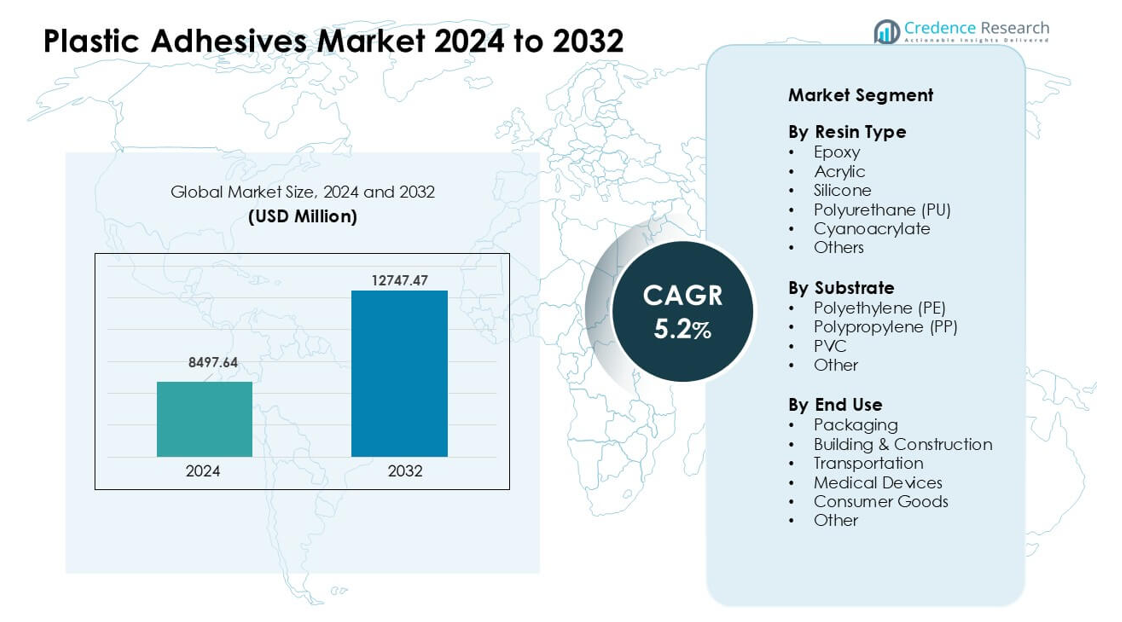
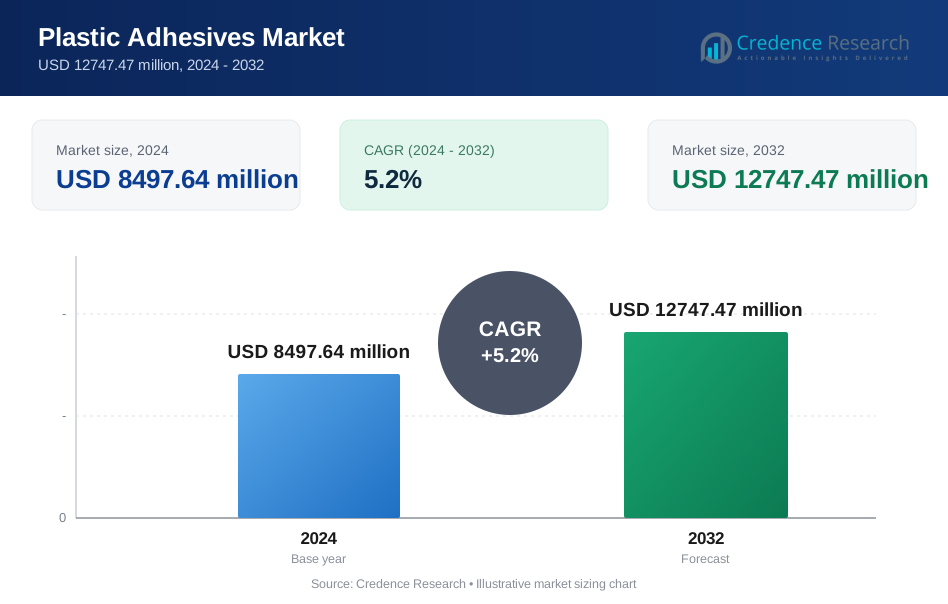
Plastic Adhesives Market was valued at USD 8497.64 million in 2024 and is anticipated to reach USD 12747.47 million by 2032, growing at a CAGR of 5.2% during the forecast period.
| REPORT ATTRIBUTE | DETAILS |
|---|---|
| Historical Period | 2020-2023 |
| Base Year | 2024 |
| Forecast Period | 2025-2032 |
| Plastic Adhesives Market Size 2024 | USD 8497.64 million |
| Plastic Adhesives Market, CAGR | 5.2% |
| Plastic Adhesives Market Size 2032 | USD 12747.47 million |
The Plastic Adhesives Market is driven by major players such as Henkel AG, 3M, Master Bond Inc, Dymax Corporation, Illinois Tool Works, Ashland Inc, Mapei S.P.A., H.B. Fuller, Arkema, and Dow Inc. These companies compete through advanced resin technologies, faster-curing systems, and solutions tailored for packaging, automotive, electronics, and medical applications. Their focus on low-VOC and recyclable adhesive chemistries supports growing sustainability needs across industries. North America led the global market in 2024 with about 34% share, supported by strong automotive production, expanding medical device manufacturing, and high adoption of premium adhesive technologies across major end-use sectors.
Market Insights:
- The Plastic Adhesives Market reached significant value at USD 8497.64 million in 2024 and is projected to grow steadily through 2032 at a strong CAGR of 5.2%, supported by rising use across packaging, automotive, and electronics sectors.
- Growth is driven by higher demand for lightweight plastics and strong adoption of epoxy and acrylic adhesives, with epoxy leading the resin segment at about 32% share due to strong structural bonding needs.
- Key trends include the shift toward low-VOC and recyclable adhesive chemistries, along with fast-curing systems suited for automated and high-speed production lines across major industries.
- The competitive landscape features Henkel AG, 3M, H.B. Fuller, Arkema, Dow Inc, and others that invest in advanced formulations and sustainable solutions to strengthen product performance and compliance.
- North America led the market with around 34% share, followed by Asia Pacific at nearly 31%, while packaging remained the dominant end-use segment with about 41% share in 2024.
Market Segmentation Analysis:
By Resin Type
Epoxy led the resin segment in 2024 with about 32% share. Strong structural strength, thermal stability, and wide bonding range kept epoxy ahead in automotive, electronics, and construction projects. Acrylic grades grew due to fast curing needs in packaging and consumer goods, while polyurethane gained traction in flexible joints. Silicone held steady demand in high-temperature uses, and cyanoacrylates expanded in medical and small-component assembly. Rising use of lightweight plastics in transport and electronics supported strong demand for epoxy-based plastic adhesives.
- For instance, the global plastic‑adhesives market report indicates that epoxy‑based adhesives held a 32.45% revenue share in 2024.
By Substrate
Polypropylene (PP) dominated this segment in 2024 with nearly 38% share. PP held the lead because the material is widely used across automotive interior parts, packaging crates, caps, and consumer goods. Adhesive makers developed improved surface-treatment and primer systems to address PP’s low surface energy, supporting higher bonding strength. Polyethylene (PE) followed due to strong use in films and rigid containers. PVC adhesives gained traction in pipes, profiles, and medical components. Growth in food packaging and lightweight molded parts helped PP maintain its dominant spot.
- For instance, researchers have successfully increased adhesion strength on PP substrates by treating PP films with a side‑chain crystalline block copolymer (SCCBC); the modified PP achieved a tensile‑shear adhesion strength of 1.05 N/mm² (versus negligible adhesion for untreated PP).
By End Use
Packaging held the largest share in 2024 with about 41% share. This segment grew due to rising demand for flexible pouches, labels, laminates, and rigid containers across food, beverage, and personal care lines. Strong sealing strength, fast curing, and compliance with safety rules supported wider use of plastic adhesives. Building and construction used adhesives for panels, flooring, and insulation. Automotive and transport relied on bonding for trims and interior modules. Medical devices expanded due to sterile-grade applications. High packaged-goods demand kept packaging in the leading position.
Key Growth Drivers:
Rising Adoption of Lightweight Plastics in Key Industries
Demand for lightweight plastics increased across automotive, electronics, and consumer goods, which boosted the use of plastic adhesives. Manufacturers replaced mechanical fasteners with advanced bonding solutions that deliver lower weight, better design flexibility, and improved stress distribution. Automakers used adhesives to bond interior trims, lighting units, and under-the-hood parts, supporting fuel efficiency rules. Electronics brands adopted high-strength grades for compact assemblies in smartphones, appliances, and EV battery packs. Growth in flexible packaging and medical components added further momentum. Rising focus on durability, noise reduction, and multi-material bonding kept lightweight plastics a major driver for plastic adhesive consumption.
- For instance, a global strategic business report notes that plastic adhesives have become “essential enablers” in lightweight, multi‑material product assemblies across automotive, electronics, packaging, and medical device sectors especially where plastics like polyolefins or composites need bonding in place of mechanical fasteners.
Expansion of Packaging Demand Across Food, Beverage, and Personal Care
Packaging brands used more laminated films, rigid plastics, and multi-layer structures, which increased reliance on high-performance adhesive systems. Plastic adhesives supported fast sealing speeds, better shelf-life protection, and safe bonding for food-contact materials. Growth in e-commerce raised the need for durable packaging formats with strong tear and impact resistance. Personal care and pharmaceutical companies preferred plastic adhesives for tubes, labels, caps, and blister packages. Brands expanded use of recyclable and mono-material packaging, which increased the demand for adhesives designed for PP and PE substrates. Rising packaged-goods consumption worldwide kept packaging a critical growth engine for the market.
- For instance, in flexible and rigid packaging, adhesives enable bonding of low-surface-energy plastics like polyethylene and polypropylene a capability heavily emphasized in market reports as a key factor in the adhesives market’s expansion across packaging and consumer goods.
Advancements in Adhesive Chemistry and Bonding Technologies
New adhesive chemistries improved curing speed, surface compatibility, flexibility, and bonding strength, which drove wider adoption in high-performance applications. Epoxy and acrylic grades delivered stronger thermal and chemical resistance for automotive and industrial needs. Polyurethane systems expanded in flexible joints, while medical-grade cyanoacrylates supported sterile bonding in device assembly. Plasma and corona treatments improved adhesion on low-energy plastics like PP and PE. Automation in assembly lines increased demand for precision dosing systems and fast-curing adhesives. Industry shifts toward stronger, safer, and more versatile bonding solutions continued to push innovation, raising performance expectations across multiple end-use sectors.
Key Trends & Opportunities:
Growth of Eco-Friendly and Recyclable Adhesive Solutions
Sustainability trends encouraged producers to develop low-VOC, solvent-free, and recyclable adhesive formulations. Packaging brands shifted toward mono-material PE and PP structures, which required compatible adhesive systems that support recycling streams. Water-based and bio-based chemistries gained attention due to regulatory pressure on hazardous substances. Companies also explored adhesives that debond on command to support circular design in electronics and consumer goods. Rising investment in green materials and compliance with global sustainability targets positioned eco-friendly adhesive solutions as a major trend and long-term market opportunity.
- For instance, according to a report on the sustainable adhesives market, adhesives designed for debonding under specific conditions such as heat, moisture, or chemical triggers are increasingly used so that plastics, metals, glass and paper can be separated at end-of-life and recycled more easily.
Adoption of Automation and High-Speed Production Lines
Manufacturers upgraded to automation in automotive, electronics, and packaging plants, increasing the need for adhesives that cure quickly and maintain consistent quality. Robotic dispensing systems improved precision, reduced waste, and ensured repeatability in high-volume operations. Fast-curing acrylic, hot-melt, and UV-curable adhesives supported this shift, enabling higher throughput levels. Smart factories used sensors and digital monitoring tools to optimize adhesive flow and bonding strength. As more industries adopt Industry 4.0 systems, adhesive suppliers will gain new opportunities by offering products tailored for automated, high-speed workflows.
- For instance, automated adhesive dispensing systems have been shown to deliver “pinpoint accuracy,” ensuring uniform bead size, placement, and volume even on complex geometries increasing consistency and reducing waste compared to manual application.
Key Challenges:
Bonding Challenges with Low-Surface-Energy Plastics
Common plastics like polyethylene and polypropylene pose bonding difficulties due to low surface energy, which limits adhesive wetting and penetration. Manufacturers often need extra steps such as plasma, flame, or corona treatment to improve adhesion, which adds cost and slows production. Specialized primers increase reliability but raise chemical-handling concerns. Although newer adhesive formulations improved compatibility, achieving stable long-term bonding remains difficult in heavy-duty or high-temperature environments. These performance constraints limit the use of standard adhesives and require ongoing innovation to meet demanding industrial needs.
Regulatory Pressure on Chemicals and VOC Emissions
The market faces strict global rules targeting volatile organic compounds, hazardous solvents, and chemicals with health risks. Compliance increases formulation complexity and raises production costs for adhesive manufacturers. Many traditional adhesives contain substances restricted under EU REACH, U.S. EPA standards, and regional packaging safety rules. Producers must invest in R&D to create safer alternatives without compromising strength or curing speed. Industries like food packaging and medical devices require rigorous testing, which slows product approvals. These regulatory pressures remain a major challenge and influence future product development strategies.
Regional Analysis:
North America
North America led the Plastic Adhesives Market in 2024 with about 34% share. Strong demand came from automotive lightweighting, medical device production, and high-performance packaging. U.S. automakers used epoxy and polyurethane systems for interior and structural bonding, while electronics firms adopted fast-curing acrylics for compact assemblies. Growth in e-commerce supported wider use of laminated and flexible packaging. The region also advanced sustainable adhesive technologies due to rising VOC regulations. Strong R&D spending and a high concentration of premium adhesive manufacturers helped North America maintain its leadership position across industrial and consumer applications.
Europe
Europe held nearly 28% share in 2024, driven by strict environmental rules, expanding electric vehicle production, and strong packaging innovation. Germany, France, and the U.K. used high-performance adhesives for EV battery packs, medical devices, and precision electronics. The EU’s circular economy targets pushed demand for recyclable and solvent-free adhesive systems, especially for PP and PE packaging lines. Growth in construction renovation and lightweight composites also supported consumption. Strong regulatory pressure encouraged companies to shift toward greener chemistries, keeping Europe a key region for advanced and eco-focused adhesive technologies.
Asia Pacific
Asia Pacific accounted for about 31% share in 2024 and grew fastest due to rapid industrialization, strong electronics manufacturing, and high plastic production volumes. China, Japan, South Korea, and India used large quantities of acrylic, epoxy, and polyurethane adhesives for smartphones, appliances, transport components, and packaging films. Expanding automotive plants and rising EV output continued to boost demand. The region also benefited from strong e-commerce packaging needs and large-scale consumer goods production. Competitive manufacturing costs and increased investment in automation positioned Asia Pacific as the strongest growth engine in the global market.
Latin America
Latin America held around 4% share in 2024, supported by growing packaging, automotive aftermarket, and building construction activities. Brazil and Mexico adopted more plastic adhesives in food packaging, household goods, and interior automotive trims. Demand for durable and cost-effective adhesive solutions increased as manufacturers expanded local production capacity. Growth in healthcare packaging and basic medical devices also contributed to steady uptake. Infrastructure upgrades and rising consumption of packaged goods helped maintain moderate growth. Limited technology investment compared to major regions restrained faster expansion but kept the market stable.
Middle East & Africa
Middle East & Africa captured nearly 3% share in 2024, driven by rising construction spending, industrial diversification, and steady packaging demand. Gulf nations used plastic adhesives for panels, insulation systems, and interior applications in large building projects. Growth in food and beverage packaging supported wider adoption of laminating and sealing adhesives. South Africa expanded use in automotive assembly and consumer goods manufacturing. The region’s shift toward local production of plastics and packaging materials created new opportunities, although slower technology adoption and economic volatility limited broader uptake across industrial sectors.
Market Segmentations:
By Resin Type
- Epoxy
- Acrylic
- Silicone
- Polyurethane (PU)
- Cyanoacrylate
- Others
By Substrate
- Polyethylene (PE)
- Polypropylene (PP)
- PVC
- Other
By End Use
- Packaging
- Building & Construction
- Transportation
- Medical Devices
- Consumer Goods
- Other
By Geography
- North America
- U.S.
- Canada
- Mexico
- Europe
- Germany
- France
- U.K.
- Italy
- Spain
- Rest of Europe
- Asia Pacific
- China
- Japan
- India
- South Korea
- South-east Asia
- Rest of Asia Pacific
- Latin America
- Brazil
- Argentina
- Rest of Latin America
- Middle East & Africa
- GCC Countries
- South Africa
- Rest of the Middle East and Africa
Competitive Landscape:
The Plastic Adhesives Market features strong competition among leading companies such as Henkel AG, 3M, Master Bond Inc, Dymax Corporation, Illinois Tool Works, Ashland Inc, Mapei S.P.A., H.B. Fuller, Arkema, and Dow Inc. These companies focus on advanced resin chemistries, including epoxy, polyurethane, acrylic, and silicone systems that support high-strength bonding across packaging, automotive, medical, and electronics uses. Major players invest in faster-curing, low-VOC, and recyclable adhesive solutions to meet tightening global regulations and sustainability goals. Many firms expand production in Asia Pacific and strengthen partnerships with automotive and packaging OEMs. Growing demand for multi-material bonding and lightweight structures drives continuous R&D activity. Companies also enhance their portfolios with digital dispensing tools, surface-preparation technologies, and application-specific adhesive grades. This competitive environment pushes innovation and reinforces the market’s shift toward high-performance and eco-friendly bonding systems.
Key Player Analysis:
- Henkel AG
- 3M
- Master Bond Inc
- Dymax Corporation
- Illinois Tool Works
- Ashland Inc
- Mapei S.P.A.
- B. Fuller
- Arkema
- Dow Inc
Recent Developments:
- In August 2025, Henkel AG Announced a new generation of phthalate-free PVC-based Darex COV sealants for pail & drum applications (improved health/environment credentials).
- In May 2025, Master Bond Inc. Announced new product releases (example: EP3HTSDA-2Med, a one-part silver-filled electrically conductive epoxy that passed ISO 10993-5; news release dated 05/19/2025). Master Bond’s May 2025 news stream also highlights UV/LED and dual-cure adhesives engineered for bonding challenging substrates.
- In June 2024, Dow Inc. Dow announced that three of its adhesive systems used with polyethylene film packaging received formal recognition from the Association of Plastic Recyclers for compatibility with PE film recycling. This validation supports brand owners and converters in designing plastic packaging structures that maintain strong adhesion while remaining recyclable in established PE streams.
Report Coverage:
The research report offers an in-depth analysis based on Resin Type, Substrate, End-Use and Geography. It details leading market players, providing an overview of their business, product offerings, investments, revenue streams, and key applications. Additionally, the report includes insights into the competitive environment, SWOT analysis, current market trends, as well as the primary drivers and constraints. Furthermore, it discusses various factors that have driven market expansion in recent years. The report also explores market dynamics, regulatory scenarios, and technological advancements that are shaping the industry. It assesses the impact of external factors and global economic changes on market growth. Lastly, it provides strategic recommendations for new entrants and established companies to navigate the complexities of the market.
Future Outlook:
- Demand for high-strength adhesives will rise as industries shift toward lightweight plastic components.
- Adoption of recyclable and low-VOC adhesive systems will grow due to strict sustainability rules.
- Fast-curing chemistries will expand to support automated and high-speed production lines.
- Use of bonding solutions for EV battery modules and interior parts will increase.
- Medical device makers will adopt more biocompatible and sterile-grade adhesive formulations.
- Packaging brands will move toward mono-material structures that require advanced PP and PE bonding.
- Surface-activation technologies like plasma and corona treatment will see wider use.
- Manufacturers will invest in digital dispensing tools for precise and consistent adhesive application.
- Asia Pacific will gain stronger momentum as a key manufacturing hub for electronics and plastics.
- Companies will expand R&D to create adhesives compatible with circular design and easy disassembly.
Request a Free Sample
Fill in your details and we'll send you a free sample report.
- Sample data tables & charts
- Research methodology
Need a Custom Version of This Report?
Tailor the scope, geography, or segments to your exact requirements.
- Custom geography or segment scope
- Direct access to our analyst team
Frequently Asked Questions
What is the current market size for Plastic Adhesives Market, and what is its projected size in 2032?
At what Compound Annual Growth Rate is Plastic Adhesives Market projected to grow between 2024 and 2032?
Which Plastic Adhesives Market segment held the largest share in 2024?
What are the primary factors fueling the growth of Plastic Adhesives Market?
Who are the leading companies in Plastic Adhesives Market?
Table of Content
Chapter 1. Report Introduction
- 1.1 Report Description & Purpose
- 1.1.1 Report Title & Market Definition
- 1.1.2 Unique Selling Propositions (USP) & Key Differentiators
- 1.1.3 Value Proposition for Stakeholders
- 1.2 Research Objectives
- 1.2.1 Market Sizing Objectives (Volume & Revenue)
- 1.2.2 Segmentation Objectives
- 1.2.3 Competitive Intelligence Objectives
- 1.2.4 Forecast & Scenario Objectives
- 1.3 Report Scope
- 1.3.1 Plastic Adhesives Scope – Types & Subtypes Covered
- 1.3.2 Geographic Scope – Regions & Countries Covered
- 1.3.3 Historical Period, Base Year & Forecast Period (2024; forecast to 2032)
- 1.3.4 Inclusions & Exclusions
- 1.4 HS Code & Classification Framework
- 1.5 Currency, Units & Pricing Basis
- 1.6 Target Stakeholders
- 1.7 Limitations & Assumptions
Chapter 2. Executive Summary
- 2.1 Global Plastic Adhesives Market Snapshot
- 2.1.1 Market Size – Historical (2024) & Forecast (2024-2032) (2024: USD 8497.64 million → 2032: USD 12747.47 million)
- 2.1.2 Volume & Revenue – Global Totals
- 2.1.3 Key Market Highlights – Top Five Facts
- 2.2 Plastic Adhesives Market Segmentation Snapshot
- 2.2.1 Market Split by Region – 2024 vs. 2032
- 2.3 Competitive Snapshot
- 2.3.1 Top 10 Players by Revenue Share – 2024
- 2.3.2 Top 10 Players by Volume Share – 2024
- 2.3.3 Recent Strategic Developments (18-Month Summary)
- 2.4 Key Investment Highlights & Strategic Conclusions
Chapter 3. Plastic Adhesives Market Dynamics & Industry Analysis
- 3.1 Market Overview & Context
- 3.1.1 Plastic Adhesives Market Position in the Broader Automotive Value Chain
- 3.1.2 OEM vs. Replacement Market Dynamics
- 3.1.3 Market Maturity & Development Stage by Region
- 3.2 Plastic Adhesives Market Drivers
- 3.3 Plastic Adhesives Market Restraints & Challenges
- 3.4 Plastic Adhesives Market Opportunities
- 3.5 Porter's Five Forces Analysis
- 3.5.1 Threat of New Entrants
- 3.5.2 Bargaining Power of Suppliers
- 3.5.3 Bargaining Power of Buyers
- 3.5.4 Threat of Substitutes
- 3.5.5 Competitive Rivalry – Intensity Assessment
- 3.6 Plastic Adhesives Value Chain Analysis
- 3.6.1 Upstream – Raw Material/Input Suppliers
- 3.6.1.1 Raw Material/Input 1
- 3.6.1.2 Raw Material/Input 2
- 3.6.1.3 Raw Material/Input 3
- 3.6.2 Midstream – Production/Manufacturing/Service Delivery
- 3.6.2.1 Production/Process Overview
- 3.6.2.2 Key Facility Locations & Capacity by Manufacturer
- 3.6.3 Downstream – Distribution & End Consumer
- 3.6.3.1 Primary Channel – B2B/OEM
- 3.6.3.2 Secondary Channels – Dealer, Retail, Online, Direct
- 3.6.4 Value Chain Profitability Analysis
- 3.6.1 Upstream – Raw Material/Input Suppliers
- 3.7 PESTEL Analysis
- 3.7.1 Political Factors
- 3.7.2 Economic Factors
- 3.7.3 Social Factors
- 3.7.4 Technological Factors
- 3.7.5 Environmental Factors
- 3.7.6 Legal Factors
- 3.8 Plastic Adhesives Supply Chain Analysis
- 3.8.1 Raw Material/Input Supply Risk Assessment
- 3.8.2 Manufacturing Concentration Risk (Geographic Exposure)
- 3.8.3 Trade Disruption Impact Analysis
- 3.9 Regulatory & Policy Landscape
Note: The regulatory and policy landscape section covers regulations based on their applicability to the market, Plastic Adhesives category, geography, and scope of the study. Only regulatory frameworks with a material impact on operations, compliance, trade, sustainability, or market access are analyzed in detail.
Chapter 4. Key Investment Pockets & Opportunity Analysis
- 4.1 Plastic Adhesives Market Attractiveness Analysis
- 4.1.1 By Region – Investment Attractiveness Matrix (Volume × CAGR)
- 4.2 Absolute Revenue Growth Opportunity
- 4.2.1 By Region – Absolute USD Growth Through 2032
- 4.3 Incremental Volume Opportunity
- 4.3.1 By Region – Incremental Volume Through 2032
- 4.3.2 Segment – Incremental Volume
- 4.4 Emerging Submarket Opportunity Deep Dive (Subject to Applicability)
- 4.5 Emerging Market Opportunity Scorecards
- 4.5.1 United States
- 4.5.2 Europe
- 4.5.3 Asia
- 4.5.4 Middle East & Africa
Note: Emerging Market Opportunity Scorecards will be included based on relevance and strategic importance. Regions listed are indicative and may vary depending on data availability and market dynamics.
Chapter 5. Plastic Adhesives Import-Export Analysis & Trade Flows
- 5.1 Global Trade Overview
- 5.1.1 Global Export Value by Country (2024)
- 5.1.2 Global Export Volume by Country (2024)
- 5.1.3 Global Import Value by Country (2024)
- 5.1.4 Global Import Volume by Country (2024)
- 5.1.5 Net Trade Balance by Country (2024)
- 5.2 Export Analysis – Segment
- 5.2.1 Type 1 (HS Code)
- 5.2.2 Type 2 (HS Code)
- 5.2.3 Type 3 (HS Code)
- 5.2.4 Type 4 (HS Code)
- 5.2.5 Type 5 (HS Code)
- 5.3 Import Analysis – Segment
- 5.3.1 Type 1 (HS Code)
- 5.3.2 Type 2 (HS Code)
- 5.3.3 Type 3 (HS Code)
- 5.3.4 Type 4 (HS Code)
- 5.3.5 Type 5 (HS Code)
- 5.4 Average Unit Trade Prices
- 5.4.1 Average Export Price – Segment & Country
- 5.4.2 Average Import Price – Segment & Source Country
- 5.4.3 Price Trends (2024)
- 5.5 Key Trade Route Analysis
- 5.5.1 Trade Route 1
- 5.5.2 Trade Route 2
- 5.5.3 Trade Route 3
- 5.5.4 Trade Route 4
- 5.5.5 Trade Route 5
- 5.6 Trade Policy Impact Assessment
- 5.6.1 US Anti-Dumping & Section 301 Tariffs
- 5.6.2 EU Customs Union Impact
- 5.6.3 Major Free Trade Agreements
- 5.6.4 USMCA Rules of Origin
Note: Trade policy analysis will be included only where relevant to the Plastic Adhesives market.
Chapter 6. Competitive Landscape & Company Benchmarking
- 6.1 Plastic Adhesives Market Concentration & Structure
- 6.1.1 Herfindahl-Hirschman Index (HHI) – vs. 2024
- 6.1.2 Tier 1, Tier 2 & Tier 3 Market Structure
- 6.1.3 Global, Regional & Local Player Dynamics
- 6.2 Plastic Adhesives Market Share Analysis – 2024
- 6.2.1 Global Revenue Share by Company
- 6.2.2 Global Volume Share by Company
- 6.2.3 Regional Revenue Share
- 6.2.4 Market Share Evolution ( vs. 2024)
- 6.2.5 OEM Segment Share by Company
- 6.2.6 Replacement Segment Share by Company
- 6.3 Production/Delivery Capacity & Facility Analysis
- 6.3.1 Global Installed Capacity
- 6.3.2 Capacity Utilization Rates
- 6.3.3 Production/Output Volume
- 6.3.4 Facility Locations & Capacity Map
- 6.3.5 Planned Capacity Additions
- 6.4 Plastic Adhesives Competitive Benchmarking Matrix
- 6.4.1 Revenue, Volume, CAGR & Profitability Comparison
- 6.4.2 Channel Revenue Mix
- 6.4.3 Geographic Revenue Exposure
- 6.4.4 R&D Intensity
- 6.4.5 Sustainability Maturity
- 6.5 Strategic Developments in Plastic Adhesives (Last 24 Months)
- 6.5.1 Mergers, Acquisitions & Divestments
- 6.5.2 New Plastic Adhesives Launches
- 6.5.3 Facility Expansions
- 6.5.4 Strategic Alliances, Joint Ventures & Partnerships
- 6.5.5 Distribution Expansion & Market Entry
- 6.5.6 Sustainability & ESG Initiatives
- 6.6 Competitive Strategy Mapping
- 6.6.1 Leader, Challenger, Follower & Niche Classification
- 6.6.2 Pricing Strategy Comparison
- 6.6.3 Channel Strategy Matrix
Note: Strategic developments are included based on their materiality and the availability of reliable information.
Chapter 7. Global Plastic Adhesives Market – By Distribution Channel
- 7.1 Segment Overview
- 7.1.1 Volume & Revenue Split by Channel (2024 & 2032)
- 7.1.2 Channel Mix Evolution (2024-2032)
Chapter 8. Regional Market Analysis – Global Overview
- 8.1 Global Regional Overview
- 8.1.1 Regional Volume Share
- 8.1.2 Regional Revenue Share
- 8.1.3 Regional Volume by Region
- 8.1.4 Regional Revenue by Region
- 8.1.5 Regional Forecast Through 2032
- 8.2 Cross-Regional Segment Analysis
- 8.2.1 By Distribution Channel
- 8.2.2 By Brand/Price Tier
Chapter 9. North America Plastic Adhesives Market
- 9.1 United States
- 9.2 Canada
- 9.3 Mexico
Chapter 10. Europe Plastic Adhesives Market
- 10.1 Germany
- 10.2 France
- 10.3 Italy
- 10.4 United Kingdom
- 10.5 Spain
- 10.6 Poland
- 10.7 Russia
- 10.8 Netherlands
- 10.9 Belgium
- 10.10 Sweden
- 10.11 Denmark
- 10.12 Norway
- 10.13 Rest of Europe
Chapter 11. Asia Pacific Plastic Adhesives Market
- 11.1 China
- 11.2 India
- 11.3 Japan
- 11.4 South Korea
- 11.5 Thailand
- 11.6 Indonesia
- 11.7 Vietnam
- 11.8 Malaysia
- 11.9 Australia
- 11.10 Rest of Asia Pacific
Chapter 12. Latin America Plastic Adhesives Market
- 12.1 Brazil
- 12.2 Argentina
- 12.3 Colombia
- 12.4 Chile
- 12.5 Rest of Latin America
Chapter 13. Middle East Plastic Adhesives Market
- 13.1 Saudi Arabia
- 13.2 United Arab Emirates
- 13.3 Turkey
- 13.4 Israel
- 13.5 Iran
- 13.6 Rest of the Middle East
Chapter 14. Africa Plastic Adhesives Market
- 14.1 South Africa
- 14.2 Egypt
- 14.3 Nigeria
- 14.4 Morocco
- 14.5 Rest of Africa
Chapter 15. Plastic Adhesives Company Profiles
- 15.1 [Company 01]
- 15.1.1 Company Overview
- 15.1.2 Key Management Personnel
- 15.1.3 Products & Services Portfolio
- 15.1.4 Financial Performance
- 15.1.5 Key Market Focus & Geographic Presence
- 15.1.6 Recent Developments & Strategic Initiatives
Note: The company profile list is preliminary and may change based on research findings, market developments, data availability, and client requirements.
Chapter 16. Appendices
- Appendix A – List of Abbreviations & Acronyms
- Appendix B – Industry Classification Code Reference – Full Series
- Appendix C – Production & Capacity Data Tables
- Appendix D – End-Use & Demand Base Tables
- Appendix E – Consumption & Replacement Rate Assumptions
- Appendix F – ASP Reference Tables
- Appendix G – Manufacturing & Facility Database
- Appendix H – Import-Export Data Tables
- Appendix I – Regulatory Summary Tables
- Appendix J – Primary Research Participant List (Anonymized)
- Appendix K – Primary Research Questionnaire Framework
- Appendix L – Data Sources & Bibliography
- Appendix M – Market Size Divergence & Source Comparison
Chapter 17. Research Methodology
- 17.1 Research Framework & Philosophy
- 17.2 Secondary Research – Sources, Hierarchy & Data Extraction
- 17.3 Data Modeling – Bottom-Up & Top-Down Market Sizing
- 17.4 Primary Research – Stakeholder Framework, LOI & Sample Sizes
- 17.5 Forecast Methodology – Regression, Scenario & Sensitivity Analysis
- 17.6 Quality Control – Four-Layer Validation Framework
- 17.7 Limitations & Standard Assumptions
- 17.8 Disclaimer
