
| REPORT ATTRIBUTE | DETAILS |
|---|---|
| Historical Period | 2019-2022 |
| Base Year | 2023 |
| Forecast Period | 2024-2032 |
| Polyethylene Furanoate (PEF) Market Size 2023 | USD 18.5 million |
| Polyethylene Furanoate (PEF) Market, CAGR | 8.50% |
| Polyethylene Furanoate (PEF) Market Size 2032 | USD 38.6 million |
Market Insights
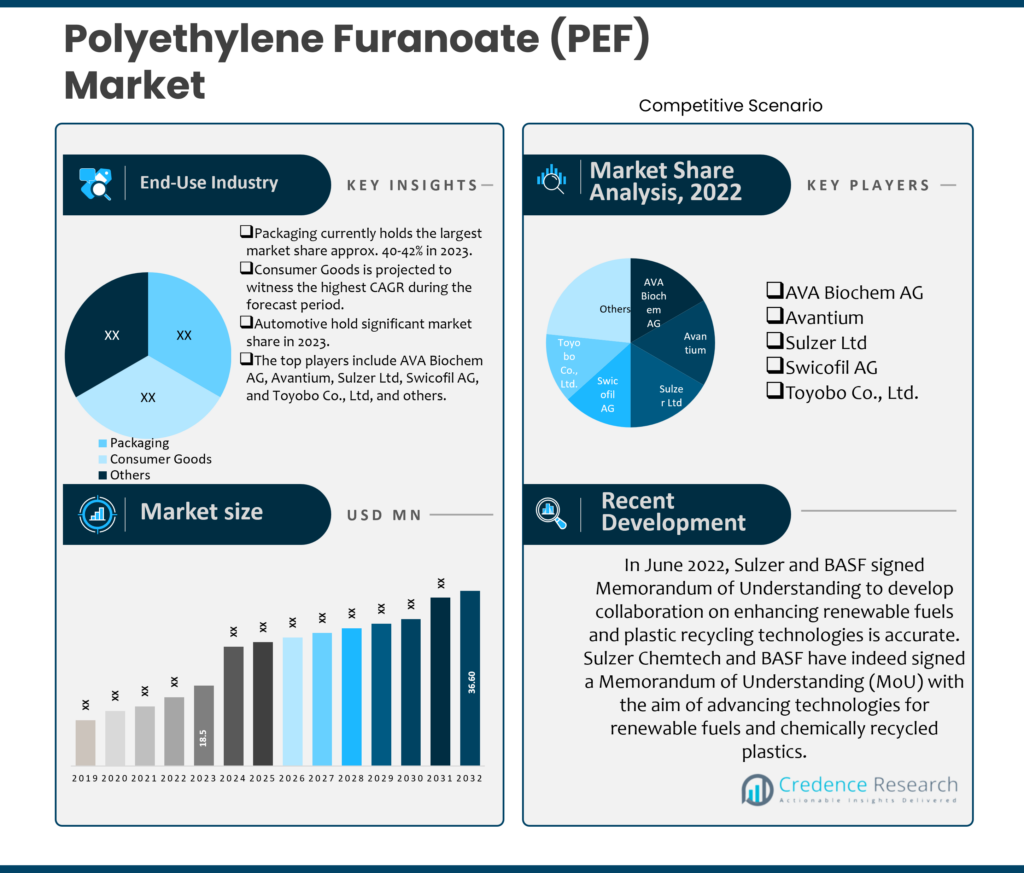
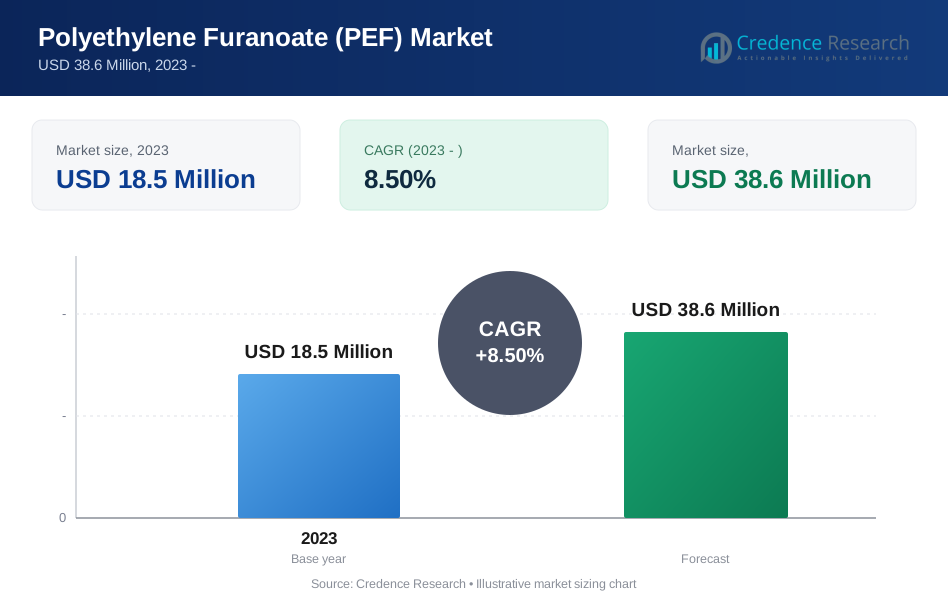
- The Polyethylene Furanoate (PEF) Market attained a valuation of USD 18.5 Million in 2023 and is anticipated to escalate to USD 38.6 Million by 2032, exhibiting a robust CAGR of 8.50% during the forecast period from 2024 to 2032.
- Among the key segments, Packaging emerged as the dominant end-use industry, holding approximately 40-42% of the total market share in 2023. However, Consumer Goods are projected to witness the highest growth rate during the forecast period.
- Beverage Bottles currently hold the largest market share approx 40-45% in 2023. The bio-based nature of PEF makes it ideal for beverage bottles, and beverage companies are being urged to use environmentally friendly packaging.
- North America held the largest share of the market in 2023, accounting for around 38-42%. This is attributed to stringent environmental regulations, robust industrial infrastructure, and high consumer awareness regarding environmental issues.
- The rise in demand for PEF, driven by changing consumer preferences towards environmentally friendly products and government initiatives promoting environmental sustainability, fuels the growth of the Polyethylene Furanoate (PEF) Market.
- Key opportunities in the market include expanding applications beyond traditional packaging, adoption of various strategies among market players, and advances in PEF processing technology, fostering market expansion.
Executive Summary
Market Definition
Polyethylene furanoate (PEF) is another bio-based polyester that has gained considerable attention as a potential replacement for traditional petroleum-based plastics such as PET (Polyethylene Terephthalate). Its unique chemical structure provides improved barrier properties, making it suitable for a wide range of applications including packaging, textiles, bottles, and films. The PEF market is experiencing significant growth due to increasing consumer awareness of environmental issues and demand for sustainable packaging solutions. Due to its excellent operating characteristics of gas and due to its effective moisture barrier properties, PEF offers an attractive option for manufacturers to achieve sustainability goals while maintaining product integrity. Increasing productivity will also reduce production costs, which is expected to further boost market acceptance. Key players in the PEF market are investing in research and development to expand application possibilities and improve product performance.
Market Overview
The Polyethylene Furanoate (PEF) Market has exhibited significant growth and is anticipated to maintain a robust Compound Annual Growth Rate (CAGR) of 8.50% from 2024 to 2032. Valued at USD 18.5 million in 2023, this market is forecasted to reach USD 38.6 million by 2032.
Among the primary segments, Packaging emerged as the dominant end-use industry, comprising approximately 40-42% of the total market share in 2023. However, Consumer Goods are anticipated to observe the highest CAGR over the forecast period.
Beverage Bottles currently hold the largest market share, approximately 40-45% in 2023. The bio-based nature of PEF makes it ideal for beverage bottles, and beverage companies are being urged to use environmentally friendly packaging.
North America constituted a significant portion of the market in 2023, followed by Asia Pacific and Europe, collectively representing just under 55% of the market share.
The rise in demand for PEF is driven by factors such as changing consumer preferences towards environmentally friendly products, government initiatives promoting environmental sustainability, and the expanding middle-class population with evolving preferences.
Continuous advancements in PEF processing technology and strategic partnerships further strengthen the market growth, especially in regions with robust industrial infrastructure and high consumer awareness regarding environmental issues.
Segmentation by End-Use Industry
- Packaging currently holds the largest market share approx. 40-42% in 2023 due to increasing demand for sustainable packaging solutions due to environmental concerns and regulatory pressures to reduce plastic waste.
- Consumer Goods is projected to witness the highest CAGR during the forecast period owing to its durable packaging in healthcare.
Segmentation by Application
- Beverage Bottles currently hold the largest market share approx. 40-45% in 2023. Beverage companies are being urged to use environmentally friendly packaging. The bio-based nature of PEF makes it ideal for beverage bottles.
- Fibers are projected to witness the highest CAGR during the forecast period. PEF fibers can potentially command higher margins compared to PEF bottles due to their value-added applications in clothing and textiles.
Segmentation by Region
- North America held largest share around 38-42% of the market in 2023. This is owing to its sustainability, robust industrial infrastructure and high consumer awareness regarding environmental issues. Furthermore, continuous research and development efforts and strategic partnerships further strengthen the market growth.
- Asia Pacific and Europe collectively account for just under 55% share in 2023, with Asia Pacific holding over 20% share in the same year.
- The rest of the world, including Latin America, the Middle East, and Africa, supplies the remaining demand for Polyethylene Furanoate (PEF).
Expanding middle-class population with, changing consumer preferences towards environmentally friendly products, and government initiatives and policies promoting environmental sustainability and reducing plastic waste are also contributing to the market growth.
The North America region holds the largest market share in the Polyethylene Furanoate (PEF) market. Stringent environmental regulations and policies aimed at reducing solid waste generation across North America have been a major factor in the adoption of PEF. Governments in the region have implemented policies and guidelines that encourage the sustainable use of biodegradable materials, which has led to an increase in the demand for PEF as an alternative construction method replacing conventional petroleum-based plastics. For instance, in September 2023, the Department of the Interior has finalized plans to gradually eliminate single-use plastics on public lands over the next ten years. This initiative aligns with Secretary Deb Haaland's Order 3407, signed in June 2022, which aims to reduce the use of single-use plastic products. Additionally, the region is home to many major customers who have committed to environmentally friendly packaging. Major brands such as PepsiCo, Coca-Cola, and Danone have all committed to incorporating PEF and other bio-based plastics into their packaging, driving market growth in North America. For instance, in August 2023, PepsiCo has announced plans to eliminate plastic rings from its beverage multipacks in the US, replacing them with paper-based solutions. In addition, the availability of abundant raw materials such as corn stover, which is a crucial feedstock for PEF production, has created favorable conditions for producers in the region.
Asia Pacific hold is projected to witness the highest CAGR during the forecast period of the global Polyethylene Furanoate (PEF) market. The region is experiencing rapid economic growth and urbanization, which is fueling the growth in the consumption of packaged goods, especially beverages. In addition, the Asia-Pacific market is benefiting from increasing environmental consciousness among consumers, who are actively seeking eco-friendly alternatives to conventional plastic products further driving the market growth. The renewability and potential disruption of PEF make it an attractive option for customers in the region, making it more acceptable. Furthermore, strong regional R&D efforts in bio-based renewable plastics contribute to the growth of the PEF market. For instance, in April 2024, Bioform Technologies successfully raised $5 million in seed funding from Suzano Ventures, the corporate venture capital arm of Suzano, a leading market pulp producer. This investment will enable Bioform technologies to advance the development of bio-based alternatives to single-use plastics further boost the APAC growth.
Key Highlights of the Report
The Polyethylene Furanoate (PEF) market is segmented by end-use industry, application, region, and key players. The growing demand for PEF is driven by factors such as increasing environmental concerns, changing consumer preferences towards sustainable products, and government initiatives promoting environmental sustainability.
Packaging emerges as the dominant end-use industry segment, comprising approximately 40-42% of the total market share in 2023. Consumer Goods are anticipated to witness the highest growth rate during the forecast period, reflecting the trend towards durable packaging in healthcare.
Beverage Bottles lead the application segment, currently holding the largest market share at approximately 40-45% in 2023. PEF's bio-based nature makes it ideal for beverage bottles, aligning with beverage companies' efforts to adopt environmentally friendly packaging.
North America holds the largest share of the Polyethylene Furanoate (PEF) market, supported by stringent environmental regulations and robust industrial infrastructure. Major players such as AVA Biochem AG, Avantium, and Sulzer Ltd. focus on innovation and strategic partnerships to drive market growth and maintain competitiveness.
Continuous advancements in PEF processing technology and expanding applications beyond traditional packaging contribute to market expansion, especially in regions with high consumer awareness regarding environmental issues and sustainable products.
What Are The Main Drivers Of The Global Polyethylene Furanoate (PEF) Market?
The global Polyethylene Furanoate (PEF) market is driven by growing environmental concerns and a shift towards sustainable products consumers and businesses are looking for an alternative to conventional plastics due to increasing environmental awareness. PEF offers a biodegradable and innovative alternative, which is attractive to companies looking to meet sustainability goals and comply with regulations. Furthermore, advancements in PEF processing technology and increasing investments in research and development are also contributing to the growth of the market.
What Are The Major Challenges Faced By The Global Polyethylene Furanoate (PEF) Market?
The global Polyethylene Furanoate (PEF) market is mainly challenged by competition from established petrochemical-based plastics which dominate the market due to its low price and high consumption, and scaling up PEF production while maintaining cost competitiveness remains challenging. Moreover, regulatory and certification requirements for bioplastics can present hurdles.
What Are The Growth Opportunities In The Global Polyethylene Furanoate (PEF) Market?
The global Polyethylene Furanoate (PEF) market presents numerous growth opportunities due to various factors. First, increasing consumer awareness and demand for environmentally less sustainable products is driving the adoption of PEF as an alternative to conventional plastics. Second advances in PEF technology offer opportunities for cost reduction and scalability, making it more competitive in the market. Third, government policies and regulations promoting the use of biodegradable materials further stimulate market growth. Moreover, the expanding application of PEF in various industries such as packaging, textiles and automotive provides promising avenues for market expansion. In addition, adoption of various strategies among market players makes significant opportunity for the market.
Market Drivers
Advances In Polyethylene Furanoate (PEF) Processing Technology
Advances in polyethylene furanoate (PEF) processing technology are vital to the growth of the global PEF market. These advances simplify manufacturing processes, increase productivity, and reduce costs, making PEF more competitive with conventional plastics. Advanced manufacturing techniques enable the production of high-quality PEFs with sustainable properties that meet stringent industry standards and customer requirements. For instance, the YXY technology catalytically converts plant-based sugars (fructose) into FDCA (furandicarboxylic acid), which is the key building block for a wide range of plant-based chemicals and plastics, such as polyethylene furanoate (PEF). Furthermore, the innovation in manufacturing technologies facilitates the development of new PEF-based products and applications and expands its market potential in various sectors. Overall, continuous improvement in PEF application technology enables innovative, sustainable growth and market development in the industry.
Market Restraints
Competition From Established Petrochemical-Based Plastics
Competition from established petrochemical-based plastics create challenges for Polyethylene Furanoate (PEF) market. Petrochemical plastics have long existence, industry, low manufacturing costs, and make them the default choice for many industries. Overcoming this competition requires demonstrating the unique benefits of PEF, such as its renewable and biodegradable nature, superior performance properties, and reduced environmental impact. In addition, product improvements, price competition and regulatory framework challenges hinder market access and adoption of PEF. To address these barriers through innovation, strategic planning and environment increasing environmental awareness is essential to unleash the full potential of PEF in the global market.
Opportunities
Adoption Of Various Strategies Among Market Players
Adoption of various strategies among market players offers significant growth opportunities of the global Polyethylene Furanoate (PEF) market. The major companies serving the global Polyethylene Furanoate (PEF) Market are AVA Biochem AG, Avantium, Sulzer Ltd, Swicofil AG, and Toyobo Co., Ltd, among others. The market players are considerably contributing to the market growth by the adoption of various strategies including mergers & acquisitions, collaborations, funding, and new product launches, to stay competitive in the market. For instance, in May 2021, Sulzer partnered with Swiss AVA Biochem to expand its technology portfolio for renewable, bio-based, and recyclable materials production. This collaboration involves an exclusive license agreement to commercialize AVA Biochem's innovative technology for producing sustainable commodity chemicals from biomass.
Competitive Landscape
Key Players
The global Polyethylene Furanoate (PEF) market is highly competitive, with several key players. Some of the major players in the market and their market share are as follows:
- AVA Biochem AG
- Avantium
- Sulzer Ltd
- Swicofil AG
- Toyobo Co., Ltd.
- Others
These organizations prioritize product innovation, distribution channel expansion, and mergers and acquisitions to stay competitive.
The global Polyethylene Furanoate (PEF) market's key players continually seek to stay ahead by offering new products and developments.
In June 2022, Sulzer and BASF signed Memorandum of Understanding to develop collaboration on enhancing renewable fuels and plastic recycling technologies is accurate. Sulzer Chemtech and BASF have indeed signed a Memorandum of Understanding (MoU) with the aim of advancing technologies for renewable fuels and chemically recycled plastics.
In May 2021, Sulzer partnered with Swiss AVA Biochem to expand its technology portfolio for renewable, bio-based, and recyclable materials production. This collaboration involves an exclusive license agreement to commercialize AVA Biochem's innovative technology for producing sustainable commodity chemicals from biomass.
Summary of Key Findings
- The Polyethylene Furanoate (PEF) Market is experiencing significant growth, driven by growing environmental concerns, changing consumer preferences towards sustainable products, and government initiatives promoting environmental sustainability and reducing plastic waste. Key drivers fueling this growth include the expanding middle-class population, increasing demand for environmentally friendly products, and advancements in PEF processing technology.
- Market segmentation within the Polyethylene Furanoate (PEF) Market includes factors such as end-use industry, application, region, and key players, reflecting the diverse uses and applications of PEF across various sectors.
- Packaging emerges as the dominant end-use industry segment, comprising approximately 40-42% of the total market share in 2023. Consumer Goods are projected to witness the highest growth rate during the forecast period, driven by durable packaging requirements in healthcare.
- Beverage Bottles lead the application segment, currently holding the largest market share at approximately 40-45% in 2023. PEF's bio-based nature makes it ideal for beverage bottles, aligning with beverage companies' efforts to adopt environmentally friendly packaging.
- North America holds the largest share of the Polyethylene Furanoate (PEF) market, supported by stringent environmental regulations and robust industrial infrastructure. Major players such as AVA Biochem AG, Avantium, and Sulzer Ltd. focus on innovation and strategic partnerships to drive market growth and maintain competitiveness.
Future Outlook
- The future outlook for the Polyethylene Furanoate (PEF) Market indicates promising growth opportunities, particularly within sectors such as packaging, textiles, and automotive, driven by increasing consumer awareness and demand for environmentally sustainable products. However, anticipated challenges include competition from established petrochemical-based plastics, regulatory requirements, and scaling up PEF production while maintaining cost competitiveness.
- To maintain competitiveness in the Polyethylene Furanoate (PEF) Market, industry players should adopt various strategies such as continuous technological innovation, strategic collaborations, securing investments for research and development, and expanding market reach. Companies must prioritize addressing regulatory requirements, improving PEF processing technology, and exploring new applications in emerging markets to ensure sustained growth amidst evolving environmental dynamics.
How CXOs Can Benefit from the Credence Research Polyethylene Furanoate (PEF) Market Report
The Credence Research Polyethylene Furanoate (PEF) Market Report provides CXOs with a comprehensive overview of the market, including:
- Market size and growth forecast:The report provides detailed estimates of the global Polyethylene Furanoate (PEF) market size, segmented by end-use industry, application, region. It also includes forecasts for the market through 2032, based on key trends and drivers.
- Market segmentation:The report segments the Polyethylene Furanoate (PEF) market by end-use industry, application, region. The increasing demand for advanced solutions is driven. This segmentation provides CXOs with a granular understanding of the market and the opportunities in each segment.
- Competitive landscape:The report profiles the key players in the Polyethylene Furanoate (PEF) market and provides insights into their strategies, product offerings, and financial performance. This information can help CXOs to identify and assess their competition.
- Key trends and drivers:The report identifies and analyzes the key trends and drivers that are shaping the Polyethylene Furanoate (PEF) market. This information can help CXOs to make informed decisions about their investments and strategies.
CXOs can use the insights from the Credence Research Polyethylene Furanoate (PEF) Market Report to:
- Identify growth opportunities:The report can help CXOs to identify new growth opportunities in the Polyethylene Furanoate (PEF) market. For example, the report identifies the growing demand for Polyethylene Furanoate (PEF) from cloud computing providers and telecom companies as a key opportunity.
- Make informed investment decisions:The report can help CXOs to make informed investment decisions about Polyethylene Furanoate (PEF). For example, the report provides insights into the key factors to consider when evaluating Polyethylene Furanoate (PEF) providers and selecting Polyethylene Furanoate (PEF) solutions.
- Develop competitive strategies:The report can help CXOs to develop competitive strategies for their Polyethylene Furanoate (PEF) businesses. For example, the report identifies the key strategies that Polyethylene Furanoate (PEF) providers are using to differentiate themselves from their competitors.
- Track market developments:The report can help CXOs to track market developments and stay ahead of the curve. For example, the report provides insights into the latest trends and innovations in the Polyethylene Furanoate (PEF) market.
Overall, the Credence Research Polyethylene Furanoate (PEF) Market Report is a valuable resource for CXOs who are looking to gain a deeper understanding of the market and identify opportunities for growth.
Segmentation
-
End-Use Industry:
- Packaging
- Textiles
- Automotive
- Electronics
- Consumer Goods
- Healthcare
- Others
-
Application:
- Beverage Bottles
- Food Packaging
- Films and Sheets
- Fibers
- Containers
- Automotive Parts
- Electronics Enclosures
- 3D Printing
- Others
-
By Region
- North America
- US
- Canada
- Mexico
- Europe
- Germany
- France
- UK.
- Italy
- Spain
- Rest of Europe
- Asia Pacific
- China
- Japan
- India
- South Korea
- South-east Asia
- Rest of Asia Pacific
- Latin America
- Brazil
- Argentina
- Rest of Latin America
- Middle East & Africa
- GCC Countries
- South Africa
- Rest of Middle East and Africa
- North America
Adjacent Markets
In the Polyethylene Furanoate (PEF) market, there are several adjacent markets which has high revenue growth opportunities. The key adjacent markets for Polyethylene Furanoate (PEF) market -
Adjacent Markets |
||
| Bioplastics Market | Bio-based Polymers Market | Eco-friendly Bottles and Containers Market |
| Renewable Packaging Market | Green Packaging Market | Biodegradable Films Market |
| Sustainable Textiles Market | Biomass-derived Chemicals Market | Plant-based Packaging Market |
Request a Free Sample
Fill in your details and we'll send you a free sample report.
- Sample data tables & charts
- Research methodology
Need a Custom Version of This Report?
Tailor the scope, geography, or segments to your exact requirements.
- Custom geography or segment scope
- Direct access to our analyst team
Frequently Asked Questions
What is the current size of the global Polyethylene Furanoate (PEF) market?
What is the expected growth rate of the Polyethylene Furanoate (PEF) market between 2024 and 2032?
Which segment is leading the market share in terms of End-Use Industry?
Which Application governs the demand for Polyethylene Furanoate (PEF)s in the world?
Which Application segment is expected to post the highest CAGR during the forecast period?
Which region is fueling the growth of the Polyethylene Furanoate (PEF) industry?
Who are the major players in the global Polyethylene Furanoate (PEF) market?
What are the major market drivers of the Polyethylene Furanoate (PEF) industry?
What are the major market restraints of the Polyethylene Furanoate (PEF) industry?
What are the major market opportunities of the Polyethylene Furanoate (PEF) industry?
Table of Content
Chapter 1. Report Introduction
- 1.1 Report Description & Purpose
- 1.1.1 Report Title & Market Definition
- 1.1.2 Unique Selling Propositions (USP) & Key Differentiators
- 1.1.3 Value Proposition for Stakeholders
- 1.2 Research Objectives
- 1.2.1 Market Sizing Objectives (Volume & Revenue)
- 1.2.2 Segmentation Objectives
- 1.2.3 Competitive Intelligence Objectives
- 1.2.4 Forecast & Scenario Objectives
- 1.3 Report Scope
- 1.3.1 Polyethylene Furanoate (PEF) Scope – Types & Subtypes Covered
- 1.3.2 Geographic Scope – Regions & Countries Covered
- 1.3.3 Historical Period, Base Year & Forecast Period (2023; forecast to the forecast period)
- 1.3.4 Inclusions & Exclusions
- 1.4 HS Code & Classification Framework
- 1.5 Currency, Units & Pricing Basis
- 1.6 Target Stakeholders
- 1.7 Limitations & Assumptions
Chapter 2. Executive Summary
- 2.1 Global Polyethylene Furanoate (PEF) Market Snapshot
- 2.1.1 Market Size – Historical (2023) & Forecast (the forecast period) (2023: USD 18.5 Million → forecast year: USD 38.6 Million)
- 2.1.2 Volume & Revenue – Global Totals
- 2.1.3 Key Market Highlights – Top Five Facts
- 2.2 Polyethylene Furanoate (PEF) Market Segmentation Snapshot
- 2.2.1 Market Split by Region – 2023 vs.
- 2.3 Competitive Snapshot
- 2.3.1 Top 10 Players by Revenue Share – 2023
- 2.3.2 Top 10 Players by Volume Share – 2023
- 2.3.3 Recent Strategic Developments (18-Month Summary)
- 2.4 Key Investment Highlights & Strategic Conclusions
Chapter 3. Polyethylene Furanoate (PEF) Market Dynamics & Industry Analysis
- 3.1 Market Overview & Context
- 3.1.1 Polyethylene Furanoate (PEF) Market Position in the Broader Automotive Value Chain
- 3.1.2 OEM vs. Replacement Market Dynamics
- 3.1.3 Market Maturity & Development Stage by Region
- 3.2 Polyethylene Furanoate (PEF) Market Drivers
- 3.3 Polyethylene Furanoate (PEF) Market Restraints & Challenges
- 3.4 Polyethylene Furanoate (PEF) Market Opportunities
- 3.5 Porter's Five Forces Analysis
- 3.5.1 Threat of New Entrants
- 3.5.2 Bargaining Power of Suppliers
- 3.5.3 Bargaining Power of Buyers
- 3.5.4 Threat of Substitutes
- 3.5.5 Competitive Rivalry – Intensity Assessment
- 3.6 Polyethylene Furanoate (PEF) Value Chain Analysis
- 3.6.1 Upstream – Raw Material/Input Suppliers
- 3.6.1.1 Raw Material/Input 1
- 3.6.1.2 Raw Material/Input 2
- 3.6.1.3 Raw Material/Input 3
- 3.6.2 Midstream – Production/Manufacturing/Service Delivery
- 3.6.2.1 Production/Process Overview
- 3.6.2.2 Key Facility Locations & Capacity by Manufacturer
- 3.6.3 Downstream – Distribution & End Consumer
- 3.6.3.1 Primary Channel – B2B/OEM
- 3.6.3.2 Secondary Channels – Dealer, Retail, Online, Direct
- 3.6.4 Value Chain Profitability Analysis
- 3.6.1 Upstream – Raw Material/Input Suppliers
- 3.7 PESTEL Analysis
- 3.7.1 Political Factors
- 3.7.2 Economic Factors
- 3.7.3 Social Factors
- 3.7.4 Technological Factors
- 3.7.5 Environmental Factors
- 3.7.6 Legal Factors
- 3.8 Polyethylene Furanoate (PEF) Supply Chain Analysis
- 3.8.1 Raw Material/Input Supply Risk Assessment
- 3.8.2 Manufacturing Concentration Risk (Geographic Exposure)
- 3.8.3 Trade Disruption Impact Analysis
- 3.9 Regulatory & Policy Landscape
Note: The regulatory and policy landscape section covers regulations based on their applicability to the market, Polyethylene Furanoate (PEF) category, geography, and scope of the study. Only regulatory frameworks with a material impact on operations, compliance, trade, sustainability, or market access are analyzed in detail.
Chapter 4. Key Investment Pockets & Opportunity Analysis
- 4.1 Polyethylene Furanoate (PEF) Market Attractiveness Analysis
- 4.1.1 By Region – Investment Attractiveness Matrix (Volume × CAGR)
- 4.2 Absolute Revenue Growth Opportunity
- 4.2.1 By Region – Absolute USD Growth Through the forecast period
- 4.3 Incremental Volume Opportunity
- 4.3.1 By Region – Incremental Volume Through the forecast period
- 4.3.2 Segment – Incremental Volume
- 4.4 Emerging Submarket Opportunity Deep Dive (Subject to Applicability)
- 4.5 Emerging Market Opportunity Scorecards
- 4.5.1 United States
- 4.5.2 Europe
- 4.5.3 Asia
- 4.5.4 Middle East & Africa
Note: Emerging Market Opportunity Scorecards will be included based on relevance and strategic importance. Regions listed are indicative and may vary depending on data availability and market dynamics.
Chapter 5. Polyethylene Furanoate (PEF) Import-Export Analysis & Trade Flows
- 5.1 Global Trade Overview
- 5.1.1 Global Export Value by Country (2023)
- 5.1.2 Global Export Volume by Country (2023)
- 5.1.3 Global Import Value by Country (2023)
- 5.1.4 Global Import Volume by Country (2023)
- 5.1.5 Net Trade Balance by Country (2023)
- 5.2 Export Analysis – Segment
- 5.2.1 Type 1 (HS Code)
- 5.2.2 Type 2 (HS Code)
- 5.2.3 Type 3 (HS Code)
- 5.2.4 Type 4 (HS Code)
- 5.2.5 Type 5 (HS Code)
- 5.3 Import Analysis – Segment
- 5.3.1 Type 1 (HS Code)
- 5.3.2 Type 2 (HS Code)
- 5.3.3 Type 3 (HS Code)
- 5.3.4 Type 4 (HS Code)
- 5.3.5 Type 5 (HS Code)
- 5.4 Average Unit Trade Prices
- 5.4.1 Average Export Price – Segment & Country
- 5.4.2 Average Import Price – Segment & Source Country
- 5.4.3 Price Trends (2023)
- 5.5 Key Trade Route Analysis
- 5.5.1 Trade Route 1
- 5.5.2 Trade Route 2
- 5.5.3 Trade Route 3
- 5.5.4 Trade Route 4
- 5.5.5 Trade Route 5
- 5.6 Trade Policy Impact Assessment
- 5.6.1 US Anti-Dumping & Section 301 Tariffs
- 5.6.2 EU Customs Union Impact
- 5.6.3 Major Free Trade Agreements
- 5.6.4 USMCA Rules of Origin
Note: Trade policy analysis will be included only where relevant to the Polyethylene Furanoate (PEF) market.
Chapter 6. Competitive Landscape & Company Benchmarking
- 6.1 Polyethylene Furanoate (PEF) Market Concentration & Structure
- 6.1.1 Herfindahl-Hirschman Index (HHI) – vs. 2023
- 6.1.2 Tier 1, Tier 2 & Tier 3 Market Structure
- 6.1.3 Global, Regional & Local Player Dynamics
- 6.2 Polyethylene Furanoate (PEF) Market Share Analysis – 2023
- 6.2.1 Global Revenue Share by Company
- 6.2.2 Global Volume Share by Company
- 6.2.3 Regional Revenue Share
- 6.2.4 Market Share Evolution ( vs. 2023)
- 6.2.5 OEM Segment Share by Company
- 6.2.6 Replacement Segment Share by Company
- 6.3 Production/Delivery Capacity & Facility Analysis
- 6.3.1 Global Installed Capacity
- 6.3.2 Capacity Utilization Rates
- 6.3.3 Production/Output Volume
- 6.3.4 Facility Locations & Capacity Map
- 6.3.5 Planned Capacity Additions
- 6.4 Polyethylene Furanoate (PEF) Competitive Benchmarking Matrix
- 6.4.1 Revenue, Volume, CAGR & Profitability Comparison
- 6.4.2 Channel Revenue Mix
- 6.4.3 Geographic Revenue Exposure
- 6.4.4 R&D Intensity
- 6.4.5 Sustainability Maturity
- 6.5 Strategic Developments in Polyethylene Furanoate (PEF) (Last 24 Months)
- 6.5.1 Mergers, Acquisitions & Divestments
- 6.5.2 New Polyethylene Furanoate (PEF) Launches
- 6.5.3 Facility Expansions
- 6.5.4 Strategic Alliances, Joint Ventures & Partnerships
- 6.5.5 Distribution Expansion & Market Entry
- 6.5.6 Sustainability & ESG Initiatives
- 6.6 Competitive Strategy Mapping
- 6.6.1 Leader, Challenger, Follower & Niche Classification
- 6.6.2 Pricing Strategy Comparison
- 6.6.3 Channel Strategy Matrix
Note: Strategic developments are included based on their materiality and the availability of reliable information.
Chapter 7. Global Polyethylene Furanoate (PEF) Market – By Distribution Channel
- 7.1 Segment Overview
- 7.1.1 Volume & Revenue Split by Channel (2023 & )
- 7.1.2 Channel Mix Evolution (the forecast period)
Chapter 8. Regional Market Analysis – Global Overview
- 8.1 Global Regional Overview
- 8.1.1 Regional Volume Share
- 8.1.2 Regional Revenue Share
- 8.1.3 Regional Volume by Region
- 8.1.4 Regional Revenue by Region
- 8.1.5 Regional Forecast Through the forecast period
- 8.2 Cross-Regional Segment Analysis
- 8.2.1 By Distribution Channel
- 8.2.2 By Brand/Price Tier
Chapter 9. North America Polyethylene Furanoate (PEF) Market
- 9.1 United States
- 9.2 Canada
- 9.3 Mexico
Chapter 10. Europe Polyethylene Furanoate (PEF) Market
- 10.1 Germany
- 10.2 France
- 10.3 Italy
- 10.4 United Kingdom
- 10.5 Spain
- 10.6 Poland
- 10.7 Russia
- 10.8 Netherlands
- 10.9 Belgium
- 10.10 Sweden
- 10.11 Denmark
- 10.12 Norway
- 10.13 Rest of Europe
Chapter 11. Asia Pacific Polyethylene Furanoate (PEF) Market
- 11.1 China
- 11.2 India
- 11.3 Japan
- 11.4 South Korea
- 11.5 Thailand
- 11.6 Indonesia
- 11.7 Vietnam
- 11.8 Malaysia
- 11.9 Australia
- 11.10 Rest of Asia Pacific
Chapter 12. Latin America Polyethylene Furanoate (PEF) Market
- 12.1 Brazil
- 12.2 Argentina
- 12.3 Colombia
- 12.4 Chile
- 12.5 Rest of Latin America
Chapter 13. Middle East Polyethylene Furanoate (PEF) Market
- 13.1 Saudi Arabia
- 13.2 United Arab Emirates
- 13.3 Turkey
- 13.4 Israel
- 13.5 Iran
- 13.6 Rest of the Middle East
Chapter 14. Africa Polyethylene Furanoate (PEF) Market
- 14.1 South Africa
- 14.2 Egypt
- 14.3 Nigeria
- 14.4 Morocco
- 14.5 Rest of Africa
Chapter 15. Polyethylene Furanoate (PEF) Company Profiles
- 15.1 [Company 01]
- 15.1.1 Company Overview
- 15.1.2 Key Management Personnel
- 15.1.3 Products & Services Portfolio
- 15.1.4 Financial Performance
- 15.1.5 Key Market Focus & Geographic Presence
- 15.1.6 Recent Developments & Strategic Initiatives
Note: The company profile list is preliminary and may change based on research findings, market developments, data availability, and client requirements.
Chapter 16. Appendices
- Appendix A – List of Abbreviations & Acronyms
- Appendix B – Industry Classification Code Reference – Full Series
- Appendix C – Production & Capacity Data Tables
- Appendix D – End-Use & Demand Base Tables
- Appendix E – Consumption & Replacement Rate Assumptions
- Appendix F – ASP Reference Tables
- Appendix G – Manufacturing & Facility Database
- Appendix H – Import-Export Data Tables
- Appendix I – Regulatory Summary Tables
- Appendix J – Primary Research Participant List (Anonymized)
- Appendix K – Primary Research Questionnaire Framework
- Appendix L – Data Sources & Bibliography
- Appendix M – Market Size Divergence & Source Comparison
Chapter 17. Research Methodology
- 17.1 Research Framework & Philosophy
- 17.2 Secondary Research – Sources, Hierarchy & Data Extraction
- 17.3 Data Modeling – Bottom-Up & Top-Down Market Sizing
- 17.4 Primary Research – Stakeholder Framework, LOI & Sample Sizes
- 17.5 Forecast Methodology – Regression, Scenario & Sensitivity Analysis
- 17.6 Quality Control – Four-Layer Validation Framework
- 17.7 Limitations & Standard Assumptions
- 17.8 Disclaimer
