
Market Overview:
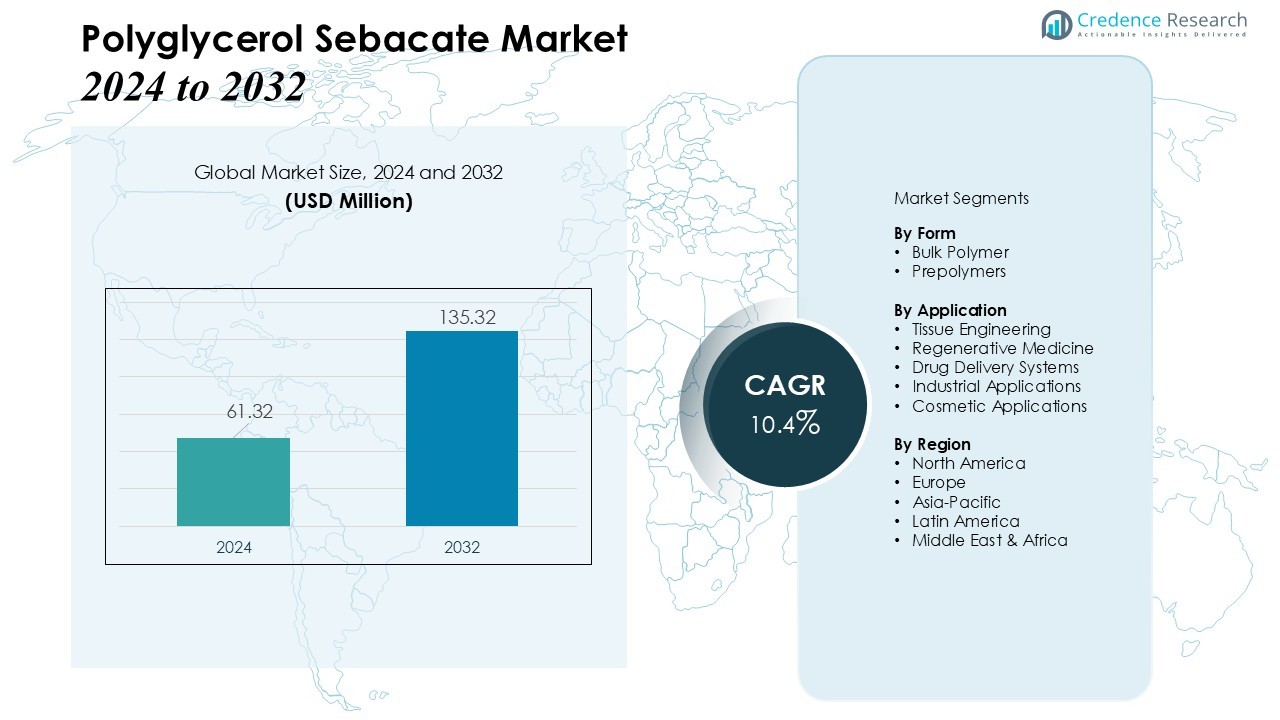
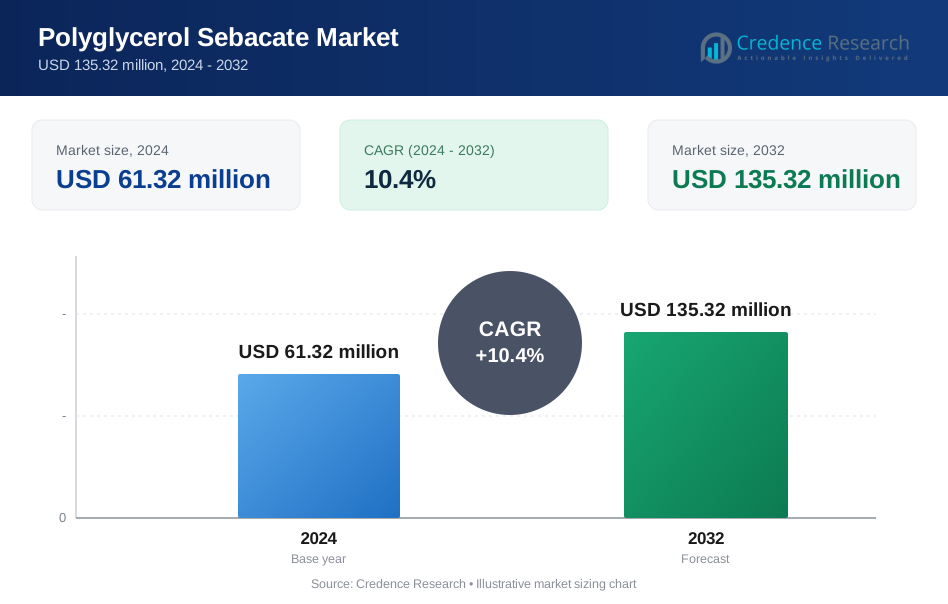
The Polyglycerol Sebacate Market size was valued at USD 61.32 million in 2024 and is anticipated to reach USD 135.32 million by 2032, at a CAGR of 10.4% during the forecast period (2024-2032).
| REPORT ATTRIBUTE | DETAILS |
|---|---|
| Historical Period | 2020-2023 |
| Base Year | 2024 |
| Forecast Period | 2025-2032 |
| Polyglycerol Sebacate Market Size 2024 | USD 61.32 Million |
| Polyglycerol Sebacate Market, CAGR | 10.4% |
| Polyglycerol Sebacate Market Size 2032 | USD 135.32 Million |
Several key drivers underpin this rapid expansion. PGS’s intrinsic properties — biodegradability, biocompatibility, tunable elasticity, and controlled degradation — make it highly attractive for biomedical uses such as tissue engineering, regenerative medicine, drug delivery systems, and medical implants. Moreover, growing regulatory and industry emphasis on sustainable, bio‑based materials encourages replacement of conventional polymers with PGS, especially in medical devices, coatings, and clean‑label cosmetic applications. Continued R&D efforts into novel formulations and manufacturing processes further strengthen the market’s growth trajectory.
Regionally, growth shows notable geographic variation. The Asia‑Pacific region — particularly countries such as China and India — demonstrates the fastest demand surge, underpinned by expanding biomedical research infrastructure, rising investments in biodegradable polymers, and increasing manufacturing capacities. Meanwhile, North America and Europe continue to lead in absolute value, driven by advanced regulatory environments, well‑established medical device industries, and high adoption rates of PGS for tissue regeneration, nerve and cardiovascular applications, and controlled drug delivery.
Market Insights:
- The Polyglycerol Sebacate Market was valued at USD 61.32 million in 2024 and is projected to reach USD 135.32 million by 2032, reflecting a CAGR of 10.4% during the forecast period, driven by strong demand in biomedical and sustainable applications.
- It benefits from intrinsic properties such as biodegradability, biocompatibility, tunable elasticity, and controlled degradation, making it ideal for tissue engineering, regenerative medicine, drug delivery, and medical implants.
- Demand grows due to increasing regulatory and industry emphasis on sustainable, bio-based materials, encouraging replacement of conventional polymers with PGS in medical devices, coatings, and clean-label cosmetic products.
- Technical versatility allows PGS to combine with natural and synthetic polymers, including collagen, gelatin, PLA, or PEG, enabling hybrid materials for diverse applications from soft tissue repair to bone grafts.
- Regionally, North America holds 38% of the market with strong biomedical research and medical device infrastructure, Europe captures 29% driven by regulatory support and sustainability initiatives, and Asia-Pacific represents 24% due to healthcare investments, rising awareness, and emerging industrial capabilities.
 Market Drivers:
Driving Biocompatibility and Biodegradability Trends
The Polyglycerol Sebacate (PGS) market benefits significantly from growing demand for materials that combine biocompatibility with biodegradability. Manufacturers and researchers value PGS for its ability to degrade harmlessly in biological environments while supporting tissue growth. Its compatibility with soft tissues and low inflammatory response make it a preferred choice for scaffolds, implants, and other biomedical uses. These intrinsic material qualities continue to attract attention in regenerative medicine, pushing demand upward.
- For instance, PGS developed in the lab of Professor Robert Langer exhibits exceptional biocompatibility with minimal acute and chronic inflammatory responses in vivo, making it highly suitable for biomedical applications such as scaffolds and implants, with studies showing complete degradation in biological environments within approximately 60 days after subcutaneous implantation in rats.
Expansion of Medical and Regenerative Medicine Applications
PGS finds rising adoption across tissue engineering, drug delivery systems, wound healing, nerve and vascular repair, and other regenerative‑medicine fields. It supports creation of scaffolds that mimic natural tissue elasticity and structure, enabling cell growth and integration in healing or implant contexts. Its tunable degradation kinetics also enable controlled drug release and bioresorbable implants. The acceleration of research and clinical‑translation efforts fuels the PGS market’s growth in the medical sector.
- For instance, a study developed elastomeric PGS:gelatin nanofibrous scaffolds mimicking myocardium tissue architecture, demonstrating tunable chemical composition and stiffness suitable for heart tissue engineering.
Growing Emphasis on Sustainable and Eco-Friendly Materials
Industrial and regulatory shifts toward sustainability elevate interest in PGS as a green polymer alternative to traditional plastics. Producers and end‑users increasingly select biodegradable elastomers to reduce environmental footprint and comply with stricter waste‑management norms. This broader sustainability push extends beyond biomedicine into coatings, bio‑textiles, and other sectors exploring eco‑friendly materials. Demand for sustainable solutions continues to expand, attracting wider cross‑sector consideration.
Technical Versatility and Innovation in Polymer Blends
Researchers and manufacturers exploit PGS’s compatibility with both natural and synthetic polymers — such as collagen, gelatin, PLA, or PEG — to tailor mechanical strength, elasticity, and degradation rates. This flexibility enables creation of hybrid biomaterials suited for diverse applications from soft tissue repair to bone grafts. Ongoing R&D continues to refine formulations and broaden PGS’s utility, enhancing its attractiveness to device makers, pharmaceutical developers, and cosmetic formulators alike.
Market Trends:
Rising Adoption of Polyglycerol Sebacate in Advanced Biomedical Applications
The Polyglycerol Sebacate Market demonstrates a significant shift toward advanced biomedical applications, driven by its unique combination of elasticity, biocompatibility, and controlled biodegradability. It finds increasing use in tissue engineering, regenerative medicine, and controlled drug delivery systems, where traditional polymers fail to meet performance standards. Researchers and manufacturers leverage its mechanical properties to create scaffolds and implants that closely mimic human tissue behavior. Demand growth also stems from rising investments in R&D to develop next-generation biomaterials. Healthcare providers and medical device companies integrate PGS to enhance treatment outcomes and patient safety. This trend supports broader acceptance of bioresorbable and environmentally friendly materials in critical medical applications.
- For instance, in a Frontiers in Chemistry study, PGS-based multiporous matrices with RGD and VEGF mimetic peptides supported greater rBMSC adhesion, signaling, and proliferation, achieving 34 citations for tissue engineering validation.
Expansion into Sustainable Industrial and Cosmetic Applications
PGS’s versatility extends beyond the medical sector into sustainable industrial and cosmetic applications. It supports the production of eco-friendly coatings, adhesives, and biodegradable elastomers, which meet stricter environmental regulations and consumer expectations. Manufacturers exploit its compatibility with other polymers to create hybrid materials with tailored mechanical and chemical properties. Growing interest in green chemistry encourages adoption in personal care formulations, particularly in clean-label and biodegradable cosmetic products. Regulatory frameworks that prioritize sustainability amplify market momentum. Companies increasingly invest in scaling production and developing cost-effective processes to meet rising demand across diverse industries. This trend reinforces PGS’s position as a high-performance, environmentally responsible polymer solution.
- For instance, the incorporation of BC increased tensile strength and Young's modulus, with PEGIS/BC10 offering optimized mechanical performance, demonstrating the potential for eco-friendly coatings and adhesives with enhanced durability.
Market Challenges Analysis:
High Production Costs and Complex Manufacturing Processes
The Polyglycerol Sebacate Market faces challenges due to high production costs and complex synthesis methods. It requires precise control over reaction conditions and purification processes to achieve consistent quality, which increases manufacturing expenses. Limited availability of high-purity raw materials further constrains large-scale production. These factors restrict adoption among cost-sensitive manufacturers and smaller biomedical companies. Companies must invest in specialized equipment and skilled personnel to maintain product reliability. Cost pressures may slow market expansion despite strong demand in medical and industrial applications. Efficient process optimization and scale-up strategies remain critical to overcoming these barriers.
Regulatory and Technical Standardization Barriers Across Regions
Regulatory hurdles and lack of standardized technical guidelines pose additional challenges for the Polyglycerol Sebacate Market. It must meet stringent safety and efficacy requirements for medical and cosmetic applications, which vary across regions. Divergent testing protocols and approval timelines delay product commercialization. Technical standardization for material properties, performance metrics, and quality benchmarks remains limited. These obstacles hinder global market penetration and complicate cross-border collaborations. Companies must navigate complex regulatory landscapes while ensuring compliance and maintaining high product standards. Overcoming these barriers is essential to achieve consistent growth and broader adoption of PGS-based solutions.
Market Opportunities:
Expansion of Biomedical and Regenerative Medicine Applications
The Polyglycerol Sebacate Market presents significant opportunities in biomedical and regenerative medicine sectors. It supports development of bioresorbable implants, tissue scaffolds, and controlled drug delivery systems, where conventional polymers offer limited performance. Researchers continue to explore its tunable mechanical and degradation properties to create customized solutions for cardiovascular, neural, and orthopedic applications. Growing investments in healthcare infrastructure and medical research accelerate adoption of advanced biomaterials. Increasing collaboration between academic institutions, startups, and established medical device companies further expands its application potential. Rising demand for patient-specific treatments enhances market opportunities for PGS-based products.
Diversification into Sustainable Industrial and Cosmetic Sectors
PGS offers opportunities beyond healthcare, particularly in sustainable industrial and cosmetic applications. It enables production of biodegradable coatings, adhesives, and eco-friendly personal care formulations. Its compatibility with other polymers allows creation of hybrid materials tailored for specific mechanical and chemical requirements. Growing environmental regulations and consumer preference for green products drive interest across these sectors. Companies investing in scalable production methods and innovative formulations can capture new market segments. Expanding cross-industry adoption reinforces the market potential of Polyglycerol Sebacate as a versatile and sustainable polymer solution.
Market Segmentation Analysis:
By Form
The Polyglycerol Sebacate Market is segmented by form into bulk polymer and prepolymers. Bulk polymer dominates due to its wide adoption in tissue engineering, drug delivery systems, and bioresorbable implants. It offers high mechanical strength, tunable elasticity, and controlled degradation, which makes it ideal for scaffolds and medical devices. Prepolymers attract demand in research and development settings, where they allow precise formulation of customized biomaterials. Both forms benefit from ongoing innovation in polymer chemistry, enabling tailored properties for diverse biomedical and industrial applications.
- For instance, crosslinked PGS elastomers achieved a Young modulus of 1.57 MPa, ultimate tensile strength of 1.83 MPa, and elongation at break of 409%.
By Application
Application segments include tissue engineering, regenerative medicine, drug delivery systems, and industrial and cosmetic uses. Tissue engineering holds the largest share, driven by the need for biocompatible and biodegradable scaffolds that support cell growth and integration. Regenerative medicine and drug delivery segments expand rapidly due to rising investments in bioresorbable implants and controlled-release systems. Industrial and cosmetic applications gain traction with the adoption of eco-friendly coatings, adhesives, and biodegradable formulations. It supports cross-sector demand growth through its versatility and compatibility with other polymers, enhancing performance in both medical and non-medical fields.
- For instance, Polyglycolic acid (PGA) scaffolds from textile processing achieved 97% porosity and maintained structural integrity for 8 weeks in chondrocyte culture, regenerating 1 cm diameter x 0.35 cm thick cartilaginous tissue
Segmentations:
By Form
- Bulk Polymer
- Prepolymers
By Application
- Tissue Engineering
- Regenerative Medicine
- Drug Delivery Systems
- Industrial Applications
- Cosmetic Applications
By Region
- North America
- U.S.
- Canada
- Mexico
- Europe
- Germany
- France
- U.K.
- Italy
- Spain
- Rest of Europe
- Asia Pacific
- China
- Japan
- India
- South Korea
- South-east Asia
- Rest of Asia Pacific
- Latin America
- Brazil
- Argentina
- Rest of Latin America
- Middle East & Africa
- GCC Countries
- South Africa
- Rest of the Middle East and Africa
Regional Analysis:
North America Leads with Advanced Biomedical Research and Adoption
North America accounts for 38% of the global Polyglycerol Sebacate Market, reflecting its dominance in biomedical innovation. The region benefits from a well-established medical device industry and strong research infrastructure. It attracts significant investments in regenerative medicine, tissue engineering, and bioresorbable implant development. High awareness of innovative biomaterials among healthcare providers accelerates adoption in clinical applications. Regulatory frameworks in the region support safe implementation of novel polymers, ensuring compliance and reliability. Continuous collaboration between universities, startups, and medical device manufacturers drives new product development.
Europe Expands through Stringent Regulatory Support and Sustainability Initiatives
Europe holds 29% of the global Polyglycerol Sebacate Market, driven by strong regulatory frameworks and sustainability initiatives. The region applies PGS in regenerative medicine, drug delivery, and eco-friendly industrial products. It emphasizes biodegradable and environmentally responsible polymers, stimulating adoption across healthcare and cosmetic industries. Research institutions and medical companies engage in collaborative projects to refine PGS formulations. Rising consumer preference for green products further strengthens demand. Regulatory oversight combined with sustainability initiatives enhances the long-term potential for PGS adoption.
Asia-Pacific Emerges as a High-Growth Market Driven by Infrastructure and Investments
Asia-Pacific represents 24% of the global Polyglycerol Sebacate Market, reflecting rapid expansion fueled by emerging economies. It benefits from increasing investments in healthcare infrastructure, medical research, and advanced manufacturing capabilities. Growing awareness of bioresorbable polymers in medical and cosmetic sectors accelerates regional demand. Government support for innovation and environmentally friendly materials encourages adoption across multiple industries. The region’s large population and rising healthcare expenditure create substantial opportunities for growth. Strategic partnerships and technology transfer initiatives further strengthen Asia-Pacific’s position in the PGS landscape.
Key Player Analysis:
- BASF SE
- Cambridge Polymers Group
- Evonik Industries AG
- Fuso Chemical Co., Ltd.
- Orthofix International NV
- Polymers LLC
- PolySciTech (Akina, Inc.)
- Resinex
- Secant LLC
- Sigma‑Aldrich (Merck Group)
- Synthecon Inc.
Competitive Analysis:
The Polyglycerol Sebacate Market is characterized by the presence of established chemical and polymer companies, along with specialized biotechnology firms. Key players focus on product innovation, high-quality manufacturing, and strategic partnerships to strengthen market position. It experiences intense competition in research and development, with companies striving to enhance polymer properties for biomedical, industrial, and cosmetic applications. Strategic initiatives include collaborations with research institutions, expansion of production capacities, and introduction of tailored PGS formulations to meet specific end-use requirements. Market leaders leverage technical expertise and robust distribution networks to maintain a competitive edge. Small and medium enterprises compete by offering niche, customizable solutions, targeting specialized biomedical and sustainable material applications. Continuous innovation, intellectual property development, and regional expansion remain central to sustaining market share and fostering long-term growth in the global PGS landscape.
Recent Developments:
- In October 2025, BASF SE announced the start of a €1.5 billion share buyback program beginning in November 2025 through June 2026, advancing from prior plans to return capital to shareholders.
- In October 2025, Evonik Industries AG received a CPHI Pharma Award for EUDRACAP® colon functional capsules, targeting ileo-colonic drug delivery.
Report Coverage:
The research report offers an in-depth analysis based on Form, Application and Region. It details leading market players, providing an overview of their business, product offerings, investments, revenue streams, and key applications. Additionally, the report includes insights into the competitive environment, SWOT analysis, current market trends, as well as the primary drivers and constraints. Furthermore, it discusses various factors that have driven market expansion in recent years. The report also explores market dynamics, regulatory scenarios, and technological advancements that are shaping the industry. It assesses the impact of external factors and ITALY economic changes on market growth. Lastly, it provides strategic recommendations for new entrants and established companies to navigate the complexities of the market.
Future Outlook:
- Polyglycerol Sebacate will continue to gain traction in tissue engineering and regenerative medicine due to its biocompatibility and controlled biodegradability.
- It will see increasing adoption in bioresorbable implants and scaffolds for cardiovascular, neural, and orthopedic applications.
- The demand for advanced drug delivery systems will drive innovation in tunable PGS formulations for controlled release applications.
- Expansion into industrial applications such as eco-friendly coatings, adhesives, and biodegradable elastomers will broaden market opportunities.
- Cosmetic and personal care industries will increasingly utilize PGS in clean-label and sustainable product formulations.
- Ongoing research and development will enhance PGS’s mechanical strength, elasticity, and compatibility with other polymers.
- Collaborative efforts between academic institutions, medical device companies, and polymer manufacturers will accelerate commercialization of novel PGS-based products.
- Emerging economies in Asia-Pacific will witness significant growth due to rising healthcare investments and expanding research infrastructure.
- Regulatory support and sustainability initiatives in Europe and North America will continue to encourage adoption in medical and industrial sectors.
- Technological advancements in large-scale production and cost optimization will improve accessibility and encourage wider market penetration.
Request a Free Sample
Fill in your details and we'll send you a free sample report.
- Sample data tables & charts
- Research methodology
Need a Custom Version of This Report?
Tailor the scope, geography, or segments to your exact requirements.
- Custom geography or segment scope
- Direct access to our analyst team
Frequently Asked Questions
What is the current market size for Polyglycerol Sebacate Market, and what is its projected size in 2032?
At what Compound Annual Growth Rate is the Polyglycerol Sebacate Market projected to grow between 2024 and 2032?
Which Polyglycerol Sebacate Market segment held the largest share in 2024?
What are the primary factors fueling the growth of the Polyglycerol Sebacate Market?
Who are the leading companies in the Polyglycerol Sebacate Market?
Table of Content
Chapter 1. Report Introduction
- 1.1 Report Description & Purpose
- 1.1.1 Report Title & Market Definition
- 1.1.2 Unique Selling Propositions (USP) & Key Differentiators
- 1.1.3 Value Proposition for Stakeholders
- 1.2 Research Objectives
- 1.2.1 Market Sizing Objectives (Volume & Revenue)
- 1.2.2 Segmentation Objectives
- 1.2.3 Competitive Intelligence Objectives
- 1.2.4 Forecast & Scenario Objectives
- 1.3 Report Scope
- 1.3.1 Polyglycerol Sebacate Scope – Types & Subtypes Covered
- 1.3.2 Geographic Scope – Regions & Countries Covered
- 1.3.3 Historical Period, Base Year & Forecast Period (2024; forecast to 2032)
- 1.3.4 Inclusions & Exclusions
- 1.4 HS Code & Classification Framework
- 1.5 Currency, Units & Pricing Basis
- 1.6 Target Stakeholders
- 1.7 Limitations & Assumptions
Chapter 2. Executive Summary
- 2.1 Global Polyglycerol Sebacate Market Snapshot
- 2.1.1 Market Size – Historical (2024) & Forecast (2024-2032) (2024: USD 61.32 million → 2032: USD 135.32 million)
- 2.1.2 Volume & Revenue – Global Totals
- 2.1.3 Key Market Highlights – Top Five Facts
- 2.2 Polyglycerol Sebacate Market Segmentation Snapshot
- 2.2.1 Market Split by Region – 2024 vs. 2032
- 2.3 Competitive Snapshot
- 2.3.1 Top 10 Players by Revenue Share – 2024
- 2.3.2 Top 10 Players by Volume Share – 2024
- 2.3.3 Recent Strategic Developments (18-Month Summary)
- 2.4 Key Investment Highlights & Strategic Conclusions
Chapter 3. Polyglycerol Sebacate Market Dynamics & Industry Analysis
- 3.1 Market Overview & Context
- 3.1.1 Polyglycerol Sebacate Market Position in the Broader Automotive Value Chain
- 3.1.2 OEM vs. Replacement Market Dynamics
- 3.1.3 Market Maturity & Development Stage by Region
- 3.2 Polyglycerol Sebacate Market Drivers
- 3.3 Polyglycerol Sebacate Market Restraints & Challenges
- 3.4 Polyglycerol Sebacate Market Opportunities
- 3.5 Porter's Five Forces Analysis
- 3.5.1 Threat of New Entrants
- 3.5.2 Bargaining Power of Suppliers
- 3.5.3 Bargaining Power of Buyers
- 3.5.4 Threat of Substitutes
- 3.5.5 Competitive Rivalry – Intensity Assessment
- 3.6 Polyglycerol Sebacate Value Chain Analysis
- 3.6.1 Upstream – Raw Material/Input Suppliers
- 3.6.1.1 Raw Material/Input 1
- 3.6.1.2 Raw Material/Input 2
- 3.6.1.3 Raw Material/Input 3
- 3.6.2 Midstream – Production/Manufacturing/Service Delivery
- 3.6.2.1 Production/Process Overview
- 3.6.2.2 Key Facility Locations & Capacity by Manufacturer
- 3.6.3 Downstream – Distribution & End Consumer
- 3.6.3.1 Primary Channel – B2B/OEM
- 3.6.3.2 Secondary Channels – Dealer, Retail, Online, Direct
- 3.6.4 Value Chain Profitability Analysis
- 3.6.1 Upstream – Raw Material/Input Suppliers
- 3.7 PESTEL Analysis
- 3.7.1 Political Factors
- 3.7.2 Economic Factors
- 3.7.3 Social Factors
- 3.7.4 Technological Factors
- 3.7.5 Environmental Factors
- 3.7.6 Legal Factors
- 3.8 Polyglycerol Sebacate Supply Chain Analysis
- 3.8.1 Raw Material/Input Supply Risk Assessment
- 3.8.2 Manufacturing Concentration Risk (Geographic Exposure)
- 3.8.3 Trade Disruption Impact Analysis
- 3.9 Regulatory & Policy Landscape
Note: The regulatory and policy landscape section covers regulations based on their applicability to the market, Polyglycerol Sebacate category, geography, and scope of the study. Only regulatory frameworks with a material impact on operations, compliance, trade, sustainability, or market access are analyzed in detail.
Chapter 4. Key Investment Pockets & Opportunity Analysis
- 4.1 Polyglycerol Sebacate Market Attractiveness Analysis
- 4.1.1 By Region – Investment Attractiveness Matrix (Volume × CAGR)
- 4.2 Absolute Revenue Growth Opportunity
- 4.2.1 By Region – Absolute USD Growth Through 2032
- 4.3 Incremental Volume Opportunity
- 4.3.1 By Region – Incremental Volume Through 2032
- 4.3.2 Segment – Incremental Volume
- 4.4 Emerging Submarket Opportunity Deep Dive (Subject to Applicability)
- 4.5 Emerging Market Opportunity Scorecards
- 4.5.1 United States
- 4.5.2 Europe
- 4.5.3 Asia
- 4.5.4 Middle East & Africa
Note: Emerging Market Opportunity Scorecards will be included based on relevance and strategic importance. Regions listed are indicative and may vary depending on data availability and market dynamics.
Chapter 5. Polyglycerol Sebacate Import-Export Analysis & Trade Flows
- 5.1 Global Trade Overview
- 5.1.1 Global Export Value by Country (2024)
- 5.1.2 Global Export Volume by Country (2024)
- 5.1.3 Global Import Value by Country (2024)
- 5.1.4 Global Import Volume by Country (2024)
- 5.1.5 Net Trade Balance by Country (2024)
- 5.2 Export Analysis – Segment
- 5.2.1 Type 1 (HS Code)
- 5.2.2 Type 2 (HS Code)
- 5.2.3 Type 3 (HS Code)
- 5.2.4 Type 4 (HS Code)
- 5.2.5 Type 5 (HS Code)
- 5.3 Import Analysis – Segment
- 5.3.1 Type 1 (HS Code)
- 5.3.2 Type 2 (HS Code)
- 5.3.3 Type 3 (HS Code)
- 5.3.4 Type 4 (HS Code)
- 5.3.5 Type 5 (HS Code)
- 5.4 Average Unit Trade Prices
- 5.4.1 Average Export Price – Segment & Country
- 5.4.2 Average Import Price – Segment & Source Country
- 5.4.3 Price Trends (2024)
- 5.5 Key Trade Route Analysis
- 5.5.1 Trade Route 1
- 5.5.2 Trade Route 2
- 5.5.3 Trade Route 3
- 5.5.4 Trade Route 4
- 5.5.5 Trade Route 5
- 5.6 Trade Policy Impact Assessment
- 5.6.1 US Anti-Dumping & Section 301 Tariffs
- 5.6.2 EU Customs Union Impact
- 5.6.3 Major Free Trade Agreements
- 5.6.4 USMCA Rules of Origin
Note: Trade policy analysis will be included only where relevant to the Polyglycerol Sebacate market.
Chapter 6. Competitive Landscape & Company Benchmarking
- 6.1 Polyglycerol Sebacate Market Concentration & Structure
- 6.1.1 Herfindahl-Hirschman Index (HHI) – vs. 2024
- 6.1.2 Tier 1, Tier 2 & Tier 3 Market Structure
- 6.1.3 Global, Regional & Local Player Dynamics
- 6.2 Polyglycerol Sebacate Market Share Analysis – 2024
- 6.2.1 Global Revenue Share by Company
- 6.2.2 Global Volume Share by Company
- 6.2.3 Regional Revenue Share
- 6.2.4 Market Share Evolution ( vs. 2024)
- 6.2.5 OEM Segment Share by Company
- 6.2.6 Replacement Segment Share by Company
- 6.3 Production/Delivery Capacity & Facility Analysis
- 6.3.1 Global Installed Capacity
- 6.3.2 Capacity Utilization Rates
- 6.3.3 Production/Output Volume
- 6.3.4 Facility Locations & Capacity Map
- 6.3.5 Planned Capacity Additions
- 6.4 Polyglycerol Sebacate Competitive Benchmarking Matrix
- 6.4.1 Revenue, Volume, CAGR & Profitability Comparison
- 6.4.2 Channel Revenue Mix
- 6.4.3 Geographic Revenue Exposure
- 6.4.4 R&D Intensity
- 6.4.5 Sustainability Maturity
- 6.5 Strategic Developments in Polyglycerol Sebacate (Last 24 Months)
- 6.5.1 Mergers, Acquisitions & Divestments
- 6.5.2 New Polyglycerol Sebacate Launches
- 6.5.3 Facility Expansions
- 6.5.4 Strategic Alliances, Joint Ventures & Partnerships
- 6.5.5 Distribution Expansion & Market Entry
- 6.5.6 Sustainability & ESG Initiatives
- 6.6 Competitive Strategy Mapping
- 6.6.1 Leader, Challenger, Follower & Niche Classification
- 6.6.2 Pricing Strategy Comparison
- 6.6.3 Channel Strategy Matrix
Note: Strategic developments are included based on their materiality and the availability of reliable information.
Chapter 7. Global Polyglycerol Sebacate Market – By Distribution Channel
- 7.1 Segment Overview
- 7.1.1 Volume & Revenue Split by Channel (2024 & 2032)
- 7.1.2 Channel Mix Evolution (2024-2032)
Chapter 8. Regional Market Analysis – Global Overview
- 8.1 Global Regional Overview
- 8.1.1 Regional Volume Share
- 8.1.2 Regional Revenue Share
- 8.1.3 Regional Volume by Region
- 8.1.4 Regional Revenue by Region
- 8.1.5 Regional Forecast Through 2032
- 8.2 Cross-Regional Segment Analysis
- 8.2.1 By Distribution Channel
- 8.2.2 By Brand/Price Tier
Chapter 9. North America Polyglycerol Sebacate Market
- 9.1 United States
- 9.2 Canada
- 9.3 Mexico
Chapter 10. Europe Polyglycerol Sebacate Market
- 10.1 Germany
- 10.2 France
- 10.3 Italy
- 10.4 United Kingdom
- 10.5 Spain
- 10.6 Poland
- 10.7 Russia
- 10.8 Netherlands
- 10.9 Belgium
- 10.10 Sweden
- 10.11 Denmark
- 10.12 Norway
- 10.13 Rest of Europe
Chapter 11. Asia Pacific Polyglycerol Sebacate Market
- 11.1 China
- 11.2 India
- 11.3 Japan
- 11.4 South Korea
- 11.5 Thailand
- 11.6 Indonesia
- 11.7 Vietnam
- 11.8 Malaysia
- 11.9 Australia
- 11.10 Rest of Asia Pacific
Chapter 12. Latin America Polyglycerol Sebacate Market
- 12.1 Brazil
- 12.2 Argentina
- 12.3 Colombia
- 12.4 Chile
- 12.5 Rest of Latin America
Chapter 13. Middle East Polyglycerol Sebacate Market
- 13.1 Saudi Arabia
- 13.2 United Arab Emirates
- 13.3 Turkey
- 13.4 Israel
- 13.5 Iran
- 13.6 Rest of the Middle East
Chapter 14. Africa Polyglycerol Sebacate Market
- 14.1 South Africa
- 14.2 Egypt
- 14.3 Nigeria
- 14.4 Morocco
- 14.5 Rest of Africa
Chapter 15. Polyglycerol Sebacate Company Profiles
- 15.1 [Company 01]
- 15.1.1 Company Overview
- 15.1.2 Key Management Personnel
- 15.1.3 Products & Services Portfolio
- 15.1.4 Financial Performance
- 15.1.5 Key Market Focus & Geographic Presence
- 15.1.6 Recent Developments & Strategic Initiatives
Note: The company profile list is preliminary and may change based on research findings, market developments, data availability, and client requirements.
Chapter 16. Appendices
- Appendix A – List of Abbreviations & Acronyms
- Appendix B – Industry Classification Code Reference – Full Series
- Appendix C – Production & Capacity Data Tables
- Appendix D – End-Use & Demand Base Tables
- Appendix E – Consumption & Replacement Rate Assumptions
- Appendix F – ASP Reference Tables
- Appendix G – Manufacturing & Facility Database
- Appendix H – Import-Export Data Tables
- Appendix I – Regulatory Summary Tables
- Appendix J – Primary Research Participant List (Anonymized)
- Appendix K – Primary Research Questionnaire Framework
- Appendix L – Data Sources & Bibliography
- Appendix M – Market Size Divergence & Source Comparison
Chapter 17. Research Methodology
- 17.1 Research Framework & Philosophy
- 17.2 Secondary Research – Sources, Hierarchy & Data Extraction
- 17.3 Data Modeling – Bottom-Up & Top-Down Market Sizing
- 17.4 Primary Research – Stakeholder Framework, LOI & Sample Sizes
- 17.5 Forecast Methodology – Regression, Scenario & Sensitivity Analysis
- 17.6 Quality Control – Four-Layer Validation Framework
- 17.7 Limitations & Standard Assumptions
- 17.8 Disclaimer
