
Market Overview:
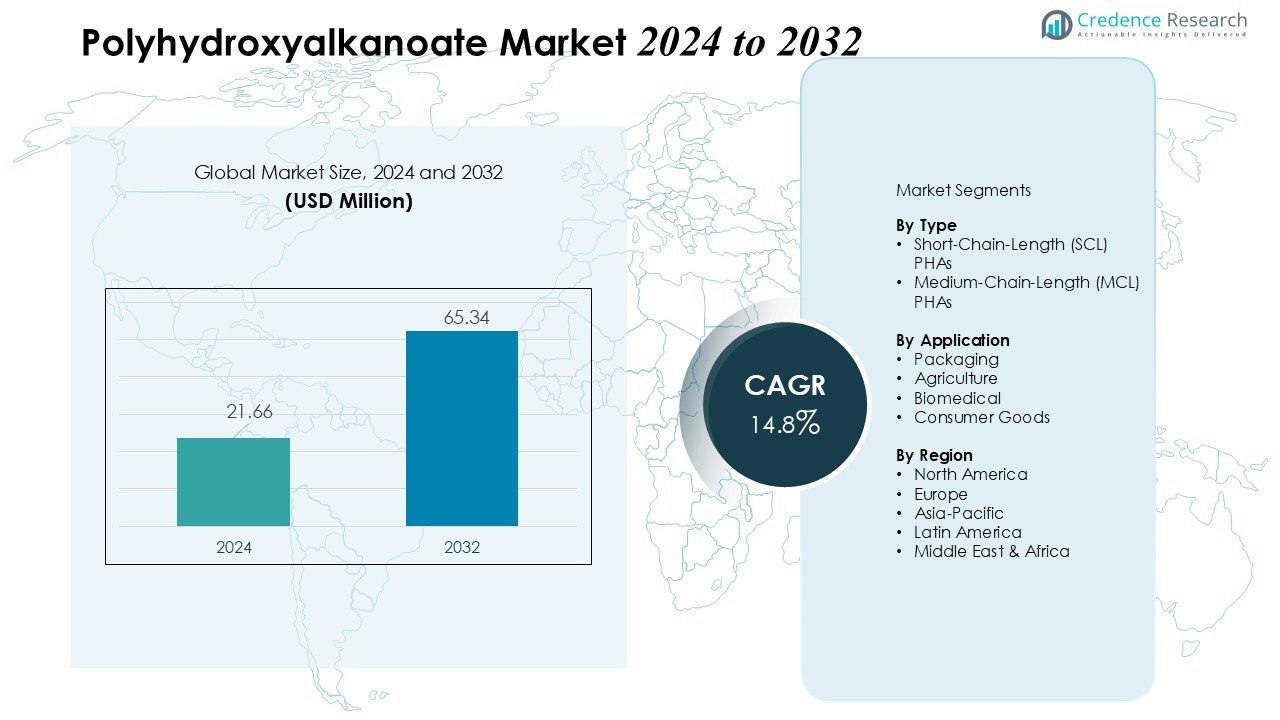
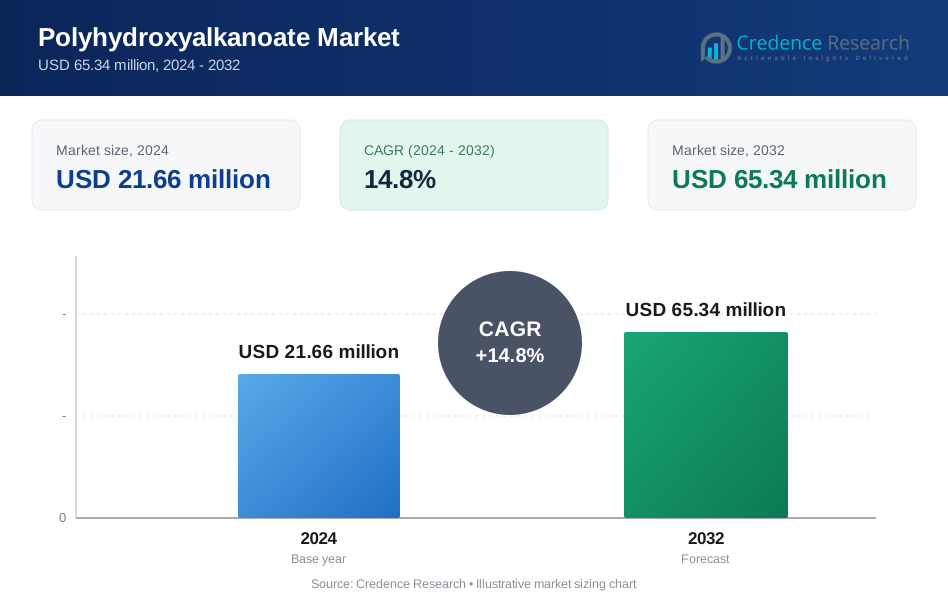
The Polyhydroxyalkanoate Market size was valued at USD 21.66 million in 2024 and is anticipated to reach USD 65.34 million by 2032, at a CAGR of 14.8% during the forecast period (2024-2032).
| REPORT ATTRIBUTE | DETAILS |
|---|---|
| Historical Period | 2020-2023 |
| Base Year | 2024 |
| Forecast Period | 2025-2032 |
| Polyhydroxyalkanoate Market Size 2024 | USD 21.66 Million |
| Polyhydroxyalkanoate Market, CAGR | 14.8% |
| Polyhydroxyalkanoate Market Size 2032 | USD 65.34 Million |
The growth of the PHA market is primarily driven by rising environmental concerns, stringent regulations against single‑use plastics, and increasing demand for sustainable alternatives from key end‑use industries such as packaging, agriculture, and biomedical sectors. Technological advancements—including microbial fermentation improvements and adoption of waste‑based feedstocks—are also reducing production costs and broadening application potential, further fueling market adoption.
Regionally, the market’s expansion is led by the Asia-Pacific region, which benefits from abundant agricultural feedstock, low-cost production capabilities, and growing industrial demand. Europe continues to hold a significant share due to robust regulatory frameworks and strong sustainability mandates, while North America demonstrates consistent growth propelled by regulatory pressure and demand for eco‑friendly materials.
Market Insights:
- The Polyhydroxyalkanoate Market reached USD 21.66 million in 2024 and is projected to grow to USD 65.34 million by 2032, registering a CAGR of 14.8%, driven by increasing environmental regulations and demand for sustainable alternatives.
- Rising government mandates against single-use plastics and stricter environmental policies encourage industries to adopt biodegradable polymers, creating significant growth opportunities for PHA in packaging, consumer goods, and retail sectors.
- Growing consumer awareness about ecological issues and preference for eco-friendly products boosts adoption, positioning PHA as a preferred alternative to conventional plastics across multiple industries.
- PHA demonstrates versatility across sectors including packaging, agriculture, biomedical, and consumer goods due to its biodegradability and renewable feedstock origins, supporting broader market penetration.
- North America holds 35% of the market due to advanced production infrastructure and regulatory support, Europe accounts for 30% backed by sustainability mandates, while Asia-Pacific contributes 25% driven by low-cost production and industrial expansion.
 Market Drivers:
Rising Stringency of Environmental Regulations and Plastic‑Waste Policies
Governments across major economies continue to tighten regulations aimed at reducing plastic pollution and single‑use plastic reliance. Many jurisdictions enforce outright bans or restrictions on disposable plastic items — from grocery bags to cutlery — prompting industries to seek sustainable, biodegradable alternatives. The Polyhydroxyalkanoate Market benefits directly from this regulatory push. It draws increasing interest from packaging, consumer goods, and retail sectors that must comply with evolving environmental mandates.
- For Instance, Tetra Pak has increased the use of sugarcane-derived bioplastics in its carton packaging solutions, and the containers are designed to be 100% recyclable where adequate infrastructure and specialized facilities are in place.
Shifting Consumer Preference toward Sustainable Materials
Consumers worldwide grow more aware of ecological issues tied to plastic waste and are increasingly demanding environmentally responsible products. This demand drives companies to adopt biodegradable polymers, creating a strong pull for PHA-based solutions. The appeal of PHA’s renewable‑resource origins and compostability aligns with broader consumer values around sustainability and corporate social responsibility. Growing eco-consciousness among end users places it as a preferred alternative to conventional plastics.
- For instance, Danimer Scientific was an early producer of biodegradable PHA resins, and while it initially had a manufacturing capacity of approximately 9,000 metric tons (around 10,000 U.S. tons) annually at its Winchester, Kentucky, plant in March 2020, its production capacity varied significantly in the following years due to expansions, operational challenges, and financial difficulties.
Versatility Across Multiple End‑Use Industries
PHA demonstrates suitability for a diverse range of applications — from packaging and agriculture to biomedical and consumer goods. Its biodegradability and renewable feedstock origins make it attractive across food packaging, disposable items, mulch films, and medical disposables. This cross‑sector flexibility expands the market potential and supports broader adoption. Manufacturers value PHA because it allows substitution of traditional plastics without compromising biodegradability or regulatory compliance.
Economic Drivers from Raw‑Material Price Fluctuations and Circular‑Economy Trends
Volatile fossil‑fuel and crude‑oil prices increase the cost of conventional plastics, making bio‑based alternatives like PHA more economically attractive. In parallel, global momentum toward circular‑economy models — emphasizing renewable inputs, waste reduction, and resource reuse — creates favorable conditions for sustainable polymers. Industries seeking to reduce carbon footprint and dependency on petrochemicals find that it delivers a strategic advantage. This shift encourages long‑term investment in PHA production capacity and application development.
Market Trends:
Rising Demand for Sustainable and Biodegradable Materials Driving Market Expansion
The Polyhydroxyalkanoate Market experiences robust growth due to increasing global emphasis on sustainability and environmental preservation. Manufacturers and end-users are shifting toward biodegradable alternatives to conventional plastics, fueling demand for PHAs across packaging, agriculture, and biomedical sectors. It offers excellent biodegradability and biocompatibility, making it a preferred choice in medical applications, including drug delivery systems and tissue engineering. Regulatory frameworks and government initiatives promoting eco-friendly materials further support market adoption. Industrial players invest in cost-effective production technologies, improving yield and reducing reliance on petroleum-based feedstocks. Strong consumer awareness regarding plastic pollution strengthens the market’s long-term growth potential.
- For Instance, RWDC Industries produces a PHA material (branded as Solon®) that is certified by TÜV Austria as entirely biodegradable in natural environments, including soil, freshwater, and marine conditions.
Technological Advancements and Strategic Collaborations Enhancing Market Competitiveness
Technological innovation drives the Polyhydroxyalkanoate Market, focusing on enhanced production efficiency and diverse polymer properties. It benefits from advanced microbial fermentation techniques and metabolic engineering, which reduce production costs and improve material performance. Companies pursue strategic partnerships, joint ventures, and acquisitions to expand product portfolios and strengthen regional presence. Rising application in packaging, automotive, and medical sectors creates opportunities for customized solutions and high-value products. Investment in research and development enables scalable production and addresses limitations such as brittleness and high production cost. The market shows increasing competition among leading players, motivating continuous innovation and process optimization.
- For Instance, Danimer Scientific and PepsiCo partnered starting in 2017 to develop PHA-based flexible films. By 2021, Danimer had completed an expansion to bring its production capacity to 20 million pounds annually at its Kentucky facility.
Market Challenges Analysis:
High Production Costs and Technical Limitations Constrain Market Growth
The Polyhydroxyalkanoate Market faces challenges from high production costs compared to conventional plastics, limiting widespread adoption. It relies on complex microbial fermentation and feedstock availability, which affect overall scalability and profitability. Technical limitations, including brittleness and lower thermal stability, restrict application in certain industrial sectors. Manufacturers invest heavily in research and process optimization to overcome these barriers. Fluctuations in raw material prices and supply chain constraints further impact production efficiency. Limited awareness among small and medium enterprises slows market penetration. Competitive pressure from cheaper biodegradable alternatives also influences pricing strategies.
Regulatory Compliance and Market Entry Barriers Pose Additional Challenges
Stringent regulatory requirements for biopolymers and environmental certifications pose obstacles for new entrants in the Polyhydroxyalkanoate Market. It requires adherence to safety, quality, and environmental standards, increasing time and cost for commercialization. Limited infrastructure for large-scale production in emerging regions hinders rapid market expansion. Market players face challenges in educating end-users about product benefits and handling practices. High initial capital investment and risk associated with innovative technologies affect smaller manufacturers. Industry consolidation and dominance of established players create competitive barriers. Continuous innovation remains critical to overcome these operational and regulatory challenges.
Market Opportunities:
Expansion Potential in Biodegradable Packaging and Consumer Goods
The Polyhydroxyalkanoate Market presents significant opportunities in the packaging and consumer goods sectors due to increasing demand for eco-friendly alternatives to conventional plastics. It offers complete biodegradability and non-toxic properties, making it ideal for food packaging, disposable items, and personal care products. Growing consumer awareness about plastic pollution encourages manufacturers to adopt PHA-based solutions. Rising regulations limiting single-use plastics in Europe, North America, and Asia-Pacific further stimulate market adoption. Companies investing in scalable production techniques can capitalize on cost efficiency and higher profit margins. The expanding retail and e-commerce sectors create additional demand for sustainable packaging solutions.
Opportunities in Medical, Agricultural, and Industrial Applications
Technological advancements and research-driven innovation provide new avenues for the Polyhydroxyalkanoate Market. It demonstrates strong potential in biomedical applications, including drug delivery systems, wound dressings, and tissue engineering due to its biocompatibility. In agriculture, PHA-based films and coatings support sustainable farming practices. Industrial applications, including biodegradable plastics for automotive and electronics sectors, are gaining traction. Collaborations between biotech firms and chemical manufacturers accelerate product development and market penetration. Increasing government incentives for green materials further strengthen growth prospects and attract investment.
Market Segmentation Analysis:
By Type
The Polyhydroxyalkanoate Market is categorized primarily into short-chain-length (SCL) PHAs and medium-chain-length (MCL) PHAs. It shows strong demand for SCL-PHAs due to their superior biodegradability and suitability for packaging, disposable items, and agricultural films. MCL-PHAs gain traction in specialized applications, including medical devices, tissue engineering, and high-performance industrial components, due to their enhanced flexibility and thermal properties. Production strategies vary based on microbial strains and feedstock types, influencing yield, polymer quality, and cost efficiency. Industry players invest in R&D to optimize polymer composition, targeting application-specific performance improvements.
- For instance, pilot-plant data for a large-scale PHA production process have indicated the ability to achieve fermentation titers in the range of 80-100 g/L using optimized microbial strains and integrated production concepts.
By Application
PHA finds widespread use across packaging, agriculture, biomedical, and consumer goods sectors. It demonstrates significant adoption in food packaging and disposable cutlery due to its compostable nature and compliance with environmental regulations. In agriculture, it serves as biodegradable mulch films and coatings that reduce plastic waste and support sustainable farming practices. Biomedical applications, including drug delivery systems, surgical implants, and wound dressings, leverage PHA’s biocompatibility and non-toxic properties. Consumer goods manufacturers increasingly integrate PHA into eco-friendly products to meet rising demand for sustainable alternatives. Growing awareness of environmental sustainability and regulatory support drives adoption across all applications.
Segmentations:
By Type
- Short-Chain-Length (SCL) PHAs
- Medium-Chain-Length (MCL) PHAs
By Application
- Packaging
- Agriculture
- Biomedical
- Consumer Goods
By Region
- North America
- U.S.
- Canada
- Mexico
- Europe
- Germany
- France
- U.K.
- Italy
- Spain
- Rest of Europe
- Asia Pacific
- China
- Japan
- India
- South Korea
- South-east Asia
- Rest of Asia Pacific
- Latin America
- Brazil
- Argentina
- Rest of Latin America
- Middle East & Africa
- GCC Countries
- South Africa
- Rest of the Middle East and Africa
Regional Analysis:
North America Dominates with Strong Biopolymer Production and Regulatory Support
North America holds a significant portion of the Polyhydroxyalkanoate Market, accounting for 35% of global revenue, driven by advanced production infrastructure and robust regulatory backing. It benefits from government initiatives promoting sustainable materials and strict restrictions on single-use plastics. High adoption across packaging, medical, and automotive sectors strengthens regional demand. Research institutions and industry players collaborate to develop cost-efficient production methods and innovative applications. Rising consumer preference for eco-friendly products reinforces market expansion. Investment in large-scale production facilities positions the region as a key contributor to global supply.
Europe Gains Traction through Environmental Regulations and Sustainable Practices
Europe captures 30% of the global Polyhydroxyalkanoate Market, supported by stringent environmental policies and strong sustainability mandates. It sees growing adoption in packaging, agriculture, and healthcare sectors. Manufacturers focus on enhancing product performance and reducing production costs to meet rising market expectations. Strategic partnerships and collaborations between chemical companies and biotech firms accelerate innovation and commercial deployment. The presence of leading PHA producers in Germany, France, and the Netherlands reinforces market stability. Expanding consumer awareness about environmental impact drives wider use of biodegradable alternatives.
Asia-Pacific Experiences Rapid Growth with Expanding Industrial Applications
Asia-Pacific accounts for 25% of the Polyhydroxyalkanoate Market, driven by rising industrial demand and supportive government policies. It experiences increasing adoption in packaging, agriculture, and medical sectors due to population growth and urbanization. Countries like China, Japan, and India invest in R&D and scale-up of biopolymer production technologies. Collaborations between domestic and international firms facilitate technology transfer and market expansion. Strong manufacturing capabilities and growing awareness of sustainable alternatives propel adoption across multiple industries. The region offers lucrative opportunities for both new entrants and established players seeking growth.
Key Player Analysis:
- Bio-on SpA Source (Italy)
- PolyFerm Canada (Canada)
- Tianjin GreenBio Materials Co., Ltd. (China)
- Kaneka Corporation (Japan)
- Danimer Scientific (U.S.)
- Newlight Technologies (U.S.)
- RWDC (U.S.)
- Tianan Enmat (China)
- Paques Biomaterials (The Netherlands)
- CjBio (South Korea)
- Bluepha (China)
- Full Cycle Bioplastics (U.S.)
Competitive Analysis:
The Polyhydroxyalkanoate Market is highly competitive, characterized by the presence of global and regional players focusing on innovation, production efficiency, and strategic partnerships. It is dominated by companies investing in advanced microbial fermentation technologies and cost-effective production methods to improve yield and polymer quality. Leading players pursue mergers, acquisitions, and collaborations to expand geographic reach and product portfolios. Research and development efforts concentrate on enhancing material properties, including flexibility, thermal stability, and biodegradability, to cater to diverse end-use applications. Market entrants face challenges from established companies with strong distribution networks and regulatory compliance expertise. Continuous innovation, strategic investments, and adoption of sustainable feedstocks are critical factors driving competitiveness. The market’s growth trajectory depends on the ability of players to balance production cost, regulatory requirements, and evolving consumer demand for eco-friendly alternatives.
Recent Developments:
- In June 2025, Teknor Apex acquired Danimer Scientific, strengthening its position in the bioplastics market.
- In November 2025, CJ Biomaterials signed a partnership with BIQ Materials to produce artificial turf infill using PHACT™ PHA biopolymer, with the ceremony held in late October 2025.
Report Coverage:
The research report offers an in-depth analysis based on Type, Application and Region. It details leading market players, providing an overview of their business, product offerings, investments, revenue streams, and key applications. Additionally, the report includes insights into the competitive environment, SWOT analysis, current market trends, as well as the primary drivers and constraints. Furthermore, it discusses various factors that have driven market expansion in recent years. The report also explores market dynamics, regulatory scenarios, and technological advancements that are shaping the industry. It assesses the impact of external factors and ITALY economic changes on market growth. Lastly, it provides strategic recommendations for new entrants and established companies to navigate the complexities of the market.
Future Outlook:
- Rising global emphasis on sustainability will continue to drive adoption of PHA across multiple industries.
- Technological advancements in microbial fermentation and waste-based feedstocks will reduce production costs and improve scalability.
- Growing demand for biodegradable packaging and disposable products will expand market penetration in consumer goods and retail sectors.
- Regulatory pressure against single-use plastics will reinforce the shift toward eco-friendly polymer alternatives.
- PHA’s versatility will support increased applications in biomedical, agriculture, and industrial sectors.
- Strategic collaborations and partnerships among manufacturers and research institutions will accelerate innovation and product development.
- Emerging markets in Asia-Pacific and Latin America will offer significant growth opportunities due to low-cost production and expanding industrial demand.
- Investment in R&D will focus on enhancing material properties, including flexibility, thermal stability, and mechanical strength.
- Increasing consumer awareness of environmental impact will strengthen demand for sustainable and renewable polymer solutions.
- Industry players prioritizing large-scale production, cost optimization, and compliance with environmental standards will maintain a competitive edge in the market.
Request a Free Sample
Fill in your details and we'll send you a free sample report.
- Sample data tables & charts
- Research methodology
Need a Custom Version of This Report?
Tailor the scope, geography, or segments to your exact requirements.
- Custom geography or segment scope
- Direct access to our analyst team
Frequently Asked Questions
What is the current market size for the Polyhydroxyalkanoate Market, and what is its projected size in 2032?
At what Compound Annual Growth Rate is the Polyhydroxyalkanoate Market projected to grow between 2024 and 2032?
Which Polyhydroxyalkanoate Market segment held the largest share in 2024?
What are the primary factors fueling the growth of the Polyhydroxyalkanoate Market?
Who are the leading companies in the Polyhydroxyalkanoate Market?
Table of Content
Chapter 1. Report Introduction
- 1.1 Report Description & Purpose
- 1.1.1 Report Title & Market Definition
- 1.1.2 Unique Selling Propositions (USP) & Key Differentiators
- 1.1.3 Value Proposition for Stakeholders
- 1.2 Research Objectives
- 1.2.1 Market Sizing Objectives (Volume & Revenue)
- 1.2.2 Segmentation Objectives
- 1.2.3 Competitive Intelligence Objectives
- 1.2.4 Forecast & Scenario Objectives
- 1.3 Report Scope
- 1.3.1 Polyhydroxyalkanoate Scope – Types & Subtypes Covered
- 1.3.2 Geographic Scope – Regions & Countries Covered
- 1.3.3 Historical Period, Base Year & Forecast Period (2024; forecast to 2032)
- 1.3.4 Inclusions & Exclusions
- 1.4 HS Code & Classification Framework
- 1.5 Currency, Units & Pricing Basis
- 1.6 Target Stakeholders
- 1.7 Limitations & Assumptions
Chapter 2. Executive Summary
- 2.1 Global Polyhydroxyalkanoate Market Snapshot
- 2.1.1 Market Size – Historical (2024) & Forecast (2024-2032) (2024: USD 21.66 million → 2032: USD 65.34 million)
- 2.1.2 Volume & Revenue – Global Totals
- 2.1.3 Key Market Highlights – Top Five Facts
- 2.2 Polyhydroxyalkanoate Market Segmentation Snapshot
- 2.2.1 Market Split by Region – 2024 vs. 2032
- 2.3 Competitive Snapshot
- 2.3.1 Top 10 Players by Revenue Share – 2024
- 2.3.2 Top 10 Players by Volume Share – 2024
- 2.3.3 Recent Strategic Developments (18-Month Summary)
- 2.4 Key Investment Highlights & Strategic Conclusions
Chapter 3. Polyhydroxyalkanoate Market Dynamics & Industry Analysis
- 3.1 Market Overview & Context
- 3.1.1 Polyhydroxyalkanoate Market Position in the Broader Automotive Value Chain
- 3.1.2 OEM vs. Replacement Market Dynamics
- 3.1.3 Market Maturity & Development Stage by Region
- 3.2 Polyhydroxyalkanoate Market Drivers
- 3.3 Polyhydroxyalkanoate Market Restraints & Challenges
- 3.4 Polyhydroxyalkanoate Market Opportunities
- 3.5 Porter's Five Forces Analysis
- 3.5.1 Threat of New Entrants
- 3.5.2 Bargaining Power of Suppliers
- 3.5.3 Bargaining Power of Buyers
- 3.5.4 Threat of Substitutes
- 3.5.5 Competitive Rivalry – Intensity Assessment
- 3.6 Polyhydroxyalkanoate Value Chain Analysis
- 3.6.1 Upstream – Raw Material/Input Suppliers
- 3.6.1.1 Raw Material/Input 1
- 3.6.1.2 Raw Material/Input 2
- 3.6.1.3 Raw Material/Input 3
- 3.6.2 Midstream – Production/Manufacturing/Service Delivery
- 3.6.2.1 Production/Process Overview
- 3.6.2.2 Key Facility Locations & Capacity by Manufacturer
- 3.6.3 Downstream – Distribution & End Consumer
- 3.6.3.1 Primary Channel – B2B/OEM
- 3.6.3.2 Secondary Channels – Dealer, Retail, Online, Direct
- 3.6.4 Value Chain Profitability Analysis
- 3.6.1 Upstream – Raw Material/Input Suppliers
- 3.7 PESTEL Analysis
- 3.7.1 Political Factors
- 3.7.2 Economic Factors
- 3.7.3 Social Factors
- 3.7.4 Technological Factors
- 3.7.5 Environmental Factors
- 3.7.6 Legal Factors
- 3.8 Polyhydroxyalkanoate Supply Chain Analysis
- 3.8.1 Raw Material/Input Supply Risk Assessment
- 3.8.2 Manufacturing Concentration Risk (Geographic Exposure)
- 3.8.3 Trade Disruption Impact Analysis
- 3.9 Regulatory & Policy Landscape
Note: The regulatory and policy landscape section covers regulations based on their applicability to the market, Polyhydroxyalkanoate category, geography, and scope of the study. Only regulatory frameworks with a material impact on operations, compliance, trade, sustainability, or market access are analyzed in detail.
Chapter 4. Key Investment Pockets & Opportunity Analysis
- 4.1 Polyhydroxyalkanoate Market Attractiveness Analysis
- 4.1.1 By Region – Investment Attractiveness Matrix (Volume × CAGR)
- 4.2 Absolute Revenue Growth Opportunity
- 4.2.1 By Region – Absolute USD Growth Through 2032
- 4.3 Incremental Volume Opportunity
- 4.3.1 By Region – Incremental Volume Through 2032
- 4.3.2 Segment – Incremental Volume
- 4.4 Emerging Submarket Opportunity Deep Dive (Subject to Applicability)
- 4.5 Emerging Market Opportunity Scorecards
- 4.5.1 United States
- 4.5.2 Europe
- 4.5.3 Asia
- 4.5.4 Middle East & Africa
Note: Emerging Market Opportunity Scorecards will be included based on relevance and strategic importance. Regions listed are indicative and may vary depending on data availability and market dynamics.
Chapter 5. Polyhydroxyalkanoate Import-Export Analysis & Trade Flows
- 5.1 Global Trade Overview
- 5.1.1 Global Export Value by Country (2024)
- 5.1.2 Global Export Volume by Country (2024)
- 5.1.3 Global Import Value by Country (2024)
- 5.1.4 Global Import Volume by Country (2024)
- 5.1.5 Net Trade Balance by Country (2024)
- 5.2 Export Analysis – Segment
- 5.2.1 Type 1 (HS Code)
- 5.2.2 Type 2 (HS Code)
- 5.2.3 Type 3 (HS Code)
- 5.2.4 Type 4 (HS Code)
- 5.2.5 Type 5 (HS Code)
- 5.3 Import Analysis – Segment
- 5.3.1 Type 1 (HS Code)
- 5.3.2 Type 2 (HS Code)
- 5.3.3 Type 3 (HS Code)
- 5.3.4 Type 4 (HS Code)
- 5.3.5 Type 5 (HS Code)
- 5.4 Average Unit Trade Prices
- 5.4.1 Average Export Price – Segment & Country
- 5.4.2 Average Import Price – Segment & Source Country
- 5.4.3 Price Trends (2024)
- 5.5 Key Trade Route Analysis
- 5.5.1 Trade Route 1
- 5.5.2 Trade Route 2
- 5.5.3 Trade Route 3
- 5.5.4 Trade Route 4
- 5.5.5 Trade Route 5
- 5.6 Trade Policy Impact Assessment
- 5.6.1 US Anti-Dumping & Section 301 Tariffs
- 5.6.2 EU Customs Union Impact
- 5.6.3 Major Free Trade Agreements
- 5.6.4 USMCA Rules of Origin
Note: Trade policy analysis will be included only where relevant to the Polyhydroxyalkanoate market.
Chapter 6. Competitive Landscape & Company Benchmarking
- 6.1 Polyhydroxyalkanoate Market Concentration & Structure
- 6.1.1 Herfindahl-Hirschman Index (HHI) – vs. 2024
- 6.1.2 Tier 1, Tier 2 & Tier 3 Market Structure
- 6.1.3 Global, Regional & Local Player Dynamics
- 6.2 Polyhydroxyalkanoate Market Share Analysis – 2024
- 6.2.1 Global Revenue Share by Company
- 6.2.2 Global Volume Share by Company
- 6.2.3 Regional Revenue Share
- 6.2.4 Market Share Evolution ( vs. 2024)
- 6.2.5 OEM Segment Share by Company
- 6.2.6 Replacement Segment Share by Company
- 6.3 Production/Delivery Capacity & Facility Analysis
- 6.3.1 Global Installed Capacity
- 6.3.2 Capacity Utilization Rates
- 6.3.3 Production/Output Volume
- 6.3.4 Facility Locations & Capacity Map
- 6.3.5 Planned Capacity Additions
- 6.4 Polyhydroxyalkanoate Competitive Benchmarking Matrix
- 6.4.1 Revenue, Volume, CAGR & Profitability Comparison
- 6.4.2 Channel Revenue Mix
- 6.4.3 Geographic Revenue Exposure
- 6.4.4 R&D Intensity
- 6.4.5 Sustainability Maturity
- 6.5 Strategic Developments in Polyhydroxyalkanoate (Last 24 Months)
- 6.5.1 Mergers, Acquisitions & Divestments
- 6.5.2 New Polyhydroxyalkanoate Launches
- 6.5.3 Facility Expansions
- 6.5.4 Strategic Alliances, Joint Ventures & Partnerships
- 6.5.5 Distribution Expansion & Market Entry
- 6.5.6 Sustainability & ESG Initiatives
- 6.6 Competitive Strategy Mapping
- 6.6.1 Leader, Challenger, Follower & Niche Classification
- 6.6.2 Pricing Strategy Comparison
- 6.6.3 Channel Strategy Matrix
Note: Strategic developments are included based on their materiality and the availability of reliable information.
Chapter 7. Global Polyhydroxyalkanoate Market – By Distribution Channel
- 7.1 Segment Overview
- 7.1.1 Volume & Revenue Split by Channel (2024 & 2032)
- 7.1.2 Channel Mix Evolution (2024-2032)
Chapter 8. Regional Market Analysis – Global Overview
- 8.1 Global Regional Overview
- 8.1.1 Regional Volume Share
- 8.1.2 Regional Revenue Share
- 8.1.3 Regional Volume by Region
- 8.1.4 Regional Revenue by Region
- 8.1.5 Regional Forecast Through 2032
- 8.2 Cross-Regional Segment Analysis
- 8.2.1 By Distribution Channel
- 8.2.2 By Brand/Price Tier
Chapter 9. North America Polyhydroxyalkanoate Market
- 9.1 United States
- 9.2 Canada
- 9.3 Mexico
Chapter 10. Europe Polyhydroxyalkanoate Market
- 10.1 Germany
- 10.2 France
- 10.3 Italy
- 10.4 United Kingdom
- 10.5 Spain
- 10.6 Poland
- 10.7 Russia
- 10.8 Netherlands
- 10.9 Belgium
- 10.10 Sweden
- 10.11 Denmark
- 10.12 Norway
- 10.13 Rest of Europe
Chapter 11. Asia Pacific Polyhydroxyalkanoate Market
- 11.1 China
- 11.2 India
- 11.3 Japan
- 11.4 South Korea
- 11.5 Thailand
- 11.6 Indonesia
- 11.7 Vietnam
- 11.8 Malaysia
- 11.9 Australia
- 11.10 Rest of Asia Pacific
Chapter 12. Latin America Polyhydroxyalkanoate Market
- 12.1 Brazil
- 12.2 Argentina
- 12.3 Colombia
- 12.4 Chile
- 12.5 Rest of Latin America
Chapter 13. Middle East Polyhydroxyalkanoate Market
- 13.1 Saudi Arabia
- 13.2 United Arab Emirates
- 13.3 Turkey
- 13.4 Israel
- 13.5 Iran
- 13.6 Rest of the Middle East
Chapter 14. Africa Polyhydroxyalkanoate Market
- 14.1 South Africa
- 14.2 Egypt
- 14.3 Nigeria
- 14.4 Morocco
- 14.5 Rest of Africa
Chapter 15. Polyhydroxyalkanoate Company Profiles
- 15.1 [Company 01]
- 15.1.1 Company Overview
- 15.1.2 Key Management Personnel
- 15.1.3 Products & Services Portfolio
- 15.1.4 Financial Performance
- 15.1.5 Key Market Focus & Geographic Presence
- 15.1.6 Recent Developments & Strategic Initiatives
Note: The company profile list is preliminary and may change based on research findings, market developments, data availability, and client requirements.
Chapter 16. Appendices
- Appendix A – List of Abbreviations & Acronyms
- Appendix B – Industry Classification Code Reference – Full Series
- Appendix C – Production & Capacity Data Tables
- Appendix D – End-Use & Demand Base Tables
- Appendix E – Consumption & Replacement Rate Assumptions
- Appendix F – ASP Reference Tables
- Appendix G – Manufacturing & Facility Database
- Appendix H – Import-Export Data Tables
- Appendix I – Regulatory Summary Tables
- Appendix J – Primary Research Participant List (Anonymized)
- Appendix K – Primary Research Questionnaire Framework
- Appendix L – Data Sources & Bibliography
- Appendix M – Market Size Divergence & Source Comparison
Chapter 17. Research Methodology
- 17.1 Research Framework & Philosophy
- 17.2 Secondary Research – Sources, Hierarchy & Data Extraction
- 17.3 Data Modeling – Bottom-Up & Top-Down Market Sizing
- 17.4 Primary Research – Stakeholder Framework, LOI & Sample Sizes
- 17.5 Forecast Methodology – Regression, Scenario & Sensitivity Analysis
- 17.6 Quality Control – Four-Layer Validation Framework
- 17.7 Limitations & Standard Assumptions
- 17.8 Disclaimer
