
Market Overview:
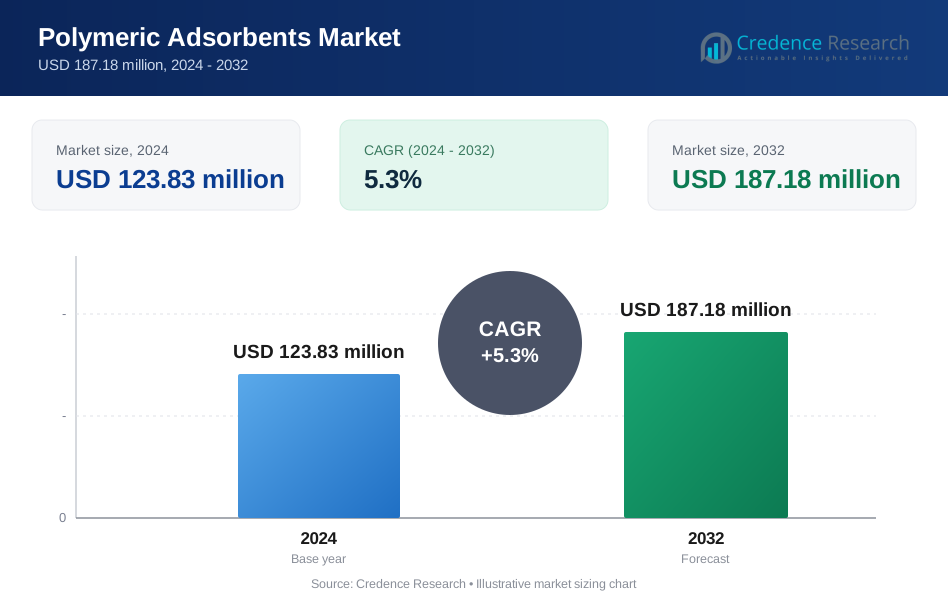
The Polymeric Adsorbents Market size was valued at USD 123.83 million in 2024 and is anticipated to reach USD 187.18 million by 2032, at a CAGR of 5.3 % during the forecast period.
| REPORT ATTRIBUTE | DETAILS |
|---|---|
| Historical Period | 2020-2023 |
| Base Year | 2024 |
| Forecast Period | 2025-2032 |
| Polymeric Adsorbents Market Size 2024 | USD 123.83 Million |
| Polymeric Adsorbents Market, CAGR | 5.3 % |
| Polymeric Adsorbents Market Size 2032 | USD 187.18 Million |
Key growth drivers include increasing regulatory pressure for wastewater treatment, the growing need for selective adsorption in drug manufacturing, and stricter quality requirements in food processing. Adoption rises further with the industry shift toward cost-effective purification media that offer longer service life and greater reusability compared to traditional activated carbon and silica-based adsorbents. Demand for high-purity resins in biotechnology and chromatography also accelerates market penetration, supported by advancements in specialty polymers and controlled pore-size technologies.
Regionally, North America and Europe hold significant market shares due to strong environmental regulations, robust pharmaceutical production, and advanced biotechnology sectors. The Asia-Pacific region is expected to witness the fastest growth, led by expanding chemical industries, rising investments in water treatment infrastructure, and increasing industrialization in China, India, and Southeast Asia. Emerging markets in Latin America and the Middle East gradually adopt polymeric adsorbents to improve industrial compliance and sustainability.
Market Insights:
- The Polymeric Adsorbents Market was valued at USD 123.83 million in 2024 and is projected to reach USD 187.18 million by 2032, growing at a CAGR of 5.3% during the forecast period.
- North America holds the largest market share at 34.6%, driven by stringent industrial discharge regulations, advanced water treatment infrastructure, and high pharmaceutical adoption; Europe follows with 29.1%, supported by rigorous food safety standards and strong biotech presence; Asia-Pacific accounts for 22.4% due to expanding industrial applications and increasing use in food and pharmaceuticals.
- Asia-Pacific is the fastest-growing region with a projected CAGR exceeding 6.5%, fueled by rapid industrialization, increasing investments in water treatment infrastructure, and rising demand from chemical and bioprocessing industries in China and India.
- Among the applications, wastewater treatment dominates with a 41.3% share, supported by growing environmental compliance needs across industries such as textiles, chemicals, and mining.
- Pharmaceutical applications contribute 33.5% of the market share, driven by rising demand for high-purity APIs, chromatography resins, and selective separation processes in biologics manufacturing.
 Market Drivers:
Growing Demand for High-Purity Separation in Pharmaceutical and Bioprocessing Applications
Rising emphasis on high-purity drug manufacturing drives extensive utilization of polymer-based adsorbents in active pharmaceutical ingredient (API) purification, chromatography, and controlled separation. These materials enhance binding selectivity, chemical stability, and cleaning efficiency. The Polymeric Adsorbents Market benefits from stringent quality standards and increasing biologics production. Pharmaceutical and biotech companies prefer synthetic adsorbents due to superior regeneration cycles and reduced contamination risks. This trend encourages continuous product innovation to support advanced drug development.
- For instance, AOPIM-1 microporous polymer membranes from research by Z. Wang achieve >99.9% removal of small organic molecules like Rhodamine B with adsorption capacity of 26.114 g m⁻².
Expansion of Industrial Wastewater Treatment Requirements and Environmental Regulations
Stricter global norms for industrial discharge push manufacturers toward high-performance adsorbent technologies. Polymer-based media offer effective removal of heavy metals, dyes, volatile organic compounds, and complex contaminants. Governments impose tighter standards on effluent disposal in industries such as chemicals, textiles, mining, and petrochemicals. It enables the adoption of synthetic adsorbents due to longer operational life and improved selectivity. Increasing investment in decentralized treatment systems strengthens market growth.
- For Instance, A polyethersulfone (PS) nanocomposite membrane modified by 0.75 wt.% CeF₃ nanoparticles achieved a degradation efficiency of more than 97% for organic contaminants (specifically pharmaceutical compounds) in synthetic pharmaceutical wastewater using photocatalysis under UV irradiation.
Rising Demand for Food Quality Control and Functional Separation Processes
Food and beverage companies use polymeric adsorbents for color removal, flavor purification, enzyme separation, and removal of trace contaminants. These materials help achieve consistent product quality and support compliance with stringent safety regulations. They enhance processing efficiency by reducing energy consumption and minimizing frequent replacement requirements. Global demand for specialized adsorbents increases due to expansion in nutraceuticals and food additives manufacturing. It supports greater deployment in high-volume processing facilities.
Shift Toward Cost-Effective and Customizable Adsorbent Materials Across Industries
Manufacturers prefer polymer-based adsorbents due to customizable pore structures, optimized surface chemistry, and reduced lifecycle cost. These solutions outperform traditional activated carbon or silica in targeted adsorption and regeneration performance. Industry operators gain higher throughput and longer media usability, creating measurable savings in separation processes. Growing investments in specialty polymers and engineered resins strengthen product availability. It boosts adoption across water treatment, petrochemicals, pharmaceuticals, and food processing sectors.
Market Trends:
Development of Advanced Functional Polymers for Selective Adsorption and High-Purity Processing
Innovations in porous polymer chemistry create new materials with tailored pore sizes, enhanced binding affinity, and higher chemical resistance. Manufacturers invest in engineered resins capable of capturing specific molecules, enabling better efficiency in pharmaceutical purification, food decolorization, and wastewater treatment. Customizable surface functionalities support separation of complex organic compounds and trace contaminants. This trend increases the utility of synthetic resins in chromatography and critical bioprocessing workflows. The Polymeric Adsorbents Market benefits from strong interest in high-purity purification technologies that reduce operational cost and maximize regeneration cycles. Smart polymer technologies gain traction due to their capacity to maintain stability under harsh cleaning conditions. It encourages long-term adoption in regulated industries that prioritize precision and safety.
- For instance, a DL-menthol:Lauric acid (DES) based composite membrane achieved a separation factor of 57 for butanol-water mixtures, substantially outperforming pristine PDMS membranes.
Growing Adoption of Sustainable and Reusable Adsorbent Solutions to Support Industrial Compliance
Industries move toward sustainable adsorbent systems that offer longer service life, better recyclability, and reduced waste generation. High-capacity polymeric resins deliver extended usability compared to activated carbon, enabling fewer replacements and lower disposal costs. Manufacturers promote bio-based and eco-friendly polymers to strengthen environmental compliance. Demand rises in water treatment, petrochemicals, pharmaceuticals, and food processing where regulatory pressure encourages greener purification methods. The Polymeric Adsorbents Market benefits from rising interest in low-energy purification techniques that improve cost control and reduce emissions. Regeneration technologies advance to maintain adsorption efficiency without degrading polymer quality. It supports wider industrial integration of synthetic adsorbents aligned with sustainability objectives.
- For instance, Purolite Corporation developed aromatic polymeric adsorbents with a crosslinked polystyrenic matrix, achieving superior adsorption capacity for pharmaceutical purification. Manufacturers promote bio-based and eco-friendly polymers to strengthen environmental compliance.
Market Challenges Analysis:
High Material Costs and Complex Production Technologies Impact Market Penetration
Advanced polymeric adsorbents require sophisticated synthesis methods, controlled pore engineering, and specialized raw materials. These factors increase production cost and limit adoption in low-budget industries. Many manufacturers hesitate to switch from activated carbon or silica due to initial investment barriers. Complex manufacturing processes reduce scalability and delay product standardization. The Polymeric Adsorbents Market experiences slower uptake in cost-sensitive regions where low-priced alternatives dominate. It restricts competitive pricing strategies that could accelerate wider usage.
Performance Limitations in Extreme Operating Conditions and Regulatory Constraints Some polymeric adsorbents show reduced stability under high temperature, strong oxidizing environments, and aggressive pH conditions. These limitations restrict their deployment in heavy-duty industrial applications. Frequent regeneration cycles may decrease adsorption efficiency over time, impacting long-term performance. Regulatory agencies enforce strict validation requirements for materials used in pharmaceuticals, food processing, and drinking water. Compliance demands increase testing and certification costs for manufacturers. It slows product development timelines and limits rapid market expansion.
Market Opportunities:
Rising Demand for High-Purity Processing in Pharmaceuticals, Biotechnology, and Specialty Chemicals
Advanced drug manufacturing, biologics production, and fine chemical synthesis require precise separation and purification technologies. Polymeric adsorbents provide higher selectivity and better regeneration capability than conventional media. Growing investment in chromatographic resins, enzyme purification, and controlled molecular capture opens strong commercial potential. The Polymeric Adsorbents Market benefits from expanding bioprocessing facilities and stricter purity standards. Demand strengthens further with increased production of vaccines, monoclonal antibodies, and complex APIs. It encourages development of tailored adsorbents optimized for biomanufacturing environments.
Expansion of Industrial Water Treatment and Sustainable Separation Solutions
Stringent regulations for wastewater discharge push industries to adopt efficient contaminant removal and recyclable purification systems. High-capacity polymeric adsorbents enable extended service life, reducing material waste and disposal requirements. Water-intensive industries such as textiles, mining, food processing, and petrochemicals create new opportunities for advanced synthetic resins. Bio-based polymeric adsorbents present significant scope for eco-friendly product lines. Companies seek adsorption technologies that minimize operational cost while meeting sustainability targets. It supports wider acceptance of polymer-based purification media in emerging and highly regulated markets.
Market Segmentation Analysis:
By Type
The market includes ion-exchange resins, non-ionic polymer adsorbents, specialty hydrophobic resins, and macroporous networks tailored for selective adsorption. Ion-exchange resins capture strong demand in pharmaceutical purification, heavy metal removal, and food processing due to precise binding characteristics. Non-ionic polymeric adsorbents hold a strong share in decolorization, flavor extraction, and removal of organic pollutants. Specialty and hydrophobic polymers expand adoption in petrochemicals and high-value chemical processing. The Polymeric Adsorbents Market gains momentum from engineered matrices with controlled pore size and high regeneration capacity. It supports tailored solutions for advanced separation needs.
- For instance, Bio-Rad's Bio-Rex 70 resin labeled with holmium-166 achieves labeling yields greater than 94-99% with over 95% stability in saline and serum.
By Application
Key applications include wastewater treatment, drug and API purification, food and beverage decolorization, chromatography, and chemical extraction. Wastewater treatment drives the largest share due to strict discharge regulations and rising demand for pollutant removal. Pharmaceutical manufacturing and bioprocessing show strong growth supported by high-purity processing needs. Food and beverage industries adopt polymeric adsorbents for targeted removal of pigments, contaminants, and fermentation byproducts. Chromatography uses synthetic polymers to improve molecule capture efficiency and extend media life. It reinforces market relevance in regulated, high-volume processing industries.
- For instance, the CS/n-HAp polymeric adsorbent in research by Otero et al. achieved an experimental maximum \(\text{Cd}^{2+}\) uptake of 126.65 mg/g (or approximately 127 mg/g) in batch experiments under optimized conditions.
By End-User
Major end users include pharmaceuticals, biotechnology companies, food and beverages, water treatment facilities, petrochemicals, and chemical manufacturers. Water treatment plants lead demand due to expanding infrastructure and stricter environmental compliance norms. Pharmaceutical and biotech sectors increase usage for purification of biologics, complex APIs, and enzyme products. Food producers rely on polymeric adsorbents to maintain product quality and meet safety standards. Petrochemical and chemical industries deploy them for selective removal of impurities, improving process efficiency. It supports cross-industry adoption driven by operational efficiency and sustainability targets.
Segmentations:
By Type
- Ion-Exchange Resins
- Non-Ionic Polymer Adsorbents
- Hydrophobic Resins
- Macroporous and Specialty Resins
By Application
- Wastewater Treatment
- Pharmaceutical and Bioprocessing Purification
- Food and Beverage Decolorization and Extraction
- Chemical and Petrochemical Extraction
By End-User
- Pharmaceuticals and Biotechnology
- Water Treatment Facilities
- Food and Beverage Producers
- Petrochemical and Chemical Industries
By Region
- North America
- U.S.
- Canada
- Mexico
- Europe
- Germany
- France
- U.K.
- Italy
- Spain
- Rest of Europe
- Asia Pacific
- China
- Japan
- India
- South Korea
- South-east Asia
- Rest of Asia Pacific
- Latin America
- Brazil
- Argentina
- Rest of Latin America
- Middle East & Africa
- GCC Countries
- South Africa
- Rest of the Middle East and Africa
Regional Analysis:
Strong Market Presence Driven by Environmental Compliance in North America and Europe
North America maintains a solid position due to strict regulations on industrial discharge and strong adoption in pharmaceutical manufacturing. The region benefits from advanced water treatment infrastructure and extensive use of ion-exchange resins in high-purity processes. Pharmaceutical companies in the United States invest in synthetic adsorbents to support large-scale biologics and API production. Europe shows similar momentum supported by rigorous wastewater directives and strong regulatory oversight in food safety. Industries in Germany, France, and the United Kingdom deploy polymeric adsorbents to enhance separation efficiency and meet purity benchmarks. The Polymeric Adsorbents Market gains support from technological innovation and stringent operational standards. It drives continuous product upgrades to meet evolving compliance needs.
Rapid Industrial Expansion and Investment in Water Treatment Boost Asia-Pacific Growth
Asia-Pacific records the fastest growth due to rising industrialization and expanding chemical, pharmaceutical, and textile manufacturing bases. China, India, and Southeast Asia increase adoption of resin-based purification technologies to meet growing environmental mandates. Urbanization pressures water treatment infrastructure, prompting demand for high-capacity adsorbents with longer service life. Food and beverage producers in the region incorporate advanced purification systems to ensure consistency and safety. Growing investments in bioprocessing and contract manufacturing strengthen commercialization of specialty adsorbents. Local resin production capabilities expand to reduce import dependency. It positions the region as a high-potential growth hub for purification technologies.
Growing Adoption in Emerging Economies Driven by Industrial Compliance Initiatives
Latin America and the Middle East & Africa gradually increase their use of polymeric adsorbents, driven by tighter wastewater policies and evolving industrial standards. Governments incentivize modernization of treatment systems in textile, mining, and petrochemical sectors. Local industries adopt resin-based solutions to lower operational cost and reduce waste. Water scarcity concerns push utilities to incorporate recyclable adsorbents with extended regeneration cycles. Food producers seek high-purity decolorization and contaminant removal solutions to support export compliance. Limited infrastructure presents challenges yet encourages collaboration with global technology providers. It supports long-term demand for synthetic adsorbents in regulated processing sectors.
Key Player Analysis:
- Purolite Corporation
- Mitsubishi Chemical Corporation
- Thermax Global
- Lanxess AG
- The Dow Chemical Company
- Resintech Inc.
Competitive Analysis:
The Polymeric Adsorbents Market features a competitive landscape dominated by global resin manufacturers and purification technology providers. Key players include Purolite Corporation, Mitsubishi Chemical Corporation, Thermax Global, Lanxess AG, The Dow Chemical Company, and Resintech Inc. These companies focus on high-performance resins with advanced pore structures, high regeneration capability, and targeted molecular capture. They invest in specialty polymers for pharmaceutical purification, wastewater treatment, and food processing to strengthen product portfolios. Competition centers on selective adsorption efficiency, compliance with regulatory standards, and operational cost reduction. Strategic priorities include capacity expansion, technology partnerships, and region-specific manufacturing to meet rising demand in Asia-Pacific and Europe. It drives continuous innovation in engineered resins tailored for high-purity industrial applications.
Recent Developments:
- In June 2025, Ecolab introduced the Purolite AP+50 affinity chromatography resin at BIO 2025.
- In August 2025, Purolite announced expansion with a new resin manufacturing facility in China, with construction starting in 2024 and deliveries from late 2026.
Report Coverage:
The research report offers an in-depth analysis based on Type, Application, End-User and Region. It details leading Market players, providing an overview of their business, product offerings, investments, revenue streams, and key applications. Additionally, the report includes insights into the competitive environment, SWOT analysis, current Market trends, as well as the primary drivers and constraints. Furthermore, it discusses various factors that have driven Market expansion in recent years. The report also explores Market dynamics, regulatory scenarios, and technological advancements that are shaping the industry. It assesses the impact of external factors and global economic changes on Market growth. Lastly, it provides strategic recommendations for new entrants and established companies to navigate the complexities of the Market.
Future Outlook:
- High-purity requirements in pharmaceuticals and bioprocessing will drive greater adoption of engineered polymeric adsorbents.
- Growing demand for efficient wastewater treatment solutions will expand usage in industrial discharge and municipal treatment facilities.
- Development of bio-based and recyclable adsorbent materials will gain momentum to support sustainability objectives.
- Advanced chromatography resins with tailored pore structures will see strong uptake in biologics and enzyme purification.
- Manufacturers will invest in improved regeneration cycles to reduce operating costs and extend media lifespan.
- Regional production capabilities, particularly in Asia-Pacific, will expand to reduce import dependency and support local supply chains.
- Automation in separation and purification systems will increase demand for high-performance adsorbents compatible with continuous processing.
- Food and beverage industries will deploy specialty resins to meet stricter contaminant control and product consistency standards.
- Strategic collaborations between chemical companies and biotech manufacturers will accelerate innovation in specialty adsorption technologies.
- It will witness wider adoption in petrochemical applications due to the need for selective extraction of complex organic molecules.
Request a Free Sample
Fill in your details and we'll send you a free sample report.
- Sample data tables & charts
- Research methodology
Need a Custom Version of This Report?
Tailor the scope, geography, or segments to your exact requirements.
- Custom geography or segment scope
- Direct access to our analyst team
Frequently Asked Questions
What is the current market size for the Polymeric Adsorbents Market, and what is its projected size in 2032?
At what Compound Annual Growth Rate is the Polymeric Adsorbents Market projected to grow between 2024 and 2032?
Which Polymeric Adsorbents Market segment held the largest share in 2024?
What are the primary factors fueling the growth of the Polymeric Adsorbents Market?
Who are the leading companies in the Polymeric Adsorbents Market?
Which region commanded the largest share of the Polymeric Adsorbents Market in 2024?
Table of Content
Chapter 1. Report Introduction
- 1.1 Report Description & Purpose
- 1.1.1 Report Title & Market Definition
- 1.1.2 Unique Selling Propositions (USP) & Key Differentiators
- 1.1.3 Value Proposition for Stakeholders
- 1.2 Research Objectives
- 1.2.1 Market Sizing Objectives (Volume & Revenue)
- 1.2.2 Segmentation Objectives
- 1.2.3 Competitive Intelligence Objectives
- 1.2.4 Forecast & Scenario Objectives
- 1.3 Report Scope
- 1.3.1 Polymeric Adsorbents Scope – Types & Subtypes Covered
- 1.3.2 Geographic Scope – Regions & Countries Covered
- 1.3.3 Historical Period, Base Year & Forecast Period (2024; forecast to 2032)
- 1.3.4 Inclusions & Exclusions
- 1.4 HS Code & Classification Framework
- 1.5 Currency, Units & Pricing Basis
- 1.6 Target Stakeholders
- 1.7 Limitations & Assumptions
Chapter 2. Executive Summary
- 2.1 Global Polymeric Adsorbents Market Snapshot
- 2.1.1 Market Size – Historical (2024) & Forecast (2024-2032) (2024: USD 123.83 million → 2032: USD 187.18 million)
- 2.1.2 Volume & Revenue – Global Totals
- 2.1.3 Key Market Highlights – Top Five Facts
- 2.2 Polymeric Adsorbents Market Segmentation Snapshot
- 2.2.1 Market Split by Region – 2024 vs. 2032
- 2.3 Competitive Snapshot
- 2.3.1 Top 10 Players by Revenue Share – 2024
- 2.3.2 Top 10 Players by Volume Share – 2024
- 2.3.3 Recent Strategic Developments (18-Month Summary)
- 2.4 Key Investment Highlights & Strategic Conclusions
Chapter 3. Polymeric Adsorbents Market Dynamics & Industry Analysis
- 3.1 Market Overview & Context
- 3.1.1 Polymeric Adsorbents Market Position in the Broader Automotive Value Chain
- 3.1.2 OEM vs. Replacement Market Dynamics
- 3.1.3 Market Maturity & Development Stage by Region
- 3.2 Polymeric Adsorbents Market Drivers
- 3.3 Polymeric Adsorbents Market Restraints & Challenges
- 3.4 Polymeric Adsorbents Market Opportunities
- 3.5 Porter's Five Forces Analysis
- 3.5.1 Threat of New Entrants
- 3.5.2 Bargaining Power of Suppliers
- 3.5.3 Bargaining Power of Buyers
- 3.5.4 Threat of Substitutes
- 3.5.5 Competitive Rivalry – Intensity Assessment
- 3.6 Polymeric Adsorbents Value Chain Analysis
- 3.6.1 Upstream – Raw Material/Input Suppliers
- 3.6.1.1 Raw Material/Input 1
- 3.6.1.2 Raw Material/Input 2
- 3.6.1.3 Raw Material/Input 3
- 3.6.2 Midstream – Production/Manufacturing/Service Delivery
- 3.6.2.1 Production/Process Overview
- 3.6.2.2 Key Facility Locations & Capacity by Manufacturer
- 3.6.3 Downstream – Distribution & End Consumer
- 3.6.3.1 Primary Channel – B2B/OEM
- 3.6.3.2 Secondary Channels – Dealer, Retail, Online, Direct
- 3.6.4 Value Chain Profitability Analysis
- 3.6.1 Upstream – Raw Material/Input Suppliers
- 3.7 PESTEL Analysis
- 3.7.1 Political Factors
- 3.7.2 Economic Factors
- 3.7.3 Social Factors
- 3.7.4 Technological Factors
- 3.7.5 Environmental Factors
- 3.7.6 Legal Factors
- 3.8 Polymeric Adsorbents Supply Chain Analysis
- 3.8.1 Raw Material/Input Supply Risk Assessment
- 3.8.2 Manufacturing Concentration Risk (Geographic Exposure)
- 3.8.3 Trade Disruption Impact Analysis
- 3.9 Regulatory & Policy Landscape
Note: The regulatory and policy landscape section covers regulations based on their applicability to the market, Polymeric Adsorbents category, geography, and scope of the study. Only regulatory frameworks with a material impact on operations, compliance, trade, sustainability, or market access are analyzed in detail.
Chapter 4. Key Investment Pockets & Opportunity Analysis
- 4.1 Polymeric Adsorbents Market Attractiveness Analysis
- 4.1.1 By Region – Investment Attractiveness Matrix (Volume × CAGR)
- 4.2 Absolute Revenue Growth Opportunity
- 4.2.1 By Region – Absolute USD Growth Through 2032
- 4.3 Incremental Volume Opportunity
- 4.3.1 By Region – Incremental Volume Through 2032
- 4.3.2 Segment – Incremental Volume
- 4.4 Emerging Submarket Opportunity Deep Dive (Subject to Applicability)
- 4.5 Emerging Market Opportunity Scorecards
- 4.5.1 United States
- 4.5.2 Europe
- 4.5.3 Asia
- 4.5.4 Middle East & Africa
Note: Emerging Market Opportunity Scorecards will be included based on relevance and strategic importance. Regions listed are indicative and may vary depending on data availability and market dynamics.
Chapter 5. Polymeric Adsorbents Import-Export Analysis & Trade Flows
- 5.1 Global Trade Overview
- 5.1.1 Global Export Value by Country (2024)
- 5.1.2 Global Export Volume by Country (2024)
- 5.1.3 Global Import Value by Country (2024)
- 5.1.4 Global Import Volume by Country (2024)
- 5.1.5 Net Trade Balance by Country (2024)
- 5.2 Export Analysis – Segment
- 5.2.1 Type 1 (HS Code)
- 5.2.2 Type 2 (HS Code)
- 5.2.3 Type 3 (HS Code)
- 5.2.4 Type 4 (HS Code)
- 5.2.5 Type 5 (HS Code)
- 5.3 Import Analysis – Segment
- 5.3.1 Type 1 (HS Code)
- 5.3.2 Type 2 (HS Code)
- 5.3.3 Type 3 (HS Code)
- 5.3.4 Type 4 (HS Code)
- 5.3.5 Type 5 (HS Code)
- 5.4 Average Unit Trade Prices
- 5.4.1 Average Export Price – Segment & Country
- 5.4.2 Average Import Price – Segment & Source Country
- 5.4.3 Price Trends (2024)
- 5.5 Key Trade Route Analysis
- 5.5.1 Trade Route 1
- 5.5.2 Trade Route 2
- 5.5.3 Trade Route 3
- 5.5.4 Trade Route 4
- 5.5.5 Trade Route 5
- 5.6 Trade Policy Impact Assessment
- 5.6.1 US Anti-Dumping & Section 301 Tariffs
- 5.6.2 EU Customs Union Impact
- 5.6.3 Major Free Trade Agreements
- 5.6.4 USMCA Rules of Origin
Note: Trade policy analysis will be included only where relevant to the Polymeric Adsorbents market.
Chapter 6. Competitive Landscape & Company Benchmarking
- 6.1 Polymeric Adsorbents Market Concentration & Structure
- 6.1.1 Herfindahl-Hirschman Index (HHI) – vs. 2024
- 6.1.2 Tier 1, Tier 2 & Tier 3 Market Structure
- 6.1.3 Global, Regional & Local Player Dynamics
- 6.2 Polymeric Adsorbents Market Share Analysis – 2024
- 6.2.1 Global Revenue Share by Company
- 6.2.2 Global Volume Share by Company
- 6.2.3 Regional Revenue Share
- 6.2.4 Market Share Evolution ( vs. 2024)
- 6.2.5 OEM Segment Share by Company
- 6.2.6 Replacement Segment Share by Company
- 6.3 Production/Delivery Capacity & Facility Analysis
- 6.3.1 Global Installed Capacity
- 6.3.2 Capacity Utilization Rates
- 6.3.3 Production/Output Volume
- 6.3.4 Facility Locations & Capacity Map
- 6.3.5 Planned Capacity Additions
- 6.4 Polymeric Adsorbents Competitive Benchmarking Matrix
- 6.4.1 Revenue, Volume, CAGR & Profitability Comparison
- 6.4.2 Channel Revenue Mix
- 6.4.3 Geographic Revenue Exposure
- 6.4.4 R&D Intensity
- 6.4.5 Sustainability Maturity
- 6.5 Strategic Developments in Polymeric Adsorbents (Last 24 Months)
- 6.5.1 Mergers, Acquisitions & Divestments
- 6.5.2 New Polymeric Adsorbents Launches
- 6.5.3 Facility Expansions
- 6.5.4 Strategic Alliances, Joint Ventures & Partnerships
- 6.5.5 Distribution Expansion & Market Entry
- 6.5.6 Sustainability & ESG Initiatives
- 6.6 Competitive Strategy Mapping
- 6.6.1 Leader, Challenger, Follower & Niche Classification
- 6.6.2 Pricing Strategy Comparison
- 6.6.3 Channel Strategy Matrix
Note: Strategic developments are included based on their materiality and the availability of reliable information.
Chapter 7. Global Polymeric Adsorbents Market – By Distribution Channel
- 7.1 Segment Overview
- 7.1.1 Volume & Revenue Split by Channel (2024 & 2032)
- 7.1.2 Channel Mix Evolution (2024-2032)
Chapter 8. Regional Market Analysis – Global Overview
- 8.1 Global Regional Overview
- 8.1.1 Regional Volume Share
- 8.1.2 Regional Revenue Share
- 8.1.3 Regional Volume by Region
- 8.1.4 Regional Revenue by Region
- 8.1.5 Regional Forecast Through 2032
- 8.2 Cross-Regional Segment Analysis
- 8.2.1 By Distribution Channel
- 8.2.2 By Brand/Price Tier
Chapter 9. North America Polymeric Adsorbents Market
- 9.1 United States
- 9.2 Canada
- 9.3 Mexico
Chapter 10. Europe Polymeric Adsorbents Market
- 10.1 Germany
- 10.2 France
- 10.3 Italy
- 10.4 United Kingdom
- 10.5 Spain
- 10.6 Poland
- 10.7 Russia
- 10.8 Netherlands
- 10.9 Belgium
- 10.10 Sweden
- 10.11 Denmark
- 10.12 Norway
- 10.13 Rest of Europe
Chapter 11. Asia Pacific Polymeric Adsorbents Market
- 11.1 China
- 11.2 India
- 11.3 Japan
- 11.4 South Korea
- 11.5 Thailand
- 11.6 Indonesia
- 11.7 Vietnam
- 11.8 Malaysia
- 11.9 Australia
- 11.10 Rest of Asia Pacific
Chapter 12. Latin America Polymeric Adsorbents Market
- 12.1 Brazil
- 12.2 Argentina
- 12.3 Colombia
- 12.4 Chile
- 12.5 Rest of Latin America
Chapter 13. Middle East Polymeric Adsorbents Market
- 13.1 Saudi Arabia
- 13.2 United Arab Emirates
- 13.3 Turkey
- 13.4 Israel
- 13.5 Iran
- 13.6 Rest of the Middle East
Chapter 14. Africa Polymeric Adsorbents Market
- 14.1 South Africa
- 14.2 Egypt
- 14.3 Nigeria
- 14.4 Morocco
- 14.5 Rest of Africa
Chapter 15. Polymeric Adsorbents Company Profiles
- 15.1 [Company 01]
- 15.1.1 Company Overview
- 15.1.2 Key Management Personnel
- 15.1.3 Products & Services Portfolio
- 15.1.4 Financial Performance
- 15.1.5 Key Market Focus & Geographic Presence
- 15.1.6 Recent Developments & Strategic Initiatives
Note: The company profile list is preliminary and may change based on research findings, market developments, data availability, and client requirements.
Chapter 16. Appendices
- Appendix A – List of Abbreviations & Acronyms
- Appendix B – Industry Classification Code Reference – Full Series
- Appendix C – Production & Capacity Data Tables
- Appendix D – End-Use & Demand Base Tables
- Appendix E – Consumption & Replacement Rate Assumptions
- Appendix F – ASP Reference Tables
- Appendix G – Manufacturing & Facility Database
- Appendix H – Import-Export Data Tables
- Appendix I – Regulatory Summary Tables
- Appendix J – Primary Research Participant List (Anonymized)
- Appendix K – Primary Research Questionnaire Framework
- Appendix L – Data Sources & Bibliography
- Appendix M – Market Size Divergence & Source Comparison
Chapter 17. Research Methodology
- 17.1 Research Framework & Philosophy
- 17.2 Secondary Research – Sources, Hierarchy & Data Extraction
- 17.3 Data Modeling – Bottom-Up & Top-Down Market Sizing
- 17.4 Primary Research – Stakeholder Framework, LOI & Sample Sizes
- 17.5 Forecast Methodology – Regression, Scenario & Sensitivity Analysis
- 17.6 Quality Control – Four-Layer Validation Framework
- 17.7 Limitations & Standard Assumptions
- 17.8 Disclaimer
